After Two Consecutive Years of Independent Verification, Matrixdock Turns Reserve Transparency into On-Chain Financial Infrastructure

marsbitPublicado em 2026-07-28Última atualização em 2026-07-28

Resumo

The article discusses the importance of sustained transparency and independent verification for tokenized real-world assets (RWA), moving beyond a one-time proof of reserves. It highlights Matrixdock, a platform under BIT, which has completed its fourth consecutive semi-annual independent reserve audit conducted by Bureau Veritas. This marks two years of consistent verification, now extending to include its tokenized silver product (XAGm) alongside gold. The audit confirmed the full backing of all circulating tokens with physical bullion stored in institutional vaults. The piece argues that as RWAs like tokenized gold and treasuries become integral to on-chain finance—used in lending, payments, and institutional treasury management—trust must be built through continuous mechanisms, not single audits. Matrixdock’s approach, termed a "Reserve Transparency Stack," combines periodic third-party audits, monthly reserve reports, on-chain proofs, and asset lookup tools. This shift reflects an industry evolution where competitive advantage lies not just in asset tokenization, but in establishing reliable, long-term transparency infrastructure that supports ongoing participation in decentralized finance.

For tokenized assets, market trust is not built on the day of issuance.

A single audit can prove the existence of assets at a specific point in time, but when these assets begin to enter on-chain financial scenarios such as lending, payments, and fund management, the market's focus shifts to whether the underlying reserves still genuinely exist and continue to undergo independent verification months or even a year later.

As more and more RWA products enter on-chain financial scenarios, the industry's focus is gradually extending from asset issuance itself to the ongoing transparency and verification mechanisms post-issuance, shifting from "proving asset existence" to "continuously proving asset credibility." Reserve transparency is therefore no longer just an information disclosure requirement during the product issuance stage, but is beginning to become a fundamental capability supporting the sustained participation of RWAs in on-chain finance.

Recently, Matrixdock, the RWA tokenization platform under BIT (formerly Matrixport), completed its fourth consecutive six-month independent reserve audit. The independent reserve verification was again conducted by the international inspection and certification body Bureau Veritas, and for the first time included the tokenized silver product XAGm within the audit scope. This audit covered a total of 574 gold and silver bars from LBMA (London Bullion Market Association)-certified refineries, stored across three institutional-grade vaults in Singapore and Hong Kong.
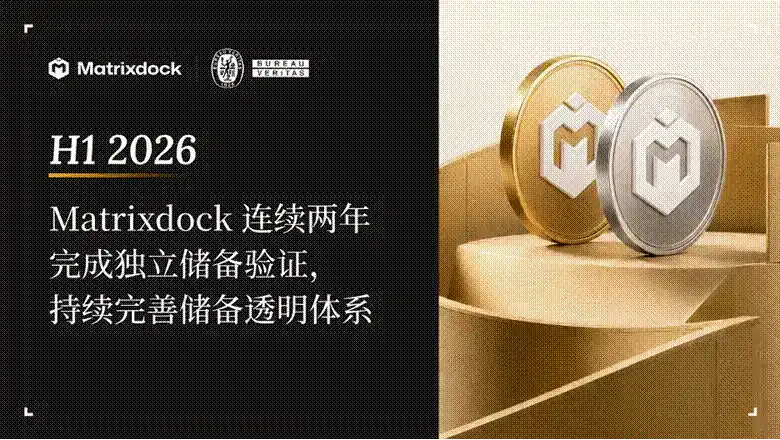
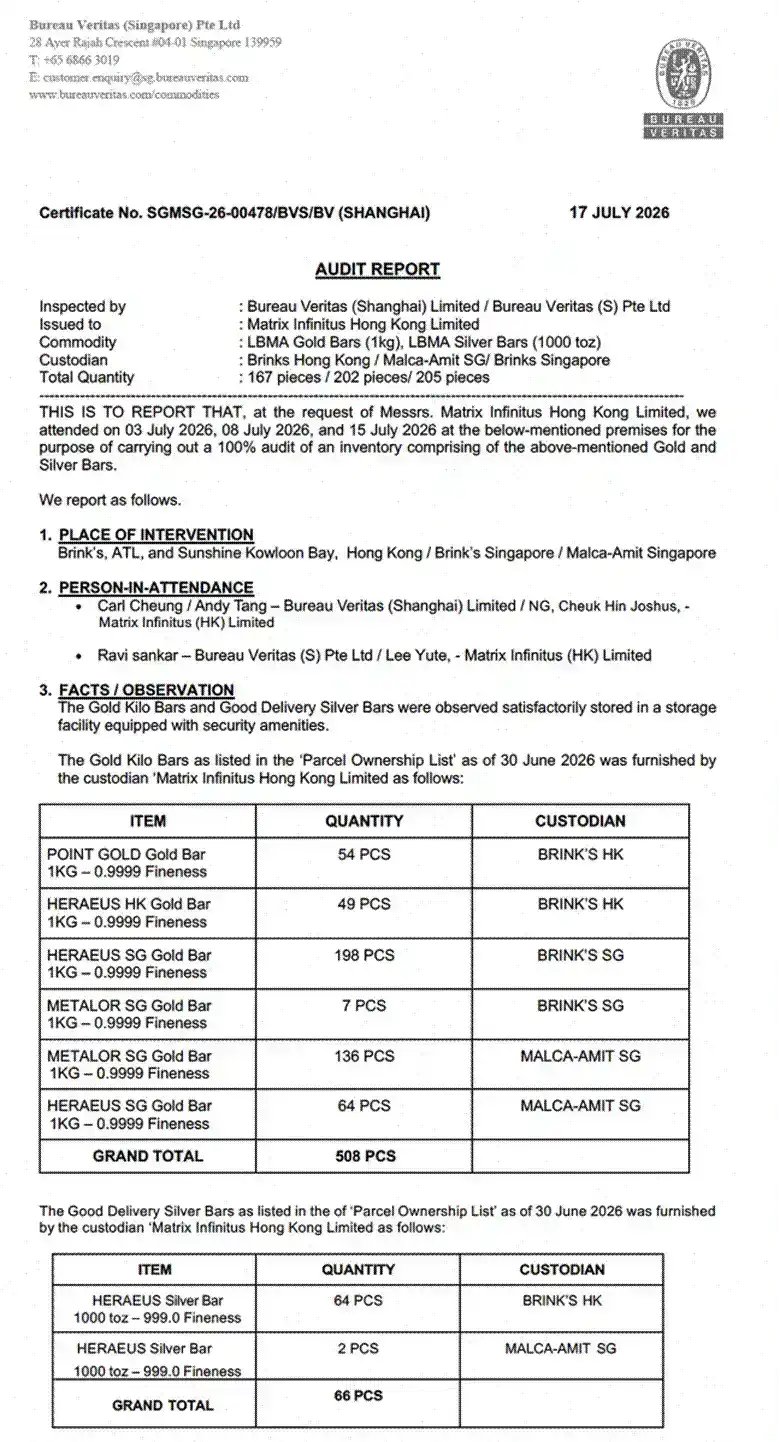
Compared to a single audit result, two consecutive years of independent verification also reflect that reserve transparency is gradually evolving from a one-time proof of assets towards a continuously operating transparent mechanism.

From One-Time Verification to a Continuously Operating Transparent Mechanism

In traditional financial markets, whether for ETFs, funds, or custodial assets, market trust is not built on a single audit, but relies on continuous information disclosure, third-party verification, and long-term operational mechanisms. For financial products, market trust stems more from a continuous, stable, and transparent mechanism than from a one-time verification result.

As RWAs begin to assume more on-chain financial functions, this type of continuously operating transparent mechanism is gradually becoming a fundamental industry capability, rather than a mere compliance requirement.

According to information released by Matrixdock, this marks the platform's fourth consecutive completion of a six-month independent reserve audit, and the second consecutive year of independent reserve verification performed by Bureau Veritas. This means Matrixdock has maintained a consistent and continuous independent reserve verification mechanism for two consecutive years.

Compared to a one-time asset verification, continuous verification by the same international third-party institution can not only maintain consistency in verification standards but also means that reserve assets can be tracked long-term under a unified methodology. For financial markets, what matters is not the audit result at a single point in time, but whether the verification mechanism can operate long-term and stably. For Matrixdock, reserve transparency does not come from a single audit, but is continuously built through ongoing operation. Two consecutive years of independent verification is precisely a manifestation of this continuous transparent mechanism.

In this audit, Bureau Veritas completed physical verification of all metal bars across the three institutional-grade vaults, including weighing, dimension measurement, and item-by-item cross-checking with vault records. The audit results show that the underlying gold reserves for XAUm are consistent with the circulating token quantity; after applying the corresponding ozPerToken value, the reserve assets for XAGm are also consistent with the circulating token quantity, with no discrepancies found.

Meanwhile, the inclusion of XAGm in the independent reserve audit for the first time signifies that the same set of reserve verification standards is beginning to cover more tokenized precious metal products, rather than being applicable only to a single asset.

Transparency: More Than Just Proving Asset Existence

If reserve transparency in the past primarily meant "proving the genuine existence of assets," then as RWAs enter the on-chain finance stage, it is beginning to take on another, more important function—continuously supporting market trust.

In addition to the semi-annual independent reserve verification, Matrixdock also continuously discloses monthly reserve reports, on-chain Proof of Reserves, and the Gold Allocation Lookup tool among other transparency mechanisms. This provides the market with continuously updated reserve information, rather than relying solely on periodic audit results.

Matrixdock refers to this system as the "Reserve Transparency Stack." This system does not rely on a single proof but combines multiple components—independent third-party verification, on-chain data verification, and continuous information disclosure—to jointly build reserve transparency capability.

Behind this change is also a reflection of the industry's evolving needs. For lending protocols, payment networks, and institutional fund management, what truly matters is not just whether there is sufficient reserve backing on the day of asset issuance, but whether the assets can continuously maintain transparency, verifiability, and traceability throughout their entire lifecycle. Transparency is evolving from a one-time "proof" into an essential trust foundation supporting the continuous operation of on-chain finance.

When Reserve Transparency Begins to Impact On-Chain Finance

In recent years, tokenized gold, U.S. Treasury bonds, and other RWA products are gradually entering more on-chain financial applications such as lending, liquidity management, payments, and institutional reserve management. Real-world assets are shifting from being mere "on-chain representations" to becoming "on-chain financial assets."

This change signifies that the role of the underlying reserve is also transforming. In the past, it primarily supported asset issuance; now, it is beginning to support the continuous circulation, collateralization, settlement, and institutional allocation of assets on-chain. For institutions, assets not only need to be tokenized but also require the capability for continuous verification, continuous disclosure, and continuous operation.

According to information disclosed by Matrixdock, continuous reserve verification helps tokenized assets further enter lending, institutional fund management, and more on-chain financial scenarios. From this perspective, what reserve transparency supports is no longer a single product, but the trust foundation required for assets to enter the on-chain financial ecosystem.

If the competitive focus in the RWA industry over the past few years has been "how to bring real-world assets onto the chain," then as the industry gradually enters a new developmental stage, competition is beginning to shift towards "how to enable these assets to participate in on-chain finance long-term." With asset issuance becoming increasingly mature, continuous verification, continuous disclosure, and long-term operational mechanisms are becoming new focal points for institutions.

For the entire RWA industry, what may truly differentiate players in the future is perhaps no longer just the scale of assets, but who can continuously verify reserves, continuously disclose information, continuously build market trust, and consolidate these capabilities into a long-term, stable, and operating transparent system. As more and more real-world assets enter on-chain financial scenarios like lending, payments, and institutional fund management, reserve transparency is also evolving from a product capability into an important trust infrastructure connecting real-world assets with on-chain finance.

This article is contributed and does not necessarily represent the views of BlockBeats.

Perguntas relacionadas

QWhat is the core evolution of reserve transparency for RWA platforms as discussed in the article?

AThe article highlights that reserve transparency is evolving from a one-time proof of assets at issuance into a continuous operating mechanism. It is shifting from merely 'proving assets exist' to 'continuously proving assets are trustworthy,' becoming a fundamental trust infrastructure for RWA to participate in on-chain finance over their lifecycle.

QWhat significant milestone did Matrixdock achieve in its recent audit according to the text?

AMatrixdock completed its fourth consecutive semi-annual independent reserve audit conducted by Bureau Veritas. This marks two consecutive years of consistent independent verification for its gold product (XAUm) and, for the first time, included its silver product (XAGm) within the audit scope.

QHow does Matrixdock's 'Reserve Transparency Stack' provide ongoing transparency beyond periodic audits?

ABeyond the semi-annual independent audits, Matrixdock's 'Reserve Transparency Stack' includes continuous disclosures such as monthly reserve reports, on-chain Proof of Reserves, and a Gold Allocation Lookup tool. This multi-layered system provides persistent, updated information rather than relying solely on periodic audit results.

QWhy is a consistent, long-term verification mechanism considered more important for financial markets than a single audit?

AFor financial markets, trust is built on sustained, reliable transparency mechanisms and long-term operational stability, not a snapshot audit result. Consistent verification by the same independent third-party (like Bureau Veritas for Matrixdock) ensures methodological consistency and allows for long-term tracking of reserve assets, which is crucial for institutional confidence in on-chain finance applications.

QWhat broader industry shift does the article suggest is happening in the RWA sector regarding competition?

AThe article suggests the RWA industry's focus is shifting from competition on 'how to bring real-world assets on-chain' to 'how to enable these assets to participate in on-chain finance long-term.' Future differentiation will depend less on asset scale and more on which platforms can build sustained trust through continuous verification, disclosure, and operation of a robust transparency framework.

Leituras Relacionadas

Saeed Al-Marri: How Tokenization Unlocks New Opportunities for Shipping Funds

Said Al-Marri: How Tokenization Opens New Opportunities for Shipping Funds For centuries, commercial shipping has been a capital-intensive asset class limited to institutional funds and shipping dynasties. Said bin Saleh Al-Marri, CEO of Ethra Invest and Ethra Ship, aims to break down these barriers by combining Real World Asset (RWA) tokenization with conservative private equity principles. This bridges decentralized finance (DeFi) with the physical realities of global trade. Tokenization allows fractional ownership of ships on a blockchain, giving smaller investors access to previously inaccessible markets. However, Al-Marri warns it is not a regulatory loophole or a cure for asset illiquidity. The core physical risks are isolated in Special Purpose Vehicles (SPVs) for qualified investors. While tokenization enhances transparency and ownership record-keeping, Al-Marri stresses that a liquid secondary market depends on transparent asset valuation and must not interfere with ship operations managed by professionals. Regarding legal enforcement, smart contracts cannot physically seize a ship. Legal recourse still relies on traditional maritime courts, ship mortgages, and flag state laws, with blockchain records needing to mirror legal ownership in the SPV perfectly. Beyond ownership, the industry faces administrative hurdles like paper-based bills of lading. Al-Marri argues the bottleneck is legal and operational standardization, not technology. He advocates for a hybrid model combining digital trade documents and programmable settlements with support from regulated financial institutions, rather than a full crypto replacement for tools like Letters of Credit. A major challenge is decarbonizing the global fleet by 2050. Transitioning to green fuels requires massive upfront investment. Al-Marri emphasizes a conservative, holistic approach to underwriting these projects, evaluating technology, fuel availability, safety, and resale value. Investments must be justified under conservative forecasts, not just optimistic ones. By combining pragmatic risk management with digital infrastructure, leaders like Al-Marri show that the evolution of maritime finance is about mobilizing capital to build a modernized and sustainable global fleet, not just putting ships on a blockchain.

cryptonews.ruHá 8m

Saeed Al-Marri: How Tokenization Unlocks New Opportunities for Shipping Funds

cryptonews.ruHá 8m

Six Years Later, UNI Finally Welcomes Its Own "Buyback Bull"

After years of debate, Uniswap's UNI token has finally entered a 'buyback bull' phase following the long-awaited activation of its fee-switch mechanism. The UNIfication proposal, executed in December 2025, redirected a portion of protocol fees from select pools and Unichain sequencer revenue into a treasury (TokenJar) dedicated to buying back and permanently burning UNI. Initial market reaction was muted due to modest early burn rates. A significant shift occurred in July 2026 with the launch of Robinhood Chain. Uniswap's immediate deployment there skyrocketed trading volume, making it a top fee-generator. Subsequently, governance votes extended the fee mechanism to v4 pools and Robinhood Chain, causing protocol revenue to nearly triple. Daily funds directed to UNI burns rose sharply, with Robinhood Chain contributing over half. This transitioned UNI's narrative from a governance token to a cash-flow asset backed by a perpetual automatic buyer. UNI's price, which had languished around $2.30 in early June, nearly doubled to approach $4.60 by late July. Analysts credit this to the tangible cash flow from fees rather than mere speculation. Unlike many newer projects where buybacks are offset by large investor unlocks, UNI's six-year history has resulted in a widely distributed and relatively clean supply, allowing the buyback pressure to effectively impact the secondary market. The key test will be whether trading activity, particularly on Robinhood Chain, sustains after its initial gas subsidies expire.

marsbitHá 13m

Six Years Later, UNI Finally Welcomes Its Own "Buyback Bull"

marsbitHá 13m

Only 153 Venture Capital Firms Invested in July: Is the Crypto VC Industry Experiencing a 'Mass Extinction'?

In July 2026, only 153 unique venture capital firms participated in disclosed crypto funding rounds, marking the lowest monthly count since November 2020. This figure represents an 87% decline from the peak of 1,177 firms in 2022. Overall, the first seven months of 2026 saw crypto projects raise approximately $11.78 billion across 481 rounds. This crypto VC contraction contrasts sharply with the broader venture capital landscape, where global VC investment reached a record $560.4 billion in H1 2026, heavily fueled by major AI company financings. This shift in capital allocation has drawn funds away from the crypto sector. Within crypto, funding is highly concentrated. Trading platforms, prediction markets, and payment sectors absorbed 53% of the total capital. While early-stage deals remain frequent, the largest sums flow to a few late-stage rounds and mergers & acquisitions, which surged to $7.23 billion in Q2 2026. The market is consolidating around top funds like a16z crypto and Dragonfly, which successfully raised new multi-billion dollar funds, while many smaller firms have retreated. Analysts describe this as a "great extinction" for crypto VCs, where capital is becoming more selective, favoring proven business models and assets over early-stage speculation. This raises the bar for project quality, funding efficiency, and viable exit paths.

marsbitHá 33m

Only 153 Venture Capital Firms Invested in July: Is the Crypto VC Industry Experiencing a 'Mass Extinction'?

marsbitHá 33m

Trading

Spot
活动图片