After the UFO Files Are Made Public, Prediction Markets Only Price the Probability of Alien Existence at 20%?

Odaily星球日报Publicado em 2026-05-09Última atualização em 2026-05-09

Resumo

The U.S. Department of Defense has launched a website declassifying UFO/UAP files, releasing an initial batch of over 160 documents. These include videos, photos, mission logs, sighting reports, and communications from agencies like NASA and the FBI, featuring unexplained incidents such as anomalous lights near Apollo missions and a "jellyfish"-shaped object over the UAE. Despite widespread public discussion, the prediction market predict.fun shows only a 20% probability that the U.S. government will officially confirm the existence of extraterrestrial life or technology by December 31, 2026. The market's focus is not on whether aliens exist, but on whether U.S. authorities will make a definitive, binding statement before the deadline. Analysts note the file release provides transparency and fuels debate but does not constitute an official confirmation. The 20% odds reflect a time-discounted assessment, acknowledging the possibility of future evidence while doubting a conclusive governmental stance within the current year. This event highlights how prediction markets translate speculative narratives into tradable contracts based on verifiable outcomes and specific timelines.

Original | Odaily Planet Daily (@OdailyChina)

Author | Asher(@Asher_ 0210)

Last night, the U.S. Department of Defense officially launched the UFO Archive Disclosure website, releasing the first batch of government documents related to UAPs, unidentified flying objects, and suspected extraterrestrial life. According to public reports, this initial release comprises over 160 documents, including videos, photos, mission records, sighting reports, communication logs, and historical archives from multiple U.S. federal agencies such as NASA, the FBI, and the Department of Defense.

These documents are not just abstract government reports; they contain a large amount of specific imagery and historical records. Among them, the Apollo mission spacecraft once captured three anomalous light points hovering above the Moon, and Apollo 17 communication logs also contain discussions among astronauts about mysterious objects approaching the spacecraft. Another batch of materials shows that unexplained objects have appeared in places like the United Arab Emirates, Greece, and Iraq.

Even more viral are those unresolved cases in the files with visual details. A jellyfish-shaped object appeared over the UAE, some materials record unidentified flying objects resembling luminous spheres and objects with an octagonal star-like shape, and the FBI has also captured anomalous targets near U.S. military aircraft. An image released by the U.S. Department of Defense also shows an unidentified object appearing over the western United States in September 2025.
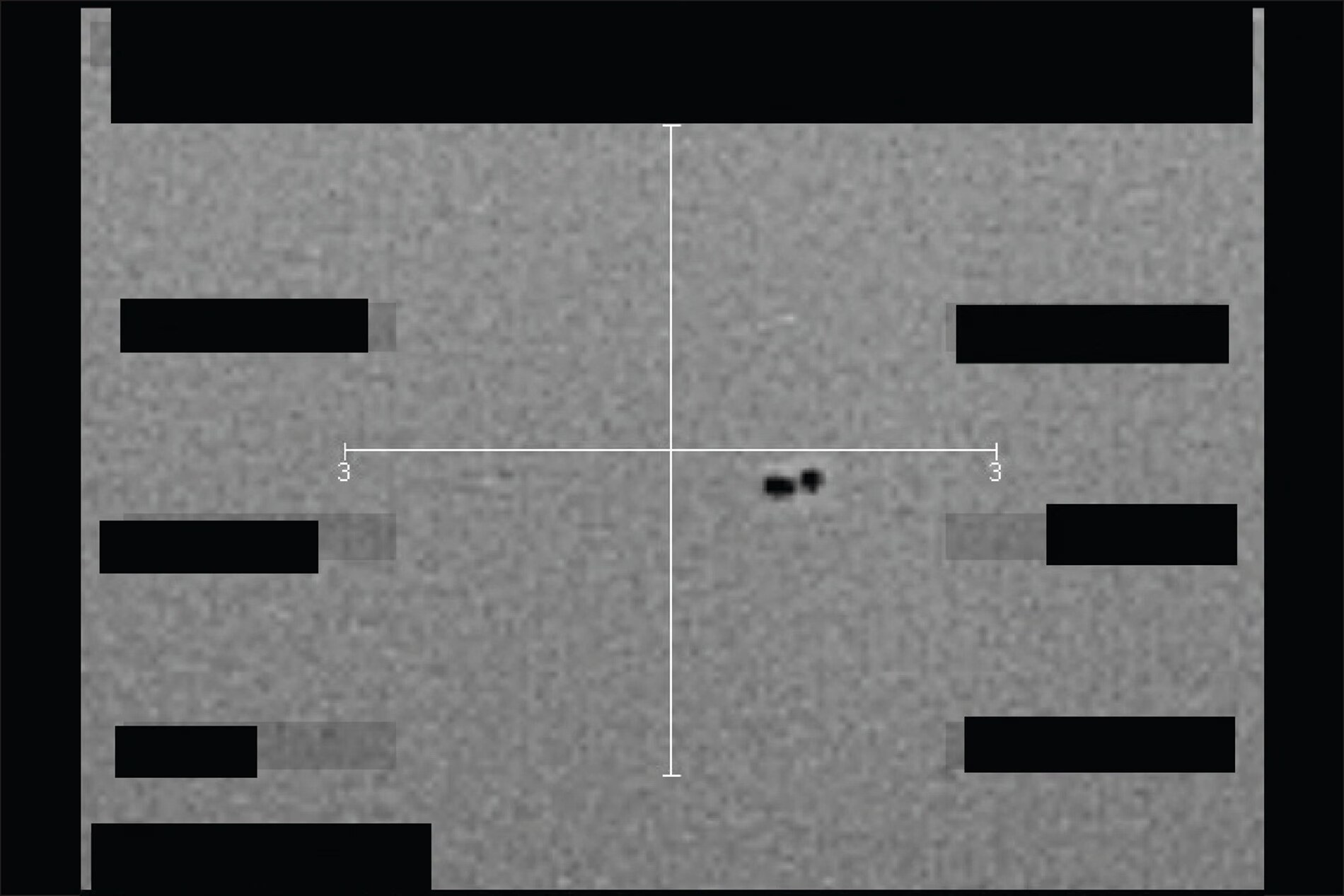
An image released by the U.S. Department of Defense claims to show an unidentified object appearing over the western United States in September 2025 (Source: U.S. Department of Defense)

Compared to mere text reports, this imagery and eyewitness testimony is more likely to cause UFO discussions to spread rapidly, making this disclosure seem more like a concentrated exhibition of "declassified archives."

However, the answer from prediction markets is much more restrained than that of social media. After the first batch of UFO files was made public, the probability for the event "Will the US confirm that aliens exist before 2026-12-31 23:59:59 ET" on the prediction market predict.fun did not surge significantly because of this explosive news. The market did not directly interpret this disclosure as "the U.S. is about to confirm alien existence," and the probability remains at only 20%.
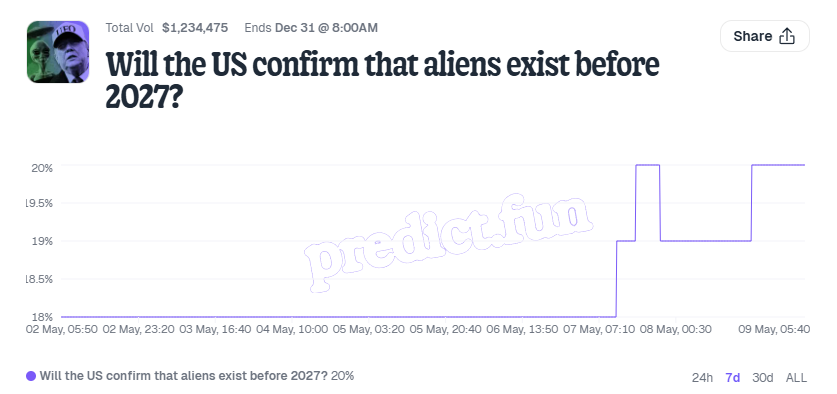
Source: https://predict.fun/market/will-the-us-confirm-that-aliens-exist-before-2027

So, why hasn't this UFO file disclosure significantly changed the judgment of the prediction markets?

Prediction Markets Are Not Betting on Whether Aliens Exist, But on Whether the U.S. Government Will Acknowledge It

Many people, upon seeing a 20% probability, might first think that the prediction market believes the probability of aliens existing is only 20%. But this actually misunderstands the market itself.

Markets like predict.fun are not truly trading on whether extraterrestrial life exists in the universe, but on whether the U.S. government will explicitly confirm the existence of extraterrestrial life or alien technology before 23:59 ET on December 31, 2026. According to the market's settlement rules, only if the U.S. President, a Cabinet member, a member of the Joint Chiefs of Staff, or a U.S. federal agency explicitly makes such a statement will the market settle as Yes; otherwise, it will settle as No. The primary settlement source is official U.S. government information, also referencing consensus formed by credible media reports.

This rule is crucial. It means that a video of an unidentified flying object is not enough, a blurry photo is not enough, an astronaut communication log is not enough, and the military admitting that some phenomena are temporarily unexplainable is also not enough. What can truly trigger a Yes is the U.S. government stating clearly enough, acknowledging that extraterrestrial life or alien technology indeed exists.

Disclosing files is merely placing more material before the public, while official confirmation means the government is backing a conclusion. The former generates discussion; the latter triggers settlement. Between them lies a line that is very difficult to cross.

Archive Disclosure Is Not an Answer Announcement

This UFO file disclosure is indeed not an ordinary information update. The U.S. Department of Defense released related materials in a centralized manner through a dedicated website and stated that more files will be released in batches continuously in the future. For the public, this means that UFO and UAP materials previously scattered across different agencies, eras, and archival systems are being reorganized into an official portal. It makes discussion more focused and makes it easier for the outside world to track what materials the U.S. government actually possesses.

However, judging from the currently disclosed content, this batch of files appears more like presenting historical sightings, anomalous imagery, mission records, and old archives to the public, rather than providing a unified explanation for these materials. The U.S. Department of Defense is not directly telling the world "what this is," but is releasing more unresolved cases, leaving the judgment space to the public.

This also puts this disclosure in a delicate position. It increases transparency but does not change the nature of the events. UFO discussions have thus gained more material, but this material primarily serves to expand the questions themselves rather than advancing unexplained phenomena to extraterrestrial confirmation.

For prediction markets, this file disclosure is more like a new starting point for observation, rather than evidence sufficient to rewrite the odds. It brings the UFO topic back to center stage and gives subsequent file updates transaction value; but the initial batch of materials still consists mainly of historical records, sighting reports, and unresolved imagery. What the market is truly waiting for is a higher-level, harder-to-ignore, and more official key signal.

Is 20% an Underestimation or an Overestimation?

From an emotional perspective, 20% might seem low. After all, UFO file disclosure has entered an official rhythm, and subsequent materials will continue to be released. If clearer military videos, higher-level internal records, or more direct assessments from federal agencies emerge in the future, the Yes price could still be rapidly revalued.

But from a market pricing perspective, 20% is not low. Because this market is not trading an open-ended question, but a question with a clear deadline. The market needs to judge not just whether the U.S. will confirm the existence of extraterrestrial life or alien technology, but also whether such confirmation will happen before the end of 2026.

Time itself is a barrier. Even if files continue to be released, even if more unresolved cases enter the public view, it does not mean the U.S. government will complete evidence review, internal coordination, political assessment, and provide a sufficiently clear conclusion within a few months. For an official system, continuing to disclose material is one thing; reaching a definitive conclusion in a short time is another.

Therefore, the current 20% probability is more like a tail-end pricing with a time discount. It does not deny that subsequent files may continue to create volatility, but it also shows that the market does not believe the initial disclosure has fundamentally changed the assessment of the event. For traders, the disclosure of files itself is not scarce; what is truly scarce is the key signal that could drive official confirmation before the end of this year. Before such a signal appears, the Yes price will find it difficult to be pushed higher solely by archival updates.

When UFOs Enter Prediction Markets, Truth Begins to Have a Price

The most noteworthy aspect of this event is no longer just a certain photo, a certain video, or a jellyfish-shaped object. UFO discussions have long remained in the realm of emotion, belief, and conspiracy narratives. Believers see more clues in every file disclosure, while skeptics continue to emphasize insufficient evidence, misidentification, and technical noise. Both sides have debated for years but find it hard to truly convince each other because they are often not discussing the same question.

Prediction markets pull this question one step closer to reality. They do not attempt to answer whether other life exists in the universe, but narrow the question down to a more specific level—will the U.S. government explicitly acknowledge the existence of extraterrestrial life or alien technology before the end of this year. They turn a previously hard-to-grasp imagination into an event that can be traded, settled, and constantly adjusted as information changes.

Therefore, this roughly 20% probability is not a final judgment on whether alien life exists, but the market's judgment on whether the U.S. government will concede by the end of this year. It truly reflects traders' comprehensive judgment of the evidence chain, official statements, and the time window.

When humanity's oldest puzzle enters prediction markets, truth is no longer just something to be awaited and discussed; it also begins to be priced. UFOs may still hang in the sky, but when they will be officially confirmed, when they will transition from unexplained phenomena to factual conclusions, has already landed in the market.

Perguntas relacionadas

QWhat is the specific event being traded on predict.fun related to the UFO file release, and what is its current market probability?

AThe event being traded is whether the U.S. government will officially confirm the existence of extraterrestrial life or alien technology before 11:59 PM ET on December 31, 2026. Following the release of the UFO files, the current market probability for this event is approximately 20%.

QAccording to the article, why didn't the UFO file release significantly increase the market probability on predict.fun?

AThe file release did not significantly increase the probability because the market is trading on a specific event: an official U.S. government confirmation. The released files primarily present historical records, sightings, and unexplained materials without providing an official government conclusion or confirmation of extraterrestrial existence. The market views this as expanding the discussion, not as definitive evidence that will force an official acknowledgment within the given timeframe.

QWhat types of materials were included in the first batch of UFO files released by the U.S. Department of Defense?

AThe first batch included approximately 160 documents comprising videos, photos, mission logs, eyewitness reports, communication records, and historical archives. Examples include footage of three anomalous lights from the Apollo mission, communication from Apollo 17 discussing a mysterious object, records of jellyfish-shaped objects over the UAE, and images of unexplained objects over the western U.S. in September 2025.

QFrom a market pricing perspective, why does the article suggest the 20% probability is 'not low'?

AThe 20% probability is considered 'not low' because the market event has a strict deadline (end of 2026). This time constraint adds significant pressure. Even with ongoing file releases, the market judges it unlikely that the U.S. government will complete the necessary evidence review, internal coordination, and political assessment to make a definitive public confirmation within just a few months. The probability reflects a 'time-discounted' assessment of a low-probability, high-impact event.

QHow does the article describe the fundamental shift that prediction markets bring to the UFO discussion?

AThe article states that prediction markets shift the UFO discussion from abstract debates about belief, emotion, and conspiracy theories into a concrete, tradable event. Instead of arguing about whether aliens exist in the universe, the market prices the likelihood of a specific, verifiable action: the U.S. government officially confirming their existence by a set date. This means truth is no longer just waited for or discussed; it is given a price and continuously re-evaluated based on new information.

Leituras Relacionadas

Senior Trader's Confession: How to Trade Market's False Expectations?

Veteran trader's case study: trading the market's "wrong expectations". This trade centered on a textbook "expectation error" after a weak CPI report. While the market initially priced in broad monetary easing (sending Nasdaq to 30,060), the crucial 30-year real yield hit a 20-year high. This signaled a fractured transmission mechanism: short-term rates eased, but long-term funding costs (vital for tech valuations) refused to fall. The trader executed five short positions on the Nasdaq (NQ) as it fell from 30,060 to 28,768. The core methodology: don't just trade the data, but analyze the market's implied causal chain and identify where it breaks. In this case, the chain was: Weak CPI → Policy Easing → Lower Long-Term Funding Costs → NQ Valuation Expansion. The break occurred between policy easing and long-term rates. The "veto variable" – long-term real yields – refused to confirm the bullish narrative. Trades were structured around "fast variables" (price) temporarily repairing while "slow variables" (funding conditions) remained broken. The article outlines a repeatable framework: 1) Map the market's implied causal chain. 2) Identify the veto variable. 3) Observe if it rejects the narrative. 4) Enter when price still follows the old script. 5) Choose the cleanest asset expression (e.g., short NQ, not broad S&P). 6) Define both invalidation and fulfillment exit conditions. The key insight: Alpha often comes not from an information edge, but from a "reaction function edge" – recognizing when the market is applying an outdated causal logic to new data. The critical question: What causal chain is the market's first reaction relying on, and is that chain still valid today?

marsbitHá 19m

Senior Trader's Confession: How to Trade Market's False Expectations?

marsbitHá 19m

Opinion: The Hedging Relationship Between U.S. Treasuries and Stocks Has Broken Down, and BTC, as a Risk Asset, Is Under Dual Pressure

For the past 20 years, U.S. investors relied on a free insurance policy: when stocks fell, bonds rose, cushioning portfolio losses. This reliable inverse correlation underpinned entire financial strategies. However, this mechanism broke down around 2020 and has not recovered. Currently, the two-month rolling correlation between the S&P 500 and 10-year Treasury yields is at -0.69, its lowest level since 1996, indicating stocks and bonds are moving in sync to an unprecedented degree, eliminating the traditional portfolio shock absorber. The失效 of this hedge is not simply due to lost confidence in U.S. debt. The key driver is the shift from growth-dominated to inflation-dominated market narratives. When growth fears prevail, stocks and bonds move inversely. Since 2022, persistent inflation volatility has been the dominant factor, causing both asset classes to suffer simultaneously from higher inflation expectations. Investors now seek safety without duration risk, favoring cash, dollars, and short-term Treasuries while selling long-duration bonds. Record U.S. deficits, rising net interest payments, and waning foreign demand (e.g., from Japan) are pressuring long-term yields, with the 30-year yield surpassing 5%. This environment places Bitcoin, as a risk asset on the far end of the risk curve, under dual pressure. Higher risk-free rates increase the opportunity cost of holding non-yielding assets like Bitcoin, while falling equities reduce overall risk appetite. Bitcoin's performance has become highly sensitive to macro conditions such as real yields, dollar strength, and financial conditions. While its long-term thesis as a fixed-supply asset outside the sovereign credit system is strengthened by these fiscal trends, the same conditions hurt it in the short term. The return of bonds as a effective hedge requires inflation volatility to subside, growth risks to retake dominance, and the Fed to have room to ease policy. Until then, Bitcoin trades in a market where the deepest asset class no longer absorbs shocks, removing the safety floor for all risk assets, especially those that pay nothing to wait.

marsbitHá 20m

Opinion: The Hedging Relationship Between U.S. Treasuries and Stocks Has Broken Down, and BTC, as a Risk Asset, Is Under Dual Pressure

marsbitHá 20m

Funding Weekly | Crypto.com Secures $400M Investment, CeFi and Stablecoin Sectors Continue to Attract Capital

Crypto Weekly Investment Recap: Funds Converge on CeFi, Stablecoins, and AI Last week's crypto and AI investment landscape saw significant capital concentration, with a few large deals dominating. **Crypto/Web3 Highlights (July 13-19):** Total investment exceeded **$812 million** across 17 deals. Key trends: * **Centralized Finance (CeFi) & Stablecoins** remained a major magnet, led by **Crypto.com**'s massive **$400 million** raise from Citadel Securities, valuing the exchange at $20B. * **Infrastructure & Tools** saw 7 deals, including **Cyclops** ($20M for stablecoin payments) and **ADI Chain** ($50M for stablecoin settlement infrastructure). * **DeFi** had 2 deals, such as AI-native DEX **Quote Trade** ($4M). * Other notable raises: API broker **Alpaca** ($135M), cross-border platform **Flex** ($70M), treasury firm **ORANGE JUICE** ($40M), and prediction market **Pascal** ($9M). * **Acquisitions:** Keyrock bought BlockFills' trading unit, SBI Holdings acquired Singapore exchange Coinhako, and MoonPay bought startup Glide. **AI & Robotics Highlights:** Investment momentum in AI remained very strong. * Nvidia-backed AI cloud service **Fireworks** raised a massive **$1.5 billion** at a $17.5B valuation. * In robotics, **Walden Robotics** (spun out from Toyota) secured **$300 million**, and Chinese humanoid firm ****逐际动力** **(Climax Dynamics) raised nearly **$200 million** in a Pre-IPO round. * Other significant AI raises included Indian programming platform **Emergent** ($130M) and drone company **Brinc** ($125M), backed by Sam Altman. Overall, the trend shows capital flowing heavily into established crypto financial services, stablecoin infrastructure, and large-scale AI/robotics commercialization.

marsbitHá 1h

Funding Weekly | Crypto.com Secures $400M Investment, CeFi and Stablecoin Sectors Continue to Attract Capital

marsbitHá 1h

The Gentlest Bear Market? BTC Bears Exit, ARK and Bitwise Collectively Bullish

**Title: The Mildest Bear Market? BTC Shorts Exit, ARK and Bitwise Collectively Bullish** Bitcoin continues to consolidate around $75,000 while Ethereum struggles near $1,900. Market data shows $116 million in liquidations over 24 hours, with $62.7 million from short positions, and the Fear & Greed Index remains at 35 (Fear). According to Polymarket, there's a 33% probability BTC falls below $50,000 this year. ARK Invest's Q2 2026 Bitcoin report notes technical weakness but identifies potential bottoming signals, including a record high in long-term holder supply, suggesting selling exhaustion. Bitwise's Juan Leon calls this the "structurally mildest bear market" on record, with a ~50% drawdown from highs, less severe than past cycles. He highlights institutional accumulation and a shift in investor dialogue from survival to entry points. Technical analysis from Bit suggests a potential C-wave low may have formed, with an ideal bottoming range between $50,000-$55,000. However, glassnode's CryptoVizArt warns that failure to break $66,000 could signal a local top, as new buyer accumulation is concentrated there. Analyst Darkfost identifies a critical support band between $59,000-$70,000, where 50% of BTC's circulating supply has changed hands. Notably, trader Doctor Profit announced closing all crypto short positions—including BTC shorts from $115k-$125k and over 100 altcoin shorts—for significant profit. He has begun a phased accumulation of Bitcoin spot starting at $64,000, reversing his previous $40k-$50k target, citing structural positives like regulatory clarity and institutional adoption. He argues the anticipated September/October bottom may arrive earlier than the herd expects.

Foresight NewsHá 2h

The Gentlest Bear Market? BTC Bears Exit, ARK and Bitwise Collectively Bullish

Foresight NewsHá 2h

Trading

Spot
活动图片