After the UFO Files Are Made Public, Prediction Markets Only Price the Probability of Alien Existence at 20%?

Odaily星球日报Publicado em 2026-05-09Última atualização em 2026-05-09

Resumo

The U.S. Department of Defense has launched a website declassifying UFO/UAP files, releasing an initial batch of over 160 documents. These include videos, photos, mission logs, sighting reports, and communications from agencies like NASA and the FBI, featuring unexplained incidents such as anomalous lights near Apollo missions and a "jellyfish"-shaped object over the UAE. Despite widespread public discussion, the prediction market predict.fun shows only a 20% probability that the U.S. government will officially confirm the existence of extraterrestrial life or technology by December 31, 2026. The market's focus is not on whether aliens exist, but on whether U.S. authorities will make a definitive, binding statement before the deadline. Analysts note the file release provides transparency and fuels debate but does not constitute an official confirmation. The 20% odds reflect a time-discounted assessment, acknowledging the possibility of future evidence while doubting a conclusive governmental stance within the current year. This event highlights how prediction markets translate speculative narratives into tradable contracts based on verifiable outcomes and specific timelines.

Original | Odaily Planet Daily (@OdailyChina)

Author | Asher(@Asher_ 0210)

Last night, the U.S. Department of Defense officially launched the UFO Archive Disclosure website, releasing the first batch of government documents related to UAPs, unidentified flying objects, and suspected extraterrestrial life. According to public reports, this initial release comprises over 160 documents, including videos, photos, mission records, sighting reports, communication logs, and historical archives from multiple U.S. federal agencies such as NASA, the FBI, and the Department of Defense.

These documents are not just abstract government reports; they contain a large amount of specific imagery and historical records. Among them, the Apollo mission spacecraft once captured three anomalous light points hovering above the Moon, and Apollo 17 communication logs also contain discussions among astronauts about mysterious objects approaching the spacecraft. Another batch of materials shows that unexplained objects have appeared in places like the United Arab Emirates, Greece, and Iraq.

Even more viral are those unresolved cases in the files with visual details. A jellyfish-shaped object appeared over the UAE, some materials record unidentified flying objects resembling luminous spheres and objects with an octagonal star-like shape, and the FBI has also captured anomalous targets near U.S. military aircraft. An image released by the U.S. Department of Defense also shows an unidentified object appearing over the western United States in September 2025.
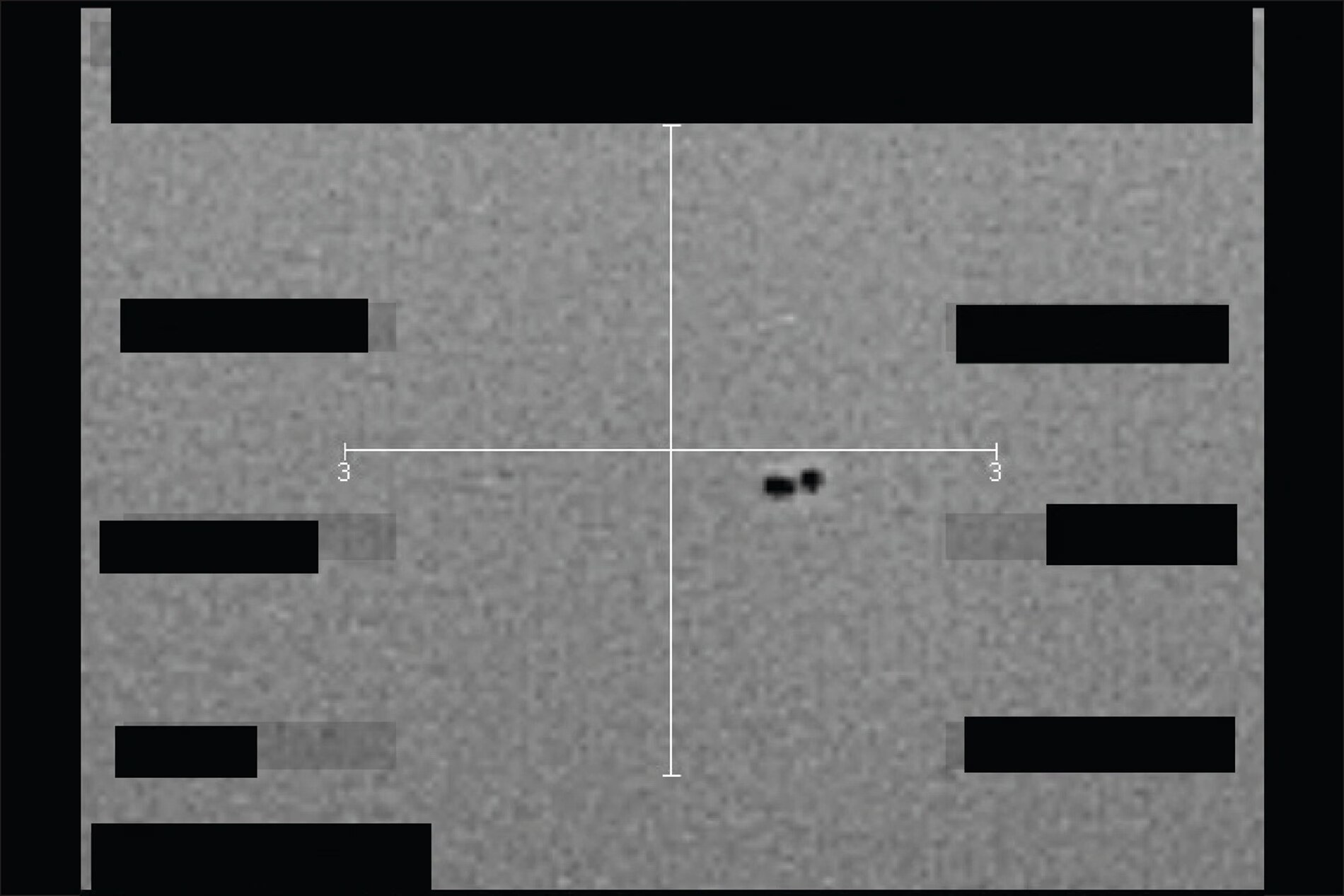
An image released by the U.S. Department of Defense claims to show an unidentified object appearing over the western United States in September 2025 (Source: U.S. Department of Defense)

Compared to mere text reports, this imagery and eyewitness testimony is more likely to cause UFO discussions to spread rapidly, making this disclosure seem more like a concentrated exhibition of "declassified archives."

However, the answer from prediction markets is much more restrained than that of social media. After the first batch of UFO files was made public, the probability for the event "Will the US confirm that aliens exist before 2026-12-31 23:59:59 ET" on the prediction market predict.fun did not surge significantly because of this explosive news. The market did not directly interpret this disclosure as "the U.S. is about to confirm alien existence," and the probability remains at only 20%.
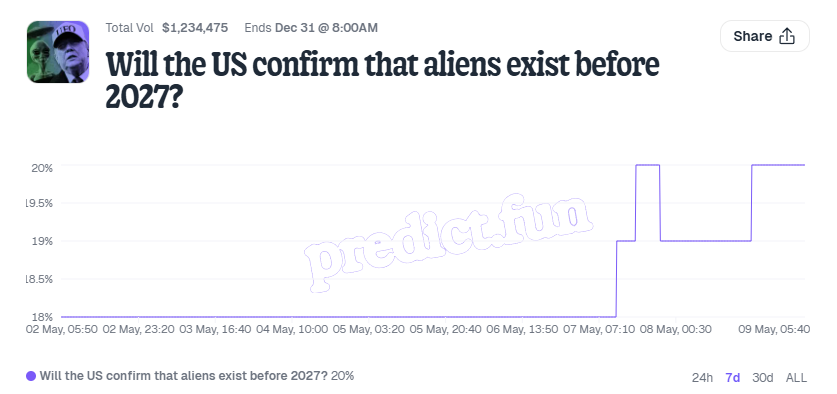
Source: https://predict.fun/market/will-the-us-confirm-that-aliens-exist-before-2027

So, why hasn't this UFO file disclosure significantly changed the judgment of the prediction markets?

Prediction Markets Are Not Betting on Whether Aliens Exist, But on Whether the U.S. Government Will Acknowledge It

Many people, upon seeing a 20% probability, might first think that the prediction market believes the probability of aliens existing is only 20%. But this actually misunderstands the market itself.

Markets like predict.fun are not truly trading on whether extraterrestrial life exists in the universe, but on whether the U.S. government will explicitly confirm the existence of extraterrestrial life or alien technology before 23:59 ET on December 31, 2026. According to the market's settlement rules, only if the U.S. President, a Cabinet member, a member of the Joint Chiefs of Staff, or a U.S. federal agency explicitly makes such a statement will the market settle as Yes; otherwise, it will settle as No. The primary settlement source is official U.S. government information, also referencing consensus formed by credible media reports.

This rule is crucial. It means that a video of an unidentified flying object is not enough, a blurry photo is not enough, an astronaut communication log is not enough, and the military admitting that some phenomena are temporarily unexplainable is also not enough. What can truly trigger a Yes is the U.S. government stating clearly enough, acknowledging that extraterrestrial life or alien technology indeed exists.

Disclosing files is merely placing more material before the public, while official confirmation means the government is backing a conclusion. The former generates discussion; the latter triggers settlement. Between them lies a line that is very difficult to cross.

Archive Disclosure Is Not an Answer Announcement

This UFO file disclosure is indeed not an ordinary information update. The U.S. Department of Defense released related materials in a centralized manner through a dedicated website and stated that more files will be released in batches continuously in the future. For the public, this means that UFO and UAP materials previously scattered across different agencies, eras, and archival systems are being reorganized into an official portal. It makes discussion more focused and makes it easier for the outside world to track what materials the U.S. government actually possesses.

However, judging from the currently disclosed content, this batch of files appears more like presenting historical sightings, anomalous imagery, mission records, and old archives to the public, rather than providing a unified explanation for these materials. The U.S. Department of Defense is not directly telling the world "what this is," but is releasing more unresolved cases, leaving the judgment space to the public.

This also puts this disclosure in a delicate position. It increases transparency but does not change the nature of the events. UFO discussions have thus gained more material, but this material primarily serves to expand the questions themselves rather than advancing unexplained phenomena to extraterrestrial confirmation.

For prediction markets, this file disclosure is more like a new starting point for observation, rather than evidence sufficient to rewrite the odds. It brings the UFO topic back to center stage and gives subsequent file updates transaction value; but the initial batch of materials still consists mainly of historical records, sighting reports, and unresolved imagery. What the market is truly waiting for is a higher-level, harder-to-ignore, and more official key signal.

Is 20% an Underestimation or an Overestimation?

From an emotional perspective, 20% might seem low. After all, UFO file disclosure has entered an official rhythm, and subsequent materials will continue to be released. If clearer military videos, higher-level internal records, or more direct assessments from federal agencies emerge in the future, the Yes price could still be rapidly revalued.

But from a market pricing perspective, 20% is not low. Because this market is not trading an open-ended question, but a question with a clear deadline. The market needs to judge not just whether the U.S. will confirm the existence of extraterrestrial life or alien technology, but also whether such confirmation will happen before the end of 2026.

Time itself is a barrier. Even if files continue to be released, even if more unresolved cases enter the public view, it does not mean the U.S. government will complete evidence review, internal coordination, political assessment, and provide a sufficiently clear conclusion within a few months. For an official system, continuing to disclose material is one thing; reaching a definitive conclusion in a short time is another.

Therefore, the current 20% probability is more like a tail-end pricing with a time discount. It does not deny that subsequent files may continue to create volatility, but it also shows that the market does not believe the initial disclosure has fundamentally changed the assessment of the event. For traders, the disclosure of files itself is not scarce; what is truly scarce is the key signal that could drive official confirmation before the end of this year. Before such a signal appears, the Yes price will find it difficult to be pushed higher solely by archival updates.

When UFOs Enter Prediction Markets, Truth Begins to Have a Price

The most noteworthy aspect of this event is no longer just a certain photo, a certain video, or a jellyfish-shaped object. UFO discussions have long remained in the realm of emotion, belief, and conspiracy narratives. Believers see more clues in every file disclosure, while skeptics continue to emphasize insufficient evidence, misidentification, and technical noise. Both sides have debated for years but find it hard to truly convince each other because they are often not discussing the same question.

Prediction markets pull this question one step closer to reality. They do not attempt to answer whether other life exists in the universe, but narrow the question down to a more specific level—will the U.S. government explicitly acknowledge the existence of extraterrestrial life or alien technology before the end of this year. They turn a previously hard-to-grasp imagination into an event that can be traded, settled, and constantly adjusted as information changes.

Therefore, this roughly 20% probability is not a final judgment on whether alien life exists, but the market's judgment on whether the U.S. government will concede by the end of this year. It truly reflects traders' comprehensive judgment of the evidence chain, official statements, and the time window.

When humanity's oldest puzzle enters prediction markets, truth is no longer just something to be awaited and discussed; it also begins to be priced. UFOs may still hang in the sky, but when they will be officially confirmed, when they will transition from unexplained phenomena to factual conclusions, has already landed in the market.


Perguntas relacionadas

QWhat is the specific event being traded on predict.fun related to the UFO file release, and what is its current market probability?

AThe event being traded is whether the U.S. government will officially confirm the existence of extraterrestrial life or alien technology before 11:59 PM ET on December 31, 2026. Following the release of the UFO files, the current market probability for this event is approximately 20%.

QAccording to the article, why didn't the UFO file release significantly increase the market probability on predict.fun?

AThe file release did not significantly increase the probability because the market is trading on a specific event: an official U.S. government confirmation. The released files primarily present historical records, sightings, and unexplained materials without providing an official government conclusion or confirmation of extraterrestrial existence. The market views this as expanding the discussion, not as definitive evidence that will force an official acknowledgment within the given timeframe.

QWhat types of materials were included in the first batch of UFO files released by the U.S. Department of Defense?

AThe first batch included approximately 160 documents comprising videos, photos, mission logs, eyewitness reports, communication records, and historical archives. Examples include footage of three anomalous lights from the Apollo mission, communication from Apollo 17 discussing a mysterious object, records of jellyfish-shaped objects over the UAE, and images of unexplained objects over the western U.S. in September 2025.

QFrom a market pricing perspective, why does the article suggest the 20% probability is 'not low'?

AThe 20% probability is considered 'not low' because the market event has a strict deadline (end of 2026). This time constraint adds significant pressure. Even with ongoing file releases, the market judges it unlikely that the U.S. government will complete the necessary evidence review, internal coordination, and political assessment to make a definitive public confirmation within just a few months. The probability reflects a 'time-discounted' assessment of a low-probability, high-impact event.

QHow does the article describe the fundamental shift that prediction markets bring to the UFO discussion?

AThe article states that prediction markets shift the UFO discussion from abstract debates about belief, emotion, and conspiracy theories into a concrete, tradable event. Instead of arguing about whether aliens exist in the universe, the market prices the likelihood of a specific, verifiable action: the U.S. government officially confirming their existence by a set date. This means truth is no longer just waited for or discussed; it is given a price and continuously re-evaluated based on new information.

Leituras Relacionadas

SharpLink CEO: How to Understand Ethereum Developers Just Exceeded 1 Million?

SharpLink CEO reflects on the milestone of Ethereum surpassing 1 million historical developers, emphasizing that this figure represents the largest pool of technical talent ever assembled around an open, permissionless blockchain network. While approximately 232,000 developers remain active, the key question for the crypto industry is not which chain is fastest, but where the best builders choose to build long-term. Ethereum's advantage lies in a decade-long accumulation of infrastructure, standards, tools, liquidity, and a cohesive culture, making it the default operating system for programmable finance. This developer base is tackling complex challenges: the Glamsterdam upgrade aims to enhance scalability while preserving core principles; synchronous composability seeks to unify Rollup ecosystems; and significant efforts are underway for post-quantum security. Ethereum's deeper network effects stem from composability and shared standards (like the EVM and Solidity), creating a flywheel of more developers, tools, and liquidity. Three reinforcing strengths cement Ethereum's lead: credible neutrality (secured by ~900k validators), a modular architecture with interconnected Rollups, and a culture that attracts top researchers. The ecosystem is consolidating as the trusted coordination layer for internet-native finance, favored by large institutions valuing security and liquidity. The future of Ethereum is being built by this global community of founders and architects.

链捕手Há 2m

SharpLink CEO: How to Understand Ethereum Developers Just Exceeded 1 Million?

链捕手Há 2m

A Clod of Chinese Soil Chokes Two Japanese Giants

"Chinese Soil Chokes Japanese Giants" The production of a key electronic specialty gas, tungsten hexafluoride (WF6), vital for manufacturing AI chips, was halted by two leading Japanese producers—Kanto Denka and Central Glass. Their shutdown was not due to a technological failure but a sudden, critical shortage of a raw material they had long taken for granted: ultra-high-purity (6N-grade) tungsten powder, which is almost entirely sourced from China. Following a quiet Chinese export announcement in January 2026, tungsten powder shipments to Japan dropped to zero for months. Despite frantic efforts, Japanese companies found no viable alternative; imported powder was three times more expensive and lacked the required purity. Their existing stockpiles were exhausted by mid-2026. WF6 is essential for depositing tungsten into the microscopic contact holes of High Bandwidth Memory (HBM) chips, which are crucial for advanced processors like those from Nvidia. While Japanese firms had mastered producing ultra-pure WF6 gas, their entire supply chain relied on China's 6N tungsten powder—a dependency now revealed as a fatal vulnerability. China's dominance in this "soil" results from decades of painstaking R&D by companies like Xiamen Tungsten and China Tungsten & Hightech. They overcame immense technical hurdles, such as separating chemically similar molybdenum from tungsten, to achieve mass production of the world's purest tungsten powder. With their primary suppliers gone, Kanto Denka and Central Glass announced a permanent halt to WF6 production starting July 1, 2026. This immediately created a supply crisis for major semiconductor manufacturers like Samsung and SK Hynix, forcing them to urgently seek and certify new Chinese suppliers for WF6 itself. The reversal marks a dramatic shift: China has moved from exporting low-value raw materials to controlling the high-purity foundation of a critical global tech supply chain, upending a long-established industrial hierarchy.

marsbitHá 33m

A Clod of Chinese Soil Chokes Two Japanese Giants

marsbitHá 33m

Without Tencent, What's Left for Suiyuan?

The article centers on the crucial question posed in the title: what is Seyond Technology really worth if its dominant customer, Tencent, were to stop purchasing its AI chips? As the last of China's "Four AI Chip Dragons" to secure approval for a public listing, Seyond's IPO filing reveals a profound and controversial dependency. In 2025, 74.9% to over 80% of its revenue came from Tencent. The piece argues that this extreme customer concentration is not merely a vulnerability but a strategic outcome of China's AI industry evolution. It contrasts Seyond's path with its peers (Moore Thread, Biren Technology, and MetaX), noting that while others raced to market with ambitious stories, Seyond focused first on securing and delivering for a major client. Its explosive revenue growth—with Q1 2026 up 1474.85% year-on-year—is driven by concentrated orders from Tencent, which itself faces massive, escalating AI compute demands for products like its Yuanbao and Hunyuan models. The relationship is framed as a deliberate, symbiotic cultivation of a supply chain. As both a major shareholder (20.26%) and primary client, Tencent is actively fostering Seyond to build a controllable, stable alternative to NVIDIA, similar to how global tech giants historically nurtured key suppliers. The high switching costs—involving software stacks and deployed systems—create a deep "ecological moat" for Seyond within Tencent's ecosystem. The analysis positions the AI chip landscape in three tiers: NVIDIA as the global leader, Huawei's Ascend as the state-backed player, and commercial firms like Seyond competing for market orders. Seyond is increasingly seen as "Tencent's compute foundation," with its product roadmap closely aligned with the tech giant's needs. The conclusion is that the industry's metric for success is shifting from fundraising and technical specs to real orders, delivery capability, and ecosystem binding. Seyond's value, therefore, lies not just in its chips but in holding a massive, multi-year procurement order from China's largest internet company—a tangible asset arguably more telling than any technical whitepaper in the current climate. The core insight is that for domestic chips, the ultimate challenge isn't just catching up technologically with NVIDIA, but earning the trust, scenarios, and recurring orders from a major anchor client.

marsbitHá 1h

Without Tencent, What's Left for Suiyuan?

marsbitHá 1h

Trading

Spot
Futuros
活动图片