After the Great NFT Collapse: Speculation is Dead, Utility Reigns?

marsbitPublicado em 2026-01-06Última atualização em 2026-01-06

Resumo

The NFT market has experienced a dramatic collapse, marked by the cancellation of NFT Paris 2025 due to severe financial strain. Over five years, NFTs transitioned from a speculative frenzy—epitomized by Beeple’s $69.3 million sale—to a period of severe contraction. Data reveals a 35% increase in supply in 2025, while sales plummeted by 37%, and the total market capitalization fell 86% from its 2022 peak. Average sale prices dropped to $96, down 75% from the bull market highs. Even blue-chip projects like CryptoPunks and Bored Ape Yacht Club saw floor prices crash by over 78%. Major platforms struggled: OpenSea’s monthly revenue fell from up to $120 million to under $1 million, prompting a pivot to a broader “Trade Everything” model. Blur and Magic Eden saw token prices drop over 98%, while older platforms like X2Y2 shut down entirely. Amid the downturn, Pudgy Penguins emerged as a success story by leveraging its IP into physical consumer goods, generating an estimated $50 million annually through retail partnerships and brand campaigns—avoiding crypto terminology to appeal to mainstream audiences. Similarly, Yuga Labs transferred CryptoPunks to a non-profit to focus on cultural preservation rather than speculation. NFTs are increasingly functioning as utility tools: Courtyard.io tokenizes physical Pokémon cards, facilitating over $12.7 million in sales in a month, while FIFA uses NFTs for World Cup ticket verification to combat scalping. The speculative NFT era i...

Original Author: Sanqing, Foresight News

On January 5th, the NFT Paris developer conference, originally scheduled for February, was abruptly canceled. The banks of the Seine, once home to all-night parties, are now left with only a cold official announcement tweet: "The market crash has hit us hard. Even with aggressive cost-cutting measures, we are still unable to sustain it."

Five years ago, digital artist Beeple's work "Everydays: The First 5000 Days" sold for a staggering $69.3 million at Christie's auction house. Subsequently, from CryptoPunks selling for tens of millions to countless digital collectibles backed by mainstream institutions, that was the golden age of NFTs.

From a record-breaking, historic auction sale to a forced industry conference cancellation, NFTs have completed a full cycle from frenzy to清算 (liquidation/reckoning) in just five years.

Image - Everydays: The First 5000 Days NFT

NFT Market Supply and Demand Imbalance

Supply Explosion. According to CryptoSlam data, the supply in 2025 increased by 35% compared to 1 billion in 2024. Over the past four years, the total number of NFTs has skyrocketed from 38 million to 1.34 billion, an increase of approximately 3,400%.

Sales Shrinkage. According to CryptoSlam data, the total NFT sales in 2025 were approximately $5.63 billion, a 37% decrease from $8.9 billion in 2024. According to CoinGecko data, the total NFT market capitalization fell from a peak of about $17 billion in April 2022 to about $2.4 billion by the end of 2025, a drop of about 86%. In 2025 alone, the total NFT market capitalization shrank from about $9.2 billion in January to its year-end size, a staggering annual decline of 68%.

Liquidity Dilution. As the minting threshold lowered, the market entered a "high-frequency, low-price" mode. According to CryptoSlam data, the average transaction price has fallen from $124 in 2024 to $96 by the end of 2025. Compared to the average transaction price of over $400 during the peak of the 2021-2022 bubble, it has fallen by three-quarters.
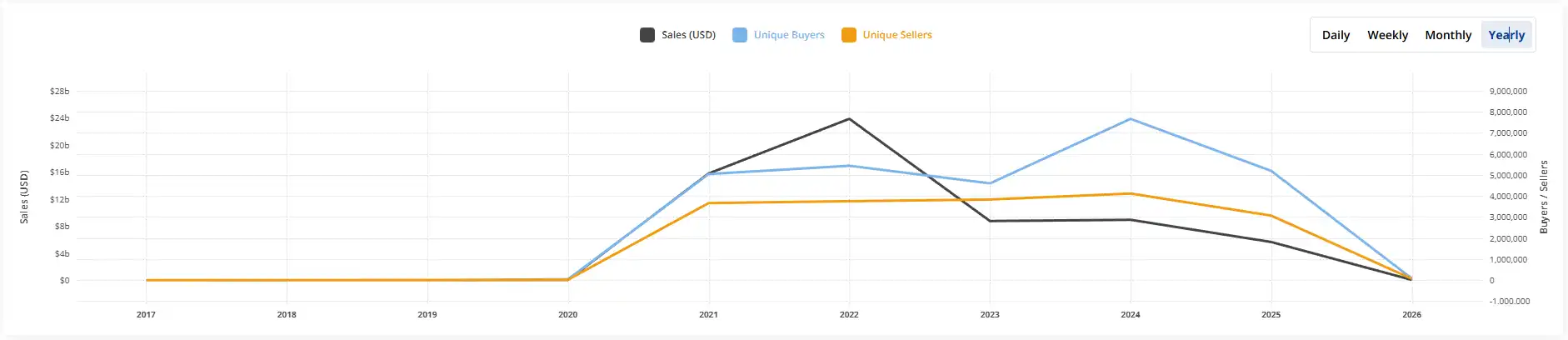
Image Source: CryptoSlam

Even former top-tier NFT projects and blue-chip NFTs could not escape the fate. Taking CryptoPunks as an example, the floor price has fallen to about 30 ETH, down 78% from its peak of 125 ETH in 2021; Bored Ape Yacht Club (BAYC) fell about 83% from around 30 ETH to about 5 ETH; Azuki fell about 93% from around 12 ETH to 0.8 ETH.

Collective "Flight" and Evolution of Platforms

The movements of industry leaders mark the end of this cycle.

OpenSea, which once firmly held the top spot in the NFT market, saw its platform revenue drop from $50 million to $120 million per month during the NFT golden age to less than one million.

Therefore, OpenSea announced a transformation. The platform will shift from a单纯的 "NFT marketplace" to a universal on-chain trading center for "Trade Everything", covering physical collectibles and digital assets like tokens, and confirmed it will issue a token.

Blur, which had a meteoric rise, saw its TVL continuously hit new lows, and its token price also fell 99% from its high.

Then there's Magic Eden, which started on Solana. After a year of operation, it issued a token. Affected by the NFT market conditions and the落地 (materialization) of short-selling expectations, the platform's trading volume began to shrink, and its token price also fell over 98% from its high.

Even projects that couldn't keep up with the changing times, like the older NFT marketplace X2Y2, have been淘汰 (eliminated), completely shutting down, with the team having pivoted to the AI field.

From "Token" to "Brand"

Amid the widespread despair, Pudgy Penguins successfully broke through against the trend, becoming an industry outlier. Its success does not rely on complex innovation in token technology or short-term speculative hype, but rather on transforming digital IP into physical consumer goods, gradually building a sustainable brand ecosystem that spans Web3 and traditional retail.

Through the dual revenue model推行 (implemented) by CEO Luca Netz, Pudgy Penguins deeply integrates IP licensing with physical goods. Its physical toys have entered over 10,000 retail channels globally, including Walmart, Target, and Walgreens. According to an AInvest report, this transformation has brought the project approximately $50 million in annual revenue, effectively offsetting the impact of the overall crypto market contraction.
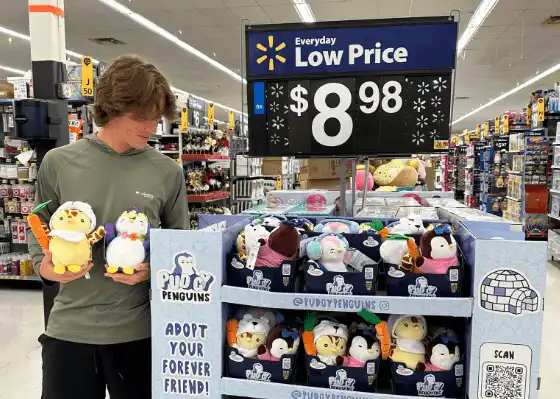
Image - Pudgy Penguins toy shelf in a US Walmart

During the 2025 Christmas period, Pudgy Penguins spent approximately $500,000 to project a giant animation on the Las Vegas landmark Sphere.
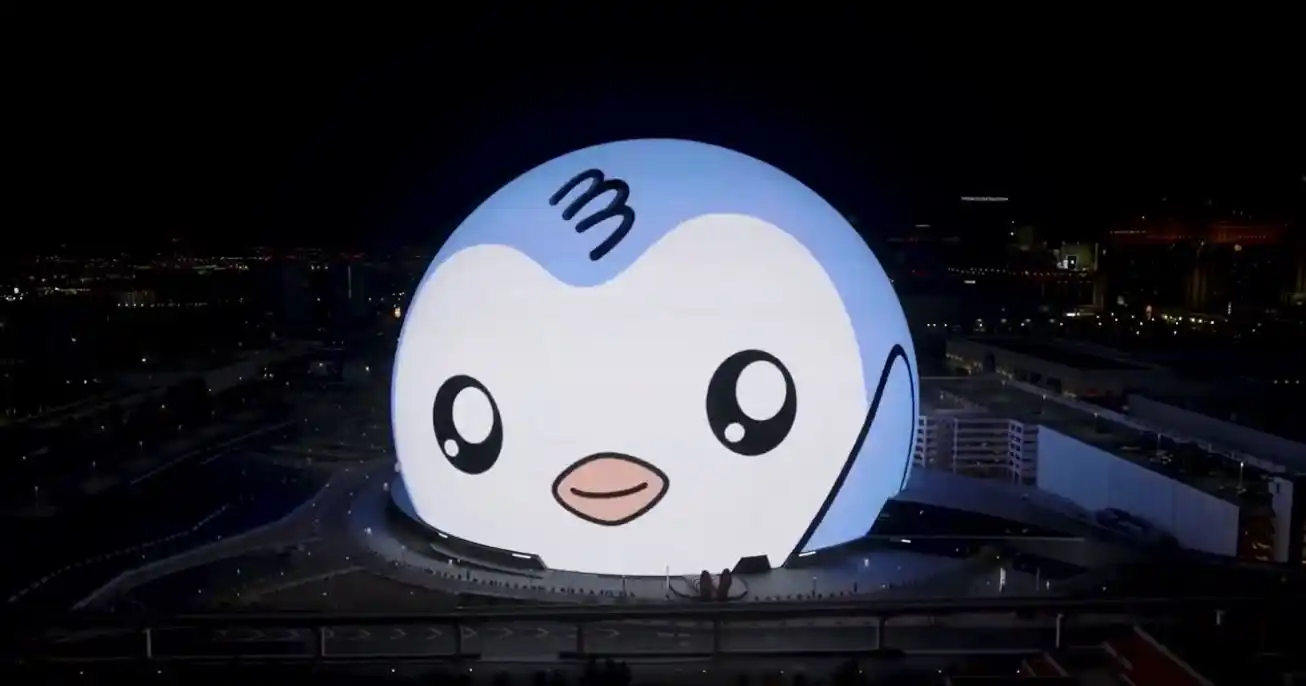
Image - Pudgy Penguins image on the Sphere

This advertisement, aimed at millions of tourists, avoided crypto jargon and the term NFT, presenting only a family-friendly IP image. It stimulated secondary market liquidity through brand exposure. In the past 14 days, the floor price of this NFT rose 25%, and trading volume increased by about 33%.

This shift in thinking from speculation to cultural operation seems to be becoming a consensus among industry survivors. Last May, Bored Ape Yacht Club (BAYC) issuer Yuga Labs transferred the IP rights of the top NFT project CryptoPunks to the non-profit organization Infinite Node Foundation, aiming to剥离 (strip) it from its speculative nature of price fluctuations and seek longer-term art preservation and cultural operation.

Physical Backing and Functional Return

Beyond IP branding, NFTs are becoming the underlying tool for connecting real-world assets (RWA).

Physical Card Trading. The platform Courtyard.io is changing the game. They deposit real Pokémon cards into certified vaults and tokenize them as NFTs. In the 30 days leading up to the end of 2025, the platform processed over 230,000 transactions, generating approximately $12.7 million in sales, proving strong market demand for this type of highly liquid, physically-backed asset.

Functional Tickets. FIFA (Fédération Internationale de Football Association) has also joined this camp, introducing "priority purchase right" NFTs in the ticket sales for the 2026 World Cup. These NFTs are not for speculation but serve as a verification tool to prevent scalper premiums and price fraud in the secondary market.

What Died in NFTs, and What Remains

NFTs have not "completely died out," but they have indeed died once.

What died is the fantasy of viewing NFTs as a financial asset that could脱离 (detach from) real-world value and be continuously minted and traded based solely on narrative. In the face of the reality of infinite supply and limited demand, this path was destined to be unsustainable.

What remains is the role of NFTs as a "credential layer." They are no longer required to create value alone but are embedded within IP brands, physical assets, and functional scenarios,承担 (undertaking) the basic functions of rights confirmation, transfer, participation, and verification.

From Pudgy Penguins' toy shelves, to the on-chain circulation of physical cards, to the anti-scalping mechanism for World Cup tickets, NFTs are stepping down from the stage of speculation and returning to the toolbox.

For the NFT speculative market, this is undoubtedly a winter. But for NFTs themselves, this is more like a rebirth after disenchantment.


Leituras Relacionadas

North Korean Hackers Loot $500 Million in a Single Month, Becoming the Top Threat to Crypto Security

North Korean hackers, particularly the notorious Lazarus Group and its subgroup TraderTraitor, have stolen over $500 million from cryptocurrency DeFi platforms in less than three weeks, bringing their total theft for the year to over $700 million. Recent major attacks on Drift Protocol and KelpDAO, resulting in losses of approximately $286 million and $290 million respectively, highlight a strategic shift: instead of targeting core smart contracts, attackers are now exploiting vulnerabilities in peripheral infrastructure. For instance, the KelpDAO attack involved compromising downstream RPC infrastructure used by LayerZero's decentralized validation network (DVN), allowing manipulation without breaching core cryptography. This sophisticated approach mirrors advanced corporate cyber-espionage. Additionally, North Korea has systematically infiltrated the global crypto workforce, with an estimated 100 operatives using fake identities to gain employment at blockchain companies, enabling long-term access to sensitive systems and facilitating large-scale thefts. According to Chainalysis, North Korean-linked hackers stole a record $2 billion in 2025, accounting for 60% of all global crypto theft that year. Their total historical crypto theft has reached $6.75 billion. Post-theft, they employ specialized money laundering methods, heavily relying on Chinese OTC brokers and cross-chain mixing services rather than standard decentralized exchanges. Security experts, while acknowledging the increased sophistication, emphasize that many attacks still exploit fundamental weaknesses like poor access controls and centralized operational risks. Strengthening private key management, limiting privileged access, and enhancing coordination among exchanges, analysts, and law enforcement immediately after an attack are critical to improving defense and fund recovery chances. The industry's challenge now extends beyond secure smart contracts to safeguarding operational security at the infrastructure level.

marsbitHá 37m

North Korean Hackers Loot $500 Million in a Single Month, Becoming the Top Threat to Crypto Security

marsbitHá 37m

Circle CEO's Seoul Visit: No Korean Won Stablecoin Issuance, But Met All Major Korean Banks

Circle CEO Jeremy Allaire's recent activities in Seoul indicate a strategic shift for the company, moving away from issuing a Korean won-backed stablecoin and instead focusing on embedding itself as a key infrastructure provider within Korea’s financial and crypto ecosystem. Despite Korea accounting for nearly 30% of global crypto trading volume—with a market characterized by high retail participation and altcoin dominance—Circle has chosen not to compete for the role of stablecoin issuer. Instead, Allaire met with major Korean banks (including Shinhan, KB, and Woori), financial groups, leading exchanges (Upbit, Bithumb, Coinone), and tech firms like Kakao. This approach reflects a broader industry transition: the core of stablecoin competition is shifting from issuance rights to systemic positioning. With Korean regulators still debating whether banks or tech companies should issue stablecoins, Circle is avoiding regulatory uncertainty by strengthening its role as a service and technology partner. The company is deepening integration with trading platforms, building connections, and promoting stablecoin infrastructure. This positions Circle to benefit regardless of which entity eventually issues a won stablecoin. Allaire also noted the potential for a Chinese yuan stablecoin in the next 3–5 years, underscoring a regional trend of stablecoins becoming more regulated and integrated with traditional finance. Ultimately, Circle’s strategy highlights that future influence in the stablecoin market will belong not necessarily to the issuers, but to the foundational infrastructure layers that enable cross-system transactions.

marsbitHá 1h

Circle CEO's Seoul Visit: No Korean Won Stablecoin Issuance, But Met All Major Korean Banks

marsbitHá 1h

SpaceX Ties Up with Cursor: A High-Stakes AI Gambit of 'Lock First, Acquire Later'

SpaceX has secured an option to acquire AI programming company Cursor for $60 billion, with an alternative clause requiring a $10 billion collaboration fee if the acquisition does not proceed. This structure is not merely a potential acquisition but a strategic move to control core access points in the AI era. The deal is designed as a flexible, dual-path arrangement, allowing SpaceX to either fully acquire Cursor or maintain a binding partnership through high-cost collaboration. This "option-style" approach minimizes immediate regulatory and integration risks while ensuring long-term alignment between the two companies. At its core, the transaction exchanges critical AI-era resources: SpaceX provides its Colossus supercomputing cluster—one of the world’s most powerful AI training infrastructures—while Cursor contributes its AI-native developer environment and strong product adoption. This synergy connects compute power, models, and application layers, forming a closed-loop AI capability stack. Cursor, founded in 2022, has achieved rapid growth with over $1 billion in annual revenue and widespread enterprise adoption. Its value lies in transforming software development through AI agents capable of coding, debugging, and system design—positioning it as a gateway to future software production. For SpaceX, this move is part of a broader strategy to evolve from a aerospace company into an AI infrastructure empire, integrating xAI, supercomputing, and chip manufacturing. Controlling Cursor fills a gap in its developer tooling layer, strengthening its AI narrative ahead of a potential IPO. The deal reflects a shift in AI competition from model superiority to ecosystem and entry-point control. With programming tools as a key battleground, securing developer loyalty becomes crucial for dominating the software production landscape. Risks include questions around Cursor’s valuation, technical integration challenges, and potential regulatory scrutiny. Nevertheless, the deal underscores a strategic bet: controlling both compute and software development access may redefine power dynamics in the AI-driven future.

marsbitHá 1h

SpaceX Ties Up with Cursor: A High-Stakes AI Gambit of 'Lock First, Acquire Later'

marsbitHá 1h

Trading

Spot
Futuros
活动图片