Author: Chloe, ChainCatcher
When the price of Bitcoin retreated 30% from its all-time high and spot ETFs faced three consecutive months of net outflows, MicroStrategy, the world's largest Bitcoin strategic reserve company, defied the trend by aggressively increasing its holdings by over $3.7 billion in a single month. Meanwhile, its stock MSTR experienced a sharp correction of over 60%, and its mNAV dropped from 2.4 to a more rational range of 1.07. This article will analyze MicroStrategy's three potential future scenarios under different market conditions based on macroeconomic data and institutional weaknesses. With the premium bubble now gone, is this the best time to enter MSTR?
MicroStrategy Defies Trend, Buys Over $3.7 Billion Worth of BTC in a Single Month
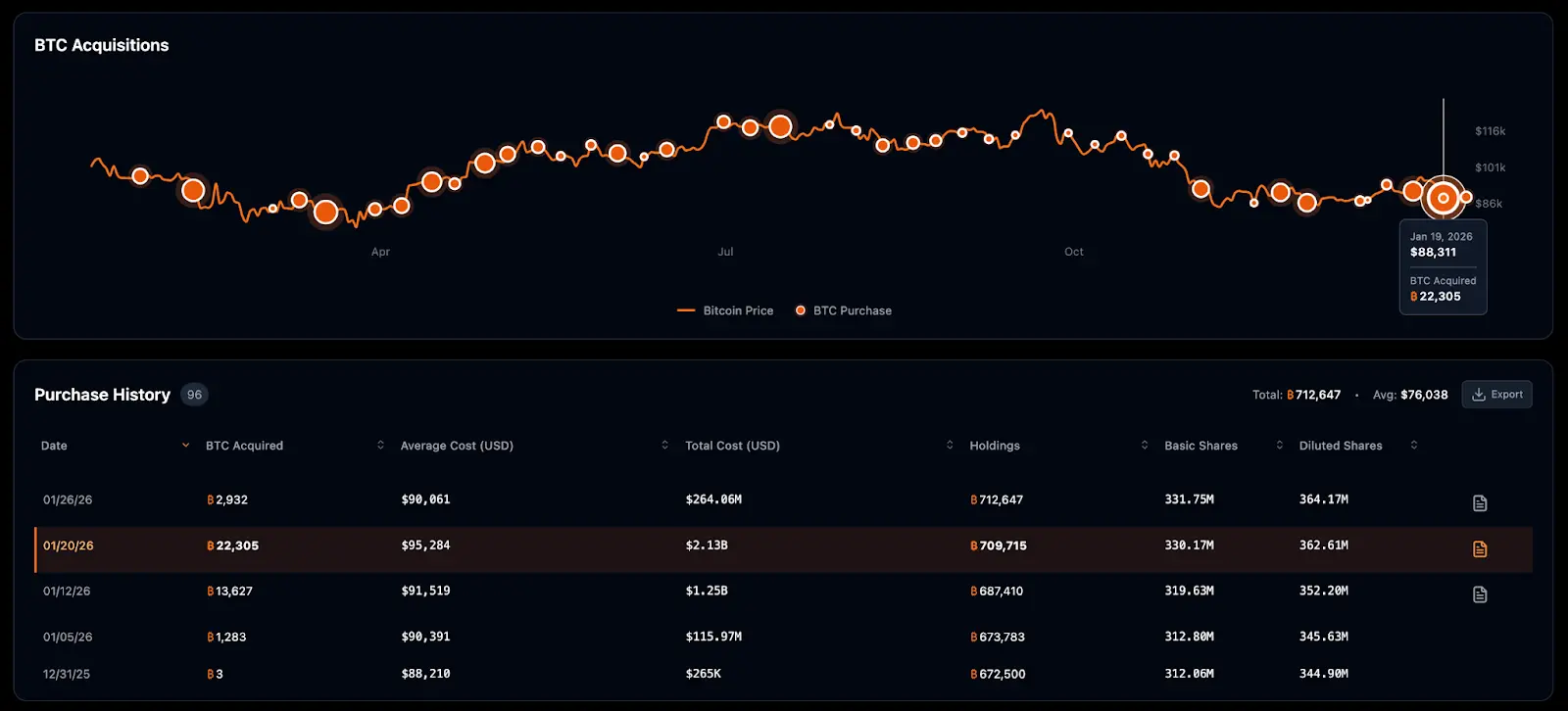
After Bitcoin hit a new all-time high of $126,000 in October 2025, it experienced a sharp pullback, now trading around $88,000, a drop of 30%. However, this correction did not shake the resolve of MicroStrategy, the world's largest Bitcoin reserve company. In early 2026, the company continued to buy at an even more aggressive pace, demonstrating its strong confidence in Bitcoin to the global market.
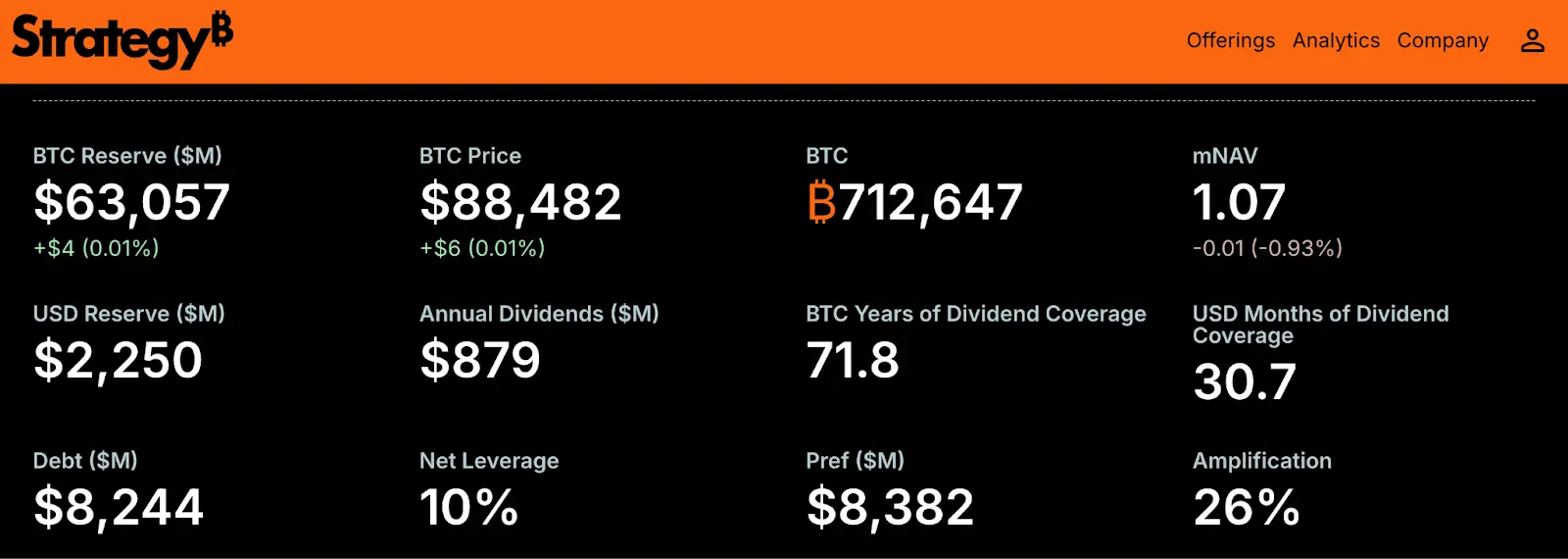
According to data from Bitcoin Strategy Tracker, MicroStrategy purchased over 40,000 Bitcoins in January 2026 alone. Particularly, between January 6 and January 20, it bought 35,932 Bitcoins in two batches, with an average purchase price ranging from $91,500 to $95,300. Statistics show that MicroStrategy's total investment in January reached $3.7 billion; as of January 27, its balance sheet held 712,647 Bitcoins, with an overall average purchase cost of $76,038.
In addition to aggressively buying in the spot market, MicroStrategy is also expanding its influence into the European market. Several financial institutions have launched leveraged products linked to MicroStrategy (MSTR) on major European exchanges, aiming to attract traditional capital from across the Atlantic. Meanwhile, interest from top global financial institutions in holding MSTR has also grown significantly. Investment management giant Vanguard Group's funds recently disclosed holdings of MicroStrategy stock; the Louisiana State Employees' Retirement Fund and Japan's financial giant Sumitomo Mitsui Trust Holdings have also included MSTR in their investment portfolios according to recent reports.
Bitcoin's Structural Weakness and Institutional Wait-and-See
However, MicroStrategy's enthusiastic buying and numerous positive news have not dispelled the overall market chill. For investors, current macroeconomic data shows a clear demand gap:
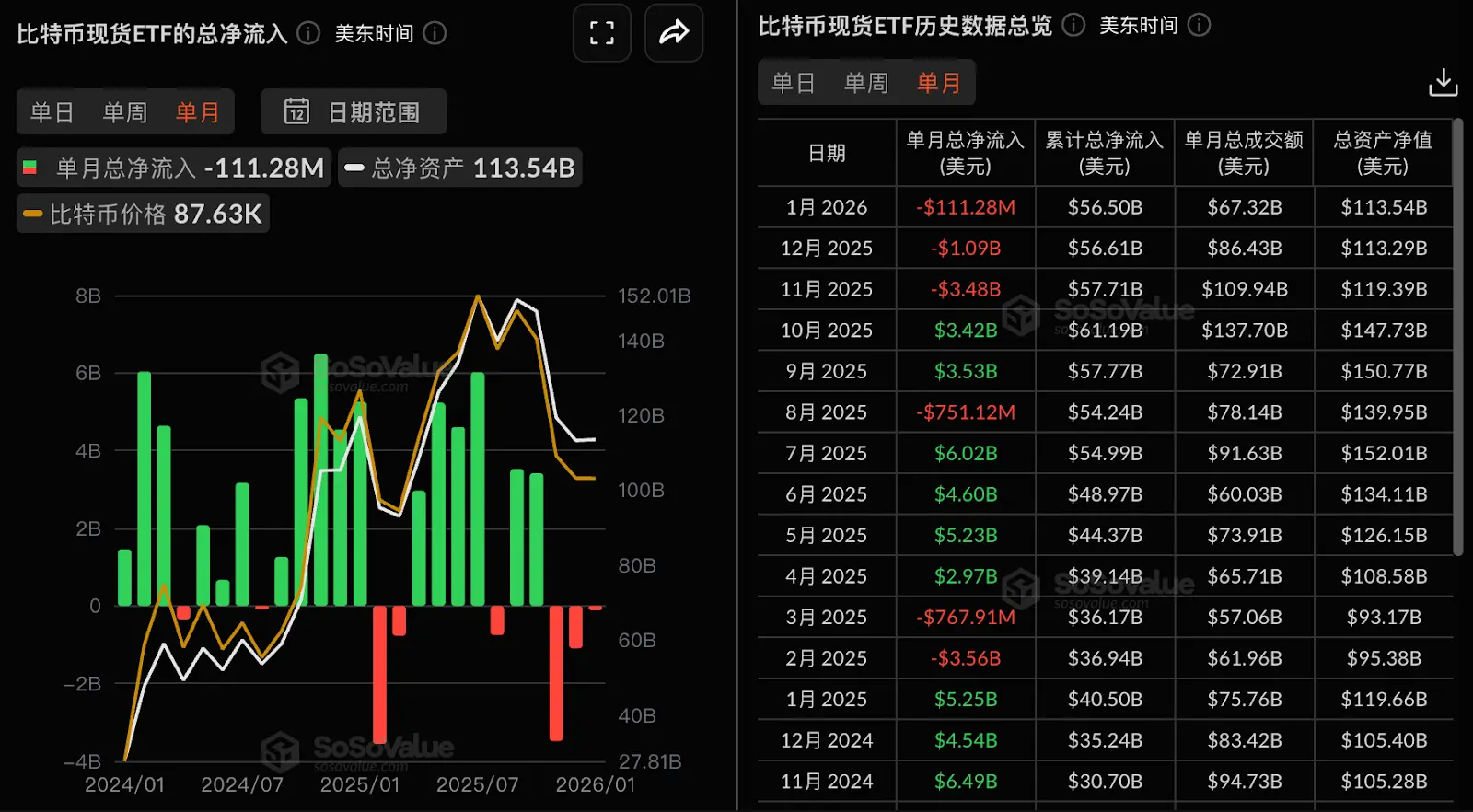
Bitcoin spot ETFs have seen three consecutive months of net outflows: Since November 2025, U.S. Bitcoin spot ETFs have been stuck in a three-month streak of net outflows, including a net outflow of $3.48 billion in November, $1.09 billion in December, and although the outflow slowed to $111 million in January 2026, the trend has not ended. This shows that mainstream Wall Street funds have been withdrawing during this period, in stark contrast to MicroStrategy's counter-trend accumulation.
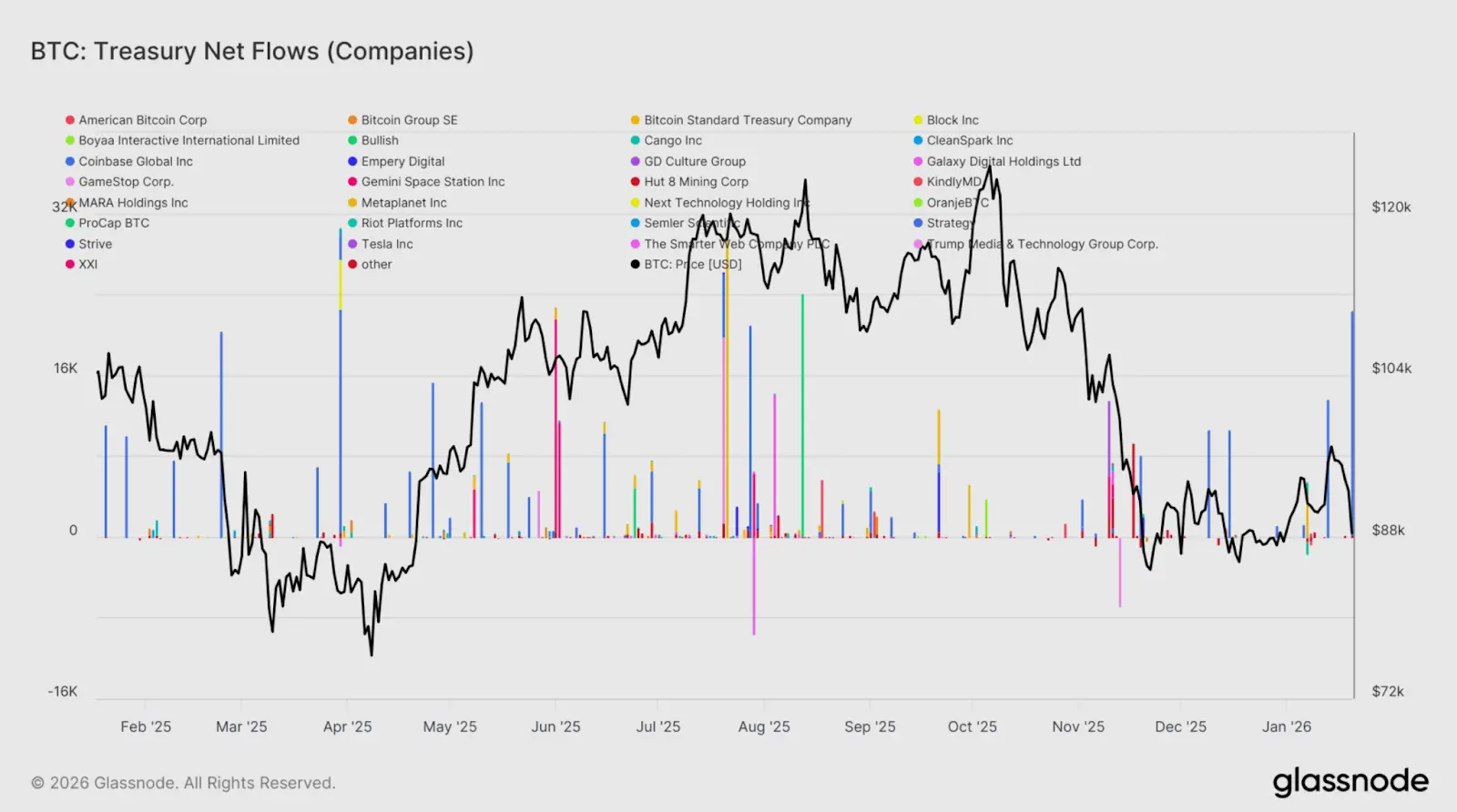
Sporadic and Uneven Inflows into Bitcoin Treasuries: A Glassnode report points out that recent corporate inflows have been concentrated in individual event-driven trades rather than widespread accumulation. The chart below shows that the buying is primarily driven by MicroStrategy, while other Bitcoin treasury companies have not made further purchases recently, contrasting sharply with the boom from May to August 2025 when multiple treasury companies bought collaboratively, accelerating the trend.
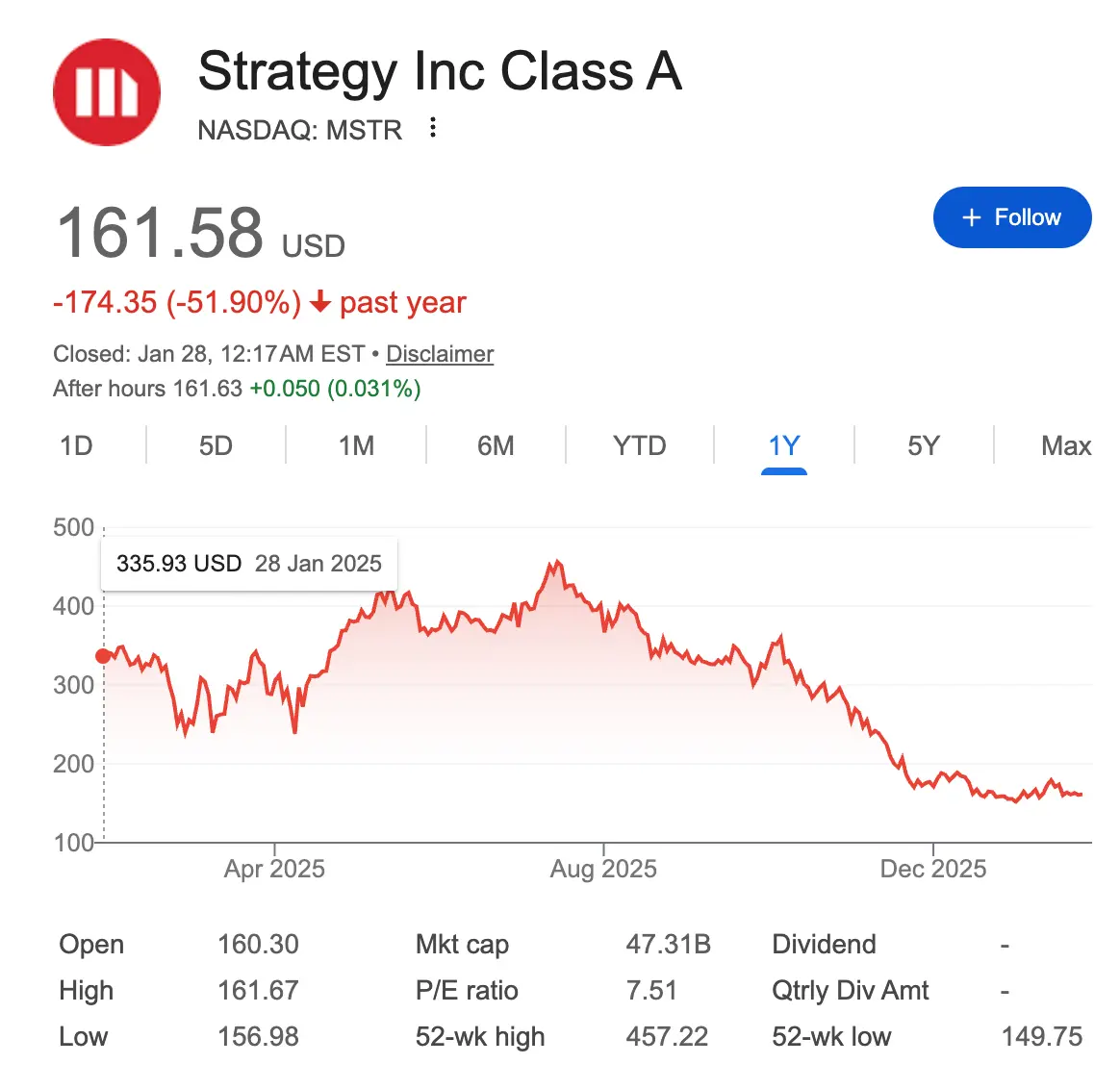
Another brutal reality can be observed: Bitcoin fell from its high of $126,000 to the current $88,000, a drop of about 30%; however, MicroStrategy's (MSTR) stock price plummeted from its high of $457 last July to around $160 currently, a drop of 65%, meaning MicroStrategy's decline was almost twice that of Bitcoin. The leveraged tool that amplified gains on the way up has become an "accelerator" for the stock price plunge during the downturn.
MSTR's Premium Reset and Three Potential Future Outcomes
After experiencing a dual correction in stock price and premium, the core question facing investors is: Is the current MSTR stock price of $160 an entry opportunity or the beginning of another crash?
A key metric is: MicroStrategy's mNAV performance relative to its Bitcoin holdings. At the end of 2024, the market was willing to pay a premium of up to 2.4 times to hold MSTR; with the recent stock price drop of over 60%, this premium has significantly contracted to 1.07 times. From a valuation perspective, this means the emotional泡沫 in the market has been largely squeezed out, and the current stock price is highly close to its asset bottom price, providing a more cost-effective entry point for long-term Bitcoin bulls.
However, MicroStrategy's debt risk cannot be ignored. As of early 2026, the company's perpetual preferred equity reached $8.36 billion, surpassing its $8.21 billion in convertible debt. While this shift eliminates refinancing pressure from debt maturity, it also brings持续性 cash outflows. MicroStrategy currently holds approximately $2.25 billion in cash reserves, with annual dividend and interest obligations around $876 million.
At the current spending rate, the company has about two and a half years of financial buffer. A more critical test will come in September 2027, when the $1.01 billion "put option" on its 2028 notes may require cash payment, depending on the stock price performance at that time.
Simultaneously, based on Forbes' perspective, the following three scenarios can be summarized for the future market:
Scenario 1 (Base Case): If Bitcoin consolidates within the range of $85,000 to $100,000, the market will enter a period of testing patience. Limited by macroeconomic policy uncertainty, geopolitical turmoil, and the lack of new large institutional groups buying collaboratively, MicroStrategy's premium is expected to remain low, and the stock price is预计 to fluctuate between $150 and $250.
Scenario 2 (Optimistic Outlook): If Bitcoin breaks through the $100,000 mark and charges towards $150,000, MicroStrategy is expected to restart its "leveraged long" engine. According to analysis from Canaccord Genuity and Bernstein, the target price could return to above $450. For investors seeking excess returns, MicroStrategy remains the most powerful leveraged Bitcoin investment vehicle in the capital market.
Scenario 3 (Pessimistic Outlook): This is the situation most feared by critics like Peter Schiff. If the Bitcoin price falls below $80,000,甚至 approaching the average cost line of $76,000, the company will find it difficult to maintain its buying through low-cost financing tools; more严峻的是, the accumulated dividends on perpetual preferred stock will also face huge financial pressure, potentially triggering a vicious cycle of asset value and financing capacity trampling each other.
Market "Consensus" is in a Fragile Period, Going Long Depends on Investor Risk Appetite
Should you go long on MicroStrategy (MSTR) now? The argument for going long is that the premium has been reset (mNAV has dropped from a high of 2.4 to 1.07), and the risk release is relatively sufficient. If you believe Bitcoin below $100,000 is a serious "mispricing," then MicroStrategy is your best lever to放大 profits.
The conservative view is that macroeconomic policy uncertainty, geopolitical turmoil,持续 ETF outflows, and corporate treasury wait-and-see attitudes show the market "consensus" is in a fragile period. If MicroStrategy fights alone, it will be difficult to resist the overall macro gravity, perhaps only providing a bottoming effect.
The answer ultimately depends on the investor's risk appetite. For those who believe digital gold will ultimately prevail, this is an entry opportunity after the premium has shrunk; but for funds seeking stability, remaining neutral might be a more rational choice until Wall Street institutions show a turn towards net inflows again.