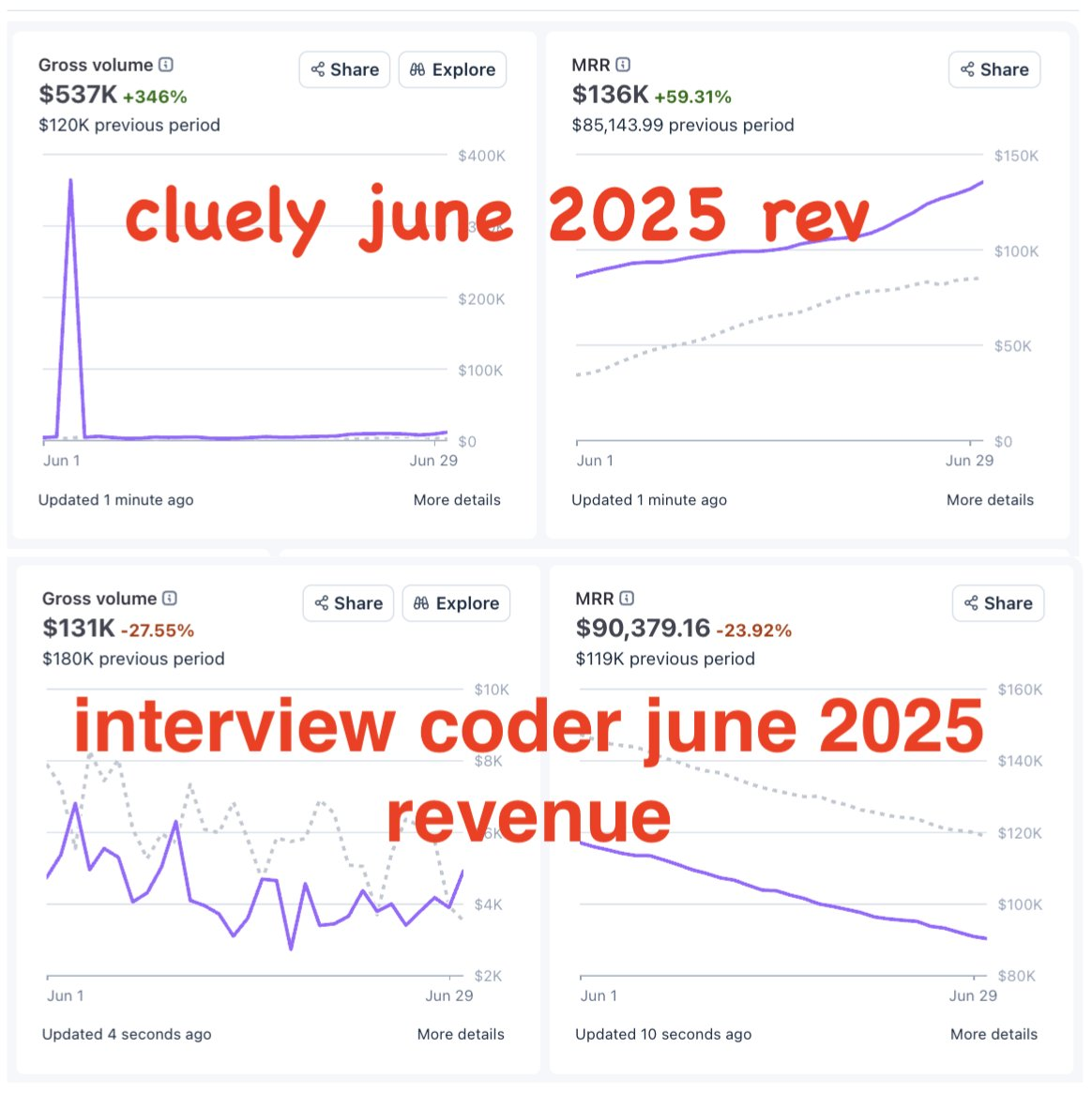
After Falsifying Revenue, Why Did This CEO Choose a 'No Pants' Response?

比推Publicado em 2026-03-11Última atualização em 2026-03-11

Resumo

CEO Roy Lee, founder of AI startup Cluely, responded to accusations of inflating revenue figures not with a traditional apology, but with a deliberately absurd video performance. After being accused of falsely claiming $7M in annual recurring revenue in a TechCrunch interview, Lee first admitted to casually providing the number, then released a video where he appeared professionally dressed from the waist up—only to stand up and reveal he was not wearing pants. The company, which began by creating an AI-powered interview cheating tool and was co-founded after Lee was expelled from Columbia University, has consistently leveraged controversy as a core growth strategy. Rather than mitigating the scandal, Lee turned it into a viral moment, echoing a broader trend in tech and crypto where attention itself is monetized. Major investor a16z has backed Cluely, with partners arguing that in an era of commoditized AI models, viral storytelling and public attention are the new moats. Lee’s response exemplifies how some founders now treat controversy not as risk, but as fuel for growth.

Author: DingDang

Original Title: CEO Uses Humor to Respond to Crisis, AI Entrepreneurs Steal Crypto's Marketing Playbook


In most startups, if exposed for 'falsifying revenue,' it would likely lead to a PR crisis—issuing a statement, explaining the misunderstanding, correcting data metrics, apologizing, and then steering the conversation back to product or business growth.

But Cluely's CEO Roy Lee clearly had no intention of doing that.

A Company That Started with a 'Cheating Tool'

Cluely was founded in 2025, and its initial product came from a project called Interview Coder, developed by Roy Lee and his college roommate Neel. This was a tool that used AI to help users cheat in LeetCode interviews. Due to this project, both were eventually expelled from Columbia University.

For most people, being expelled from school would be a black mark to cover up. But Roy Lee turned this incident into a marketing opportunity, even a 'turning point in life.'

Cluely's initial product slogan was: 'Cheat on Everything.' It wasn't until November 2025 that Cluely began shifting its product narrative from a 'cheating tool' to an AI note-taking assistant, such as using AI to automatically organize meeting content, optimize collaboration efficiency, and even modify attendees' expressions to hide distractions. But no matter how the product evolved, the company, or rather, its CEO, never shook off a very distinct vibe: it almost grew through controversy.

And the ensuing storm, in a way, continued down this path.

A Farce Triggered by 'Falsified Revenue'

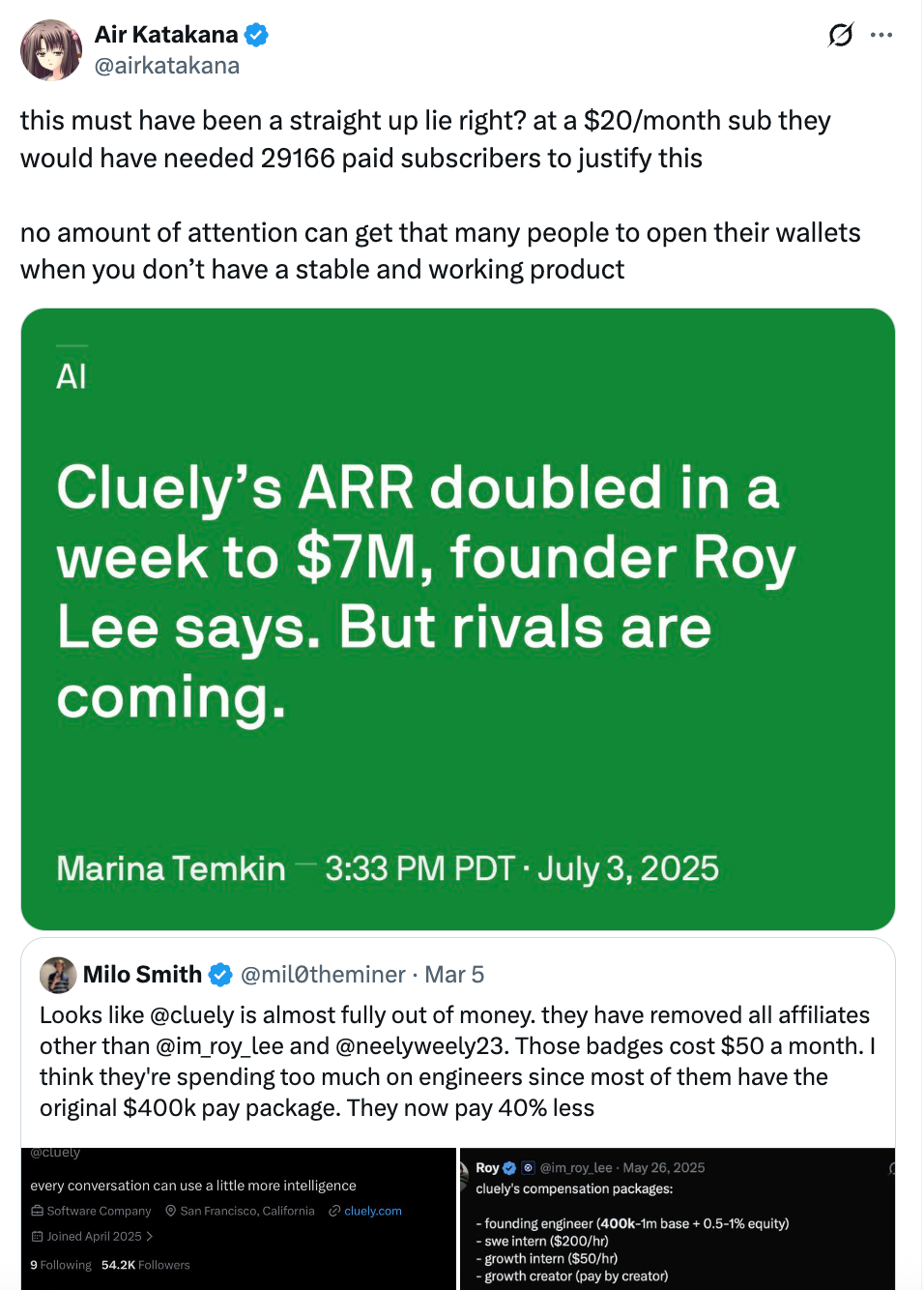
The incident began when someone dug up a July 2025 report by TechCrunch. The article mentioned that Cluely's Annual Recurring Revenue (ARR) had doubled in a week, reaching $7 million. This data was questioned as fraudulent.
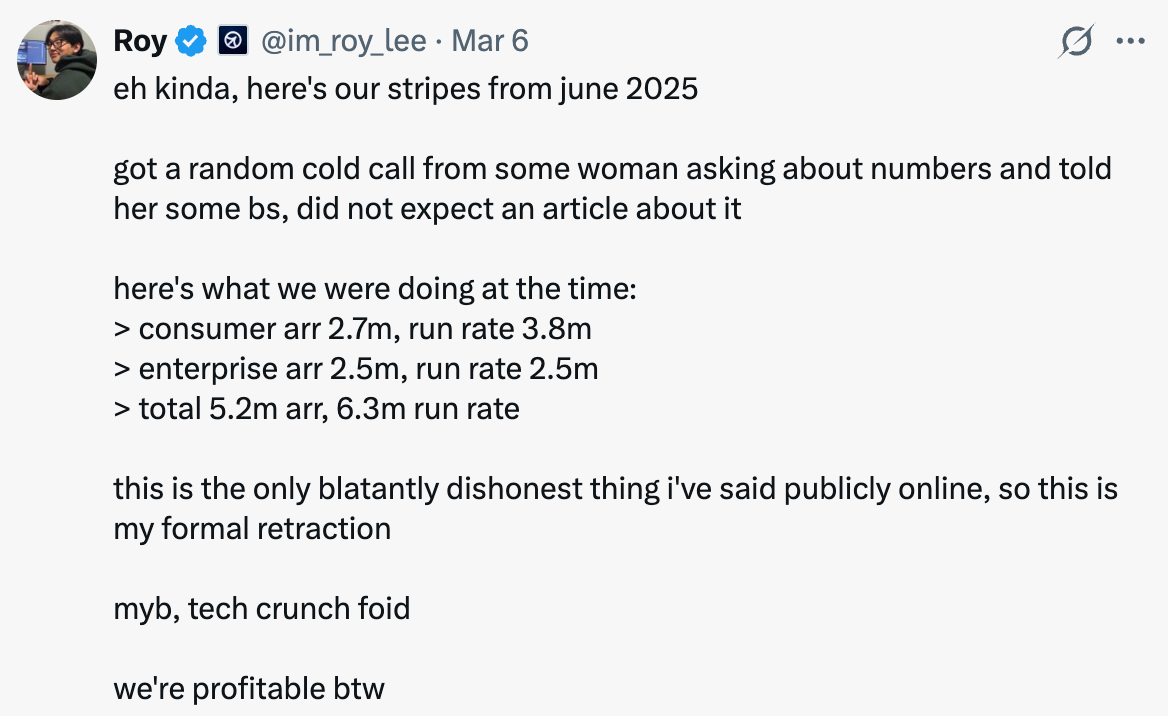
Facing the质疑, Cluely CEO Roy Lee was quite candid. He quickly posted to admit that he had casually mentioned the number when a reporter called him, not expecting it to be included in a formal article. Seemingly to prove it wasn't an intentional exaggeration, he also posted Cluely's actual data from June 2025: consumer business annual revenue of $2.7 million and enterprise business annual revenue of $2.5 million, totaling $5.2 million.

Up to this point, there was nothing sensational, and the explanation was plausible.
But on the same day, TechCrunch reporter Julie Bort published a rebuttal to Roy's claim. She stated that the interview was arranged proactively by Cluely's PR team, was documented, and was not a casual chat.

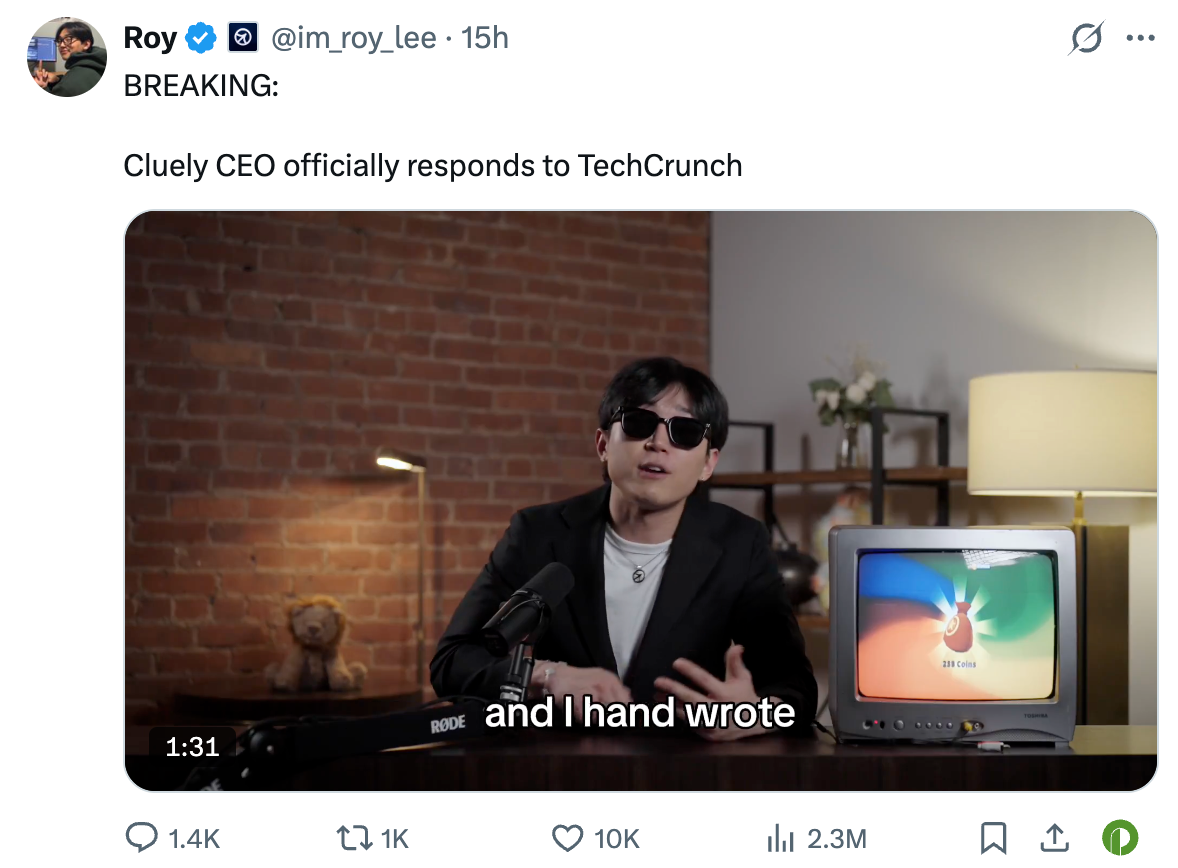
Roy Lee didn't continue with a written explanation but chose a more dramatic way to respond. He released a video with the caption, 'Breaking News: Cluely CEO Officially Responds to TechCrunch.'

In the video, he sat in front of the camera wearing sunglasses and a suit, with a microphone on the desk, looking as if he was about to make a serious statement. But the setting wasn't an office; it looked more like a living room, with an old desktop computer next to him playing Subway Surfers—a classic time-wasting game. Roy's response was also completely informal, more like a self-deprecating performance, mixed with self-mockery and bragging, his tone reminiscent of a rapper freestyling.

Even more absurdly, at the end of the video, he stood up from behind the desk, revealing that this CEO, formal from the waist up, was wearing no pants......
Thus, a crisis PR situation originally about 'falsified revenue' was handled as a traffic-grabbing, self-mocking performance.

What a16z Is Betting On Is Actually the Attention Economy

The capital market doesn't seem to mind this kind of performative founder personality either. In June 2025, Cluely announced the completion of a $15 million Series A funding round, with participating institutions including the renowned venture capital firm Andreessen Horowitz (a16z). Its partner Bryan Kim once mentioned on a podcast: In the AI era, the traditional 'artisan product + slow growth' model is no longer sufficient; viral spread itself is part of the product.

What he considers the 'new AI startup template' is that in an era where model capabilities are increasingly commoditized, attention itself is becoming a key resource. Whoever can capture user attention first may build a new moat.

From the 'cheating controversy' of Interview Coder, to the entrepreneurial story of being expelled from Columbia, to this absurd 'response video,' Roy Lee's entire personal brand has been built along this path: controversy itself is the content for propagation. This might also explain why a16z chose to invest in Cluely, to invest in Roy Lee.

When Controversy Becomes a Growth Strategy

In past entrepreneurial narratives, growth typically came from product capability, technological barriers, and business models. But in today's internet environment, another resource is becoming increasingly important—attention.

This logic has actually been proven in the crypto industry long ago. Many crypto projects capture user attention by creating topics, controversies, or even dramatic events, and then convert this traffic into product growth or commercial value, especially with the rise of Memes—pure propagation, no (traditional) product.

In a way, Roy Lee's response video is a classic case of this logic: when negative news emerges, rather than trying to suppress the controversy, repackage the controversy itself as传播 content.

Evidently, in the current internet environment, attention is often more valuable than explaining the truth.


Twitter:https://twitter.com/BitpushNewsCN

Bitpush TG Discussion Group:https://t.me/BitPushCommunity

Bitpush TG Subscription: https://t.me/bitpush

Original link:https://www.bitpush.news/articles/7618818

Perguntas relacionadas

QWhat was the initial product developed by Cluely's CEO and co-founder, and what was the consequence of its creation?

AThe initial product was Interview Coder, an AI tool designed to help users cheat on LeetCode coding interviews. As a result, both Roy Lee and his roommate were expelled from Columbia University.

QHow did Cluely's CEO, Roy Lee, respond to the allegations of falsifying revenue reported by TechCrunch?

ARoy Lee first admitted in a post that he had casually provided the number during a call with a journalist without expecting it to be published. He then released a satirical video response where he appeared professionally dressed from the waist up but was not wearing pants, turning the crisis into a performance to attract attention.

QWhich prominent venture capital firm invested in Cluely's Series A funding round, and what was their stated reasoning for such investments in the AI era?

AAndreessen Horowitz (a16z) participated in Cluely's $15 million Series A funding round. Their partner, Bryan Kim, stated that in the AI era, viral marketing itself is part of the product, and capturing user attention is a critical resource for building a moat.

QAccording to the article, what is the 'new AI startup template' that Cluely's strategy exemplifies?

AThe 'new AI startup template' is one where, in an era of increasingly commoditized model capabilities, attention itself becomes a key resource. The strategy involves generating controversy and using viral, dramatic events to capture user attention and drive growth, rather than relying solely on traditional product capability or technological barriers.

QHow did the company's product narrative evolve from its origins to late 2025?

AOriginally promoted with the slogan 'Cheat on Everything' as a tool for cheating, the company began shifting its product narrative in November 2025 towards an AI note-taking assistant. This new focus included features like automatically organizing meeting content, improving collaboration efficiency, and even modifying attendees' expressions to hide distraction.

Leituras Relacionadas

From South Korea to the United States: Blue-Collar Jobs Are Becoming Increasingly Popular, Thanks to AI

AI is reshaping the labor market's value proposition. The traditional four-year college degree is losing its appeal as a guaranteed career path, while skilled blue-collar trades like electricians, welders, and plumbers are experiencing historic demand and wage premiums. This shift is driven by dual pressures: AI's displacement of certain white-collar roles and a booming need for physical infrastructure and data center construction. Data confirms the trend. In the U.S., vocational school revenue surged, and a significant portion of recent layoffs are AI-related. Surveys show a majority of Gen Z adults plan to pursue blue-collar work, citing better job security against AI automation. Vocational education interest has exploded recently. Experts cite a psychological shift as younger generations seek tangible, AI-resistant careers and avoid high student debt. In many cases, salaries for skilled trades now match or exceed those requiring a bachelor's degree. In South Korea, semiconductor vocational high schools boast near-total employment, with graduates securing high-paying roles at companies like Samsung. The shortage is structural, exacerbated by a retiring baby boomer workforce and massive infrastructure projects. Companies like JPMorgan Chase, Meta, and Lowe's are investing heavily in training programs. However, overcoming historical stigma and a "perception gap" around trade careers remains a key challenge to closing the talent gap.

marsbitHá 42m

From South Korea to the United States: Blue-Collar Jobs Are Becoming Increasingly Popular, Thanks to AI

marsbitHá 42m

Qualcomm: AI Hype Subsides, When Will Smartphones Emerge from the Gloom?

Qualcomm reported its Q3 FY2026 results (ending June 2026), with revenue of $9.95B, down 4% YoY but above expectations. Gross margin declined to 53.1%, pressured by rising costs across manufacturing and memory. Key business segments showed mixed performance: Handset revenue fell 19.6% YoY to $5.09B, dragged by an 11% decline in non-Apple Android shipments and weaker high-end mix. Conversely, Automotive revenue surged 61% to $1.59B, and IoT grew 9% to $1.83B. Core operating profit dropped 41% YoY due to margin compression and higher expenses. Management's Q4 FY2026 guidance projects revenue of $9.7B-$10.5B, in line with consensus, but Non-GAAP EPS guidance of $2.05-$2.25 fell short of expectations. Amidst persistent weakness in its core handset market, Qualcomm is pursuing growth in AI, focusing on Edge AI (smartphones, PCs, automotive) and Data Center AI. Its data center strategy includes four pillars: AI accelerators (e.g., AI200), commercial CPUs (Dragonfly C1000), custom silicon, and connectivity solutions. While these initiatives initially boosted its stock, concerns over AI capital expenditure sustainability have since erased those gains. The company targets $5B in data center revenue for FY2027 and $15B for FY2029. The report concludes that with the traditional handset business still under pressure, the data center opportunity is currently viewed as a longer-term option, and a more conservative valuation based on core operations may be warranted until AI contributions materialize.

marsbitHá 46m

Qualcomm: AI Hype Subsides, When Will Smartphones Emerge from the Gloom?

marsbitHá 46m

From TPU to Self-Evolving Agents: How Jeff Dean Predicts the Next Step in AI

At the 2026 YC Startup School, Jeff Dean outlined his vision for AI's next phase, shifting focus from simply scaling models to building intelligent, autonomous systems. He believes AI's progress is no longer just about creating smarter models, but about integrating them into systems capable of long-term, iterative work, automated experimentation, and continuous learning. This evolution moves the competition from "who has the bigger model" to "who can best organize intelligence." Dean suggests AI capabilities are now comparable to a junior engineer, enabling the automation of complex workflows. However, the true challenge and opportunity lie in managing these AI "workers" at scale. He emphasizes the importance of **context engineering**—structuring tools, memory, and feedback loops—over raw model power. For startups, this means building deep expertise in niche domains where general models currently fail (near 0-1% success rates), leveraging proprietary data, specialized tools, and domain-specific evaluators. A recurring theme is re-examining fundamental constraints. Dean's past work, like moving Google's search index to memory or creating the TPU, stemmed from questioning outdated assumptions about hardware and cost. He sees similar inflection points today, particularly in **specialized inference hardware** to drastically reduce latency and energy consumption for real-time Agent operation. Notably, he points out that in modern AI systems, the dominant cost is often not computation but **data movement**. Reliable, long-running Agents require robust system design, borrowing concepts from distributed computing like checkpointing, state management, and parallel exploration to handle failures and maintain progress over days or weeks. As AI automates execution, the scarcest human skills will shift to **defining clear specifications**, **judging what problems are worth solving** (taste), and designing effective feedback loops. Ultimately, Dean's framework prioritizes understanding the problem deeply, identifying the true bottlenecks, and systematically building closed-loop systems where AI can not only perform tasks but also improve AI itself.

marsbitHá 46m

From TPU to Self-Evolving Agents: How Jeff Dean Predicts the Next Step in AI

marsbitHá 46m

Trading

Spot
活动图片