After Chasing All Airdrops, the Biggest One Turns Out to Be Yuanbao

比推Publicado em 2026-02-04Última atualização em 2026-02-04

Resumo

The article, titled "The Biggest Airdrop for Crypto People is Given by Yuanbao," discusses the recent popularity of Yuanbao's cash red packet campaign in the crypto community. Amid a significant market downturn in late January, where cryptocurrencies like Bitcoin and Ethereum saw sharp declines, many crypto traders turned to claiming small cash rewards from Yuanbao as a form of psychological relief. The author contrasts Web2 and Web3 airdrop models: Yuanbao, backed by Tencent, offers simple, no-cost cash rewards with high certainty, while crypto project airdrops often involve high costs (time, capital, effort) and uncertain returns, sometimes resulting in net losses for users—exemplified by cases like Infinex, where users faced substantial financial setbacks despite long-term participation. The piece argues that crypto airdrops have shifted from rewarding early users to serving as exit strategies for projects, reducing user trust and retention. It concludes that while airdrops can drive user acquisition, long-term retention depends on product-market fit and user experience—areas where Web3 projects can learn from Web2 giants like Tencent.

Author: Golem(@web 3_golem), Odaily Planet Daily

Original Title: The Biggest Airdrop for Crypto People Is Given by Yuanbao


"xxx has sent you a cash red envelope!"

After Yuanbao's cash red envelope activity began on February 1st, many long-dead project/research exchange groups completely transformed into "grab Yuanbao wool" mutual aid groups.

For crypto people, switching from being esteemed crypto traders to wool parties grabbing Yuanbao red envelopes is also a helpless move.

Starting from January 31st, global financial markets plummeted. Precious metals, which had previously surged, quickly crashed. Spot silver nearly erased its yearly gains, and spot gold once fell below $4500. The crypto market wasn't much better. On February 2nd, Bitcoin broke below the $75,000 support level, touching a low of $74,604. ETH fell to a low of $2157.14, and SOL even fell below $100, touching a low of $95.95.

According to Coinglass data, the crypto market's total liquidation amount reached $2.5615 billion on January 31st, setting a record for the highest single-day liquidation volume since the "10.11 crash." Therefore, "too亏损到不想说话 (losing so much I don't want to talk)" became the true psychological state of many crypto people (like the silent Yi Lihua).

For crypto people who just experienced a bloodbath, grabbing Yuanbao red envelopes, though a drop in the bucket for recouping losses, can provide some psychological comfort, temporarily escaping the harsh market reality.
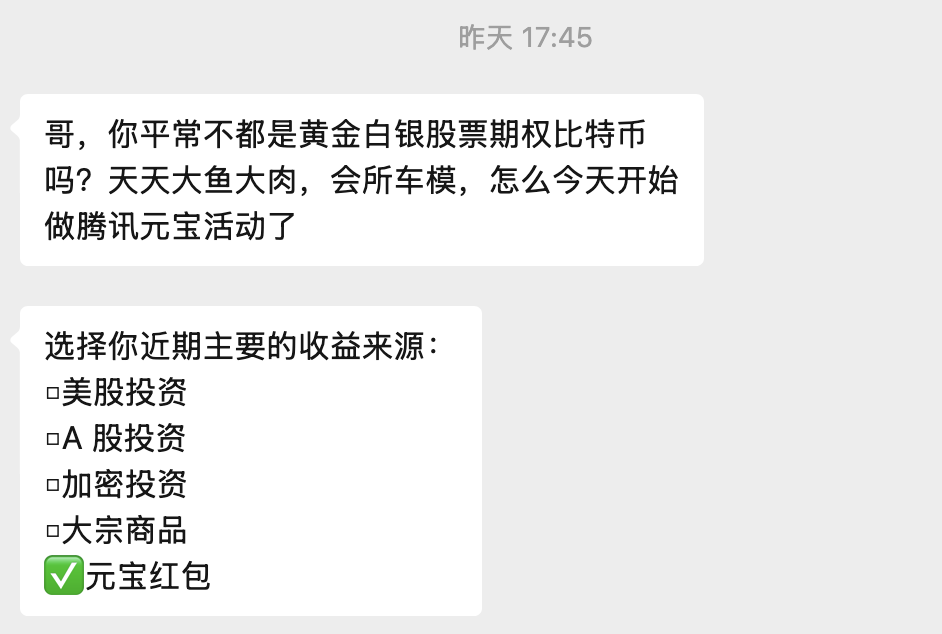
Joke in group chat

Crypto Airdrops: From Swallowing Losses Silently to Passionate Rights Protection

Saying that Yuanbao's cash red envelope is the biggest airdrop for crypto people today is not a gimmick.

The amount Yuanbao can distribute to each user in cash red envelopes is not large, mostly ranging from ten to几十 (a few tens) RMB, but its value lies in its simple interaction and truly zero cost. Users only need to spend a little time recruiting people and step-by-step experiencing product features to get cash red envelopes, with a short task cycle enabling quick returns.

In contrast, project airdrops in the crypto space are first distributed in token form. Profit is truly realized only after the tokens are sold. Although the single received amount seems much larger than Yuanbao's, after deducting time, research, opportunity, wear and tear, and potential costs of being stuck with unsellable tokens, how much is left?

A user who accompanied Infinex for 406 days deeply feels this. On January 31st, the decentralized perpetual contract trading platform Infinex announced TGE and airdrop claims. The project team successfully上岸 (made it ashore), but the community was collectively反撸 (reverse-fleeced).

一千万是只猫 (X:@RXu107) is a typical representative of being reverse-fleeced. On February 1st, he posted that he spent over $11,900 (approx. RMB 82,000) participating in this project (4400 U for NFT, 7500 U for public sale) and作为社区成员深度陪跑了 406天 (accompanied deeply as a community member for 406 days). But on TGE day, not only did he not recover his costs, but his paper loss also exceeded 100,000 RMB (2900 U + 11,284 locked INX tokens).

Faced with the reverse-fleece, the blogger had no choice but to repeatedly tell his friends how难受 (awful) he felt.
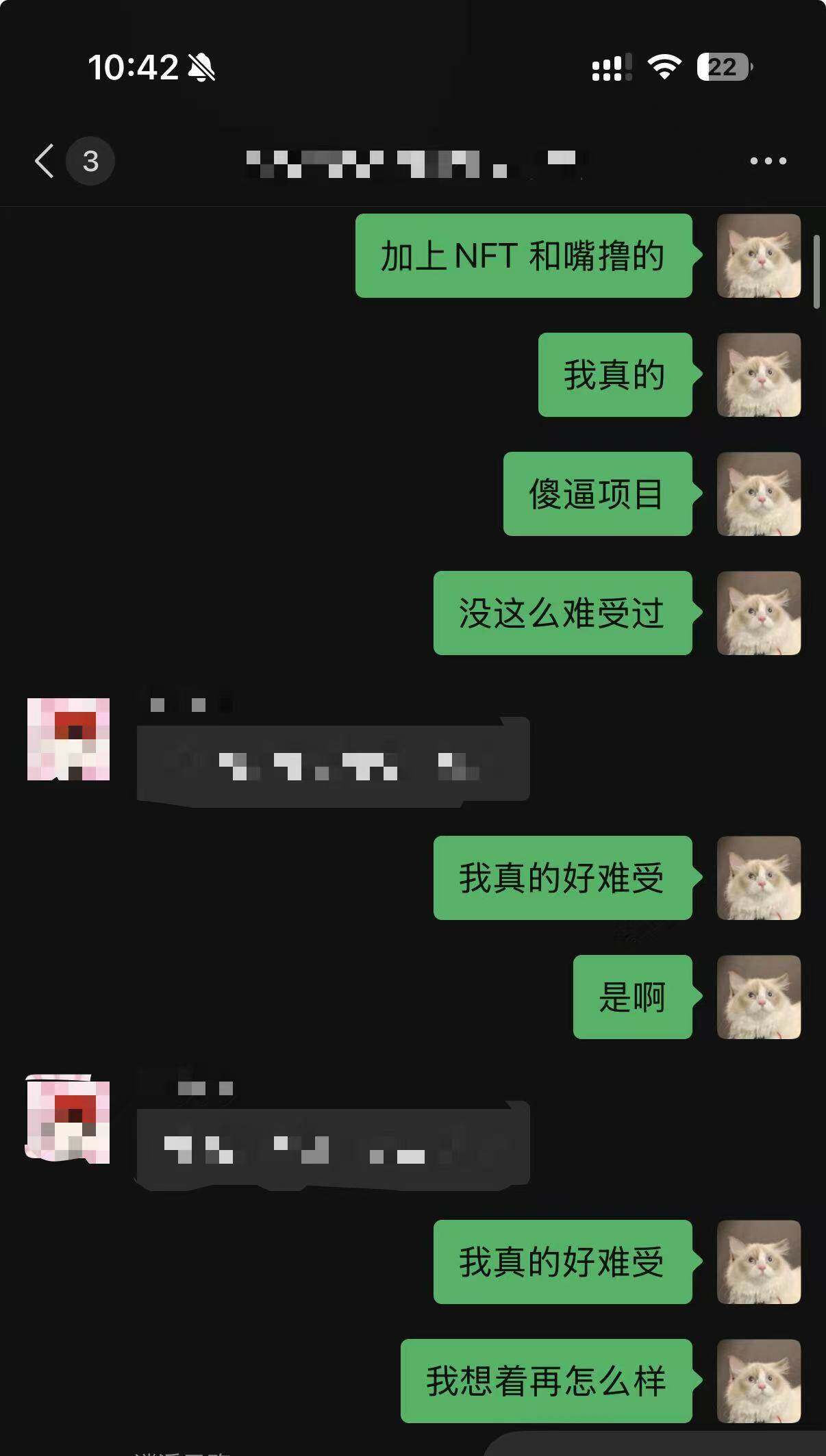
Blogger reverse-fleeced by Infinex tells friend he feels awful

At Infinex's TGE, the fully diluted valuation was only $150 million. The total投入 (input) for Yuanbao's New Year red envelope activity is approximately $140 million USD. What does this mean? It's equivalent to Tencent directly buying Infinex at its maximum valuation and giving it away for free to the whole nation.

Faced with the pain of being reverse-fleeced and deceived, most people in the community choose the same approach as "一千万是只猫"—swallow the loss silently. But some choose to stand up and confront the project team.

Crypto blogger Ice Frog (X:@Ice_Frog666666) is a typical representative. He started by撸毛 (wool grabbing), but ironically, in 2025, Ice Frog was either engaged in airdrop rights protection or on his way to airdrop rights protection. He is currently still negotiating with the prediction market project Space (Odaily Note: Space raised $20 million publicly, team privately took $13 million) and has even taken legal measures.

Web2 Can Afford to Deliver Airdrops, Web3 Can't Afford to Keep Promises

The most ironic point is that today's "input-reward" imbalance in crypto airdrops is not the "moral decay" of a single project, but the result of a整套行业结构变化 (complete set of industry structural changes).

In 2020, Uniswap opened the era of crypto project airdrops. Since then, there have been constant major airdrop opportunities in the crypto space. Stories of getting a car from an airdrop, swapping an airdrop for a house, or reaching A8 (wealth level) through airdrops attracted batch after batch of people into the wool grabbing track, presenting an aesthetic of "the industry is on the rise."

But by 2025, this changed. Market narratives dried up, primary financing weakened, secondary buying power was insufficient. Airdrops were no longer about sharing the future with early users, but more like mortgaging the future for present data, creating an exit path for the project team itself or换取下一轮融资窗口 (exchanging for the next financing window). Thus, major airdrops disappeared, small airdrops shrank, and "being reverse-fleeced" became the industry norm.

The so-called airdrop is just rewriting the advertising budget into a reward pool, bypassing third parties to directly establish growth relationships with users. Whether it's the 1 billion RMB given by Web2's Yuanbao or the fixed airdrop allocation in Web3 project tokenomics, the essence is this logic.

But the difference is that Web2 giants use cash to buy user certainty, while Web3 offers token returns as a promise that may be fulfilled. This results in the same tactic leading to two different destinies.

The certainty of Yuanbao's cash red envelopes comes from cash flow and约束机制 (binding mechanisms). Tencent's strong cash flow determines that Yuanbao "can pay out." The binding mechanisms under mature laws determine that Yuanbao "cannot renege." Coupled with the "simple and brainless" barrier-free interaction, users naturally understand it as a "welfare."

In contrast, crypto people not only付出 (pay) costs several times higher than Web2 wool grabbing (e.g., capital, time, energy) but also worry about being sybil attacked, token lock-up periods, and ever-changing airdrop rules. The most ironic thing is that the收益 (returns) obtained in the end are not as good as Yuanbao's.

Therefore, today's crypto airdrops have long degenerated from direct growth rewards into promises with constantly deferred fulfillment, or even unfulfilled promises. If this situation does not change in 2026, the user retention rate will be sacrificed along with it.

From User Growth to Retention, Airdrop Utility Can Only Support the First Half at Most

Using airdrops for user growth has always been the most common and direct means in the business world to deal with strong competitors.

Tencent invested 1 billion RMB cash to support Yuanbao because its competitor Doubao is strong enough. By the end of 2025, Doubao was the first AI product in China to exceed 100 million daily active users. The same goes for Web3. In the prediction market track, Polymarket dominates. To grab users, Opinion, predict.fun, and Limitless also use points airdrops for user growth, directly pulling users into the product.

In the short term, airdrops can indeed create a huge user influx entry point. But in the long run, what determines user retention is still product-market fit, user experience, and ecological linkage. In Web3's business history, there are no shortage of project cases that were bustling before the airdrop but became deserted afterwards. Therefore, both Web2 and Web3 face the same "post-airdrop problem": how to retain users.

Ten years ago, Tencent, a company good at imitating first and then surpassing, used "WeChat Red Envelopes" to push WeChat Pay into a national-level入口 (entry point), proving its extreme familiarity with the "user growth → retention → habit" chain. Whether they can create another miracle for Yuanbao in the same way is still debated, but they at least have ample experience in "how to convert airdrops into retention."

To this end, Odaily Planet Daily contacted a certain Yuanbao insider and asked from a product perspective how Web3 project airdrops should be improved. The answer was very practical:

"As one of the internet companies with the largest market capitalization, Web3 projects may not have direct references from Tencent. But the core of user growth methods like airdrops is still to improve retention. This requires a series of联动 (linkages) after the airdrop. For example, PR and marketing need to think about how to further spread the玩法 (gameplay/mechanics). The product side also needs to make more moves to achieve this."

From the perspective of Web3 practitioners,只聊流量玩法终觉浅 (only discussing traffic tactics feels shallow in the end). What product features, beyond the token, can actually retain users is更值得推敲 (more worth scrutinizing).


Twitter:https://twitter.com/BitpushNewsCN

Bitpush TG Exchange Group:https://t.me/BitPushCommunity

Bitpush TG Subscription: https://t.me/bitpush


Original link:https://www.bitpush.news/articles/7608562

Perguntas relacionadas

QWhat is the main point of the article regarding the comparison between Web2 and Web3 airdrops?

AThe article argues that Web2 airdrops, like Yuanbao's cash red packets, offer small but guaranteed and frictionless rewards, while Web3 airdrops often require significant investment of time, money, and effort, yet yield uncertain returns due to factors like token lock-ups, rule changes, and the risk of being 'sybil attacked' or 'rug pulled', making them less rewarding in practice.

QWhy did the Yuanbao cash red packet campaign become so popular among crypto users in early February?

AIt became popular because it offered a simple, no-cost way to earn small cash rewards during a period of significant market downturn, providing psychological comfort and a temporary escape from heavy trading losses, as the crypto market experienced a major crash with billions liquidated.

QWhat example does the article use to illustrate the problem of being 'rug pulled' in a Web3 airdrop?

AThe article cites the example of a user who spent over $11,900 (including buying an NFT and participating in a public sale) on the Infinex project over 406-day period, only to end up with a significant financial loss at TGE, unable to even recoup their initial investment.

QAccording to the article, what is the fundamental difference in how Web2 and Web3 projects fund their user growth campaigns (airdrops)?

AWeb2 giants like Tencent use their strong cash flow to fund guaranteed cash rewards (like Yuanbao's 1.4 billion USD equivalent campaign), backed by legal constraints ensuring payout. Web3 projects, however, use token rewards which are merely a promise of future value that is often deferred, uncertain, and subject to various risks, making them less reliable.

QWhat key challenge do both Web2 and Web3 projects face after conducting a large airdrop campaign, as mentioned in the article?

ABoth face the challenge of user retention. While airdrops are effective for initial user acquisition and growth, long-term user retention depends on factors like product-market fit, user experience, and ecological utility, not just the initial incentive.

Leituras Relacionadas

The Shutdown of Claude Mythos Revealed the True Cost of Renting AI to Me

The sudden shutdown of Claude Mythos this week starkly highlights a critical, often overlooked risk for founders: when your core capability relies entirely on someone else's platform, your fate is not in your own hands. The key question becomes: who truly owns the intelligence your product depends on? For years, the debate around open-source models focused on cost. Now, the evidence is clear: fine-tuned open-source models can achieve frontier-level quality for specific, mission-critical tasks at a fraction of the cost. However, the deeper issue is control. Relying on a third-party API is like renting; it works until the landlord changes the rules, raises the rent, or asks you to leave—as Mythos experienced. The lesson is not to stop using frontier models—they are incredible infrastructure. The goal is ownership. Ownership means starting with a powerful open-source model and shaping it around what makes your company unique: your data, workflows, domain expertise, and definition of "good." Over time, the model becomes less generic and more reflective of your business, creating durable value. The optimistic conclusion is that AI's future doesn't hinge on one superior model. There is no single frontier. The frontier includes proprietary models, models fine-tuned on company-specific knowledge, specialized models for narrow problems, and intelligent routers orchestrating model ensembles. The most interesting development is not models getting smarter, but intelligence becoming increasingly customizable. The winning companies will be those that transform intelligence into a unique, owned asset. Looking ahead, the vision is not one model dominating all, but many teams owning the part of the frontier that matters most to them.

marsbitHá 27m

The Shutdown of Claude Mythos Revealed the True Cost of Renting AI to Me

marsbitHá 27m

Tiger Research: U.S. Strategic Bitcoin Reserve - Should the Market Be Happy or Disappointed?

Tiger Research analyzes the evolution of U.S. legislative efforts regarding a strategic Bitcoin reserve, concluding the market impact is limited in the short term but potentially positive long-term. The core event was a March 2025 executive order by former President Trump, which designated confiscated Bitcoin as a strategic reserve and promised not to sell existing holdings (approx. 190k BTC). As it contained no mandate to purchase new Bitcoin, the market reacted negatively, with prices dropping 5.7%. Legislative history shows a significant retreat from initial ambitions. The 2024 "BITCOIN Act" proposed mandatory purchases of 1 million BTC over five years. Reintroduced in 2025, it stalled due to high fiscal costs, concerns over dollar hegemony, and opposition from the Treasury Secretary. The current frontrunner, the 2026 "American Retirement and Monetary Advancement (ARMA) Act," is a compromise. It lacks any purchase requirement, instead focusing on consolidating existing government-held Bitcoin and legally prohibiting its sale for at least 20 years. While ARMA has higher passage odds due to bipartisan support and no purchase mandate, its immediate market effect is neutral. It eliminates potential government selling pressure but creates no new demand. The long-term significance is that formally establishing Bitcoin as a national reserve asset in law could later reignite debates on mandatory purchases. Therefore, the path to a government buyer is longer than initially priced by the market, but the directional narrative remains intact.

marsbitHá 30m

Tiger Research: U.S. Strategic Bitcoin Reserve - Should the Market Be Happy or Disappointed?

marsbitHá 30m

US Stock Market Trend (June 16): SpaceX Rises 42% in Two Days, New Fed Chairman Takes Office Today

**U.S. Stocks Trend (June 16): SpaceX Soars 42% in Two Days, New Fed Chair Takes Office Today** Markets surged on Monday following former President Trump's social media announcement of a completed U.S.-Iran deal to reopen the Strait of Hormuz, pending a June 19 signing. The news triggered a broad risk-on rally: oil prices crashed, tech stocks soared, bond yields fell, and defensive sectors lagged. **Market Performance:** The Nasdaq jumped 3.07%, led by semiconductor stocks like Micron (+9.2%). The S&P 500 gained 1.65%, and the Dow rose 0.92% to a record high. However, the Russell 2000 small-cap index underperformed (+0.72%). SpaceX continued its hot streak, rising another 5% pre-market after disclosures of large buys by an Australian billionaire and Cathie Wood's ARK. Boeing also rallied on the transportation optimism. Conversely, energy stocks like Chevron fell over 3% on the oil price plunge, with other defensive sectors also selling off. The day's action showed a clear rotation of funds from energy/defensive plays into AI and tech narratives. **Macro & Outlook:** The VIX fear index fell 8.37%. Treasury yields declined, and WTI crude dropped over 5%. Attention now shifts to a packed schedule: the Bank of Japan is widely expected to hike rates to 1.0% on Tuesday. The Fed's June meeting concludes Wednesday, marking new Chair Wash's debut. While rates are expected to hold, his tone on stubborn inflation and the "dot plot" will be crucial for gauging the 2024 rate path. The formal Iran deal signing is set for Friday. **Trend Perspective:** While the peace deal is a genuine positive, Monday's explosive rally may have gotten ahead of itself, pricing in a swift resolution to inflation concerns. The shortened trading week faces a triple test: BoJ tightening, the Fed's policy stance, and deal implementation details. Tech and semiconductors, which led the surge, remain vulnerable to any disappointment from these key events. The real price discovery begins with the central banks' communications this week.

marsbitHá 51m

US Stock Market Trend (June 16): SpaceX Rises 42% in Two Days, New Fed Chairman Takes Office Today

marsbitHá 51m

Trading

Spot
Futuros

Artigos em Destaque

Como comprar ONE

Bem-vindo à HTX.com!Tornámos a compra de Harmony (ONE) simples e conveniente.Segue o nosso guia passo a passo para iniciar a tua jornada no mundo das criptos.Passo 1: cria a tua conta HTXUtiliza o teu e-mail ou número de telefone para te inscreveres numa conta gratuita na HTX.Desfruta de um processo de inscrição sem complicações e desbloqueia todas as funcionalidades.Obter a minha contaPasso 2: vai para Comprar Cripto e escolhe o teu método de pagamentoCartão de crédito/débito: usa o teu visa ou mastercard para comprar Harmony (ONE) instantaneamente.Saldo: usa os fundos da tua conta HTX para transacionar sem problemas.Terceiros: adicionamos métodos de pagamento populares, como Google Pay e Apple Pay, para aumentar a conveniência.P2P: transaciona diretamente com outros utilizadores na HTX.Mercado de balcão (OTC): oferecemos serviços personalizados e taxas de câmbio competitivas para os traders.Passo 3: armazena teu Harmony (ONE)Depois de comprar o teu Harmony (ONE), armazena-o na tua conta HTX.Alternativamente, podes enviá-lo para outro lugar através de transferência blockchain ou usá-lo para transacionar outras criptomoedas.Passo 4: transaciona Harmony (ONE)Transaciona facilmente Harmony (ONE) no mercado à vista da HTX.Acede simplesmente à tua conta, seleciona o teu par de trading, executa as tuas transações e monitoriza em tempo real.Oferecemos uma experiência de fácil utilização tanto para principiantes como para traders experientes.

312 Visualizações TotaisPublicado em {updateTime}Atualizado em 2026.06.02

Como comprar ONE

Discussões

Bem-vindo à Comunidade HTX. Aqui, pode manter-se informado sobre os mais recentes desenvolvimentos da plataforma e obter acesso a análises profissionais de mercado. As opiniões dos utilizadores sobre o preço de ONE (ONE) são apresentadas abaixo.

活动图片













