After being noticed by IBM, the token of three.ws surged 50 times

foresightnews_apiPublicado em 2026-06-05Última atualização em 2026-06-05

Resumo

IBM's public acknowledgment and collaboration with Solana AI project three.ws sparked a massive 50x surge in its $THREE token. Three.ws is building a "3D Agent Layer" for the internet, aiming to move AI beyond chat interfaces into interactive 3D digital characters that can be embedded on websites. These agents possess bodies (3D models), brains (LLMs), memory, skills, and optional on-chain identities and wallets for payments. The platform's architecture consists of four layers: a Viewer layer for 3D rendering, an Agent layer for AI behavior and skills, an optional Identity layer for persistent profiles, and an Embedding layer for deployment. For monetization, developers can set per-use fees for agent interactions, paid in USDC via the x402 protocol. Key to its enterprise strategy are partnerships with IBM and AWS. Integration with AWS Marketplace provides enterprise billing and deployment channels, while the IBM collaboration aims to combine three.ws's 3D agents with IBM's enterprise AI, cloud services, and Granite models. The challenge remains whether businesses will adopt these embodied AI agents and what utility the $THREE token will ultimately hold within the ecosystem.


Author: KarenZ, Foresight News


A piece of news about an IBM collaboration quickly brought the Solana ecosystem project three.ws into market view, and its token three soared 50 times.


The immediate catalyst for the price surge came from IBM. On the evening of June 1 and early morning of June 2, IBM's official Twitter account responded twice to related content about the collaboration posted by three.ws.


During the news dissemination, the three.ws token three experienced rapid growth. According to GMGN data, the market cap of three rose from around $300,000 before IBM's response to a high of $16.38 million on June 4, representing a surge of up to 53 times. Currently, the market cap of three fluctuates around $13 million.
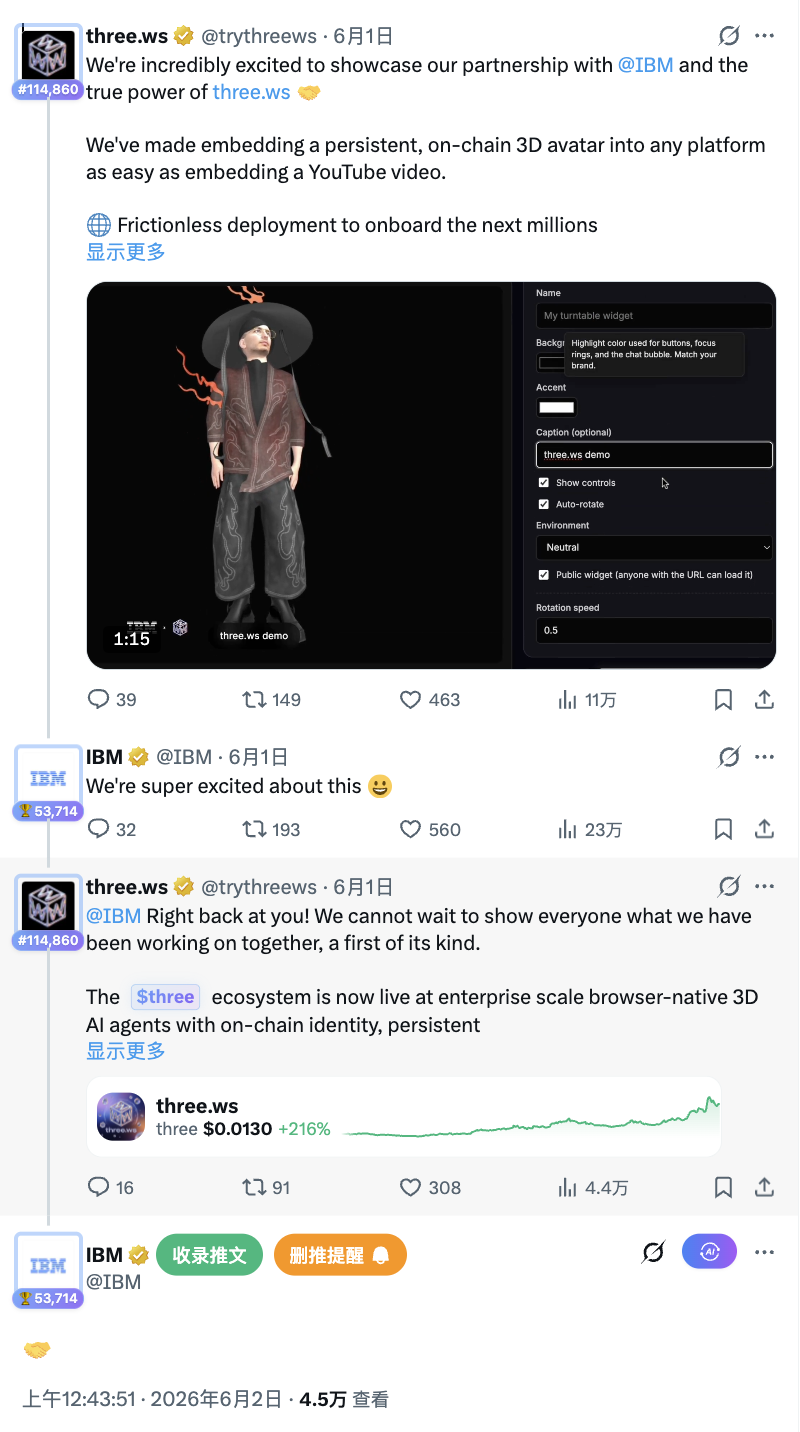


It is evident that this was not a sustained rally starting from the token's issuance. three was launched on the Solana chain as early as late April, with the main price increase concentrated around the time of IBM's public responses and the collaboration announcement.


However, understanding three.ws solely as a Solana AI project backed by an IBM collaboration overlooks the real problem it aims to solve: most AI Agents still reside within chatboxes and background programs, invisible to users and difficult to identify, own, or invoke across different websites, devices, and on-chain environments.


three.ws hopes to equip AI Agents with a body, memory, identity, wallet, and distribution channels, transforming them into 3D digital characters that can appear on web pages, perform actions, and execute transactions.


Releasing AI from the Chatbox onto the Web Page


three.ws defines itself as the "3D Agent Layer" for the internet. Its founder, @nichxbt, currently has over 20,000 followers on Twitter and holds a blue verification checkmark.


The project is currently listed on the AWS Marketplace and Alibaba Cloud International Marketplace and has joined the Google Cloud for Web3 Startups program. three.ws is also included in the Anthropic official MCP Registry, is a W3C contributor, and was a participant in the Solana Frontier Hackathon.


Based on the project's existing code and documentation, three.ws's foundational capabilities include loading, inspecting, and displaying 3D models on the web client, subsequently integrated with large language models, memory, voice, skills, on-chain identity, and payment functionalities.
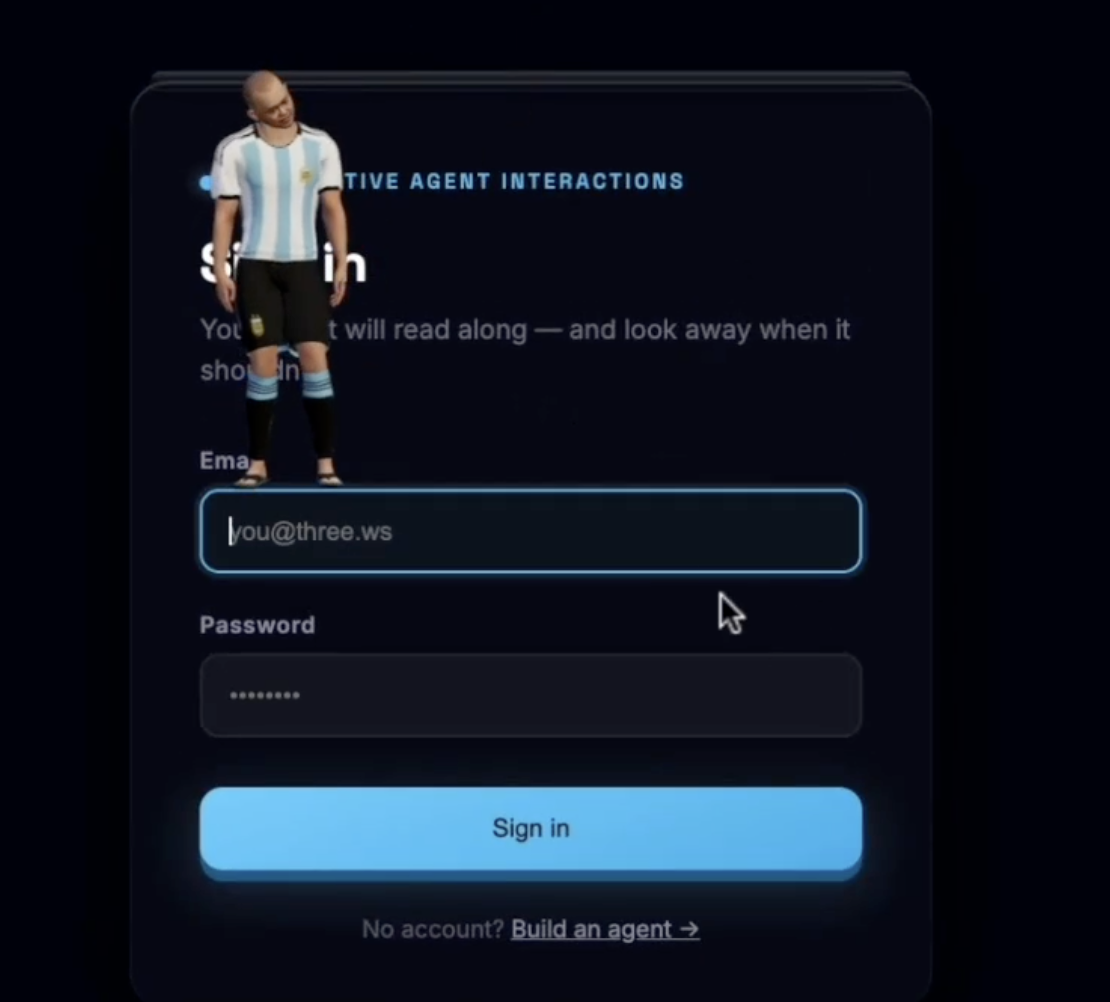

In simple terms, developers can create a 3D character on the platform, connect it to a large language model, memory system, voice, and skills, and then embed it into a website via a web component.


For example, businesses could deploy a 3D shopping guide Agent on a product page to introduce items, answer questions, and demonstrate product features through actions. Developers can also build digital customer service agents, virtual teachers, game characters, or personal AI assistants.


This process is somewhat similar to embedding a YouTube video. Developers don't need to build complex 3D pages separately; after adding the component and Agent ID, users can see and interact with the Agent in their browser.


three.ws offers multiple ways to create characters. Users can upload a selfie to generate an animatable 3D avatar in about 60 seconds; they can also generate models from text or images, upload their own GLB or glTF files, or use the character editor for creation.


Once the character is generated, developers can configure different large language models, voices, and skills for it.


three.ws also integrates on-chain capabilities for Agents. An Agent can own a Solana wallet, pay USDC for premium APIs via the x402 protocol, and register its identity as a Metaplex Core asset on Solana or via ERC-8004 on EVM chains. Here, identity and funds need to be distinguished: the on-chain identity proves who the Agent belongs to and where its profile points; the wallet is responsible for payments and executing transactions.


How Does a 3D Agent Operate?


three.ws consists of four independent technological layers that can be replaced individually. Developers can use all four layers in combination or utilize only a portion of them.
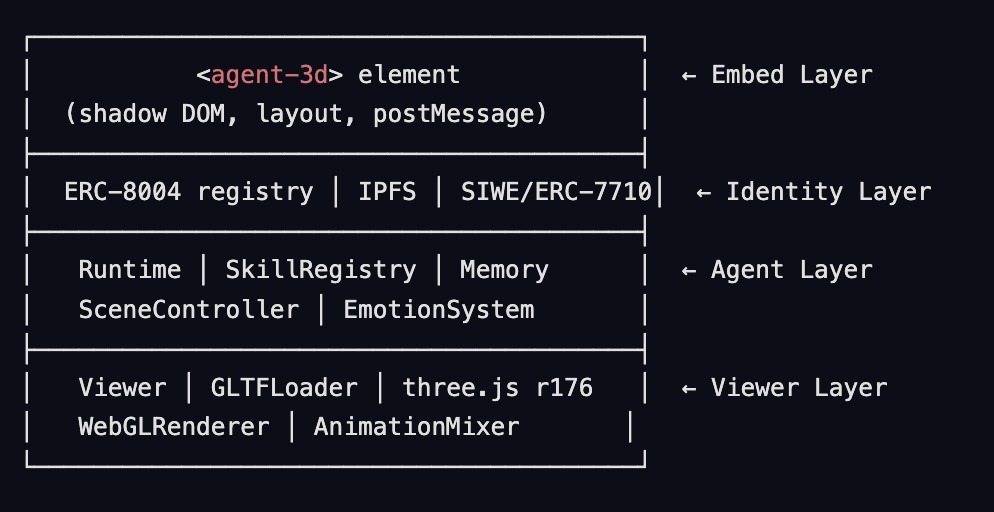


The bottom layer is the Viewer layer, also known as the rendering layer.


This layer is responsible for loading and displaying the 3D model in the browser, including lighting, camera, materials, and animations. It is built on three.js and inherently does not know if there is an AI, wallet, or on-chain identity behind the model. Therefore, even without connecting an Agent, the Viewer can function independently as a 3D model viewer.


The second layer is the Agent layer, which serves as the character's brain and behavioral system.


After receiving user input, the large language model makes judgments based on character settings, historical memory, and installed skills. If a user asks the character to wave, the model calls the corresponding tool, and the scene controller plays the waving animation; if the character needs to remember something, the memory module saves the relevant information.


This layer also includes an emotion system. The character can change expressions, gaze, and actions based on events, such as appearing happier after completing a task or showing concern when an operation fails.


The third layer is the Identity layer. This layer is an optional module.


The Identity layer ensures that the Agent maintains the same identity across different websites, devices, and sessions. The Agent's profile, memory patterns, and resource addresses can be written into a Manifest file and stored via IPFS or the platform's servers.


According to the three.ws official documentation, its Solana Agent already supports on-chain identity registration via Metaplex Core, but the ERC-8004-related on-chain reputation registration and verification registry are currently only available on the EVM side, with the verification registry still in the testnet phase.


The fourth layer is the Embedding and Distribution layer. This layer is responsible for bringing the Agent in front of users. Developers can add characters to websites, applications, and enterprise interfaces via web components, iframes, Widgets, or SDKs.


In simpler terms, the rendering layer handles the body and movements, the Agent layer provides the brain, memory, and skills, the identity layer offers an optional digital passport, and the embedding layer is responsible for deploying this character onto websites and applications.


The fee structure of three.ws should be understood from two dimensions: through which channels do users access or purchase services? And what costs are incurred after using the platform?


Regarding purchase/usage channels, one can directly subscribe, choosing a free version, Pro (US$49 per month), or an enterprise plan based on usage needs. The AWS Marketplace serves as an enterprise procurement channel.


After subscribing to three.ws, developers can use x402 to set prices for the Agent's chat, content generation, or API calls, with the caller paying per use in USDC. Platform fees are deducted from the developer's earnings: during the public beta, the platform fee for the free version is 0% (post-beta rates are not yet announced); the Pro version has a 2.9% platform fee, and enterprise plan fees are customized per agreement.


IBM Adds Enterprise Capabilities, AWS and Other Platforms Handle Distribution


For 3D AI Agent projects, creating a digital character capable of demonstrations is not difficult. The real challenge lies in integrating the product into enterprise procurement systems and meeting requirements for billing, deployment, identity verification, and AI governance.


three.ws is addressing these aspects through platforms like IBM and AWS Marketplace.


On May 27, three.ws announced becoming a member of the AWS Partner Network (APN) and subsequently launched on the AWS Marketplace. This means enterprise clients can procure three.ws services through their existing AWS accounts.


Later, three.ws published a technical article on the AWS Builder Center blog detailing its SaaS product billing solution. This solution connects AWS Marketplace's customer verification, usage metering, and subscription management with the on-chain x402 payment interface.


Regarding the IBM collaboration, three.ws plans to combine its 3D Agent technology with IBM's enterprise AI, hybrid cloud, and market channels, and integrate IBM's Granite series models for scenarios such as conversational AI, image understanding, semantic matching, market prediction, and enterprise governance.


AWS Marketplace helps three.ws enter enterprise procurement and billing systems, while IBM provides enterprise AI technology and commercial channels. Both partnerships aim towards the same goal: transforming the browser-based 3D AI Agent from an eye-catching demo into a service that enterprises can procure, deploy, and manage.


In a bear market, IBM's public response granted three.ws scarce market attention.


However, beyond the hype, the project still needs to answer more practical questions: do enterprises and developers truly need an AI Agent with a body, skills, and a digital identity, and what role will the token three ultimately play within this system.


Perguntas relacionadas

QWhat was the direct catalyst for the significant price increase of the three token, and what was the reported growth?

AThe direct catalyst was IBM's official social media responses to collaboration-related content posted by three.ws. Following this, the token's market capitalization reportedly surged from around $300,000 to a high of $16.38 million, representing a growth of approximately 53 times (or 50-fold).

QAccording to the article, what is the core problem that three.ws aims to solve, beyond just being an AI project with IBM backing?

AThe core problem three.ws aims to solve is that most AI Agents are currently confined to chat windows and backend programs, making them invisible to users and difficult to identify, own, or invoke across different websites, devices, and blockchain environments. It seeks to equip AI Agents with a body, memory, identity, wallet, and distribution channels to become interactive 3D digital characters.

QHow does the three.ws platform allow developers to integrate a 3D AI Agent into a website?

ADevelopers can integrate a 3D AI Agent by creating a character on the three.ws platform, connecting it to an LLM, memory system, voice, and skills, and then embedding it into a website using a simple web component (like ``). This process is likened to embedding a YouTube video, requiring only the component and an Agent ID.

QWhat are the four independent technical layers that constitute the three.ws system, and what is the primary function of the 'Viewer' layer?

AThe four layers are: 1) Viewer Layer (rendering), 2) Agent Layer (brain/behavior), 3) Identity Layer (optional), and 4) Embedding & Distribution Layer. The primary function of the Viewer layer is to load and display 3D models in a browser, handling lighting, camera, materials, and animations. It is built on three.js and can function independently as a 3D model viewer.

QWhat strategic roles do the partnerships with IBM and AWS Marketplace play for three.ws, according to the article?

AThe partnership with AWS Marketplace helps three.ws enter the enterprise procurement and billing system, allowing business customers to purchase its services through their existing AWS accounts. The collaboration with IBM provides enterprise-grade AI technology (like IBM Granite models), hybrid cloud capabilities, and commercial market channels. Together, they aim to transform the 3D AI Agent from a demo into a service that enterprises can procure, deploy, and manage.

Leituras Relacionadas

Agent Race Ends, Super Workbench Takes Over

The era of fragmented AI agents is ending. Over the past month, China's tech giants—Tencent, Alibaba, and ByteDance—have simultaneously shifted strategy: instead of launching new, standalone AI agents, they are consolidating their various agent projects into unified "super workbenches." Tencent integrated its QClaw teams into WorkBuddy, a strategic product hailed as a potential third flagship after QQ and WeChat. Alibaba is merging its QoderWork, Wukong, and MuleRun agents into a new "Qianwen Office" platform under DingTalk's leadership. ByteDance rebranded its TRAE SOLO coding agent to TRAE Work, signaling a broader focus on workflow collaboration. This convergence marks a pivotal industry consensus. The initial exploration phase, where companies rapidly built numerous overlapping agents for different scenarios, proved costly and inefficient. With open-source tools eroding technical barriers, competition has shifted from agent creation to resource consolidation and cost control. Historically, platform wars are won not by creating more products, but by simplifying them—as seen with browsers unifying web access and super-apps consolidating services. Now, the "super workbench" aims to become the unified AI entry point for work. This reflects a deeper market realization: the primary audience for AI is no longer just programmers (a market in the tens of millions) but all knowledge workers (a market of billions). The real opportunity lies in augmenting everyday tasks—managing emails, documents, data, and meetings—across the entire workday. The core battleground is becoming control over the primary AI entry point that employees use daily. Tencent's WorkBuddy leverages WeChat and Tencent Docs; Alibaba's Qianwen Office taps into DingTalk's organizational data; ByteDance's TRAE Work integrates with Feishu's workflows. Whoever owns this "super workbench" gains strategic control over orchestrating enterprise data and APIs. This shift is redefining enterprise software. Traditional SaaS applications, valued for their user interfaces, will recede into the background. Their core functionalities will be exposed as standardized "Skills" or APIs for the super workbench's agents to invoke. Software value will shift from selling user seats to charging based on API calls and outcomes delivered. The evolution of agents is moving through clear stages: first as novel standalone products, then as consolidated primary work entry points, and finally as pervasive, invisible capabilities embedded into the digital fabric. The recent moves by major tech firms signal the transition from the first stage into the second, accelerating toward the third. In the end, the most successful agent technology may become invisible—like electricity or the HTTP protocol—a fundamental, unnamed infrastructure powering work itself.

marsbitHá 10m

Agent Race Ends, Super Workbench Takes Over

marsbitHá 10m

Michael Saylor: 110 Reasons to Oppose BIP-110

Michael Saylor presents 110 arguments against Bitcoin Improvement Proposal (BIP) 110, a soft fork aimed at restricting certain non-monetary data storage uses (like inscriptions) on the Bitcoin blockchain. He acknowledges the proponents' valid concerns—such as node costs, fee pressure, and preserving Bitcoin's monetary focus—but fundamentally disagrees with the proposed solution. Saylor argues that BIP 110 represents a dangerous precedent of using consensus rules to enforce value judgments on transaction validity, moving away from Bitcoin's core principles of neutrality and permissionless innovation. His key objections are organized into eleven categories: 1) It violates neutrality and hard consensus by banning currently valid transactions. 2) It fails to meet the high burden of proof required for a consensus change, lacking concrete data on the alleged crisis. 3) Its seven bundled technical restrictions are overly broad, targeting generic script functionalities and blocking future upgrade paths. 4) It sacrifices compatibility and future optionality by closing off designed upgrade hooks. 5) Its temporary rules add significant complexity (grandfathering, expiry states) without sufficient justification. 6) The economic and security impacts, particularly on miner revenue and fee markets, are uncertain and unmodeled. 7) Superior, market-based tools (fee markets, relay/mining policies) already exist to manage blockchain load. 8) It stifles innovation by creating a chilling effect for developers. 9) Its modified activation mechanism (55% threshold, forced signaling) is aggressive and risks network splits. 10) The precedent it sets—using consensus to suppress disliked but legal uses—is more dangerous than the problem it aims to solve. 11) A better path exists: improving measurements, refining resource-based policies, and allowing market forces to work. Saylor concludes that Bitcoin's strength lies in its neutral rules, open markets, and hard consensus. Changing these foundational elements to target specific use cases is an unnecessary and risky "iatrogenic" intervention. He advocates for guarding Bitcoin's neutrality rather than acting as its redeemer.

marsbitHá 25m

Michael Saylor: 110 Reasons to Oppose BIP-110

marsbitHá 25m

Trading

Spot
活动图片

