
After AAVE Was Hit, What Did Spark Do Right to Attract $1.3 Billion Against the Trend?

marsbitPublicado em 2026-04-22Última atualização em 2026-04-22

Resumo

Amid a $15.1 billion liquidity crisis at Aave triggered by a cross-chain vulnerability involving rsETH, which led to $200 million in bad debt, Spark Protocol emerged as a safe haven, attracting $1.3 billion in inflows. Spark’s TVL surged to $4.74 billion, with ETH deposit rates spiking to 130% due to high demand and scarce liquidity. Spark’s resilience stemmed from its conservative governance and multi-layered risk framework. Unlike Aave, which aggressively listed rsETH to boost capital efficiency, Spark had proactively delisted the asset months earlier, avoiding exposure. The protocol employs strict rate-limited caps, higher interest rate buffers, and a modular isolation architecture to mitigate risks. These measures prevent over-concentration, ensure liquidity during stress, and attract arbitrage capital during high utilization. The shift from Aave to Spark signals a market preference for security over yield, underscoring the importance of disciplined risk management in DeFi.

Author: Jae, PANews

When Aave faced a massive withdrawal of hundreds of billions of dollars, Spark caught the overflowing liquidity.

The on-chain disaster triggered by cross-chain vulnerabilities in Kelp DAO and LayzerZero split the DeFi lending market into two distinct worlds.

The influx of "toxic" asset rsETH into Aave resulted in approximately $200 million in bad debt, causing a complete liquidity drain and a panicked exodus of hundreds of billions in funds.

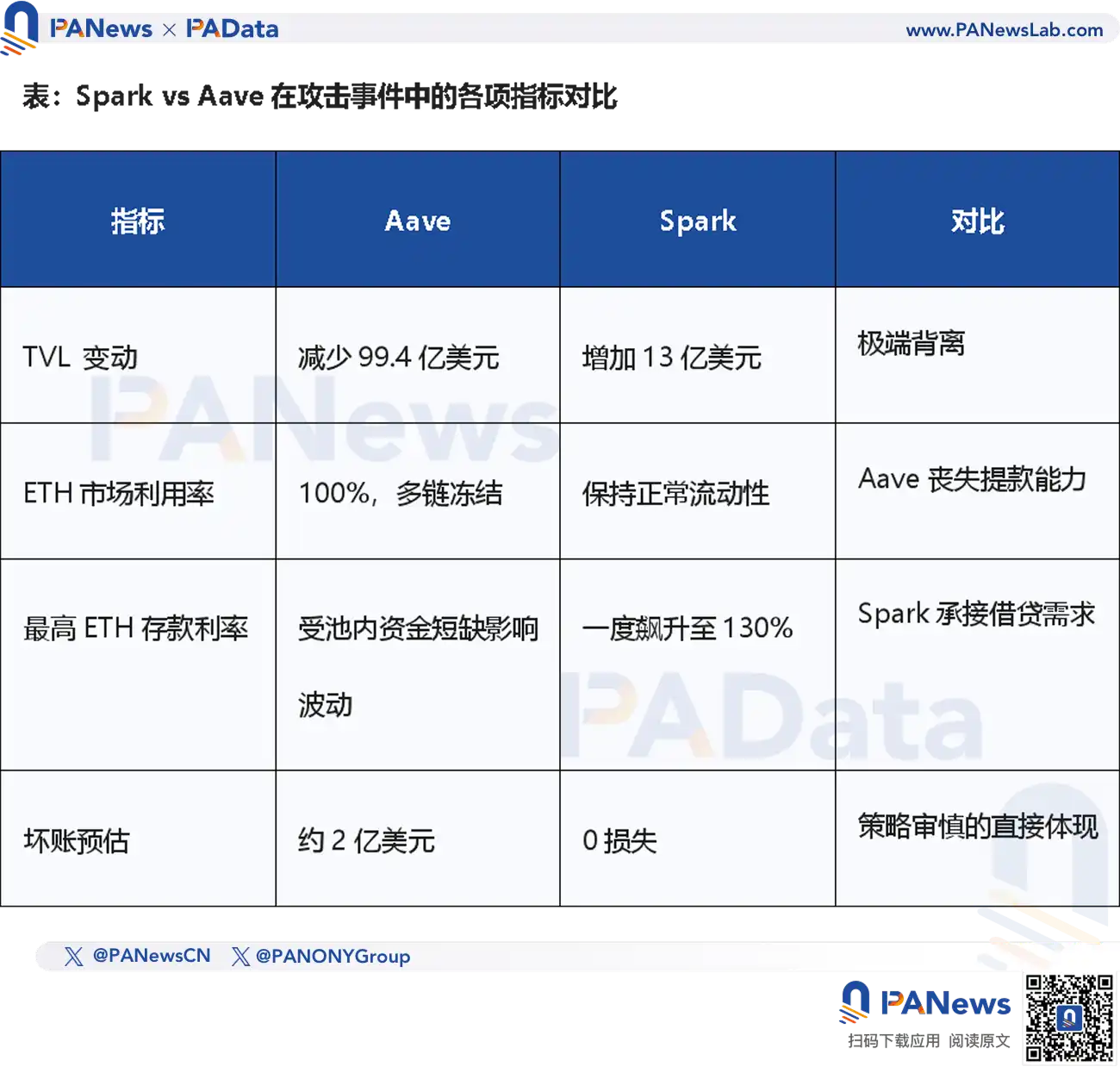
However, amid the widespread fear, another lending protocol giant, Spark, had its moment of glory. Its TVL (Total Value Locked) rapidly increased by $1.3 billion, and the ETH deposit rate once surged to 130%, making it the safe harbor of choice for whales transferring assets.

A black swan event has revalidated the true ruler of the DeFi iron throne.

Aave's Bloodbath of a Bank Run, Spark Seizes the Opportunity to Attract $1.3 Billion

The breach of rsETH's cross-chain bridge effectively pressed the pause button on Aave's entire lending market.

Hackers used fraudulently minted rsETH as collateral on Aave to borrow large amounts of WETH, draining the pool of clean assets and leaving behind a pool of bad debt.

Related reading: KelpDAO Cross-Chain Explosion, AAVE Becomes the "Patsy," Industry Calls for Risk Repricing

Panic spread like a virus: Over the past three and a half days, $151 billion has fled Aave, with total deposits dropping from $485 billion to $307 billion—about one-third of the funds have exited; WETH utilization rates on multiple chains hit 100% directly; depositors couldn't withdraw, and liquidators had no funds to borrow.

The most notable move came from Justin Sun, who quickly withdrew 65,584 ETH from Aave, worth approximately $154 million.

This "withdraw first" behavior created a herd effect in the market. For investors, no annualized yield could offset the panic of being unable to withdraw their principal.

Just as Aave became the hackers' liquidity exit, Spark became the users' escape route.

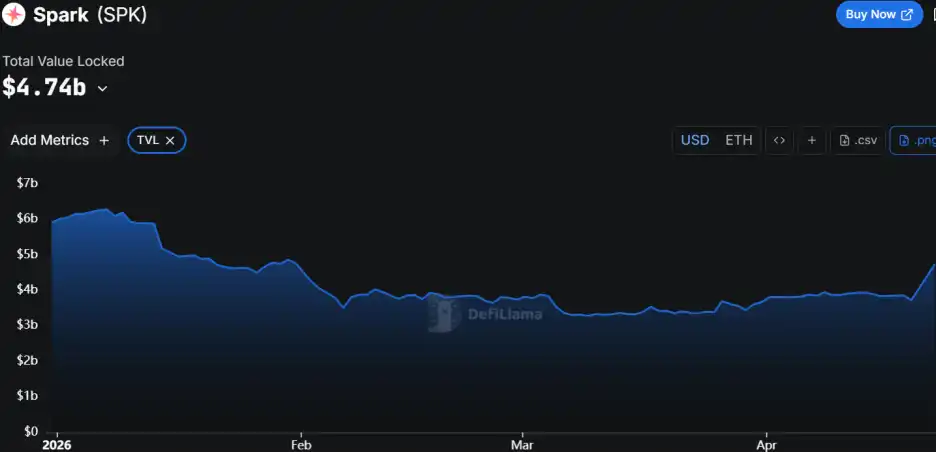
Spark's TVL反而 increased by $1.3 billion, with its total scale reaching $4.74 billion. This money is a vote of confidence cast by the market with real capital.
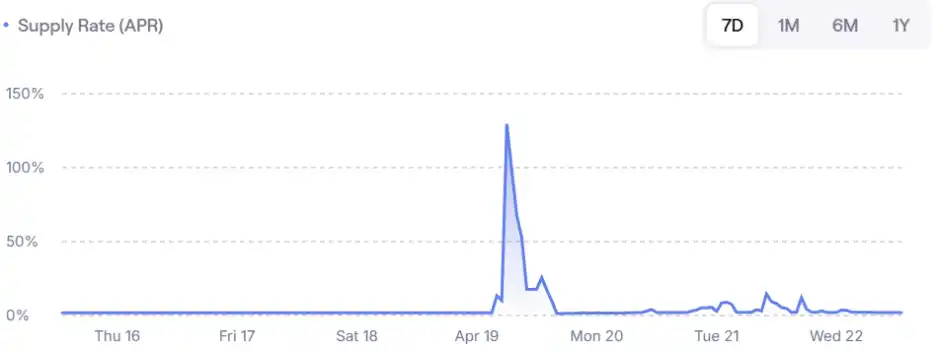
Due to the massive influx of borrowing demand into Spark, coupled with highly scarce liquidity, Spark's ETH deposit rate experienced a spectacular surge, once reaching an annualized level of 130%. This directly reflects the extremely high premium for safe assets.
Spark's ability to meet this demand is thanks to its unique ecosystem structure. Unlike Aave, it is the lending engine of the Sky ecosystem, backed by the vast USDS reserves. As Sky's liquidity outpost, Spark not only relies on external deposits but can also directly obtain stablecoin supplies through Sky's credit lines.

This "central bank-level" liquidity backing allows it to keep withdrawal channels open even during market turmoil.
Abandoning TVL Vanity, Spark Defies Trend to Delist rsETH

Spark avoided the rsETH pitfall due to a counter-trend decision made three months ago.

Same day, different fate. On January 29th, the two major lending platforms took opposite approaches in handling Liquid Restaking Tokens (LRTs).

Aave went full throttle. The protocol officially launched rsETH E-Mode, allowing users to conduct leveraged borrowing with a high collateral ratio (LTV) of 93%. Aave's goal was to attract an anticipated $1 billion inflow of rsETH, restore WETH utilization, and boost TVL and revenue.

Spark prudently retreated. The protocol passed a governance Spell to completely halt new supply of rsETH and gradually remove it from the asset list.

This move by Spark caused strong dissatisfaction among ETH循环杠杆 users, who often use repeated抵押 of stETH or rsETH and similar staking assets to arbitrage interest rate differentials. Spark's delisting forced them to migrate their positions, with most flowing to Aave, which had more lenient policies and lower interest rates.

At the time, the community questioned Spark's team for being "too conservative" or "abandoning growth." No one expected that this step might have saved the entire protocol later.

After the fact, Spark's Strategy Lead, monetsupply.eth, pointed out in a review that the decision to delist rsETH was based on a security-oriented tightening mechanism.

  1. Marginal Cost vs. Marginal Benefit: If the cost of maintaining a certain asset exceeds its risk-adjusted return to the protocol, such assets will be purged;
  2. Risk Exposure: rsETH had extremely low utilization on Spark, almost monopolized by the same wallet address, making risk difficult to disperse;
  3. User Preference Research: The sole whale user of rsETH expressed a willingness to actively migrate to more mature collateral like wstETH or weETH, providing an opportunity for the protocol to smoothly clean up the asset.

It was this decision-making discipline and transparency, which "does not blindly pursue TVL," that allowed Spark to avoid all potential losses that could have been caused by hackers exploiting rsETH.

Multi-Layered Risk Control System: Rate Limits + Interest Rate Buffer + Isolated Architecture

PANews believes that even if rsETH had not been delisted, Spark's architecture would have been sufficient to withstand such risks. Compared to Aave's pursuit of capital efficiency at the expense of safety redundancy, Spark has established a multi-tiered, in-depth defense system.

Spark implements strict deposit and borrowing rate limits (Rate-Limited Caps), meaning the amount of funds that can be deposited and borrowed within a fixed time increases gradually. Even if rsETH were still listed, an attacker could not deposit $290 million in collateral all at once as they did on Aave. This design forcibly limits the maximum risk exposure scale of a single event, hard-capping losses within an acceptable range.

Spark has long maintained relatively high interest rate ceilings. Under stable market conditions, higher borrowing rates, while deterring over-borrowing (if it's expensive to borrow, people borrow less), on the other hand attract more people to deposit (depositors earn more). The result is that the pool always retains liquidity, avoiding a situation where funds are "all borrowed out," preventing people from being unable to withdraw their money. Especially during market crashes, it avoids bank runs due to liquidity枯竭.

When pool utilization rises, Spark's interest rate curve slope becomes steeper than Aave's, which has two significant consequences:

  • Forced Deleveraging: High interest costs force borrowers to actively seek liquidity to repay loans.

  • Attracting Supplementary Liquidity: High deposit APY quickly attracts external arbitrage capital, thus resolving the deadlock of 100% utilization.

Spark's modular isolated architecture offers strong controllability in risk management. When handling high-risk synthetic assets like USDe, Spark has also adopted a prudent approach, isolating them in specific primary risk pools. This ensures that even if a specific asset encounters problems, it will not affect the main lending pools on the platform.
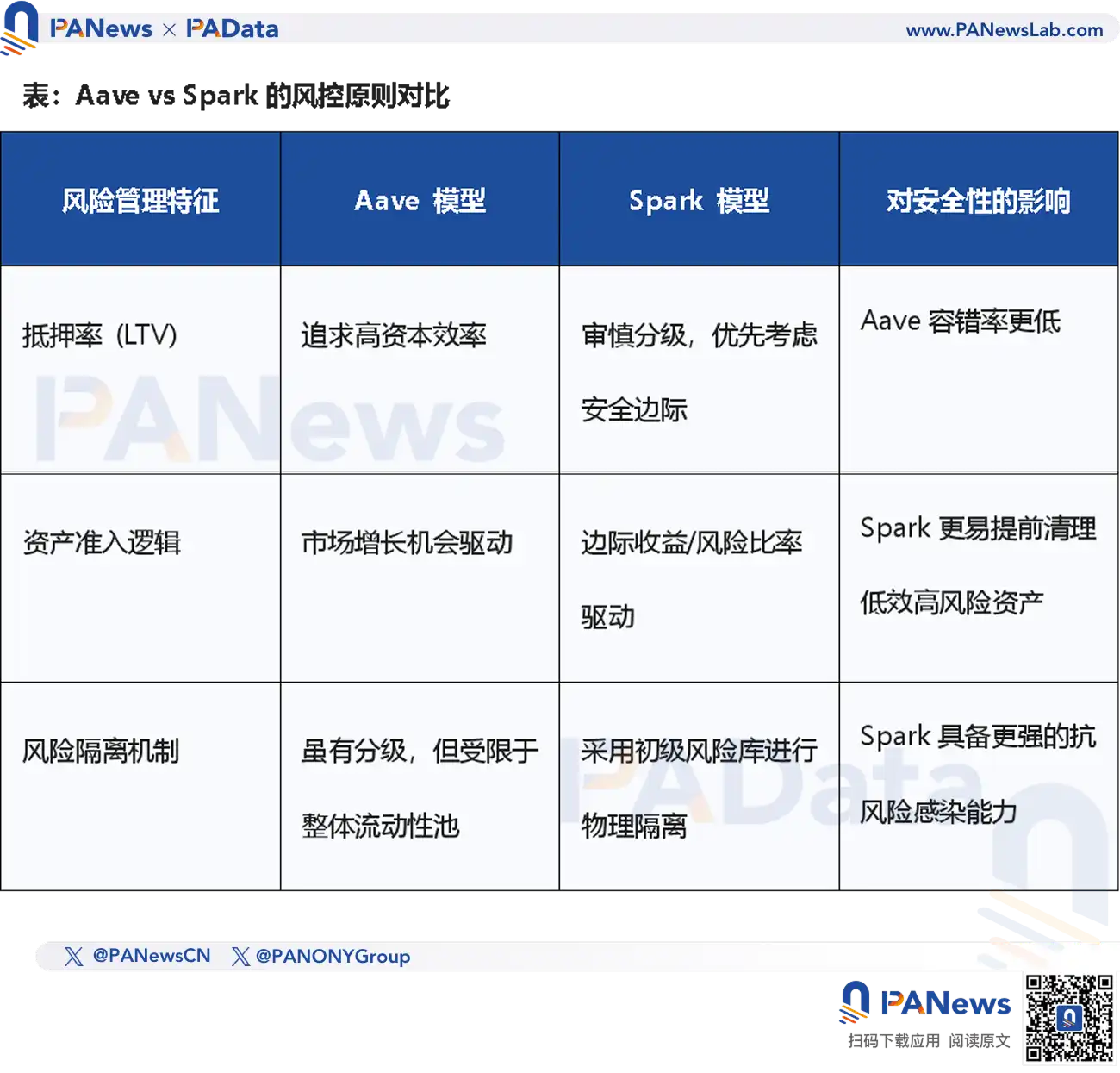
The great liquidity migration from Aave to Spark signifies a shift in risk preference from yield chasing to safety and stability.

Aave's hundred-billion-dollar outflow is a wake-up call for all protocols pursuing high capital efficiency. When safety margins are sacrificed, any minor external关联 risk can evolve into a global crisis for the protocol.

Spark's rise proves that in an uncertain market environment, prudent risk governance decisions and the implementation of a "risk-first" strategy are the moats with greater long-term value.


Criptomoedas em alta

Perguntas relacionadas

QWhat was the main reason behind Spark's significant increase in TVL (Total Value Locked) during the Aave crisis?

ASpark's TVL increased by $1.3 billion because it was perceived as a safe haven for users fleeing the rsETH-related instability on Aave. Its unique ecosystem, backed by the substantial USDS reserves of the Sky ecosystem, provided a reliable liquidity backstop, ensuring withdrawal channels remained open during the market turmoil.

QHow did Spark's decision regarding rsETH months before the incident contribute to its stability?

AThree months prior to the incident, Spark made a proactive governance decision to halt new supplies of rsETH and gradually remove it from its asset list. This risk-averse move, based on a cost-benefit analysis, low utilization, and concentrated risk exposure, prevented Spark protocol from being exposed to the rsETH exploit that caused significant bad debt on Aave.

QWhat are the key risk management features of its protocol that the article highlights as reasons for Spark's resilience?

AThe article highlights Spark's multi-layered risk management system, which includes strict Rate-Limited Caps to restrict large, sudden deposits/borrows, a higher interest rate curve that discourages over-leverage and attracts liquidity during stress, and a modular, isolated architecture that contains problems from risky assets in separate silos to protect the main lending pools.

QWhat specific event triggered the massive withdrawal of funds from Aave and the subsequent liquidity crisis?

AThe specific event was a cross-chain bridge exploit involving Kelp DAO's rsETH. A hacker used fraudulently minted rsETH as collateral on Aave to borrow a large amount of WETH, draining the pool of 'clean' assets and leaving behind approximately $200 million in bad debt, which triggered panic and a bank run.

QWhat does the shift of liquidity from Aave to Spark signify in terms of market risk preference according to the article?

AThe shift signifies a change in market risk preference from pursuing high capital efficiency to prioritizing safety and stability. It served as a warning to protocols that sacrifice security margins for efficiency, demonstrating that prudent risk governance and a 'risk-first' strategy are more valuable long-term moats in an uncertain market environment.

Leituras Relacionadas

Podcast Notes | Conversation with GSR Asset Management Head: To Determine if This Crypto Rally is Real, Just Watch the Lending Rates on Aave

Podcast Summary: Dialogue with GSR's Head of Asset Management: To Determine if This Crypto Rally is Real, Just Check Lending Rates on Aave Andy Baehr, Managing Director of Asset Management at GSR, discusses the current crypto market, characterizing it as stuck in a state of "ambivalence" with short-lived, unsustainable rallies. He outlines a simple framework: the market moves between "ambivalence" and "conviction" (sustained upward momentum). Currently, every rally resembles a single-stage rocket booster that quickly fizzles out. Baehr identifies three key signals to watch: 1) DeFi lending rates, 2) the potential passage of the CLARITY Act, and 3) the market forming a consensus on the "Fed hawkish peak." He emphasizes that the most immediate indicator for the sustainability of the recent CPI-triggered rally is the USDC borrowing rate on Aave, currently around 3.75%—close to U.S. Treasury yields. The absence of a credit spread indicates low leverage demand and a lack of market energy. He explains that a healthy, sustained rally requires layered buying pressure. Last year's rally progressed from an ETH short squeeze to crypto-native trader influx and finally to ETF inflows. Currently, this structure is missing. Other potential structural buyers like Digital Asset Treasury (DAT) companies are absent, and ETF flows have proven transient. Baehr notes that while small-cap crypto tokens outperformed large caps in Q2—a potential sign of capitation in major assets—capital is also flowing to more exciting opportunities like AI stocks and tech IPOs, leaving crypto sidelined. Regarding DeFi, he highlights that platforms like Aave provide a clear, real-time signal of leverage demand through their supply/demand-driven interest rates. A significant, sustained rate increase would signal genuine market conviction. He also observes the quiet emergence of fixed-income-like products and vaults in DeFi. On regulation, the probability of the CLARITY Act passing before the August 7th deadline has dropped linearly from 75% to below 40% on Polymarket. Baehr suggests its passage would be treated as a bullish surprise, a potent driver for price movement. However, political hurdles, including ethical clause debates and disclosures about the First Family's crypto profits, remain significant obstacles. Ultimately, the market awaits clarity on the Fed's terminal rate under Chair Warsh. Until the "Fed Solstice"—the point where the market collectively understands the peak of hawkish policy—sustained conviction will be difficult to achieve.

marsbitHá 33m

Podcast Notes | Conversation with GSR Asset Management Head: To Determine if This Crypto Rally is Real, Just Watch the Lending Rates on Aave

marsbitHá 33m

7 Months After the Collapse of Huiwang, Southeast Asia's Escrow Platforms Undergo a Major Reshuffle

Following the collapse of Huione Pay—dubbed the "Alipay of Southeast Asia"—seven months ago, the region's underground financial guarantee platform sector is undergoing a significant reshuffle. This power vacuum has been swiftly filled by emerging platforms such as XinBi, Tiger/Navigator, JinBei (renamed JinBo), Dali/Tiancheng, and FullyLight. These platforms, operating largely via Telegram and offering services like escrow for illicit transactions, have absorbed the vast user base and markets left behind by Huione. While positioning themselves as "trust intermediaries," their primary clientele consists of networks involved in online scams, money laundering, illegal gambling, and even human trafficking. For instance, the Tiger/Navigator platform explicitly provides "escrow" services for kidnapping-for-ransom operations ("强押车交易"). Data underscores the immense scale: Huione alone processed over $103 billion in cryptocurrency payments and facilitated over $31 billion through its escrow market before its downfall, linking it to Cambodia's notorious Prince Group. Since its collapse, competitors have seen explosive growth. For example, the XinBi platform has accumulated over $1.6 billion in total USDT revenue, while platforms like NewPay, OkPay (under Dali), and FullyLight Wallet collectively processed over $4.8 billion in USDT in a single year. This ecosystem thrives in regions like Cambodia and Myanmar, where regulatory gaps allow these platforms to act as critical financial infrastructure for sprawling cybercrime industries, from scam compounds to online casinos. The article concludes that the moniker "Southeast Asian Alipay" is a misnomer, obscuring the platforms' fundamental role in enabling serious criminal enterprises rather than representing legitimate financial innovation.

Odaily星球日报Há 1h

7 Months After the Collapse of Huiwang, Southeast Asia's Escrow Platforms Undergo a Major Reshuffle

Odaily星球日报Há 1h

Trading

Spot

Artigos em Destaque

Como comprar AAVE

Bem-vindo à HTX.com!Tornámos a compra de Aave Protocol (AAVE) simples e conveniente.Segue o nosso guia passo a passo para iniciar a tua jornada no mundo das criptos.Passo 1: cria a tua conta HTXUtiliza o teu e-mail ou número de telefone para te inscreveres numa conta gratuita na HTX.Desfruta de um processo de inscrição sem complicações e desbloqueia todas as funcionalidades.Obter a minha contaPasso 2: vai para Comprar Cripto e escolhe o teu método de pagamentoCartão de crédito/débito: usa o teu visa ou mastercard para comprar Aave Protocol (AAVE) instantaneamente.Saldo: usa os fundos da tua conta HTX para transacionar sem problemas.Terceiros: adicionamos métodos de pagamento populares, como Google Pay e Apple Pay, para aumentar a conveniência.P2P: transaciona diretamente com outros utilizadores na HTX.Mercado de balcão (OTC): oferecemos serviços personalizados e taxas de câmbio competitivas para os traders.Passo 3: armazena teu Aave Protocol (AAVE)Depois de comprar o teu Aave Protocol (AAVE), armazena-o na tua conta HTX.Alternativamente, podes enviá-lo para outro lugar através de transferência blockchain ou usá-lo para transacionar outras criptomoedas.Passo 4: transaciona Aave Protocol (AAVE)Transaciona facilmente Aave Protocol (AAVE) no mercado à vista da HTX.Acede simplesmente à tua conta, seleciona o teu par de trading, executa as tuas transações e monitoriza em tempo real.Oferecemos uma experiência de fácil utilização tanto para principiantes como para traders experientes.

442 Visualizações TotaisPublicado em {updateTime}Atualizado em 2026.06.02

Como comprar AAVE

Discussões

Bem-vindo à Comunidade HTX. Aqui, pode manter-se informado sobre os mais recentes desenvolvimentos da plataforma e obter acesso a análises profissionais de mercado. As opiniões dos utilizadores sobre o preço de AAVE (AAVE) são apresentadas abaixo.

活动图片












