After a Valuation of $1 Billion and Five Years of Exploration, Why Did It 'Admit Defeat'?

深潮Publicado em 2025-12-09Última atualização em 2025-12-09

Resumo

After five years of development and raising $180 million at a near $1 billion valuation, Farcaster has officially conceded that its Web3 social strategy did not succeed. The platform, initially designed as a decentralized alternative to Twitter, aimed to address issues like platform monopoly, user data ownership, and creator monetization through an on-chain, protocol-based approach. Despite a brief surge in early 2024—when monthly active users (MAU) peaked at around 80,000—growth quickly stalled. MAU has since declined to under 20,000 by late 2025. Farcaster’s user base remained heavily concentrated within the crypto-native community, failing to attract mainstream users due to high barriers to entry, niche content, and inferior user experience compared to established platforms like X or Instagram. Co-founder Dan Romero announced a strategic pivot from social-first to a wallet-focused product, acknowledging that social alone wasn’t driving sustainable growth. Internal data showed that wallet features—used for transactions, trading, and interacting with dApps—consistently outperformed social modules in user retention and frequency. The shift reflects a broader realization: It’s easier to add social features to a wallet than to build a social product around crypto. While the move has sparked some community discontent, Farcaster is betting that deeper integration with on-chain utilities represents a more viable path to product-market fit.

Written by: Bootly

After five years of operation, raising approximately $180 million in total funding, and reaching a valuation once nearing $1 billion, Farcaster has officially admitted: the path of Web3 social has not succeeded.
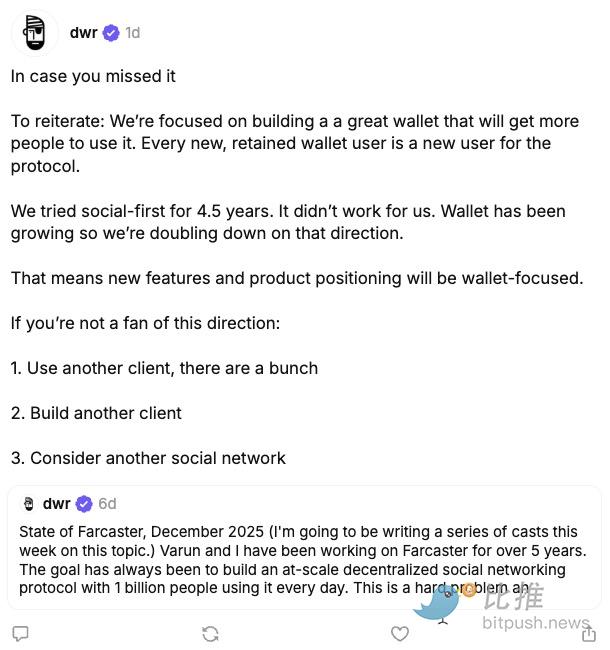
Recently, Farcaster co-founder Dan Romero posted a series of messages on the platform, announcing that the team will abandon the "social-first" product strategy and instead fully focus on the wallet direction. In his words, this is not an active upgrade but a choice forced by reality after a long period of attempts.

"We tried social-first for 4.5 years, and it didn't work."

This judgment not only signifies Farcaster's transformation but also once again highlights the structural challenges of Web3 social.

The Gap Between Ideal and Reality: Why Farcaster Failed to Become the 'Decentralized Twitter'

Farcaster was born in 2020, during the rise of the Web3 narrative. It attempted to solve three core problems of Web2 social platforms:

  • Platform monopoly and censorship

  • User data not belonging to users themselves

  • Creators unable to monetize directly

Its design approach was highly idealistic:

  • Decentralized protocol layer

  • Freedom to build clients

  • Social relationships on-chain and migratable

Among the various "decentralized social" projects, Farcaster was once considered the product closest to PMF. Especially after Warpcast gained traction in 2023, many KOLs from Crypto Twitter joined, making it seem like the prototype of the next-generation social network.

But problems soon emerged.

According to Farcaster's monthly active user (MAU) statistics on Dune Analytics, Farcaster's user growth trajectory shows a very clear but not optimistic pattern:
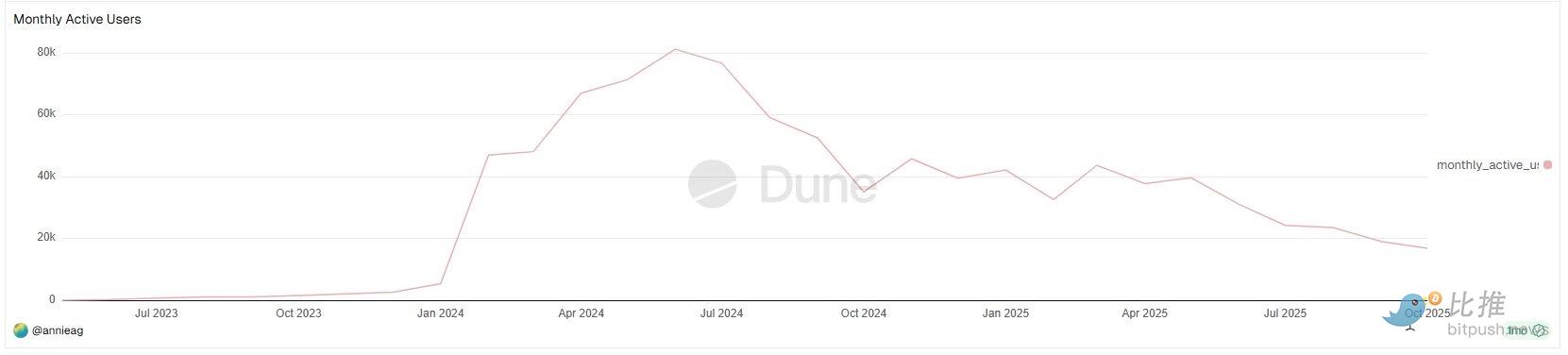
For most of 2023, Farcaster's monthly active users were almost negligible;

The real growth inflection point occurred in early 2024, with MAU rapidly increasing from a few thousand to about 40,000–50,000 in a short time, and even approaching 80,000 by mid-2024.

This was Farcaster's only truly scalable growth window since its inception. It is particularly noteworthy that this growth did not occur during a bear market but during a period of high activity in the Base ecosystem and the emergence of dense SocialFi narratives.

However, this window did not last long.

Starting in the second half of 2024, monthly active data showed a clear decline, and over the following year, it exhibited a volatile downward trend:

  • MAU rebounded multiple times, but the peaks continued to lower

  • By the second half of 2025, monthly active users had fallen to less than 20,000

In fact, Farcaster's growth has always been unable to "break through," with its user structure highly homogeneous:

  • Crypto practitioners

  • VCs

  • Builders

  • Crypto-native users

For ordinary users:

  • High registration barrier

  • Social content is heavily "insider-focused"

  • User experience not better than X / Instagram

This prevented Farcaster from ever forming true network effects.

DeFi KOL Ignas (@DeFiIgnas) on X bluntly stated that Farcaster "just admitted what everyone has felt for a long time":

The strength of X's (formerly Twitter) network effects is almost impossible to break head-on.

This is not a problem with the crypto narrative but a structural barrier of social products. From a product perspective, the issues with Farcaster's social side are very typical:

  • User growth has always been locked into the crypto-native crowd

  • Content is highly insular and difficult to spill over

  • Creator monetization and user retention did not form a positive feedback loop

This is why Ignas succinctly summarized Farcaster's new strategy in one sentence:

"It's easier to add social to a wallet than to add a wallet to a social product."

This judgment essentially admits that "social is not the first-order need of Web3."

"The Bubble Is Comfortable, but the Numbers Are Cold"

If MAU data answers "how Farcaster performed," then another question is: How big is this market itself?

Crypto creator Wiimee provided a set of striking comparative data on X.
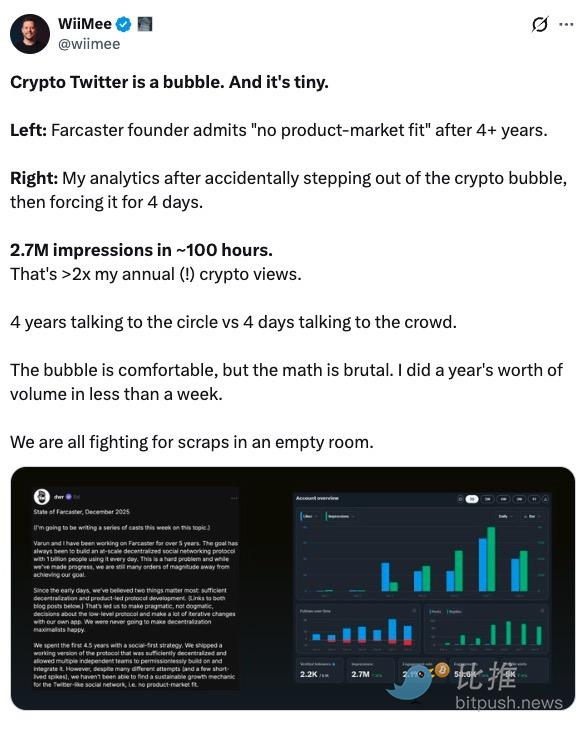
After "accidentally stepping out of the crypto content circle," Wiimee created content for a general audience for four consecutive days. His analysis data showed that in about 100 hours, he received 2.7 million impressions, more than double the total views of all his crypto content over a year.

He stated:

"Crypto Twitter is a bubble, and it's small. Four years of speaking to insiders is less effective than four days of speaking to the masses."

This is not a direct criticism of Farcaster but reveals a more fundamental problem:

Crypto social itself is a highly self-referential ecosystem with weak spillover capabilities. When content, relationships, and attention are all confined to the same batch of users, even the most refined protocol design cannot break through the upper limit of market scale.

This means Farcaster faced not "the product isn't good enough" but "there aren't enough people in the field."

Wallet, on the Other Hand, Achieved PMF

What truly changed Farcaster's internal judgment was not a reflection on social but the unexpected validation of the wallet.

Earlier in 2024, Farcaster introduced a built-in wallet in its application, initially intended only as a supplement to the social experience. But from usage data, the wallet's growth slope, frequency of use, and retention performance were significantly different from the social module.

Dan Romero emphasized in a public response:

"Every new and retained wallet user is a new user for the protocol."

This statement itself reveals the logical core of the strategic shift. The wallet addresses not "the desire to express" but real, rigid on-chain behavioral needs: transfers, transactions, signatures, and interactions with new applications.

In October, Farcaster acquired Clanker, an AI Agent-driven token issuance tool, and gradually integrated it into the wallet system. This move was also seen as the team's clear bet on the "wallet-first" path.

From a business perspective, this direction has clear advantages:

  • Higher frequency of use

  • Clearer monetization path

  • Tighter integration with the on-chain ecosystem

In contrast, social seems more like a nice-to-have rather than an engine for growth.

Although the wallet strategy is justified by the data, community controversy has also followed.

Several long-term users explicitly stated that they are not opposed to the wallet itself but are uncomfortable with the cultural shift that comes with it: from "users" being redefined as "traders," from "co-builders" being labeled as "old guard."

This exposes a practical problem: when a product direction changes, community sentiment is often harder to migrate than the roadmap. Farcaster's protocol layer remains decentralized, but the choice of product direction is still concentrated in the hands of the team. This tension is amplified during transformation.

Romero later admitted that there were communication issues but made it clear that the team had made its choice.
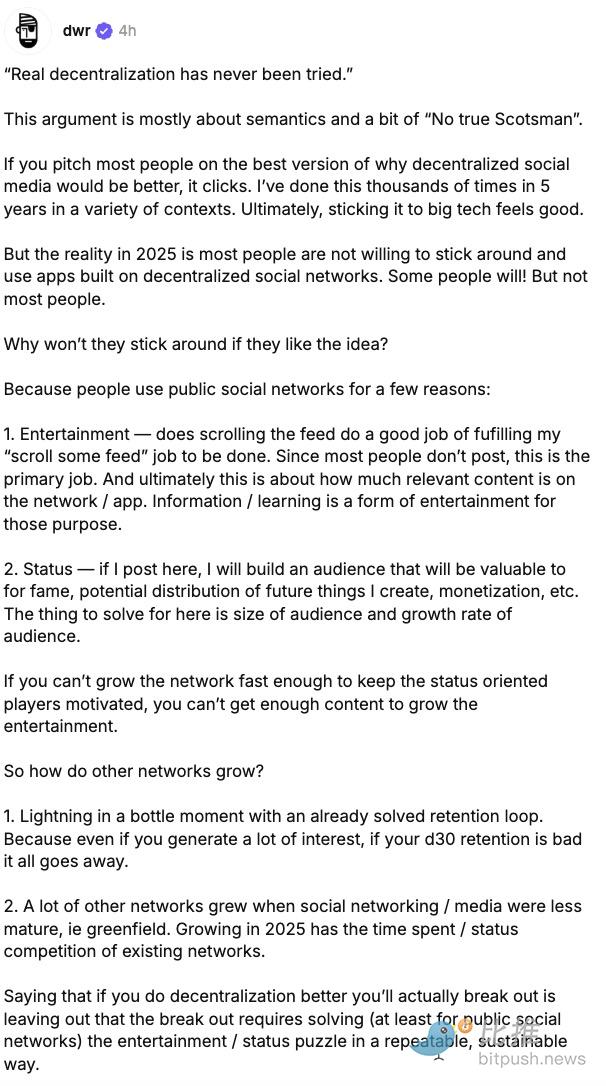
This is not arrogance but a common decisive reality for startup projects in the later stages of their lifecycle. In this sense, Farcaster did not abandon the social ideal but gave up the illusion of its scalability.

As one observer perhaps put it best:

"First, let users stay for the tools; then there is space for social to exist."

Farcaster's choice may not be the most romantic, but it might be the one closest to reality. Deeply integrating native financial tools (wallets, transactions, issuance) is the practical path to converting into sustainable commercial value.

Criptomoedas em alta

Perguntas relacionadas

QWhy did Farcaster decide to pivot from a social-first strategy to a wallet-focused approach?

AFarcaster shifted its strategy because after 4.5 years of focusing on social, it did not achieve product-market fit. The social approach failed to scale beyond the crypto-native user base, while the wallet feature demonstrated stronger growth, retention, and clearer monetization paths.

QWhat were the main challenges Farcaster faced in trying to build a decentralized social platform?

AFarcaster struggled with high user onboarding barriers, highly insular crypto-focused content, inability to break out of the crypto echo chamber, and failure to form genuine network effects competitive with platforms like X (Twitter) or Instagram.

QHow did Farcaster's user growth trend reflect its struggles in social?

AFarcaster's monthly active users (MAU) saw a brief surge to around 80,000 in mid-2024 but quickly declined, falling to under 20,000 by late 2025. Growth was confined to crypto insiders and never achieved broad adoption.

QWhat key insight did the comparison between crypto content and mainstream content exposure reveal?

AA creator's experiment showed that four days of creating content for a general audience generated 2.7 million impressions—more than double the exposure of a year's worth of crypto content—highlighting the small size and limited reach of the crypto social bubble.

QWhy is the wallet considered a more promising direction for Farcaster than social?

AThe wallet addresses core, frequent on-chain needs like transactions, transfers, and signing, leading to higher usage and retention. It integrates more effectively with the crypto economy and offers clearer monetization compared to social features, which are harder to scale and monetize.

Leituras Relacionadas

DRAM ETF Issuer: Samsung, SK Hynix, Micron All Surpass $1 Trillion, the AI Era of Memory Chips Has Only Just Begun

Authors: Dave Mazza, Thomas DiFazio | Source: Deep Tide TechFlow The article, written by Roundhill Investments (issuer of the DRAM ETF), responds to Morningstar's caution about investing in memory chip stocks. Morningstar warns of the sector's history of boom-bust cycles, a lack of economic moats, and potential momentum-driven overvaluation. Roundhill argues the current situation is structurally different due to AI. Key points in Roundhill's rebuttal include: * **Changed Demand & Supply Dynamics:** AI infrastructure, not consumer electronics, is now the primary growth driver for memory demand. New, strict long-term supply agreements with hyperscalers reflect the high capital intensity of advanced manufacturing. * **Existence of a Moat:** High-Bandwidth Memory (HBM), essential for AI, has extremely high manufacturing barriers. The market is dominated by Samsung, SK Hynix, and Micron, with new entrants blocked by technological complexity and long lead times for equipment like ASML's EUV machines. * **Strong Fundamental Outlook:** Analyst consensus projects the three companies will rank among the world's most profitable by 2027, with combined profits of $704 billion on over $1 trillion in revenue. Their operating margins have already reached record highs. * **Valuation Re-rating:** Despite significant stock price gains, memory stocks trade at attractive valuations (e.g., a median NTM P/E of 8.37x for the DRAM ETF) relative to projected explosive EPS growth. Roundhill suggests historical valuation frameworks may no longer apply given the new profitability paradigm. Conclusion: Roundhill contends the rally is justified by fundamentals, marking a structural shift for the memory industry into a new era of sustained, AI-driven demand against constrained supply, rather than a repeat of past cycles.

marsbitHá 17m

DRAM ETF Issuer: Samsung, SK Hynix, Micron All Surpass $1 Trillion, the AI Era of Memory Chips Has Only Just Begun

marsbitHá 17m

EF's Epic Reorganization: 20% Layoffs, Budget Halved, Is Ethereum Gearing Up for a Leaner Future?

The Ethereum Foundation (EF) has announced a major organizational restructuring, involving a 20% staff reduction (approx. 54 employees) and a division into functional clusters like Protocol, Access, User, Community, and Institutional layers. Co-founder Vitalik Buterin further revealed plans to cut the EF's budget by around 40% over the coming years, aiming to reduce its annual spending rate from about 15% to roughly 5% by 2030, transitioning to an endowment-driven model. This overhaul is seen as a long-overdue correction to the EF's ambiguous role. As Ethereum grew, the foundation faced persistent criticism over ETH sales, perceived lack of execution, and unclear strategy, often becoming a focal point for community frustration amid ETH's price stagnation. The reform aims to redefine the EF's boundaries, narrowing its focus to core protocol research, public goods funding, and ecosystem coordination, while offloading more applied development work to the broader market. Concurrently, ecosystem forces like the newly formed Ethlabs (founded by ex-EF researchers) and other independent groups are stepping in to fill the space, signaling a shift from a centralized model to a more distributed, collaborative ecosystem structure. The move was notably praised by Solana co-founder toly, who viewed a "leaner" EF as potentially more decisive and agile.

Odaily星球日报Há 58m

EF's Epic Reorganization: 20% Layoffs, Budget Halved, Is Ethereum Gearing Up for a Leaner Future?

Odaily星球日报Há 58m

Dragonfly Partner Haseeb: The Fastest-Growing Companies of the Future May All Get Stuck at 149 Employees

Dragonfly partner Haseeb explores the distorted economics of AI model pricing, drawing parallels to tax policy. He notes that startups and small teams (under 150 users) enjoy heavily subsidized, fixed-price AI subscriptions (like Claude Code), where the marginal cost of an additional token is effectively zero. This creates a powerful incentive for them to maximize token usage ("token-maxxing") and innovate aggressively with AI automation. In contrast, large enterprises (over 150 users) are forced onto "Enterprise" plans, paying per-token API fees with high (~75%) markups. This acts like a steep "tax" on AI-powered labor, disincentivizing marginal automation and experimental use, and encouraging them to retain more human workers. Haseeb argues this pricing creates a "150-person cliff," a regulatory notch similar to labor laws in France that discourage firms from growing past 50 employees. He predicts the fastest-growing future companies may deliberately cap their headcount at 149 to avoid the punitive enterprise pricing. This would foster an "AI-first" management philosophy obsessed with automation and outsourcing to stay lean. While not intentionally designed, this bifurcated pricing could become one of the most influential de facto tax policies, shaping how AI replaces labor—not through mass layoffs at big firms, but through agile, AI-native startups outcompeting them.

marsbitHá 1h

Dragonfly Partner Haseeb: The Fastest-Growing Companies of the Future May All Get Stuck at 149 Employees

marsbitHá 1h

Trading

Spot
Futuros

Artigos em Destaque

O que é NATGAS

O Contrato Perpétuo NATGASUSDT é o símbolo de negociação para o Gás Natural cotado em dólares americanos, representando 1 MMBtu (Milhões de Unidades Térmicas Britânicas) de gás natural.

12 Visualizações TotaisPublicado em {updateTime}Atualizado em 2026.06.18

O que é NATGAS

Como comprar NATGAS

Bem-vindo à HTX.com!Tornámos a compra de Natgas (NATGAS) simples e conveniente.Segue o nosso guia passo a passo para iniciar a tua jornada no mundo das criptos.Passo 1: cria a tua conta HTXUtiliza o teu e-mail ou número de telefone para te inscreveres numa conta gratuita na HTX.Desfruta de um processo de inscrição sem complicações e desbloqueia todas as funcionalidades.Obter a minha contaPasso 2: vai para Comprar Cripto e escolhe o teu método de pagamentoCartão de crédito/débito: usa o teu visa ou mastercard para comprar Natgas (NATGAS) instantaneamente.Saldo: usa os fundos da tua conta HTX para transacionar sem problemas.Terceiros: adicionamos métodos de pagamento populares, como Google Pay e Apple Pay, para aumentar a conveniência.P2P: transaciona diretamente com outros utilizadores na HTX.Mercado de balcão (OTC): oferecemos serviços personalizados e taxas de câmbio competitivas para os traders.Passo 3: armazena teu Natgas (NATGAS)Depois de comprar o teu Natgas (NATGAS), armazena-o na tua conta HTX.Alternativamente, podes enviá-lo para outro lugar através de transferência blockchain ou usá-lo para transacionar outras criptomoedas.Passo 4: transaciona Natgas (NATGAS)Transaciona facilmente Natgas (NATGAS) no mercado à vista da HTX.Acede simplesmente à tua conta, seleciona o teu par de trading, executa as tuas transações e monitoriza em tempo real.Oferecemos uma experiência de fácil utilização tanto para principiantes como para traders experientes.

9 Visualizações TotaisPublicado em {updateTime}Atualizado em 2026.06.18

Como comprar NATGAS

O que é NASDAQ100

O Índice Nasdaq-100 inclui 100 das maiores empresas não financeiras listadas no Mercado de Ações Nasdaq e é amplamente utilizado como referência para ações de crescimento e tecnologia de grande capitalização nos EUA.

9 Visualizações TotaisPublicado em {updateTime}Atualizado em 2026.06.18

O que é NASDAQ100

Discussões

Bem-vindo à Comunidade HTX. Aqui, pode manter-se informado sobre os mais recentes desenvolvimentos da plataforma e obter acesso a análises profissionais de mercado. As opiniões dos utilizadores sobre o preço de A (A) são apresentadas abaixo.

活动图片