After a 30x Surge and Then a Collapse, Who Set Up the RIVER Scheme Promoted by Hayes?

marsbitPublicado em 2026-02-03Última atualização em 2026-02-03

Resumo

The native token RIVER of the chain-abstract stablecoin system River experienced an extreme price surge and crash in January 2026, rising over 2700% from around $2 to over $87 in four weeks, before plummeting 87% to around $11 in just six days. The volatility drew scrutiny from analysts, with Bubblemaps identifying a cluster of over 2,000 wallets linked to RIVER’s creators, which allegedly profited around $10 million through coordinated selling on Bitget. The token had gained attention after Arthur Hayes publicly endorsed it and the project raised $12 million in strategic funding. Analysis by CoinGlass highlighted how negative funding rates were exploited to manipulate leverage and liquidity, triggering cascading liquidations. The event underscores risks associated with low-float, high-volatility tokens where concentrated ownership and derivative structures can amplify both gains and losses.

In the first month of 2026, the native token RIVER of the chain-abstracted stablecoin system River experienced an extreme inverted V-shaped reversal within just four weeks. Starting from around $2 in late December 2025, it surged to a historical high of over $87, marking an increase of more than 2700%, only to plummet rapidly within six days to a low of around $11, a drop of 87%.
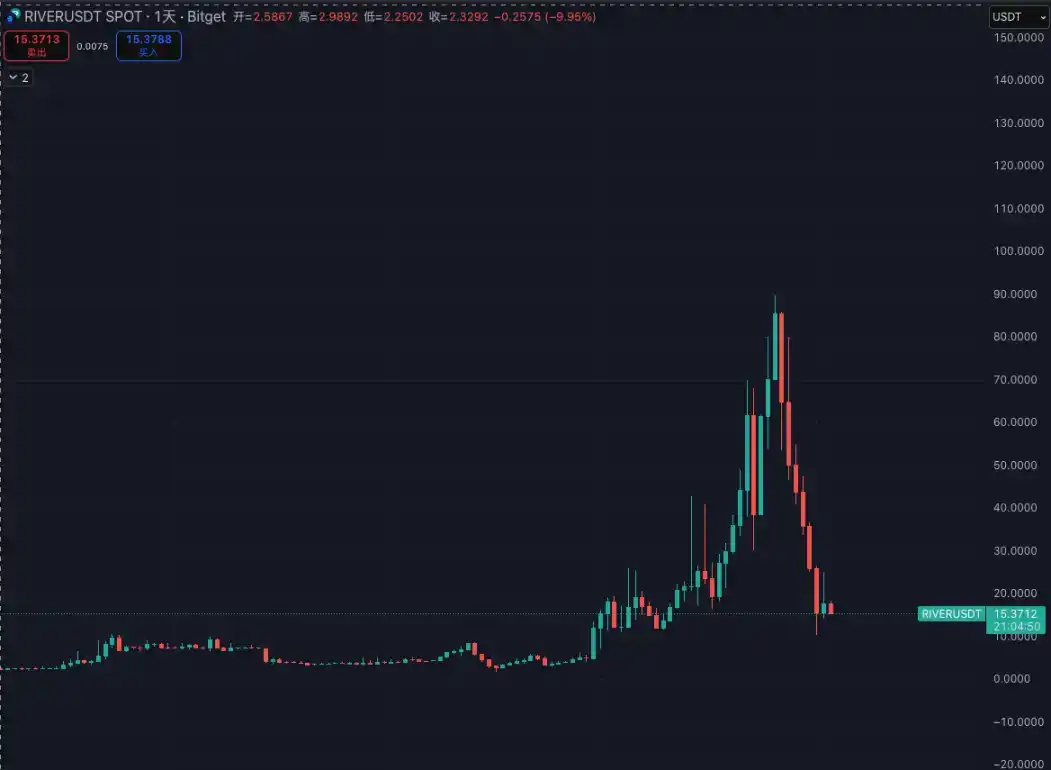
This abnormal market volatility has drawn significant attention from industry observers and on-chain data analysis institutions. As third-party data agencies like Bubblemaps disclosed key evidence on January 27, suspicions surrounding RIVER token price manipulation, highly concentrated early holdings, and profits by associated addresses are growing.

New Funding of $12 Million, Promoted by Arthur Hayes

The River project is developed by the RiverdotInc team, with its main focus on building a chain-abstracted stablecoin system for the multi-chain ecosystem. The system aims to connect assets, liquidity, and yields across different blockchains, enabling seamless cross-chain interactions without relying on traditional bridging or wrapping mechanisms.

On January 6, BitMEX founder Arthur Hayes publicly called for CEXs to list the token and predicted it would explode. Hayes' endorsement provided the first boost for RIVER. Despite most mainstream crypto assets being in a downward trend at the time, RIVER began a unilateral upward trend, with its market cap more than quadrupling in just a few weeks.
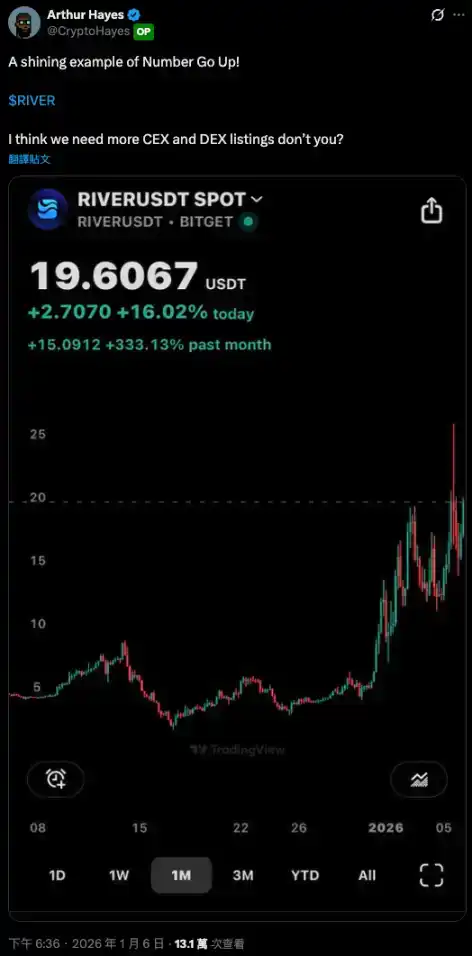
On January 23, River announced the completion of a $12 million strategic funding round. In addition to previously reported participation from Justin Sun and TRON DAO, this round of investors also included Maelstrom Fund (founded by Arthur Hayes), The Spartan Group, and Nasdaq-listed companies and institutions from the United States and Europe.

Officially, the funding will be used to support River's expansion into EVM and non-EVM ecosystems (including TRON, Sui, and major EVM networks) and to continue building on-chain liquidity infrastructure. The funds will accelerate ecosystem deployment, deepen stablecoin liquidity, and promote the integration of satUSD in trading, lending, staking, and yield scenarios. Additionally, River will launch yield products Smart Vault and Prime Vault, providing a unified interface for users and institutions to access cross-ecosystem yields through protocol-native and institutional-grade strategies.

Interestingly, just a couple of days after announcing the large funding round, RIVER's price hit its peak and began to decline.

Funding Rate-Driven Price Manipulation Tactics

CoinGlass once used RIVER as an example to discuss how funding rates can be used in conjunction with leverage structures to drive price volatility, emphasizing that this pattern has appeared in multiple tokens over the past two years, with RIVER being just one case. It stressed that many traders misunderstand funding rates. Funding rates do not provide directional predictive signals; they provide information on the imbalance between long and short positions, indicating which side of the market is more crowded.

Step 1: Suppress the price while pushing the funding rate into deeply negative territory. First, keep the price low or suppressed while pushing the funding rate into a significantly negative range. The result is that short positions become increasingly concentrated, and the market begins to form a consensus expectation that a rebound is imminent due to the negative funding rate.

Step 2: Lure some traders to go long. During the phase of deeply negative funding rates, some traders will open long positions, motivated by the expectation of a rebound and the hope of receiving funding rate payments. The thread refers to this expectation as part of the trap.

Step 3: Price pushes upward can also occur during negative funding rate phases. CoinGlass's key argument is that when funding rates are extremely negative, prices do not need to enter a trend reversal. The market only needs a controlled upward push to trigger a chain reaction among shorts, including liquidations, stop-losses, and passive covering.
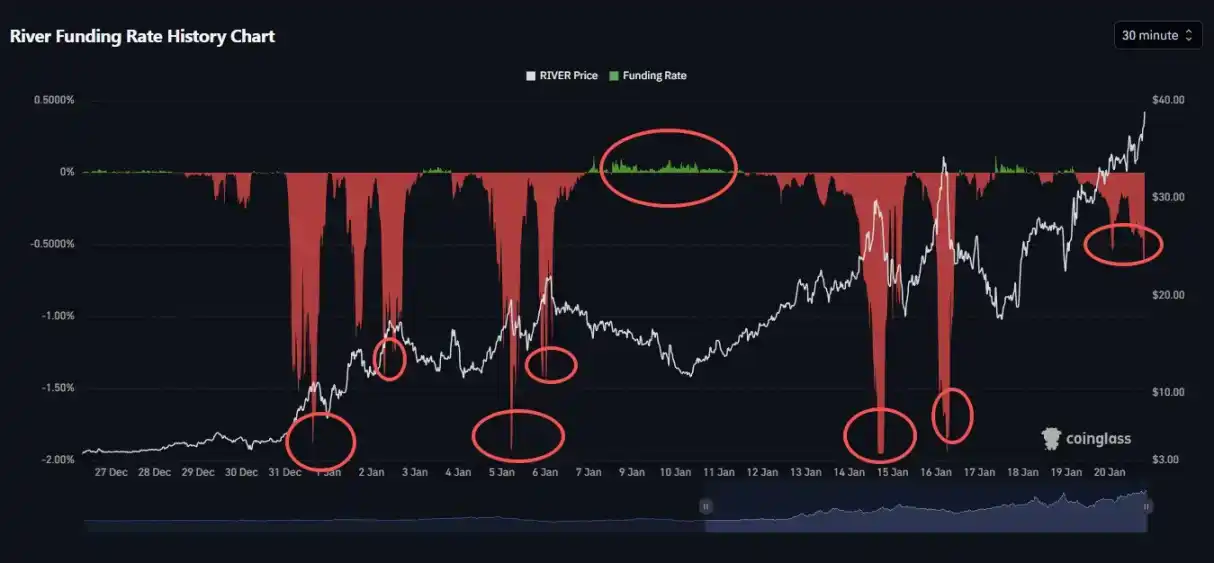
Why does the rally happen when the funding rate is still negative? Many sharp rallies start when funding rates are still negative. The driving force behind the price push comes from the unwinding of leveraged positions, and passive buying in the market amplifies the gains. After the crowded shorts are cleared, funding rates quickly return to more neutral levels. Some traders interpret the normalization of funding rates as a signal of market recovery.

CoinGlass warns that this is actually just the "reset" process of the trap, and manipulators can repeatedly execute the cycle of "creating extreme rates, attracting consistent positions, forcing liquidations, and resetting."

Analysis: RIVER Creators Suspected to Be Directly Related to a Large Cluster of Addresses, Selling RIVER for $10 Million in Profits

According to Bubblemaps monitoring, a large cluster containing over 2,000 wallet addresses is directly related to RIVER.
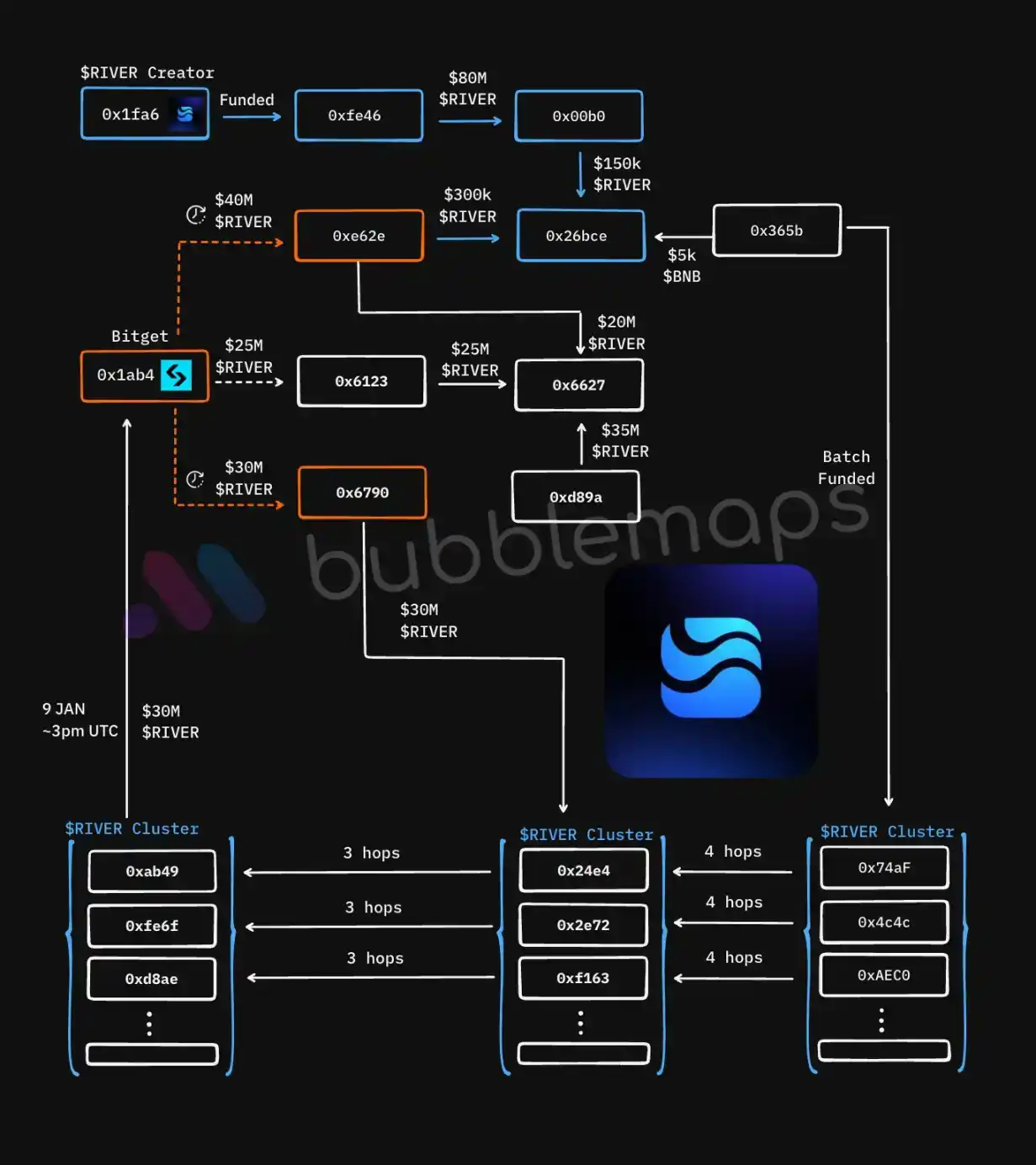
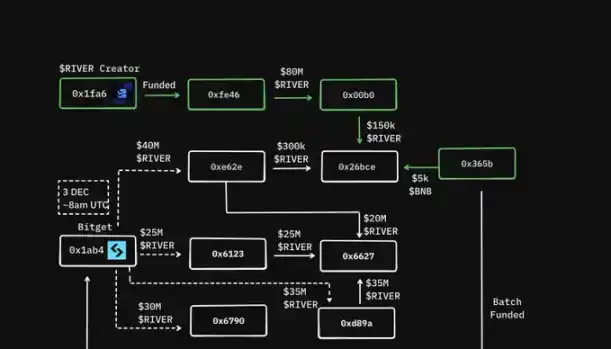
It pointed out that one month after RIVER's launch, seven addresses withdrew 230 million RIVER tokens from Bitget. These wallets had no prior activity and received the tokens within a tight time window on December 3 and 29.

One wallet, 0x6790, distributed 400,000 RIVER across hundreds of wallets. All these receiving wallets showed similar patterns: no prior activity, receiving similar amounts of RIVER, sending tokens to Bitget on January 9 likely for sale, funded by a single source, and经过四层跳转 (after four layers of hopping).
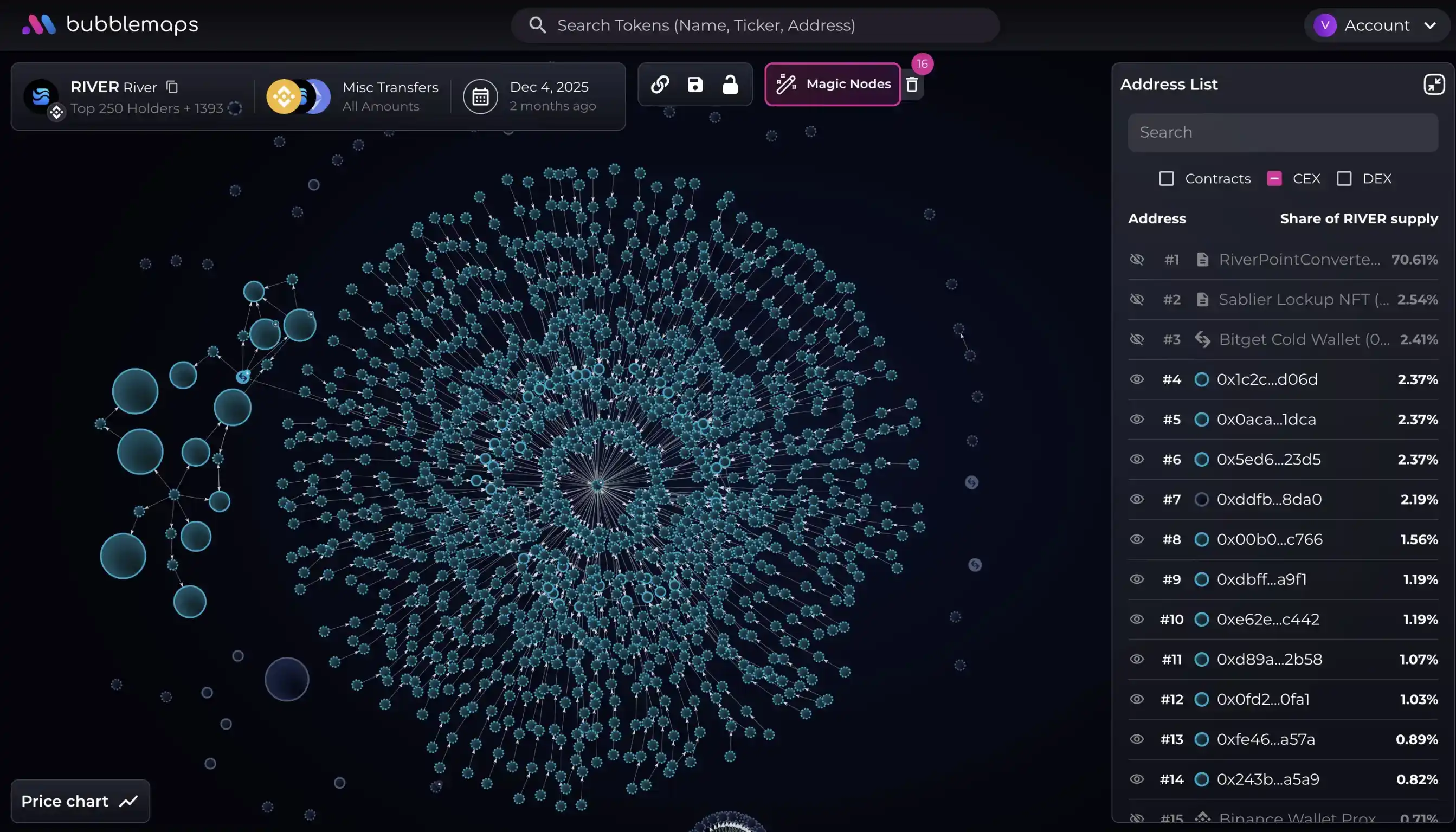
Bubblemaps noted that the wallet funding this cluster is address 0x365b, which is directly connected to the RIVER creator. Additionally, the wallet 0x6790, which distributed RIVER to the cluster, shows links pointing to the RIVER creator. It estimates the cluster's profits at $10 million.
What is certain now is that RIVER completed a drastic repricing from rapid rise to rapid retreat in an extremely short time. Market focus has shifted from narrative and growth expectations to whether there are abnormalities in token distribution and fund flows. The address cluster and associated clues raised by Bubblemaps have amplified suspicions of early concentration of holdings, profits by associated addresses, and selling through exchanges; the funding rate and position crowding mechanism mentioned by CoinGlass provide another explanatory framework, suggesting that derivative structures may have amplified the price swings.

For the market, the RIVER incident once again serves as a reminder that tokens with low circulation and high volatility are prone to extreme price movements when sentiment and structure resonate, and when negative signals emerge in holdings and trading structures, price adjustments often come faster and deeper.


Perguntas relacionadas

QWhat was the extreme price movement of RIVER token in the first month of 2026?

AThe RIVER token experienced an extreme inverted V-shaped reversal, surging from around $2 in late December 2025 to a high of over $87, a gain of more than 2700%, before crashing down to around $11 in just six days, a drop of 87%.

QWho is a prominent figure that publicly endorsed the RIVER token and what was his prediction?

ABitMEX founder Arthur Hayes publicly called for CEXs to list the token and predicted it would experience a massive breakout.

QAccording to the analysis from Bubblemaps, what was the suspected link between a large cluster of wallets and the RIVER token creators?

ABubblemaps identified a cluster of over 2000 wallet addresses directly linked to RIVER's creators, with evidence showing these wallets received tokens from the creators and later sold them on Bitget, netting an estimated profit of $10 million.

QHow did CoinGlass describe the mechanism of price manipulation involving funding rates, as exemplified by RIVER?

ACoinGlass described a套路 where manipulators first suppress the price to create deeply negative funding rates, lure in long positions expecting a rebound, and then trigger a short squeeze by pushing the price up, forcing liquidations and stop-losses. This cycle of creating extreme rates, attracting one-sided positions, forcing liquidations, and resetting can be repeated.

QWhat was the purpose of the $12 million strategic funding round announced by River, and who were some of the investors?

AThe $12 million strategic funding round was intended to support River's expansion into EVM and non-EVM ecosystems (including TRON, Sui, and major EVM networks), build on-chain liquidity infrastructure, accelerate ecosystem deployment, and launch yield products like Smart Vault and Prime Vault. Investors included Maelstrom Fund (Arthur Hayes), The Spartan Group, Justin Sun, TRON DAO, and Nasdaq-listed companies from the US and Europe.

Leituras Relacionadas

10% Position Limit Proposed: UK Retail Authorized Funds to Gain Indirect Exposure to Crypto Assets

The UK Financial Conduct Authority (FCA) is consulting on a proposal (CP26/17) that would allow retail funds, including UCITS and most Non-UCITS Retail Schemes (NURS), to invest up to 10% of their total assets in cryptoasset exchange-traded notes (crypto ETNs). This would enable indirect exposure to cryptoassets for mainstream investors through regulated funds. The rule maintains the existing prohibition on funds holding underlying cryptocurrencies like Bitcoin or Ethereum directly. The proposal introduces a strict 10% cap, positioning crypto ETNs as a potential satellite holding within diversified portfolios. Funds must ensure these investments align with their stated objectives and risk profiles. Notably, the cap does not apply to Qualified Investor Schemes (QIS) for professional clients, while Long-Term Asset Funds (LTAFs) would be prohibited from holding crypto ETNs. This move builds on the FCA's 2025 decision to permit retail trading of crypto ETNs on UK regulated exchanges. However, significant compliance burdens fall on fund managers, who must conduct thorough due diligence, assess liquidity, and provide clear risk disclosures to investors. The FCA emphasizes that even a small allocation can significantly impact a fund's risk profile. The policy's practical impact remains uncertain. Widespread adoption depends on whether asset managers deem the potential benefits worth the operational costs, disclosure requirements, and reputational risks. The consultation is open for feedback until July 13, 2026. Ultimately, the proposal represents a cautious, incremental step toward integrating cryptoassets into the regulated fund landscape, rather than a broad opening.

Foresight NewsHá 17m

10% Position Limit Proposed: UK Retail Authorized Funds to Gain Indirect Exposure to Crypto Assets

Foresight NewsHá 17m

Public Version of Mythos Officially Launched: Analyzing the Advantages and Limitations of AI Smart Contract Auditing

Publicly available Mythos, Anthropic's AI model, has officially launched, demonstrating both significant potential and limitations in smart contract security auditing. The article analyzes its capabilities through real-world cases. AI excels in identifying subtle, low-level vulnerabilities through pattern recognition and large-scale code screening. A key example is detecting a storage slot collision between a custom rewards mapping and a third-party library's ReentrancyGuard, a vulnerability easily missed in manual audits. In the recent Zcash incident, AI also rapidly discovered a critical soundness bug that had remained hidden for years. However, AI currently struggles with complex, interconnected scenarios. When tested on the Curve LlamaLend sDOLA exploit, which involved manipulating prices across multiple protocols (Curve pools, lending markets) to trigger liquidations, Fable 5 failed to identify the core cross-protocol attack vector. These scenarios require a deep understanding of DeFi economic models and multi-contract interactions. In conclusion, while AI tools like Mythos significantly boost efficiency in finding standardized, syntactic vulnerabilities, they cannot yet replace expert analysis for complex, business-logic, and cross-protocol attacks. An effective audit workflow combines AI's speed for initial screening with human expertise for in-depth, holistic analysis.

marsbitHá 22m

Public Version of Mythos Officially Launched: Analyzing the Advantages and Limitations of AI Smart Contract Auditing

marsbitHá 22m

Trade.xyz's Rebase Refusal Sparks Controversy, On-Chain Pre-IPO Market Faces Major Pricing Test

The debate surrounding Trade.xyz's refusal to adjust its SPCX (SpaceX pre-IPO) perpetual contract pricing amid updated share count revelations highlights a key challenge for on-chain pre-IPO markets. While several centralized exchanges (CEXs) paused and repriced their contracts after SpaceX's filing showed a ~10% increase in total shares, Trade.xyz maintained its market-driven pricing logic, which tracks expected per-share price sentiment rather than fundamental valuation metrics like market cap. This discrepancy triggered cross-platform arbitrage and caused leveraged long positions on Trade.xyz to suffer significant losses, as the platform's HIP-3 architecture lacks a native "Rebase" mechanism to neutrally adjust all user positions following such corporate actions. The incident underscores the difficulty for decentralized perpetual exchanges (Perp DEXs) to implement Rebase—a process CEXs handle by centrally pausing markets and adjusting ledger data. On-chain, this requires complex smart contract modifications, increasing gas costs, complexity, and potential attack surfaces. While some DEXs have managed similar adjustments, Trade.xyz's current design does not natively support it, though the team is reportedly exploring solutions for future events like stock splits. Ultimately, the controversy serves as a critical case study for the nascent on-chain pre-IPO sector, raising questions about price discovery reliability, transparent rule disclosure, and the readiness of DeFi infrastructures to handle traditional corporate actions as real-world assets (RWAs) gain traction.

marsbitHá 30m

Trade.xyz's Rebase Refusal Sparks Controversy, On-Chain Pre-IPO Market Faces Major Pricing Test

marsbitHá 30m

The 'Middle Eastern Prince' Swindles a Wealthy Woman: Renting Planes and Rolls-Royces, Scamming 120 Million Over Three Years

Two brothers who posed as "Middle Eastern princes" have been sentenced in the United States to 24 and 23 years in prison, respectively, and ordered to pay over $21.2 million in restitution and back taxes. Over three years, they fraudulently obtained approximately $21 million, primarily by promoting fictitious investment projects, including a non-existent cryptocurrency mining operation in a former General Electric industrial park in East Cleveland. The brothers, aged 42 and 33, created elaborate personas: one claimed to be a wealthy royal family heir and the city's "International Economic Advisor," while the other posed as a hedge fund manager with expertise from watching the TV show *Billions*. They bolstered their image by renting luxury cars and private jets and cultivating a relationship with a local mayor's chief of staff, who provided official-looking documents and government event access. A significant portion of the victims' funds, about $18 million, came from a single Chinese investor, a woman from Sichuan with experience in Bitcoin mining. The brothers also defrauded several women, including one former girlfriend. Their scheme unraveled when the primary investor discovered her $6 million worth of mining equipment had been sold off. The case highlights a trend of impostors using fabricated "Middle Eastern royal" identities to target wealthy individuals. Similar incidents include a "Dubai prince" who recently promoted a $500 million family office in Hong Kong and a Colombian man who impersonated a Saudi prince for decades in the US before being caught and sentenced in 2019.

marsbitHá 44m

The 'Middle Eastern Prince' Swindles a Wealthy Woman: Renting Planes and Rolls-Royces, Scamming 120 Million Over Three Years

marsbitHá 44m

Trading

Spot
Futuros

Artigos em Destaque

Como comprar RIVER

Bem-vindo à HTX.com!Tornámos a compra de River (RIVER) simples e conveniente.Segue o nosso guia passo a passo para iniciar a tua jornada no mundo das criptos.Passo 1: cria a tua conta HTXUtiliza o teu e-mail ou número de telefone para te inscreveres numa conta gratuita na HTX.Desfruta de um processo de inscrição sem complicações e desbloqueia todas as funcionalidades.Obter a minha contaPasso 2: vai para Comprar Cripto e escolhe o teu método de pagamentoCartão de crédito/débito: usa o teu visa ou mastercard para comprar River (RIVER) instantaneamente.Saldo: usa os fundos da tua conta HTX para transacionar sem problemas.Terceiros: adicionamos métodos de pagamento populares, como Google Pay e Apple Pay, para aumentar a conveniência.P2P: transaciona diretamente com outros utilizadores na HTX.Mercado de balcão (OTC): oferecemos serviços personalizados e taxas de câmbio competitivas para os traders.Passo 3: armazena teu River (RIVER)Depois de comprar o teu River (RIVER), armazena-o na tua conta HTX.Alternativamente, podes enviá-lo para outro lugar através de transferência blockchain ou usá-lo para transacionar outras criptomoedas.Passo 4: transaciona River (RIVER)Transaciona facilmente River (RIVER) no mercado à vista da HTX.Acede simplesmente à tua conta, seleciona o teu par de trading, executa as tuas transações e monitoriza em tempo real.Oferecemos uma experiência de fácil utilização tanto para principiantes como para traders experientes.

616 Visualizações TotaisPublicado em {updateTime}Atualizado em 2026.06.02

Como comprar RIVER

Discussões

Bem-vindo à Comunidade HTX. Aqui, pode manter-se informado sobre os mais recentes desenvolvimentos da plataforma e obter acesso a análises profissionais de mercado. As opiniões dos utilizadores sobre o preço de RIVER (RIVER) são apresentadas abaixo.

活动图片












