Ads During the American Super Bowl Look Like Scams

marsbitPublicado em 2026-02-12Última atualização em 2026-02-12

Resumo

The 2026 Super Bowl, often called the "American Super Bowl," was a spectacle of sports, entertainment, and high-stakes marketing. This year’s event featured three notable incidents that highlight the intersection of prediction markets, insider information, and viral marketing. First, a newly created account on the prediction market Polymarket placed nearly $80,000 in bets—with 17 out of 19 wagers correctly predicting details of the halftime show, including appearances by Lady Gaga and the absence of Travis Scott. The account’s near-perfect accuracy led to suspicions of insider trading, possibly linked to the event’s production team. Second, a trader named Alex Gonzalez ran onto the field during the game with promotional messages painted on his body. Reports indicate he had previously bet on such a field invasion occurring, after accounting for legal fees and bail, netted around $70,000. His actions blurred the line between predicting and creating events for profit. Finally, a viral “leaked” video showed influencer Logan Paul apparently betting $1 million on Polymarket during the game. It was later revealed to be a marketing stunt orchestrated by Polymarket itself, in which Paul has investment ties. Together, these events illustrate how prediction markets can be manipulated through insider knowledge, performative acts, and staged publicity—raising questions about authenticity in high-profile events.

This year's "American Super Bowl" once again captured the world's attention, much like previous years. The game itself, Mr. Beast's one-million-dollar bounty puzzle game, the halftime show... A sports event that was originally popular only in the United States has attracted global attention thanks to numerous entertainment and cultural elements.

Before we begin, let's experience just how lively the American Super Bowl is from a first-person perspective:

Amidst this density of attention, three viral events perfectly illustrate our expectations for prediction markets: an insider with a perfect winning rate betting on the halftime show performers on the prediction market Polymarket, a "fanatic fan" arrested on the spot, and a viral video of a major influencer secretly filmed using a prediction market that was later revealed to be a marketing stunt.

The "Perfect Win Rate" of Prediction Markets: New Account Achieves Extremely High Win Rate Betting on Halftime Show Lineup

Approximately 48 hours before the Super Bowl kickoff, nearly $80,000 was deposited into a newly registered account on the prediction market Polymarket. Subsequently, this account concentrated all its funds on bets related to the halftime show performers and setlist events, covering multiple specific predictions such as Lady Gaga performing and Travis Scott not performing, totaling 19 prediction bets.

After the halftime show concluded, 17 of these 19 bets hit, yielding a profit of $17,600. A new account, heavily concentrated on a single event, with a near-perfect hit rate. This goes far beyond just good luck.
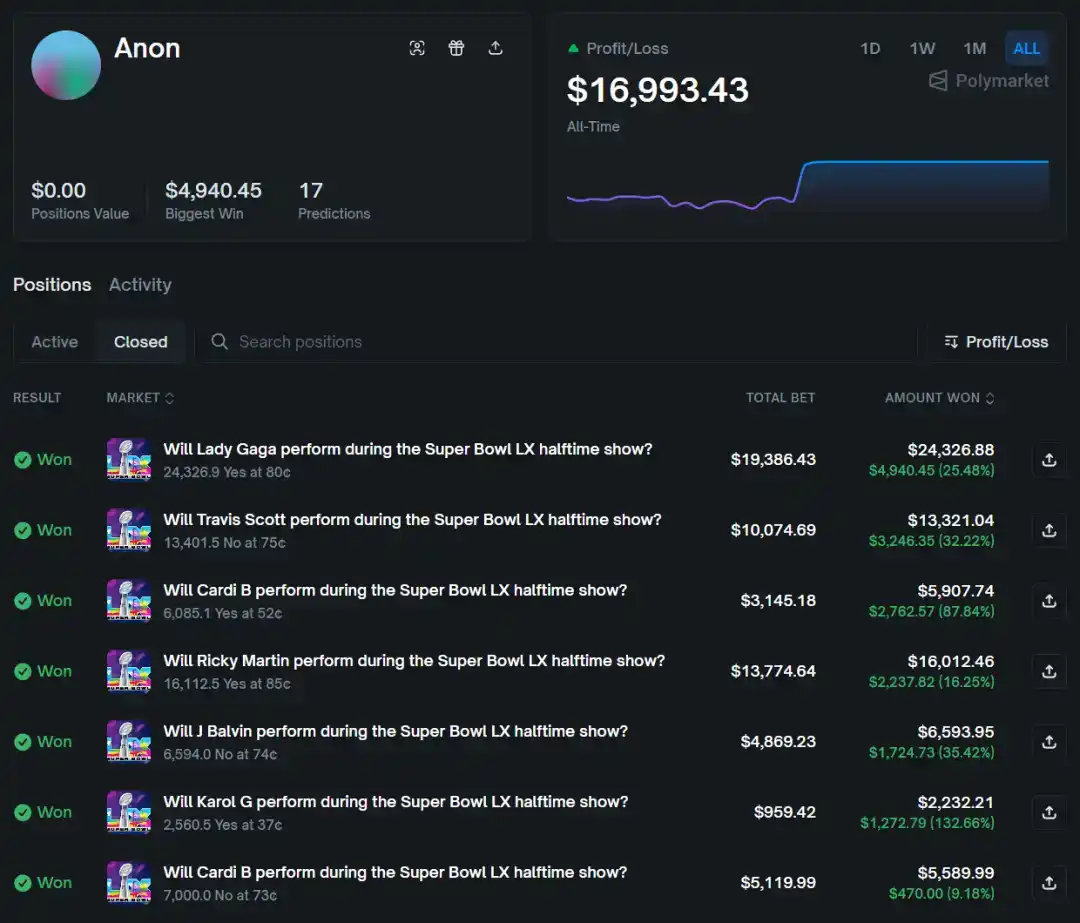
Since the Super Bowl halftime show has long been planned and produced by the company Roc Nation, the community quickly began to speculate that the account holder likely had access to insider information, or was even connected to the production team. In an event with trading volume exceeding ten million dollars, while ordinary traders were placing blind bets, this insider was perhaps holding the setlist in their left hand and locking in profits with their phone in their right.

However, the anonymous nature of blockchain also means this remains merely speculation. This transaction has become another classic case study defining prediction markets as a means for insiders to monetize information asymmetry.

Trader Bets "Someone Will Rush the Field" and Then Rushes the Field

If the insider trader was profiting from information asymmetry in the shadows, then the move by a "fan" during the game was an open stratagem. He is also the protagonist in the video at the beginning of our article.

In the fourth quarter of the game, a shirtless fan climbed over the barrier and rushed onto the Super Bowl field. Instantly, all cameras and the television broadcast focused on this intruder. His bare chest was painted with body paint, his front reading "Trade in the blind spot," and his back displaying his account ID "@fxalexg" and the advertisement "Trade with Athena."

From the moment he stepped onto the field until he was tackled by security, he ran for 30 seconds. The going rate for a 30-second ad spot during the Super Bowl is $7 million.

When viewers took out their phones to search for his account, they discovered this "fan" was not an ordinary spectator but a trader—Alex Gonzalez. The slogans on his body were essentially a moving advertisement.

Even more intriguingly, according to Sportscasting, Gonzalez had performed a similar stunt back in 2024. He reportedly bet $5,000 that "someone would rush the field during the Super Bowl," then rushed the field himself during the game, ultimately profiting about $110,000; after deducting bail and legal fees, his net gain was still around $70,000.

In other words, he not only creating the event on the field but potentially also betting on the event he himself would create in the prediction market.

When the odds are high enough, some people stop predicting the future and instead create it themselves. This is also our most extreme, and most ironic, expectation for prediction markets.

The "Secretly Filmed" Video of an Influencer Betting a Million Dollars Was Actually a Marketing Stunt

Another video from this Super Bowl that went viral across the internet came from top influencer Logan Paul—in the footage, his phone screen is lit up with the Polymarket betting interface, showing him placing a one-million-dollar bet on which team would win. The image is blurry, the angle is tilted, very much like a casual shot taken by a spectator in the back seat.

Soon after this 12-second "secretly filmed" video spread, it was reposted by the official Polymarket account, and the heat and traffic came as expected. However, this transaction never appeared in the information flow of PolyBeats, which focuses on monitoring prediction market trades.

After in-depth research, it was found that the so-called "million-dollar bet" never actually occurred. This seemingly explosive "behind-the-scenes moment," which satisfied the public's voyeuristic desires, was nothing more than a carefully packaged marketing performance: as early as December 2025, Logan Paul joined the venture capital firm Anti Fund as a partner, and this firm was one of the investors in Polymarket's Series B round in 2025.

When a globally watched sporting event simultaneously overlaps with probability markets, advertising markets, and attention markets, the boundaries of the game are no longer confined to just the two teams on the field. Beyond the odds, there's the pricing of exposure; beyond the betting lines, there's narrative design.

Driven by money and attention, the "viral moments" we scroll past on social media might not be spontaneous but the result of months of planning.


Criptomoedas em alta

Perguntas relacionadas

QWhat was the 'American Super Bowl' event mentioned in the article, and why is it attract global attention?

AThe 'American Super Bowl' refers to the annual championship game of the National Football League (NFL). It attracts global attention not just for the sport itself, but due to its heavy integration of entertainment culture, such as the high-profile halftime show, celebrity appearances, and major advertising events, which collectively draw a worldwide audience.

QHow did a new Polymarket account achieve a near-perfect prediction rate for the Super Bowl halftime show, and what does this suggest?

AA new Polymarket account deposited nearly $80,000 and placed 19 concentrated bets on specific halftime show details, like Lady Gaga appearing and Travis Scott not appearing, with 17 of them being correct. This near-perfect success rate, far beyond luck, strongly suggests the account owner had insider information, likely connected to the show's production company Roc Nation, exploiting information asymmetry for profit on the prediction market.

QWho was Alex Gonzalez, and how did he allegedly profit from the Super Bowl event according to the article?

AAlex Gonzalez was a trader who ran onto the field during the Super Bowl with painted advertisements on his body. The article suggests he had previously placed a $5,000 bet on the prediction market that 'someone would rush onto the field during the Super Bowl' and then created the event himself by doing so. He reportedly profited approximately $110,000 from that bet, with a net gain of around $70,000 after legal fees and bail.

QWhat was revealed about the viral 'secretly recorded video' of Logan Paul placing a million-dollar bet on Polymarket?

AThe viral 12-second 'secretly recorded' video of Logan Paul apparently placing a million-dollar bet on Polymarket was revealed to be a staged marketing campaign. The bet never actually placed on the market, and the video was a carefully orchestrated promotion. This was because Logan Paul is a partner in Anti Fund, a venture capital firm that was an investor in Polymarket's Series B funding round.

QWhat overarching point does the article make about prediction markets, advertising, and major events like the Super Bowl?

AThe article argues that during globally watched events like the Super Bowl, prediction markets, advertising markets, and attention economies converge. This creates an environment where what appears to be spontaneous moments—such as an insider making profitable trades, a fan rushing the field, or a viral video—are often the result of months of planning and manipulation for financial gain and exposure, blurring the lines between gambling, advertising, and narrative creation.

Leituras Relacionadas

As Consensus Accelerates, What Are Young Investors Betting On?

Title: As Consensus Forms Faster, What Are Young Investors Betting On? In the rapid evolution of tech investment, a new generation of young investors is navigating a landscape where AI, robotics, commercial aerospace, and quantum computing are advancing simultaneously. Traditional investment logic based on financial models is giving way to a need for deep technical understanding and the ability to act before industry consensus forms. An analysis of trends from the "WAIC FUTURE TECH" list of young investment leaders reveals key shifts in focus. The first major trend is the movement of AI from the digital screen into the physical world. Investment is shifting from large language models and chatbots towards embodied AI, robotics, AI hardware, and edge computing. While demonstrations generate excitement, the real challenge lies in achieving scalable, reliable, and cost-effective delivery in complex real-world environments like factories and logistics. Success depends not just on algorithms but on the integration of sensors, actuators, and control systems. Second, the competitive focus for large models is moving beyond raw capability toward building an "intelligence flywheel." The goal is to create self-reinforcing systems where user interaction generates data, improving the model, which in turn enhances the user experience and attracts more engagement. Companies that successfully embed AI into workflows to create these closed-loop systems can build lasting value that isn't easily erased by the next model upgrade. Third, facing a potential bottleneck in high-quality human-generated data, investors are looking at new underlying technologies. Reinforcement learning and self-play, as demonstrated by AlphaGo Zero, offer paths for AI to generate its own experience. Scientific foundation models, which aim to build general AI capabilities for fields like life sciences and materials discovery, represent a non-consensus direction that could unlock new frontiers of knowledge and data. Finally, in deep-tech areas like quantum computing, commercial aerospace, and space-based infrastructure, patient capital is essential. These fields have long, uncertain development and validation cycles involving complex engineering, supply chains, and regulations. Investment here requires a long-term view, focusing on foundational team capabilities and the eventual emergence of market demand, even if commercial returns are distant. Collectively, these trends illustrate how young investors are adapting to a new era. They are learning to make earlier, technically-informed judgments, balance hype with real-world viability, and provide the patient capital needed to build the deep-tech foundations of the future.

marsbitHá 6m

As Consensus Accelerates, What Are Young Investors Betting On?

marsbitHá 6m

Can Japan Buy Growth with AI? Will the Bond Market Believe It?

Japan's cabinet has introduced the 2026 Basic Policy on Economic and Fiscal Management and Reform, shifting its primary fiscal target. The new framework moves away from the traditional annual primary balance goal and instead prioritizes a stable reduction of the debt-to-GDP ratio. This change is tied to a strategy of increased "responsible proactive fiscal" spending, aiming to boost long-term growth through investments in strategic sectors like AI, semiconductors, energy, and robotics. The government estimates total public and private investment in 62 key technologies could exceed 370 trillion yen by 2040. The market reaction has been mixed and cautious. While equity markets may respond to policy signals, bond markets are focused on fiscal credibility. Concerns center on whether the weakening of the clear primary balance anchor could lead to looser fiscal discipline. If investors doubt that these strategic investments will generate sufficient productivity gains, tax revenue, and nominal growth to outpace rising interest costs, they may demand higher yields on Japanese Government Bonds (JGBs). Recent volatility in the yen and JGB yields, with the 10-year yield briefly reaching 2.9%, reflects this skepticism. The success of this new framework hinges on two factors: whether Japan can achieve a nominal growth rate consistently higher than its long-term interest rates, and whether future budgets demonstrate disciplined control over bond issuance. The government's narrative is that strategic investment is essential to break Japan's cycle of low growth, aging, and labor shortages. However, the bond market will continuously assess the credibility of this plan, pricing the risk that it may represent fiscal expansion rather than a viable growth strategy.

marsbitHá 43m

Can Japan Buy Growth with AI? Will the Bond Market Believe It?

marsbitHá 43m

Misjudged A-Shares: Resilience, Expectations, and Confidence

China's A-share market recently faced selling pressure, especially in tech sectors, initially triggered by a global tech sell-off that began in South Korea. However, the article argues this is a case of "mistaken injury" and highlights the market's underlying resilience. This resilience stems from three main pillars: **1) Tech Sector Fundamentals:** Unlike Korea's market dominated by a few memory chip stocks, China's tech sector is diversified across computing, communications, electronics, and semiconductors, supported by dual narratives of global AI supply chains and domestic substitution. Core areas like optical modules and fiber optics continue to show strong earnings growth. **2) "National Team" Support:** State-backed institutions and large corporations have made significant market purchases and announced buybacks, providing liquidity and signaling confidence. This is seen as a stabilizing policy signal, often associated with market bottoms. **3) Broader Market Pillars:** Other major sectors are showing endogenous recovery momentum. Consumer stocks benefit from stabilizing CPI and signs of sector recovery (e.g., liquor price hikes). Cyclical sectors like aluminum have high earnings, potential price increases due to tight supply, and low valuations. The financial sector offers stable dividends and low valuations. The conclusion is that the sell-off was driven by external contagion, not a collapse in fundamentals. With strong policy support and recovering momentum across key sectors, the A-share market possesses the toughness to regain stability.

marsbitHá 1h

Misjudged A-Shares: Resilience, Expectations, and Confidence

marsbitHá 1h

Trading

Spot

Artigos em Destaque

Como comprar SUPER

Bem-vindo à HTX.com!Tornámos a compra de SuperFarm (SUPER) simples e conveniente.Segue o nosso guia passo a passo para iniciar a tua jornada no mundo das criptos.Passo 1: cria a tua conta HTXUtiliza o teu e-mail ou número de telefone para te inscreveres numa conta gratuita na HTX.Desfruta de um processo de inscrição sem complicações e desbloqueia todas as funcionalidades.Obter a minha contaPasso 2: vai para Comprar Cripto e escolhe o teu método de pagamentoCartão de crédito/débito: usa o teu visa ou mastercard para comprar SuperFarm (SUPER) instantaneamente.Saldo: usa os fundos da tua conta HTX para transacionar sem problemas.Terceiros: adicionamos métodos de pagamento populares, como Google Pay e Apple Pay, para aumentar a conveniência.P2P: transaciona diretamente com outros utilizadores na HTX.Mercado de balcão (OTC): oferecemos serviços personalizados e taxas de câmbio competitivas para os traders.Passo 3: armazena teu SuperFarm (SUPER)Depois de comprar o teu SuperFarm (SUPER), armazena-o na tua conta HTX.Alternativamente, podes enviá-lo para outro lugar através de transferência blockchain ou usá-lo para transacionar outras criptomoedas.Passo 4: transaciona SuperFarm (SUPER)Transaciona facilmente SuperFarm (SUPER) no mercado à vista da HTX.Acede simplesmente à tua conta, seleciona o teu par de trading, executa as tuas transações e monitoriza em tempo real.Oferecemos uma experiência de fácil utilização tanto para principiantes como para traders experientes.

239 Visualizações TotaisPublicado em {updateTime}Atualizado em 2026.06.02

Como comprar SUPER

Discussões

Bem-vindo à Comunidade HTX. Aqui, pode manter-se informado sobre os mais recentes desenvolvimentos da plataforma e obter acesso a análises profissionais de mercado. As opiniões dos utilizadores sobre o preço de SUPER (SUPER) são apresentadas abaixo.

活动图片












