Above the Seats: A Covert Power Struggle Deciding the Fate of Encryption

marsbitPublicado em 2026-03-19Última atualização em 2026-03-19

Resumo

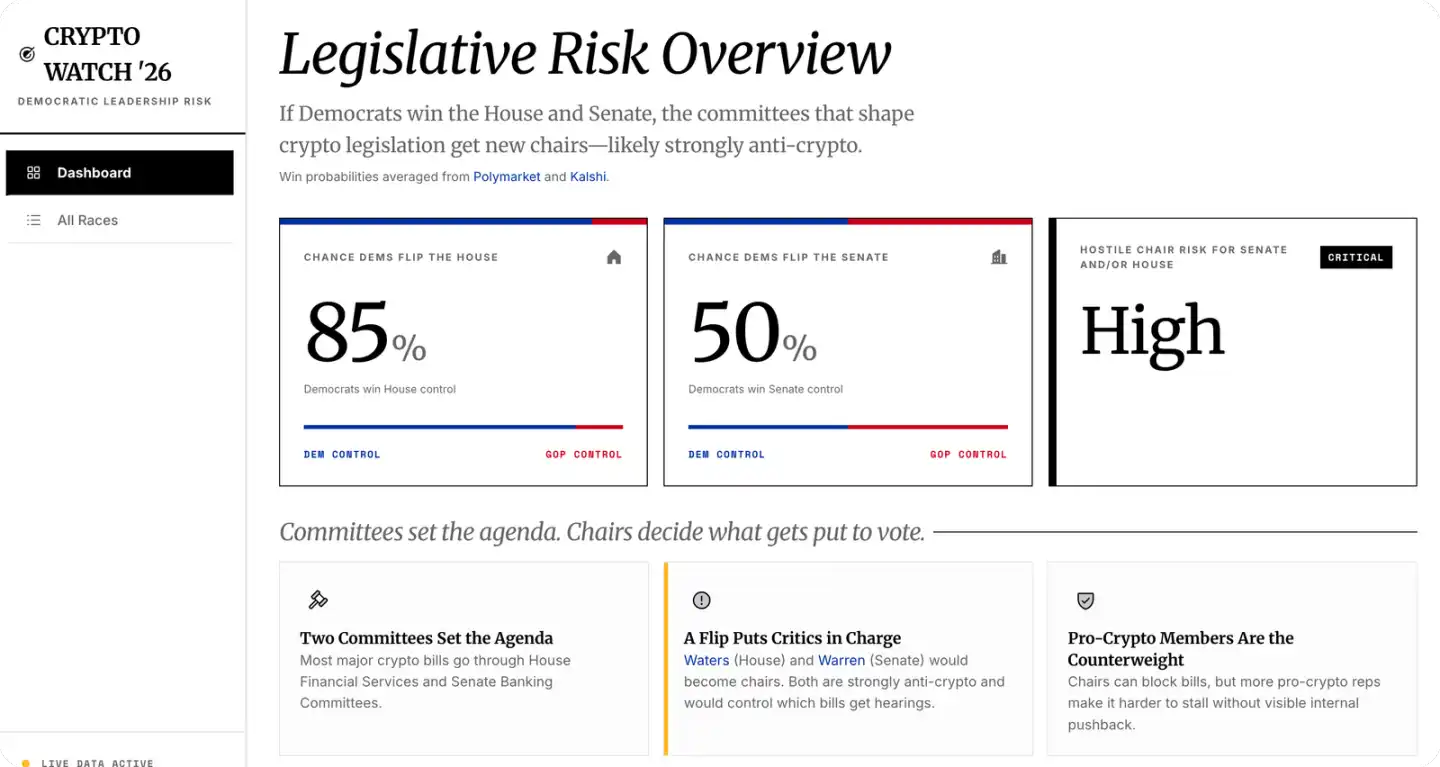
The 2026 US midterm elections pose significant risks to the crypto industry, with Democrats having an 85% chance of taking the House. This would place Maxine Waters, a vocal crypto critic, as Chair of the House Financial Services Committee (HFSC), giving her absolute power to block crypto legislation by controlling the agenda. In the Senate, Elizabeth Warren, another staunch opponent, would likely chair the Banking Committee. While nearly half of Democratic lawmakers voted for the pro-crypto GENIUS Act, this support is superficial. Bills never go to a full floor vote without first passing through committee, where chairs hold unilateral power to kill them. The current pro-crypto Republican chairs, who advanced bills like FIT21 and CLARITY, would be replaced. The analysis highlights that even though pro-crypto Democrats exist, they lack influence in the powerful committees that control legislative progress. Key elections that could shift committee dynamics are limited. The conclusion is that a Democratic sweep would create a severe structural headwind, stalling major crypto legislation in Congress despite bipartisan voter support.

Written by: David Christopher

Compiled by: Saoirse, Foresight News

What level of risk does this midterm election truly conceal for the encryption industry? As the possibility of a Democratic sweep of both the Senate and the House of Representatives in the midterm elections continues to rise, I aim to conduct an in-depth analysis of its potential impact on the future trajectory of the encryption industry, based on current polls.

To this end, I have consulted prediction markets on one hand, and resources like Stand with Crypto (SWC) on the other—a platform that records the policy stances of various candidates towards the encryption industry. I have integrated this information and built an analytical dashboard accordingly.

Although the data is still being supplemented and refined, I have established a core database tracking key districts where Democratic candidates are leading, and correlating their encryption policy positions with potential influence in Congressional committees. This analysis preliminarily reveals the policy landscape for the coming months: superficially, there appears to be room for cooperation, but a deeper look uncovers profound structural issues.
A Surprising Reality

First, it must be clarified that Democratic support for the encryption industry is actually higher than commonly perceived—at least on certain bills.

In the House of Representatives, 101 Democratic lawmakers (approximately 48% of the caucus) voted in favor of the GENIUS Act; in the Senate, 18 Democrats (40%) voted to advance the bill to a floor vote. This seems to form a tangible bipartisan support coalition. However, this support is confined to that specific bill. Once it enters the core stage that truly determines legislative direction—the committee process—this support vanishes entirely.

This is precisely the crux of the issue.

The Core Source of Influence

Encryption-related legislation is never brought directly to a full floor vote.

Whether it's stablecoin regulation, market structure rules, or defining the authority of the U.S. Securities and Exchange Commission (SEC), all issues must first undergo committee review. The House Financial Services Committee (HFSC) and the Senate Banking Committee are the two core bodies that determine the life or death of encryption bills (market structure bills also require input from the Agriculture Committee regarding the relevant authority of the Commodity Futures Trading Commission (CFTC)).

Committee chairs hold absolute agenda control: they decide which bills get hearings, which move to the deliberation stage, and which die quietly in procedural deadlock. A chair opposed to a bill does not need to vote it down; they can simply kill it by refusing to schedule it.

Republican chairs in recent years have fully demonstrated the influence of this power:

  • Senate Banking Committee Chair Tim Scott pushed the GENIUS Act through committee review and helped it pass the Senate vote;
  • Former House Financial Services Committee Chair Patrick McHenry strongly advocated for the FIT21 Act, making it the first major encryption market structure bill to pass the House;
  • Current House Financial Services Committee Chair French Hill has continued this momentum, pushing related bills like the CLARITY Act through the House (although this bill remains stalled in the Senate), and consistently holding hearings on digital assets and capital markets modernization.

So, what changes if Democrats achieve a full victory?

The majority party will control all committee chair positions in Congress, without exception. If Democrats recapture the House, they will chair all House committees; if they take the Senate, they will fully control all Senate committees. The selection of chairs within the majority party is typically based on seniority.

  • House Financial Services Committee: The most senior Democrat is Maxine Waters;
  • Senate Banking Committee: The highest-ranking Democrat is Elizabeth Warren.

It is well-known that both have voted against all major encryption bills. Warren led the opposition during the GENIUS Act deliberations, calling it "a threat to national security"; Waters directly condemned the bill as "a complete and total crypto scam."

The key point of contention in the House is this—once party control changes, the subcommittees will be completely reorganized. The majority party will dictate the allocation and proportional adjustment of seats for new members. Waters will have significant influence over personnel arrangements within the House Financial Services Committee and its subcommittees, including deciding who will oversee "digital asset" related matters. Admittedly, she cannot unilaterally decide all members (the party leadership and caucus have a say), but it is enough to steer the committee towards her preferred anti-encryption stance.

The Democratic contingent in the current House Financial Services Committee is already clearly leaning anti-encryption: Brad Sherman, Stephen Lynch, Emanuel Cleaver, and Sylvia Garcia all hold strong opposing views. Even with pro-encryption members like Jim Himes, Bill Foster, Ritchie Torres, Josh Gottheimer, and Vicente Gonzalez, they cannot control the agenda under Waters' chairmanship.
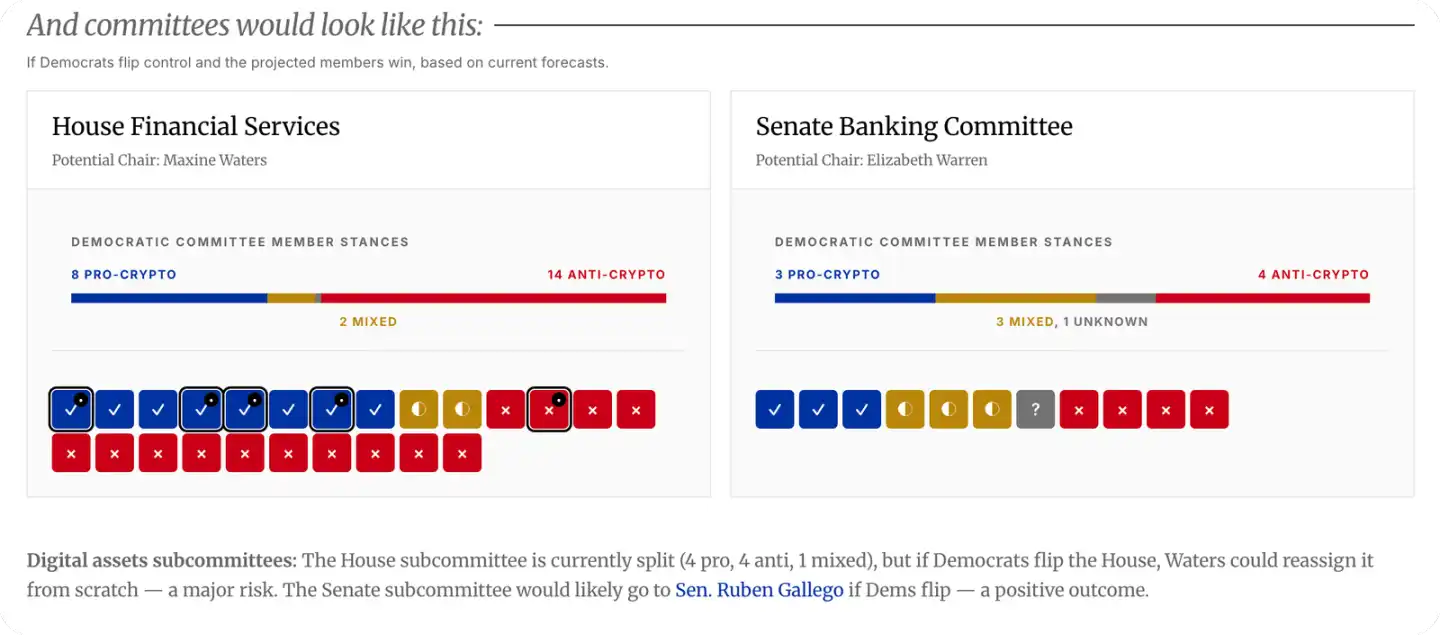
This chart shows the distribution of encryption stances in the two core committees if Democrats regain control of Congress in the 2026 midterm elections, visually reflecting the regulatory landscape the encryption industry will face.

The situation in the Senate Banking Committee is slightly better. Although Warren would become chair, the committee's composition is more diverse: it includes pro-encryption senators (e.g., Mark Warner, Ruben Gallego, Angela Alsobrooks), opponents (e.g., Tina Smith), and swing-vote moderates. A slight positive is that if Democrats control the Senate, Senator Gallego, rated favorably on the SWC platform, is highly likely to chair the digital assets subcommittee. Although Warren would still control the full committee's agenda, Gallego could potentially carve out some space for pro-encryption voices at the subcommittee level.

The Key Elections That Truly Impact the Landscape

Most existing pro-encryption Democratic lawmakers are not on the House Financial Services Committee or the Senate Banking Committee. They can certainly vote in favor of relevant bills in full floor votes, and they can pressure party leadership (though, given the high degree of partisanship on this issue, most are reluctant to speak out for the encryption industry), but they cannot force committee chairs to advance legislation.

Only a handful of elections can truly change the power composition within these committees.
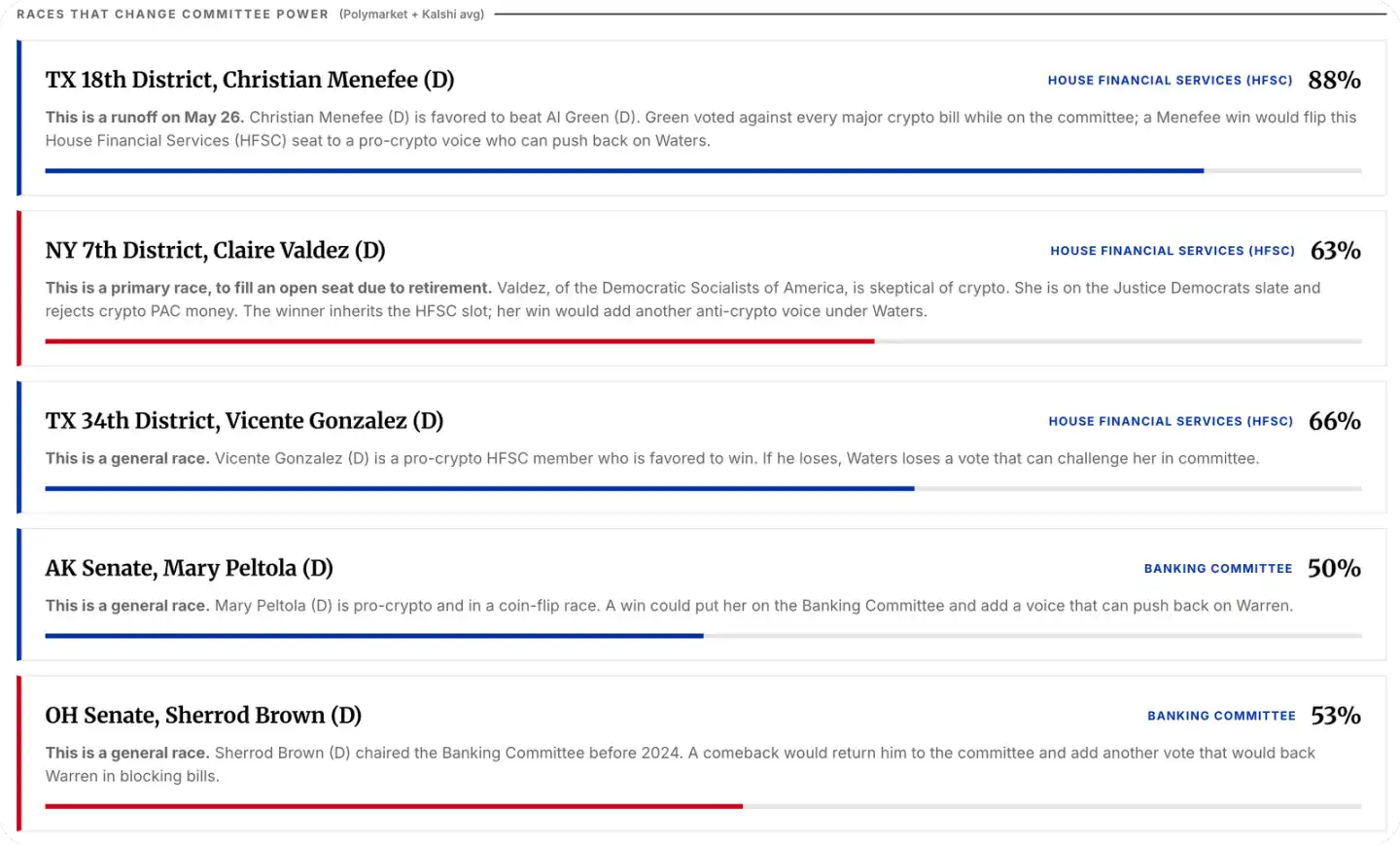
This chart is an analysis of key district races affecting U.S. Congressional encryption legislative power. Data is averaged from Polymarket and Kalshi prediction markets. It corely shows which election results would directly change the encryption stance of the House Financial Services Committee (HFSC) and the Senate Banking Committee.

The Final Conclusion of the Midterm Elections

The prospects in the House are extremely grim.

The probability of Democrats retaking the House is as high as 85%, meaning Waters is highly likely to chair the House Financial Services Committee, wielding absolute power to reorganize subcommittees and control the legislative agenda. The remaining bright spots are extremely limited: Menefee has a chance to defeat Green for a seat, and Gonzalez is highly likely to retain his current seat. These scenarios might create some checks and balances, but they cannot change the core of power—the ownership of the chairmanship.

The Senate is the encryption industry's last remaining stronghold, and the situation worsened last night: Juliana Stratton defeated Raja Krishnamoorthi in the Illinois primary. Based on SWC platform records, combined with the fact that Fairshake (a U.S. Super PAC with ties to the encryption industry, and currently one of the most influential political lobbying organizations in the crypto space) spent $7 million opposing her, it is clear that Stratton is a staunch anti-encryption politician.

Even more frustrating is the overall picture: approximately 47% of Democratic lawmakers in both chambers supported the GENIUS Act, and 37% of House Democrats supported the CLARITY Act—pro-encryption Democrats do exist. But the life or death of bills is never decided by full floor votes; it depends on the committees. Committee votes on market structure bills strictly follow party lines. The existing support base simply cannot transmit to the core环节 that truly determines legislative direction.

The encryption industry should not have become so partisan. Pro-encryption Democrats do exist; they just happen not to be in the key positions that hold real legislative power.


Perguntas relacionadas

QWhat is the main concern for the crypto industry regarding the upcoming midterm elections according to the article?

AThe main concern is that if Democrats sweep both the House and Senate, key congressional committees like the House Financial Services Committee (HFSC) and Senate Banking Committee will be chaired by strong crypto opponents like Maxine Waters and Elizabeth Warren, who can block crypto-related bills by controlling the agenda and refusing to advance them to a full vote.

QWhich two congressional committees are identified as the most critical for the fate of crypto legislation?

AThe House Financial Services Committee (HFSC) and the Senate Banking Committee are the two core committees that determine the survival or death of crypto bills, as all related legislation must pass through them first before reaching a full floor vote.

QWho are the likely Democratic chairs of the HFSC and Senate Banking Committee if their party gains control, and what are their stances on crypto?

AMaxine Waters would likely chair the House Financial Services Committee (HFSC), and Elizabeth Warren would likely chair the Senate Banking Committee. Both are strong opponents of crypto; Warren called the GENIUS Act a 'threat to national security,' and Waters denounced it as a 'total crypto scam.'

QWhat specific power does a committee chair hold over crypto legislation, as explained in the article?

AA committee chair has absolute agenda control: they decide which bills get hearings, which move to markup, and which die in procedural gridlock. They can kill a bill they oppose simply by refusing to schedule it for consideration, without needing to vote it down.

QDespite significant Democratic support for some crypto bills in full votes, why does the article argue this support is ineffective?

AThe support is ineffective because crypto bills never go directly to a full vote; they must first pass through committees. The chairs of these key committees, who are staunch crypto opponents, can block the bills from ever reaching a full vote, rendering the broader support meaningless.

Leituras Relacionadas

MoneyGram: Why Did We Launch Our Own Stablecoin?

MoneyGram, a global leader in cross-border remittances for over 80 years, has launched its own stablecoin, MGUSD. The initiative aims to evolve from single-transaction services to becoming a more integral part of users' financial lives. By allowing customers to hold a stable US dollar balance within the MoneyGram app, MGUSD enables not only remittances but also everyday spending, currency exchange, cash access, and future financial services. Targeting the billions globally who face challenges like currency volatility or lack of bank accounts, MGUSD leverages Stellar blockchain technology with a self-custody wallet architecture. This gives users control over their assets while providing a secure, compliant experience through a trusted brand. The approach focuses on solving existing customer pain points within MoneyGram's established network, rather than competing for broad crypto market liquidity. A key advantage is MoneyGram's hybrid model, combining digital services with the world's largest physical network for crypto-to-cash conversions. The stablecoin also modernizes the company's internal infrastructure, streamlining treasury management and partner settlements, with annual forex volume via stablecoins already reaching $2 billion. The project was delivered in about a year, driven by a reorganization into agile, cross-functional teams that operate with startup-like speed while leveraging decades of institutional expertise. Partners include Stablecoin (issuance), Crossmint (wallet APIs), Fireblocks (enterprise treasury), m0 (smart contracts), and the Stellar network. MoneyGram emphasizes that enhancing direct consumer offerings strengthens its partner ecosystem. The future direction is clear: to provide users worldwide with stable value storage, better financial tools, and greater control over their funds through a trusted, existing network.

Foresight NewsHá 7m

MoneyGram: Why Did We Launch Our Own Stablecoin?

Foresight NewsHá 7m

BIP-110 Controversy Intensifies: Bitcoin May Face Its Most Divisive Hard Fork Battle in Years

Bitcoin is approaching a critical block height of 961,632, which could activate the controversial BIP-110 proposal. This proposal aims to restrict the amount of non-financial data, such as inscriptions and other large data payloads, within Bitcoin transactions. Supporters, including some node operators and Bitcoin purists, argue that BIP-110 is necessary to preserve Bitcoin's core function as a monetary settlement layer by reducing network congestion and node operational burdens caused by non-essential data. They frame it as a correction to keep the network true to its original purpose. However, critics, including prominent figures like Blockstream's Adam Back and developer Jameson Lopp, warn that the proposal's implementation mechanism is dangerously flawed. They highlight that its low 55% miner signaling threshold, coupled with a contentious enforcement mechanism allowing nodes to unilaterally reject non-compliant blocks, significantly increases the risk of a chain split. Opponents argue this sets a dangerous precedent for transaction censorship, undermines Bitcoin's protocol neutrality, and creates excessive uncertainty for developers and businesses, especially since the rule is proposed as a temporary one-year measure. Market analysts, such as those from Bitfinex, suggest a full-scale network split is unlikely due to a lack of broad economic consensus. Major mining pools remain neutral, and adoption of the new rules is minimal. They view the situation more as a governance stress test. The primary risk is operational disruption: if a minority chain persists, major exchanges and custodians may need to temporarily suspend Bitcoin deposits and withdrawals to manage security and liquidity, potentially unsettling newer institutional investors. While BIP-110 is not expected to succeed in overtaking the main chain, its approach has ignited a significant debate about Bitcoin's governance, core values, and resilience.

Foresight NewsHá 45m

BIP-110 Controversy Intensifies: Bitcoin May Face Its Most Divisive Hard Fork Battle in Years

Foresight NewsHá 45m

Crypto Market Makers Are Collectively Seeking Change as Money Becomes Harder to Earn

**Summary: Crypto Market Makers Adapt as Margins Shrink** Leading crypto market maker GSR exemplifies a broader industry shift, moving beyond traditional market-making to become a full-service "Web3 investment bank." Its recent strategic acquisitions—including an SEC-registered broker-dealer, rebranded as GSR Securities—and purchases of token advisory firms aim to create an integrated platform covering token design, fundraising, listing, liquidity provision, and asset management. This includes launching an ETF and investing in tokenization platforms like Libeara, backed by a strategic investment from Standard Chartered's SC Ventures. This transformation is not unique to GSR. Other major players like Keyrock, B2C2, Wintermute, and DWF Labs are also expanding geographically, pursuing regulatory licenses (especially under frameworks like MiCA in the EU), and diversifying into over-the-counter (OTC) trading, asset management, and real-world asset tokenization. The driving force behind this collective pivot is a rapidly changing market. Profits from traditional altcoin market-making are declining due to fewer viable projects, reduced client budgets, increased competition, and smarter, more demanding clients. Simultaneously, regulatory pressures are mounting, making compliance a baseline cost. Extreme market events further expose teams lacking robust risk controls. Consequently, the crypto market-making business model is evolving from one reliant on information asymmetry and volatility to a more institutionalized, regulated, and service-diverse industry. Survival now depends on building systemic capabilities beyond mere liquidity provision.

marsbitHá 2h

Crypto Market Makers Are Collectively Seeking Change as Money Becomes Harder to Earn

marsbitHá 2h

Trading

Spot
Futuros
活动图片




