Abandoning Token Issuance, Abolishing veBAL: Can Balancer's 'All-or-Nothing Gamble' Bring Renewal?

marsbitPublicado em 2026-03-24Última atualização em 2026-03-24

Resumo

Balancer, a veteran DeFi protocol, is undergoing a radical transformation following a major $120M security breach in November 2025 that accelerated its existing financial decline. With annual revenue of just $290K against a $2.87M operational budget, its DAO treasury was on track to be depleted within four years. TVL plummeted from a peak of $3B to under $160M. On March 23, 2026, the core team proposed two major overhauls: a tokenomics reform and an operational restructuring. The key strategy shifts from token emission-driven growth to a sustainable, fee-based model. Operational changes include dissolving Balancer Labs, reducing the team from 25 to 12.5 full-time equivalents, and cutting the annual budget by 34% to $1.9M. The protocol will focus solely on its core products: Boosted Pools, a revamped reCLAMM, and LBPs, while maintaining deployments only on Ethereum, Gnosis, Arbitrum, and Base. Tokenomics reforms are more drastic: BAL token emissions will stop immediately, and the veBAL governance system will be abolished. All protocol fees will now go entirely to the DAO treasury, and V3 protocol fees are reduced from 50% to 25% to attract LPs. A $500K compensation fund is allocated for veBAL holders. A crucial exit mechanism is proposed: a 12-week window, opening one year after the vote, allowing BAL holders to burn their tokens for stablecoins at a Net Asset Value (NAV) of $0.16 per BAL. If fully utilized, this could burn 35% of the circulating supply. The team projects...

Original Author: KarenZ, Foresight News

On November 3, 2025, a security incident resulting in losses exceeding $120 million largely shattered the growth illusion of the veteran DeFi protocol, Balancer.

This was the largest security incident in Balancer's history. But the deeper wound lies not in that astronomical figure.

Looking at the financial data attached to Balancer's latest proposal, its fundamentals are already grim: the protocol's annualized fees are approximately $1.65 million, while the DAO's estimated annualized revenue is only $290,000, accounting for 17.5%.

The remaining funds flow to veBAL holders, core pools, the Balancer Alliance plan, and other parties. The entire system appears to be a continuously running "money printer," but it's actually "leaking" on both sides: on one hand, fees are split and lost through multiple layers; on the other hand, the BAL token has an annual inflationary release of approximately 3.78 million tokens, creating continuous selling pressure of about $580,000 at current prices — note that BAL's current fully diluted valuation (FDV) is only $11 million.

The annual operating budget is as high as $2.87 million, while the annualized revenue is only $290,000, resulting in a deficit of $2.58 million.

The DAO treasury (excluding BAL) holds only $10.3 million. At this rate, the treasury has less than 4 years left.

After the security incident, Balancer's TVL took a further hit. It dropped from $800 million to approximately $300 million, and then continued to decrease. The current TVL is less than $160 million. Recall that at its peak in 2021, Balancer's TVL had reached over $3 billion.
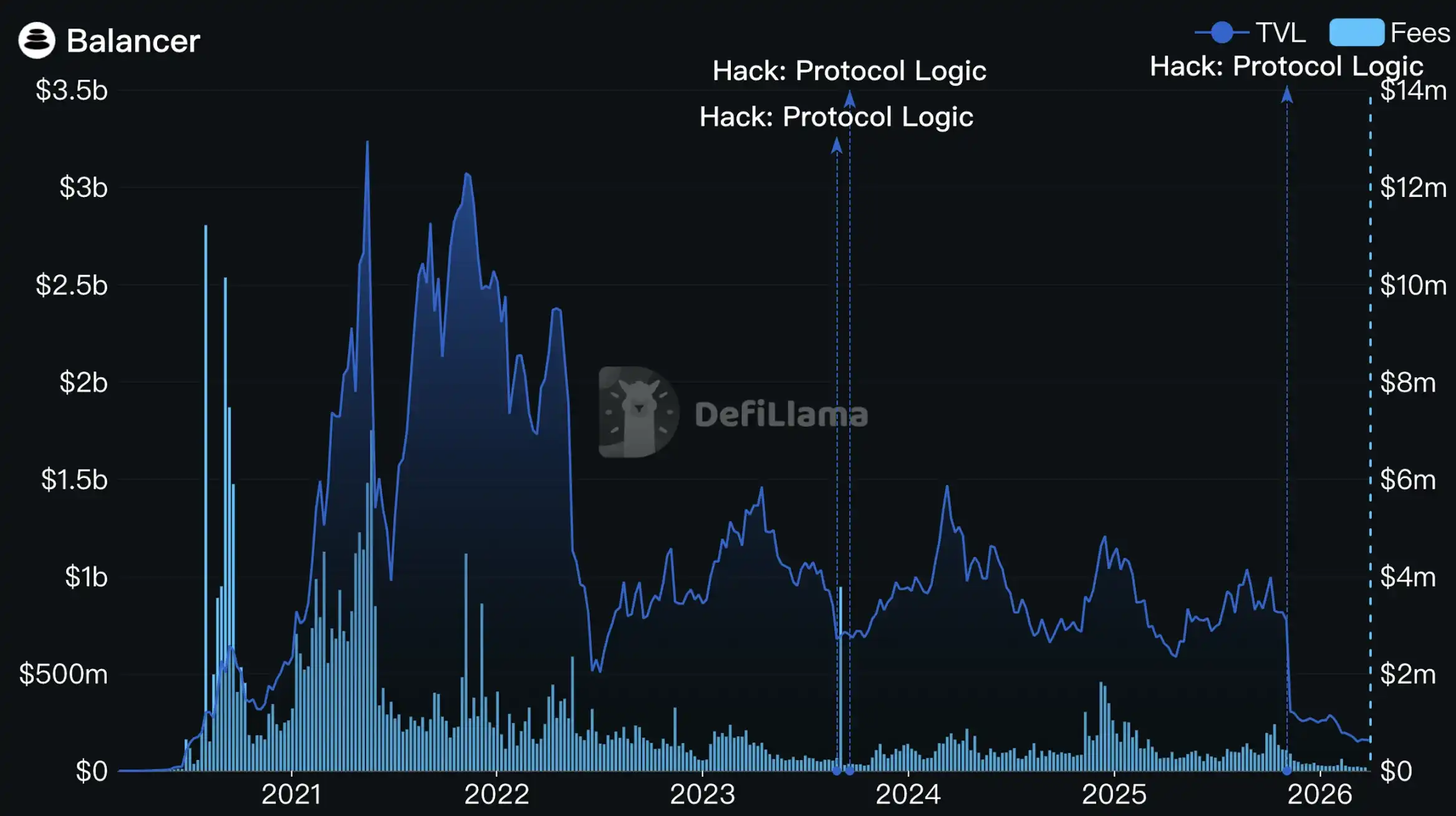
Source: DefiLlama

Balancer has officially reached a crossroads. On March 23, 2026, the Balancer core team simultaneously released two important governance proposals: a comprehensive overhaul of BAL tokenomics and an operational restructuring.

The core logic of these two documents combined can be summarized in one sentence: Abandon the growth model driven by token releases and shift towards sustainable operation driven by revenue.

Operational Restructuring: Team "Slimming Down," Annual Budget Reduced by 34%

The proposal suggests formally dissolving Balancer Labs, with its core technical personnel transitioning to contractor roles and merging into Balancer OpCo Limited, which will continue to operate as the DAO's legal proxy entity.

The team size will be compressed from about 25 people to 12.5 full-time equivalents (including dedicated service providers like Beets, MAXYZ, etc.), and the annual operating budget will be reduced from $2.87 million to $1.9 million, a 34% cut.
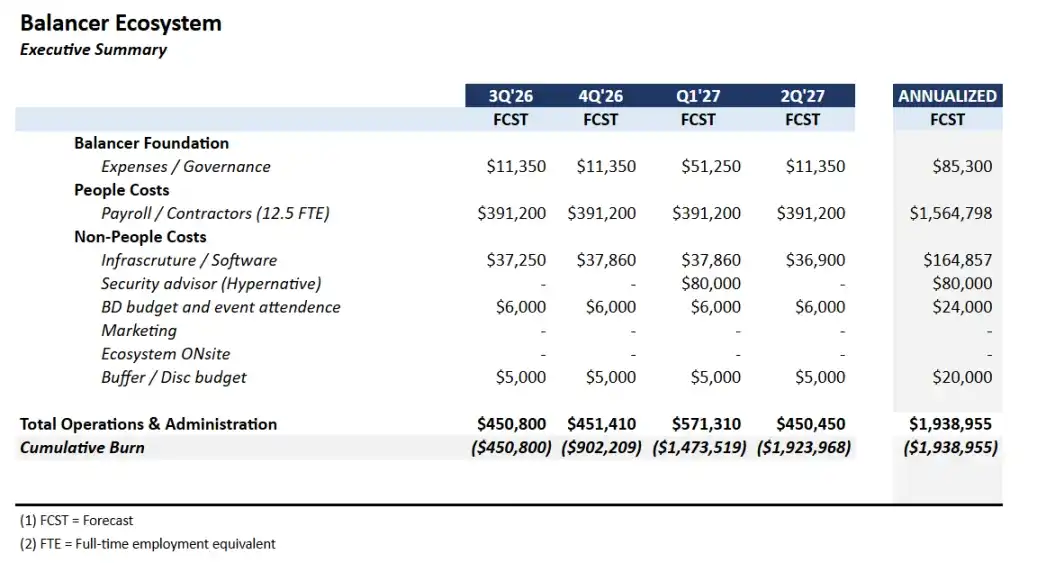
The product lines are also being drastically narrowed. The team will focus resources on three products with validated commercial viability: Boosted Pools (flagship product), reCLAMM (to be relaunched after fixing vulnerabilities, possibly renamed), and LBP (token launch pools, operated opportunistically).

Other exploratory directions, such as ETF structured products, yield optimizers, and AI-driven liquidity tools, will only proceed subject to meeting "core KPIs".

On-chain deployments are also being scaled back. The current model of maintaining V2 and V3 on over 9 chains is unsustainable. The team explicitly retains four core chains: Ethereum, Gnosis, Arbitrum, and Base. Other deployments will be reviewed individually based on fee revenue and operational costs, and terminated if they do not meet standards.

Tokenomics Reform: A Complete Overhaul, Not Minor Tweaks

Stop BAL Emissions, Abolish veBAL

If the proposal passes, Balancer will terminate BAL token incentive emissions, with no transition period.

Simultaneously, the veBAL governance mechanism will be formally abolished. Holders will stop receiving any economic rewards after the final bi-weekly fee distribution. Their locked veBAL will become purely governance credentials, waiting to expire at the end of the lock-up period.

This is a painful decision, but the logic behind it is clear: the veBAL mechanism had a structural flaw from the start, being prone to oligopolistic control. Currently, Aura Finance (a veBAL meta-governance protocol) and whales hold significant voting power, making genuine community voices increasingly faint in governance. This mechanism not only failed to promote the protocol's healthy development but became a vehicle for circular economic games — protocol money flows to middlemen via incentives, and the middlemen's votes direct more incentives towards themselves.

If veBAL was once an experiment by Balancer borrowing from Curve's design, the team now frankly admits: the experiment is over, and the results did not meet expectations.

Regarding the termination of veBAL economic rights, Balancer stated it will provide a $500,000 compensation activity, distributed directly to veBAL holders as pure cash compensation.

All Fees Go to DAO Treasury, Reduce V3 Protocol Take Rate

All protocol fees — V2 swap fees, V3 swap fees, Yield fees, LBP fees — will thereafter flow 100% to the DAO treasury, abandoning the previous multi-party split mechanism.

Simultaneously, the V3 protocol fee take rate will be reduced from 50% to 25%. This means for the same transaction, liquidity providers (LPs) previously received 50%, but will now receive 75%.

These two moves seem opposite in direction but share the same underlying logic: the former eliminates the circular economy, allowing the treasury to obtain real usable funds; the latter increases LP attractiveness, trading lower platform fees for more organic liquidity and real trading volume.

The proposal estimates that post-reform, the DAO's annualized revenue could reach approximately $1.22 million, more than 4 times the current $290,000.

Exit Option: Burn BAL for Stablecoins at $0.16 per Token

The treasury will also allocate 35% of its assets (currently about $3.6 million) to a dedicated pool. This is not for actively buying BAL on the secondary market, but to open a "burn for stablecoins" channel: BAL holders can voluntarily send their tokens to a contract to be burned, receiving stablecoins of equivalent value at the NAV price (Net Asset Value, approximately $0.16 per token).

The window will open 12 months after the proposal passes and last for 12 weeks. Any unused stablecoins after the window closes will return to the treasury. The 12-month waiting period is designed specifically to allow holders whose veBAL unlocks gradually to participate.

At the time of writing, the BAL price is $0.1548, below the NAV price. Offering an exit at the NAV price provides a more dignified option for those wanting to leave than a secondary market stampede.

If this channel is fully utilized, it would burn approximately 22.7 million BAL tokens, about 35% of the circulating supply, which is 6 times the current annual inflation emission.

9-Year "Runway": Is It Enough?

If both proposals pass, the team's projected financial model is as follows:

DAO annualized revenue ~$1.22 million (assuming TVL recovers somewhat after V3 fee reduction), annual operating expenses $1.9 million, buyback expenditure ~$3.6 million, plus the $500,000 veBAL compensation.

After completing the buyback and compensation, the treasury would still have approximately $6.2 million remaining. The annual funding gap would narrow from about $2.6 million to $700,000, giving a theoretical survival period of nearly 9 years.

For a DeFi protocol, 9 years is enough to span a full industry cycle.

But this model is built on optimistic assumptions: that reducing the V3 protocol take rate will indeed attract more organic TVL; that the slimmed-down team can truly support daily protocol operations, security maintenance, etc.; and that core products (especially reCLAMM) can successfully attract the market again after repairs.

If any link underperforms expectations, the 9-year survival period will shorten rapidly. The team itself explicitly states that if DAO monthly revenue falls below $60,000 for 3 consecutive months, a revised plan must be submitted to the community.

For Balancer, this is a nearly all-or-nothing reform. Abandoning the once-proud veBAL mechanism, abandoning the complex multi-party split structure, and returning to an extremely simplified origin: let real transaction fees drive protocol survival, not newly minted tokens maintaining false prosperity.

Whether this desperate reform will work ultimately depends on the market and time, awaiting long-term observation.


Perguntas relacionadas

QWhat were the main reasons behind Balancer's decision to abandon the veBAL mechanism and stop BAL token emissions?

ABalancer decided to abandon veBAL and stop BAL emissions because the veBAL mechanism was structurally flawed, leading to oligopolistic control by entities like Aura Finance and large holders, which stifled genuine community governance. The token-based growth model created a circular economy where incentives flowed to middlemen instead of supporting protocol health. Additionally, the annual inflation of 3.78 million BAL tokens created significant sell pressure, exacerbating financial unsustainability.

QHow does Balancer plan to address its financial sustainability issues after the proposed changes?

ABalancer aims to achieve financial sustainability by shifting to a revenue-driven model. Key measures include redirecting 100% of protocol fees to the DAO treasury, reducing operational budget by 34% to $1.9 million annually, and lowering the V3 protocol fee take rate to 25% to attract more organic liquidity. These changes are projected to increase DAO annualized revenue to approximately $1.22 million, extending the treasury's runway to nearly 9 years.

QWhat compensation is Balancer offering to veBAL holders, and how will it be funded?

ABalancer is offering a $500,000 compensation package to veBAL holders, funded directly from the DAO treasury. This is a cash compensation for the termination of their economic rights, as veBAL will become a governance-only credential with no further financial benefits after the final fee allocation.

QWhat is the purpose of the 'burn-for-stablecoin' mechanism, and how does it work?

AThe 'burn-for-stablecoin' mechanism allows BAL holders to voluntarily burn their tokens in exchange for stablecoins at a fixed Net Asset Value (NAV) price of $0.16 per BAL. It is designed to provide an orderly exit for holders wishing to leave, reducing sell pressure on the secondary market. The DAO will allocate 35% of its treasury (about $3.6 million) for this purpose, with the window opening 12 months after proposal approval and lasting for 12 weeks.

QWhich product lines and chains will Balancer focus on after the operational restructuring?

APost-restructuring, Balancer will concentrate resources on three commercially validated product lines: Boosted Pools (flagship product), reCLAMM (to be relaunched after bug fixes and possible rebranding), and LBPs (opportunistic operation). Deployment will be limited to core chains: Ethereum, Gnosis, Arbitrum, and Base, with other chains subject to review based on fee revenue and operational costs.

Leituras Relacionadas

Blocked Its Own Treasure, WeChat AI Steps Up

Tencent's stock surged over 10% on June 2nd amid reports that WeChat, with 1.43 billion monthly users, is finalizing tests for a native AI Agent. The reported feature, accessible by swiping right from the main interface, allows users to issue commands in natural language. The AI then decomposes tasks and automatically calls upon relevant Mini Programs within WeChat to complete actions like ordering food, booking tickets, or making payments, creating a closed-loop service execution system. This strategic shift follows the internal conflict and subsequent "blocking" of Tencent's standalone AI app, Yuanbao, by WeChat for violating sharing rules during a 2026 Spring Festival promotion. The incident highlighted a lack of internal consensus and exposed the weakness of competing in the standalone AI assistant arena against rivals like ByteDance's Doubao (345M MAU) and Alibaba's Qianwen. The new WeChat AI Agent aims to leverage WeChat's unique assets—its massive user base, standardized Mini Program APIs, WeChat Pay, and identity system—to move from simple content generation to actual task execution. Analysts note this changes the competitive landscape from model benchmarks to which AI can connect to more real-world services. However, success depends on key variables: the capability of Tencent's underlying Hunyuan model, managing massive inference costs, and redesigning incentives for Mini Program developers whose traffic might be bypassed. The move is seen as an attempt to keep user service intent within WeChat's ecosystem as AI begins to redefine how users access services.

marsbitHá 51m

Blocked Its Own Treasure, WeChat AI Steps Up

marsbitHá 51m

ByteDance Adopts Arm CPUs, Jensen Huang: So Sad I Didn't Buy Arm

**Summary:** At Computex 2026, Arm CEO Rene Haas announced that ByteDance and Oracle have adopted Arm's self-designed Arm AGI data center CPU. The company expects significant revenue growth from this product, projecting $20 billion in demand for the 2027/2028 fiscal years. Haas noted that restricting AI-capable CPUs from the US to China is nearly impossible due to their widespread applications. Arm's stock has surged dramatically this year, notably rising 16% after NVIDIA's Arm-based Vera CPU and RTX Spark announcements. A highlight was the informal, humorous on-stage conversation between Haas and NVIDIA CEO Jensen Huang. Huang joked about NVIDIA's failed attempt to acquire Arm and playfully lamented selling his Arm shares. Both executives showed a clear sense of camaraderie and shared regret over the missed merger. Key technical topics were discussed: 1. **AI PC Design:** Huang explained NVIDIA's RTX Spark superchip (with a 20-core Arm CPU) is designed for future AI agents that will autonomously run and use tools on PCs, blending local and cloud processing. 2. **Agent vs. OS:** Huang emphasized the operating system remains crucial, as AI agents rely on its APIs and tools to function. 3. **Growth Constraints:** He identified the shift to "useful AI" that generates profitable tokens as a primary driver for immense, almost limitless, computational demand. Haas outlined Arm's strategy across PC and data centers. For PCs, Arm collaborates with partners like NVIDIA and MediaTek, offering its compute subsystem (CSS) for custom SoCs. In data centers, its Arm AGI CPU (built on TSMC's 3nm process) has gained major partners including OpenAI, Meta, and now ByteDance and Oracle. Arm presented a multi-year roadmap for its in-house CPU line. The article concludes that while GPUs dominated the AI training race, the explosion of AI agents is shifting significant focus to CPUs for inference, state management, and tool orchestration. The industry is trending towards vertical integration, with companies like cloud providers designing chips and chip/IP firms offering full solutions, all competing to deliver more efficient computing per watt.

marsbitHá 1h

ByteDance Adopts Arm CPUs, Jensen Huang: So Sad I Didn't Buy Arm

marsbitHá 1h

New Wall Street Play: Yen Shorts Still Adding, But Japan Stocks Don't Rely on Carry Trade Unwinding

On June 3rd, USD/JPY hit 160.44, its highest level since July 2024, while the Nikkei 225 surged past 68,000 points. Contrary to popular narratives of an imminent "carry trade unwind" akin to August 2024, data reveals a more complex picture. Speculative net short positions in yen futures have actually increased, reaching -114,667 contracts by late May, suggesting traders are doubling down rather than retreating. Meanwhile, Japan's Finance Ministry conducted its largest-ever single-round FX intervention (11.73 trillion yen) in April-May but failed to hold the 160 yen line. The Nikkei's rally is not driven by carry trade dynamics. Foreign investors are aggressively buying Japanese stocks, with net purchases in 2026 running nearly 16 times higher than 2025 levels. This inflow is concentrated in AI and semiconductor-related stocks like SoftBank and Socionext, fueled by positive sector outlooks, rather than being a flight from unwinding yen shorts. Furthermore, the Nikkei has continued climbing despite the Bank of Japan's (BOJ) rate hikes to 0.75%. This disconnect exists because the current equity boom is fueled by AI-driven foreign investment, not reliant on cheap yen funding. However, this relationship remains fragile. Should the BOJ hike rates further (e.g., to 1.0%) while dollar weakness increases carry trade costs, the trajectories of the yen and Japanese stocks could reconverge, potentially triggering volatility.

marsbitHá 1h

New Wall Street Play: Yen Shorts Still Adding, But Japan Stocks Don't Rely on Carry Trade Unwinding

marsbitHá 1h

Broadcom's Q3 Guidance Misses Expectations by $12 Billion, After-Hours Trading Plummets Over 13%, AI Narrative "Cooling"?

On June 3, Broadcom released record Q2 FY26 results with revenue of $22.19B, up 48% YoY, and AI chip sales of $10.8B, up 143%. Adjusted EPS of $2.44 beat estimates. However, its Q3 AI semiconductor revenue guidance of $16B, while up over 200% YoY, fell roughly $1.2B (7%) short of analyst consensus expectations of $17.2B. This miss, coupled with slightly weaker-than-expected software revenue, triggered a severe market reaction. CEO Hock Tan maintained the FY26 AI revenue outlook of over $100B but did not raise it, disappointing investors who had priced in more robust growth. The stock plummeted over 13% in after-hours trading, erasing roughly $270B in market cap. The sell-off extended to peers like Marvell. A key concern for markets, particularly for Chinese optical module suppliers, was Tan's comment that the contribution of AI networking (e.g., Ethernet switches, optical interconnect chips) to AI revenue, currently near 40%, is expected to normalize to around 30% over time, signaling a potential peak in growth for that segment. Despite the guidance shortfall, Tan reiterated that AI demand remains "insatiable" and reaffirmed the long-term target of exceeding $100B in AI revenue by FY27. The reaction highlights the heightened sensitivity and premium valuation placed on AI-exposed stocks, where anything less than stellar guidance can prompt significant profit-taking. The broader question is whether this represents a cooling AI narrative or a correction in overstretched valuations.

marsbitHá 1h

Broadcom's Q3 Guidance Misses Expectations by $12 Billion, After-Hours Trading Plummets Over 13%, AI Narrative "Cooling"?

marsbitHá 1h

Trading

Spot
Futuros
活动图片