Abandon Illusions, Prepare for the Most Grueling Time in the Crypto Market

marsbitPublicado em 2025-12-20Última atualização em 2025-12-20

Resumo

The article argues that while cryptocurrency adoption will continue to accelerate, market valuations may remain depressed or decline further for a prolonged period. This decoupling between real-world usage and price action is presented not as a flaw, but as a necessary and healthy feature of the market's maturation. The author draws a parallel to the dot-com bubble, where internet user growth exploded even as the Nasdaq crashed. The core thesis is that the market is undergoing a painful but essential recalibration. Many assets were fundamentally overvalued, and the current phase will pressure-test business models, eliminating flawed projects and forcing rational valuations. Cryptocurrency is transitioning from a speculative asset to a core, "boring" infrastructure technology, much like the internet did. This shift creates discomfort. Builders, early investors, and retail token holders may see value captured by traditional companies and VCs that leverage the open infrastructure. The article posits that the biggest beneficiaries might be traditional and hybrid businesses that use crypto to improve efficiency, rather than the underlying protocols themselves. The author's outlook for near-term prices is not optimistic, warning that the process could be a prolonged test of patience. They advocate for a long-term perspective, capital preservation, and a focus on businesses with sound unit economics, while cautioning against over-financialized models and excessive infrastructure ...

Author: Santiago Roel Santos

Compiled by: Tim, PANews

The Price and Adoption Paradox

Crypto adoption will continue, but market prices may not recover for a long time.

This contradiction between accelerating real-world adoption and lagging market prices is not a flaw, but a necessary feature of the current stage of crypto market evolution.

If you look at the crypto market from a ten-year perspective, its prospects are very attractive. However, maintaining this long-term perspective is psychologically challenging. You should be prepared to watch adoption rates expand while prices stagnate or slowly decline; you must also be prepared to watch others profit in other areas (AI, stocks, or the next hot trend the market hypes) while the crypto space seems forgotten.

It will feel unfair, and the process will be grueling. But the price lag is inevitable. Fundamentally, many of these crypto assets never deserved the valuations they once had.

The market doesn't care about actual adoption until the price crashes and it starts to care again.

Application Proliferation Fuels Bubbles

Initial application proliferation can actually fuel bubble problems. This is the painful process of value discovery. When real usage demand cannot support inflated valuations, the market will recalibrate, and this is precisely the necessary path to long-term healthy development.

When crypto infrastructure achieves scaled application, it becomes clear that the capital invested far exceeds its actual needs. Application proliferation will bring pressure tests for business models rather than value verification. Some projects will die off quietly, and while others may survive, their valuations will be far lower than the visions painted at their peak.

Cryptocurrency is moving from the spotlight, the main character, to gradually fading from view, becoming ordinary. From exciting to mundane, and this is the necessary path from noise to maturity.

This is a good thing.

This script isn't new. During the dot-com bubble burst, the NASDAQ index plummeted by about 78%, while the number of internet users tripled and broadband infrastructure was fully deployed. The market took years to recover, and now the internet has quietly reshaped the world. While investors were still licking their wounds, software was "eating" the whole world.
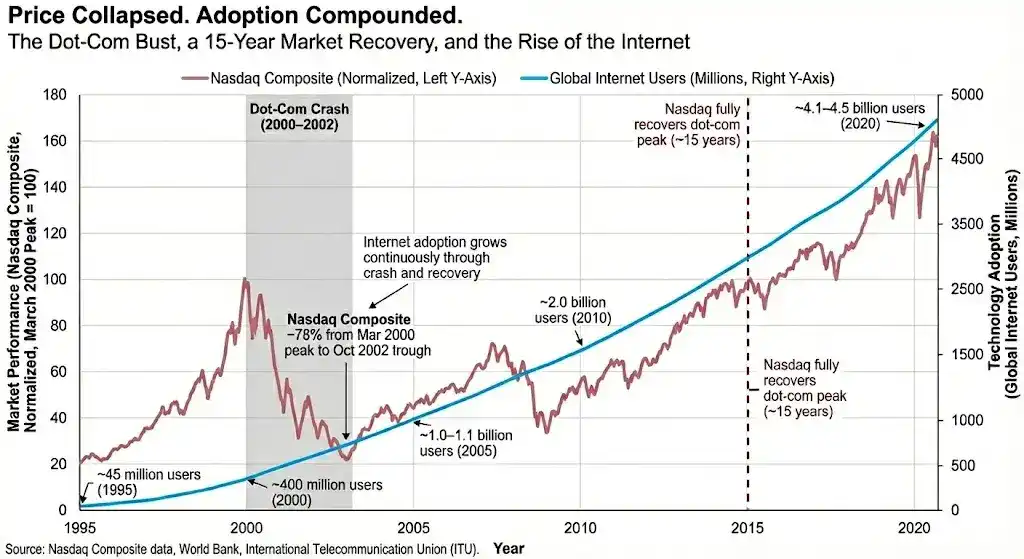
Infrastructure technology does not reward impatient investors.

When Infrastructure Wins, Who Will Be the Real Winners?

The shift in market phases will make many participants uncomfortable. Builders who have spent years maintaining open-source codebases will watch other companies copy their work and reap most of the economic benefits; early native crypto VCs who invested in infrastructure will see traditional VCs capture more value; retail investors who bought tokens instead of equity may feel marginalized, as enterprises benefit from the ecosystem network without returning corresponding value to token holders.

Some are structural problems, some are self-inflicted dilemmas.

The market is adjusting itself. Open networks will develop rapidly, system incentives will change, value capture mechanisms will improve, but not all models will survive long enough to benefit.

Crypto adoption is quietly advancing, it's just that the market hasn't truly valued it yet. It may take years for the market to re-establish the value connection and recognize that crypto technology is a core operating system, not just a speculative asset.

Price Cycles and Application Cycles Are Two Different Things

Price cycles are driven by market psychology and liquidity.

Application cycles are driven by utility value and infrastructure.

The two are related, but not synchronized. Historically, prices often led adoption, which is common in early technological revolutions. Now, adoption is starting to lead, and prices are instead lagging.

Right now, the marginal buyers of crypto assets are elsewhere, they are chasing the AI wave. This phenomenon may continue, or it may reverse, regardless of our will.

But what we can see is that a world without stablecoins, without transparent capital channels, without global 24/7 real-time settlement is becoming increasingly difficult to imagine.

The most profound lesson cycles teach us is: we must accept that the disconnect between application and price may last much longer than expected, and if you want sustained compound interest, you need to remain rational when you lose patience.

This is not a HODL manifesto.

Many crypto projects will never recover. Some were flawed by design, some lack moats, and others have been completely abandoned. New winners will inevitably be born, there will be fallen stars, and a few true dark horses.

Pullbacks Are Healthy

We are entering a different regulatory and economic environment. This creates an opportunity to solve long-standing problems: weak product revenue, insufficient asset disclosure, mismatched equity and token structures, and opaque team incentives.

If the crypto industry really wants to become what it aspires to be, it must first act the part.

I believe anything is possible. My most confident view is that most businesses will adopt crypto technology to remain competitive within the next 15 years. By then, the total market capitalization of cryptocurrency will exceed ten trillion dollars. Stablecoins, tokenization, user scale, and on-chain activity will grow exponentially. Meanwhile, valuation standards will be redefined, existing giants may decline, and unreasonable business models will eventually be eliminated.

This is healthy, and necessary.

Cryptocurrency will eventually become invisible. The more a company makes crypto the core of its product, the more fragile its business model often is. The truly lasting winners will embed it deeply in business processes, payment systems, and balance sheets. Users should not be aware of the crypto technology's existence, but should feel its benefits: faster settlement, lower costs, and reduced intermediaries.

Cryptocurrency should be pure and "boring".

As capital tightens, the era of airdrop proliferation, subsidy-driven demand, unreasonable incentives, and over-financialization is coming to an end. This is just another inevitable historical cycle.

My basic judgment is simple: crypto adoption will accelerate, prices will readjust, and valuations will return to rationality. Crypto is a long-term trend, but this absolutely does not mean the tokens you hold will necessarily rise.

Who Actually Captures the Value of Crypto Technology?

Basic technology primarily benefits consumers by lowering prices and improving experience. The secondary beneficiaries are those enterprises that upgrade their own systems to leverage cheaper, faster, more programmable infrastructure.

This theoretical framework raises some uncomfortable but necessary questions:

  • Visa or Circle?
  • Stripe or Ethereum?
  • Robinhood or Coinbase?
  • A basket of Layer 1 protocols or user aggregators?
  • A basket of Layer 1 protocols or DeFi?
  • A basket of Layer 1 protocols or DePIN?
  • DeFi or traditional finance stocks?
  • DePIN or infrastructure stocks?

This isn't an absolute either/or; diversified investment strategies are also feasible. The question is about relative value and relative performance. Who will capture the surplus value created by blockchain?

I lean towards traditional and hybrid enterprises that connect to open settlement channels to reduce costs and increase profit margins. History suggests they often benefit more than the infrastructure itself.

But it must be emphasized that there are exceptions to every theoretical framework.

What I Believe, and What I Don't

I do believe that networks with real demand will eventually monetize, the internet has proven this. Facebook also went through many years before commercialization.

I am confident that the value of some Layer 1s will be validated as they develop, eventually matching their valuation. But I also believe most will struggle to attract users and find sufficient value support.

I believe the gap between winners and losers will widen further. Distribution, market entry strategy, user relationships, and unit economics will be far more important than first-mover advantage.

A common misconception in crypto is overestimating the early advantage of technological leadership while underestimating other elements required for subsequent development.

Back to Reality

My view on price movements in the coming years is not particularly optimistic. Adoption will continue to rise, but prices may fall further, potentially exacerbated by broader stock market mean reversion and a cooling AI hype cycle.

But, patience is a great advantage.

  • I am bullish on Crypto-as-a-Service models
  • I am bullish on crypto-enabled enterprises
  • I am bearish on over-financialization
  • I am bearish on failed unit economics
  • I am bearish on overbuilding infrastructure

Protecting capital becomes crucial. Cash is undervalued: not for its yield, but for the psychological immunity it grants. It allows you to act decisively when others cannot.

The market has entered a fast-paced and increasingly impatient era. Nowadays, having a longer time horizon than most participants is itself a substantial advantage. Professional managers must frequently adjust positions to prove their value. Faced with increasing life pressures, retail investors are increasingly chasing short-term trends. And institutional investors will inevitably once again declare cryptocurrency dead.

Slowly, more traditional companies will adopt crypto technology, more balance sheets will connect to the blockchain.

One day, when we look back on this period in hindsight, everything will seem so clear. The signals were everywhere, it's just that firm conviction often seems easy only after prices rise.

Until then: wait for the pain to arrive.

Wait for sellers to capitulate, wait for faith to collapse, but we are not there yet.

No need to rush into action, the market will continue to fluctuate, life goes on, spend more time with the people you care about. Don't let your investment portfolio become your whole life.

The crypto world will operate silently, whether the market is in the shadows or under bright lights.

Good luck to all.

Perguntas relacionadas

QAccording to the article, what is the paradox between price and adoption in the current crypto market?

AThe paradox is that crypto adoption continues to accelerate, but market prices may stagnate or decline for a long time. This is a necessary feature of the current stage of market evolution, not a flaw.

QWhat historical event does the author compare the current crypto market phase to, and what was the outcome of that event?

AThe author compares it to the dot-com bubble burst, where the NASDAQ index fell about 78% while internet user numbers tripled and broadband infrastructure was widely deployed. The market took years to recover, but the internet ultimately reshaped the world.

QWho does the author suggest will be the ultimate beneficiaries as crypto infrastructure matures and becomes widely adopted?

AThe author suggests that the primary beneficiaries will be consumers through lower prices and better experiences, and the secondary beneficiaries will be traditional and hybrid enterprises that upgrade their systems to use the cheaper, faster, and more programmable infrastructure.

QWhat is the author's view on the future price trend of crypto assets in the coming years?

AThe author is not particularly optimistic about price movements in the coming years. They believe adoption will continue to rise, but prices may fall further, potentially exacerbated by a broader stock market mean reversion and a cooling AI hype cycle.

QWhat key piece of caution does the author give to investors regarding their investment strategy and mindset?

AThe author cautions that protecting capital is crucial and emphasizes the underestimated value of cash, not for its yield, but for the psychological immunity it provides, allowing one to act decisively when others cannot. They advise having a longer time horizon and not letting one's portfolio become their entire life.

Leituras Relacionadas

STAR 50 Soars 10.73%, Why Did A-Shares Stage a "V-Shaped Reversal"?

After a prolonged decline, the Chinese A-share market staged a strong rally on July 21. The STAR 50 index surged 10.73%, its largest single-day gain in nearly a year, leading a broad-based "V-shaped" reversal. The Shanghai Composite Index rose 1.79%, the Shenzhen Component Index gained 4.81%, and the ChiNext Index jumped 7.05%. Total market turnover reached 2.97 trillion yuan, an increase of 256.1 billion yuan from the previous session, with over 3,100 stocks advancing. The semiconductor sector spearheaded the rebound, with related ETFs posting significant gains. Analysts attribute the surge to three converging factors. First, coordinated capital inflows from "national team" institutions, insurance funds, listed company buybacks, and fund house self-purchases have bolstered market liquidity and confidence. Second, supportive policy signals, including commitments from regulators to ensure stable market operations, provided a favorable backdrop. Third, a stabilization and recovery in overseas markets, notably South Korea, created a positive external environment. Institutions suggest the most severe panic selling phase for the tech sector has likely passed, following a significant digestion of crowded positions and leveraged funds. While short-term volatility may persist, the medium to long-term outlook remains underpinned by enduring trends like AI computing demand expansion and semiconductor localization. The market's focus now shifts to the sustainability of supportive fund flows, earnings reports, and upcoming catalysts from the global AI industry chain.

marsbitHá 27m

STAR 50 Soars 10.73%, Why Did A-Shares Stage a "V-Shaped Reversal"?

marsbitHá 27m

U.S. Tech Momentum Stocks Post Largest Single-Day Gain Ever, But Is the Plunge Over?

US tech momentum stocks staged a sharp rebound on Tuesday (July 21st). Morgan Stanley's TMT Momentum Factor surged over 12%, marking its largest single-day gain on record, exceeding even peaks from the 2000 dot-com bubble. Key momentum indices from Goldman Sachs also posted their strongest daily performances in years. The rally was led by semiconductors, with the Philadelphia Semiconductor Index jumping 4.6%. This rebound followed three consecutive down days and a cumulative 33% plunge in momentum stocks, one of the steepest drawdowns since the dot-com era. Analysts attribute the surge largely to a short squeeze. Heavy selling had pushed high-beta momentum stocks into deeply oversold territory, forcing many short sellers, particularly in Asia, to cover their positions, creating a self-reinforcing buying spiral. However, the rebound's internals appear weak. Trading volume was notably low, and advancing stocks still lagged decliners on the S&P 500, indicating a narrow, concentrated rally rather than broad market participation. Diverging views emerge on the outlook. BTIG warns the bounce has hit key resistance and recommends selling into strength, citing extreme volatility and historical parallels to past market tops. Conversely, Goldman Sachs and UBS believe the momentum unwind is nearing its end, suggesting it may be time to gradually add exposure, as positioning has been significantly reduced. They caution, however, that high volatility warrants a measured approach, potentially using defined-risk strategies. The upcoming earnings season, particularly reports from major tech firms like Alphabet, is seen as a critical test for the rally's sustainability. Simultaneously, bond markets flashed a warning, with yields rising partly due to spiking oil prices. Analysts note that if long-term Treasury yields break decisively higher, it could pose a significant headwind for equities, especially growth stocks.

marsbitHá 34m

U.S. Tech Momentum Stocks Post Largest Single-Day Gain Ever, But Is the Plunge Over?

marsbitHá 34m

U.S. Tech Momentum Stocks Record Largest Single-Day Gain Ever, but Has the Rout Ended?

U.S. tech momentum stocks staged a dramatic rebound on Tuesday, July 21st. Key momentum indices like the Morgan Stanley TMT Momentum Factor and Goldman Sachs' High Beta Momentum Long Index posted historic or near-historic single-day gains, fueled largely by semiconductor stocks. This sharp rally followed a severe three-day sell-off that saw momentum stocks plunge 33%, marking one of the steepest pullbacks since the dot-com bubble. Analysts attribute the bounce primarily to a short squeeze, as forced covering from over-leveraged traders, particularly in Asia, created a buying spiral. However, the rally's health is questioned due to weak market breadth—overall trading volume was low, and decliners outnumbered advancers in the S&P 500 despite the index's gain—suggesting a narrow, concentrated surge rather than broad recovery. Opinions on the sustainability diverge. BTIG strategists warn the rebound has hit key resistance levels, citing extreme volatility and historic stock dispersion as signs of an ongoing broader correction, and recommend selling into strength. Conversely, Goldman Sachs and UBS view the aggressive momentum unwinding as nearing its end, noting reduced positioning and a lack of new fundamental catalysts. They suggest the sell-off presents a selective opportunity to add exposure, albeit cautiously and gradually using defined-risk strategies. The immediate trajectory hinges on the ongoing earnings season, with market focus on Alphabet's capital expenditure guidance for AI investment clarity. Meanwhile, bond markets present a risk, with rising Treasury yields—potentially heading toward 5.5%—and widening credit spreads for mega-cap tech companies posing a threat to equity valuations. The combination of technical factors, earnings results, and macro conditions leaves the durability of the rebound in doubt.

链捕手Há 37m

U.S. Tech Momentum Stocks Record Largest Single-Day Gain Ever, but Has the Rout Ended?

链捕手Há 37m

Long-Divided Must Unite, Long-United Must Divide: When L1 Becomes Its Own Rollup, What Is Ethereum's Endgame?

"The Inevitable Cycle: When L1 Becomes Its Own Rollup – What is Ethereum's Endgame?" For years, the Ethereum community grappled with concerns that L2s were fragmenting the ecosystem and eroding L1's value. While L2s provided cheaper execution, they also splintered liquidity and the unified user experience of a single chain. This has prompted a fundamental reassessment of the relationship between L1 and L2. Ethereum's roadmap is evolving. The "Scale" initiative merges L1 and L2 expansion into a holistic framework. L1 itself is advancing with higher gas limits, statelessness, and zkEVM verification, no longer content to be just a low-throughput settlement layer. Consequently, the primary value proposition of L2s is shifting from merely providing cheap blockspace to offering L1 cannot easily provide: application-specific optimizations, privacy features, and flexible governance models. L2s are becoming a spectrum of execution environments with varying degrees of security inheritance from Ethereum. A critical challenge in this multi-chain future is interoperability. The vision is to make Ethereum "feel like one chain again." This relies on advancements in native account abstraction (like EIP-7702) and intent-based architectures (Open Intents Framework), where users declare desired outcomes, and solvers handle the complex cross-chain execution. Furthermore, shortening Ethereum's finality time from minutes to seconds is crucial, as it underpins trust between chains for bridges, stablecoins, and cross-chain applications. Perhaps the most provocative idea is that Ethereum L1 itself could become a form of "its own Rollup." As zkEVM and proof systems mature, high-performance nodes could execute transactions and generate validity proofs. Regular validators would then verify these proofs instead of re-executing all transactions. This blurs the traditional L1/L2 hierarchy, making "Rollup" more of a general execution-verification architecture. Native Rollup aims to integrate L2 validation more directly into the Ethereum protocol, allowing L2s to inherit L1's security more fully and move away from reliance on security councils. In the end, L2s are not destined to replace L1 or be made obsolete by it. The likely future is a unified system where diverse execution environments—each optimized for specific use cases like DeFi, gaming, or privacy—coexist. They will share a common foundation of security, liquidity, and verifiable state, seamlessly connected to restore a cohesive user experience. The next phase for Ethereum is not just about scaling through separation, but about intelligently reintegrating what was separated back into a coherent whole.

链捕手Há 53m

Long-Divided Must Unite, Long-United Must Divide: When L1 Becomes Its Own Rollup, What Is Ethereum's Endgame?

链捕手Há 53m

Trading

Spot
活动图片





