Aave Scraps Avara and Family Wallet as SUBBD Momentum Builds

bitcoinistPublicado em 2026-02-04Última atualização em 2026-02-04

Resumo

Aave has retired its Avara brand and shut down the Family Wallet, signaling a strategic retreat from consumer-facing products to refocus on its core lending protocol and Lens ecosystem. This move reflects a broader market shift away from generalist "super-apps" toward specialized platforms that solve specific industry problems. In this context, SUBBD Token is gaining momentum by targeting the $85 billion creator economy. It combines AI and Web3 to disrupt high-fee structures and platform dependency faced by content creators. The project offers AI-driven tools like personal assistants, voice cloning, and influencer creation to automate and monetize content. SUBBD has raised over $4.5 million in its presale, with tokens priced at $0.05749. It also offers a 20% APY staking incentive to encourage long-term holding. The platform emphasizes creator sovereignty, reduced fees, and direct audience monetization—addressing key pain points that mainstream platforms like OnlyFans and Patreon fail to resolve. This utility-focused approach contrasts with Aave’s abandoned broader strategy, highlighting a market trend where crypto is valued for solving real-world problems rather than offering generalized interfaces.

Trusted Editorial content, reviewed by leading industry experts and seasoned editors. Ad Disclosure

Quick Facts:

  • ➡️ Aave has retired the Avara brand and shuttered the Family Wallet to refocus on its core lending protocol and Lens ecosystem.
  • ➡️ The market trend is shifting away from generalist “super-apps” toward specialized platforms that solve specific industry pain points.
  • ➡️ SUBBD Token is capitalizing on this shift by using AI and Web3 to disrupt the high-fee structures of the $85B creator economy.
  • ➡️ Early data shows strong demand for SUBBD’s model, with over $4.5 million raised during its presale phase.

The ‘crypto super-app’ dream took a hit this week. Aave, one of decentralized finance’s largest lending protocols, announced a strategic retreat from its consumer-facing wallet ambitions.

Stani Kulechov, Aave’s founder, confirmed the organization is retiring the ‘Avara’ parent brand and shutting down the Family Wallet, a product acquired just last year to bridge the gap between DeFi and everyday users.
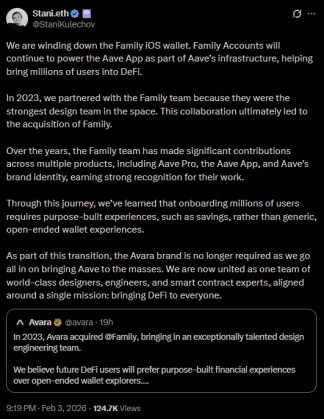

It’s a sharp pivot back to basics. For the past two years, the narrative was all about expansion—building social graphs (Lens Protocol), stablecoins (GHO), and wallets under one massive umbrella. But that era appears over.

The reversal suggests the market frankly no longer rewards broad, open-ended ecosystems that lack immediate stickiness. Instead, liquidity is flowing toward purpose-built protocols that solve specific, high-friction problems rather than general utility.

This restructuring comes as the broader crypto market hunts for the next major narrative beyond simple asset speculation. While infrastructure giants like Aave consolidate to defend their moats, capital is rotating into sectors offering tangible utility for non-crypto natives.

Specifically, the intersection of AI and the creator economy is seeing aggressive growth. It’s within this vacuum of consumer utility that projects like SUBBD Token ($SUBBD) are finding traction, using the exact kind of specialized focus that the ‘Family’ wallet missed.

Buy your $SUBBD here.

AI Tools Replace Generic Interfaces

The failure of the Family Wallet highlights a brutal truth in crypto: users don’t need another place to store private keys; they need a reason to use them.

While Aave retreats to infrastructure, SUBBD Token ($SUBBD) is capitalizing on the $85 billion content creation industry by attacking the inefficiencies of Web2 incumbents. The current landscape for creators is defined by exploitation, platforms routinely extract up to 70% of earnings in fees, while arbitrary bans restrict audience reach.

SUBBD addresses this not by building a generic wallet, but by deploying an EVM-compatible ecosystem designed specifically for creator sovereignty. By merging Web3 payments with proprietary AI models, the platform offers tools that were previously fragmented across a dozen subscriptions.

Features like the AI Personal Assistant allow creators to automate interactions, while AI Voice Cloning and AI Influencer Creation open new revenue streams that don’t require the creator to be physically present 24/7.
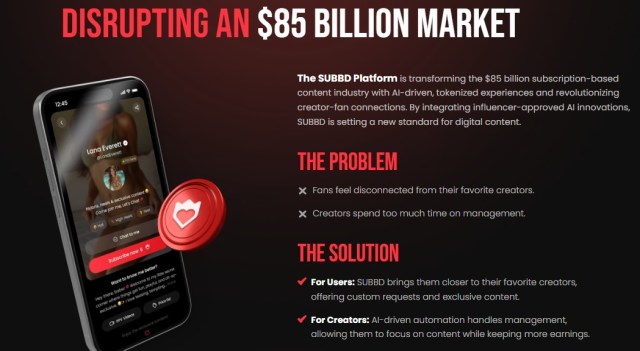
This utility-first approach differs fundamentally from the strategy Aave just abandoned. Where Avara attempted to capture users through a generalist interface, SUBBD captures them through essential service provision. The platform’s decentralized architecture ensures creators maintain ownership of their content and earnings, removing the middleman risk that plagues platforms like OnlyFans or Patreon.

For the market, this represents a shift from ‘crypto as a wallet’ to ‘crypto as a business backend.’

Check out the SUBBD ecosystem.

SUBBD Presale Draws Capital Seeking Utility

The market’s appetite for this specific utility is quantifiable. While legacy DeFi tokens struggle with governance restructuring, SUBBD Token has maintained steady inflows during its presale phase.

According to current data, the project has successfully raised $1.4M, signaling strong confidence from early adopters who view the convergence of AI and content monetization as the next logical step for retail crypto adoption.

Investors are currently entering at a price point of $0.05749, positioning themselves before the platform’s full public rollout. Beyond the speculative aspect, the protocol’s staking mechanics are designed to encourage long-term ecosystem stability.
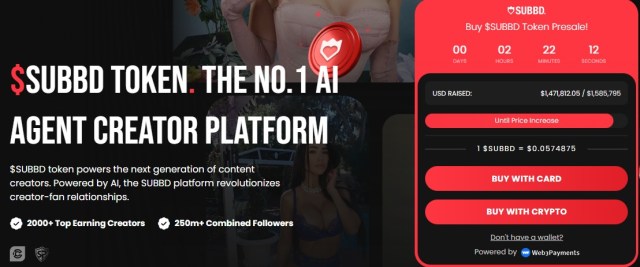
The project offers a fixed 20% APY for the first year to participants who lock their tokens. This incentive structure does two things: it reduces circulating supply volatility during the critical early growth phase, and it aligns incentives between the platform’s developers and its community.

Smart money monitors these metrics closely because they suggest a departure from ‘vaporware.’ The token serves a dual purpose: governance rights over platform features, such as voting on AI creator curation, and utility within the ecosystem for tipping, subscriptions, and accessing token-gated content.

As Aave refocuses on the backend of DeFi, projects like SUBBD are building the front-end utility that actually drives mass adoption.

You can buy $SUBBD here.

The content provided in this article is for informational purposes only and does not constitute financial advice. Cryptocurrency investments carry inherent risks, including high volatility and potential loss of capital. Always conduct your own due diligence before investing.

Editorial Process for bitcoinist is centered on delivering thoroughly researched, accurate, and unbiased content. We uphold strict sourcing standards, and each page undergoes diligent review by our team of top technology experts and seasoned editors. This process ensures the integrity, relevance, and value of our content for our readers.

patrubogdan

Follow

Full Profile

Related Posts

Crypto Market Structure Bill Nears Key Moment As CFTC Chair Signals Progress Within Months

Dubai’s $280M Diamond Tokenization Sets RWA Precedent as Bitcoin Hyper Secures $31.2M

Bitcoin Dominance Shifts: Crypto Usage Spreads Beyond Bitcoin as $HYPER Keeps Gaining

Binance Crushes Competition With $155B Asset Surge; $HYPER Emerging as Bitcoin L2 Leader

Criptomoneda prometedora para invertir ante el cambio de sentimiento: el auge de la infraestructura Bitcoin

Criptomoneda prometedora para invertir mientras cambia el sentimiento del mercado: Bitcoin Hyper redefine la Capa 2

Perguntas relacionadas

QWhat strategic changes did Aave announce regarding its consumer-facing products?

AAave announced it is retiring the 'Avara' parent brand and shutting down the Family Wallet, a product it acquired last year, to refocus on its core lending protocol and the Lens ecosystem.

QAccording to the article, what market trend is causing a shift away from 'super-apps'?

AThe market trend is shifting away from generalist 'super-apps' toward specialized platforms that solve specific, high-friction industry pain points and offer tangible utility.

QWhat specific industry is SUBBD Token targeting, and what is its total market size?

ASUBBD Token is targeting the content creator economy, which the article states is an $85 billion industry.

QWhat are two specific AI-powered tools the SUBBD platform offers to creators?

AThe SUBBD platform offers an AI Personal Assistant to automate interactions and AI Voice Cloning and AI Influencer Creation to open new revenue streams.

QHow much capital has the SUBBD Token presale raised, according to the data in the article?

AAccording to the article, the SUBBD Token presale has raised $1.4 million.

Leituras Relacionadas

From Gas Limit to 'Keyed Nonces', How to Understand the Next Step in Ethereum Scalability?

Ethereum’s scalability efforts are shifting toward a user-centric approach—focusing not only on higher TPS, but on translating technical upgrades into lower costs, smoother operations, and better wallet experiences. Two recent developments highlight this direction: - **Raising the Gas Limit to 200 million**: Following the Fusaka upgrade that increased it to 60 million, a consensus has formed around a potential future increase to 200 million. This would boost Ethereum’s execution capacity, but it is planned alongside other upgrades—such as ePBS, Block-Level Access Lists (BAL), and EIP-8037—to manage state growth and keep node operation viable for average participants. - **Keyed Nonces (EIP-8250)**: This proposal aims to improve how transactions are queued. Instead of a single linear nonce per account, it introduces multiple independent nonce domains. This prevents different types of transactions—such as private payments, session keys, or batch operations—from blocking each other. Vitalik Buterin views this as a foundational step toward better privacy support and more flexible state scalability. Together, these upgrades are part of a broader move to push complexity from wallets, DApps, and relays back into the protocol layer. For everyday users, this means future Ethereum interactions could become less congested, more intuitive, and safer—especially as core improvements in account abstraction, cross-L2 interoperability, and node decentralization continue to progress. Ultimately, Ethereum is evolving to handle not just more transactions, but more varied and complex on-chain use cases while preserving its decentralized foundation.

marsbitHá 13m

From Gas Limit to 'Keyed Nonces', How to Understand the Next Step in Ethereum Scalability?

marsbitHá 13m

Leaving OpenAI, How Much Has Their Net Worth Increased?

Former OpenAI employees have collectively accrued near-trillion dollar valuations through ventures and investments, charting AI's future. The article highlights two main paths: founding high-value companies like Anthropic and Perplexity, or applying insider insights as investors. Leopold Aschenbrenner exemplifies the investor path. After being fired from OpenAI, he leveraged firsthand knowledge of AI's massive energy demands to make hugely successful public market bets on nuclear and fuel cell companies, practicing "cross-industry cognitive arbitrage." Other alumni, like the Zero Shot VC fund founders, use their technical foresight for early-stage investing. Their key advantage lies not just in picking winners, but in knowing which technical approaches are likely dead ends—a "veto list" derived from internal OpenAI experience. Angel investing within the network, as seen with Mira Murati and Sam Altman, operates on deep, pre-existing understanding of a founder's capabilities, reducing due diligence to near zero. This creates an ecosystem bound by a shared belief in AGI's imminent arrival, differing from networks like the "PayPal Mafia" which were built on shared past struggles. The shift of these builders to investors signals a profound conviction: their situational awareness of the AI landscape is now so clear that deploying capital based on that judgment is more efficient than building themselves. They are allocating bets on the future they helped shape from the inside.

marsbitHá 24m

Leaving OpenAI, How Much Has Their Net Worth Increased?

marsbitHá 24m

Countdown to the AI Bull Market? Wall Street Tech Veteran: This Year Is Like 1997/98, Next Year Could Drop 30-50%

"AI Bull Market Countdown? Wall Street Veteran: This Year Feels Like 1997/98, Next Year Could Drop 30-50%" In an interview, veteran tech analyst Dan Niles draws parallels between the current AI boom and the 1997-98 period of the internet boom, suggesting the bull run isn't over yet. The core new driver is identified as "Agentic AI," which performs multi-step tasks and consumes vastly more computing power than conversational AI. This shift is expected to boost demand for cloud infrastructure and benefit CPU makers like Intel and AMD, potentially pressuring GPU leader Nvidia. However, Niles warns of significant short-term overbought conditions in semiconductors. His central warning is for a potential major market correction of 30-50% starting in early 2027. Drivers include a slowdown from high growth comparables, the outsized capital demands of companies like OpenAI, and a wave of massive tech IPOs sucking liquidity from the market. A J.P. Morgan survey of 56 global investors aligns with this view, finding that 54% expect a >30% U.S. stock correction by 2027. Among mega-cap tech, Niles favors Google due to its full-stack AI capabilities and cash flow, expresses concern about Meta's user growth, and sees potential for Apple's AI Siri and foldable iPhone. Niles advises investors to be nimble, hold significant cash, and closely monitor the conflicting signals from equities, oil prices, and bond yields, which he believes cannot all be correct simultaneously.

marsbitHá 57m

Countdown to the AI Bull Market? Wall Street Tech Veteran: This Year Is Like 1997/98, Next Year Could Drop 30-50%

marsbitHá 57m

Trading

Spot
Futuros
活动图片





