Aave Scraps Avara and Family Wallet as SUBBD Momentum Builds

bitcoinistPublicado em 2026-02-04Última atualização em 2026-02-04

Resumo

Aave has retired its Avara brand and shut down the Family Wallet, signaling a strategic retreat from consumer-facing products to refocus on its core lending protocol and Lens ecosystem. This move reflects a broader market shift away from generalist "super-apps" toward specialized platforms that solve specific industry problems. In this context, SUBBD Token is gaining momentum by targeting the $85 billion creator economy. It combines AI and Web3 to disrupt high-fee structures and platform dependency faced by content creators. The project offers AI-driven tools like personal assistants, voice cloning, and influencer creation to automate and monetize content. SUBBD has raised over $4.5 million in its presale, with tokens priced at $0.05749. It also offers a 20% APY staking incentive to encourage long-term holding. The platform emphasizes creator sovereignty, reduced fees, and direct audience monetization—addressing key pain points that mainstream platforms like OnlyFans and Patreon fail to resolve. This utility-focused approach contrasts with Aave’s abandoned broader strategy, highlighting a market trend where crypto is valued for solving real-world problems rather than offering generalized interfaces.

Trusted Editorial content, reviewed by leading industry experts and seasoned editors. Ad Disclosure

Quick Facts:

  • ➡️ Aave has retired the Avara brand and shuttered the Family Wallet to refocus on its core lending protocol and Lens ecosystem.
  • ➡️ The market trend is shifting away from generalist “super-apps” toward specialized platforms that solve specific industry pain points.
  • ➡️ SUBBD Token is capitalizing on this shift by using AI and Web3 to disrupt the high-fee structures of the $85B creator economy.
  • ➡️ Early data shows strong demand for SUBBD’s model, with over $4.5 million raised during its presale phase.

The ‘crypto super-app’ dream took a hit this week. Aave, one of decentralized finance’s largest lending protocols, announced a strategic retreat from its consumer-facing wallet ambitions.

Stani Kulechov, Aave’s founder, confirmed the organization is retiring the ‘Avara’ parent brand and shutting down the Family Wallet, a product acquired just last year to bridge the gap between DeFi and everyday users.
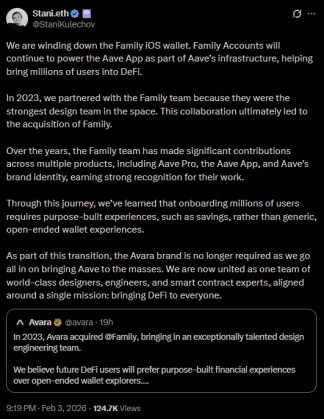

It’s a sharp pivot back to basics. For the past two years, the narrative was all about expansion—building social graphs (Lens Protocol), stablecoins (GHO), and wallets under one massive umbrella. But that era appears over.

The reversal suggests the market frankly no longer rewards broad, open-ended ecosystems that lack immediate stickiness. Instead, liquidity is flowing toward purpose-built protocols that solve specific, high-friction problems rather than general utility.

This restructuring comes as the broader crypto market hunts for the next major narrative beyond simple asset speculation. While infrastructure giants like Aave consolidate to defend their moats, capital is rotating into sectors offering tangible utility for non-crypto natives.

Specifically, the intersection of AI and the creator economy is seeing aggressive growth. It’s within this vacuum of consumer utility that projects like SUBBD Token ($SUBBD) are finding traction, using the exact kind of specialized focus that the ‘Family’ wallet missed.

Buy your $SUBBD here.

AI Tools Replace Generic Interfaces

The failure of the Family Wallet highlights a brutal truth in crypto: users don’t need another place to store private keys; they need a reason to use them.

While Aave retreats to infrastructure, SUBBD Token ($SUBBD) is capitalizing on the $85 billion content creation industry by attacking the inefficiencies of Web2 incumbents. The current landscape for creators is defined by exploitation, platforms routinely extract up to 70% of earnings in fees, while arbitrary bans restrict audience reach.

SUBBD addresses this not by building a generic wallet, but by deploying an EVM-compatible ecosystem designed specifically for creator sovereignty. By merging Web3 payments with proprietary AI models, the platform offers tools that were previously fragmented across a dozen subscriptions.

Features like the AI Personal Assistant allow creators to automate interactions, while AI Voice Cloning and AI Influencer Creation open new revenue streams that don’t require the creator to be physically present 24/7.
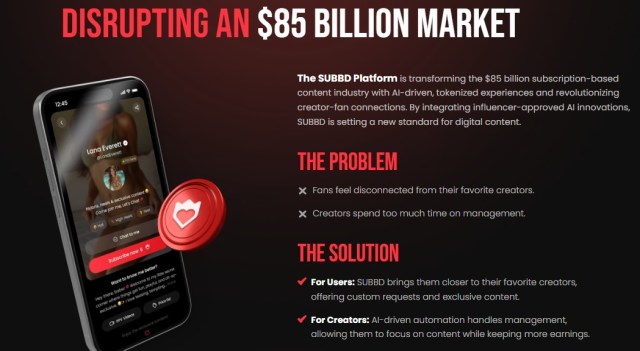
This utility-first approach differs fundamentally from the strategy Aave just abandoned. Where Avara attempted to capture users through a generalist interface, SUBBD captures them through essential service provision. The platform’s decentralized architecture ensures creators maintain ownership of their content and earnings, removing the middleman risk that plagues platforms like OnlyFans or Patreon.

For the market, this represents a shift from ‘crypto as a wallet’ to ‘crypto as a business backend.’

Check out the SUBBD ecosystem.

SUBBD Presale Draws Capital Seeking Utility

The market’s appetite for this specific utility is quantifiable. While legacy DeFi tokens struggle with governance restructuring, SUBBD Token has maintained steady inflows during its presale phase.

According to current data, the project has successfully raised $1.4M, signaling strong confidence from early adopters who view the convergence of AI and content monetization as the next logical step for retail crypto adoption.

Investors are currently entering at a price point of $0.05749, positioning themselves before the platform’s full public rollout. Beyond the speculative aspect, the protocol’s staking mechanics are designed to encourage long-term ecosystem stability.

The project offers a fixed 20% APY for the first year to participants who lock their tokens. This incentive structure does two things: it reduces circulating supply volatility during the critical early growth phase, and it aligns incentives between the platform’s developers and its community.

Smart money monitors these metrics closely because they suggest a departure from ‘vaporware.’ The token serves a dual purpose: governance rights over platform features, such as voting on AI creator curation, and utility within the ecosystem for tipping, subscriptions, and accessing token-gated content.

As Aave refocuses on the backend of DeFi, projects like SUBBD are building the front-end utility that actually drives mass adoption.

You can buy $SUBBD here.

The content provided in this article is for informational purposes only and does not constitute financial advice. Cryptocurrency investments carry inherent risks, including high volatility and potential loss of capital. Always conduct your own due diligence before investing.

Editorial Process for bitcoinist is centered on delivering thoroughly researched, accurate, and unbiased content. We uphold strict sourcing standards, and each page undergoes diligent review by our team of top technology experts and seasoned editors. This process ensures the integrity, relevance, and value of our content for our readers.

patrubogdan

Follow

Full Profile

Related Posts

Crypto Market Structure Bill Nears Key Moment As CFTC Chair Signals Progress Within Months

Dubai’s $280M Diamond Tokenization Sets RWA Precedent as Bitcoin Hyper Secures $31.2M

Bitcoin Dominance Shifts: Crypto Usage Spreads Beyond Bitcoin as $HYPER Keeps Gaining

Binance Crushes Competition With $155B Asset Surge; $HYPER Emerging as Bitcoin L2 Leader

Criptomoneda prometedora para invertir ante el cambio de sentimiento: el auge de la infraestructura Bitcoin

Criptomoneda prometedora para invertir mientras cambia el sentimiento del mercado: Bitcoin Hyper redefine la Capa 2

Perguntas relacionadas

QWhat strategic changes did Aave announce regarding its consumer-facing products?

AAave announced it is retiring the 'Avara' parent brand and shutting down the Family Wallet, a product it acquired last year, to refocus on its core lending protocol and the Lens ecosystem.

QAccording to the article, what market trend is causing a shift away from 'super-apps'?

AThe market trend is shifting away from generalist 'super-apps' toward specialized platforms that solve specific, high-friction industry pain points and offer tangible utility.

QWhat specific industry is SUBBD Token targeting, and what is its total market size?

ASUBBD Token is targeting the content creator economy, which the article states is an $85 billion industry.

QWhat are two specific AI-powered tools the SUBBD platform offers to creators?

AThe SUBBD platform offers an AI Personal Assistant to automate interactions and AI Voice Cloning and AI Influencer Creation to open new revenue streams.

QHow much capital has the SUBBD Token presale raised, according to the data in the article?

AAccording to the article, the SUBBD Token presale has raised $1.4 million.

Leituras Relacionadas

If the AI Bubble Is Already Bursting, Who Will Truly Survive?

If the AI Bubble is Bursting, Who Will Remain? The debate over an AI bubble is intensifying, with figures like Ray Dalio warning of high levels and Jensen Huang seeing immense, early-stage opportunity. Both views hold truth: a speculative bubble in capital markets likely exists, mirroring the dot-com era, but the underlying technological shift is real and transformative. History shows that while bubbles burst—wiping out overvalued companies and speculative capital—they often leave behind critical physical and digital infrastructure. The dot-com bust, for instance, eliminated many firms but left the global fiber optic networks and data centers that enabled the rise of Amazon, Netflix, and cloud computing. Today's massive AI infrastructure investments (projected at trillions by 2030) in data centers, power, cooling, and GPUs may follow a similar path, creating the foundation for future applications. A key divergence from past bubbles is the "Jevons Paradox" effect in AI. As the cost of AI inference has plummeted by over 99.7% since 2023, enterprise spending on AI has skyrocketed. Cheap "tokens" have unlocked vast, previously uneconomical use cases, moving AI from simple chatbots into core business workflows—code generation, legal document review, scientific simulation, and financial analysis. The market is now in a phase of self-correction, weeding out superficial "API-wrapper" startups, but this cleansing process strengthens the ecosystem. The long-term trajectory is clear. The value is gradually shifting from capital expenditure (CapEx) on hardware to operational expenditure (OpEx) on transformative applications. As AI becomes a utility, the winners will be firms that deeply integrate it to solve vertical industry problems in law, healthcare, finance, and manufacturing. The泡沫 will recede, but the foundational shift towards an AI-powered era across all sectors is irreversible. The underlying productive force of AI contains no bubble.

marsbitHá 18m

If the AI Bubble Is Already Bursting, Who Will Truly Survive?

marsbitHá 18m

If the AI Bubble Is Already Bursting, Who Will Truly Remain?

**Summary: If the AI Bubble is Bursting, What Will Remain?** The debate around an AI bubble is intensifying, with figures like Ray Dalio warning of high valuations while Jensen Huang sees immense opportunity. This echoes the dot-com bubble, which saw massive wealth destruction but ultimately left behind critical infrastructure like undersea cables and broadband, enabling future giants like Amazon and Netflix. Similarly, today's AI boom involves trillions invested in data centers, power, cooling, and GPUs, while application-layer revenue remains comparatively modest. This investment-disparity signals a bubble. However, the core technological progress is real and accelerating. AI inference costs have plummeted by over 99.7% since 2023, making intelligence increasingly cheap and accessible. This cost collapse is unlocking vast new demand. Instead of reducing spending, enterprises are tripling their AI cloud expenditure. Cheap "tokens" enable AI to move beyond simple chatbots into complex workflows—automating code writing, legal document review, financial analysis, and scientific research. This follows "Jevons's paradox": improved efficiency leads to greater total consumption. The market is now undergoing a necessary purification, weeding out "API-wrapper" startups with no real moat. The deeper evolution involves a shift from capital expenditure (CapEx) on infrastructure to operational expenditure (OpEx) on value-creation in applications. While hardware vendors currently profit most, long-term value will migrate to AI-native firms solving vertical industry problems. Ultimately, a market correction will cleanse speculative excess but will not reverse the AI+ trend. The massive physical and algorithmic infrastructure being built will endure, becoming a cheap, utility-like foundation. Just as the internet became indispensable to all industries post-2000, AI is poised to empower and redefine every sector, moving society irreversibly toward an intelligence-augmented era. The bubble may burst, but the underlying productive momentum is solid.

链捕手Há 25m

If the AI Bubble Is Already Bursting, Who Will Truly Remain?

链捕手Há 25m

Microsoft CEO: In the AI Era, How Do You Define a Company's Moat?

Microsoft CEO Satya Nadella argues that in the AI era, a company's true competitive edge, or "moat," is not determined by choosing the single most powerful model, but by its ability to build a continuous "learning loop." This system integrates and evolves by connecting human workflows, domain expertise, organizational judgment, and employee experience. He posits that future companies will accumulate two types of capital: Human Capital (employee knowledge, judgment, creativity) and "Token Capital" (a firm's own built and owned AI capabilities). Importantly, AI amplifies rather than devalues human capital. Human direction is essential to guide progress, as computational power alone is aimless. The core opportunity lies in creating a closed-loop system where human and token capital reinforce each other in a compound, self-improving cycle. A company must be able to preserve its unique institutional knowledge—its "company veteran" expertise—even if it switches underlying general-purpose AI models. This requires private evaluation benchmarks, reinforcement learning environments based on internal data, and queryable knowledge bases. Nadella warns against a future where economic value is concentrated by a few dominant models that commoditize entire industries' knowledge. Instead, the priority should be building a broad "frontier ecosystem" where every company, industry, and nation can own its learning loop. This allows organizations to retain control of their intellectual property, amplify employee capabilities, and ensure the economic value created by AI is captured within their own businesses and communities. True corporate sovereignty in the AI age comes from turning organizational knowledge into a compounding system that creates enduring, defensible value.

marsbitHá 1h

Microsoft CEO: In the AI Era, How Do You Define a Company's Moat?

marsbitHá 1h

ETFs Are Just the Ticket: The True Institutionalization of Bitcoin Is Happening Where You Can't See It

Beyond the Bitcoin ETF spotlight, a deeper institutionalization is underway, leveraging Bitcoin as a foundational financial primitive. Institutions are using Bitcoin for purposes long reserved for assets like U.S. Treasuries and gold: as collateral for loans, insurance reserves, and the backbone of rated bonds. Examples include a Barbados-based insurer capitalizing with $40M in Bitcoin reserves and Ledn's $188M securitization of Bitcoin-backed loans, which received the first-ever investment-grade rating (BBB-) from S&P for a digital asset-backed security. This structure was stress-tested during a 27% price drop in early 2026, triggering automatic liquidations that functioned as designed but revealed the systemic risk of synchronized selling across leveraged positions. Infrastructure is evolving to support this, with platforms like Anchorage Digital's Atlas network enabling secure, institutional-grade settlement and collateral management. Strategies like basis trades and corporate treasuries (exemplified by companies like MicroStrategy issuing billions in equity and debt to fund Bitcoin acquisitions) further integrate Bitcoin into financial mechanics. While ETFs solved "how to own" Bitcoin, these developments answer "what to do with it," embedding the asset into the working machinery of finance—as collateral upon which loans, derivatives, and structured products are built. The real, enduring institutional shift is happening in these largely invisible plumbing and financing systems.

marsbitHá 1h

ETFs Are Just the Ticket: The True Institutionalization of Bitcoin Is Happening Where You Can't See It

marsbitHá 1h

ZEC Co-Founder Responds to Orchard Vulnerability: No Signs of Theft, Orchard Pool to Be Sealed

ZEC Co-Founder Addresses Orchard Vulnerability: No Signs of Theft, Plans to Sunset Orchard Pool A security vulnerability was recently discovered in Zcash's Orchard shielded pool, raising key concerns. The primary questions are whether the flaw was exploited, if user funds are safe, whether users can verify the total ZEC supply, and if other similar vulnerabilities exist. Analysis suggests the vulnerability was likely not exploited prior to its discovery. It was found proactively by a researcher using specialized tools, not due to an active breach. The development team and mining pools acted quickly to contain the issue. Typical financially-motivated attacks would likely have left visible on-chain evidence, which has not been observed. User funds in Orchard are considered safe and should be recoverable, assuming no prior exploitation. If the flaw was never used, all legitimate funds can be withdrawn. The article outlines risks associated with moving funds to transparent addresses or other pools, but concludes that leaving assets in place is a reasonable option. Currently, users cannot independently verify that the total ZEC supply hasn't been inflated due to this bug. However, the planned Ironwood network upgrade is designed to resolve this. It will permanently close the Orchard pool to new deposits and internal transfers, allowing only withdrawals. This mechanism will cap total withdrawals at the amount of legitimately deposited funds, enabling anyone to cryptographically verify the supply post-upgrade. Multiple teams, including Shielded Labs, have conducted extensive audits focused on counterfeiting vulnerabilities, assisted by advanced AI tools. No additional flaws of this type have been found so far, increasing confidence that no other similar undisclosed vulnerabilities exist. In summary, evidence indicates the Orchard bug was probably not used, user funds are secure, and no other counterfeiting flaws are currently known. The upcoming Ironwood upgrade will restore users' ability to independently verify the total ZEC supply, closing this chapter.

Foresight NewsHá 1h

ZEC Co-Founder Responds to Orchard Vulnerability: No Signs of Theft, Orchard Pool to Be Sealed

Foresight NewsHá 1h

Trading

Spot
Futuros
活动图片





