a16z: PR as BD, How to Break Through the 'Noise' in the Crypto Industry?

marsbitPublicado em 2026-01-20Última atualização em 2026-01-20

Resumo

In the article "a16z: PR as BD – How to Break Through the Noise in Crypto," the author argues that "communications" is a broad term encompassing strategies for engaging various stakeholders, including employees, media, and investors. It involves owned content, social media, community building, speaking opportunities, and media relations (PR). No single tactic is superior; the optimal strategy depends on answering three core questions: What are your business goals? Who is your target audience? What is the best way to reach them? A consistent core narrative is paramount. The piece particularly defends the enduring value of media relations (PR), which, despite its controversial reputation in tech, remains a crucial tool. Media coverage provides third-party validation, expands reach to new audiences (potential employees, clients, influencers), and drives traffic back to owned channels. It is compared to business development (BD), where building genuine relationships with journalists is key. To break through the noise, founders are advised to: 1) Be their own best spokesperson, 2) Build relationships with media like doing BD, 3) View media as neither friend nor foe but as entities seeking good stories, and 4) Contextualize their story within larger industry or global narratives. The article concludes that the best defense against potential negative press is a good offense: proactively building communication channels and media relationships before a crisis strikes.

Compiled by: Ken, ChainCatcher

"Communication" is a general term referring to the strategies companies use to communicate with different groups—employees, media, investors, etc.

Communication encompasses various methods: creating owned content on official websites and social media channels (i.e., "direct-to-audience" communication); writing thought leadership articles; coordinating internal employee communication; collaborating with influencers (key opinion leaders); and curating organic or paid event and speaking opportunities. Of course, communication also includes dealing with the media (i.e., public relations or publicity).

No single communication strategy or tactic is absolutely superior to others. So, how do you find the right approach for you?

In this article, I will explain how to frame your communication strategy and what levers you can use to implement it. I will then argue that, although traditional media relations have a poor reputation in some tech circles, they remain a crucial tool for startups to convey their message externally.

How to Think About Your Communication Strategy

My mental model for communication strategy is built on answering three questions:

  1. What are your business goals?

  2. To achieve those goals, which audiences do you need to reach?

  3. What is the best strategy to reach those audiences?

Overarching all of this is your message and narrative—what problem are you and your team solving? What will the world look like when it's solved? Who will benefit in this new world?

Regardless of who you are talking to or through which medium, your core narrative and message should remain consistent. However, you need to emphasize different aspects depending on the audience. For example, investors focus on details and future growth prospects, while the media is more concerned with headlines and how you got to where you are today.

What Actions Can You Take?

Although different projects have varying business goals and audiences, the available strategies or tactics are largely similar. These strategies include:

  • Owned Content: For example, creating your own blog, producing videos, or publishing white papers on your official website.

  • Social Media (Brand & Personal): Although you don't own the social platforms, they are one of the best ways to reach your audience. For startups, this includes a combination of brand accounts (company official accounts) and personal accounts (founders' and employees' accounts).

  • Community Building: Whether through Discord, Signal, Telegram, or WhatsApp, online community management allows you to establish direct contact with developers, partners, or other key audiences in the ecosystem.

  • Speaking Opportunities and Conferences: Including giving speeches or making appearances at important offline community events and conferences.

  • Media/Press: The last strategy includes both proactive and reactive engagement with the media—whether proactively pitching stories, providing expert commentary, submitting articles, or responding to media inquiries. This includes both vertical crypto media (like Coindesk, The Block, etc.) and traditional mainstream media (like The Wall Street Journal, Bloomberg, etc.).

The Role of Media for Founders

The last strategy mentioned above—media relations (i.e., PR)—is the most controversial in the eyes of many tech founders. This is not without reason: although some journalists and media outlets have indeed become more hostile towards the tech industry, this is still one of the topics I get asked about most often when consulting for startups.

Many founders ask how to get funding coverage on TechCrunch, or how to land a glossy profile in Fortune magazine. They are also curious about how to get on TBPN, or record an hour-long podcast with the Bankless guys.

Why? Because regardless of your personal perception of the media, media coverage combines third-party endorsement with the potential for audience expansion, allowing you to reach entirely new groups: potential employees, potential clients, or potential influencers within the industry. Reaching different audiences also helps feed the growth of your own channels. Most startups cannot afford to miss out on the cost of expanding their influence and exposure.

When the founding team of Kalshi recently appeared on "CBS Sunday Morning," they reached an audience completely different from the "always-on" users of the tech Twitter圈. Kalshi CEO Tarek Mansour shared a story about the mother of a team member, vividly illustrating the power of reaching different circles through traditional media:
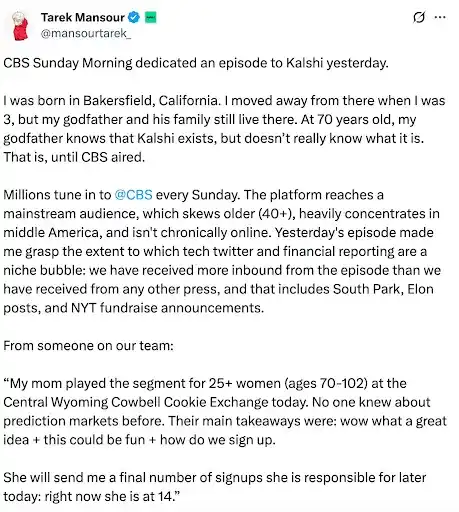
This is why media relations remain an extremely important part of the communication toolkit. Media can drive traffic back to your owned channels, help build your (and your company's) image, and accelerate everything from recruitment to sales. In the long run, media can also enhance the effectiveness of your "direct-to-audience" strategy.

Don't be afraid of media relations. Learn to use it to cut through the noise and get to the truth.

Contacting the Media: Breaking Through the Noise

Yes, we are in an era of information and content overload. This is especially true for the journalists you want to contact.

Take a look at the inbox of any journalist, podcaster, or content creator, and you will be shocked: it is filled with hundreds or thousands of emails from PR people promoting their respective clients or projects. In fact, data shows that the ratio of media PR practitioners to journalists is as high as 6 to 1. Due to the flood of information, it is almost impossible for journalists to filter out what is real substance from what is spam.

Why? Because many PR people lack professional training, or lack the confidence to push back against bad ideas proposed by clients. As a result, they mass-produce poor pitches, exacerbating the frustration of journalists, producers, and podcast hosts.

Add to that the projects that claim to offer brilliant solutions to important problems, but end up failing or being empty promises. All in all, poor pitches and over-promising共同 create an environment where "standing out" is more difficult than ever.

However,相对于 the sea of垃圾 information, quality news sources are still scarce. This means that those who can effectively tell stories and build good relationships with existing media professionals will have a clear competitive advantage.

Engaging with Media: Where to Start

Founders who want to break through the noise and engage effectively with the media should keep the following four points in mind:

  1. Founders are the best spokespeople. The company's narrative or story cannot be outsourced. Although hiring PR personnel, agencies, or freelancers can help you open doors, it must be the founders themselves who refine and vividly tell their own story.

  2. Relationships are key. Treat media relations like business development (BD). Whether it's争取 speaking opportunities or simply replying on X, building personal relationships with journalists, podcast hosts, and opinion leaders is crucial. Often, the birth of a报道, the recording of a podcast, or the acquisition of a speaking opportunity stems from connections. Why? Because journalists and opinion leaders trust the founders and PR people with whom they have built relationships, because past experience has proven that these people can provide reliable interview opportunities, answers, or other valuable resources.

2a. So, how do you build relationships with key media? Methods vary, but the core lies in proactively providing resources. First focus on how to add value to their reporting, rather than just boasting about your project. You can also use speaking and conference occasions to meet media people—just as you would do business development.

  1. The media are neither friends nor enemies. Some media do have biases, but ultimately, journalists are just looking for good stories. Remember, journalists are not your friends here to help you. The art lies in learning how to interact constructively and knowing when to shut up (sometimes, staying silent is absolutely the wise choice).

  2. Your story must fit into a broader context. The best founders can洞察 how their company, project, product, and team fit into the grand narrative of the industry and even the whole world. Helping journalists understand you, and how you fit into that larger story, trend, or movement, is key to breaking through. For example, think about the annual "Year in Review"—from Spotify to Google Search, to a16z and Coinbase's State of Crypto reports. Each案例 captures a specific moment in time—reviewing the past year and adding unique insights/perspectives that only it can provide, while making it practical and shareable through charts and visualizations. Founders can also ride the wave by hooking into hot topics (like the growth of stablecoins, the fusion of AI x Crypto, or policy debates around DeFi).

The core is: Connect your story to what is happening in the world.

The Best Defense is a Good Offense

"But," you might ask, "what if I never want to deal with the media?"

That's a noble wish. But unfortunately, as a startup grows, it is impossible to remain completely游离于 the public eye.

When facing tricky negative coverage or a crisis—whether fair or not—the best way to avoid being被动挨打 is to预先 establish contact with the media and cultivate initial rapport. Just like anything in life, having a relationship can make difficult conversations easier.

Crisis PR is a professional skill worthy of a separate discussion. But in short, the best defense is to have a good offense: having established sound communication channels, built relationships with key journalists and opinion leaders, and deeply understood your core audience *before* a crisis hits.

The media has become frightening to some and a convenient scapegoat for others. But with adequate preparation and the right mindset, media can be a powerful unlocking tool in the hands of a founder.

Let's toast to building in the open—may you master the tools to do it well.

Recommended Reading:

RootData 2025 Web3 Industry Annual Report

Binance Power Shift: The Dilemma of a 300 Million User Empire

Delphi Digital: Three Trends in Prediction Markets

Beyond Stablecoins: Circle Releases 2026 Strategy Report, Internet Financial System Has Fully Emerged


Perguntas relacionadas

QWhat are the three key questions to frame a communication strategy according to the article?

AThe three key questions are: 1. What are your business goals? 2. Which audiences do you need to reach to achieve those goals? 3. What is the best strategy to reach those audiences?

QWhy does the article argue that media relations (PR) is still a crucial part of the communication toolkit for startups?

AThe article argues that media relations combine third-party validation with the potential for audience expansion, allowing startups to reach new groups like potential employees, customers, or industry influencers. It can drive traffic back to owned channels, help build the company's image, and accelerate processes from recruitment to sales.

QWhat is the recommended approach for founders to stand out when contacting journalists amidst the information overload?

AFounders should be the best spokespeople for their own story, build genuine relationships with journalists (treating it like business development), understand that media are neither friends nor enemies but are looking for good stories, and frame their narrative within a larger, broader industry or world context.

QWhat does the article suggest is the 'best defense' against negative press or a crisis?

AThe article states that the best defense is a good offense: having established communication channels, built relationships with key journalists and influencers, and having a deep understanding of the target audience *before* a crisis occurs.

QName at least three specific communication tactics or levers mentioned in the article that a company can use.

AThe article lists several tactics, including: creating owned content (blogs, videos, whitepapers), utilizing social media (both brand and personal accounts), community building (e.g., on Discord, Telegram), securing speaking opportunities and conference appearances, and engaging with the media (PR).

Leituras Relacionadas

Must-Watch Events Next Week|CLARITY Act Could Face Senate Vote; SpaceX, Circle to Report Earnings (8.3-8.9)

**Summary: Key Events and Developments to Watch (August 3-9)** The upcoming week is marked by significant financial disclosures, key legislative deadlines, and notable product updates. **Major Financial Events:** Several companies are scheduled to release their Q2 2026 earnings. American Bitcoin (ABTC) will report on August 3, followed by SpaceX and Hut 8 Mining Corp. on August 4, and Circle on August 5. Notably, a significant portion of SpaceX shares (up to 12% of total shares) will be unlocked on August 6 following their earnings release. **Key Legislative Deadline:** The U.S. Senate faces an August 7 deadline to secure 60 votes for the CLARITY Act, a bipartisan bill aiming to establish a federal regulatory framework for cryptocurrencies. The Senate may hold a full vote on the bill during the week. **Economic Data:** The U.S. July Non-Farm Payrolls report will be released on August 7, providing crucial labor market data. **Technology & Product Updates:** * **Shutdowns:** DeFi portfolio tracker Zapper and wallet app Ctrl Wallet will cease operations on August 3. * **Upgrades:** LayerZero will deprecate its v1 relayers on August 3. XRP Ledger's new version 3.3.0, featuring five new functions, is expected next week. * **AI:** Elon Musk announced that the advanced Grok 4.6 AI model is set for release around August 7. * **Bitcoin:** The BIP-110 forced signaling for a potential Bitcoin network change is scheduled to begin around August 8. **Other Notable Events:** Chinese robotics firm Unitree Tech has set its preliminary price inquiry for its IPO for August 5. South Korean exchange Upbit will delist AQT and AERGO tokens on August 3.

marsbitHá 18m

Must-Watch Events Next Week|CLARITY Act Could Face Senate Vote; SpaceX, Circle to Report Earnings (8.3-8.9)

marsbitHá 18m

Stocks Are Plummeting More Sharply Than Cryptocurrencies. Where Has the Money Gone?

Stock Markets Plunge Deeper Than Cryptocurrencies: Where Did the Money Go? In late July, Seoul's Kospi index triggered circuit breakers for two consecutive days, plummeting over 40% from its June high. The collapse was led by heavyweight stocks like SK Hynix, whose record profits still disappointed investors, and devastating leveraged ETFs, with one major product losing over 83% of its value. This signaled a global, forced deleveraging targeting the most crowded trades. Interestingly, while stocks exhibited extreme volatility akin to crypto markets, Bitcoin rose nearly 15% in July after a prior steep drop. Analysis shows the money fleeing equities did not flow into Bitcoin. Instead, Bitcoin had already absorbed its sell-off in May-June, when U.S. spot Bitcoin ETFs saw historic outflows. The true safe-haven beneficiary was gold, whose price rose over 20% year-on-year, highlighting a decoupling between Bitcoin and gold as "digital gold." The sell-off was a targeted unwinding of leveraged positions in tech and semiconductors, accelerated by broker-dealer risk management and shifts in the AI narrative, including new competition from Chinese memory chipmakers. The retreat path was clear: from high-valuation tech stocks to cash and U.S. Treasuries, then to gold. For Bitcoin to attract sustained institutional inflows, conditions like eased global liquidity pressure, a "soft-landing" Fed rate cut, and U.S. regulatory clarity via legislation like the stalled CLARITY Act are needed. Currently, Bitcoin is not a safe haven but an already-cleared asset. Its low correlation with tech stocks, however, makes it a potential diversification play for institutional portfolios once the storm passes. The money isn't here yet, but the positioning is underway.

marsbitHá 18m

Stocks Are Plummeting More Sharply Than Cryptocurrencies. Where Has the Money Gone?

marsbitHá 18m

In Conversation with Ray Dalio: We Are Currently in an AI Bubble, with 1% of My Portfolio in Bitcoin

Ray Dalio, founder of Bridgewater Associates, warns in an interview that the current AI boom shows classic bubble characteristics, which could lead to significant economic downturns as seen in past cycles like 1929 or 2000. He explains that speculative enthusiasm, fueled by debt and overvaluation, often precedes a crash when rising rates or taxation force asset sales, causing widespread losses and recession. Dalio also outlines his "Big Cycle" theory, describing an approximate 80-year pattern where widening wealth gaps, massive government deficits, and shifting geopolitical power (like China's rise) create internal conflict and global instability. He emphasizes that we are in a late-cycle, transitional phase where traditional powers like the US and UK face decline. For personal wealth protection, Dalio advises diversification beyond cash into assets like stocks, bonds, real estate, and particularly gold, which he prefers over Bitcoin. While he holds about 1% of his portfolio in Bitcoin as a non-printable hard asset, he views gold as more secure from technological or governmental threats. Regarding AI's impact, Dalio believes it will disproportionately benefit capital owners, worsening inequality by replacing both physical and cognitive labor. He suggests that human intuition and emotional intelligence, combined with AI, will be key for future workers. On taxation, Dalio argues that wealth taxes are impractical and risk triggering asset sell-offs, reducing productive investment. He points to the UK as a cautionary example of debt, low productivity, and political strife. Geopolitically, Dalio foresees a more regionalized world, with the US showing weakness in prolonged conflicts like with Iran, akin to past imperial declines. The ideal outcome, he suggests, is coexisting powerful blocs (e.g., Americas, China-Asia Pacific) without major war.

marsbitHá 4h

In Conversation with Ray Dalio: We Are Currently in an AI Bubble, with 1% of My Portfolio in Bitcoin

marsbitHá 4h

Daily 7.2 Trillion KRW: Foreign Capital's Record Net Buying on Friday! Wall Street Says Headwinds for Korean Stock Fund Flows Have Subsided

South Korean stock market sees a dramatic shift in fund flows. On July 31, foreign investors made a record net purchase of approximately KRW 7.2 trillion in KOSPI stocks, marking a fundamental reversal from the persistent large-scale net outflows seen in previous months. This contributed to a significant narrowing of foreign net selling in July to KRW 9.8 trillion, down sharply from KRW 48.4 trillion in June and KRW 44.5 trillion in May. Simultaneously, domestic institutional pressure eased. South Korean pension funds and asset managers turned to a net buying position in July, purchasing KRW 1.0 trillion worth of KOSPI shares, contrasting with net sales in May and June. Market volatility is expected to be dampened by new financial regulations. Effective July 31, the Financial Services Commission tightened access for retail investors to single-stock leveraged ETFs by raising the minimum cash deposit requirement. Trading volumes for these products subsequently dropped to about 50% of their monthly average. Citigroup Research maintains its year-end KOSPI target of 10,000 points. The firm cites several supportive factors: the substantial easing of headwinds from capital outflows, a robust fundamental outlook for the semiconductor sector, historically low market valuations, strong economic fundamentals, and the potential for policy support from financial authorities if needed.

marsbitHá 4h

Daily 7.2 Trillion KRW: Foreign Capital's Record Net Buying on Friday! Wall Street Says Headwinds for Korean Stock Fund Flows Have Subsided

marsbitHá 4h

Trading

Spot
活动图片




