a16z Partner: Perpetual Contracts Are Rewriting Global Trading Rules

marsbitPublicado em 2026-04-10Última atualização em 2026-04-10

Resumo

Perpetual contracts ("perps"), a crypto-native innovation, are transforming global trading behavior and market structure. These non-expiring futures contracts have seen explosive on-chain growth in 2025, with decentralized exchange (DEX) volume surging 346% year-over-year to $6.7 trillion. Perps now extend beyond crypto to traditional assets like stocks, commodities, and even private company valuations. Key drivers include structural advantages over options for directional leverage: 24/7 trading, no expirations or rollovers, simpler risk exposure, and capital efficiency. Real-World Asset (RWA) perps have gained significant traction, at times comprising 44% of volume on leading DEXs like Hyperliquid. The ecosystem is expanding rapidly with new exchanges, front-ends, market creators, and liquidity providers. While challenges remain around liquidity, oracle reliability, and regulation, perps are evolving from a niche crypto instrument into a dominant global trading primitive. The open question is whether value will accumulate at the exchange layer or within applications built atop perpetual trading infrastructure.

Author: jay

Compiled by: Jiahuan, ChainCatcher

Perpetual contracts ("perps") are futures contracts that never settle. As a crypto-native innovation, they experienced an explosion on-chain in 2025. Today, they have become one of the largest markets in the crypto space, covering traditional assets with trading volumes reaching trillions of dollars.

Last year, the trading volume of perpetual contracts settled by top centralized exchanges reached $86.2 trillion (a 47% year-on-year increase), while the growth of on-chain perpetual contracts was even more astonishing: leading decentralized exchanges (DEX) reached a trading volume of $6.7 trillion (a 346% year-on-year increase). Currently, DEX trading volume accounts for about 7.8% of centralized exchange (CEX) volume, whereas just over a year ago, this proportion was only around 2.5%. [Note: While a few US-regulated centralized platforms offer US investors products similar to perpetual contracts, all centralized and decentralized exchanges restrict US investors from trading true perpetual contracts.]
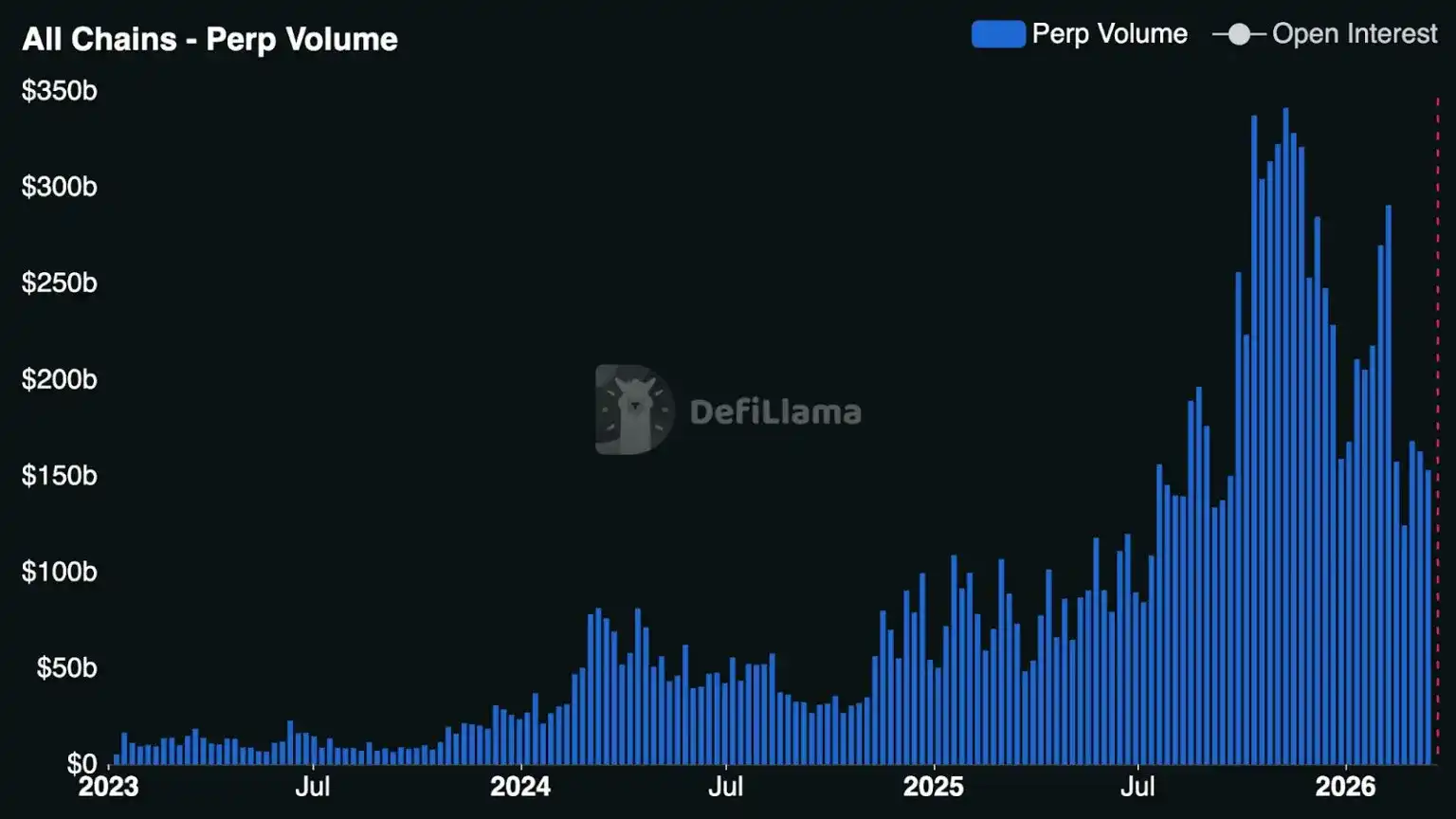
But more importantly, perpetual contracts are gradually shedding their image as a marginal crypto-native primitive and beginning to demonstrate the transformative power to reshape trading behavior and market structure fundamentally.

So, what is driving the popularity of perpetual contracts? Why now? The following will explore why global traders are increasingly favoring perpetual contracts, the scale of the market opportunity, and the opportunities seen by builders.

A Brief History and Evolution of Perpetual Contracts

The idea itself is actually older than the crypto industry. Theoretically, perpetual contracts existed as early as 1993, when Nobel laureate Robert Shiller proposed perpetual futures contracts, initially conceived as a tool to hedge against real estate value risks. But it wasn't until 2016, with the rise of BitMEX and XBTUSD (the longest-running Bitcoin perpetual swap contract), that perpetual contracts became popular in the crypto space.

A decade later, modern exchanges now offer perpetual contracts covering stocks, indices, commodities, interest rates, startup valuations, and even the price of Nvidia's H100 GPUs.

For years, perpetual contracts have been a multi-billion dollar revenue engine for centralized exchanges. As retail demand for leverage has grown, perpetual contracts have become the primary venue for short-term price discovery, liquidity, and trading activity—in many large Asian CEXs, their volume is multiple times that of spot trading.

What changed in the past year and a half is that decentralized perpetual exchanges began to meaningfully eat into the perpetual market share of CEXs. With the structural advantage of self-custody, perpetual DEXs are rapidly closing the gap with CEXs in terms of liquidity, performance, and features for active traders.

With the breakthrough success of perpetual DEXs like Hyperliquid, leading crypto wallets and applications began to support perpetual contracts and launched high-quality trading experiences, reaching millions of users. In the second half of 2025, the front-end for perpetual DEXs exploded—ranging from casual mobile apps to complex multi-venue trading terminals.

Hyperliquid, in particular, pushed the boundaries of what a DEX can offer through HIP-3 (Builder-Deployed Perpetuals). This mechanism allows anyone to permissionlessly launch a perpetual market on the exchange. With HIP-3, builders can list almost any asset and earn a 50% fee share while managing their own oracles and risk parameters.

At the same time, new entrants and competitors like Avantis, Lighter, Ostium, and Variational have emerged or accelerated product development. Increasing competition has forced perpetual DEXs to differentiate in exchange design, market structure, asset support, and permissionlessness, and has led some platforms to find strong product-market fit in new categories like real-world asset (RWA) perpetuals.

For years, perpetual traders only speculated on crypto assets—BTC, ETH, SOL, and various long-tail altcoins. But late last year, when perpetual volume cooled significantly from recent peaks amid a broader crypto market sell-off, RWA perpetuals began to gain traction. A few perpetual DEXs listed commodities, stocks, and stock indices, expanding the universe of tradable assets to include Nvidia, Samsung, even private companies like SpaceX, and commodities like silver and palladium.

This year, the growth of RWA perpetuals has accelerated further. In recent weeks, RWAs have accounted for up to 44% of Hyperliquid's total volume, and RWA pairs have consistently become some of the highest fee-generating pairs on the exchange. On Ostium, RWAs have constituted the vast majority of the exchange's volume for months.
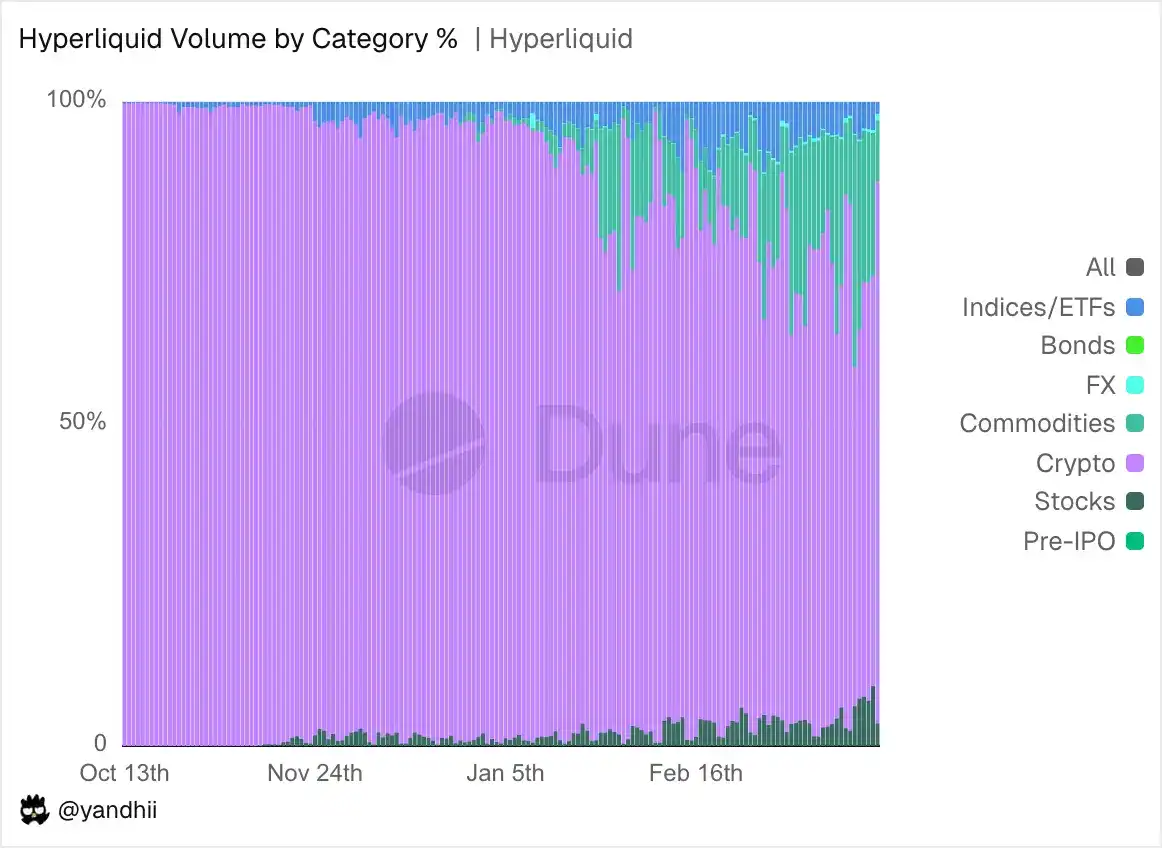
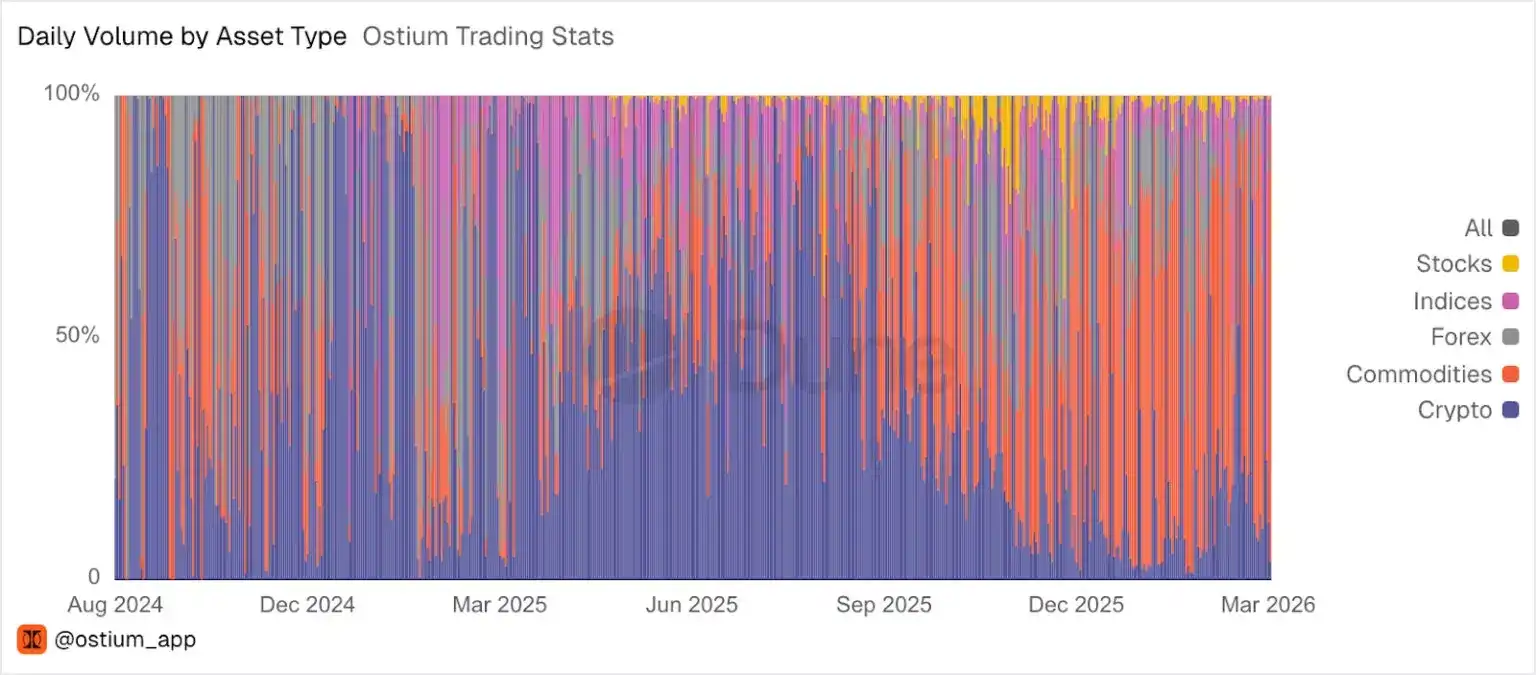
Decentralized exchanges have excelled at facilitating price discovery for RWAs like crude oil, especially on weekends when traditional exchanges are closed.

With the takeoff of RWA perpetuals, we see more companies developing products and businesses related to perpetual contracts. In the past 6 months alone, new exchanges, trading interfaces, market deployers, and liquidity providers have emerged.

Players flooding into this space include brand-new startups, startups pivoting to perpetuals, and some of the world's largest fintech companies integrating perpetual trading into their existing products.

All these diverse players are converging on the same opportunity: perpetual contracts have the potential to become one of the dominant trading instruments in global finance.

The Market Opportunity for Perpetual Contracts

Stepping back to look at traditional finance (TradFi), options are one of the largest and most actively traded markets globally. They exist in currencies, stocks, indices, commodities, and ETFs, and are extremely powerful and expressive tools that enable people to trade based on many different predictions: timing, volatility, price ranges, etc.

But if you zoom in on retail trading behavior, you find a huge amount of activity concentrated in a specific category of options: short-term, leveraged, directional exposure. A prominent example is 0DTE (zero days to expiration) options—traders pay a small cost to bet on high-magnitude intraday moves.

This type of trading is one of the fastest-growing option categories. In 2025, average daily volume for 0DTE SPX (S&P 500 Index) options reached 2.3 million contracts, up 51% year-on-year, accounting for 59% of total SPX option volume. Responding to this demand, the market introduced several new daily-expiring index products, including CBTX and MBTX Bitcoin ETF index options, and options on the equal-weight Cboe Magnificent 10 Index.

So, while options have many sophisticated uses—structured hedging, volatility trading, discrete trading, convexity (referring to the asymmetric特性 of收益与风险 : your maximum loss is fixed, but potential gains are theoretically unlimited), etc.—an enormous and growing flow of retail capital is essentially just looking for short-term, leveraged directional exposure. This is precisely the need that perpetual contracts fulfill perfectly.

The trade-offs are real: options excel at defined risk and convex payoffs, and remain the default tool for expressing volatility. Traders can lose at most the premium they pay. With perpetual contracts, the entire margined position can be liquidated. But for the directional leverage that most retail traders actually want, perpetual contracts have several structural advantages:

  • Always on. The latest generation of perpetual markets trade 24/7, with no trading hours or market close gaps. For a global, crypto-native user base, continuous access is an expected norm.
  • No strike prices, no expiration, no rollover. With a single continuous position, traders don't have to choose parameters, manage expiries, or rebuild positions daily or weekly. They can hold for seconds, months, or theoretically forever.
  • Simpler risk exposure. For perps, the primary considerations are price, collateral, and liquidation thresholds. For options, even if you're right on direction, you can lose due to time decay, implied volatility changes, and path dependence. Perps strip out this complexity. The trade is a pure expression of directional conviction.
  • Capital efficiency for continuous exposure. Short-term options require paying the full premium upfront and rolling over repeatedly. Perps require margin—often a fraction of the notional value—which is typically more capital efficient for intraday to multi-day directional positions.

Options aren't going away. They have long been part of financial history and will likely remain dominant for a significant subset of trading use cases, especially those involving defined risk and more complex payoff structures. But for the huge and growing flow of capital looking for Delta-1 directional leverage, perpetual contracts have already captured trillions in volume and billions in revenue.

This raises the question: as perpetual contracts evolve from niche tool to mainstream trading primitive, where will the value accrue in the tech stack?

In traditional markets, the most valuable companies are often built on top of exchange infrastructure, not at the exchange layer itself. For example, the retail broker Robinhood has a higher market cap than its underlying exchange, Nasdaq.

Whether this pattern holds in crypto—or whether platforms like Hyperliquid, Lighter, or Ostium can accumulate sufficiently powerful network effects at the exchange layer—is one of the most interesting open questions in the space.

Regardless, builder activity is expanding rapidly. We see developer growth in the following areas:

  • Customized distribution layers: Vertical or audience-specific frontends that not only present markets but also package narratives, strategies, gamification, or social hooks.
  • Market creators and operators (e.g., HIP-3 deployers): Operating a popular market on Hyperliquid essentially gives a deployer a "mini-exchange" without building the most complex exchange infrastructure. Today's deployers may only be scratching the surface of the data or price feeds that could be "perp-ified" in the future.
  • Specialized liquidity provision: Market makers focused on long-tail markets, event-driven order books, and cross-venue inventory management.
  • Perp-specific data infrastructure: An ecosystem of community-driven dashboards, block explorers, heatmaps, and analytics tools has already emerged around positions, funding rates, liquidations, trader signals, leverage exposure, retention cohorts, etc. More mature, high-quality, real-time data will make the entire ecosystem more transparent and efficient for all participants.

Of course, there are still significant open questions and challenges, spanning distribution, liquidity depth for new trading venues, oracle reliability as asset scope expands, inevitable tail events ("10/10" events), and regulation (which currently restricts US investor access to these products). These are the expected growing pains as perpetual contracts "graduate" from the crypto-native bubble and step onto the main stage of global finance. As the perpetual ecosystem matures, the question is no longer whether perps can scale, but who will build the most valuable applications and infrastructure around them when they do.


Perguntas relacionadas

QWhat are perpetual contracts and why are they considered a crypto-native innovation?

APerpetual contracts, or 'perps', are futures contracts that never expire and do not require settlement. They are considered a crypto-native innovation because they were popularized within the cryptocurrency space, starting with BitMEX's XBTUSD in 2016, and have since evolved to become a dominant trading instrument in crypto, with significant growth on both centralized and decentralized exchanges.

QHow has the growth of decentralized perpetual exchanges (DEX) compared to centralized exchanges (CEX) in recent years?

ADecentralized perpetual exchanges have grown at an astonishing rate. In the past year, leading DEXs saw a 346% increase in trading volume, reaching $6.7 trillion, while top CEXs settled $86.2 trillion in perpetual trading volume, a 47% increase. DEX volume now accounts for about 7.8% of CEX volume, up from just 2.5% a little over a year ago.

QWhat is HIP-3 on Hyperliquid and how does it impact the perpetual contract market?

AHIP-3, or Builder-Deployed Perpetuals, is a mechanism on Hyperliquid that allows anyone to permissionlessly launch a perpetual market on the exchange. It enables builders to list almost any asset, manage their own oracles and risk parameters, and earn 50% of the fees generated, significantly expanding the range of tradable assets and democratizing market creation.

QWhat are the key structural advantages of perpetual contracts over options for retail traders seeking directional leverage?

APerpetual contracts offer several advantages over options for directional leverage: they are always on (24/7 trading), have no strike prices or expiration dates (eliminating the need for rollovers), provide simpler risk exposure (focused on price, collateral, and liquidation thresholds without time decay or volatility complications), and offer capital efficiency for continuous exposure through margin requirements rather than full premium payments.

QWhat types of real-world assets (RWA) are being traded via perpetual contracts on DEXs, and how significant is their volume?

APerpetual contracts on DEXs now include a wide range of real-world assets such as commodities (e.g., silver, palladium, crude oil), stocks (e.g., Nvidia, Samsung), stock indices, and even private companies like SpaceX. RWA perpetuals have seen substantial growth, at times accounting for up to 44% of Hyperliquid's total volume and consistently being among the highest fee-generating pairs, with platforms like Ostium also seeing RWA dominate their trading activity.

Leituras Relacionadas

After Three Consecutive Quarters of Decline, Can the Crypto Market Find a Window for Stabilization in Q3?

The cryptocurrency market has just concluded its worst-performing quarter since 2022, with total capitalization dropping 12.6% to $2.1 trillion. All core metrics indicate capital is leaving the sector, not just rotating within it. Bitcoin fell 14.2% and Ethereum dropped 25.4% in Q2, breaking their previous correlation with US tech stocks. A key driver is the reversal in US spot Bitcoin ETF flows, which saw a net outflow of approximately $4.67 billion in Q2, including a record monthly outflow near $4.5 billion in June. While recent data suggests long-term holders are accumulating again, sustained ETF outflows mean continued selling pressure. Market focus is now singularly on the Federal Reserve. The upcoming July FOMC meeting is seen as the most critical event for Q3. A dovish signal could support Bitcoin reclaiming a $68,000-$84,000 range, while a hawkish stance might establish a new trading band around $50,000-$56,000. Additionally, regulatory uncertainty persists, with the progress of the crucial *CLARITY Act* stalling in the Senate, reducing its perceived 2026 passage probability to 40-45%. Despite the broad downturn, a few sectors showed growth. Prediction markets saw nominal volume surge 48.7% year-over-year to $113.8 billion, and tokenized collectibles transaction volume rose 143% quarterly to $1.4 billion. The Real-World Asset (RWA) tokenization sector also continued steady growth, now representing ~$28.1 billion in on-chain value. The market's foundation for an extreme crash appears limited, with Bitcoin price hovering near its 200-week moving average. However, the trading paradigm has shifted from narrative-driven speculation to decisions based on price action, policy developments, and interest rate expectations, making a broad sentiment-driven rally unlikely in the near term.

marsbitHá 15h

After Three Consecutive Quarters of Decline, Can the Crypto Market Find a Window for Stabilization in Q3?

marsbitHá 15h

BIT Trading Moment: BTC Still Suppressed by Weekly 200 EMA, Rejection May Restart Decline; Storage and Semiconductors that Surged Last Night Begin Falling in Evening Trading

**Crypto & Stock Market Wrap: Bitcoin Tests Resistance, Stocks Retreat After AI Surge** Bitcoin consolidates around $66,000, facing key resistance near $68,000—an area seen as a major psychological and technical hurdle where previous rallies have failed. Analysts note the cryptocurrency is caught between its 200-week moving average (~$63,333) and 200-week EMA (~$68,328). A clear break above $68k is needed to signal a stronger bullish trend, while a rejection could lead to a retest of $63k support. Market sentiment remains cautious, with low futures open interest pointing to a low-liquidity rebound rather than a full bull market. Bitcoin spot ETFs saw another $203 million inflow. US stock futures pointed lower after a strong Tuesday session led by a massive rebound in semiconductors and memory stocks. The rally was fueled by renewed optimism about AI-driven hardware demand, with Micron, SanDisk, and SK Hynix surging. However, those gains reversed in pre-market trading. Super Micro Computer (SMCI) soared over 20% after hours on strong guidance and a record backlog. Other standouts included Rocket Lab and nuclear energy plays Oklo and X-Energy. Rising oil prices (Brent above $91) and climbing Treasury yields (10-year near 4.64%), however, are reigniting inflation concerns and acting as a headwind for equities. In Asia, markets were mixed. South Korea's KOSPI pared early gains to close slightly higher as semiconductor stocks like SK Hynix gave back initial surges. Japan's Nikkei edged lower as the yen hit a fresh 38-year low against the dollar, raising fears of potential market intervention. Key events to watch include the Samsung Galaxy launch, AMD's AI event, and a slew of major tech earnings from Alphabet, Tesla, and IBM after the close on Wednesday, followed by the ECB meeting and Intel's earnings on Thursday.

marsbitHá 15h

BIT Trading Moment: BTC Still Suppressed by Weekly 200 EMA, Rejection May Restart Decline; Storage and Semiconductors that Surged Last Night Begin Falling in Evening Trading

marsbitHá 15h

Former CFTC Chairman, Circle President Tarbert: Preaching Long-Termism While Cashing Out $30 Million Himself

Former CFTC Chairman and Circle President Heath Tarbert has consistently advocated for a long-term vision in public, urging patience from investors as Circle’s stock price has fallen significantly from its peak. However, it has been revealed that since Circle’s IPO, Tarbert has continuously sold his CRCL shares through pre-arranged trading plans, cashing out approximately $30 million, without making any public market purchases. This contrast between his public messaging and personal actions has drawn criticism. Tarbert joined Circle in July 2023 as Chief Legal Officer, leveraging his regulatory experience to help guide the company through its IPO and expansion. Despite promoting stablecoins as long-term infrastructure, he established a 10b5-1 trading plan just before Circle went public, leading to substantial stock sales over the following year. In March 2026, he initiated another plan to sell more shares. His career trajectory highlights a pattern of moving between high-level regulatory roles and influential positions in the financial sector. After resigning as CFTC Chairman in early 2021, he joined Citadel Securities as Chief Legal Officer just 27 days later, during a period of intense regulatory scrutiny for the firm. He later joined Circle, aiding its efforts to navigate regulatory challenges for its public listing. While Tarbert's expertise in policy and compliance is valuable to companies like Circle, his actions—advocating long-term confidence while personally divesting—raise questions about the alignment between his public statements and his private financial decisions, leaving investors who followed his advice to bear the market risks.

marsbitHá 16h

Former CFTC Chairman, Circle President Tarbert: Preaching Long-Termism While Cashing Out $30 Million Himself

marsbitHá 16h

Gate Research Institute: The 'Wall Street-ization' Wave of Crypto Financial Products – Competition or Integration?

The article titled "Gate Research Institute: Are Crypto Financial Products Sparking a 'Wall Street' Wave—Competition or Convergence?" explores the evolving relationship between the crypto ecosystem and traditional finance (TradFi). The piece begins by reflecting on Bitcoin's original 2009 vision of decentralization, disintermediation, and moving away from banks. It then contrasts this with the 2024 landscape, where key crypto assets like Bitcoin are increasingly held through Wall Street products like ETFs issued by giants like BlackRock. The article questions whether this signifies that TradFi is systematically taking over the rights to issue, price, custody, and distribute crypto financial assets. The core argument is that this is not a zero-sum takeover but rather a bidirectional convergence where each side addresses the other's weaknesses. Crypto offers 24/7 global markets, programmable settlement, and open access but lacks compliant channels, institutional-grade custody, deep fiat liquidity, and mainstream distribution. TradFi possesses these but is constrained by legacy systems, limited operating hours, and slow settlement. Two primary convergence paths are highlighted: * **Path A (CEX to TradFi):** Exemplified by Gate, which has progressed from offering tokenized stocks and CFDs to providing direct, real stock trading (US, Hong Kong, South Korea) within its platform, using USDT. * **Path B (TradFi to Crypto):** Exemplified by Robinhood, which has integrated crypto trading, acquired exchanges like Bitstamp, and is moving traditional assets like stocks onto the blockchain via tokenization and its own Layer 2. Both paths are ultimately competing to become the next-generation, unified financial account—a "super account" where users can seamlessly trade cryptocurrencies, stocks, ETFs, RWA (Real World Assets), and tokenized treasury products in one interface. The growth of RWA and tokenized treasuries (e.g., BlackRock's BUIDL) is presented as the asset-layer fusion, providing stable, yield-bearing assets on-chain and acting as a bridge between the two worlds. In conclusion, the "Wall Street-ization" of crypto is framed as a mutual transformation. Decentralized ideals persist in the protocol layer, while at the application layer, a more efficient, global, and accessible unified capital market is emerging from this convergence. The future competition lies not between crypto exchanges and stockbrokers, but between platforms vying to offer the most comprehensive asset coverage, liquidity, and user experience within a single account.

marsbitHá 16h

Gate Research Institute: The 'Wall Street-ization' Wave of Crypto Financial Products – Competition or Integration?

marsbitHá 16h

Trading

Spot
活动图片




