a16z Brief: Prediction Markets Set a Record for the Third Consecutive Week, Weekly Trading Volume Surpasses $14.4 Billion for the First Time

marsbitPublicado em 2026-06-30Última atualização em 2026-06-30

Resumo

A16z Crypto's weekly report highlights record-breaking activity in prediction markets. For the third consecutive week, total weekly trading volume hit a new all-time high, surpassing $14.4 billion for the first time, a significant jump from the $5-6 billion range seen earlier this year. Aggregate open interest also reached a new weekly record of $1.6 billion, marking its third straight week of growth. This metric, which reflects the total value of unsettled bets, has increased roughly 8-fold since last autumn, indicating sustained capital inflow. While events like the World Cup drove initial interest, growth has expanded beyond sports. Non-sports categories—including politics, economics, and geopolitics—achieved a weekly volume of $3.6 billion across platforms like Kalshi and Polymarket. This figure now exceeds the entire prediction market's weekly volume (including sports) from last year. Since July 2025, non-sports trading volume has grown approximately 18-fold, with acceleration notably steepening recently.

Author: Robert Hackett

Compiled by: Deep Tide TechFlow

Deep Tide Introduction: According to data from the a16z Crypto brief, weekly trading volume in prediction markets surpassed $14.4 billion for the first time last week, setting a new all-time high for the third consecutive week. At the beginning of the year, this figure was only around $5-6 billion. Even more noteworthy is the non-sports category—covering politics, economics, geopolitics—which reached $3.6 billion in a single week, exceeding the total weekly volume (including sports) for the entire market last year. While the World Cup has driven attention and funds, the growth has long extended beyond sports betting.

Last week, weekly trading volume in prediction markets surged to $14.4 billion for the first time. At the start of the year, this number was still around $5-6 billion. The previous all-time high (approximately $10 billion) was set just a week prior.

Aggregated across all platforms, current trading volume is over 10 times higher than it was a year ago.
Caption: Trend of weekly trading volume in prediction markets, reaching $14.4 billion last week, compared to around $5-6 billion at the start of the year.

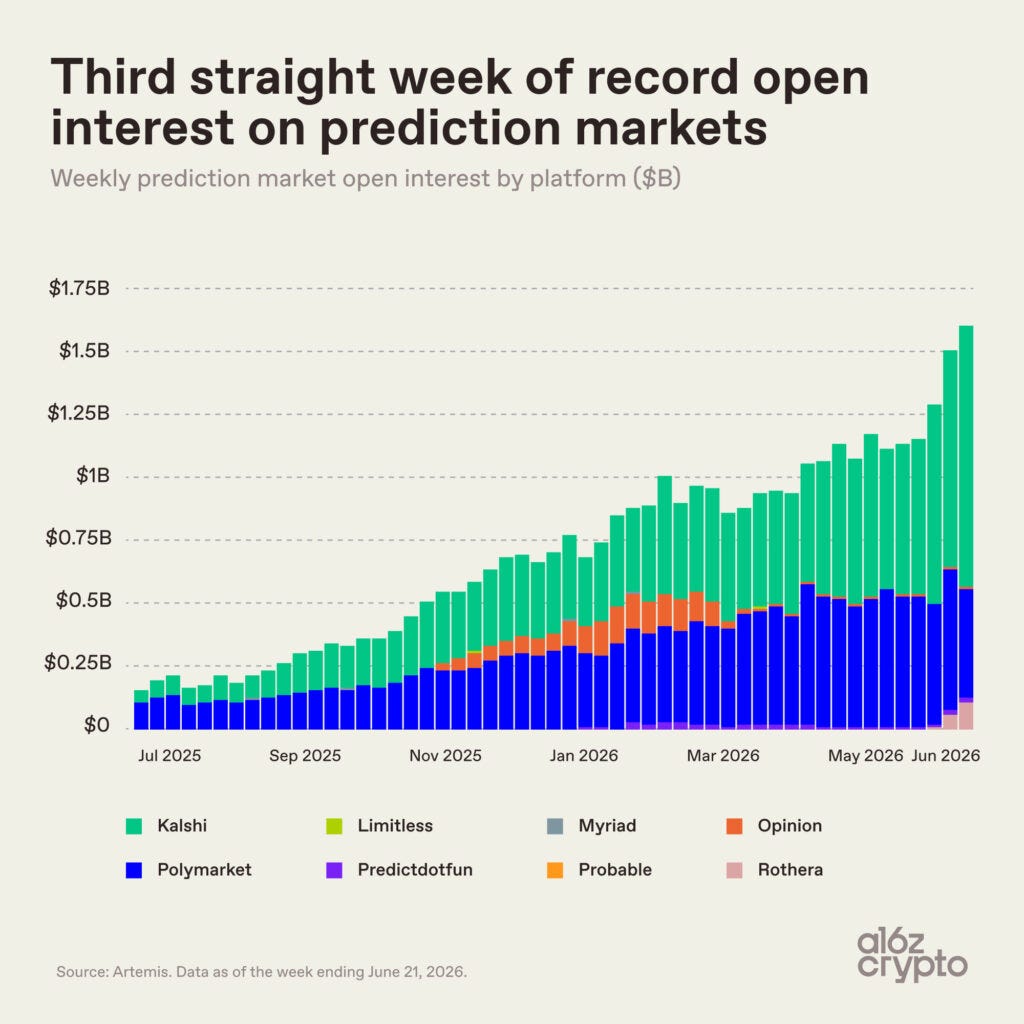
Open interest (the total value of unsettled positions) reached $1.6 billion last week, setting a new weekly record for the third consecutive week.

Unlike trading volume, open interest only increases when the rate of new positions being opened outpaces the settlement of old ones. Therefore, an upward trend in this curve indicates that more real money is being committed to these markets.

Since last fall, this curve has been steadily climbing. During this period, open interest has increased approximately eightfold, rising from less than $200 million to $1.6 billion.
Caption: Open interest has grown about 8 times since last fall, increasing from under $200 million to $1.6 billion.

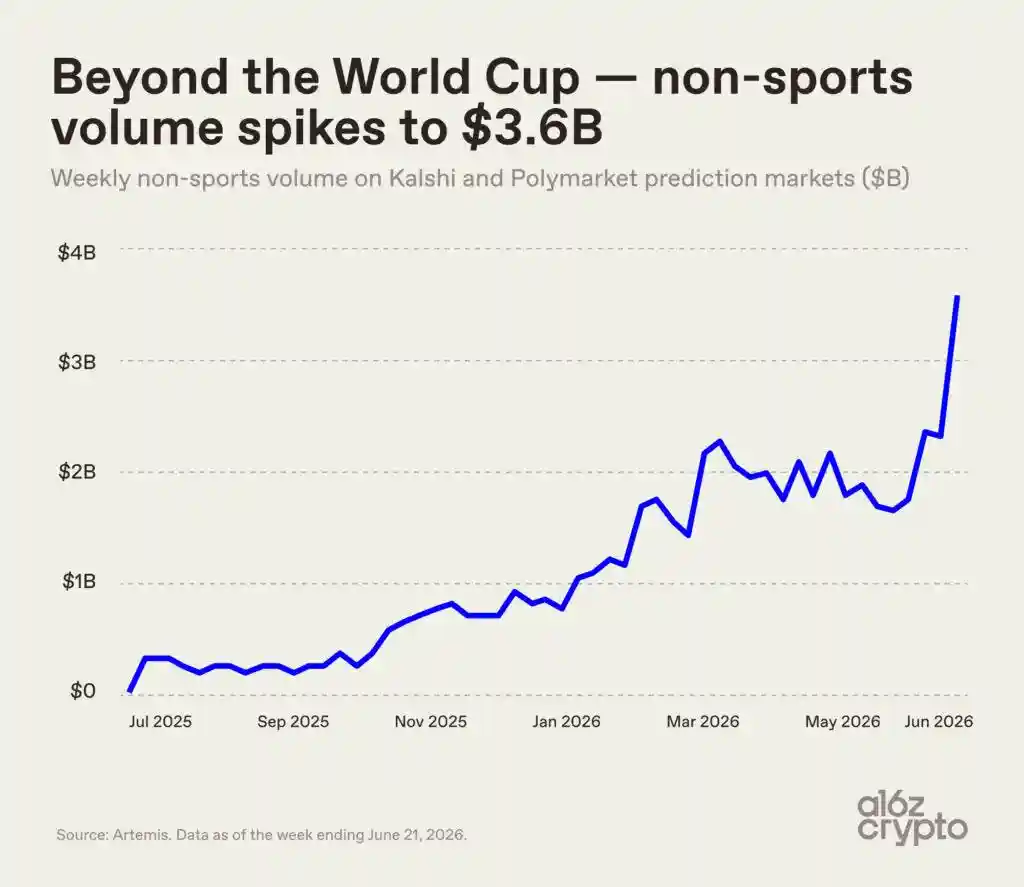
While the World Cup has absorbed significant attention and capital, other sectors have also risen alongside it. Non-sports trading volume—encompassing categories like politics, economics, geopolitics, and current events—reached $3.6 billion last week combined on the Kalshi and Polymarket platforms. This figure is larger than the total weekly volume for the entire prediction market (including sports) last year.

In July 2025, weekly non-sports trading volume was only around $200 million. It has since grown approximately 18-fold, with the slope of the curve noticeably steepening this month.

Acknowledgments: Data and charts provided by Ryan Holloway and Robert Hackett (a16z crypto special feature editor and head of special projects).

Perguntas relacionadas

QAccording to the a16z Crypto data report, what milestone did the weekly trading volume of prediction markets reach last week?

AThe weekly trading volume of prediction markets reached a new record, exceeding $14.4 billion for the first time.

QHow does the article describe the growth in non-sports trading volumes (covering politics, economics, etc.)?

ANon-sports trading volume reached $3.6 billion last week on Kalshi and Polymarket combined, which is larger than the entire prediction market's weekly volume (including sports) last year. It has grown approximately 18-fold since July 2025.

QWhat does the sustained growth in open interest indicate about the prediction markets, according to the article?

AThe steady climb in open interest, which has grown about 8-fold from under $200 million to $1.6 billion since last fall, indicates that real money is flowing into these markets as new positions are being opened faster than old ones are being settled.

QWhat was the approximate weekly trading volume for prediction markets at the beginning of the year, as mentioned in the article?

AAt the beginning of the year, the weekly trading volume for prediction markets was approximately $5-6 billion.

QWhich major event is credited with initially boosting attention and capital in prediction markets, although growth has expanded beyond it?

AThe World Cup is credited with absorbing a lot of attention and capital, but growth has since expanded far beyond sports betting.

Leituras Relacionadas

$2 Trillion: Countdown to AI's Largest IPO in History

The countdown for the largest IPO in AI history, a potential $2 trillion listing for Anthropic, is underway for October. The staggering valuation, reportedly projected by several investors, contrasts with the company's own internal restraint on setting a public target. Founded five years ago by former OpenAI core members, Anthropic's growth has been meteoric. Annual recurring revenue (ARR) surged from ~$9B in late 2025 to $47B by May 2026, with Q2 2026 revenue of $11.5B marking a 14x year-over-year increase. Bank valuations are even based on internal 2028 revenue forecasts of $190-200B. A key growth driver is Claude Code, its AI coding assistant. Its ARR quintupled in five months to $2.5B by February 2026, now constituting nearly 20% of total revenue. Surveys indicate Anthropic commands roughly 40% of enterprise LLM spending, doubling OpenAI's share in programming-specific use. However, alongside this explosive growth, reports detail significant internal cultural strife. Critics describe a divisive "priesthood" of PhD executives, led by CEO Dario Amodei, who promote a "save humanity" narrative that some employees find cult-like and alienating. This has reportedly created a demoralized workforce and a covert "underground network" of dissent among engineers torn between lucrative pre-IPO equity and a toxic work environment. Anthropic now faces a pivotal paradox: pursuing its mission of "safe" AI requires immense capital for compute, yet that capital demands relentless commercial growth. As it approaches its historic IPO, the company must navigate intense regulatory scrutiny, soaring operational costs, and internal tensions—any of which could destabilize its post-listing trajectory, much like SpaceX's significant post-IPO stock drop. The stage is set for a defining moment in tech history.

marsbitHá 1h

$2 Trillion: Countdown to AI's Largest IPO in History

marsbitHá 1h

AI Boosting Efficiency and Cutting Costs Makes VC Increasingly Expensive

"AI for Cost Reduction Makes VC Funding More Expensive" Despite the "cost-reduction and efficiency" narrative of AI, venture capital (VC) investment in the AI sector is becoming increasingly costly. While AI tools lower the initial costs for many startups—with team sizes shrinking across funding stages—the market is polarizing. For top-tier AI teams, especially those from leading companies like Google and OpenAI, funding rounds are now larger and valuations are higher than ever at the seed and early stages. For example, new ventures by prominent researchers are securing billions in funding with valuations reaching tens of billions before having a mature product. This creates a "barbell" market: lightweight startups need less capital, while elite AI firms attract massive investments early on. This dynamic raises the cost for VCs to acquire and maintain meaningful ownership stakes. As valuations soar early, securing the same equity percentage requires significantly larger capital commitments. VCs must now invest more upfront and reserve substantial funds for follow-on rounds to avoid dilution, prompting large firms like Accel and a16z to raise massive new funds. Consequently, capital is concentrating intensely in a few perceived winners like OpenAI and Anthropic, widening the gap between large and small VC funds. While high valuations bake in future growth expectations, they also compress potential returns, demanding that portfolio companies achieve unprecedented scale. For major VCs, the core strategy is clear: secure early positions in potential winners and maintain the capital to keep investing as valuations rapidly escalate.

marsbitHá 2h

AI Boosting Efficiency and Cutting Costs Makes VC Increasingly Expensive

marsbitHá 2h

An Eight-Year Investment Takes a Sharp Turn: Why Did Ethereum Suddenly Abandon Poseidon?

On August 13, Ethereum researcher Justin Drake announced a significant shift in Ethereum's Layer-1 cryptographic roadmap: abandoning the SNARK-friendly hash function Poseidon in favor of traditional functions like SHA2 or BLAKE2. This decision ends eight years of research and investment, marking a major revision to the post-quantum security strategy. Poseidon, introduced in 2019, was highly efficient for zkRollups and zkVMs within SNARK circuits. However, its need for prolonged cryptanalysis and the pressing timeline for quantum resistance revealed limitations. Recent breakthroughs in SNARK design, specifically using binary fields, now enable traditional, battle-tested hash functions to perform as efficiently as Poseidon within SNARKs. Benchmarks show modern laptops can now verify over a million traditional hash calls per second. This change is partly driven by accelerated concerns over quantum computing threats. Reports warn that "Cryptographically Relevant Quantum Computers" could break current blockchain signatures like ECDSA by the early 2030s, risking trillions in assets. Ethereum's response focuses on hash-based post-quantum signature schemes, deemed more quantum-resistant than some lattice-based alternatives under pressure from AI cryptanalysis. Ethereum's updated post-quantum roadmap targets a production-ready "leanVM" for signature aggregation by 2027, with full deployment across consensus, execution, and data layers by 2028. The shift to mature hash functions like SHA2 reduces reliance on newer algorithms and aligns with the goal of using widely analyzed cryptographic primitives. Other major blockchains are also preparing. Solana's core teams have independently chosen the NIST-standardized Falcon signature scheme for its compact size. Starknet plans a phased migration, starting with replacing its Pedersen hash with BLAKE2. Ethereum's move signifies a strategic pivot towards proven security foundations for the quantum era.

marsbitHá 3h

An Eight-Year Investment Takes a Sharp Turn: Why Did Ethereum Suddenly Abandon Poseidon?

marsbitHá 3h

Programmers Worldwide Are Wasting Money on Anthropic! The Company Can't Stand It Anymore

Anthropic recently published guidelines to help developers using Claude Code reduce unnecessary token costs. The key recommendations include: 1) Clear (/clear) conversations after completing a task to avoid carrying irrelevant file reads and command outputs into the next task. 2) Set the model and reasoning effort level at the start of a session, as switching mid-session invalidates the prompt cache, requiring a full-price recalculation of the entire dialog history. 3) Attach files using @ references instead of typing paths manually to avoid extra tool calls and searches that bloat the context. 4) Add quiet flags to verbose commands (e.g., in CLAUDE.md) to minimize lengthy output in the dialog history. 5) Use /compact while the session cache is still warm (before breaks) to compress the dialog at one-tenth the cost. 6) Offload large-output tasks to a sub-agent, which runs in an isolated context and only returns conclusions, preventing intermediate outputs from polluting the main dialog. The article explains token pricing: input tokens (prefill) are processed in parallel, while output tokens (decode) are generated serially, making output tokens five times more expensive. Caching is crucial for savings—if a request's prefix (system prompt, CLAUDE.md, dialog history) matches the previous one byte-for-byte, reading it costs only 10% of the standard input price. However, cache invalidation occurs when changing models, effort levels, fast mode, compressing dialogs, after cache expiration, or when resuming old sessions. Dialog history also grows quadratically (O(n²)) as file contents and command outputs accumulate, increasing costs per round. Proactive context management—like isolating noisy tasks, using /rewind to trim unproductive turns, and task-based session clearing—is becoming an essential skill for cost-effective AI-assisted development.

marsbitHá 5h

Programmers Worldwide Are Wasting Money on Anthropic! The Company Can't Stand It Anymore

marsbitHá 5h

Trading

Spot
活动图片