A Well-Designed "Self-Detonation": Analysis of the PGNLZ Attack Incident

marsbitPublicado em 2026-01-28Última atualização em 2026-01-28

Resumo

On January 27, 2026, an attacker executed a well-orchestrated exploit against the PGNLZ token on BNB Smart Chain, resulting in approximately $100k in losses. The attacker initiated a flash loan of 1,059 BTCB from Moolah Protocol, used it as collateral on Venus Protocol to borrow 30 million USDT, and then exchanged 23,337,952 USDT for 982,506 PGNLZ on PancakeSwap. These PGNLZ tokens were intentionally burned (sent to a dead address), drastically reducing the liquidity pool supply. This manipulation caused the price of PGNLZ to surge from approximately $0.10 to over $5,528 per token. The attacker then invoked a fee-on-transfer function, triggering a built-in burn mechanism (_executeBurnFromLP) that further depleted the pool, leaving only a minuscule amount of PGNLZ and artificially inflating the price to an extreme 40 billion times its original value. Finally, the attacker drained the liquidity pool, repaid the flash loan, and netted a significant profit. The root cause was identified as a flawed deflationary economic model with insufficient validation during fee processing and LP burns, allowing price manipulation. The incident underscores the importance of rigorous economic model design and multi-audit practices before contract deployment.

Background Introduction

On January 27, 2026, we monitored an attack on the PGNLZ project on the BNB Smart Chain:

https://bscscan.com/tx/0xa7488ff4d6a85bf19994748837713c710650378383530ae709aec628023cd7cc

After detailed analysis, the attacker continuously launched attacks against the PGNLZ project on January 27, 2026, resulting in a loss of approximately 100k USD.

Attack and Incident Analysis

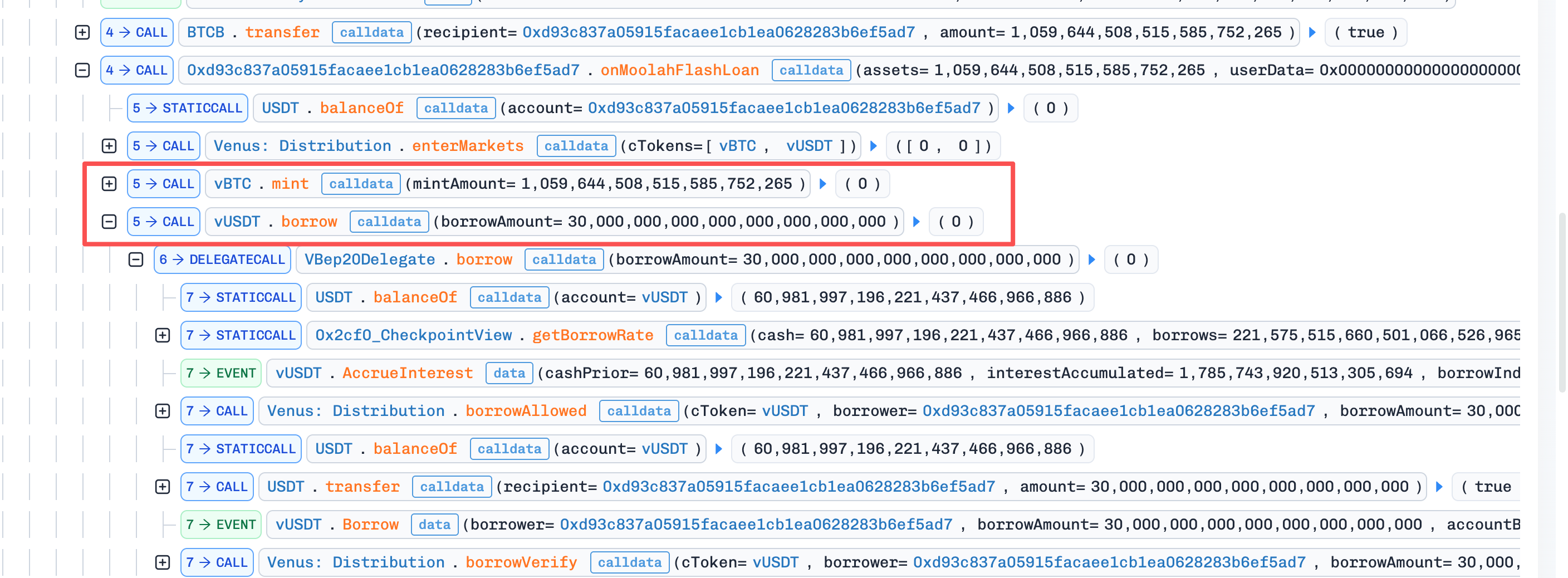
The attacker first borrowed 1,059 BTCB via a flash loan from Moolah Protocol,

Subsequently, they collateralized the 1,059 BTCB on Venus Protocol to borrow 30,000,000 USDT.
Next, the attacker called the function `swapTokensForExactTokens` on PancakeSwap, using 23,337,952 USDT to exchange for 982,506 PGNLZ, but then burned these PGNLZ (sent them to 0xdead).
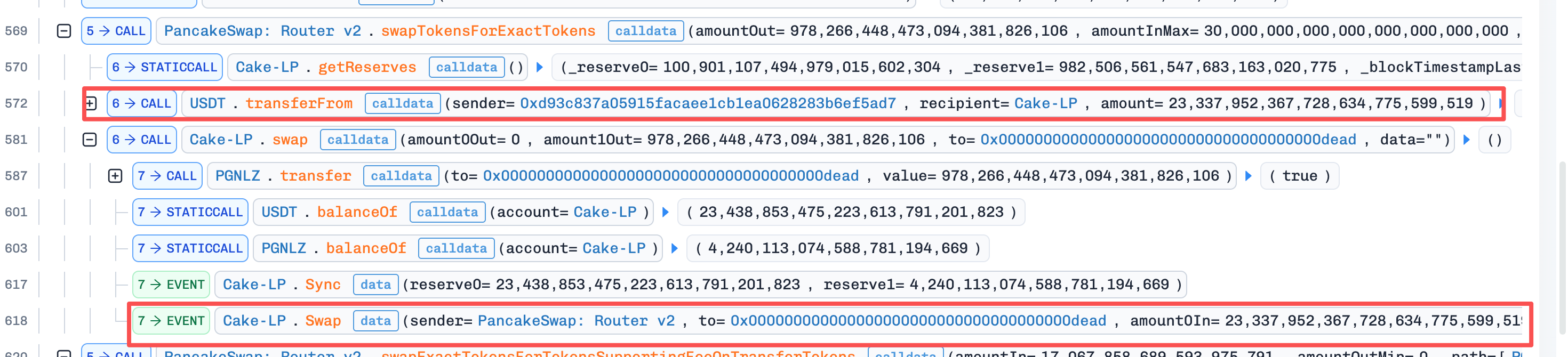
Before the swap, the PancakeSwap Pool contained 100,901 USDT and 982,506 PGNLZ, making the price of PGNLZ 1 PGNLZ = 0.1 USDT. After the swap, the PancakeSwap Pool had 23,438,853 USDT and 4,240 PGNLZ remaining, making the price of PGNLZ 1 PGNLZ = 5,528 USDT.

Subsequently, the attacker called the function `swapExactTokensForTokensSupportingFeeOnTransferTokens`. This function primarily supports Fee-On-Transfer Tokens, i.e., tokens that incur fees on transactions. PGNLZ uses `_update` to handle transaction fees. The specific call chain is: transferFrom -> _spendAllowance -> _transfer -> _update

Since this was a sell, `_handleSellTax` was called.
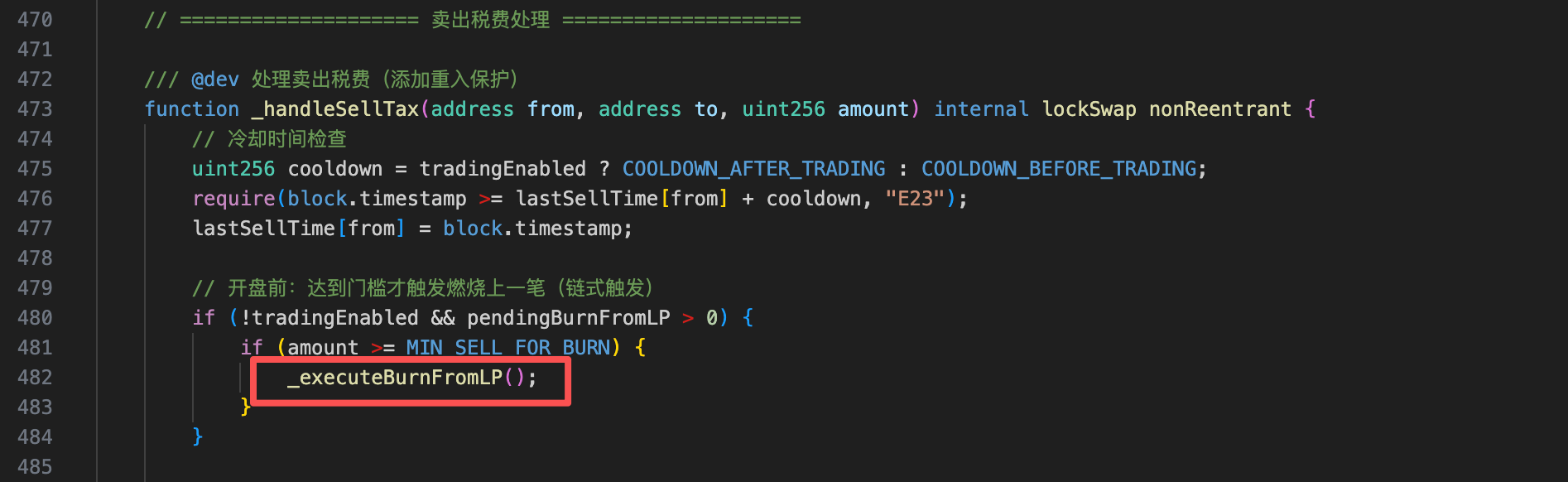
Let's look at how `_executeBurnFromLP` is implemented.
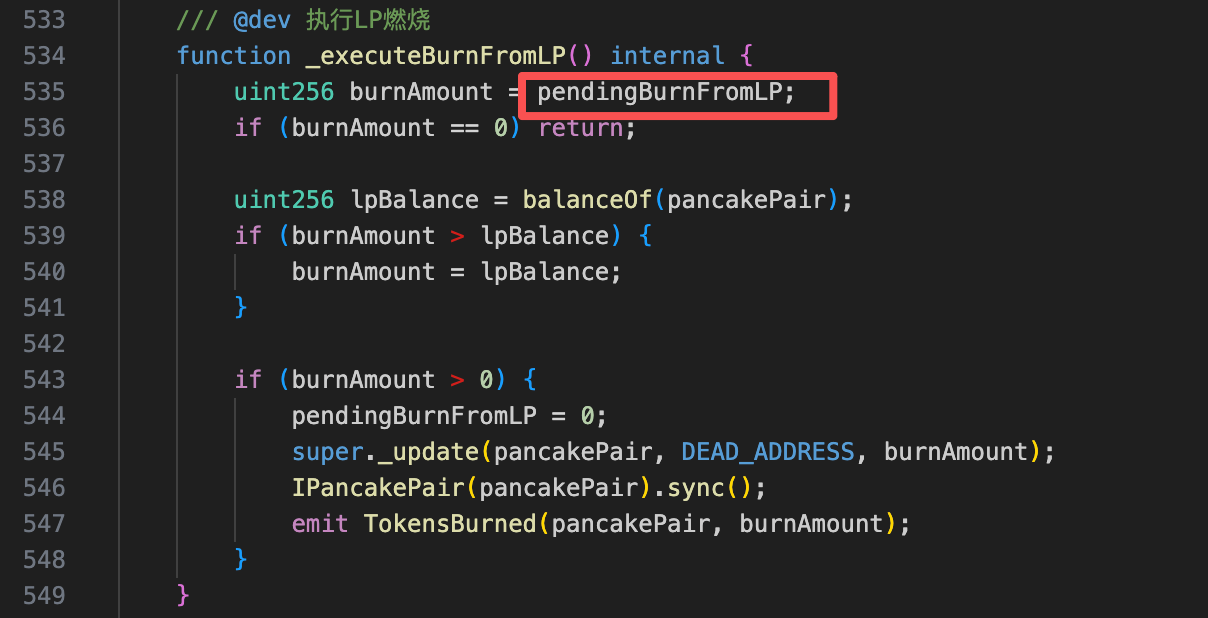
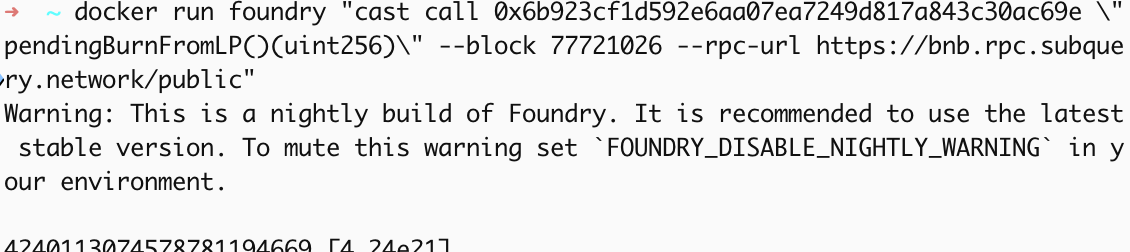
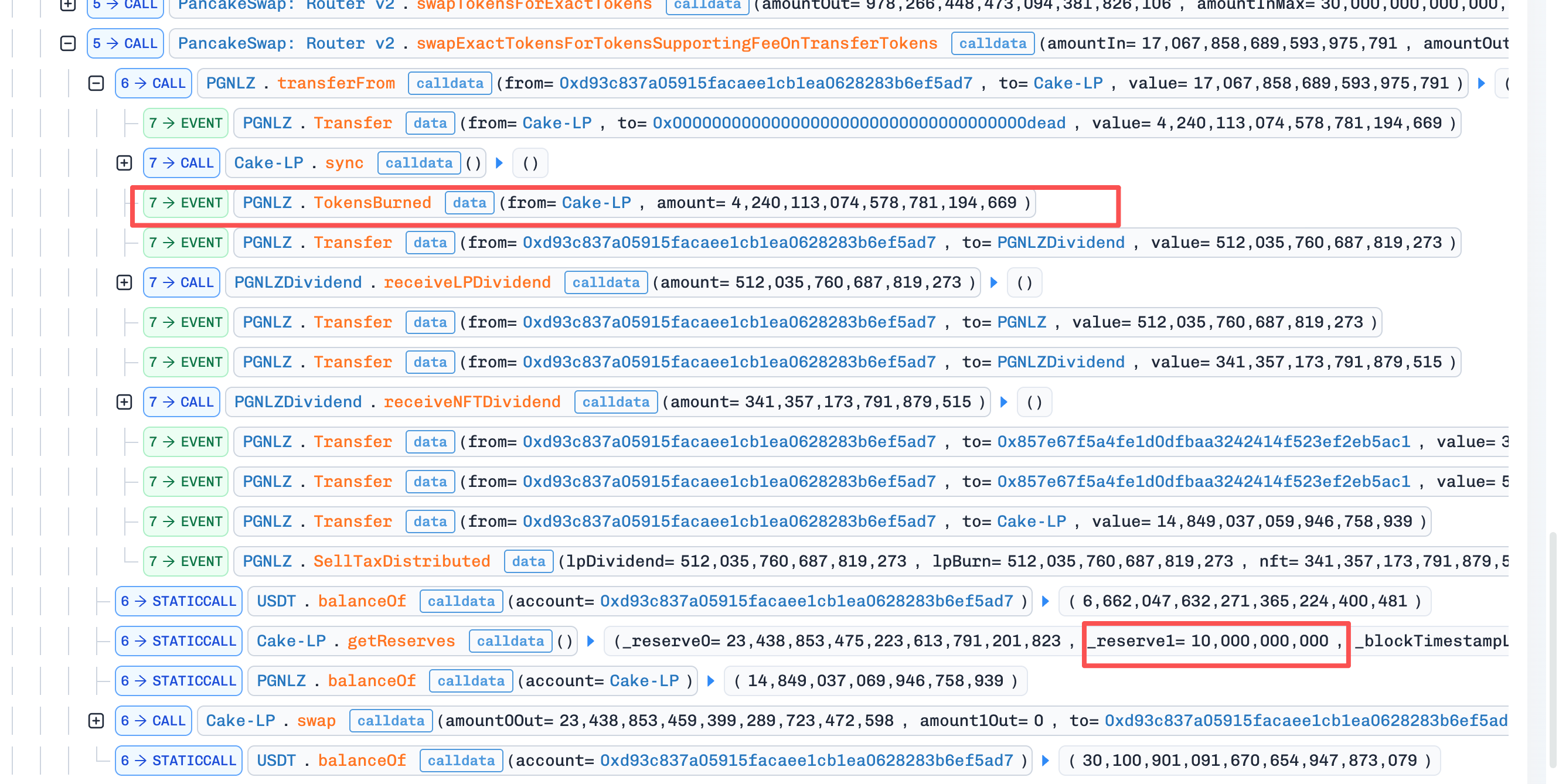
It can be seen that `_executeBurnFromLP` uses `_update` to burn the quantity of PGNLZ specified by `pendingBurnFromLP`. In the previous block, `pendingBurnFromLP` was queried as 4,240,113,074,578,781,194,669.
After the burn, the LP Pool was left with only 0.00000001 PGNLZ, making the price 1 PGNLZ = 234,385,300,000,000 USDT, a 40 Billion-fold increase.
Finally, the attacker drained the LP Pool, repaid the flash loan, and profited 100k USDT.

Summary

The cause of this vulnerability was the deflationary economic model, which lacked validation during fee deductions or LP Pool burns. This allowed the attacker to manipulate the token's price using its deflationary characteristics. It is recommended that project teams conduct thorough multi-party validation when designing economic models and code execution logic. Before contract deployment, opt for cross-audits from multiple auditing firms during the audit phase.


Criptomoedas em alta

Perguntas relacionadas

QWhat was the total financial loss caused by the attack on the PGNLZ project?

AThe attack resulted in a loss of approximately 100,000 USD.

QHow did the attacker manipulate the price of PGNLZ token during the attack?

AThe attacker first swapped a large amount of USDT for PGNLZ and burned the tokens, drastically reducing the supply in the liquidity pool. This caused the price of PGNLZ to skyrocket by 40 billion times, from 0.1 USDT to 234,385,300,000,000 USDT per token.

QWhich function did the attacker exploit to handle the fee-on-transfer mechanism during the sell operation?

AThe attacker exploited the function swapExactTokensForTokensSupportingFeeOnTransferTokens, which triggered the _handleSellTax function and subsequently _executeBurnFromLP to burn a massive amount of PGNLZ tokens from the liquidity pool.

QWhat was the root cause of the vulnerability in the PGNLZ project?

AThe vulnerability was caused by a deflationary economic model that lacked proper checks when deducting fees or burning tokens from the pool, allowing the attacker to manipulate the token's price through supply reduction.

QWhich protocols did the attacker use to obtain the initial funds for the attack?

AThe attacker used a flash loan from Moolah Protocol to borrow 1,059 BTCB, which was then collateralized on Venus Protocol to borrow 30,000,000 USDT.

Leituras Relacionadas

STAR 50 Soars 10.73%, Why Did A-Shares Stage a "V-Shaped Reversal"?

After a prolonged decline, the Chinese A-share market staged a strong rally on July 21. The STAR 50 index surged 10.73%, its largest single-day gain in nearly a year, leading a broad-based "V-shaped" reversal. The Shanghai Composite Index rose 1.79%, the Shenzhen Component Index gained 4.81%, and the ChiNext Index jumped 7.05%. Total market turnover reached 2.97 trillion yuan, an increase of 256.1 billion yuan from the previous session, with over 3,100 stocks advancing. The semiconductor sector spearheaded the rebound, with related ETFs posting significant gains. Analysts attribute the surge to three converging factors. First, coordinated capital inflows from "national team" institutions, insurance funds, listed company buybacks, and fund house self-purchases have bolstered market liquidity and confidence. Second, supportive policy signals, including commitments from regulators to ensure stable market operations, provided a favorable backdrop. Third, a stabilization and recovery in overseas markets, notably South Korea, created a positive external environment. Institutions suggest the most severe panic selling phase for the tech sector has likely passed, following a significant digestion of crowded positions and leveraged funds. While short-term volatility may persist, the medium to long-term outlook remains underpinned by enduring trends like AI computing demand expansion and semiconductor localization. The market's focus now shifts to the sustainability of supportive fund flows, earnings reports, and upcoming catalysts from the global AI industry chain.

marsbitHá 19m

STAR 50 Soars 10.73%, Why Did A-Shares Stage a "V-Shaped Reversal"?

marsbitHá 19m

U.S. Tech Momentum Stocks Post Largest Single-Day Gain Ever, But Is the Plunge Over?

US tech momentum stocks staged a sharp rebound on Tuesday (July 21st). Morgan Stanley's TMT Momentum Factor surged over 12%, marking its largest single-day gain on record, exceeding even peaks from the 2000 dot-com bubble. Key momentum indices from Goldman Sachs also posted their strongest daily performances in years. The rally was led by semiconductors, with the Philadelphia Semiconductor Index jumping 4.6%. This rebound followed three consecutive down days and a cumulative 33% plunge in momentum stocks, one of the steepest drawdowns since the dot-com era. Analysts attribute the surge largely to a short squeeze. Heavy selling had pushed high-beta momentum stocks into deeply oversold territory, forcing many short sellers, particularly in Asia, to cover their positions, creating a self-reinforcing buying spiral. However, the rebound's internals appear weak. Trading volume was notably low, and advancing stocks still lagged decliners on the S&P 500, indicating a narrow, concentrated rally rather than broad market participation. Diverging views emerge on the outlook. BTIG warns the bounce has hit key resistance and recommends selling into strength, citing extreme volatility and historical parallels to past market tops. Conversely, Goldman Sachs and UBS believe the momentum unwind is nearing its end, suggesting it may be time to gradually add exposure, as positioning has been significantly reduced. They caution, however, that high volatility warrants a measured approach, potentially using defined-risk strategies. The upcoming earnings season, particularly reports from major tech firms like Alphabet, is seen as a critical test for the rally's sustainability. Simultaneously, bond markets flashed a warning, with yields rising partly due to spiking oil prices. Analysts note that if long-term Treasury yields break decisively higher, it could pose a significant headwind for equities, especially growth stocks.

marsbitHá 26m

U.S. Tech Momentum Stocks Post Largest Single-Day Gain Ever, But Is the Plunge Over?

marsbitHá 26m

U.S. Tech Momentum Stocks Record Largest Single-Day Gain Ever, but Has the Rout Ended?

U.S. tech momentum stocks staged a dramatic rebound on Tuesday, July 21st. Key momentum indices like the Morgan Stanley TMT Momentum Factor and Goldman Sachs' High Beta Momentum Long Index posted historic or near-historic single-day gains, fueled largely by semiconductor stocks. This sharp rally followed a severe three-day sell-off that saw momentum stocks plunge 33%, marking one of the steepest pullbacks since the dot-com bubble. Analysts attribute the bounce primarily to a short squeeze, as forced covering from over-leveraged traders, particularly in Asia, created a buying spiral. However, the rally's health is questioned due to weak market breadth—overall trading volume was low, and decliners outnumbered advancers in the S&P 500 despite the index's gain—suggesting a narrow, concentrated surge rather than broad recovery. Opinions on the sustainability diverge. BTIG strategists warn the rebound has hit key resistance levels, citing extreme volatility and historic stock dispersion as signs of an ongoing broader correction, and recommend selling into strength. Conversely, Goldman Sachs and UBS view the aggressive momentum unwinding as nearing its end, noting reduced positioning and a lack of new fundamental catalysts. They suggest the sell-off presents a selective opportunity to add exposure, albeit cautiously and gradually using defined-risk strategies. The immediate trajectory hinges on the ongoing earnings season, with market focus on Alphabet's capital expenditure guidance for AI investment clarity. Meanwhile, bond markets present a risk, with rising Treasury yields—potentially heading toward 5.5%—and widening credit spreads for mega-cap tech companies posing a threat to equity valuations. The combination of technical factors, earnings results, and macro conditions leaves the durability of the rebound in doubt.

链捕手Há 29m

U.S. Tech Momentum Stocks Record Largest Single-Day Gain Ever, but Has the Rout Ended?

链捕手Há 29m

Long-Divided Must Unite, Long-United Must Divide: When L1 Becomes Its Own Rollup, What Is Ethereum's Endgame?

"The Inevitable Cycle: When L1 Becomes Its Own Rollup – What is Ethereum's Endgame?" For years, the Ethereum community grappled with concerns that L2s were fragmenting the ecosystem and eroding L1's value. While L2s provided cheaper execution, they also splintered liquidity and the unified user experience of a single chain. This has prompted a fundamental reassessment of the relationship between L1 and L2. Ethereum's roadmap is evolving. The "Scale" initiative merges L1 and L2 expansion into a holistic framework. L1 itself is advancing with higher gas limits, statelessness, and zkEVM verification, no longer content to be just a low-throughput settlement layer. Consequently, the primary value proposition of L2s is shifting from merely providing cheap blockspace to offering L1 cannot easily provide: application-specific optimizations, privacy features, and flexible governance models. L2s are becoming a spectrum of execution environments with varying degrees of security inheritance from Ethereum. A critical challenge in this multi-chain future is interoperability. The vision is to make Ethereum "feel like one chain again." This relies on advancements in native account abstraction (like EIP-7702) and intent-based architectures (Open Intents Framework), where users declare desired outcomes, and solvers handle the complex cross-chain execution. Furthermore, shortening Ethereum's finality time from minutes to seconds is crucial, as it underpins trust between chains for bridges, stablecoins, and cross-chain applications. Perhaps the most provocative idea is that Ethereum L1 itself could become a form of "its own Rollup." As zkEVM and proof systems mature, high-performance nodes could execute transactions and generate validity proofs. Regular validators would then verify these proofs instead of re-executing all transactions. This blurs the traditional L1/L2 hierarchy, making "Rollup" more of a general execution-verification architecture. Native Rollup aims to integrate L2 validation more directly into the Ethereum protocol, allowing L2s to inherit L1's security more fully and move away from reliance on security councils. In the end, L2s are not destined to replace L1 or be made obsolete by it. The likely future is a unified system where diverse execution environments—each optimized for specific use cases like DeFi, gaming, or privacy—coexist. They will share a common foundation of security, liquidity, and verifiable state, seamlessly connected to restore a cohesive user experience. The next phase for Ethereum is not just about scaling through separation, but about intelligently reintegrating what was separated back into a coherent whole.

链捕手Há 45m

Long-Divided Must Unite, Long-United Must Divide: When L1 Becomes Its Own Rollup, What Is Ethereum's Endgame?

链捕手Há 45m

Trading

Spot

Artigos em Destaque

O que é $WELL

WELL3, $$WELL: Revolucionando a Saúde e o Bem-Estar com DePIN e IA Introdução Na paisagem em rápida evolução da tecnologia digital, o sector da saúde e do bem-estar está na vanguarda da inovação, esforçando-se para melhorar os cuidados com os pacientes e promover estilos de vida mais saudáveis. Um jogador inovador neste domínio é o WELL3, um projeto pioneiro de Web3 que visa revolucionar a forma como os indivíduos se envolvem com a sua saúde. Ao aproveitar tecnologias como a Rede de Infraestrutura Física Descentralizada (DePIN), Identidade Descentralizada (DID) e Inteligência Artificial (IA), o WELL3 pretende promover jornadas de saúde seguras e potenciadas por dados. Este artigo abrangente aprofunda-se nos principais aspectos do WELL3, $$WELL, explorando as suas funcionalidades, criadores, investidores e características únicas. O que é o WELL3, $$WELL? O WELL3 serve como uma plataforma inovadora destinada a redefinir a abordagem em relação à saúde e ao bem-estar. Focado na integração de DePIN e DID juntamente com sistemas de IA, o projeto foi concebido para criar experiências personalizadas para os utilizadores, garantindo a segurança e a privacidade dos dados de saúde dos indivíduos. Com um número impressionante de mais de um milhão de utilizadores pré-registados, a missão principal do WELL3 centra-se na melhoria do bem-estar através de jornadas de saúde seguras e orientadas por dados. No seu cerne, o WELL3 utiliza tecnologias avançadas de blockchain para garantir que os utilizadores tenham total controlo sobre a sua informação pessoal. Este projeto não só aborda os desafios da segurança e acessibilidade dos dados, mas também aspira a criar uma comunidade vibrante unida por um compromisso comum com uma melhor saúde. Características-chave do WELL3: DePIN e DID: Estas tecnologias permitem a propriedade e autenticação seguras dos dados, dando aos utilizadores total controlo sobre a sua informação. Integração de IA: Utilizando análises de IA, o WELL3 oferece insights e soluções personalizadas adaptadas às necessidades de saúde individuais. Envolvimento Comunitário: Facilita um ambiente de apoio onde os utilizadores podem conectar-se, partilhar experiências e motivar-se mutuamente em prol de um viver mais saudável. Criador do WELL3, $$WELL A identidade do criador do WELL3 permanece não especificada nas informações disponíveis. À medida que o projeto avança, detalhes adicionais poderão surgir, lançando luz sobre as mentes visionárias por trás desta iniciativa transformadora. Investidores do WELL3, $$WELL O WELL3 recebeu apoio de uma miríade de entidades de investimento influentes, destacando a sua credibilidade e potencial no espaço da saúde e bem-estar. Investidores notáveis incluem: Animoca Brands AWS Samsung The Spartan Group Blocore Fenbushi Capital Newman Group Soul Capital XY Finance Lumoz O apoio destas organizações estabelecidas demonstra uma forte crença na missão do WELL3, proporcionando-lhe os recursos necessários para inovar e expandir as suas ofertas. Como Funciona o WELL3, $$WELL? O WELL3 opera fundindo tecnologias de ponta numa estrutura multichain, garantindo uma experiência do utilizador fluida e inovadora. Abaixo estão alguns fatores que posicionam o WELL3 de forma única no mercado de bem-estar: 1. Propriedade de Dados Segura Com a integração de DePIN e DID, os utilizadores podem manter total controlo sobre a sua informação de saúde pessoal. Este nível de segurança é fundamental na era digital atual, onde as violações de dados e o acesso não autorizado são frequentes. Através do WELL3, a propriedade dos dados é descentralizada, permitindo que os utilizadores gerenciem a sua informação de forma proactiva. 2. Personalização através da IA O WELL3 implementa análises impulsionadas por IA para fornecer aos utilizadores insights de saúde personalizados. Ao aproveitar o poder da IA, a plataforma consegue oferecer recomendações e soluções individualizadas, incentivando os utilizadores a alcançarem os seus objetivos de saúde de forma mais eficaz. 3. Estrutura Multichain O projeto WELL3 foi concebido para funcionar em várias plataformas de blockchain, incluindo Bitcoin, Ethereum, Polygon, Solana, Blast e TON. Esta capacidade multichain assegura que os utilizadores possam interagir com a plataforma de forma fluida em diferentes redes, aumentando a acessibilidade e a usabilidade. 4. Token WELL Central para o ecossistema WELL3 está o Token WELL, que serve múltiplas funções, incluindo utilidade, governança e recompensas. O token permite a participação no ecossistema, apoia o compartilhamento de dados de saúde e incentiva os utilizadores com base no seu envolvimento com a plataforma. Cronologia do WELL3, $$WELL A trajetória do WELL3 exibe marcos significativos no seu desenvolvimento, cada um contribuindo para o sucesso geral do projeto. Aqui está uma breve cronologia dos eventos críticos na história do WELL3: 10 de Fevereiro de 2024: O WELL3 lançou o seu projeto NFT, rapidamente subindo à ribalta como a maior coleção de NFTs na cadeia opBNB com mais de 324.000 proprietários e atingindo 8 milhões de NFTs criados até 27 de Abril de 2024. Venda Pública: O projeto alcançou um valor total notável bloqueado (TVL) de aproximadamente 15.237,2 ETH em apenas sete dias, indicando um forte interesse e apoio do mercado. Lançamento do WELL ID: A plataforma viu mais de 900.000 utilizadores inscreverem-se para o WELL ID e a sua correspondente whitelist de NFTs Ring, marcando uma fase de adoção significativa dentro do ecossistema. Desenvolvimento de Parcerias: O WELL3 estabeleceu parcerias com entidades líderes, incluindo Animoca Brands, AWS, Samsung, entre outras, para melhorar o seu ecossistema e expandir o seu alcance. Volume de Transações: O WELL3 facilitou mais de 17 milhões de dólares em transações, refletindo a sua crescente utilidade e envolvimento dentro da comunidade de saúde e bem-estar. Pontos-chave sobre o WELL3, $$WELL Como uma iniciativa progressiva voltada para o mercado do bem-estar, o WELL3 identificou vários elementos vitais que contribuirão para o seu contínuo sucesso. Aqui estão algumas conclusões importantes a notar: Tokenomics O token $$WELL tem um suprimento máximo de 42 mil milhões, com 71% destinado a iniciativas comunitárias. Esta estratégia de distribuição enfatiza o compromisso do projeto com a sua base de utilizadores e sustentabilidade a longo prazo. Período de Bloqueio Para garantir a estabilidade dentro do ecossistema, os tokens são liberados em lotes ao longo de um período de bloqueio de 24 meses, promovendo confiança e segurança entre os utilizadores. Desenvolvimento do Ecossistema A visão do WELL3 estende-se à criação de um ecossistema abrangente e sustentável para incentivar a participação comunitária ativa, comportamentos que promovam a saúde e soluções digitais que abordem as necessidades prementes do domínio do bem-estar. Adequação ao Mercado A indústria do bem-estar, avaliada em 5,6 trilhões de dólares, apresenta uma oportunidade lucrativa que o WELL3 pretende explorar. Com uma taxa de crescimento anual prevista de 5-10%, o projeto está idealmente posicionado num contexto de crescente tendência em direção a um estilo de vida saudável. Dispositivos Wearables A introdução do WELL3 Ring, um dispositivo wearable incentivado por cripto, alinha-se com a crescente demanda por dados de saúde personalizados. Este dispositivo não só melhora a experiência do utilizador, mas também redefine o que significa estar envolvido com a própria saúde no contexto do Web3. Conclusão O WELL3 representa um avanço significativo na integração da tecnologia blockchain no sector da saúde e do bem-estar. Ao abordar questões cruciais em torno da propriedade dos dados, personalização e envolvimento comunitário, esta plataforma inovadora oferece uma solução visionária para melhorar o bem-estar individual. Com um forte apoio de investidores notáveis e um compromisso com tecnologias pioneiras, o WELL3 está programado para ter um impacto duradouro na paisagem do bem-estar. Para aqueles que procuram navegar pelas complexidades da saúde na era digital, o WELL3 é certamente uma iniciativa a acompanhar à medida que continua a evoluir e crescer.

62 Visualizações TotaisPublicado em {updateTime}Atualizado em 2024.12.03

O que é $WELL

Como comprar WELL

Bem-vindo à HTX.com!Tornámos a compra de Moonwell Artemis (WELL) simples e conveniente.Segue o nosso guia passo a passo para iniciar a tua jornada no mundo das criptos.Passo 1: cria a tua conta HTXUtiliza o teu e-mail ou número de telefone para te inscreveres numa conta gratuita na HTX.Desfruta de um processo de inscrição sem complicações e desbloqueia todas as funcionalidades.Obter a minha contaPasso 2: vai para Comprar Cripto e escolhe o teu método de pagamentoCartão de crédito/débito: usa o teu visa ou mastercard para comprar Moonwell Artemis (WELL) instantaneamente.Saldo: usa os fundos da tua conta HTX para transacionar sem problemas.Terceiros: adicionamos métodos de pagamento populares, como Google Pay e Apple Pay, para aumentar a conveniência.P2P: transaciona diretamente com outros utilizadores na HTX.Mercado de balcão (OTC): oferecemos serviços personalizados e taxas de câmbio competitivas para os traders.Passo 3: armazena teu Moonwell Artemis (WELL)Depois de comprar o teu Moonwell Artemis (WELL), armazena-o na tua conta HTX.Alternativamente, podes enviá-lo para outro lugar através de transferência blockchain ou usá-lo para transacionar outras criptomoedas.Passo 4: transaciona Moonwell Artemis (WELL)Transaciona facilmente Moonwell Artemis (WELL) no mercado à vista da HTX.Acede simplesmente à tua conta, seleciona o teu par de trading, executa as tuas transações e monitoriza em tempo real.Oferecemos uma experiência de fácil utilização tanto para principiantes como para traders experientes.

172 Visualizações TotaisPublicado em {updateTime}Atualizado em 2026.06.02

Como comprar WELL

Discussões

Bem-vindo à Comunidade HTX. Aqui, pode manter-se informado sobre os mais recentes desenvolvimentos da plataforma e obter acesso a análises profissionais de mercado. As opiniões dos utilizadores sobre o preço de WELL (WELL) são apresentadas abaixo.

活动图片













