A Voice from a Seasoned Polymarket User: We've Actually Been Overtaken by Our Competitor

marsbitPublicado em 2026-04-23Última atualização em 2026-04-23

Resumo

A veteran Polymarket user expresses deep concern that the platform is losing its leadership in the prediction market space to its competitor, Kalshi. Despite Polymarket's pioneering role, strong brand, and cultural significance, operational issues and strategic missteps have allowed Kalshi to gain a significant advantage. Key points include: - Kalshi now has a higher valuation ($22B vs. $15B) and greater trading volume year-to-date. - Polymarket faces repeated technical delays, poor communication, and extended downtime, undermining user trust. - The recent announcement of perpetual contracts—prior to fixing core platform issues and fully launching the U.S. app—signals misplaced priorities, focusing on monetization over stability and accessibility. - The author urges Polymarket to prioritize fixing the platform, opening the U.S. app to all users, and improving operational reliability before expanding into new products. Despite these challenges, the author remains optimistic due to Polymarket’s iconic brand, strong community, major partnerships (e.g., ICE, MLB), and regulatory positioning. The piece concludes with a call to action: stabilize the core product, execute reliably, and reclaim market leadership.

Author:Jonah

Compiled by: Jiahuan, ChainCatcher

I've been holding onto this article for a while.

I've wanted to write it, but kept holding back, hoping things would quietly correct themselves. Until this morning when Bloomberg published "Polymarket Loses Prediction Market Lead to Delays and Backlash". To be honest, that report already says most of what I originally wanted to say. So I'll quote heavily from it, letting it shoulder some of the weight.
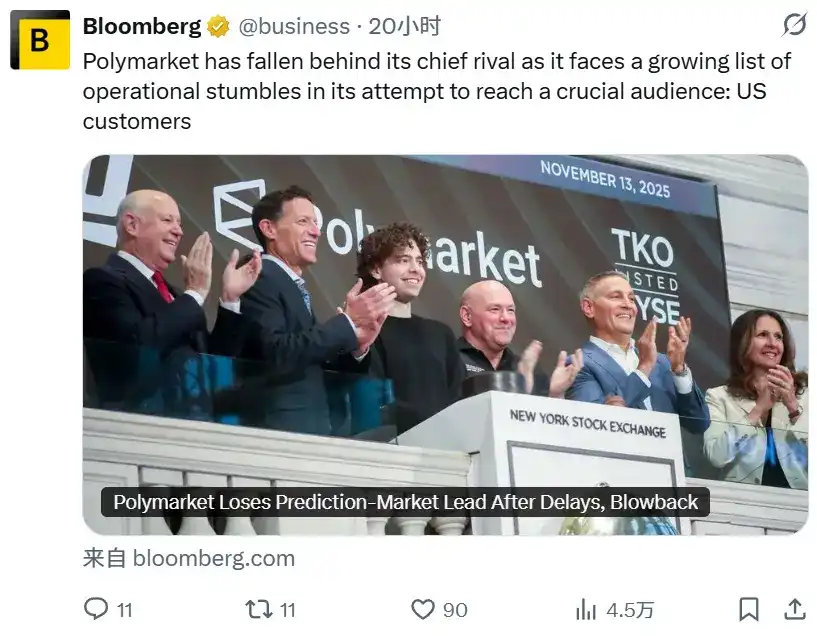
Polymarket, facing increasing operational setbacks in its attempt to reach its key audience (US customers), has now fallen behind its main competitor. From bloomberg.com

That headline is painful. And it should be.

I've been watching Polymarket since mid-2024. I believed in its vision, defended the platform in every regulatory scare, and recommended it to every trader I know. Prediction markets are some of the most important financial infrastructure of this decade, and Polymarket was the company I always hoped would win this赛道.

So this is not a hit piece. This is the kind of letter you write to something you truly care about.

Shayne Coplan, and the entire team, we need to talk.

The Current Situation is Brutal

Let's start with the data.

Reportedly, Kalshi's valuation is around $22 billion, and Polymarket's negotiated valuation is around $15 billion. That's a gap of about $7 billion against an opponent that was once far behind Polymarket. Year-to-date trading volume: Kalshi ~$37 billion, Polymarket ~$29 billion. US market share: Kalshi nearly 90%, while Polymarket is still stuck behind a waitlist.

A year ago, the mainstream narrative was "Polymarket is the king of prediction markets, Kalshi is the regulated stepchild." Today, the narrative has completely flipped. Kalshi has become the compliant, fast-delivering, institutionally credible option, while Polymarket has become the crypto-native veteran that keeps tripping over itself.

This lead was once firmly in our hands. Now, we are giving it away.

The Platform Itself Isn't Fully Operational

This needs to be said straight: there are real problems with the core product, and the company is acting like it's fine.

Last weekend, Polymarket delayed the CLOB V2 migration, the new pUSD collateral token, and the rebuilt matching engine by at least a week. To be fair, the delay itself was the right decision. The developer community had been shouting for weeks that there simply wasn't enough time for a clean migration integration. Pushing a half-finished product live would have been much worse than a delay.

So the delay is not the problem; the delay is actually a good thing.

What was embarrassing was the way the announcement was handled.

From what circulated in the community: the news of the delay went out on Twitter first, but the official migration announcement containing the guide hadn't even been posted yet. The migration guide that followed shortly after still referenced the old, now obsolete dates. Then corrections were added on top of corrections.

Structurally, this is exactly the kind of communication chaos that a "methodical operating machine" should not produce.

Then on Monday, a scheduled five-minute restart took over an hour. The exchange was effectively offline during peak weekday hours. Another small thing added to the mountain of problems.

As the Bloomberg article quotes a Polymarket spokesperson: you can't "build one of the most interesting consumer finance products of the last few years without becoming a methodical operating machine." That's true, that's the vision. But the reality is that this machine keeps failing on avoidable small things, and these small things are accumulating into a pattern.

And these are not isolated incidents:

  • Fee adjustments for sports and crypto markets seemed reactive and poorly communicated
  • The team预告ed the migration for months, with repeated delays on the infrastructure
  • Planned maintenance windows repeatedly far exceeded the stated duration
  • The US app has been stalled for months in a "mobile-only, sports-only, invite-only" beta phase, reportedly with over a million people on the waitlist

"Crypto-native" was supposed to mean more transparent, more resilient, and more accountable than traditional platforms, not an excuse for poor UX and unreliable infrastructure.

The community has patience, but patience is clearly not infinite. Every outage, every missed deadline, every vague status update pushes marginal users towards the competitor that "just works".

The Priority Order is Wrong

What really broke me yesterday was this.

Objectively, the platform is not at 100%. The upgrade was delayed. The US app is not fully open. A million people are on the waitlist. Traders on the global product suffered an outage on Monday afternoon.

And then yesterday, Polymarket announced Perpetuals.
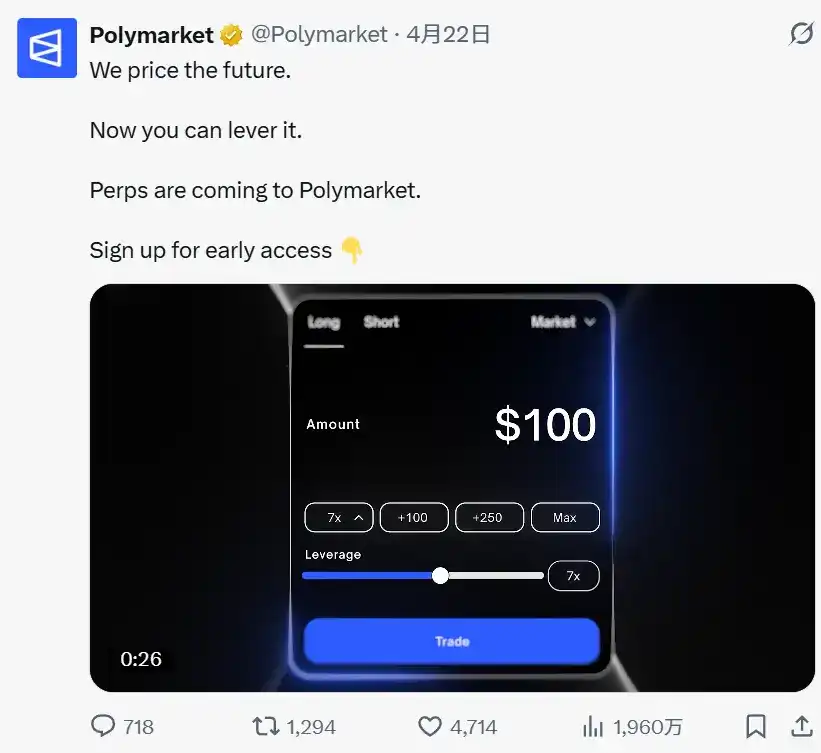
We price the future. Now you can leverage it. Perpetuals are coming to Polymarket. Sign up for early access.

Perpetuals are a great product, and in the long run, they absolutely belong on the roadmap. But announcing them now—just days after an infrastructure upgrade was delayed and a restart ran严重overtime, and while the US app is still in beta—sends only one message to most community members: a cash grab.

Perpetuals are the highest-fee, highest-leverage, highest-volume product in crypto, the fastest path to extracting revenue from existing users. Announcing them while the core exchange is unstable and a million Americans are locked out clearly signals where the team's true priorities lie: monetize the existing traders first, fix the platform later, and address the people outside the gate even later.

Whether intended or not, that is the signal this move sends. Revenue coverage优先于 product stability. Shipping new收费 products优先于 perfecting already-launched products. Harvesting existing users rather than fixing the experience for everyone—current and waiting.

Honestly, interpreting this as a "cash grab" might already be generous.

Look at the order. Kalshi预告ed its crypto perpetual product "Timeless": specific date, specific venue, specific launch event—April 27th, New York, a full product, delivered a week later.

Breaking: US's first CFTC-regulated prediction market exchange @Kalshi has chosen Pyth Pro as the exclusive data layer for its commodity markets. Gold, silver, oil, natural gas, copper, corn, soybeans, wheat. Here's why it matters.

Within days, Polymarket's response was... an early access sign-up page. No release date, no venue, no product specs, no product itself. Just a marketing tweet, a slogan "We price the future. Now you can leverage it," and a form to collect accounts.

That wasn't a product launch; it was a press release disguised as a launch announcement. When what you put out to counter an opponent is明显空洞, you are no longer setting the pace in this赛道—you are chasing someone else's pace. And there's a waitlist for it?

This is a赛道 defined by Polymarket itself. Polymarket was the pioneer, the cultural phenomenon, the incumbent with a head start of years. And today, on the derivatives launch, Polymarket became the chaser, using a sign-up form as PR material, simply because Kalshi announced first.

This is the most embarrassing sentence in this entire letter, but it's exactly what the Bloomberg article is really about.

The operational order should be very simple:

  1. The US App. Fully open it, kill the waitlist, make it stable, make it feature-complete. This is Polymarket's biggest lever, yet it's been sealed for months, letting Kalshi eat the US retail market. This must be priority number one. Not second, first.
  2. Core Platform Reliability. Finish the CLOB V2 migration, execute the pUSD transition cleanly, stop missing maintenance windows, make the exchange something traders can "set and forget".
  3. Then, and only then, expand the business surface. Perpetuals, new market categories, other things on the whiteboard.

The current order is backwards, and the community sees it clearly.

The Startup Phase is Over

The Bloomberg article put into the open what the community has been discussing for months: delays, distractions, and a culture that still feels like a 2021 wild-west startup—despite Polymarket now sitting on billions in open interest, a major partnership with ICE, a CFTC designated exchange status via the QCEX acquisition, and an MLB partnership.

That wild-west startup era is over. It has to be.

You are no longer facing a forum or a niche crypto app. You are facing a CFTC-licensed, institutionally-backed, New York-bred opponent that delivers on time and is taken seriously by regulators, counterparties, and the media.

This is the maturation period that every phenomenal finance company must eventually go through. Coinbase went through it, Stripe went through it. Every serious trading venue must eventually stop operating like a "group chat" and start becoming—to borrow the spokesperson's own words—a methodical operating machine.

Concretely, this means bringing in truly seasoned professionals in operations, risk, and PR. It means cutting out distractions that don't serve US rollout and core stability. It means over-communicating when things go wrong, with real post-mortems and real accountability, not just brief status updates and subsequent silence.

This is not hostility. This is what every serious financial venue eventually does. Polymarket is now one of them. Act like it.

Why I'm Still Bullish on Polymarket

With all that said, here's why I haven't left the platform, and why I don't think this race is over.

ICE is on your side. Jeffrey Sprecher doesn't write checks for vaporware. Intercontinental Exchange, the parent company of the NYSE, led a round last fall, a signal the market still hasn't fully priced in. You now have direct access to one of the world's most sophisticated market infrastructure operators. Use it.

The MLB partnership is a ceiling-level bonus. This signal says the endgame here is not "another betting app," but making prediction markets mainstream, embedded institutional financial infrastructure. Sports leagues, TV networks, traditional finance rails all converging on a single order book is epoch-making. Kalshi clearly doesn't have this cultural reach.

The brand is iconic. For better or worse, in public perception, Polymarket is almost synonymous with prediction markets. The election cycle cemented this彻底, with the platform being cited by journalists, hedge funds, and memes repeatedly. This is a moat most companies can only dream of.

The community is still here. The people who showed up in the early markets, scaled it during the 2024 election, and stuck with the platform through all the growing pains, haven't left. We want to win, and we want to see you win. That's why we're writing letters like this now,而不是 silently migrating volume to another platform.

Bring the Win Home

Truth: Kalshi is winning this quarter, and possibly this entire year.

But Polymarket can still win the decade. The brand, the partnerships, the community, the regulatory angle via QCEX, the ICE relationship—it's all still there, nothing is lost. It's just not being fully utilized while the team is pushing the wrong things in the wrong order.

So the ask is simple.

Fix the platform. Push out the US app. Stop announcing new products until the old ones are stable. Truly become the methodical operating machine the spokesperson described.

The community is still with you, and the believers are still here. But the window to close the gap is narrower than it was six months ago, and it will be even narrower in another six months.

Fix the platform first. Then, bring the win home.

Penned by a longtime Polymarket user who wants, more than anyone, to never have to write a letter like this again.


Perguntas relacionadas

QWhat are the main reasons the author believes Polymarket is losing its leading position in the prediction market?

AThe author cites several reasons: operational setbacks like repeated delays in infrastructure upgrades and extended maintenance windows, poor communication during these events, the prolonged waitlist for the U.S. app which blocks growth, and a misalignment of priorities where new revenue-generating products (like perpetuals) are announced before core platform stability and U.S. market access are secured.

QHow does the data compare between Polymarket and its competitor Kalshi according to the article?

AThe article states that Kalshi has a higher valuation of approximately $22 billion compared to Polymarket's reported $15 billion. In terms of year-to-date trading volume, Kalshi has about $37 billion while Polymarket has around $29 billion. Most significantly, Kalshi holds close to 90% of the U.S. market share, while Polymarket's access is still behind a waitlist.

QWhat specific product launch timing does the author criticize as demonstrating misplaced priorities?

AThe author heavily criticizes the announcement of Polymarket's perpetual contracts product. This announcement came just days after a core infrastructure upgrade was delayed and a platform restart ran significantly over time, and while the U.S. app was still in a limited, invite-only beta with a million people on the waitlist. The author sees this as prioritizing quick revenue from existing users over fixing fundamental platform issues and expanding access.

QWhat does the author suggest should be Polymarket's correct order of operational priorities?

AThe author proposes a clear order of priorities: 1) Fix and fully launch the U.S. application, removing the waitlist. 2) Ensure core platform reliability by completing the CLOB V2 migration and pUSD transition smoothly and avoiding operational hiccups. 3) Only after the first two are accomplished should the company expand into new product areas like perpetual contracts.

QDespite the criticisms, what advantages does the author believe Polymarket still holds over Kalshi?

AThe author remains bullish on Polymarket due to several key advantages: the strategic investment and infrastructure expertise from ICE (Intercontinental Exchange, owner of the NYSE), the landmark partnership with MLB which offers immense cultural reach, its iconic brand that is synonymous with prediction markets for many, and a loyal core community that has supported it through growth pains.

Leituras Relacionadas

Seeking Alpha's Hot Article: Why Might the U.S. Stock Market Crash in June?

In a recent Seeking Alpha article, financial professor and analyst Damir Tokic argues that the US stock market may be poised for a significant crash in June 2026. The core thesis centers on a "mega-bubble" in equities, particularly within the technology sector, which has driven the S&P 500 to near-record valuations, with a Shiller P/E ratio exceeding 40—a level comparable to the 2000 dot-com bubble. Tokic identifies two primary catalysts for a potential collapse. First, he points to unsustainable market exuberance fueled by what he terms the "Trump Stimulus"—massive AI capital expenditure by tech giants, which he believes is politically driven and cannot last. Second, and more urgently, he highlights the escalating Iran war as a critical threat. The ongoing closure of the Strait of Hormuz has created a severe global energy supply crunch. Strategic petroleum reserves are projected to hit critically low operational levels by June, potentially causing oil prices to spike above $200 per barrel and triggering a severe, supply-driven inflationary shock. This scenario, Tokic warns, would force the Federal Reserve's hand. Despite currently maintaining a dovish bias, the Fed would likely be compelled to officially pivot to a hawkish stance at its June FOMC meeting to combat soaring inflation and bond yields. He contends that such a shift—or even a failure to act, which would destroy Fed credibility—could be the trigger that punctures the market bubble. The resulting downturn, he concludes, could rival the bear markets of 2000 and 2008, advising investors to prepare for a major correction.

marsbitHá 13m

Seeking Alpha's Hot Article: Why Might the U.S. Stock Market Crash in June?

marsbitHá 13m

AI PC Battle: Bet on the Toll Booth, Not the Camp

**Title:** The AI PC Battle: Don't Bet on Sides, Bet on the Tollbooth **Summary:** The AI PC competition is moving beyond simple "x86 vs. Arm" narratives. The core investment thesis should focus on identifying which players can sustain margins, cash flow, and pricing power throughout the upgrade cycle, rather than backing a particular architecture. The opportunity is analyzed in three layers: 1. **The Advanced Foundry Tollbooth:** TSMC is positioned to collect "tolls" regardless of which chip designer wins, due to its dominant ~70% share in advanced semiconductor manufacturing, which is essential for high-end AI PC chips. 2. **Compute & Platform Spillover:** AMD represents an offensive in the x86 CPU+GPU space, while NVIDIA leverages its GPU and CUDA software stack dominance. Both benefit from the demand for increased local AI compute. 3. **Architecture Diffusion & Turnaround Plays:** ARM and Intel offer potential for significant upside (elasticity), but investments here require stricter discipline due to higher execution risks and competitive challenges. The industry is transitioning from concept to shipment validation. While short-term forecasts for AI PC adoption have been revised down slightly due to tariffs and procurement delays, the long-term trend towards AI becoming a standard PC feature remains intact. The key driver for upgrade cycles will be whether compelling enterprise applications (e.g., privacy-sensitive computing, low-latency inference) emerge beyond consumer-focused features like meeting summarization. Investment strategy should prioritize companies with platform-level advantages and recurring revenue streams. TSMC offers high certainty as the foundational tollbooth. AMD presents a strong offensive play within the established ecosystem. ARM and Intel are higher-risk, higher-potential-reward turnaround bets. The report cautions against chasing short-term hype and emphasizes a disciplined, long-term approach focused on buying ecosystem strength and cash-flow certainty after market enthusiasm subsides. **Key Risks:** Underwhelming AI PC applications slowing upgrade cycles; slow improvement in Windows on Arm compatibility; macro/tariff impacts on PC demand; potential advanced node supply-demand mismatches affecting TSMC; high overall AI sector valuations making stocks vulnerable to a risk-off shift in markets.

marsbitHá 28m

AI PC Battle: Bet on the Toll Booth, Not the Camp

marsbitHá 28m

Ten-Thousand-Word Analysis: From $10 to $290, MRVL Wins the Entire AI Era by 'Not Making GPUs'

Marvell Technology's stock price surged from under $10 in 2016 to a record $290 in June 2026, fueled not by making GPUs, but by dominating AI infrastructure connectivity. This analysis argues the market misvalues MRVL as merely a smaller Broadcom in custom AI chips, overlooking its true, unique position. Marvell's core strength lies in enabling high-speed data flow for AI clusters through three interconnected businesses. First, it holds a commanding ~70% market share in high-speed optical DSPs (essential for data center light modules), a deep-moat business with accelerating growth. Second, its custom AI chip design business serves hyperscalers like AWS, Microsoft, and Google, with a significant revenue pipeline despite lower margins. Third, stable cash flows come from Ethernet switch chips and enterprise storage controllers. Together, they form a full-stack "AI data movement" platform. CEO Matt Murphy's transformative leadership since 2016, involving strategic divestments, key acquisitions (like Inphi for optical DSPs), and securing long-term agreements with major cloud providers, repositioned the company. A pivotal $2 billion strategic investment from NVIDIA in 2026 underscored Marvell's critical role in the AI ecosystem, particularly through collaborations like NVLink Fusion. While Marvell faces risks—including client concentration (losing the Amazon Trainium3 design), lower-margin business mix, competitive threats, insider selling, and complex supply chains—its fundamentals remain strong. The optical interconnect moat is widening with the acquisition of Celestial AI (photonics fabric), and financial metrics show accelerating revenue growth and operating leverage. With a PEG ratio suggesting undervaluation relative to its growth, the thesis is that the market undervalues Marvell's monopolistic position in AI "plumbing" while overemphasizing its competitive custom chip segment. The story transcends investing, symbolizing how in any complex system—from the internet to AI—the value of "connection" ultimately surpasses that of individual "nodes."

marsbitHá 57m

Ten-Thousand-Word Analysis: From $10 to $290, MRVL Wins the Entire AI Era by 'Not Making GPUs'

marsbitHá 57m

AI Relay Stations Spark Heated Debate on Zhihu: Behind Cheap Tokens, What Are Users Really Worried About?

A discussion on Zhihu about "AI relay stations" shifted the niche developer topic of "cheap tokens" into broader user awareness. Users moved beyond simply questioning the legitimacy of these services to focus on practical concerns: Where do cheap tokens truly come from? Is the model being accessed the real one? Can relay stations see prompts, code, and API keys? For occasional users, are the risks worth it? The core debate centered less on price and more on trust. A primary worry is model authenticity—the risk of "model swapping," where users paying for a premium model might be routed to a cheaper one, creating an information asymmetry. Others argued that cost comparisons matter; while cheaper than official pay-as-you-go APIs, relay stations may not be the lowest-cost option versus subscriptions, domestic models, or free tiers, making user needs assessment crucial. Speculation about token sources ranged from legitimate bulk discounts to gray-area methods like account sharing or exploiting regional pricing. This opacity makes risk assessment difficult for users. Data security emerged as a critical concern, especially for enterprise use. When processing sensitive information like code, contracts, or client data, the inability to verify a relay station's data handling, retention, or access policies poses significant compliance and confidentiality risks. The evolving consensus suggests relay stations can be used cautiously for low-sensitivity, disposable tasks (e.g., summarizing public info, simple translation). However, they should not be the default for sensitive, professional, or production workflows involving proprietary data, Agents, or automated systems. Recommendations include avoiding large prepayments, not relying on a single service, using test prompts to monitor quality, anonymizing data where possible, and keeping official channels as backups. Ultimately, the discussion framed tokens not just as a billing unit but as a measure of real cost encompassing price, model integrity, data security, and service stability. The popularity of relay stations highlights user demand for affordable access, but the debate underscores a key trade-off: the savings from cheap tokens may come at the price of trust, transparency, and control over one's data and AI experience.

marsbitHá 1h

AI Relay Stations Spark Heated Debate on Zhihu: Behind Cheap Tokens, What Are Users Really Worried About?

marsbitHá 1h

Trading

Spot
Futuros
活动图片




