A Transformative Era for DeFi Collateral: Exploring RWA as the New Composable Infrastructure for DeFi

marsbitPublicado em 2026-04-20Última atualização em 2026-04-20

Resumo

DeFi Collateral Transformation: RWA Emerges as Composable Infrastructure The tokenized Real-World Asset (RWA) market has reached $27 billion, yet only about $2.7 billion is actively used as collateral in DeFi lending markets. This growth was accelerated by key 2025-2026 regulatory milestones in the U.S., including the GENIUS Act for stablecoins and the classification of major blockchain tokens as digital commodities. The composition of tokenized assets differs significantly from those actively used in DeFi. U.S. Treasuries dominate tokenized AUM (48.5%) but represent only 2% of DeFi deposits. Conversely, credit assets (17% of AUM) constitute 80% of deposits, driven by yield differentials that enable profitable leverage strategies. Reinsurance is emerging as a new composable asset class, with over 80% of its tokenized supply active in DeFi. The market is evolving in real-time. As yield spreads compress, collateral diversification is increasing, evidenced by Aave Horizon's shifting composition. Permissionless access is a critical driver for distribution, as demonstrated by Maple Finance's 'syrup' tokens, which have been composably deployed across multiple chains and protocols without requiring permissions. In conclusion, while the absolute value of RWA in DeFi is still small, its rapid growth rate, the divergence between tokenized and utilized assets, and the power of permissionless composability are the key trends shaping this new infrastructure layer.

Author: Dune

Compiled by: Felix, PANews

This article is an expanded analysis based on the speech by Fredrik Haga, co-founder and CEO of Dune, at EthCC 2026. Details below.

The scale of tokenized RWAs has reached $27 billion. However, only about $2.7 billion is actively deposited in decentralized lending markets: as collateral, in vaults, or for yield strategies. This article explores the distribution of these funds, the driving forces behind them, and what this portends for the future.

From Regulatory Clarity to Composable Capital

Three regulatory milestones in late 2025 and early 2026 accelerated the tokenization process. In July 2025, the GENIUS Act established the first comprehensive framework for payment stablecoins in the United States, requiring 1:1 asset backing and clear regulation. In March 2026, the U.S. SEC and CFTC jointly classified major blockchain tokens as digital commodities rather than securities. Days later, the SEC approved Nasdaq to trade and settle tokenized stocks and ETFs on its main market.

These milestones further propelled the tokenization process. The total supply of stablecoins, serving as the settlement layer for tokenized assets, surpassed $330 billion, growing 12-fold since 2020. During the same period, the number of active stablecoins increased from 31 to 215. Tokenized RWAs showed a similar trajectory, with their Assets Under Management (AUM) growing 27-fold in two years to approximately $27 billion, expanding from a few initial categories to the seven categories tracked in the dashboard (including reinsurance and stocks).

Beyond the impressive AUM figures, a more meaningful question is: how much of this capital is actually being used in the DeFi space. Currently, about $2.7 billion worth of RWA tokens are actively deposited in DeFi lending markets, accounting for roughly 10% of the $27 billion tokenized AUM. A year ago, this 10% share was almost non-existent. Composability is arguably the most promising advantage of tokenization. That is, the ability for tokenized assets to serve as collateral, be used for lending, and be utilized in various yield strategies across different protocols and chains.
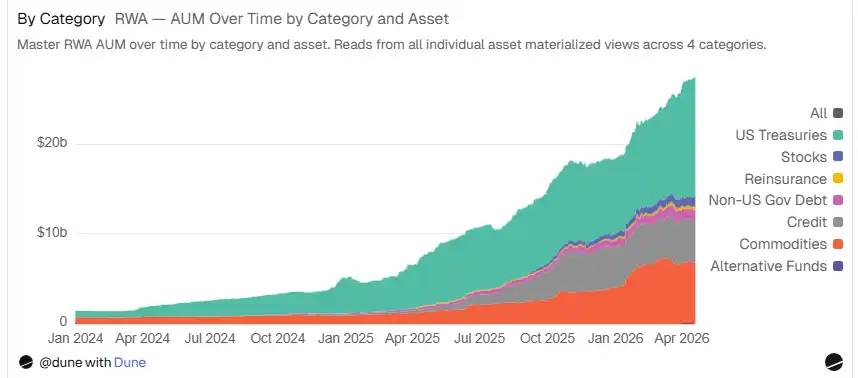
Note: The RWA tokens counted are limited to collateral and vault supplies. Data as of April 16, 2026.

Where is the ~$2.7 Billion Deposited?

The funds are distributed across four main platforms on Ethereum, Solana, and multiple L2s:
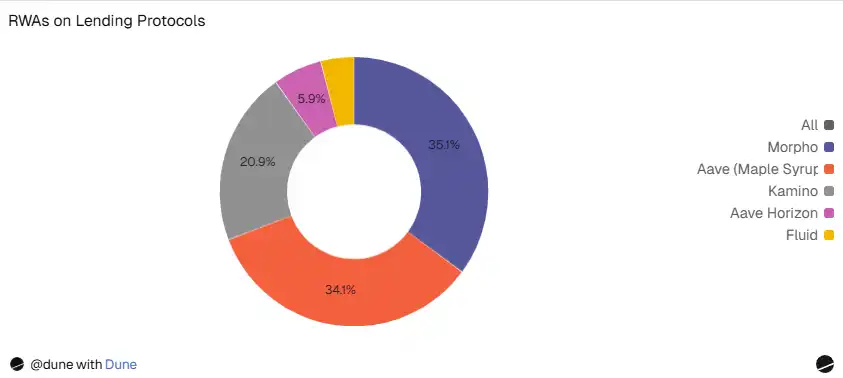
  • Morpho ($957 million): Permissionless, listing 41 RWA assets across 10 chains. Professional curators like Gauntlet and Steakhouse manage vaults, allocating funds to these markets and building structured leverage strategies on top of tokenized RWAs.
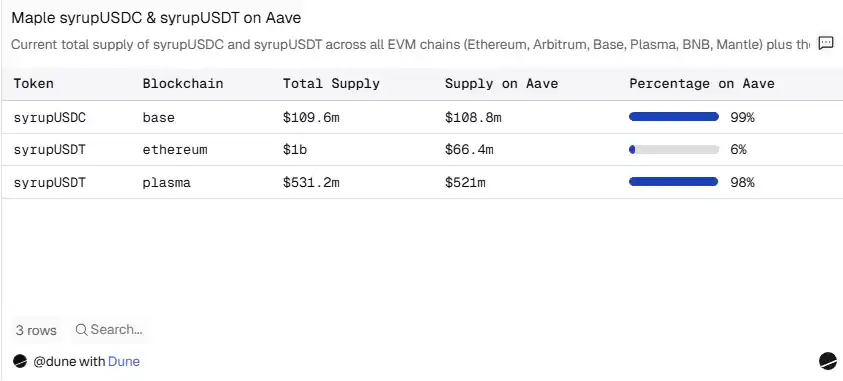
  • Aave ($929 million): Maple's syrup tokens are deposited on Plasma, Base, and Ethereum. Institutional credit flows permissionlessly to where the economics of borrowing are best.
  • Kamino ($587 million): The largest lending protocol and RWA platform on Solana. This includes $315 million for PRIME (HELOC lending yield), $161 million for syrupUSDC, $71 million for ONyc (reinsurance), $18 million for USCC, plus xStocks markets (covering seven tokenized stocks totaling $21 million).
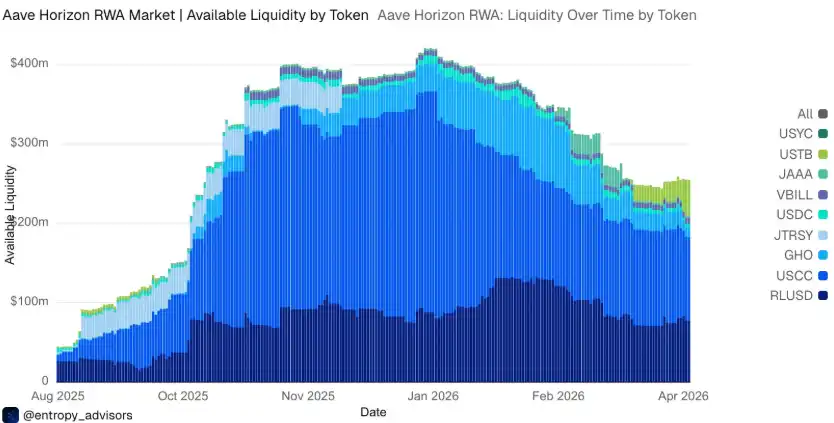
  • Aave Horizon ($161 million): Aave's permissioned, institutionally-oriented RWA market. There are 256 addresses with an average holding of $1.5 million. This includes $105 million in USCC, $46 million in USTB, $7 million in VBILL, and $3 million in JAAA. The total active borrowing in stablecoins is $124 million, with a utilization rate of 77%.
  • Fluid ($109 million): $94 million in reUSD (reinsurance), $12 million in gold, $2 million in syrup. Notably, it supports using Re Protocol's reUSD as collateral, which is not offered by other platforms.

Tokenized Assets vs. Actively Used Assets Are Not Aligned

There is a significant discrepancy between the assets dominating tokenized AUM and those actually deposited as collateral in lending protocols. These two leaderboards are almost completely inverted.
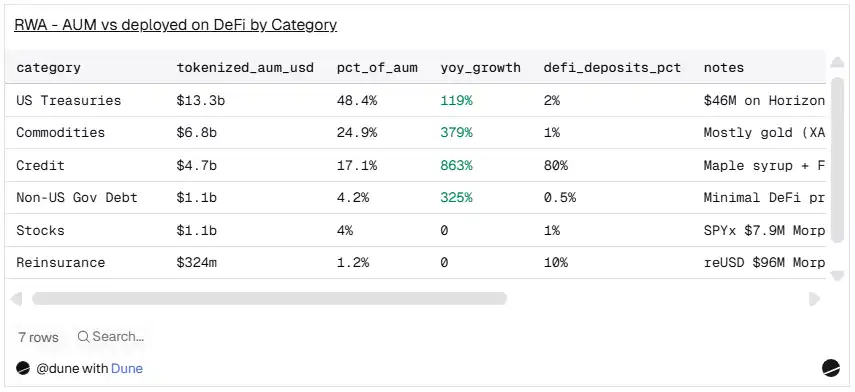
Source: Dune

U.S. Treasuries account for 48.5% of tokenized AUM ($13.2 billion) but only 2% of DeFi deposits. Credit assets account for 17% of AUM but dominate deposits at around 80%. Commodities account for 25.2% of AUM but constitute almost less than 1% of DeFi deposits.

Credit assets dominate due to their profit model. Maple's syrupUSDC yields about 6%, while Treasury Bills (T-Bills) yield about 3.5%. When your collateral earns 6% and you can borrow stablecoins at 3%, you achieve positive carry. Curators like Gauntlet build explicit looping strategies on top of this: deposit RWA as collateral, borrow against it, and buy more. This is designed and risk-controlled leverage. This also explains why credit assets appear on every major lending platform: $957 million on Morpho, $929 million on Aave, $476 million on Kamino.
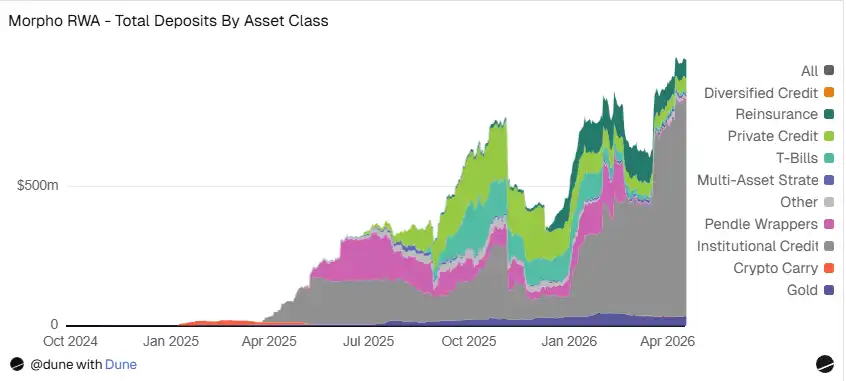
Source: Dune

Reinsurance is emerging as a genuinely new, composable asset class. Re Protocol's reUSD appears on multiple platforms: $96 million on Morpho (including $50 million in Pendle PT-reUSD), $94 million on Fluid, while OnRe's ONyc occupies $71 million on Kamino. Overall, tokenized reinsurance AUM is $324 million (1.2% of total), with DeFi deposits around $261 million (10% of total), meaning about 80% of tokenized reinsurance capital is active in lending protocols, a much higher deposit ratio than any other asset class.
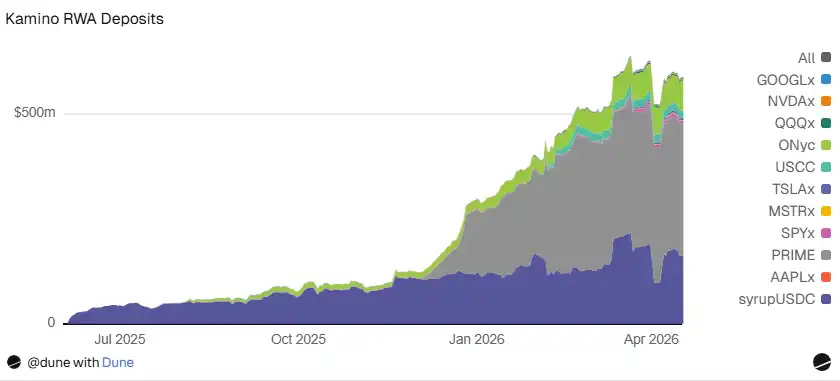
Tokenized stocks are also appearing in DeFi: SPYx ($7.9 million on Morpho), xStocks on Kamino (covering SPYx, TSLAx, QQQx, NVDAx, GOOGLx, MSTRx, AAPLx totaling $21 million), and deSPXA ($3.6 million). While the amounts are smaller, the infrastructure is live, and borrowing activity against stock collateral is happening.

This discrepancy is instructive. Tokenization prioritizes safety and familiarity. U.S. Treasuries are easy to understand, regulate, offer transparency (frequent NAV updates and easy oracle pricing), and are highly attractive to institutional balance sheets. Composability, however, values different things: yield differentials and leverage economics.

Collateral Composition is Evolving in Real-Time

The dominance of high-yield credit might be partly a function of timing. Aave Horizon provides the clearest evidence.

When Horizon launched in August 2025, Superstate's USCC, a crypto arbitrage fund, offered ~15% APY through basis trading on crypto futures. This yield led it to constitute 93% of all RWA collateral. Treasury products were also listed but saw no uptake.

Since then, as the basis narrowed, USCC's yield compressed to ~4%, converging with the 3-4% yield of Treasuries. The result: USCC's collateral share dropped from 93% to about 67%, while USTB surged 570% in 30 days from under $1 million to $45.6 million. As yield differentials narrow, the market is diversifying.
Source: Dune

This is significant not just for Horizon. If credit yields compress across the market (as often happens in mature markets), the collateral composition across all platforms could become more diverse. The assets that dominated the first wave (high-yield credit) might not dominate the next. Risk appetite, regulatory environment, and settlement mechanics will start to matter more.

Pendle adds another dimension to this evolution. Its Principal Tokens (PTs) account for $58 million in deposits on Morpho (allowing users to lock in fixed yields from RWA products). Pendle also directly offers RWA markets for thBILL and mTBILL, bringing yield curve trading into the composability stack. As more RWA products list on Pendle, fixed-rate strategies will become another channel for RWA distribution.

Permissionless Access Drives Distribution

Maple Syrup is the clearest case. syrupUSDC and syrupUSDT are permissionless ERC-20 tokens. Technically, they are hybrids between stablecoins and RWAs, as they are pegged 1:1 to USDC/USDT but earn yield from institutional credit. They are classified as RWAs because the underlying exposure is real-world lending. Anyone can mint, trade, or deposit them into any lending protocol. No KYC, no whitelists, no partnership required.

The result: 98% of syrupUSDT on Plasma and 99% of syrupUSDC on Base are actively deployed on Aave. Curators like Gauntlet on Morpho independently built leveraged vaults around Syrup without coordinating with Maple. syrupUSDC also reached $161 million on Kamino (Solana).
Source: Dune

Each integration adds utility, utility attracts capital, and capital drives more integrations. It is this flywheel effect that has led to $929 million being organically distributed across three chains.

This is crucial because distribution is recognized as the industry's biggest challenge. Centrifuge's "Tokenization Outlook 2026" report noted that 86% of operators said scaling distribution for existing products is more important than launching new ones. The Maple case on Aave shows that permissionless composability is itself a distribution channel.

$1.85 Billion Tokenized, Only $13 Million Composable

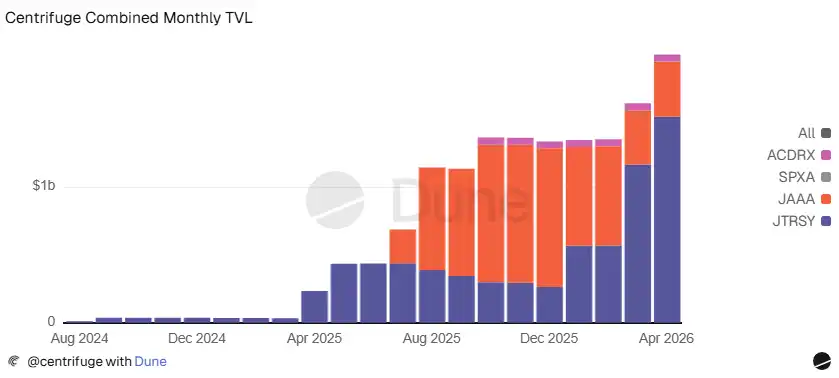
Centrifuge's report highlights both the opportunity and the gap for RWAs. It is one of the largest tokenization platforms, with institutional product AUM exceeding $1.85 billion: JTRSY (US Treasury tokenized fund) at $1.52 billion, JAAA (AAA-rated CLO tokenized fund) at $403 million, ACRDX (Apollo Diversified Credit Fund) at $52 million, and the recently launched SPXA (first S&P 500 index tokenized fund) at $3.7 million. However, only about $13 million of this is composable in DeFi: primarily through deRWA wrapper tokens and JAAA on Horizon.
Source: Dune

This gap ultimately comes down to timing and design. The deRWA wrappers only launched in September 2025. The permissioned design slowed integration, and liquidity was thin.

But integration is accelerating. Resolv committed $100 million to JAAA on Horizon. Falcon Finance added JAAA and JTRSY as collateral for USDf. Grove is deploying $250 million on Avalanche. LayerZero enables distribution across 165+ networks. And deSPXA (the DeFi wrapper version of Centrifuge's S&P 500 fund) has reached a total TVL of $3.6 million and DEX trading volume of $7.9 million, showing early organic activity and the potential of the deRWA model: permissionless wrapper tokens operating in parallel with permissioned institutional products.

Three Key Takeaways

Growth rate is more important than current size. There is $2.7 billion in RWA deposits across major DeFi lending markets, about 10% of the $27 billion tokenized AUM. But this $2.7 billion barely existed a year ago. The absolute numbers are still small, but the growth rate is what truly matters.

Tokenized assets are not the same as actively used assets. Treasuries account for 48.5% of tokenized AUM but only 2% of DeFi deposits. Credit accounts for 17% of AUM but 80% of deposits. Higher yields enable positive carry, which supports leverage loops. Credit yields above 6% work; Treasury yields at 3.5% do not. But as the macro environment changes and yield differentials shift across asset classes, collateral composition will adjust, accommodating different assets and emerging categories like reinsurance.

Permissionless access drives distribution. Maple's syrup tokens (hybrids between RWAs and stablecoins) reached over $1 billion across Aave and Kamino on four chains. The token was designed to be composable, so the market composited it. Assets that are easy to onboard get adopted more easily. Assets requiring whitelists are catching up but are moving much slower.

Related reading: On-chain is not liquidity: RWA still needs the final leap

Perguntas relacionadas

QWhat is the total value of tokenized RWA currently being actively used as collateral in DeFi lending markets, and what percentage of the total tokenized RWA AUM does this represent?

AApproximately $2.7 billion of tokenized RWA is actively used as collateral in DeFi lending markets, which represents about 10% of the total $27 billion tokenized RWA AUM.

QWhich three regulatory milestones in late 2025 and early 2026 are credited with accelerating the tokenization process?

AThe three regulatory milestones are: 1) The GENIUS Act in July 2025, which established a comprehensive U.S. framework for payment stablecoins. 2) The joint classification of major blockchain tokens as digital commodities, not securities, by the U.S. SEC and CFTC in March 2026. 3) The SEC's approval for Nasdaq to trade and settle tokenized stocks and ETFs on its main market, also in March 2026.

QWhy do credit assets dominate the DeFi collateral deposits despite U.S. Treasuries making up a larger portion of the total tokenized AUM?

ACredit assets dominate DeFi deposits because of their profit-generating model. They offer higher yields (e.g., ~6% from Maple's syrupUSDC) compared to U.S. Treasuries (~3.5%). This yield spread allows for positive carry trades, where users can borrow stablecoins at a lower rate than the yield their collateral generates, enabling leveraged strategies that are not feasible with lower-yielding assets like Treasuries.

QHow does permissionless access, as exemplified by Maple's syrup tokens, facilitate the use of RWA in DeFi?

APermissionless access facilitates RWA use in DeFi by allowing assets to be easily minted, traded, and deposited into any lending protocol without requiring KYC, whitelisting, or formal partnerships. This design enables organic distribution and integration across multiple platforms and chains, creating a flywheel effect where utility attracts capital, which in turn drives further integration. For example, Maple's syrup tokens reached over $1 billion across Aave and Kamino on four different chains.

QWhat significant discrepancy does the case of Centrifuge highlight regarding tokenized AUM and its composability in DeFi?

AThe case of Centrifuge highlights a significant gap between the total tokenized AUM and its active use in DeFi. While Centrifuge has over $1.85 billion in institutional product AUM, only about $13 million of it is composable in DeFi. This discrepancy is attributed to factors like the recent launch of its deRWA wrapper tokens and a permissioned design that initially slowed down integration and limited its composability compared to permissionless models.

Leituras Relacionadas

AI Relay Stations Spark Heated Debate on Zhihu: Behind Cheap Tokens, What Are Users Really Worried About?

A discussion on Zhihu about "AI relay stations" shifted the niche developer topic of "cheap tokens" into broader user awareness. Users moved beyond simply questioning the legitimacy of these services to focus on practical concerns: Where do cheap tokens truly come from? Is the model being accessed the real one? Can relay stations see prompts, code, and API keys? For occasional users, are the risks worth it? The core debate centered less on price and more on trust. A primary worry is model authenticity—the risk of "model swapping," where users paying for a premium model might be routed to a cheaper one, creating an information asymmetry. Others argued that cost comparisons matter; while cheaper than official pay-as-you-go APIs, relay stations may not be the lowest-cost option versus subscriptions, domestic models, or free tiers, making user needs assessment crucial. Speculation about token sources ranged from legitimate bulk discounts to gray-area methods like account sharing or exploiting regional pricing. This opacity makes risk assessment difficult for users. Data security emerged as a critical concern, especially for enterprise use. When processing sensitive information like code, contracts, or client data, the inability to verify a relay station's data handling, retention, or access policies poses significant compliance and confidentiality risks. The evolving consensus suggests relay stations can be used cautiously for low-sensitivity, disposable tasks (e.g., summarizing public info, simple translation). However, they should not be the default for sensitive, professional, or production workflows involving proprietary data, Agents, or automated systems. Recommendations include avoiding large prepayments, not relying on a single service, using test prompts to monitor quality, anonymizing data where possible, and keeping official channels as backups. Ultimately, the discussion framed tokens not just as a billing unit but as a measure of real cost encompassing price, model integrity, data security, and service stability. The popularity of relay stations highlights user demand for affordable access, but the debate underscores a key trade-off: the savings from cheap tokens may come at the price of trust, transparency, and control over one's data and AI experience.

marsbitHá 32m

AI Relay Stations Spark Heated Debate on Zhihu: Behind Cheap Tokens, What Are Users Really Worried About?

marsbitHá 32m

In-Depth Research Report on TradFi: The Convergence Wave of Crypto and Traditional Finance

In 2026, the crypto industry is undergoing a profound infrastructure-level transformation—TradFi assets are migrating on-chain at an unprecedented pace. According to CoinGecko's Q1 2026 report, the total value locked (TVL) of tokenized real-world assets (RWA) has surpassed $31 billion, a nearly 4x increase from $7.8 billion at the beginning of 2025, with the sector’s aggregate market capitalization reaching $19.3 billion. Among these, the market cap of tokenized stocks surged from $2 million to $486 million, with Q1 spot trading volume reaching $15.1 billion—a single quarter already surpassing the entire second half of 2025. RWA perpetual contract Q1 trading volume reached a staggering $524.8 billion, far exceeding the $313 billion for all of 2025. Meanwhile, BlackRock's BUIDL fund has reached $2.3 billion in scale and has filed for two new tokenized funds, signaling that the world's largest asset manager's tokenization strategy is evolving from pilot to product suite expansion. HTX, as a core participant in the crypto exchange sector, officially launched TradFi perpetual futures products including NVDA, AAPL, MSFT, META, and SPY in 2026, enabling crypto users to gain 24/7 trading access to core U.S. equities. Boston Consulting Group predicts that global tokenized asset scale could reach $16 trillion by 2030, while McKinsey offers a conservative estimate of approximately $2 trillion. The on-chain migration of TradFi assets is no longer a "future narrative" but a structural transformation unfolding in real time, as crypto exchanges evolve from single crypto asset trading platforms toward "multi-asset-class trading infrastructure."

HTX LearnHá 35m

In-Depth Research Report on TradFi: The Convergence Wave of Crypto and Traditional Finance

HTX LearnHá 35m

Blocked Its Own Treasure, WeChat AI Steps Up

Tencent's stock surged over 10% on June 2nd amid reports that WeChat, with 1.43 billion monthly users, is finalizing tests for a native AI Agent. The reported feature, accessible by swiping right from the main interface, allows users to issue commands in natural language. The AI then decomposes tasks and automatically calls upon relevant Mini Programs within WeChat to complete actions like ordering food, booking tickets, or making payments, creating a closed-loop service execution system. This strategic shift follows the internal conflict and subsequent "blocking" of Tencent's standalone AI app, Yuanbao, by WeChat for violating sharing rules during a 2026 Spring Festival promotion. The incident highlighted a lack of internal consensus and exposed the weakness of competing in the standalone AI assistant arena against rivals like ByteDance's Doubao (345M MAU) and Alibaba's Qianwen. The new WeChat AI Agent aims to leverage WeChat's unique assets—its massive user base, standardized Mini Program APIs, WeChat Pay, and identity system—to move from simple content generation to actual task execution. Analysts note this changes the competitive landscape from model benchmarks to which AI can connect to more real-world services. However, success depends on key variables: the capability of Tencent's underlying Hunyuan model, managing massive inference costs, and redesigning incentives for Mini Program developers whose traffic might be bypassed. The move is seen as an attempt to keep user service intent within WeChat's ecosystem as AI begins to redefine how users access services.

marsbitHá 1h

Blocked Its Own Treasure, WeChat AI Steps Up

marsbitHá 1h

ByteDance Adopts Arm CPUs, Jensen Huang: So Sad I Didn't Buy Arm

**Summary:** At Computex 2026, Arm CEO Rene Haas announced that ByteDance and Oracle have adopted Arm's self-designed Arm AGI data center CPU. The company expects significant revenue growth from this product, projecting $20 billion in demand for the 2027/2028 fiscal years. Haas noted that restricting AI-capable CPUs from the US to China is nearly impossible due to their widespread applications. Arm's stock has surged dramatically this year, notably rising 16% after NVIDIA's Arm-based Vera CPU and RTX Spark announcements. A highlight was the informal, humorous on-stage conversation between Haas and NVIDIA CEO Jensen Huang. Huang joked about NVIDIA's failed attempt to acquire Arm and playfully lamented selling his Arm shares. Both executives showed a clear sense of camaraderie and shared regret over the missed merger. Key technical topics were discussed: 1. **AI PC Design:** Huang explained NVIDIA's RTX Spark superchip (with a 20-core Arm CPU) is designed for future AI agents that will autonomously run and use tools on PCs, blending local and cloud processing. 2. **Agent vs. OS:** Huang emphasized the operating system remains crucial, as AI agents rely on its APIs and tools to function. 3. **Growth Constraints:** He identified the shift to "useful AI" that generates profitable tokens as a primary driver for immense, almost limitless, computational demand. Haas outlined Arm's strategy across PC and data centers. For PCs, Arm collaborates with partners like NVIDIA and MediaTek, offering its compute subsystem (CSS) for custom SoCs. In data centers, its Arm AGI CPU (built on TSMC's 3nm process) has gained major partners including OpenAI, Meta, and now ByteDance and Oracle. Arm presented a multi-year roadmap for its in-house CPU line. The article concludes that while GPUs dominated the AI training race, the explosion of AI agents is shifting significant focus to CPUs for inference, state management, and tool orchestration. The industry is trending towards vertical integration, with companies like cloud providers designing chips and chip/IP firms offering full solutions, all competing to deliver more efficient computing per watt.

marsbitHá 1h

ByteDance Adopts Arm CPUs, Jensen Huang: So Sad I Didn't Buy Arm

marsbitHá 1h

Trading

Spot
Futuros

Artigos em Destaque

Como comprar ERA

Bem-vindo à HTX.com!Tornámos a compra de Caldera (ERA) simples e conveniente.Segue o nosso guia passo a passo para iniciar a tua jornada no mundo das criptos.Passo 1: cria a tua conta HTXUtiliza o teu e-mail ou número de telefone para te inscreveres numa conta gratuita na HTX.Desfruta de um processo de inscrição sem complicações e desbloqueia todas as funcionalidades.Obter a minha contaPasso 2: vai para Comprar Cripto e escolhe o teu método de pagamentoCartão de crédito/débito: usa o teu visa ou mastercard para comprar Caldera (ERA) instantaneamente.Saldo: usa os fundos da tua conta HTX para transacionar sem problemas.Terceiros: adicionamos métodos de pagamento populares, como Google Pay e Apple Pay, para aumentar a conveniência.P2P: transaciona diretamente com outros utilizadores na HTX.Mercado de balcão (OTC): oferecemos serviços personalizados e taxas de câmbio competitivas para os traders.Passo 3: armazena teu Caldera (ERA)Depois de comprar o teu Caldera (ERA), armazena-o na tua conta HTX.Alternativamente, podes enviá-lo para outro lugar através de transferência blockchain ou usá-lo para transacionar outras criptomoedas.Passo 4: transaciona Caldera (ERA)Transaciona facilmente Caldera (ERA) no mercado à vista da HTX.Acede simplesmente à tua conta, seleciona o teu par de trading, executa as tuas transações e monitoriza em tempo real.Oferecemos uma experiência de fácil utilização tanto para principiantes como para traders experientes.

471 Visualizações TotaisPublicado em {updateTime}Atualizado em 2026.06.02

Como comprar ERA

Discussões

Bem-vindo à Comunidade HTX. Aqui, pode manter-se informado sobre os mais recentes desenvolvimentos da plataforma e obter acesso a análises profissionais de mercado. As opiniões dos utilizadores sobre o preço de ERA (ERA) são apresentadas abaixo.

活动图片













