A Robotic Version of MicroStrategy Has Arrived! Can Ordinary People Invest in Giants in the Robotics Sector?

marsbitPublicado em 2026-05-21Última atualização em 2026-05-21

Resumo

Andrew Kang, a prominent former crypto investor, has shifted his focus to AI and robotics, taking on the role of CEO at RoboStrategy. This publicly traded closed-end fund, inspired by MicroStrategy's capital model, aims to give retail investors access to early-stage robotics investments, a sector traditionally dominated by institutional capital. RoboStrategy recently listed on NASDAQ under the ticker "BOT" and secured a $2 billion equity financing commitment. Kang, co-founder of Mechanism Capital, began investing in robotics two years ago, with a notable early investment in Figure AI. RoboStrategy's portfolio now includes several robotics companies across hardware and software. The fund differentiates itself through permanent capital, a team of industry experts, and strong marketing capabilities. Its core strategy, termed R.I.S.E., involves raising capital when its share price trades at a premium to Net Asset Value (NAV), investing in high-conviction private robotics companies, scaling those investments, and using the resulting NAV growth to attract further capital—creating a potential flywheel effect. However, risks include its current high share price premium over NAV, the subjective valuation and illiquidity of its private holdings, and the inherent volatility of a closed-end fund structure.

Author: Nancy, PANews

Andrew Kang, a star investor once active in the crypto market, is shifting his focus to the AI and robotics sectors. On May 20, Andrew Kang announced his official appointment as CEO of RoboStrategy, responsible for the company's strategic direction and investment portfolio management.

As an innovative fund inspired by the capital model of the crypto DAT company Strategy, RoboStrategy recently officially launched on Nasdaq and secured up to $20 billion in equity financing commitments, quickly drawing market attention.

From Crypto to Robotics, Already Invested in Star Companies Like Figure

RoboStrategy is a public closed-end fund focused on robotics and embodied AI, co-founded by Andrew Kang and Marc Weinstein in 2025. Its goal is to open up early-stage robotics investment opportunities, previously accessible only to a few institutional investors, to a broader base of ordinary investors.

Andrew Kang and Marc Weinstein are also co-founders of the crypto investment firm Mechanism Capital. Since its establishment in 2020, Mechanism Capital has invested in over a hundred crypto projects, including well-known protocols and platforms such as Arbitrum, Pendle, Near, Deribit, and 1inch. However, based on public information, Mechanism Capital has rarely disclosed new crypto investment activities since October 2025. Andrew Kang recently admitted that he has not been closely following the crypto market for the past few months.

In contrast, he has been dedicating more effort to the robotics field. According to Andrew Kang, he began researching the robotics industry two years ago, but at that time, most VCs advised against entering this sector. In the market environment back then, robotics companies generally faced fundraising difficulties. The industry lacked mature, large-scale success stories, and there were many doubts from the outside world regarding their commercialization paths, technology implementation capabilities, and potential market size.

In his view, however, the acceleration of embodied AI development will completely transform the entire industry. Humanoid robots are one of the few directions with the potential to go "from zero to a multi-trillion dollar market," similar to the developmental stage of Bitcoin in 2013, but with a larger long-term market space. Particularly as manufacturing, logistics, and service industries continue to face labor shortages, embodied AI and robotics technologies are accelerating their entry into real industrial scenarios.

Therefore, in February 2024, Andrew Kang completed his first significant investment in robotics, investing $19 million in Figure AI. Today, Figure AI has become one of the world's highest-valued humanoid robotics companies, with a latest valuation of $39 billion, compared to its pre-money valuation of approximately $2 billion in February 2024. (Related reading:The Entrepreneur from the Farm: After Building Flying Cars, Gambles on a $39 Billion Giant in the Robotics Sector)

However, Andrew Kang also realized that the future development of the robotics industry will heavily rely on massive long-term capital, which is difficult to sustain through individuals or traditional funds alone. Meanwhile, robotics startups also need a long-term capital platform that truly understands industry demands to help them secure continuous financing, industrial resources, and market recognition support. More importantly, current robotics innovation is mainly concentrated in the private market, making it difficult for most ordinary investors to participate.

Based on this, Andrew Kang co-founded RoboStrategy. Currently, RoboStrategy has invested in robotics companies including Figure AI, Apptronik, Dyna Robotics, Dexmate, Standard Bots, and Path Robotics, covering multiple areas from hardware and infrastructure to software, with an average investment size per round of approximately $7 million.

In Andrew Kang's view, compared to traditional VCs, RoboStrategy possesses several differentiated advantages. First, as a closed-end fund, its capital is permanent, free from the fund term limitations of traditional VCs, allowing it to adopt an extremely long-term perspective in deploying in the robotics and embodied AI industry. Second, the team brings together multiple seasoned professionals from the robotics industry, including long-time founders or operators, making it regarded by many startups as one of the "most professional and knowledgeable investment institutions in the robotics industry." Additionally, leveraging the team's strengths in digital marketing and social media, RoboStrategy not only has stronger fund distribution capabilities but is also more adept at expanding market influence and industry awareness, thereby helping its portfolio companies gain more attention, talent, and resources.

Launched on Nasdaq, Attempting to Replicate the Strategy Capital Flywheel

As the first closed-end fund specifically designed for public market investors, RoboStrategy officially began trading on Nasdaq on May 11, under the ticker symbol "BOT." As of now, the BOT stock price is around $28.2, having declined approximately 21.58% since listing.
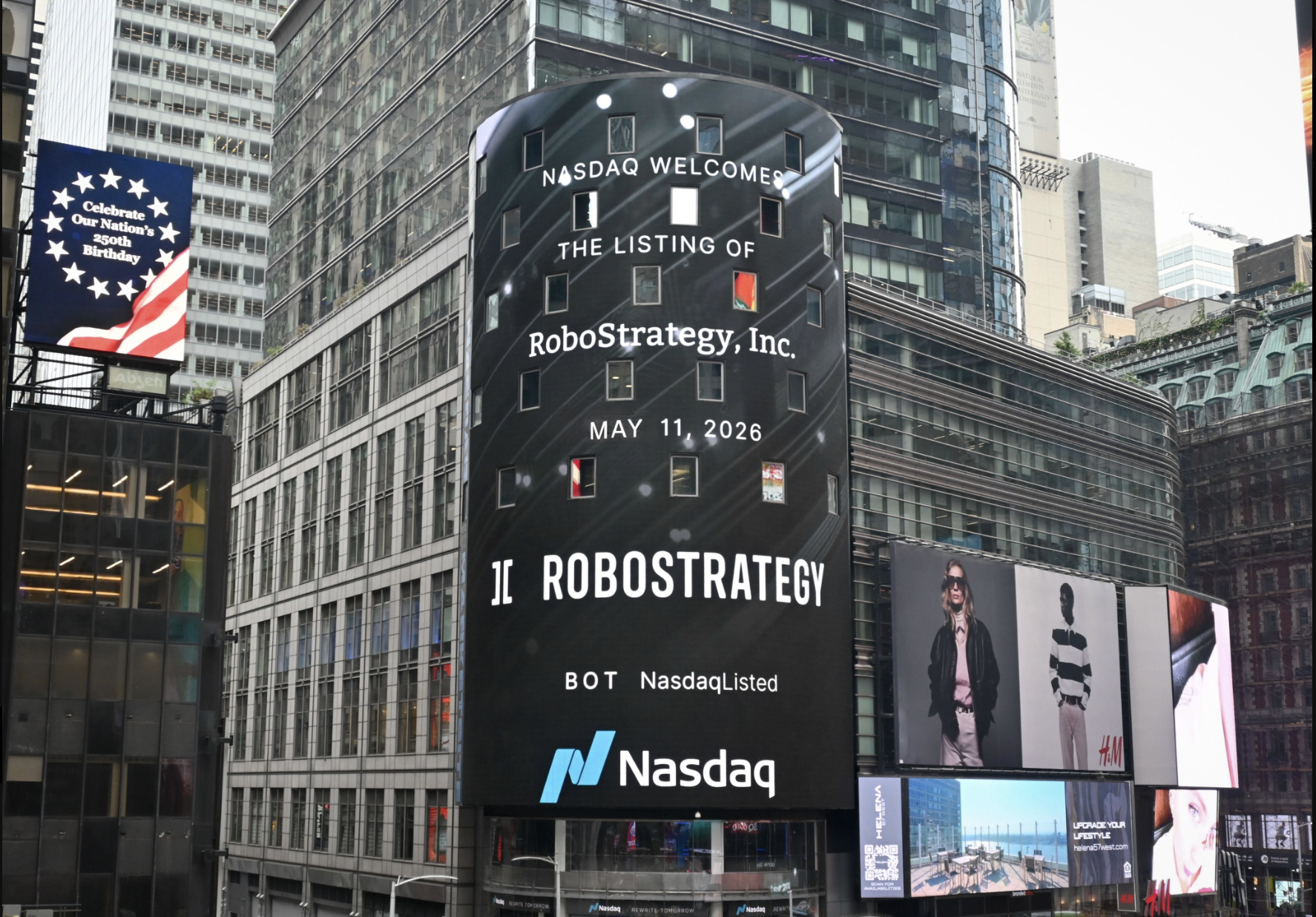
Public information shows that RoboStrategy board member Jason Zhao purchased 400,000 shares of the company at $10 per share in October last year; subsequently, Andrew Kang also purchased 246,000 shares at the same price. Meanwhile, the investment advisory firm FP Strategies LLC continued to increase its holdings by 290,000 shares at $10 per share in April this year, currently holding a cumulative total of approximately 390,000 shares.

In terms of capital operation logic, RoboStrategy draws inspiration from Strategy's Bitcoin treasury model. The latter continuously issues stocks and convertible bonds in the public capital market to obtain low-cost funds for consistently increasing its Bitcoin holdings, leveraging stock price premiums to form a capital flywheel. This model has been emulated by numerous companies.

RoboStrategy attempts to replicate this logic in the robotics sector. The fund's core idea is to use three main financing instruments—CEF, PIPE, and ATM—to continuously raise funds when the fund's stock price trades at a premium relative to its Net Asset Value (NAV), then deploy that capital into high-growth private robotics and embodied AI companies, thereby constructing the R.I.S.E capital compound interest flywheel.
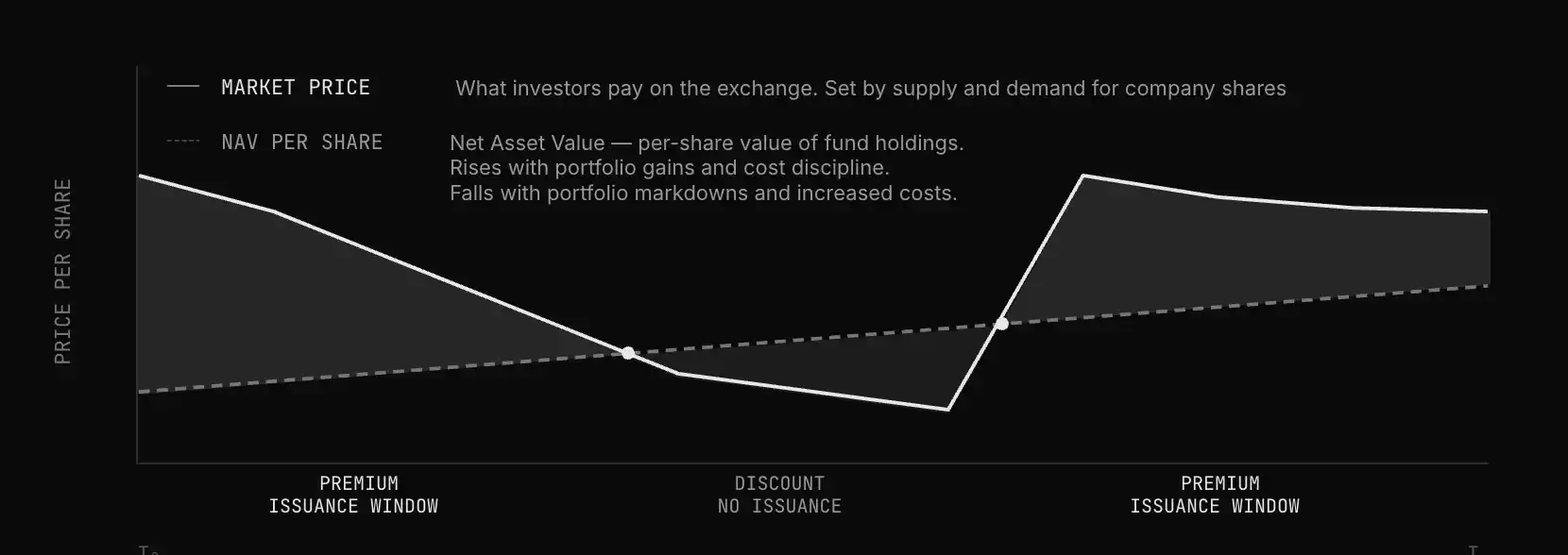
The so-called R.I.S.E represents four stages:

· Raise: Issue shares at a premium when the market price is above NAV to obtain more cash.

· Invest: Through deep due diligence, allocate funds to high-conviction robotics projects.

· Scale: Portfolio companies use the new capital to accelerate expansion, driving fund NAV growth.

· Expand: As NAV increases and industry enthusiasm rises, further attract investors and new capital, expanding the fund's scale and influence.

This model essentially utilizes the dual pricing mechanism of closed-end funds (market price vs. net asset value), aiming to achieve compound growth in NAV per share over the long term, while replacing the multi-layered fee structure of traditional private equity funds with a single public fund structure.

Earlier this month, RoboStrategy signed a $20 billion Committed Equity Financing (CEF) agreement with Roth Principal Investments, a subsidiary of Roth Capital Partners, to support its strategic growth plans.

However, just as most crypto DAT companies' treasury stories are difficult to sustain, RoboStrategy also faces risks that cannot be ignored.

As of March 31, 2026, RoboStrategy's NAV was approximately $7.31 per share, with total net assets around $145.5 million. Based on the current stock price, the market's valuation premium for it is close to 3 times. But a high premium does not mean discount risk will not materialize. Meanwhile, since the fund's investment targets are mostly unlisted robotics companies, their asset valuations themselves are highly subjective and have limited liquidity. Exit paths heavily rely on IPO or M&A markets. Once the capital environment cools down, these assets may face valuation adjustment pressure.

Furthermore, the closed-end fund structure means investors cannot redeem shares at any time like with open-end funds; they can only trade on the secondary market. Therefore, price volatility is often amplified.

Whether RoboStrategy can sustain its high premium and market enthusiasm in the long term remains to be verified by the market.


Perguntas relacionadas

QWhat is RoboStrategy, and what is its primary goal?

ARoboStrategy is a publicly traded, closed-end fund focused on robotics and embodied AI. Its primary goal is to open up early-stage investment opportunities in the robotics sector, traditionally available only to institutional investors, to the broader public market.

QWho founded RoboStrategy, and what is Andrew Kang's background?

ARoboStrategy was co-founded by Andrew Kang and Marc Weinstein in 2025. Andrew Kang is a former star investor in the crypto market and a co-founder of the crypto investment firm Mechanism Capital. He has now shifted his focus to the AI and robotics sector and serves as the CEO of RoboStrategy.

QHow is RoboStrategy's capital model inspired by MicroStrategy?

ARoboStrategy's capital model is inspired by MicroStrategy's Bitcoin treasury strategy. It aims to create a capital flywheel by issuing shares at a premium when its market price exceeds its Net Asset Value (NAV). The raised capital is then invested in high-growth private robotics companies, aiming to increase the fund's NAV and attract more capital, similar to MicroStrategy's approach with Bitcoin.

QWhat does the R.I.S.E. strategy stand for in the context of RoboStrategy?

AR.I.S.E. is RoboStrategy's four-stage capital strategy: Raise (issuing shares at a premium), Invest (allocating capital to high-conviction robotics projects), Scale (helping portfolio companies grow to increase NAV), and Expand (attracting more investors and capital as NAV and industry interest rise).

QWhat are some key risks associated with investing in RoboStrategy?

AKey risks include: 1) Potential discount to NAV if market sentiment cools. 2) Subjective and illiquid valuations of its private company investments. 3) High dependence on favorable IPO or M&A markets for exits. 4) Price volatility amplified by its closed-end fund structure, which prevents direct redemptions, forcing trades on the secondary market.

Leituras Relacionadas

The Midlife Crisis of Crypto GPs: No PMF, No Next Check from LPs

The article "The Midlife Crisis of Crypto GPs: No PMF, No Next LP Check" analyzes the shifting crypto fundraising landscape. It argues the era of selling grand visions to LPs is over; GPs must now offer products with clear Product-Market Fit (PMF). The author categorizes crypto fundraising products into three types: Primary (VC funds), Liquid (trading strategies), and CeFi/DeFi Native Yield. This summary focuses on the Primary market. Key points include: * **Market Shift:** LPs are impatient, demand immediate returns, and are skeptical of future promises. The "easy money" narrative has faded. * **GP Value Erosion:** LP learning curves have shortened (aided by AI), reducing the value of a GP's basic "crypto knowledge." Superior judgment is now rare. * **Weakened LP Motivations:** Traditional reasons for LPs to invest in crypto VC funds (capturing industry beta, gaining access, leveraging GP judgment) have weakened due to new products like ETFs and increased LP sophistication. * **Surviving in Primary:** The primary market will likely persist for: 1) large funds in endowment mandates treating it as a lottery ticket, 2) family offices/HNWIs using proprietary capital, 3) a few funds with proven recent outperformance, and 4) funds with strong ecosystem "deal-making" capabilities. * **Conclusion:** For most GPs, rebuilding trust requires starting over in a niche, demonstrating alpha-generating ability, or providing concrete value/services to LPs.

marsbitHá 1h

The Midlife Crisis of Crypto GPs: No PMF, No Next Check from LPs

marsbitHá 1h

Crypto GPs' Midlife Crisis: No PMF, No LP's Next Check

The article "The Midlife Crisis of Crypto GPs: No PMF, No LP's Next Check" analyzes the shifting crypto fundraising landscape. It argues that the era of LPs funding vague "vision" is over; GPs must now offer products with clear Product-Market Fit (PMF) to secure capital. The market has matured. LPs, disillusioned by the last cycle's failures and wary of long lock-up periods, now demand tangible, near-term returns rather than speculative narratives. The proliferation of accessible crypto ETFs and other liquid products has reduced the need for VC blind pools as an entry point. The author categorizes crypto fundraising products into three types: Primary (VC funds, with blind pools or clear pipelines), Liquid (alpha/beta, directional/market-neutral strategies), and CeFi/DeFi Native Yield (crypto-specific mechanisms like staking, farming). Focusing on the Primary market, the piece details why traditional LP rationales for investing in crypto VCs have weakened: easier beta access via ETFs, diminished "access" and "judgement" premiums as LPs build internal teams, and a widespread lack of proven superior returns from GPs. Ultimately, only specific players are likely to remain at the primary VC table: large funds with access to patient endowment capital, family offices/HNWIs investing proprietary capital, the few funds with demonstrable excess returns from the last cycle, and those with clear "deal-making" or ecosystem resource advantages. For others, the path forward is to rebuild trust by proving alpha-generation capability in a niche or providing concrete, valuable services.

链捕手Há 1h

Crypto GPs' Midlife Crisis: No PMF, No LP's Next Check

链捕手Há 1h

The Age of Decoupling Has Arrived: Bitcoin is No Longer the Sole Compass of Crypto

The era of the cryptocurrency market moving in lockstep with Bitcoin is ending, as the industry splits into two distinct asset categories: endogenous and exogenous. Endogenous assets, like Bitcoin, derive value purely from the crypto market's cycles. Their narratives swing between being "interstellar money" in bull markets and "digital collectibles" in bear markets. Exogenous assets, however, are nominally crypto but operate with independent value drivers. Examples include: * **Venice:** An AI inference service using tokens for payments; its consumer-AI business model is decoupled from crypto price swings. * **Figure:** A fintech lender using blockchain to speed up loan approvals; its core value is in credit, not crypto. * **Stablecoin firms like BVNK:** Acquired by traditional finance giants (Mastercard, Stripe), their growth is tied to payment infrastructure, not market cycles. Hybrid projects like **Hyperliquid** (a decentralized exchange) show a shift, with a growing share of non-crypto trading (e.g., prediction markets). This divergence is fundamental. Endogenous assets remain highly correlated to Bitcoin, similar to gold miners to gold. Exogenous assets are evolving to have their own fundamentals, like the weak correlation between gold and the S&P 500. This changes investment analysis. Evaluating exogenous assets requires traditional fundamental research—assessing user bases, unit economics, and moats—more akin to fintech investing than charting Bitcoin. Promising exogenous sectors include: on-chain exchanges/brokers, AI-crypto fusion, privacy-focused digital banks, lending (institutional/private credit), stablecoins/real-world asset tokenization, payment rails, and non-financial crypto-consumer products. Currently, investing via equity is often safer than via tokens, as token value accrual mechanisms need further regulatory and industry development (e.g., the CLARITY Act). Nonetheless, the core trend is clear: crypto market drivers are diversifying from a single factor (Bitcoin) to multiple fundamentals, ending the era of uniform market moves.

marsbitHá 2h

The Age of Decoupling Has Arrived: Bitcoin is No Longer the Sole Compass of Crypto

marsbitHá 2h

Trading

Spot
Futuros

Artigos em Destaque

Como comprar PEOPLE

Bem-vindo à HTX.com!Tornámos a compra de ConstitutionDAO (PEOPLE) simples e conveniente.Segue o nosso guia passo a passo para iniciar a tua jornada no mundo das criptos.Passo 1: cria a tua conta HTXUtiliza o teu e-mail ou número de telefone para te inscreveres numa conta gratuita na HTX.Desfruta de um processo de inscrição sem complicações e desbloqueia todas as funcionalidades.Obter a minha contaPasso 2: vai para Comprar Cripto e escolhe o teu método de pagamentoCartão de crédito/débito: usa o teu visa ou mastercard para comprar ConstitutionDAO (PEOPLE) instantaneamente.Saldo: usa os fundos da tua conta HTX para transacionar sem problemas.Terceiros: adicionamos métodos de pagamento populares, como Google Pay e Apple Pay, para aumentar a conveniência.P2P: transaciona diretamente com outros utilizadores na HTX.Mercado de balcão (OTC): oferecemos serviços personalizados e taxas de câmbio competitivas para os traders.Passo 3: armazena teu ConstitutionDAO (PEOPLE)Depois de comprar o teu ConstitutionDAO (PEOPLE), armazena-o na tua conta HTX.Alternativamente, podes enviá-lo para outro lugar através de transferência blockchain ou usá-lo para transacionar outras criptomoedas.Passo 4: transaciona ConstitutionDAO (PEOPLE)Transaciona facilmente ConstitutionDAO (PEOPLE) no mercado à vista da HTX.Acede simplesmente à tua conta, seleciona o teu par de trading, executa as tuas transações e monitoriza em tempo real.Oferecemos uma experiência de fácil utilização tanto para principiantes como para traders experientes.

487 Visualizações TotaisPublicado em {updateTime}Atualizado em 2026.06.01

Como comprar PEOPLE

Discussões

Bem-vindo à Comunidade HTX. Aqui, pode manter-se informado sobre os mais recentes desenvolvimentos da plataforma e obter acesso a análises profissionais de mercado. As opiniões dos utilizadores sobre o preço de PEOPLE (PEOPLE) são apresentadas abaixo.

活动图片