The company QCP Capital has published a new market review, explaining why the Federal Reserve's (Fed) decision, neutral at first glance, turned out to be more hawkish than the market expected.
On Wednesday, July 22nd, the Fed kept the target rate range at 3.50–3.75%, but, as QCP Capital analysts note, the nature of the decision was tougher than the headlines suggested. The vote was 9 to 3: the dissenting votes came from Beth Hammack, Neel Kashkari, and Lorie Logan—all three would have preferred a 25 basis point rate hike. Meanwhile, Warsh refused to give clear signals about the future, emphasizing incoming data and the Fed's inflation goal.
Markets reacted by reassessing the rate path. U.S. stocks fell immediately after the decision but sharply rebounded the next day—attention shifted to corporate earnings. The S&P 500 index added 1.7%, and the Nasdaq rose 2.8%. The main growth driver was Microsoft, whose shares rose approximately 16% after strong results from its cloud division. In contrast, Meta's stock fell after its earnings report, Amazon rose, and Apple declined in post-market trading on Thursday.
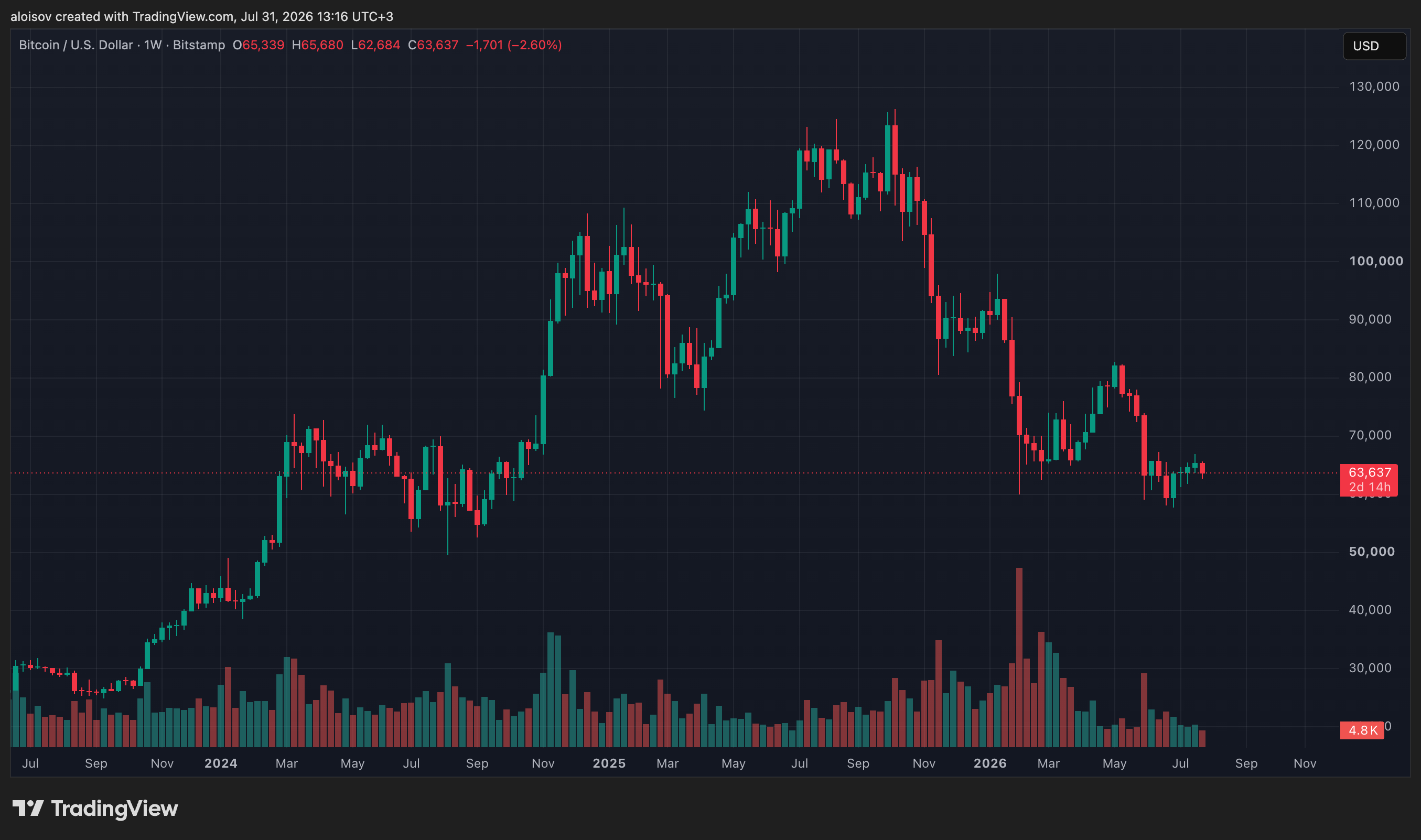
Bitcoin also reacted volatilely to the Fed's decision, dropping to around $63,000, but then partially recovered the losses. It is currently trading around $64,000 and remains in a broad sideways range—the market is balancing between persistent inflation and stable economic activity.
Growth Slows, Inflation Remains High
Rate dynamics continue to be a key factor for markets. Long-term Treasury yields remained elevated after the Fed meeting—this reflects ongoing uncertainty around inflation, government borrowing, and the future course of monetary policy.
The latest macro statistics were mixed. U.S. GDP grew by 1.5% year-on-year in the second quarter—less than the 2.1% in the first quarter. At the same time, consumer spending remained resilient, and underlying domestic demand was stronger than the headline figure suggested.
Inflation also remained above the Fed's target. The headline Personal Consumption Expenditures (PCE) index slowed to 3.7% year-on-year in June, while the core PCE decreased slightly—to 3.3%. The combination of slowing growth and persistent core inflation means that the outlook for the next rate meeting will depend on upcoming labor market and inflation data.
Sharp Reversals in Asia
Asian stock markets showed some of the most dramatic moves of the week. South Korea's KOSPI rose 17.9% today—its largest single-day gain ever—following a dramatic drop this month. Semiconductor manufacturer stocks led both the sell-off and the subsequent recovery, reflecting the index's high dependence on the global AI cycle and the memory chip market.
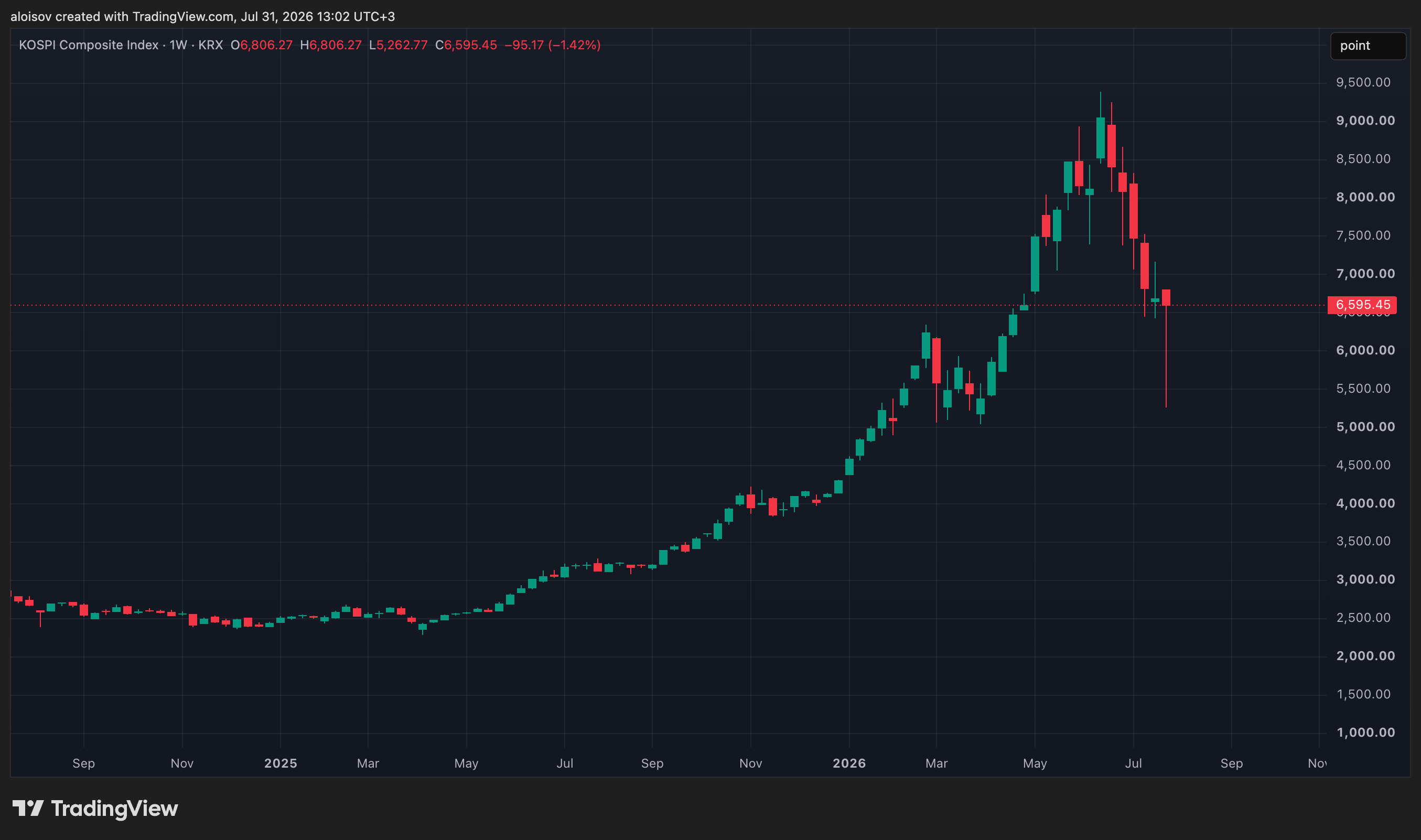
Volatility spilled over to the digital asset market as well: during the stock market sell-off, trading activity from South Korea noticeably increased. This episode highlighted the growing interconnectedness between crypto market liquidity, positioning on regional stock exchanges, and overall sentiment in the tech sector.
In Japan, the Bank of Japan kept its key rate at 1.00%. The decision kept the focus on the yen's exchange rate and the Japanese government bond market—both factors remain important components of global funding conditions.
Hedging Demand Shifts to Longer Term
The QCP Capital report pays separate attention to the Bitcoin and Ethereum options market. Analysts note that implied volatility for short-term contracts decreased after the Fed meeting was over—this indicates reduced uncertainty around the immediate event. At the same time, the so-called skew—the difference in implied volatility between put and call options at different strikes—for long-term contracts remained pronounced in favor of downside protection.
What does this mean in practice? When a trader wants to hedge against a possible price drop of an asset, they buy a put option—the right to sell the asset at a predetermined price in the future. If demand to buy such protection increases relative to the demand to buy call options (a bet on price increase), the implied volatility of puts rises more than that of calls—creating that downward skew.
-
The essence of the strategy: buying put options with a later expiration date as protection against risks that may not materialize immediately but over the coming weeks or months.
-
How it works: an investor pays a premium for the right to sell Bitcoin or Ethereum at a fixed price in the future; if the asset price falls below that level, the option holder gains the right to sell it above the market price, thus limiting losses.
-
Advantages: a predetermined and limited cost of protection (the premium amount), the ability to hedge a portfolio without selling the underlying asset.
-
Features: the premium paid for the option is entirely lost if the price drop does not occur; the cost of such protection increases as skew rises.
-
Example: if an investor anticipates potential market pressure closer to the Jackson Hole symposium or the September Fed meeting, they can buy a put expiring on those dates, locking in the cost of protection now, while short-term volatility has decreased.
In other words: the immediate cause for concern—the Fed meeting outcome—has already been priced in, but that doesn't mean the broader macroeconomic uncertainty has disappeared. The rate trajectory, volatility in Asia, and upcoming U.S. data remain significant for those building positions over a longer term.
Relative Resilience Without Clear Direction
According to QCP Capital, Bitcoin is finishing July in positive territory, despite several volatility spikes caused by macro factors, while Ethereum has shown stronger performance over the month. Exchange-traded fund (ETF) flows have also diverged: interest in Ethereum-based products persists, while Bitcoin funds show more uneven dynamics.
Corporate earnings also painted a mixed picture for the digital asset sector. Coinbase reported lower revenue and trading activity in the second quarter, but its market share and revenue from non-trading business areas continued to grow.
Overall, as QCP Capital summarizes, the crypto market is currently characterized more by relative resilience than clear directional movement. Digital assets withstood a hawkish Fed meeting, volatility on Asian exchanges, and uneven institutional flows, but the path forward remains closely tied to rates, liquidity, and overall investor risk appetite.
What's Next
-
Today: Chicago PMI business activity index, final University of Michigan consumer sentiment data, and a speech by Christopher Waller.
-
Next week: ISM data for the manufacturing and services sectors, the U.S. Treasury's announcement on government debt refinancing, and July employment data.
-
August 5th: Restrictions on leveraged single-stock ETFs come into effect in South Korea.
-
August 27–29: Economic symposium in Jackson Hole.
-
September 15–16: Fed rate meeting.
The QCP Capital report describes a market that has passed a stress test and hasn't broken. Like a tightrope walker momentarily swayed by a gust of wind but regaining balance, the crypto market maintained its course after the hawkish Fed meeting and turmoil in Asia.
The month's outcome is neither euphoria nor panic, but a fact of resilience amid mixed signals: slowing growth, persistent inflation, growing demand for long-term risk protection, and diverging flows into Bitcoin and Ethereum ETFs.
AI Opinion
The analysis reveals an interesting historical parallel that the article does not explicitly draw. The sharp reversal in Asian markets resembles the episode in August 2024, when the Bank of Japan's rate hike crashed the yen carry trade and, along with it, risk assets, as Hash Telegraph reported at the time. The macroeconomic link here is simple: cheap yen-denominated credit fueled demand for risk assets for decades, and every tightening of Japanese policy often echoes more strongly in Bitcoin and Ethereum than decisions by the Fed itself.
The risk is that the current Fed pause and the rapid recovery of the KOSPI could create a false sense of stability, while the source of the next volatility may shift precisely to Tokyo, not Washington. Should the crypto market be paying closer attention not to the September Fed meeting, but to the Bank of Japan's next move?