In the "Wild West" of cryptocurrency, "founders cashing out and exiting" and "project teams rug-pulling retail investors" have become blatant acts of profit plunder, turning into chronic maladies that shackle the development of Web3. Consequently, "tokenomics" is often seen as an accelerator for team wealth and a touchstone for user confidence.
However, when we turn our attention to Backpack, we see a completely different design: Backpack has chosen a thorny path that directly addresses the industry's pain points: at TGE, all liquid tokens are given to users, while the returns for the team and investors are entirely tied to the company's IPO process.
This move by Backpack abandons the rugged design of "VCs setting up the game, retail investors footing the bill." Whether it ultimately succeeds or not, this is a respectable attempt in the history of cryptocurrency.
Delayed Gratification: The Long-Term Game Between Team and Capital
In Backpack's token economic system, the most attention-grabbing aspect is the strict constraints on returns for the team and investors—no founders, executives, employees, or venture capitalists directly receive token allocations.
As Backpack founder and CEO Armani Ferrante put it, the "escape velocity" Backpack seeks is never about reaching a market cap of billions of dollars or hitting some short-term milestone in user numbers, but about the company successfully completing an IPO in the United States.
All tokens originally intended for "team incentives" and "investor returns" (37.5% of the total supply) are deposited into the company's "corporate treasury," i.e., on Backpack's balance sheet. Even after a successful IPO, these tokens are subject to a fully locked period of at least one year, further eliminating the possibility of "cashing out immediately upon listing."
This design of "delayed gratification" is the best protection for the project's long-term value. In the crypto industry, too many projects collapse due to the "short-sightedness" of teams and investors—selling tokens too early to cash out, causing token prices to crash, losing user trust, and ultimately leading to demise. Backpack's approach completely severs the path for insiders to "cash out short-term," forcing the team and investors to "sink or swim" with the project.
Of course, an IPO is no easy path. Backpack's founders admit that going public could be imminent, could be far off, or might never happen. But regardless of the outcome, they will give it their all. This "break or break through" determination makes Backpack stand out among the myriad of short-sighted crypto projects, yet it has won the trust of users who truly value long-term value.
User-First Token Distribution: Igniting the Growth Engine with Incentives
In Backpack's tokenomics, all liquid tokens are entirely allocated to users. In Backpack's view, users are the core driving force behind project growth, so tokens should serve as fuel to incentivize user participation and drive product development.
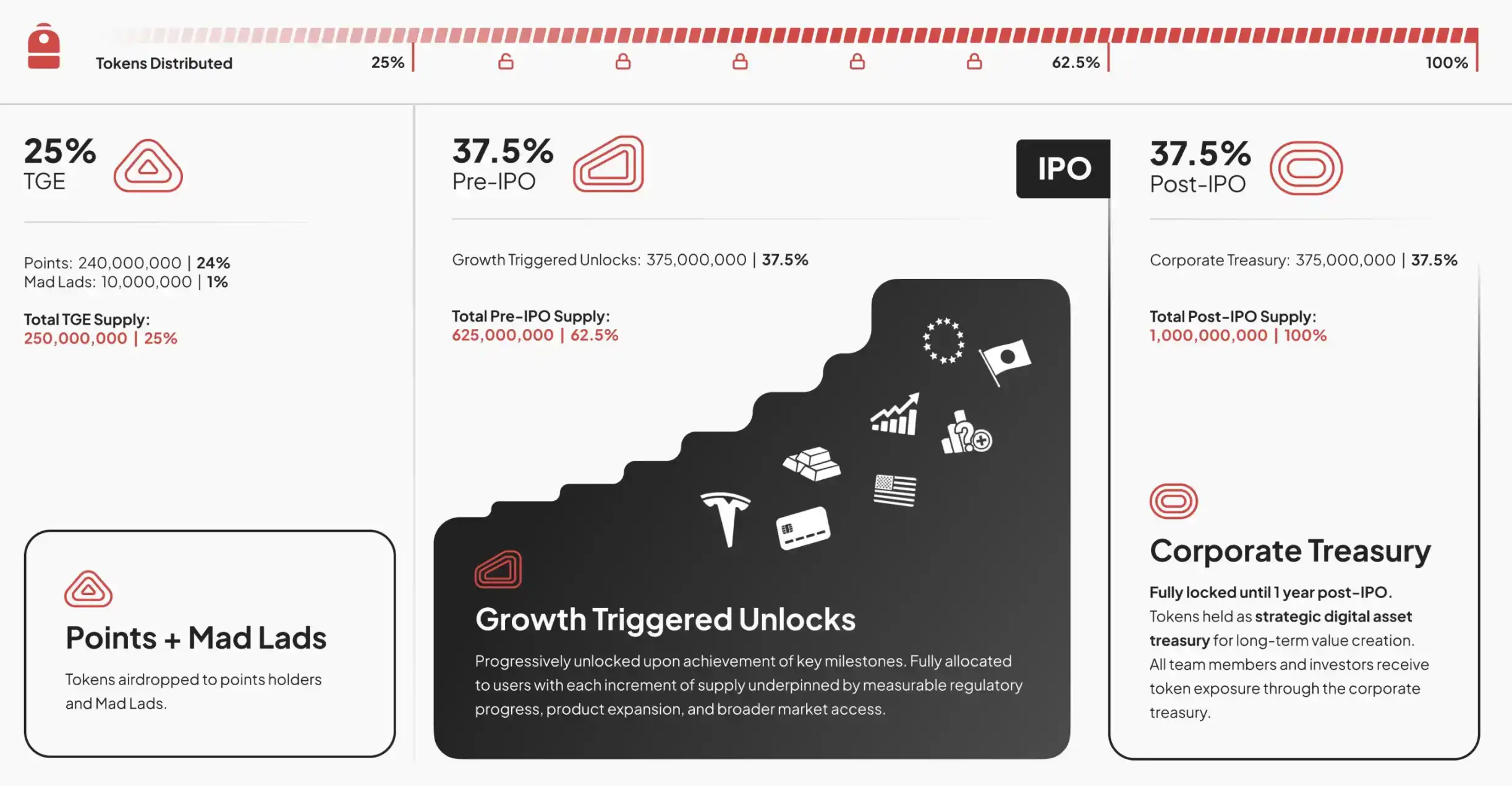
· Total supply of 1 billion tokens, 25% directly released to the community at TGE: Among these, points holders account for 24%, and Mad Lads holders account for 1%.
· Unlocked (37.5%) triggered by key product milestones before IPO. Every market expansion, every new product launch, is an opportunity to incentivize users with tokens, each triggering corresponding token unlocks. This design, through a predictable token unlock model, continuously attracts new users and expands the community scale.
More importantly, according to Armani Ferrante, Backpack has set strict constraints for token unlocks: the new ecological value brought by token unlocks must always be greater than its dilutive effect on the token price.
This design protects the core interests of users while ensuring the project's long-term value is not diluted by short-term unlocking behavior, making token incentives a true catalyst for platform growth, achieving a triple win of "user benefit, ecological value addition, and project growth."
Under Compliance: Slow is Fast
Beyond the innovation in token distribution, another distinctive feature of Backpack is its pursuit of compliance. This stands in stark contrast to the common logic in the industry of "expand first, comply later" and "prioritize scale over compliance."
As Armani Ferrante revealed, "Backpack currently serves only about 48% of regions globally. Behind this seemingly slow expansion lies a pursuit of compliance."
This strategic choice might mean missing market opportunities in the short term, but from a long-term development perspective, it is key to building a trust barrier.
Currently, Backpack's positioning is a compliant crypto exchange, offering cryptocurrency spot, derivatives, and lending services. But it is not content with being a pure cryptocurrency trading platform; it aims to build a compliant platform integrating crypto assets and traditional financial (TradFi) services. To achieve this goal, the team is laying banking rails globally and also plans to gradually launch diversified services like securities products in the future. In January, Backpack also launched a unified margin and cross-collateralization prediction product.
Market Perspective: How to View Backpack's FDV?
The market's attitude towards Backpack also reflects the controversy and potential of its model from the side.
According to Axios citing informed sources, Backpack is negotiating terms for new financing, with a pre-money valuation already reaching $1 billion.
On the prediction market Polymarket, market expectations for Backpack's token show significant volatility: the probability of Backpack's token FDV exceeding $1 billion within one day of listing is 21%, while in November 2025, this probability once reached over 80%. Of course, this volatility largely stems from the inherent uncertainty of the crypto market and also reflects the market's cautious attitude towards the "IPO-bound returns" model.
Summary
When tokens become tools for project teams to cash out, and users become targets to be harvested, the crypto industry loses its original ideals. Backpack's token distribution essentially creates a physical separation between Web2 equity incentives and Web3 token utility.
· For the team: The only way out is to make the product stronger and more compliant until the IPO. If the company fails midway or cannot go public, the equity in the team's hands will be worthless, with no possibility of cashing out.
· For the community: They are no longer the liquidity exit for VCs. Tokens are purely user rewards and ecological tools, not the team's ATM.
Backpack's choice is to redefine the value logic of crypto projects with compliance, transparency, and long-termism, showing us another possibility for the Web3 industry.
As Armani Ferrante said: "We either go big, or we go home." This statement is not only the manifesto of the Backpack team but also a mandatory question for the entire Web3 industry: Do we continue to revel in the speculative bubble,透支行业的信任与未来透支行业的信任与未来 (overdrawing the industry's trust and future原文此处为中文); or do we, like Backpack, choose the harder, slower, but more hopeful path, using long-termism to reconstruct the industry ecosystem?
Of course, an IPO is not easy, and the road is long and arduous, especially in the crypto industry, facing multiple challenges like regulation, market, and competition. Accidents and uncertainties are everywhere.







