A New Crypto Era: SEC-CFTC To Host Joint Regulatory Harmonization Event Next Week

bitcoinistPublicado em 2026-01-24Última atualização em 2026-01-24

Resumo

The U.S. Securities and Exchange Commission (SEC) and the Commodity Futures Trading Commission (CFTC) will host a joint public event on January 27 to discuss harmonizing crypto regulations. The event, part of the Trump administration's push to make the U.S. the global crypto leader, aims to clarify jurisdictional boundaries and foster innovation under American law. This follows ongoing efforts between the agencies to improve regulatory coordination, as emphasized in a September roundtable where SEC Chair Atkins declared an end to "regulatory fragmentation." Meanwhile, congressional efforts to pass crypto legislation have stalled, with the Senate Banking Committee delaying its bill after industry criticism, and Coinbase withdrawing support for what it called a "bad bill." The Senate Agriculture Committee has advanced its version of the Clarity Act, focusing on the CFTC's role.

The Securities and Exchange Commission (SEC) and the Commodity Futures Trading Commission (CFTC) have announced a joint event on the future of crypto oversight amid the Trump administration’s push to welcome the sector.

SEC-CFTC Push Joint Crypto Oversight

On Thursday, SEC Chairman Paul Atking and CFTC Chairman Michael Selig announced they will hold an event next week to discuss regulatory harmonization between the two sister agencies.

According to the announcement, the pro-industry chairmen will outline the efforts to work together and cooperate to “deliver on President Trump’s promise to make the United States the crypto capital of the world.”

The event will be hosted on January 27 at the CFTC headquarters and moderated by crypto journalist Eleanor Terret. Additionally, it will be open to the public and livestreamed on both agencies’ websites.

“For too long, market participants have been forced to navigate regulatory boundaries that are unclear in application and misaligned in design, based solely on legacy jurisdictional silos,” said SEC Chair Atkins and CFTC Chair Selig in a joint statement.

“This event will build on our broader harmonization efforts to ensure that innovation takes root on American soil, under American law, and in service of American investors, consumers, and economic leadership,” they added.

Last year, the SEC and CFTC began discussing their options for effectively collaborating on crypto regulations, as a clear framework for digital assets became a top priority for the agencies

As reported by Bitcoinist, the agencies explored reinstating the CFTC-SEC joint advisory committee to develop recommendations on ongoing issues, including efforts in regulatory coordination.

During a September joint roundtable between the two agencies, Atking declared that the era of regulatory fragmentation was ending and the age of harmonized, innovation-friendly crypto oversight was here:

We are at a crossroads. If we follow the path of our predecessors, America risks ceding leadership in the next chapter of financial history. (...) This ends now (...) our two agencies must work in lockstep to transform dual regulation from a source of confusion into a source of strength. Together, we can offer the best of both worlds: the investor protections that have defined U.S. markets, combined with the innovation-friendly approach that will keep us at the frontier of financial technology throughout the 21st century.

The SEC’s Director of the Division of Trading and Markets, Jamie Selway, highlighted the SEC’s efforts to “further harmonize its rules with our sister regulator, the CFTC. In a January 22 speech, He affirmed that the Division will work shoulder-to-shoulder with the CFTC staff to ensure the US’s continued leadership in financial markets, following Atkins’ September directions.

Congress Regulatory Efforts Stall

The SEC and CFTC’s efforts to regulate the crypto market come as the US Congress struggles to establish a framework to oversee the sector. The Senate Banking Committee’s version of the market structure bill, which focuses on the SEC’s oversight, was delayed after multiple market participants criticized the bill’s draft.

Coinbase CEO Brian Armstrong shared his disappointment with the crypto legislation, withdrawing the company’s support last week. “This version would be materially worse than the current status quo. We’d rather have no bill than a bad bill,” he affirmed.

The Senate Agriculture Committee published its version of the CLARITY Act on Thursday, which mainly addresses the CFTC’s role and regulations, scheduling its markup session for January 27.

Eleanor Terret shared that the industry’s reaction has been mostly positive, “with stakeholders noting the bill’s close similarities to the House Agriculture Committee’s version of the Clarity Act.”

However, recent reports have warned that the Banking Committee’s crypto talks may not resume until later February or early March, as focus shifts to advancing affordable housing plans linked to President Trump’s priorities.
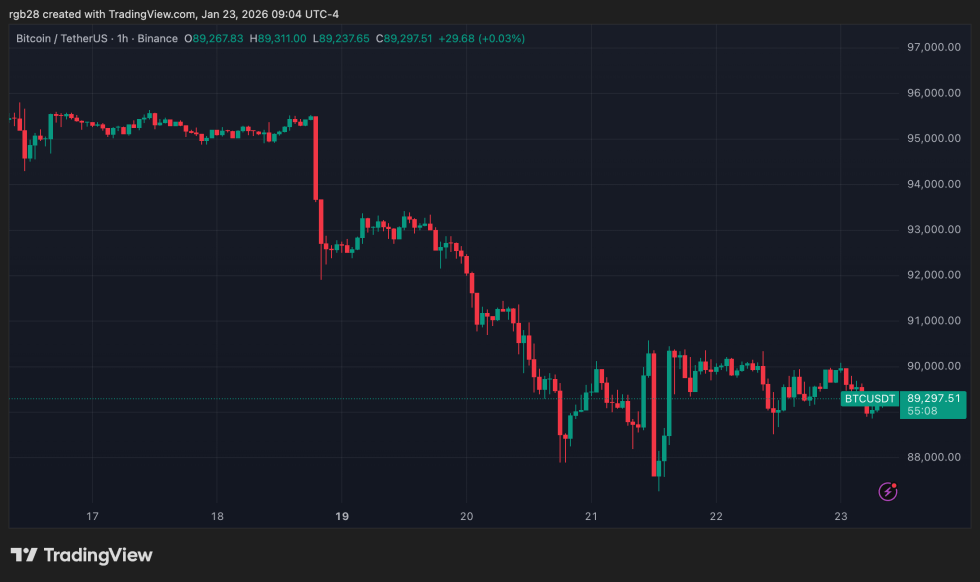
Bitcoin (BTC) trades at $89,297 in the one-week chart. Source: BTCUSDT on TradingView


Perguntas relacionadas

QWhat is the purpose of the joint event being hosted by the SEC and CFTC next week?

AThe purpose of the joint event is to discuss regulatory harmonization between the SEC and CFTC, outline efforts to cooperate, and deliver on President Trump's promise to make the United States the crypto capital of the world.

QWhere and when will the SEC-CFTC joint event take place, and how can the public access it?

AThe event will be hosted on January 27 at the CFTC headquarters. It will be open to the public and livestreamed on both agencies' websites.

QAccording to the agency chairmen, what problem has forced market participants to navigate unclear regulatory boundaries?

AThe chairmen stated that market participants have been forced to navigate regulatory boundaries that are unclear in application and misaligned in design, based solely on legacy jurisdictional silos.

QWhy did Coinbase CEO Brian Armstrong withdraw support for the Senate Banking Committee's market structure bill?

ABrian Armstrong withdrew support because he believed that version of the bill would be materially worse than the current status quo, stating, 'We'd rather have no bill than a bad bill.'

QWhat recent legislative action did the Senate Agriculture Committee take regarding crypto, and when is its markup session?

AThe Senate Agriculture Committee published its version of the CLARITY Act, which mainly addresses the CFTC's role and regulations, and scheduled its markup session for January 27.

Leituras Relacionadas

How to Do Research Well: Deliberately Practice the Real Skills That Matter

No one truly teaches you how to do research. You're often given a desk, a pre-selected problem, and vague instructions to "create something new." Consequently, many people reverse-engineer the job based on visible outputs—papers, posts, announcements—learning only how to *appear* like a researcher rather than how to *become* one. True research capability is built from stacking small, trainable skills, nearly all of which can be developed through deliberate practice. **Pick Your Own Problem:** Most researchers absorb problems from advisors or trends, lacking the underlying reasoning. Choosing a problem you genuinely care about, as John Schulman advises, leads to original work. Develop "taste" like a muscle: predict experiment outcomes, guess paper results from methods, and track which findings remain important over time. **Upgrade Your Inputs:** Relying on shared reading lists (arXiv hot lists, filtered group chats) leads to unoriginal conclusions. Undervalued old literature often holds crucial insights (e.g., MoE, LSTM, backpropagation). Richard Sutton's "The Bitter Lesson" or Claude Shannon's 1952 talk on creative thinking are more predictive than lengthy modern surveys. Breadth matters as much as depth: draw from neuroscience, mechanism design, hardware knowledge, and honest statistics. Read papers directly, especially appendices and limitations sections. **Write Everything Down:** As Paul Graham noted, writing exposes flaws in seemingly mature ideas. Writing is the cheapest defense against self-deception. Following Feynman's principle, Darwin programmatically wrote down facts contradicting his theory to combat memory bias. Maintain a detailed log of hypotheses, setups, predictions, results, and updated understandings. Reviewing past logs fosters essential humility.

marsbitHá 47m

How to Do Research Well: Deliberately Practice the Real Skills That Matter

marsbitHá 47m

Following US Ban on Fable 5, Zhipu AI's Stock Soars 47%

On June 15th, shares of Zhipu AI surged dramatically on the Hong Kong stock market, peaking at a 47.6% gain before closing 32.82% higher. This sharp increase was directly triggered by two recent industry events. On June 12th, Anthropic announced it was suspending global access to its latest flagship models, Claude Fable 5 and Claude Mythos 5, to comply with a U.S. government export control order. The next day, Zhipu AI announced it would open access to its latest open-source flagship model, GLM-5.2, under the permissive MIT license. The Anthropic incident highlighted a critical issue beyond raw model capability: the risk of sudden, unpredictable loss of access to advanced AI models, especially for developers and enterprises deeply integrated with them. This has shifted industry and market focus toward factors like stability, sustainable access, and controllability. Zhipu's move, promoting "frontier intelligence for all," positions its openly available model as a reliable and accessible alternative. The GLM-5.2 model emphasizes "Long Horizon Task" capabilities with a 1M context window, targeting complex, multi-step coding and engineering workflows where maintaining context is crucial. Analysts note this event exposes the risk of dependency on closed-source models subject to single jurisdictional controls, potentially accelerating a shift toward domestic base models and localized deployments. The market's reaction signals a new valuation dimension in AI: providers who can offer stable, long-term, and sustainably accessible AI capabilities are gaining strategic importance.

marsbitHá 1h

Following US Ban on Fable 5, Zhipu AI's Stock Soars 47%

marsbitHá 1h

Fully Entering the AI Era: Alipay Bets on Conversation, WeChat Holds Fast to Social

In May 2026, Alipay announced over 300 million AI payment transactions. Shortly after, WeChat opened its mini-programs for AI integration, sparking controversy by requiring developer source code access. This highlights their diverging approaches to AI integration. Alipay is testing "Project Treasure," an optional AI-native interface replacing traditional app grids with a conversational window. Users can command complex tasks (e.g., "book a ride and order coffee") handled end-to-end by AI. This shift follows an abandoned standalone AI app, focusing instead on enhancing its existing user base. For unmodified mini-programs, Alipay's AI uses "screen-reading" to simulate user interactions, bypassing the need for developer overhaul. It also introduced "Token Pay" for micro-transactions and "AI Wallets" for autonomous agent spending. WeChat, prioritizing its core social function, is taking an embedded approach. Its AI agent will operate within existing contexts like group chats and official accounts, assisting without a separate interface. To enable this, WeChat offers developers two paths: granting source code access for direct AI control ("Automatic Mode") or manually encapsulating services into standardized "Skills." Both place significant burden on developers. Key differences emerge in handling legacy services: WeChat demands developer cooperation (code or labor), while Alipay's screen-reading offers immediate, if potentially less stable, compatibility. Alipay's 3 billion AI transactions demonstrate user acceptance of AI-driven commercial actions. The divergent strategies may reshape mini-program ecosystems—Alipay passively "AI-fying" services, WeChat potentially favoring resource-rich developers—and set competing technical standards. Ultimately, the competition centers on where users entrust the command to "help me get things done."

marsbitHá 1h

Fully Entering the AI Era: Alipay Bets on Conversation, WeChat Holds Fast to Social

marsbitHá 1h

Trading

Spot
Futuros

Artigos em Destaque

Como comprar ERA

Bem-vindo à HTX.com!Tornámos a compra de Caldera (ERA) simples e conveniente.Segue o nosso guia passo a passo para iniciar a tua jornada no mundo das criptos.Passo 1: cria a tua conta HTXUtiliza o teu e-mail ou número de telefone para te inscreveres numa conta gratuita na HTX.Desfruta de um processo de inscrição sem complicações e desbloqueia todas as funcionalidades.Obter a minha contaPasso 2: vai para Comprar Cripto e escolhe o teu método de pagamentoCartão de crédito/débito: usa o teu visa ou mastercard para comprar Caldera (ERA) instantaneamente.Saldo: usa os fundos da tua conta HTX para transacionar sem problemas.Terceiros: adicionamos métodos de pagamento populares, como Google Pay e Apple Pay, para aumentar a conveniência.P2P: transaciona diretamente com outros utilizadores na HTX.Mercado de balcão (OTC): oferecemos serviços personalizados e taxas de câmbio competitivas para os traders.Passo 3: armazena teu Caldera (ERA)Depois de comprar o teu Caldera (ERA), armazena-o na tua conta HTX.Alternativamente, podes enviá-lo para outro lugar através de transferência blockchain ou usá-lo para transacionar outras criptomoedas.Passo 4: transaciona Caldera (ERA)Transaciona facilmente Caldera (ERA) no mercado à vista da HTX.Acede simplesmente à tua conta, seleciona o teu par de trading, executa as tuas transações e monitoriza em tempo real.Oferecemos uma experiência de fácil utilização tanto para principiantes como para traders experientes.

484 Visualizações TotaisPublicado em {updateTime}Atualizado em 2026.06.02

Como comprar ERA

Discussões

Bem-vindo à Comunidade HTX. Aqui, pode manter-se informado sobre os mais recentes desenvolvimentos da plataforma e obter acesso a análises profissionais de mercado. As opiniões dos utilizadores sobre o preço de ERA (ERA) são apresentadas abaixo.

活动图片