A Less 'Hawkish' 'Hawkish Rate Cut' and Balance Sheet Expansion Buying Bonds That 'Is Not QE'

深潮Publicado em 2025-12-11Última atualização em 2025-12-11

Resumo

The Federal Reserve cut interest rates by 25 basis points for the third consecutive time in 2024, lowering the target range to 3.50%-3.75%. The decision revealed the largest internal dissent in six years, with three officials opposing the move. The updated dot plot continues to project only one more rate cut in 2025, signaling a significant slowdown in the pace of easing. Chair Jerome Powell emphasized that the current policy stance allows the Fed to be patient and data-dependent, noting that no one is assuming the next move will be a hike. Simultaneously, the Fed announced it would begin purchasing short-term Treasury bills to maintain ample reserves in the banking system, with an initial $40 billion in purchases planned for the next month. Powell stressed that these operations are for reserve management purposes and do not represent a change in monetary policy stance. The economic projections were slightly revised, with upgrades to GDP growth and minor downgrades to inflation expectations. The labor market is showing signs of cooling, with the unemployment rate rising and job growth slowing.

Source: Wall Street Journal

The Federal Reserve cut interest rates again at the conventional pace as the market expected, but it exposed the largest divergence among voting policymakers in six years, signaling a slowdown in the pace of action next year and a potential pause in the near term. The Fed also, as expected by Wall Street, initiated reserve management operations, deciding to buy short-term Treasury bonds by year-end to address pressures in the money markets.

On Wednesday, December 10, Eastern Time, the Federal Reserve announced after its FOMC monetary policy meeting that the target range for the federal funds rate was lowered from 3.75%-4.00% to 3.50%-3.75%. This marks the third 25-basis-point rate cut this year, bringing the total reduction for the year to 75 basis points. Since September of last year, this easing cycle has cumulatively cut rates by 175 basis points.

It is worth noting that the Fed's interest rate decision faced three dissenting votes for the first time since 2019. Governor Milan, appointed by Trump, continued to advocate for a 50-basis-point cut, while two regional Fed presidents and four non-voting members supported holding rates steady. In effect, seven officials opposed the decision, reportedly the largest divergence in 37 years.

The dot plot released after the meeting showed that the interest rate path forecast by Fed policymakers remained consistent with the one published three months ago, still projecting one 25-basis-point rate cut next year. This implies that the pace of rate cuts next year will slow significantly compared to this year.

As of Tuesday's close, CME Group's FedWatch Tool showed that the futures market priced in an approximately 88% probability of a 25-basis-point cut this week, while the probability of at least another 25-basis-point cut did not reach 71% until next June. The probabilities for such a cut at the January, March, and April meetings next year all remained below 50%.

The predictions reflected by the CME tool can be summarized by the recently popular term "hawkish cut." It refers to the Fed cutting rates this time while simultaneously signaling a potential pause in action, with no further cuts in the near term.

Nick Timiraos, a veteran Fed reporter known as the "new Fed whisperer," stated bluntly after the meeting that the Fed "signaled it may pause on rate cuts for now" due to "rare" internal disagreements over whether to worry more about inflation or the job market.

Timiraos pointed out that three officials dissented from the 25-basis-point cut at this meeting, and the stalled decline in inflation and cooling labor market made this meeting the most divisive in recent years.

Powell emphasized at the post-meeting press conference that he did not believe "a rate hike at the next meeting" was anyone's base case. The current level of rates allows the Fed to be patient and observe how the economy evolves. He also stated that the available data so far does not indicate a change in the economic outlook, and the scale of Treasury purchases may remain high in the coming months.

01 Fed Cuts Rates by 25 Basis Points as Expected, Still Projects One Cut Next Year, Initiates RMP Buying $40B in Short-Term Bonds

On Wednesday, December 10, Eastern Time, the Federal Reserve announced after its FOMC monetary policy meeting that the target range for the federal funds rate was lowered from 3.75%-4.00% to 3.50%-3.75%. This marks the third consecutive FOMC meeting with a rate cut, each by 25 basis points, bringing the total reduction for the year to 75 basis points. Since September last year, this easing cycle has cumulatively cut rates by 175 basis points.

It is worth noting that the Fed's interest rate decision faced three dissenting votes for the first time since 2019. Trump-appointed Governor Milan continued to advocate for a 50-basis-point cut, while two regional Fed presidents and four non-voting members supported holding rates steady. In effect, seven officials opposed the decision, reportedly the largest divergence in 37 years.

A key change in this meeting's statement compared to the previous one was in the interest rate guidance. Although the decision was to cut rates, the statement no longer broadly said that, when considering further rate cuts, the FOMC would assess incoming data, the evolving outlook, and the balance of risks. Instead, it more explicitly referred to considering the "extent and timing" of future adjustments. The statement now reads:

"In considering the extent and timing of any adjustments to the target range for the federal funds rate, the Committee will carefully assess incoming data, the evolving outlook, and the balance of risks."

The meeting statement reiterated that inflation remains somewhat elevated and that the downside risks to employment have increased in recent months. It removed the phrase "remains low" regarding the unemployment rate, noting it had risen slightly to 4.4% as of September.

The addition of "extent and timing" regarding further rate cuts is seen as signaling a higher bar for future cuts.

Another important change in this meeting's statement compared to the last was the addition of a new paragraph specifically noting the intention to purchase short-term bonds to maintain ample reserve balances in the banking system. The statement wrote:

"The Committee views reserve balances as having declined to ample levels and will begin purchases of Treasury bills, as needed, to maintain ample reserve balances over time."

This amounts to announcing the start of so-called reserve management operations, rebuilding liquidity buffers in the money markets. Year-end often sees market disruptions as banks typically reduce activity in the repo market to support their balance sheets for regulatory and tax settlements.

The statement said reserves have declined to ample levels and, to maintain ample reserves, will begin buying short-term bills this Friday. The New York Fed plans to buy $40 billion in short-term bills over the next 30 days and expects Reserve Management Purchases (RMP) of short-term bills to remain high in the first quarter of next year.

The median projection of Fed officials' interest rate forecasts released after Wednesday's meeting showed that their expectations this time were exactly the same as the previous ones published in September.

Fed officials currently also project that, after three rate cuts this year, there will likely be one 25-basis-point cut each in the next two years.
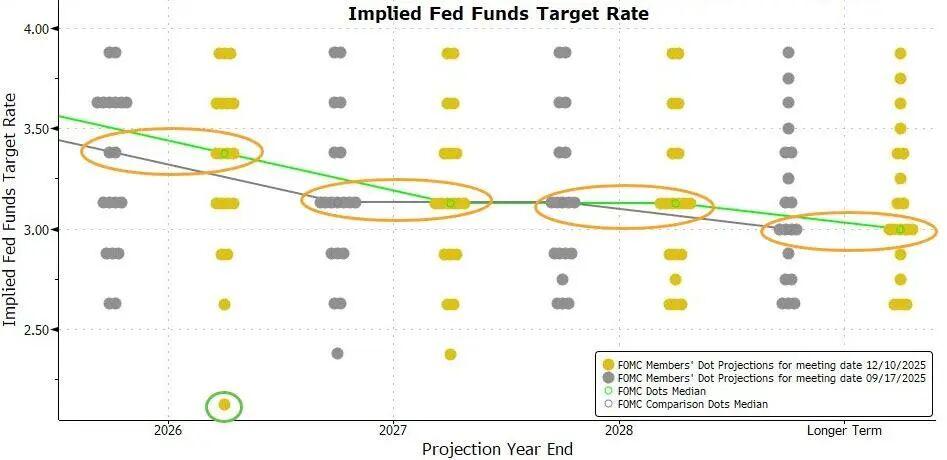
Many had expected that the dot plot reflecting future interest rate movements would show Fed policymakers leaning more hawkish. This dot plot did not show such a tendency; instead, it was slightly more dovish compared to the previous one.

Among the 19 Fed officials providing forecasts, seven now project the interest rate next year to be between 3.5% and 4.0%, compared to eight who projected this last time. This means that the number of officials expecting no rate cuts next year decreased by one.

The economic projections released after the meeting showed that Fed officials raised their GDP growth forecasts for this year and the subsequent three years, and slightly lowered the unemployment rate forecast for 2027, i.e., the year after next, by 0.1 percentage point, while leaving the forecasts for other years unchanged. This adjustment indicates that the Fed views the labor market as more resilient.

Simultaneously, Fed officials slightly lowered their forecasts for PCE inflation and core PCE inflation for this year and next year by 0.1 percentage point each. This reflects a slightly stronger confidence in inflation slowing over the coming period.

02 Powell: Current Rates Allow for Patience, Does Not Believe 'Next Move is a Hike' is Anyone's Base Case

With today's cut, the Fed has lowered the policy rate by a total of 75 basis points over the past three meetings. Powell said this will help gradually return inflation to 2% after the effects of tariffs fade.

He said the adjustments made to the policy stance since September have brought the policy rate into the range of various estimates of "neutral interest rates." The median projection of FOMC members shows the appropriate level for the federal funds rate at the end of 2026 is 3.4% and 3.1% at the end of 2027, unchanged from September.

Powell stated that currently, inflation risks are tilted to the upside, while employment risks are tilted to the downside, presenting a challenging situation.

A reasonable baseline is that the impact of tariffs on inflation will be relatively short-lived, essentially a one-time shift in the price level. Our job is to ensure this one-time price increase does not evolve into a persistent inflation problem. But at the same time, downside risks to employment have increased in recent months, and the overall balance of risks has changed. Our policy framework requires balance between the two aspects of our dual mandate. Therefore, we believe a 25-basis-point cut at this meeting was appropriate.

Given the stalled progress in bringing inflation down, Fed officials had hinted before this week's decision that further cuts might require evidence of labor market weakness. Powell said at the press conference:

"Where we are right now allows us to be patient and watch how the economy evolves."

In the Q&A session, regarding the question of whether the next policy adjustment is necessarily downward now that rates are closer to neutral, or if policy risks have truly turned two-way, Powell responded that no one has rate hikes as their base case currently, and he hasn't heard such views. There are differing views within the Committee: some members believe the current policy stance is appropriate and advocate maintaining the status quo for further observation; others believe another cut may be needed this year or next, perhaps even more than one.

When members write down their judgments on the policy path and appropriate interest rate levels, expectations are mainly concentrated on a few scenarios: either maintaining the current level, implementing a small cut, or a slightly larger cut. Powell emphasized that the current mainstream expectations do not include a rate hike scenario.

Powell stated that as a separate decision, the Fed also decided to initiate purchases of short-term U.S. Treasury bills, with the sole purpose of maintaining ample reserve supplies over time, thereby ensuring the Fed can control the policy rate effectively. He stressed that these issues are separate from the monetary policy stance itself and do not represent a change in policy orientation.

He said the scale of short-term bill purchases may remain high in the coming months, and the Fed isn't strictly "worried" about money market tensions, just that this situation came a bit sooner than expected.

Powell also stated that, according to the New York Fed's announcement, the initial scale of asset purchases will reach $40 billion in the first month and may remain high in the following months to alleviate anticipated short-term money market pressures. Afterwards, the scale of purchases is expected to decline, with the specific pace depending on market conditions.

Regarding the labor market, Powell said that although official October and November employment data are not yet available, existing evidence suggests that both layoffs and hiring remain at low levels. Simultaneously, households' perceptions of job availability and businesses' sense of hiring difficulty continue to decline. The unemployment rate continues to rise slightly, reaching 4.4%, and employment growth has slowed noticeably compared to earlier this year. The Fed also removed the phrase "the unemployment rate has remained low" from the statement.

Powell said in the subsequent Q&A that after adjusting for overestimation in the employment data, job growth may have turned slightly negative since April.


Criptomoedas em alta

Perguntas relacionadas

QWhat was the outcome of the December 10th FOMC meeting regarding the federal funds rate?

AThe Federal Reserve lowered the target range for the federal funds rate from 3.75%-4.00% to 3.50%-3.75%, marking the third 25 basis point cut of the year.

QWhat does the term 'hawkish cut' refer to in the context of this article?

AA 'hawkish cut' refers to the Fed's decision to cut interest rates while simultaneously signaling that it may pause and not cut rates again in the near future.

QWhat new policy did the Fed announce alongside the rate cut to address money market pressures?

AThe Fed announced it would begin purchasing short-term Treasury bills to maintain an ample supply of reserves in the banking system, starting with a plan to buy $40 billion over the next 30 days.

QAccording to the dot plot, how many rate cuts do Fed officials project for the year 2025?

AFed officials' median projection, as shown in the dot plot, indicates one 25 basis point rate cut for the year 2025.

QWhat was Chairman Powell's stance on the possibility of the next policy move being a rate increase?

AChairman Powell stated that he does not believe a rate hike is anyone's base case assumption for the next policy move and that the mainstream expectations were for either holding rates steady or for small cuts.

Leituras Relacionadas

Bitcoin Mining Farms Are Becoming AI Factories

Bitcoin mines are transforming into AI factories. This shift is driven by the convergence of three key assets from the previous crypto cycle: infrastructure, talent, and capital. Crypto mining companies like Crusoe, CoreWeave, and Bitdeer are repurposing their core competency—securing power, land, and grid connections in remote locations—to build data centers for AI clients. These firms are signing multi-billion dollar, long-term contracts with companies like Anthropic, AWS, and Microsoft, as AI's demand for reliable, high-capacity compute surpasses the profitability of Bitcoin mining. Simultaneously, crypto entrepreneurs and engineers are applying their skills to new AI ventures. Examples include OpenSea's co-founder launching OpenRouter (an AI model aggregator), and former Coinbase engineers building Fal.ai (a generative media infrastructure platform). Their experience in building scalable, global software networks translates effectively to the AI space. Furthermore, capital accumulated during the crypto boom is now fueling AI. Figures like Jed McCaleb (co-founder of Ripple) funded Voltage Park, a large-scale GPU cloud provider. Notably, some crypto investments, like FTX's early bets on Anthropic and Cursor, have generated astronomical paper returns, demonstrating how high-risk crypto capital flowed into AI before it became mainstream. The transition is not just about repurposing hardware, but about redirecting critical resources—power infrastructure, distributed systems expertise, and venture funding—to the next technological frontier: artificial intelligence.

链捕手Há 9m

Bitcoin Mining Farms Are Becoming AI Factories

链捕手Há 9m

Morpho Launches Fixed-Rate Product Midnight: Lenders and Borrowers Set Their Own Rates, Ending the Era of Interest Rate Models

Morpho Launches Fixed-Rate Product Midnight: Lenders and Borrowers Set Their Own Rates, Ending the Era of Algorithmic Interest Models On-chain lending has grown to $60 billion but remains minuscule compared to traditional finance's $200 trillion annual credit volume. Morpho identifies the lack of fixed rates and maturity dates as key bottlenecks. Institutions need predictability, not the passive floating rates set by algorithmic models. Midnight allows lenders and borrowers to directly quote rates, set terms, and become price makers, not takers. Fixed-rate lending is now viable due to cheaper, faster blockchains and the entry of institutions demanding control and certainty over returns, costs, and duration. Morpho Blue previously gave users control over risk; Midnight adds control over interest rates. Past attempts at on-chain fixed-rate lending failed primarily because they were built on top of floating-rate pools (creating unpredictability) or lacked sufficient active participants. Midnight avoids these pitfalls as a standalone primitive with fixed rates at its core, built upon Morpho Blue's existing large and active user base. Midnight offers distinct value: institutions gain predictable term structures and full control; fintech companies can offer tailored fixed-rate products; lenders/borrowers achieve predictability and efficiency; and curators can now differentiate by configuring both risk and interest rates. Morpho Midnight is not a replacement for Morpho Blue. The Morpho network will now feature two complementary market structures: floating-rate/open-term (Blue) for flexibility and fixed-rate/fixed-term (Midnight) for predictability. Liquidity can flow between them. The launch will be gradual, prioritizing security. Initially, it will support direct lending on Base network with one trading pair (cbBTC/USDC) and limited maturity dates. Advanced features like auto-rollovers will be introduced later.

marsbitHá 10m

Morpho Launches Fixed-Rate Product Midnight: Lenders and Borrowers Set Their Own Rates, Ending the Era of Interest Rate Models

marsbitHá 10m

human.tech Launches Clean SDK for Privacy-First Web3 Apps

human.tech has launched the Clean SDK, a toolkit enabling developers to build privacy-first Web3 applications with transparent accountability. Released alongside Aztec's version 5, the SDK provides components for integrating zero-knowledge identity verification, sanctions screening, and private transactions, without developers handling sensitive user data or building compliance infrastructure from scratch. It uses zero-knowledge proofs and programmable verification to allow apps to confirm user legitimacy and sanctions compliance while keeping identities confidential. The first application built on the SDK, Shield, a privacy bridge to Aztec, also launched. It allows users to transfer assets privately while proving a unique human is behind each transfer and that funds have passed sanctions checks, as verified by a May 2026 audit. The SDK offers three core verification techniques: Proof of Innocence (sanctions screening against 23 sources), Proof of Personhood (simpler verification via Human Passport), and Proof of Clean Hands (higher-assurance zero-knowledge government ID checks). This allows apps to authenticate users and transactions without exposing personal data. Designed for Aztec builders, the SDK lets developers add programmable privacy to decentralized apps, eliminating the need to create their own verification and ZK infrastructure. Shield demonstrates its practical use for private bridges, but the SDK aims to enable a wider ecosystem of private, accountable financial apps and services. The launch addresses growing demand for infrastructure that balances privacy and accountability. The SDK avoids traditional identity databases, storing encrypted data off-chain, screening at both entry and exit points, and including a gated disclosure mechanism for legal requests. human.tech's products, including the Clean SDK, focus on using zero-knowledge technology to enable verifiable personhood and privacy in digital systems.

TheNewsCryptoHá 47m

human.tech Launches Clean SDK for Privacy-First Web3 Apps

TheNewsCryptoHá 47m

Unlocking $100 Million in Liquidity? Pump.fun's New Policy Tests the 5-Minute Pump Technique

Pump.fun, a popular meme coin launchpad, has introduced a new standard mechanism called BOOST. It aims to address a significant capital efficiency issue: when a newly launched token graduates from its initial bonding curve to a liquidity pool (LP), roughly 20% of its liquidity becomes permanently locked as "dead liquidity," estimated to waste over $100 million annually. Instead of locking these funds permanently, BOOST repurposes them. Upon a token's migration, approximately 20% of the settlement funds (e.g., 17.6 SOL or ~$2516 USDC) are used to buy back the token on the open market over a 5-minute period via a Time-Weighted Average Price (TWAP) mechanism. All purchased tokens are immediately burned. This creates a brief, systematic buy pressure immediately after migration, potentially generating a short-term price surge ("pump") while permanently reducing the token's circulating supply. The goal is to enhance the immediate post-launch trading experience, potentially increasing trader retention and sustainable protocol revenue, which funds ongoing token buybacks. However, concerns exist that this artificial 5-minute boost could lower the barrier for launching low-quality tokens and lead to steeper price crashes once the buy pressure stops, if followed by large sell-offs. The feature automatically applies to tokens migrating after July 21, 2024, but not to previously migrated tokens or those launched via the Mayhem AI Agent lab.

marsbitHá 54m

Unlocking $100 Million in Liquidity? Pump.fun's New Policy Tests the 5-Minute Pump Technique

marsbitHá 54m

Trading

Spot

Artigos em Destaque

Como comprar O

Bem-vindo à HTX.com!Tornámos a compra de O1 exchange (O) simples e conveniente.Segue o nosso guia passo a passo para iniciar a tua jornada no mundo das criptos.Passo 1: cria a tua conta HTXUtiliza o teu e-mail ou número de telefone para te inscreveres numa conta gratuita na HTX.Desfruta de um processo de inscrição sem complicações e desbloqueia todas as funcionalidades.Obter a minha contaPasso 2: vai para Comprar Cripto e escolhe o teu método de pagamentoCartão de crédito/débito: usa o teu visa ou mastercard para comprar O1 exchange (O) instantaneamente.Saldo: usa os fundos da tua conta HTX para transacionar sem problemas.Terceiros: adicionamos métodos de pagamento populares, como Google Pay e Apple Pay, para aumentar a conveniência.P2P: transaciona diretamente com outros utilizadores na HTX.Mercado de balcão (OTC): oferecemos serviços personalizados e taxas de câmbio competitivas para os traders.Passo 3: armazena teu O1 exchange (O)Depois de comprar o teu O1 exchange (O), armazena-o na tua conta HTX.Alternativamente, podes enviá-lo para outro lugar através de transferência blockchain ou usá-lo para transacionar outras criptomoedas.Passo 4: transaciona O1 exchange (O)Transaciona facilmente O1 exchange (O) no mercado à vista da HTX.Acede simplesmente à tua conta, seleciona o teu par de trading, executa as tuas transações e monitoriza em tempo real.Oferecemos uma experiência de fácil utilização tanto para principiantes como para traders experientes.

167 Visualizações TotaisPublicado em {updateTime}Atualizado em 2026.06.29

Como comprar O

Como comprar PROS

Bem-vindo à HTX.com!Tornámos a compra de Pharos (PROS) simples e conveniente.Segue o nosso guia passo a passo para iniciar a tua jornada no mundo das criptos.Passo 1: cria a tua conta HTXUtiliza o teu e-mail ou número de telefone para te inscreveres numa conta gratuita na HTX.Desfruta de um processo de inscrição sem complicações e desbloqueia todas as funcionalidades.Obter a minha contaPasso 2: vai para Comprar Cripto e escolhe o teu método de pagamentoCartão de crédito/débito: usa o teu visa ou mastercard para comprar Pharos (PROS) instantaneamente.Saldo: usa os fundos da tua conta HTX para transacionar sem problemas.Terceiros: adicionamos métodos de pagamento populares, como Google Pay e Apple Pay, para aumentar a conveniência.P2P: transaciona diretamente com outros utilizadores na HTX.Mercado de balcão (OTC): oferecemos serviços personalizados e taxas de câmbio competitivas para os traders.Passo 3: armazena teu Pharos (PROS)Depois de comprar o teu Pharos (PROS), armazena-o na tua conta HTX.Alternativamente, podes enviá-lo para outro lugar através de transferência blockchain ou usá-lo para transacionar outras criptomoedas.Passo 4: transaciona Pharos (PROS)Transaciona facilmente Pharos (PROS) no mercado à vista da HTX.Acede simplesmente à tua conta, seleciona o teu par de trading, executa as tuas transações e monitoriza em tempo real.Oferecemos uma experiência de fácil utilização tanto para principiantes como para traders experientes.

160 Visualizações TotaisPublicado em {updateTime}Atualizado em 2026.06.29

Como comprar PROS

O que é VERONA

I. Introdução ao Projeto VERONA é uma blockchain construída para todos, em todo o lado, através da abstração da cadeia. Utilizando a sua camada de Abstração Generalizada, a VERONA distingue-se por integrar funcionalidades complexas de blockchain, como contas, assinaturas e interoperabilidade, diretamente ao nível do protocolo. Esta abordagem permite a interação com aplicações de blockchain sem a necessidade de compreender as tecnologias subjacentes.1) Informação Básica Nome: VERONA (VERONA)III. Links Relacionados Link do site oficial: https://xion.burnt.com/ Whitepaper: https://xion.burnt.com/whitepaper.pdf Exploradores: https://explorer.burnt.com/ Mídias Sociais: https://x.com/burnt_xion Nota: A introdução ao projeto provém dos materiais publicados ou fornecidos pela equipa oficial do projeto, que é apenas para referência e não constitui aconselhamento de investimento. A HTX não se responsabiliza por quaisquer perdas diretas ou indiretas resultantes.

778 Visualizações TotaisPublicado em {updateTime}Atualizado em 2026.06.22

O que é VERONA

Discussões

Bem-vindo à Comunidade HTX. Aqui, pode manter-se informado sobre os mais recentes desenvolvimentos da plataforma e obter acesso a análises profissionais de mercado. As opiniões dos utilizadores sobre o preço de A (A) são apresentadas abaixo.

活动图片