A Less 'Hawkish' 'Hawkish Rate Cut' and Balance Sheet Expansion Buying Bonds That 'Is Not QE'

深潮Publicado em 2025-12-11Última atualização em 2025-12-11

Resumo

The Federal Reserve cut interest rates by 25 basis points for the third consecutive time in 2024, lowering the target range to 3.50%-3.75%. The decision revealed the largest internal dissent in six years, with three officials opposing the move. The updated dot plot continues to project only one more rate cut in 2025, signaling a significant slowdown in the pace of easing. Chair Jerome Powell emphasized that the current policy stance allows the Fed to be patient and data-dependent, noting that no one is assuming the next move will be a hike. Simultaneously, the Fed announced it would begin purchasing short-term Treasury bills to maintain ample reserves in the banking system, with an initial $40 billion in purchases planned for the next month. Powell stressed that these operations are for reserve management purposes and do not represent a change in monetary policy stance. The economic projections were slightly revised, with upgrades to GDP growth and minor downgrades to inflation expectations. The labor market is showing signs of cooling, with the unemployment rate rising and job growth slowing.

Source: Wall Street Journal

The Federal Reserve cut interest rates again at the conventional pace as the market expected, but it exposed the largest divergence among voting policymakers in six years, signaling a slowdown in the pace of action next year and a potential pause in the near term. The Fed also, as expected by Wall Street, initiated reserve management operations, deciding to buy short-term Treasury bonds by year-end to address pressures in the money markets.

On Wednesday, December 10, Eastern Time, the Federal Reserve announced after its FOMC monetary policy meeting that the target range for the federal funds rate was lowered from 3.75%-4.00% to 3.50%-3.75%. This marks the third 25-basis-point rate cut this year, bringing the total reduction for the year to 75 basis points. Since September of last year, this easing cycle has cumulatively cut rates by 175 basis points.

It is worth noting that the Fed's interest rate decision faced three dissenting votes for the first time since 2019. Governor Milan, appointed by Trump, continued to advocate for a 50-basis-point cut, while two regional Fed presidents and four non-voting members supported holding rates steady. In effect, seven officials opposed the decision, reportedly the largest divergence in 37 years.

The dot plot released after the meeting showed that the interest rate path forecast by Fed policymakers remained consistent with the one published three months ago, still projecting one 25-basis-point rate cut next year. This implies that the pace of rate cuts next year will slow significantly compared to this year.

As of Tuesday's close, CME Group's FedWatch Tool showed that the futures market priced in an approximately 88% probability of a 25-basis-point cut this week, while the probability of at least another 25-basis-point cut did not reach 71% until next June. The probabilities for such a cut at the January, March, and April meetings next year all remained below 50%.

The predictions reflected by the CME tool can be summarized by the recently popular term "hawkish cut." It refers to the Fed cutting rates this time while simultaneously signaling a potential pause in action, with no further cuts in the near term.

Nick Timiraos, a veteran Fed reporter known as the "new Fed whisperer," stated bluntly after the meeting that the Fed "signaled it may pause on rate cuts for now" due to "rare" internal disagreements over whether to worry more about inflation or the job market.

Timiraos pointed out that three officials dissented from the 25-basis-point cut at this meeting, and the stalled decline in inflation and cooling labor market made this meeting the most divisive in recent years.

Powell emphasized at the post-meeting press conference that he did not believe "a rate hike at the next meeting" was anyone's base case. The current level of rates allows the Fed to be patient and observe how the economy evolves. He also stated that the available data so far does not indicate a change in the economic outlook, and the scale of Treasury purchases may remain high in the coming months.

01 Fed Cuts Rates by 25 Basis Points as Expected, Still Projects One Cut Next Year, Initiates RMP Buying $40B in Short-Term Bonds

On Wednesday, December 10, Eastern Time, the Federal Reserve announced after its FOMC monetary policy meeting that the target range for the federal funds rate was lowered from 3.75%-4.00% to 3.50%-3.75%. This marks the third consecutive FOMC meeting with a rate cut, each by 25 basis points, bringing the total reduction for the year to 75 basis points. Since September last year, this easing cycle has cumulatively cut rates by 175 basis points.

It is worth noting that the Fed's interest rate decision faced three dissenting votes for the first time since 2019. Trump-appointed Governor Milan continued to advocate for a 50-basis-point cut, while two regional Fed presidents and four non-voting members supported holding rates steady. In effect, seven officials opposed the decision, reportedly the largest divergence in 37 years.

A key change in this meeting's statement compared to the previous one was in the interest rate guidance. Although the decision was to cut rates, the statement no longer broadly said that, when considering further rate cuts, the FOMC would assess incoming data, the evolving outlook, and the balance of risks. Instead, it more explicitly referred to considering the "extent and timing" of future adjustments. The statement now reads:

"In considering the extent and timing of any adjustments to the target range for the federal funds rate, the Committee will carefully assess incoming data, the evolving outlook, and the balance of risks."

The meeting statement reiterated that inflation remains somewhat elevated and that the downside risks to employment have increased in recent months. It removed the phrase "remains low" regarding the unemployment rate, noting it had risen slightly to 4.4% as of September.

The addition of "extent and timing" regarding further rate cuts is seen as signaling a higher bar for future cuts.

Another important change in this meeting's statement compared to the last was the addition of a new paragraph specifically noting the intention to purchase short-term bonds to maintain ample reserve balances in the banking system. The statement wrote:

"The Committee views reserve balances as having declined to ample levels and will begin purchases of Treasury bills, as needed, to maintain ample reserve balances over time."

This amounts to announcing the start of so-called reserve management operations, rebuilding liquidity buffers in the money markets. Year-end often sees market disruptions as banks typically reduce activity in the repo market to support their balance sheets for regulatory and tax settlements.

The statement said reserves have declined to ample levels and, to maintain ample reserves, will begin buying short-term bills this Friday. The New York Fed plans to buy $40 billion in short-term bills over the next 30 days and expects Reserve Management Purchases (RMP) of short-term bills to remain high in the first quarter of next year.

The median projection of Fed officials' interest rate forecasts released after Wednesday's meeting showed that their expectations this time were exactly the same as the previous ones published in September.

Fed officials currently also project that, after three rate cuts this year, there will likely be one 25-basis-point cut each in the next two years.
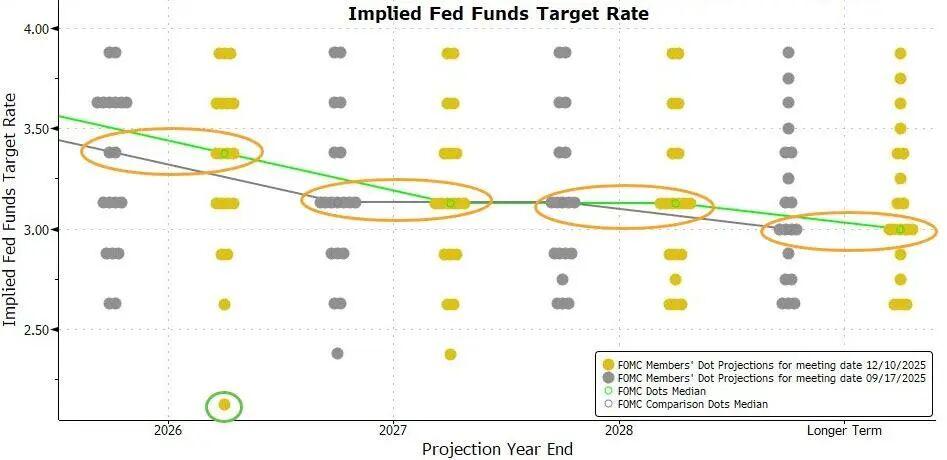
Many had expected that the dot plot reflecting future interest rate movements would show Fed policymakers leaning more hawkish. This dot plot did not show such a tendency; instead, it was slightly more dovish compared to the previous one.

Among the 19 Fed officials providing forecasts, seven now project the interest rate next year to be between 3.5% and 4.0%, compared to eight who projected this last time. This means that the number of officials expecting no rate cuts next year decreased by one.

The economic projections released after the meeting showed that Fed officials raised their GDP growth forecasts for this year and the subsequent three years, and slightly lowered the unemployment rate forecast for 2027, i.e., the year after next, by 0.1 percentage point, while leaving the forecasts for other years unchanged. This adjustment indicates that the Fed views the labor market as more resilient.

Simultaneously, Fed officials slightly lowered their forecasts for PCE inflation and core PCE inflation for this year and next year by 0.1 percentage point each. This reflects a slightly stronger confidence in inflation slowing over the coming period.

02 Powell: Current Rates Allow for Patience, Does Not Believe 'Next Move is a Hike' is Anyone's Base Case

With today's cut, the Fed has lowered the policy rate by a total of 75 basis points over the past three meetings. Powell said this will help gradually return inflation to 2% after the effects of tariffs fade.

He said the adjustments made to the policy stance since September have brought the policy rate into the range of various estimates of "neutral interest rates." The median projection of FOMC members shows the appropriate level for the federal funds rate at the end of 2026 is 3.4% and 3.1% at the end of 2027, unchanged from September.

Powell stated that currently, inflation risks are tilted to the upside, while employment risks are tilted to the downside, presenting a challenging situation.

A reasonable baseline is that the impact of tariffs on inflation will be relatively short-lived, essentially a one-time shift in the price level. Our job is to ensure this one-time price increase does not evolve into a persistent inflation problem. But at the same time, downside risks to employment have increased in recent months, and the overall balance of risks has changed. Our policy framework requires balance between the two aspects of our dual mandate. Therefore, we believe a 25-basis-point cut at this meeting was appropriate.

Given the stalled progress in bringing inflation down, Fed officials had hinted before this week's decision that further cuts might require evidence of labor market weakness. Powell said at the press conference:

"Where we are right now allows us to be patient and watch how the economy evolves."

In the Q&A session, regarding the question of whether the next policy adjustment is necessarily downward now that rates are closer to neutral, or if policy risks have truly turned two-way, Powell responded that no one has rate hikes as their base case currently, and he hasn't heard such views. There are differing views within the Committee: some members believe the current policy stance is appropriate and advocate maintaining the status quo for further observation; others believe another cut may be needed this year or next, perhaps even more than one.

When members write down their judgments on the policy path and appropriate interest rate levels, expectations are mainly concentrated on a few scenarios: either maintaining the current level, implementing a small cut, or a slightly larger cut. Powell emphasized that the current mainstream expectations do not include a rate hike scenario.

Powell stated that as a separate decision, the Fed also decided to initiate purchases of short-term U.S. Treasury bills, with the sole purpose of maintaining ample reserve supplies over time, thereby ensuring the Fed can control the policy rate effectively. He stressed that these issues are separate from the monetary policy stance itself and do not represent a change in policy orientation.

He said the scale of short-term bill purchases may remain high in the coming months, and the Fed isn't strictly "worried" about money market tensions, just that this situation came a bit sooner than expected.

Powell also stated that, according to the New York Fed's announcement, the initial scale of asset purchases will reach $40 billion in the first month and may remain high in the following months to alleviate anticipated short-term money market pressures. Afterwards, the scale of purchases is expected to decline, with the specific pace depending on market conditions.

Regarding the labor market, Powell said that although official October and November employment data are not yet available, existing evidence suggests that both layoffs and hiring remain at low levels. Simultaneously, households' perceptions of job availability and businesses' sense of hiring difficulty continue to decline. The unemployment rate continues to rise slightly, reaching 4.4%, and employment growth has slowed noticeably compared to earlier this year. The Fed also removed the phrase "the unemployment rate has remained low" from the statement.

Powell said in the subsequent Q&A that after adjusting for overestimation in the employment data, job growth may have turned slightly negative since April.


Perguntas relacionadas

QWhat was the outcome of the December 10th FOMC meeting regarding the federal funds rate?

AThe Federal Reserve lowered the target range for the federal funds rate from 3.75%-4.00% to 3.50%-3.75%, marking the third 25 basis point cut of the year.

QWhat does the term 'hawkish cut' refer to in the context of this article?

AA 'hawkish cut' refers to the Fed's decision to cut interest rates while simultaneously signaling that it may pause and not cut rates again in the near future.

QWhat new policy did the Fed announce alongside the rate cut to address money market pressures?

AThe Fed announced it would begin purchasing short-term Treasury bills to maintain an ample supply of reserves in the banking system, starting with a plan to buy $40 billion over the next 30 days.

QAccording to the dot plot, how many rate cuts do Fed officials project for the year 2025?

AFed officials' median projection, as shown in the dot plot, indicates one 25 basis point rate cut for the year 2025.

QWhat was Chairman Powell's stance on the possibility of the next policy move being a rate increase?

AChairman Powell stated that he does not believe a rate hike is anyone's base case assumption for the next policy move and that the mainstream expectations were for either holding rates steady or for small cuts.

Leituras Relacionadas

Fu Peng's First Public Speech in 2026: What Exactly Are Crypto Assets? Why Did I Join the Crypto Asset Industry?

Fu Peng, a renowned macroeconomist and now Chief Economist at New火 Group, delivered his first public speech of 2026 at the Hong Kong Web3 Festival. He explained his perspective on crypto assets and why he joined the industry, framing it within the context of macroeconomic trends and financial evolution. Fu emphasized that crypto assets are transitioning from an early, belief-driven phase to a mature, institutionally integrated asset class. He drew parallels to the 1970s-80s, when technological advances (like computing) revolutionized traditional finance, leading to the rise of FICC (Fixed Income, Currencies, and Commodities). Similarly, current advancements in AI, data, and blockchain are reshaping finance, with crypto assets becoming part of a new "FICC + C" (C for Crypto) framework. He noted that institutional capital, including traditional hedge funds, avoided early crypto due to its speculative nature but are now engaging as regulatory clarity emerges (e.g., stablecoin laws, CFTC classifying crypto as a commodity). Fu predicted that 2025-2026 marks a turning point where crypto becomes a standardized, financially viable asset for diversified portfolios, akin to commodities or derivatives in traditional finance. Fu defined Bitcoin not as "digital gold" in a simplistic sense but as a value-preserving, financially tradable asset. He highlighted that crypto's future lies in regulated, institutional adoption, moving away from retail-dominated trading. His entry into crypto signals this maturation, where traditional finance integrates crypto into mainstream asset management.

marsbitHá 3m

Fu Peng's First Public Speech in 2026: What Exactly Are Crypto Assets? Why Did I Join the Crypto Asset Industry?

marsbitHá 3m

Justin Sun Sues Trump Family: What $75 Million Bought Was Only a Blacklist

Justin Sun, founder of Tron, has filed a lawsuit in federal court against World Liberty Financial (WLF), alleging he was made the "primary target of a fraudulent scheme" after investing $75 million. Sun claims the investment secured him an advisor title and WLFI tokens, which were later frozen by WLF, causing "hundreds of millions in losses." The dispute began in late 2024 when Sun's investment helped revive WLF's struggling token sale, which ultimately raised $550 million. Shortly after, the SEC dropped its lawsuit against Sun following Donald Trump's inauguration. However, relations soured when Sun refused WLF's demands for additional funding. In August 2025, WLF added a "blacklist" function to its smart contract, allowing it to unilaterally freeze tokens. Sun's holdings, worth approximately $107 million, were frozen, and he was threatened with token destruction. The lawsuit highlights WLF's structure, which directs 75% of token sale profits to the Trump family, who had earned $1 billion by December 2025. WLF's CEO is Zach Witkoff, son of U.S. Middle East envoy Steve Witkoff. The project faces scrutiny for opaque operations, including a controversial loan arrangement on the Dolomite platform, co-founded by a WLF advisor. Despite Sun's history with the SEC, the case underscores centralization risks within DeFi, as WLF controls governance and holds powers to freeze assets arbitrarily. Sun's tokens remain frozen as legal proceedings begin.

marsbitHá 11m

Justin Sun Sues Trump Family: What $75 Million Bought Was Only a Blacklist

marsbitHá 11m

$500 to Buy OpenAI Stock: Silicon Valley's Most Respectable Liquidity Invitation

Silicon Valley's largest venture capital platform, AngelList, has launched a new fund called USVC, allowing U.S. retail investors to buy into high-profile AI companies like OpenAI, Anthropic, and xAI with a minimum investment of $500—no accredited investor status required. Promoted by AngelList co-founder Naval Ravikant, the fund is framed as an opportunity for ordinary people to access high-growth private tech investments traditionally reserved for VCs. However, critics argue it functions more like an exit vehicle for early insiders. USVC acquires shares not through primary rounds but largely via secondary transactions—purchasing stakes from early investors, VC funds, and employees looking to cash out at peak valuations. With companies like xAI heavily weighted in the portfolio, the fund effectively channels retail money into providing liquidity for insiders who entered at much lower valuations. The fund’s structure raises concerns: shares are illiquid, with no secondary market, and buybacks are limited and discretionary. The actual annual fee reaches 3.61%, far above the advertised 1% management fee. This model parallels the "low float, high fully diluted valuation" strategy seen in crypto, where early investors profit by selling to latecomers at inflated prices. The timing—alongside similar moves by platforms like Robinhood—suggests that Silicon Valley’s sudden interest in retail inclusion may be less about democratizing access and more about securing exits for insiders.

marsbitHá 42m

$500 to Buy OpenAI Stock: Silicon Valley's Most Respectable Liquidity Invitation

marsbitHá 42m

Trading

Spot
Futuros

Artigos em Destaque

Como comprar CFG

Bem-vindo à HTX.com!Tornámos a compra de Centrifuge (CFG) simples e conveniente.Segue o nosso guia passo a passo para iniciar a tua jornada no mundo das criptos.Passo 1: cria a tua conta HTXUtiliza o teu e-mail ou número de telefone para te inscreveres numa conta gratuita na HTX.Desfruta de um processo de inscrição sem complicações e desbloqueia todas as funcionalidades.Obter a minha contaPasso 2: vai para Comprar Cripto e escolhe o teu método de pagamentoCartão de crédito/débito: usa o teu visa ou mastercard para comprar Centrifuge (CFG) instantaneamente.Saldo: usa os fundos da tua conta HTX para transacionar sem problemas.Terceiros: adicionamos métodos de pagamento populares, como Google Pay e Apple Pay, para aumentar a conveniência.P2P: transaciona diretamente com outros utilizadores na HTX.Mercado de balcão (OTC): oferecemos serviços personalizados e taxas de câmbio competitivas para os traders.Passo 3: armazena teu Centrifuge (CFG)Depois de comprar o teu Centrifuge (CFG), armazena-o na tua conta HTX.Alternativamente, podes enviá-lo para outro lugar através de transferência blockchain ou usá-lo para transacionar outras criptomoedas.Passo 4: transaciona Centrifuge (CFG)Transaciona facilmente Centrifuge (CFG) no mercado à vista da HTX.Acede simplesmente à tua conta, seleciona o teu par de trading, executa as tuas transações e monitoriza em tempo real.Oferecemos uma experiência de fácil utilização tanto para principiantes como para traders experientes.

204 Visualizações TotaisPublicado em {updateTime}Atualizado em 2026.03.19

Como comprar CFG

O que é WL

I. Introdução ao ProjetoWorldLand é uma L2 ou side chain do Ethereum, concebida como uma solução de baixo para cima para melhorar o ecossistema Ethereum.II. Informação sobre o Token1) Informação BásicaNome do token: WL (WorldLand)III. Links RelacionadosWebsite:https://worldland.foundation/Exploradores:https://bscscan.com/address/0x8aaB31fbc69C92fa53f600910Cf0f215531F8239Redes Sociais:https://x.com/WorldLand_space Nota: A introdução ao projeto provém dos materiais publicados ou fornecidos pela equipa oficial do projeto, que é apenas para referência e não constitui aconselhamento de investimento. A HTX não se responsabiliza por quaisquer perdas diretas ou indiretas resultantes.

173 Visualizações TotaisPublicado em {updateTime}Atualizado em 2026.03.28

O que é WL

Como comprar WL

Bem-vindo à HTX.com!Tornámos a compra de WorldLand (WL) simples e conveniente.Segue o nosso guia passo a passo para iniciar a tua jornada no mundo das criptos.Passo 1: cria a tua conta HTXUtiliza o teu e-mail ou número de telefone para te inscreveres numa conta gratuita na HTX.Desfruta de um processo de inscrição sem complicações e desbloqueia todas as funcionalidades.Obter a minha contaPasso 2: vai para Comprar Cripto e escolhe o teu método de pagamentoCartão de crédito/débito: usa o teu visa ou mastercard para comprar WorldLand (WL) instantaneamente.Saldo: usa os fundos da tua conta HTX para transacionar sem problemas.Terceiros: adicionamos métodos de pagamento populares, como Google Pay e Apple Pay, para aumentar a conveniência.P2P: transaciona diretamente com outros utilizadores na HTX.Mercado de balcão (OTC): oferecemos serviços personalizados e taxas de câmbio competitivas para os traders.Passo 3: armazena teu WorldLand (WL)Depois de comprar o teu WorldLand (WL), armazena-o na tua conta HTX.Alternativamente, podes enviá-lo para outro lugar através de transferência blockchain ou usá-lo para transacionar outras criptomoedas.Passo 4: transaciona WorldLand (WL)Transaciona facilmente WorldLand (WL) no mercado à vista da HTX.Acede simplesmente à tua conta, seleciona o teu par de trading, executa as tuas transações e monitoriza em tempo real.Oferecemos uma experiência de fácil utilização tanto para principiantes como para traders experientes.

235 Visualizações TotaisPublicado em {updateTime}Atualizado em 2026.03.28

Como comprar WL

Discussões

Bem-vindo à Comunidade HTX. Aqui, pode manter-se informado sobre os mais recentes desenvolvimentos da plataforma e obter acesso a análises profissionais de mercado. As opiniões dos utilizadores sobre o preço de A (A) são apresentadas abaixo.

活动图片