A High-Stakes Gamble in the Regulatory Void: Binance Fully Backs Unlicensed Stablecoin U

比推Publicado em 2026-01-13Última atualização em 2026-01-13

Resumo

On January 13, Binance announced the listing of the stablecoin United Stables (U), launching U/USDT and U/USDC trading pairs with zero trading and leverage fees. Within 30 minutes, trading volume exceeded $4.5 million. U is issued by United Stables Limited, a BVI-registered entity, and is backed 1:1 by reserves held in a trust structure with fiat in regulated banks and digital assets with licensed custodians. It has received a custody attestation from Ceffu and a smart contract audit from PeckShield. Notably, U currently lacks regulatory approval under major frameworks like EU’s MiCA, Hong Kong’s Stablecoin Ordinance, or the U.S. GENIUS Act. Binance, though not the official issuer, is deeply integrated with U across its ecosystem—including BNB Chain, Binance Wallet, and DeFi protocols—providing liquidity and adoption support. The CEO, Athena Y, is a former Binance NFT lead and Ceffu CEO, but the project has not fully disclosed its core team or financial backing. U aims to serve as a “unified liquidity layer” rather than a direct competitor to USDT or USDC, targeting use cases in exchanges, DeFi, payments, and AI agents. As of January 13, U’s supply is around 410 million tokens with nearly 14,000 holders. It has been adopted by HTX, Aster, Lista DAO, and AEON Pay, though on-chain activity remains moderate.

Author: Nicky, Foresight News

Original Title: Is U the Stablecoin Binance Needs?


On January 13, Binance announced the listing of United Stables (U) and opened spot trading pairs for U/USDT and U/USDC, simultaneously launching zero-fee activities for these spot and leverage trading pairs. Within 30 minutes of the listing, the trading volume exceeded $4.5 million.

Against the backdrop of a highly mature stablecoin landscape and a continuously tightening regulatory environment, Binance's decision to list a new dollar-denominated stablecoin at this time carries significant implications. Since the gradual phase-out of BUSD, the compliance costs and regulatory pressures faced by centralized exchanges directly issuing stablecoins have significantly increased, while the demand for stable assets in trading, DeFi, and on-chain settlement scenarios has not diminished. How to introduce a stablecoin that is highly synergistic with its ecosystem without directly assuming issuance responsibilities has become a practical issue that exchanges must address.

The emergence of United Stables (U) may precisely meet this need. U is issued by the independent legal entity United Stables Limited, with Binance not being its legal issuer. However, the stablecoin has been rapidly integrated into BNB Chain, Binance Wallet, Binance Exchange, and multiple ecosystem protocols, making it highly tied to the Binance ecosystem in terms of usage.

Binance not only provides spot and leverage trading pairs for U but also simultaneously launches zero-fee activities to create conditions for its rapid establishment of liquidity and usage depth in the early stages.

On December 18, 2025, Binance founder CZ mentioned the latest progress of U during the "2025 Year-End Q&A AMA" hosted by BNB Chain, stating that it "has certain potential." However, the project has not disclosed any financing progress, and YZi Labs has also not disclosed relevant investment information.

United Stables (U) is issued by United Stables Limited, a company registered in the British Virgin Islands (BVI). According to the project's official website, U is pegged to the US dollar and adopts a 1:1 reserve backing mechanism. Reserve assets are custodied through an independent trust structure to achieve legal isolation from the issuer's assets. Fiat reserves are held in compliant banking institutions, while digital asset reserves are custodied by licensed custodians.
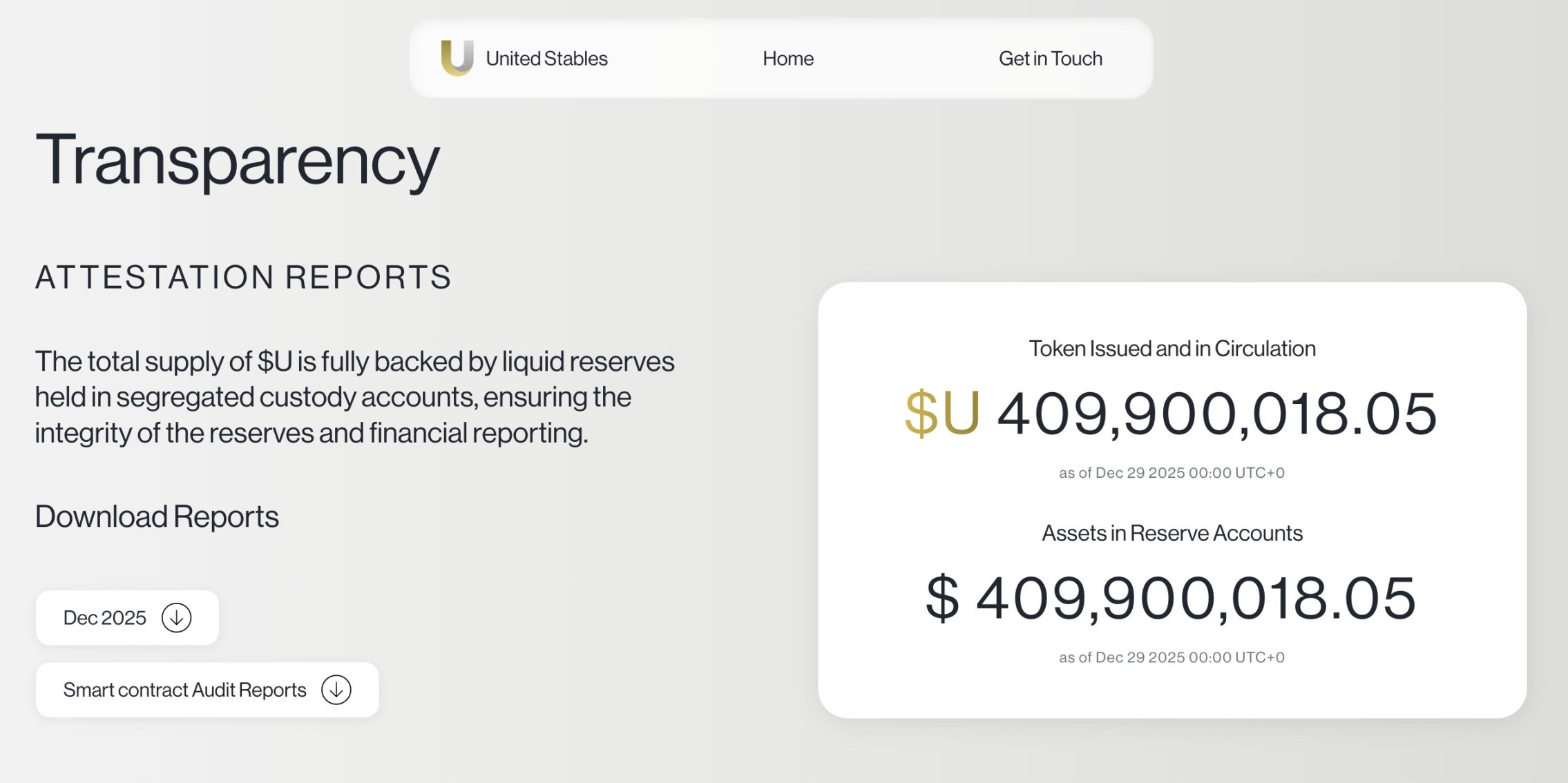
Previously, the digital asset custody platform Ceffu issued the latest custody balance proof for the project on December 29, 2025, while PeckShield has issued a smart contract audit report.

For comparison, the reserve management models of current mainstream stablecoins vary. Tether (USDT) is issued by Tether Limited, with its reserve assets primarily consisting of US Treasury bonds, money market instruments, reverse repurchase agreements, and cash. These assets are held by multiple financial institutions and custodians, and reserve proof reports issued by third-party accounting firms are regularly published. Circle (USDC), on the other hand, manages its reserves through regulated bank accounts and US-registered government money market funds, continuously disclosing reviewed or audited reserve reports.

It is important to note that United Stables Limited explicitly states on its official website that U has not been registered or licensed under the EU's MiCA, Hong Kong's "Stablecoin Ordinance," the US GENIUS Act, or any relevant US or EU securities or stablecoin regulatory frameworks. This means the stablecoin is currently not included in the regulatory systems for stablecoins in major jurisdictions.
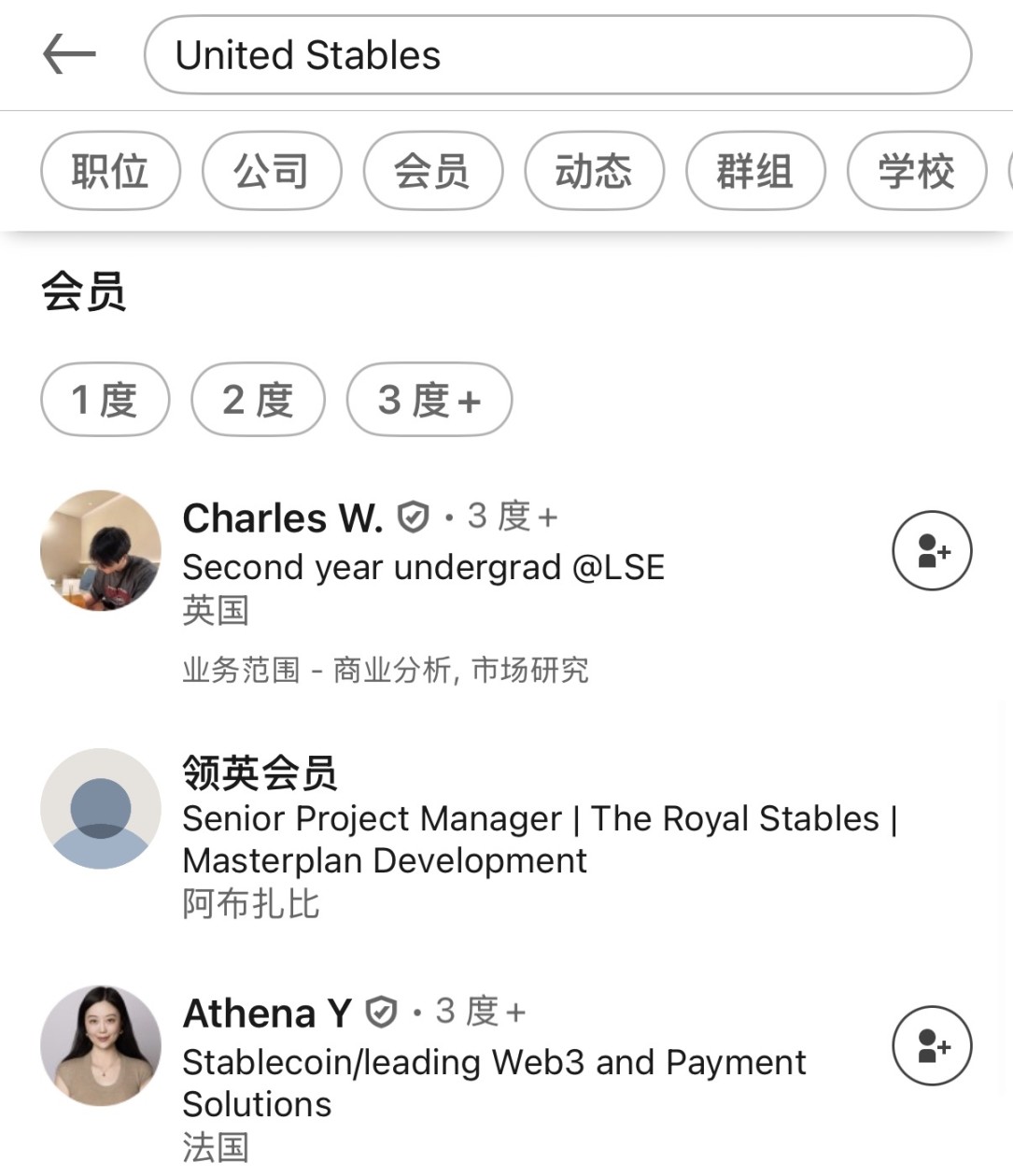
Public information shows that its core members include Athena Y and Charles W., among others. Athena Y is currently the CEO of United Stables, previously the co-founder of the payment platform Wello, and has served as the head of Binance's NFT business and as the CEO of the institutional digital asset custody platform Ceffu. Charles W. is currently studying at the London School of Economics (LSE) and participates in the project's community communication and external collaboration as an intern at United Stables. His past experiences include internships at institutions such as Goldman Sachs and Citadel.

Further background checks on the project reveal that, apart from the public information about the CEO, United Stables has not systematically disclosed a complete management team structure, including key positions such as compliance, risk control, finance, or reserve management.

In terms of product positioning, U does not describe itself as a direct replacement for mainstream stablecoins like USDT or USDC but rather attempts to serve as a "unified liquidity layer." Its core idea is to use fiat or mainstream stablecoins for minting, providing a unified settlement and circulation vehicle for different stablecoins when used on-chain, thereby reducing the operational friction costs across protocols and scenarios. The official documentation also mentions that U's target use cases include exchanges, DeFi, payment networks, and AI automation agents, among others.

According to on-chain data, as of the time of writing on January 13, the total supply of U is approximately 410 million tokens, with nearly 14,000 holder addresses and over 1.8 million cumulative transfers.

In terms of ecosystem progress, U has been rapidly integrated into multiple applications and protocols centered around BNB Chain after its launch. On December 18, 2025, HTX listed U and opened deposit and withdrawal services, while Aster simultaneously opened the U/USDT trading pair. Binance Wallet also supported trading on BNB Chain and Ethereum networks on the same day.

On the same day, Four.Meme announced that U would be one of the stablecoins used for fundraising and trading on its platform. However, current on-chain data shows that the overall scale of Meme tokens using U as their liquidity remains limited, with UDOG leading with a market capitalization of approximately $900,000, though it was not launched on the Four.Meme platform.

In DeFi, Lista DAO has launched U vaults and multiple lending markets. As of the time of writing on January 13, the deposit scale of the U Vault is approximately 3.51 million tokens, with an annualized yield of about 3.3%. In the payment sector, AEON announced a collaboration with United Stables. Its AEON Pay already supports offline扫码 payments using U and has adopted U as a settlement asset for x402 AI-native payment and automated trading scenarios on BNB Chain.


Twitter:https://twitter.com/BitpushNewsCN

Bitpush TG Discussion:https://t.me/BitPushCommunity

Bitpush TG Subscription: https://t.me/bitpush

Original link:https://www.bitpush.news/articles/7602245

Perguntas relacionadas

QWhat is the name of the new stablecoin that Binance has listed, and what trading pairs were launched?

AThe new stablecoin is called United Stables (U). Binance launched the U/USDT and U/USDC spot trading pairs.

QWhich company issues the U stablecoin, and in which jurisdiction is it registered?

AThe U stablecoin is issued by United Stables Limited, which is registered in the British Virgin Islands (BVI).

QAccording to the article, what major regulatory frameworks has U NOT obtained registration or licensing under?

AU has not obtained registration or licensing under the EU's MiCA, Hong Kong's Stablecoin Ordinance, the U.S. GENIUS Act, or any U.S. or EU securities or stablecoin regulatory frameworks.

QWho is the CEO of United Stables, and what is her previous professional background?

AThe CEO of United Stables is Athena Y. She was previously a co-founder of the payment platform Wello, served as the head of Binance's NFT business, and was the CEO of the institutional digital asset custody platform Ceffu.

QWhat is the stated goal or core idea behind the U stablecoin's product positioning?

AThe core idea is to act as a 'unified liquidity layer' by accepting fiat or major stablecoins for minting, providing a unified settlement and circulation载体 for different stablecoins to reduce friction costs in cross-protocol and cross-scenario operations.

Leituras Relacionadas

It Took Me a Year to See the Bitter Truth About Agent Payments

After a year building infrastructure for the Agent economy, engaging with major players like Stripe, Visa, and Coinbase, the author shares a sobering analysis of the current state of Agent payments. The core finding is a stark lack of genuine, immediate demand across most envisioned use cases. The article breaks down four key market segments: 1. **Agent-to-Merchant (Consumer Shopping):** For most product categories (e.g., clothing, electronics), conversational AI shopping is a step backwards from visual e-commerce interfaces. While agents excel at understanding needs, they can't replace side-by-side product comparison. Real merchant interest is defensive "Agent Engine Optimization," not driven by current customer demand. Potential exists for high-frequency, low-decision purchases (like food delivery) or navigating complex store UIs, but these require massive B2C distribution channels dominated by giants like Amazon. 2. **Agent-to-API (Developer Services):** Developers already have subscriptions and billing relationships for APIs (compute, data). Prepaid balances solve micro-payment issues for low transaction volumes. A deeper structural problem is that major SaaS vendors' business models rely on enterprise contracts, resisting granular pay-per-call pricing. While protocols like MPP and x402 serve the long tail of niche services, this market is small and developers are historically low-willingness-to-pay. 3. **Agent-to-Agent:** This remains largely theoretical with minimal transaction volume. While it represents a long-term bet on a fundamentally new transaction infrastructure (sub-second, micro-penny to million-dollar, multi-party settlements), it does not constitute a present market. 4. **Agent-to-Finance:** This is the only category with existing, paying demand. Integrating AI into financial workflows (trading, portfolio management) is a natural evolution and enables new capabilities like autonomous rebalancing. However, competition favors established, regulated institutions. The "real problem" is not moving money between agents, but the broader challenge of **coordination**—orchestrating work between agents and humans, verifying outcomes, and settling results. Payment is just one component of settlement, which is itself part of coordination. Companies that solve the coordination layer will subsume payment, not the other way around. While well-funded incumbents build defensively for a long-term future, startups must find where the market is today—which, for the author's team, lies outside these four categories in an area of real, growing, and underserved activity.

marsbitHá 22m

It Took Me a Year to See the Bitter Truth About Agent Payments

marsbitHá 22m

It Took Me a Year to See the Hard Truth About Agent Payments

**Title: It Took Me a Year to See the Hard Truth About Agent Payments** Over the past year, I've worked on infrastructure for the Agent economy, engaging with major players like Stripe, Visa, Coinbase, and numerous startups. The findings reveal a stark reality: genuine, widespread demand for Agent-based payments does not yet exist. **Key Observations:** * **Agent-to-Merchant (Shopping):** The user experience for AI shopping often falls short, especially for visual product discovery. While AI excels at understanding needs, conversational interfaces can't yet replace browsing and comparing multiple products visually. Current merchant interest is largely defensive ("Agent Engine Optimization") for a future that hasn't arrived. High-frequency, low-friction purchases (like food delivery) are potential fits, but lack open APIs and face high AI inference costs. Simpler, more affordable, or cross-language interactions for complex UIs are a niche opportunity but require massive consumer distribution to scale. * **Agent-to-API (Developer Tools):** Developer payment needs for APIs (computing, data, models) are already met through subscriptions and prepaid credits. The core challenge is not payment friction but supplier economics: most large SaaS providers prefer enterprise contracts over micropayments for API calls. Protocols like MPP and x402 suit the long-tail of smaller services but cater to a developer market historically reluctant to pay for these tools. Major infrastructure needs at the top of the stack are already being addressed. * **Agent-to-Agent (Machine Commerce):** This is a long-term vision with almost no current transaction volume. While a future with high-speed, high-frequency, multi-party machine-to-machine transactions would require novel infrastructure, it remains theoretical. The market is not here yet. * **Agent-to-Finance:** This is the only category with clear, present demand. Financial professionals and DeFi users already pay for tools, and AI augmentation is a natural evolution. Autonomous AI agents can enable entirely new financial strategies. However, competition is fierce from established, regulated incumbents who can more easily layer AI onto their existing products. **The Core Insight:** Companies, especially giants with long time horizons, are building defensively for a potential future of mass machine commerce. For them, early investment is a low-cost hedge. For startups, the current market reality is different. The primary challenge isn't just moving money between agents (payments). The larger, unsolved problem is **orchestration** – coordinating work between agents and humans, verifying outcomes, and then settling. Payment is just a part of settlement, which is just a part of orchestration. Companies that solve the orchestration problem will subsume payments, not the other way around. After a year of building, we see the real, growing, and underserved market opportunity lies in this broader domain of orchestration.

链捕手Há 45m

It Took Me a Year to See the Hard Truth About Agent Payments

链捕手Há 45m

Claude Opus 4.8 Finds a $4.5 Billion Bug: The AI Era is Mass-Producing Hackers

A researcher discovered a critical "infinite mint" vulnerability in the Zcash cryptocurrency's Orchard protocol using Claude Opus 4.8, leading to a swift fix but also a 50% market drop, erasing billions in value. This incident highlights a new era where powerful, accessible AI models are dramatically lowering the barrier to finding software vulnerabilities. Previously, the security community feared specialized models like Claude Mythos Preview, capable of finding decades-old zero-day exploits. The Zcash case, however, involved a publicly available, general-purpose model. This shift makes advanced security auditing—and attack capabilities—accessible to far more people, not just experts. The mass democratization of vulnerability discovery brings a dual challenge: a flood of low-quality, AI-generated false reports that overwhelm maintainers, and the real, rapid uncovering of deep, dangerous bugs. Open-source projects, often understaffed and unfunded, are particularly vulnerable to this "attention DDoS." The article cites examples like curl shutting down its bug bounty program due to the unsustainable workload. Our perceived digital safety has often been luck, relying on the high cost and effort required to find deeply hidden flaws in complex systems, as seen with historical vulnerabilities like Heartbleed or Baron Samedit. AI changes this cost structure, effectively "mass-producing flashlights" to illuminate every corner of our codebase. While large companies operate extensive security chains involving external white-hat hackers and massive defensive operations, the global cybersecurity workforce faces a severe shortage, especially of experienced personnel capable of analyzing complex threats and coordinating fixes. The core dilemma emerges: AI makes *finding* bugs cheap and scalable, but *fixing* them remains a slow, expensive, and human-intensive process. The article concludes that AI won't destroy the internet but acts as a bright light, revealing that our digital existence is not inherently secure but is precariously maintained by ongoing human effort. The true cost in the AI era may not be discovery, but whether there will be enough people left willing and able to do the hard work of repair.

marsbitHá 1h

Claude Opus 4.8 Finds a $4.5 Billion Bug: The AI Era is Mass-Producing Hackers

marsbitHá 1h

Codex Goal Mode Usage Guide: How to Make AI Continuously Pursue a Specific Objective

"Codex Goal Mode: How to Make AI Work Continuously Toward a Specific Goal" OpenAI's Codex "goal mode" (/goal) transforms the AI from a reactive code assistant into a proactive execution agent capable of working autonomously for hours or even days to achieve a defined objective. To maximize its effectiveness, follow these key principles: 1. **Define Clear, Verifiable Exit Criteria:** The goal prompt should be a concise, measurable success condition, not a lengthy specification. Use quantifiable metrics like "reduce build time by 30%" or "achieve 100% test parity." 2. **Provide Initial Guidance and Tools:** Direct Codex toward likely problem areas and specify available tools (e.g., browsers, testing environments) to prevent it from exploring unproductive paths. 3. **Enable Progress Measurement:** Equip Codex with ways to track advancement, such as creating comparison tools for visual tasks or evaluation sets, ensuring it can gauge its own progress. 4. **Use a Realistic Execution Environment:** For tasks like performance optimization, provide access to environments that closely mimic production (e.g., similar configs, databases) to yield valid results. 5. **Be Cautious with Visual Goals:** Avoid vague "pixel-perfect" instructions. Instead, supplement visual references with functional checklists or design system specifications to prevent Codex from obsessing over minor details. 6. **Implement Progress Tracking:** For long-running tasks, have Codex commit code to draft PRs, update progress documents, or send Slack updates to maintain visibility into its work. 7. **Review and Consolidate Results:** Once the goal is met, instruct Codex to review its work, clean up ineffective experimental code, and reflect on what strategies succeeded or failed. Ultimately, using goal mode shifts the developer's role from writing prompts to managing a persistent engineering agent—defining objectives, establishing metrics, configuring environments, and conducting final reviews.

marsbitHá 2h

Codex Goal Mode Usage Guide: How to Make AI Continuously Pursue a Specific Objective

marsbitHá 2h

Trading

Spot
Futuros

Artigos em Destaque

O que é BNB WHALES

Compreender as Baleias BNB: Um Mergulho Profundo na Paisagem das Criptomoedas Introdução às Baleias BNB No vibrante mundo das criptomoedas, novos projetos emergem regularmente, muitas vezes prometendo soluções inovadoras e experiências únicas. Um desses projetos é o BNB Whales, lançado em 2023 e construído na BNB Smart Chain (BEP20). O BNB Whales propõe estabelecer uma presença distinta dentro do ecossistema das criptomoedas, focando na criação de uma plataforma envolvente que combina os benefícios da tecnologia blockchain com interações sociais e de jogos. Este artigo tem como objetivo aprofundar-se no BNB Whales, explorando seus componentes principais, mecânicas e trajetória de desenvolvimento. O que são as Baleias BNB? As Baleias BNB são uma iniciativa em criptomoeda que busca proporcionar uma variedade diversificada de características e oportunidades para os seus utilizadores no emergente ambiente Web3. Utilizando o padrão BEP20, o projeto opera com um suprimento total de tokens de 100 trilhões (100.000.000.000.000.000). Apesar deste número significativo, é notável que não existem tokens atualmente em circulação, indicando que o projeto pode ainda estar nas suas fases iniciais de desenvolvimento. O objetivo principal do BNB Whales é criar uma plataforma onde os utilizadores possam participar em várias atividades interativas, beneficiando-se da segurança e transparência proporcionadas pela tecnologia blockchain. Ao fomentar um ambiente único e envolvente, o BNB Whales visa construir uma forte comunidade de utilizadores que estão investidos no projeto e no seu desenvolvimento. Quem é o Criador do BNB Whales? A identidade do criador do BNB Whales permanece não divulgada neste momento, apresentando um desafio para aqueles que procuram entender os princípios fundacionais e as perspetivas visionárias do projeto. Esta ausência de informação disponível publicamente acerca da liderança do projeto pode levantar questões entre potenciais investidores e utilizadores sobre a sua estrutura de governança e responsabilidade. Quem são os Investidores do BNB Whales? À medida que o BNB Whales continua a evoluir, a informação sobre investidores específicos ou apoio de fundações de investimento está atualmente indisponível. A documentação oficial do projeto, incluindo o seu whitepaper, não divulga apoiantes financeiros individuais ou institucionais. A falta de transparência neste aspeto pode, por vezes, levantar questões sobre a legitimidade e sustentabilidade de novos projetos dentro do ecossistema das criptomoedas. Como Funciona o BNB Whales? O BNB Whales opera na BNB Smart Chain utilizando o padrão BEP20, que é conhecido pela sua eficiência e baixas taxas de transação, atraindo uma variedade de desenvolvedores e projetos. O aspeto único do BNB Whales reside no seu foco na criação de uma plataforma orientada pela comunidade. Embora detalhes operacionais precisos sejam escassos, o projeto enfatiza a interação e o envolvimento, potencialmente incorporando elementos gamificados nas suas ofertas. A ênfase na comunidade é fundamental, uma vez que se alinha com as tendências predominantes no espaço das criptomoedas, onde a contribuição e participação do utilizador frequentemente ditam o sucesso de um projeto. Mais inovações podem ser antecipadas, mas, neste momento, os mecanismos e características específicos que diferenciam o BNB Whales de outras iniciativas de criptomoedas permanecem por elucidar totalmente. Sem informações detalhadas sobre a sua funcionalidade, é desafiador avaliar abrangentemente os diferenciais do projeto. Cronologia do BNB Whales O desenvolvimento do BNB Whales desenrolou-se ao longo de marcos importantes, marcando a sua jornada na paisagem das criptomoedas. Abaixo está uma cronologia de eventos significativos relacionados com o projeto: 2023: Lançamento do BNB Whales, marcando a entrada do projeto no mercado. 2023: Publicação do whitepaper do projeto, que estabelece os objetivos gerais e a estrutura operacional. Em andamento: O BNB Whales continua a desenvolver as suas características, visando construir uma base de utilizadores robusta e expandir as suas ofertas. Pontos Chave Sobre o BNB Whales Plataforma: BNB Smart Chain (BEP20) Suprimento Total: 100 trilhões de tokens (100.000.000.000.000.000) Suprimento Circulante: 0 tokens (indicando uma fase incipiente) Objetivo do Projeto: Fomentar uma plataforma de criptomoedas envolvente para interação e construção de comunidade. Criador: Desconhecido Investidores: Não divulgados Status Operacional: Ativo com desenvolvimento e expansão em curso Conclusão À medida que o BNB Whales navega pela competitiva paisagem das criptomoedas, oferece uma visão do potencial de projetos orientados pela comunidade construídos sobre as bases da tecnologia blockchain. Ao focar no envolvimento e interação, a iniciativa encontra-se na vanguarda da inovação no espaço Web3. No entanto, o sucesso do projeto depende, em última instância, da clareza das suas mecânicas operacionais, da divulgação da sua governança e do estabelecimento de uma sólida comunidade de utilizadores. Para potenciais utilizadores e investidores, o BNB Whales representa um estudo de caso na natureza em evolução dos projetos de criptomoedas — um que ilustra tanto as possibilidades emocionantes como as complexidades associadas a novas iniciativas. À medida que a paisagem continua a evoluir, será essencial monitorar o progresso do BNB Whales e o seu impacto no ecossistema mais amplo das criptomoedas.

383 Visualizações TotaisPublicado em {updateTime}Atualizado em 2024.12.03

O que é BNB WHALES

Como comprar BNB

Bem-vindo à HTX.com!Tornámos a compra de Binance Coin (BNB) simples e conveniente.Segue o nosso guia passo a passo para iniciar a tua jornada no mundo das criptos.Passo 1: cria a tua conta HTXUtiliza o teu e-mail ou número de telefone para te inscreveres numa conta gratuita na HTX.Desfruta de um processo de inscrição sem complicações e desbloqueia todas as funcionalidades.Obter a minha contaPasso 2: vai para Comprar Cripto e escolhe o teu método de pagamentoCartão de crédito/débito: usa o teu visa ou mastercard para comprar Binance Coin (BNB) instantaneamente.Saldo: usa os fundos da tua conta HTX para transacionar sem problemas.Terceiros: adicionamos métodos de pagamento populares, como Google Pay e Apple Pay, para aumentar a conveniência.P2P: transaciona diretamente com outros utilizadores na HTX.Mercado de balcão (OTC): oferecemos serviços personalizados e taxas de câmbio competitivas para os traders.Passo 3: armazena teu Binance Coin (BNB)Depois de comprar o teu Binance Coin (BNB), armazena-o na tua conta HTX.Alternativamente, podes enviá-lo para outro lugar através de transferência blockchain ou usá-lo para transacionar outras criptomoedas.Passo 4: transaciona Binance Coin (BNB)Transaciona facilmente Binance Coin (BNB) no mercado à vista da HTX.Acede simplesmente à tua conta, seleciona o teu par de trading, executa as tuas transações e monitoriza em tempo real.Oferecemos uma experiência de fácil utilização tanto para principiantes como para traders experientes.

904 Visualizações TotaisPublicado em {updateTime}Atualizado em 2026.06.02

Como comprar BNB

O que é BNB CARD

Compreender o BNB Card: Revolucionando a Identidade Digital no Web3 No panorama em rápida evolução da tecnologia blockchain e das criptomoedas, o BNB Card ou $BNBCARD destaca-se como um projeto notável. Este token meme utilitário, impulsionado pela comunidade, aproveita a BNB Smart Chain (BSC), visando integrar a cultura meme com soluções inovadoras de identidade digital. À medida que mais utilizadores mergulham nos domínios da descentralização, é crucial dissecar o que o BNB Card oferece, as suas nuances operacionais e o seu potencial impacto no mercado. O que é o BNB Card ($BNBCARD)? No seu cerne, o BNB Card representa um token meme com utilidade substancial. É projetado para capacitar os utilizadores, permitindo a criação de cartões de identidade digital personalizados que são tanto expressivos quanto funcionais. O projeto encapsula várias características-chave: Cartões de Identidade Personalizáveis: Os utilizadores têm a capacidade de desenhar cartões de identidade digital com o tema da Binance, proporcionando-lhes uma plataforma para autoexpressão e interação comunitária aprimorada. Estrutura Descentralizada: Desenvolvido na BSC, o BNB Card enfatiza atributos chave como segurança, transparência e soberania do utilizador. A natureza descentralizada da estrutura permite transações que são tanto eficientes quanto seguras. Modelo Centrado na Comunidade: A ênfase na participação de base em vez de modelos financeiros impulsionados por laboratórios cria um ambiente envolvente para os seus utilizadores. Ao aproveitar a viralidade inerente da cultura meme, o BNB Card promove um movimento comunitário robusto. O objetivo principal do BNB Card é democratizar as ferramentas de identidade digital no Web3, oferecendo soluções acessíveis que beneficiam os utilizadores sem os encargos normalmente associados aos sistemas tradicionais de gestão de identidade. Criador e Investidores Ao explorar a identidade por trás do BNB Card, é importante notar que nenhum criador singular é explicitamente creditado. Em vez disso, o projeto parece ser impulsionado pela comunidade, sugerindo um esforço coletivo inspirado pela noção do “Cartão de Construtor Precoce” da Binance. Esta abordagem de desenvolvimento orgânico é comum entre projetos dentro do espectro dos tokens meme, onde o desenvolvimento é frequentemente influenciado pela paixão da comunidade em vez de uma autoridade central. Em termos de investimento, a ausência de apoiantes institucionais divulgados publicamente destaca ainda mais a fundação de base do projeto. Ele prospera com apoio comunitário orgânico, refletindo uma característica usual de projetos impulsionados por memes que frequentemente envolvem o seu público através de canais sociais em vez de rotas de investimento formais. Como Funciona O BNB Card emprega vários mecanismos que delineiam o seu funcionamento e espírito inovador: Utilidade do Token: O token BNBCARD permite aos utilizadores aceder a um conjunto de ferramentas de criação de ID, ao mesmo tempo que fornece uma plataforma para a governança comunitária. O token serve como o elemento central que possibilita essas funcionalidades. Integração Blockchain: Ao utilizar a BSC, o BNB Card garante compatibilidade com aplicações baseadas na Ethereum Virtual Machine (EVM). Esta integração oferece aos utilizadores os benefícios de baixas taxas de transação, ao mesmo tempo que melhora a acessibilidade. Ecossistema DIY: Central para o apelo do BNB Card é a sua abordagem faça você mesmo (DIY) para a geração de cartões de identidade digital. Este elemento participativo incentiva os utilizadores a envolverem-se na expressão criativa, promovendo uma cultura inclusiva que prospera na contribuição e colaboração. Cronologia A cronologia é vital para compreender a trajetória do BNB Card. Marcos importantes na história do projeto incluem: 18 de Março de 2025: O BNB Card foi listado na LBank, marcando um passo significativo na sua jornada de troca e abrindo portas para liquidez e acessibilidade para os utilizadores. 19 de Março de 2025: Um momento crucial ocorreu quando o token experimentou um aumento astronómico de 26.000% em 24 horas, atraindo atenção pelo seu potencial e pelo entusiasmo da comunidade. Desenvolvimentos em Curso: O projeto está continuamente a expandir as suas parcerias com exchanges descentralizadas (DEXs) como a PancakeSwap, melhorando ainda mais a liquidez e o envolvimento dos utilizadores. Inovação e Diferenciação Compreender o que distingue o BNB Card envolve uma exploração mais profunda da sua estrutura inovadora: Híbrido Meme-Utilitário: O BNB Card combina com sucesso o apelo lúdico da cultura meme com aplicações práticas na gestão de identidade digital. Esta abordagem de nicho atende efetivamente a uma ampla demografia, apelando tanto a utilizadores experientes em tecnologia quanto àqueles novos no mundo das criptomoedas. Governança Descentralizada: Operar sem controle centralizado permite ao projeto aproveitar diretamente a contribuição da comunidade. O processo de tomada de decisão coletiva, sustentado pela participação da comunidade, capacita os utilizadores, garantindo que as suas vozes contribuam para o desenvolvimento e direção do projeto. Escalabilidade: O BNB Card pode beneficiar imensamente das atualizações do roteiro de 2025 para a BNB Chain, que incluem melhorias como aumento da velocidade das transações e a integração de ferramentas de inteligência artificial. Estas melhorias posicionam o projeto de forma vantajosa dentro de um ambiente altamente competitivo. Conclusão O BNB Card é emblemático de uma nova onda de soluções de identidade digital dentro do ecossistema Web3. Ao misturar diversão, envolvimento comunitário e utilidade prática, convida os utilizadores a participar ativamente na formação das suas personas digitais. À medida que o projeto navega pelo dinâmico panorama das criptomoedas, o seu sucesso dependerá provavelmente de manter um forte apoio comunitário enquanto se adapta aos avanços tecnológicos e às necessidades dos utilizadores. A integração da descentralização com a cultura meme serve não apenas como um meio para o envolvimento impulsionado pelos utilizadores, mas também como uma base para a narrativa em evolução em torno da identidade digital na era da blockchain. Em suma, o BNB Card não só exemplifica a convergência de criatividade e utilidade dentro do espaço cripto, mas também sublinha a importância da comunidade na orientação do futuro das tecnologias descentralizadas.

342 Visualizações TotaisPublicado em {updateTime}Atualizado em 2025.03.26

O que é BNB CARD

Discussões

Bem-vindo à Comunidade HTX. Aqui, pode manter-se informado sobre os mais recentes desenvolvimentos da plataforma e obter acesso a análises profissionais de mercado. As opiniões dos utilizadores sobre o preço de BNB (BNB) são apresentadas abaixo.

活动图片














