SUI Faces Daily $15 Million Token Unlock, While BEAT Leads $81 Million Token Release Wave This Week

cryptonews.ruPublicado em 2026-07-29Última atualização em 2026-07-29

Resumo

The article discusses significant token unlocks planned for this week in the crypto market. According to Cryptorank, seven assets, including $SUI and $BEAT, are set for major releases. Analyst account Top7 estimates a $74.9 million one-time unlock for $BEAT on August 1, constituting about 2.12% of its circulating supply. $EIGEN and $KITE will also unlock on the same day for $7.65M and $6.08M respectively, with $BTW and $ZAMA following on August 2 for a combined $13.24M. In contrast to these large, concentrated unlocks, the $SUI token follows a different, continuous daily vesting mechanism, distributing approximately $15.4 million worth of tokens weekly into circulation among community reserves, early contributors, and the Mysten Labs treasury. This gradual release is seen as less likely to cause immediate selling pressure compared to one-time events. As of July 29, $SUI trades at $0.69 with a market cap of around $2.78 billion. The piece explains that large unlocks are important for traders as they increase the pool of tokens available for sale, potentially creating downward price pressure if supply outpaces demand. This effect is considered strongest for "cliff" unlocks like $BEAT's. Despite being a regular feature on unlock trackers due to its volume and vesting schedule, $SUI's ecosystem has shown independent growth, including a reported influx of $65 billion in stablecoin volume following a recent fee reduction. A key test will be whether $SUI's price holds steady from ...

Token unlocking occurs when previously restricted circulation cryptocurrencies, typically reserved for the project team, early investors, or an ecosystem fund, become available for trading on the open market. In a Cryptorank review, $SUI was named one of seven assets with significant unlocks scheduled for this week, alongside $BEAT, $BTW, ENA from Ethena, $EIGEN from EigenLayer, $ZAMA from Zama, and $KITE from Kite AI.
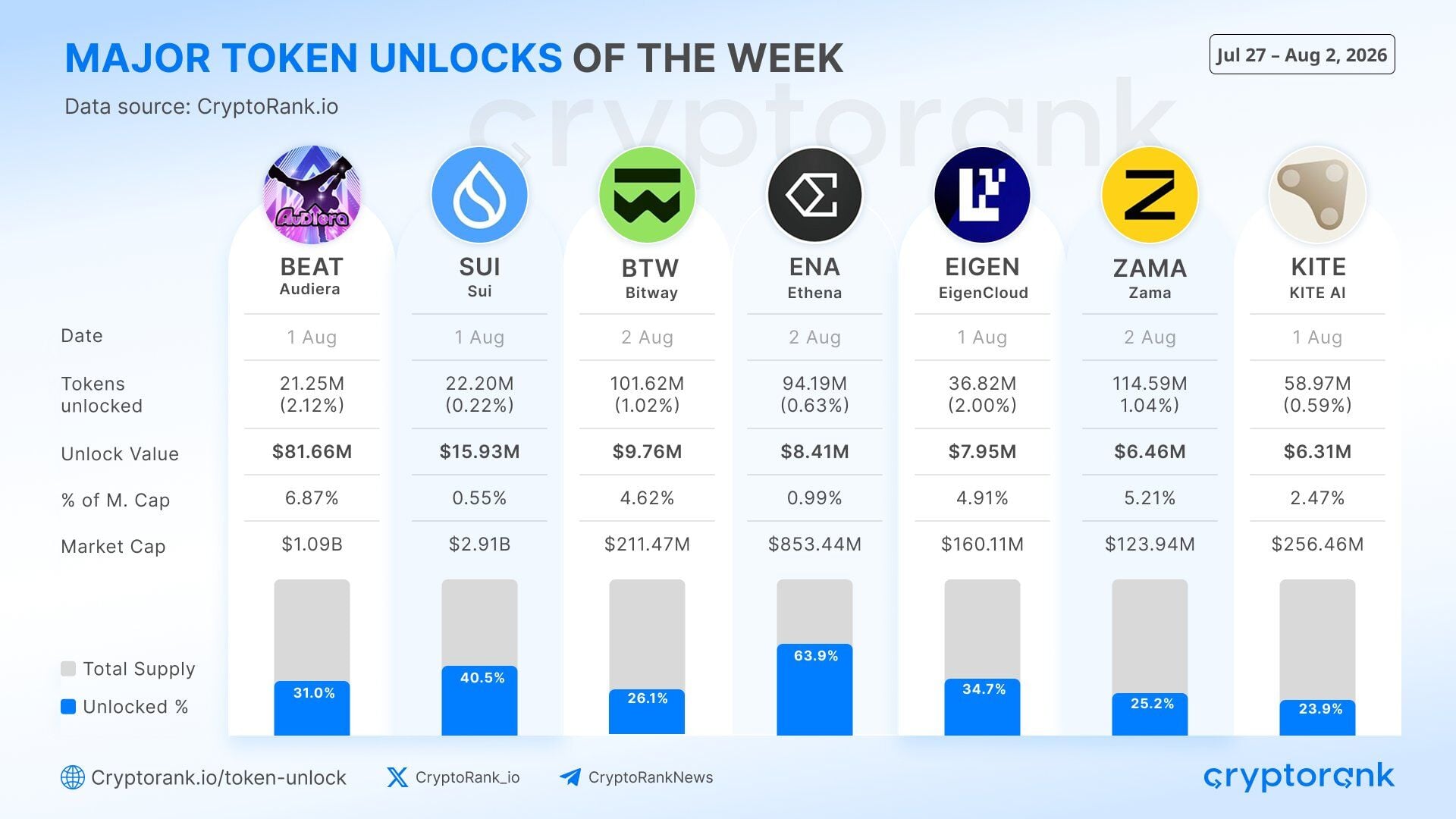
A separate tracker maintained by the crypto analytics account Top7 estimates the $BEAT release volume at $74.9 million, scheduled for a one-time unlock on August 1, representing approximately 2.12% of the total circulating token supply. The $EIGEN and $KITE token unlocks follow on the same day, valued at $7.65 million and $6.08 million respectively, while $BTW and $ZAMA follow on August 2 with a combined value of $13.24 million.

The $SUI Unlock Mechanism Works Differently

Unlike the one-time event for $BEAT, $SUI does not release tokens in a single batch. More precisely, the Sui network, developed by Mysten Labs, distributes the new supply on a constant daily basis to categories such as the Community Reserve, early contributors, and the Mysten Labs treasury.

This structure introduces approximately $15.4 million worth of $SUI into circulation over the week, rather than concentrating the impact on a single trading day.

The maximum supply of $SUI is capped at 10 billion tokens, with about 4.05 billion, or roughly 40%, already in circulation. As of July 29, the token is trading at $0.69, giving it a market capitalization of approximately $2.78 billion.

On August 1 alone, approximately 13.72 million $SUI will be unlocked, distributed among three stakeholder groups: 4 million will go to the Community Reserve, 7.65 million to early contributors, and 2.07 million to the Mysten Labs treasury.

Why Unlocks Affect Markets

Large unlocks are significant for traders as they increase the pool of tokens that can be sold simultaneously. When new supply hits exchanges faster than demand absorbs it, prices can experience downward pressure, especially for tokens where the unlocking holders include venture investors or early team members looking to realize profits.

Analysts tracking vesting schedules argue this effect is strongest with "cliff" unlocks, such as with $BEAT, where a significant portion of supply is released at once, as opposed to gradual daily releases like those for $SUI.

This aspect alone has made $SUI a regular feature on unlock watchlists, not necessarily signaling acute selling pressure. The token has appeared in weekly unlock listings throughout 2026, given its volume and continuous vesting mechanism, even as the Sui ecosystem has shown growth in other areas independent of this.

Earlier this year, Mysten Labs reduced transaction fees on the Sui network, and as reported by Bitcoin.com News, this move helped attract $65 billion worth of stablecoin volume to the network, indicating that trader attention to this asset extends far beyond its unlock schedule.

The next signal to watch is whether the price of $SUI holds steady between August 1 and 2, even as five other tokens simultaneously absorb concentrated releases—this test could determine how traders price in future weeks of unlocks on the Sui network.

end-content
Perguntas relacionadas

QWhat is token unlocking in the context of crypto markets, and why is it significant?

AToken unlocking refers to the release of previously restricted or locked cryptocurrencies—typically reserved for project teams, early investors, or ecosystem funds—into the open market for trading. It is significant because it increases the supply of tokens available for sale. If new supply enters exchanges faster than demand can absorb it, prices can face downward pressure, especially when large, concentrated unlocks occur.

QAccording to the article, how is SUI's token unlock mechanism different from that of BEAT?

ASUI's token unlock mechanism differs from BEAT's in its distribution schedule. SUI does not release tokens in a single, lump-sum event. Instead, the Sui network, developed by Mysten Labs, distributes new supply on a continuous, daily basis to categories like community reserves, early contributors, and the Mysten Labs treasury. This spreads approximately $15.4 million worth of SUI into circulation over a week. In contrast, BEAT is scheduled for a one-time, lump-sum unlock of roughly $74.9 million on August 1.

QWhich token is expected to have the largest value unlock on August 1 according to the tracker mentioned in the article?

AAccording to the tracker from crypto analytics account Top7 mentioned in the article, the token expected to have the largest value unlock on August 1 is $BEAT, with an estimated value of $74.9 million.

QWhat are the three stakeholder groups that will receive unlocked SUI tokens on August 1, and what are the respective amounts?

AOn August 1, three stakeholder groups will receive unlocked SUI tokens: 4 million SUI will go to the community reserve, 7.65 million SUI to early contributors, and 2.07 million SUI to the Mysten Labs treasury.

QWhy do analysts suggest that 'cliff' unlocks (like BEAT's) have a stronger market impact than gradual daily unlocks (like SUI's)?

AAnalysts suggest that 'cliff' unlocks have a stronger immediate market impact than gradual daily unlocks because they release a significant portion of the token supply all at once. This sudden influx of new, sellable tokens can quickly outpace market demand, creating more pronounced downward pressure on prices. Gradual daily releases, like SUI's, distribute the selling pressure over time, which can be more easily absorbed by the market.

Leituras Relacionadas

After R&D Investment Catches Up with the U.S., Is the Sino-U.S. Chip Competition Still Just About Money?

The article examines the significance of recent data showing China's total R&D expenditure, measured by purchasing power parity (PPP), catching up to or slightly surpassing that of the United States in 2024. It argues that while this milestone reflects China's immense capacity to mobilize research resources, the competition in semiconductors now extends far beyond sheer financial input. The analysis highlights key differences: China's R&D is heavily skewed towards experimental development (over 80%), focusing on product engineering and industrialization, whereas the U.S. allocates a proportionally larger share (about 15%) to basic research. Furthermore, leading U.S. semiconductor firms reinvest a significant portion of their substantial global sales revenue into R&D, creating a sustainable commercial innovation cycle that is difficult to replicate. The article emphasizes that semiconductor progress depends on converting R&D into commercially viable products that pass rigorous customer validation and achieve repeat orders, not just on spending levels. It concludes that as China enters the top tier of R&D spenders, the critical challenges shift to improving resource allocation efficiency, fostering long-term basic research, and building effective mechanisms to bridge the gap between laboratory discoveries and reliable, market-ready industrial capabilities.

marsbitHá 41m

After R&D Investment Catches Up with the U.S., Is the Sino-U.S. Chip Competition Still Just About Money?

marsbitHá 41m

Top 10% of American Households Capture 88% of Wealth, How Is the AI Era Cake Divided?

AI Worsens Wealth Inequality as Top 10% of US Families Garner 88% of Stock Gains (2019-2026) A report from the China Finance 40 Forum highlights that the AI boom is significantly widening wealth inequality in the United States. From 2019 to Q1 2026, wealth from directly held stocks by US households nearly doubled from $29 trillion to approximately $55 trillion, with rapid growth concentrated post-2023, coinciding with the AI-driven stock market surge. The distribution of these gains has been starkly uneven. Between 2022 and Q1 2026, the wealth increase of about $21 trillion was captured almost entirely by the wealthiest families: the top 10% secured roughly 88% ($18.5 trillion), while the bottom 50% received only about 1% ($0.2 trillion). This has contributed to a growing disparity in disposable income shares. The report, referencing economic historian Robert Allen, draws parallels to historical technological shifts like the "Engels' Pause" during the First Industrial Revolution, where worker wages stagnated despite productivity gains. It suggests AI could induce a similar period where capital收益 outpace labor income, exacerbating inequality. Huang Yiping of Peking University identifies four mechanisms through which AI impacts income distribution: capital-bias (reducing labor's income share), task polarization (hollowing out middle-skill jobs), skill-based digital divides, and wealth amplification through assets. He warns that if this trend continues, strong supply growth driven by AI could be undermined by persistently weak consumer demand, threatening sustainable economic growth. To address these challenges, the report proposes a three-pronged strategy: 1) Defensive measures like strengthening social safety nets and antitrust enforcement; 2) Empowering workers through education reform and lifelong learning to collaborate with AI; and 3) Rebalancing via policies such as potential taxes on AI超额收益 and mechanisms for broader sharing of technology's benefits, ensuring AI's红利 are more equitably distributed.

marsbitHá 46m

Top 10% of American Households Capture 88% of Wealth, How Is the AI Era Cake Divided?

marsbitHá 46m

Trading

Spot
活动图片