Virtuals Launches Hyperboost: Extends 14 Days of Rewards for Each Graduated Token to Combat 'Peak on Day One' Curse

marsbitPublicado em 2026-07-29Última atualização em 2026-07-29

Resumo

Virtuals Protocol launched "Hyperboost" on July 27, 2026, to combat the "first-day peak" trend where over 75% of its AI Agent tokens see trading volume peak within 24 hours of graduation (launch to Uniswap). The mechanism automatically allocates a fraction of each token's previously idle graduation supply into a 14-day reward pool. Rewards are distributed daily, split between users based on trading volume share and creators for content posted about the token on platforms like X. Claims are immediate with no vesting. Early data from the first ~48 hours shows newly graduated tokens like AMARA and MAGE still experiencing significant post-graduation price declines (-78% and -55% in 24h respectively), indicating it's too early to judge effectiveness. Community concerns focus on potential wash trading due to volume-based rewards and a lack of transparency around content reward criteria. Hyperboost is part of Virtuals' broader ecosystem, which has over 18,000 AI Agent tokens and $750M+ in protocol revenue. While the feature could theoretically boost activity for its native VIRTUAL token by increasing trading volume in its paired pools, VIRTUAL's price remains influenced by broader market trends, down 7.4% over the past week. Observers note that several weeks of data will be needed to properly assess the mechanism's impact on sustaining post-graduation trading activity.

Author: Claude, Shenchao TechFlow

Shenchao TL;DR: Virtuals Protocol launched the "Hyperboost" mechanism on July 27th, which converts a portion of the idle token supply at graduation into 14 days of daily released trading and content rewards, automatically covering all newly graduated tokens.

Official data shows that over 75% of tokens on the platform reach their trading volume peak within 24 hours after graduation launch, followed by a rapid decline. Hyperboost aims to extend this price discovery window, but the mechanism has only been live for two days. Early graduated projects still show the typical 'post-graduation plunge' trend, and its effectiveness remains to be seen.
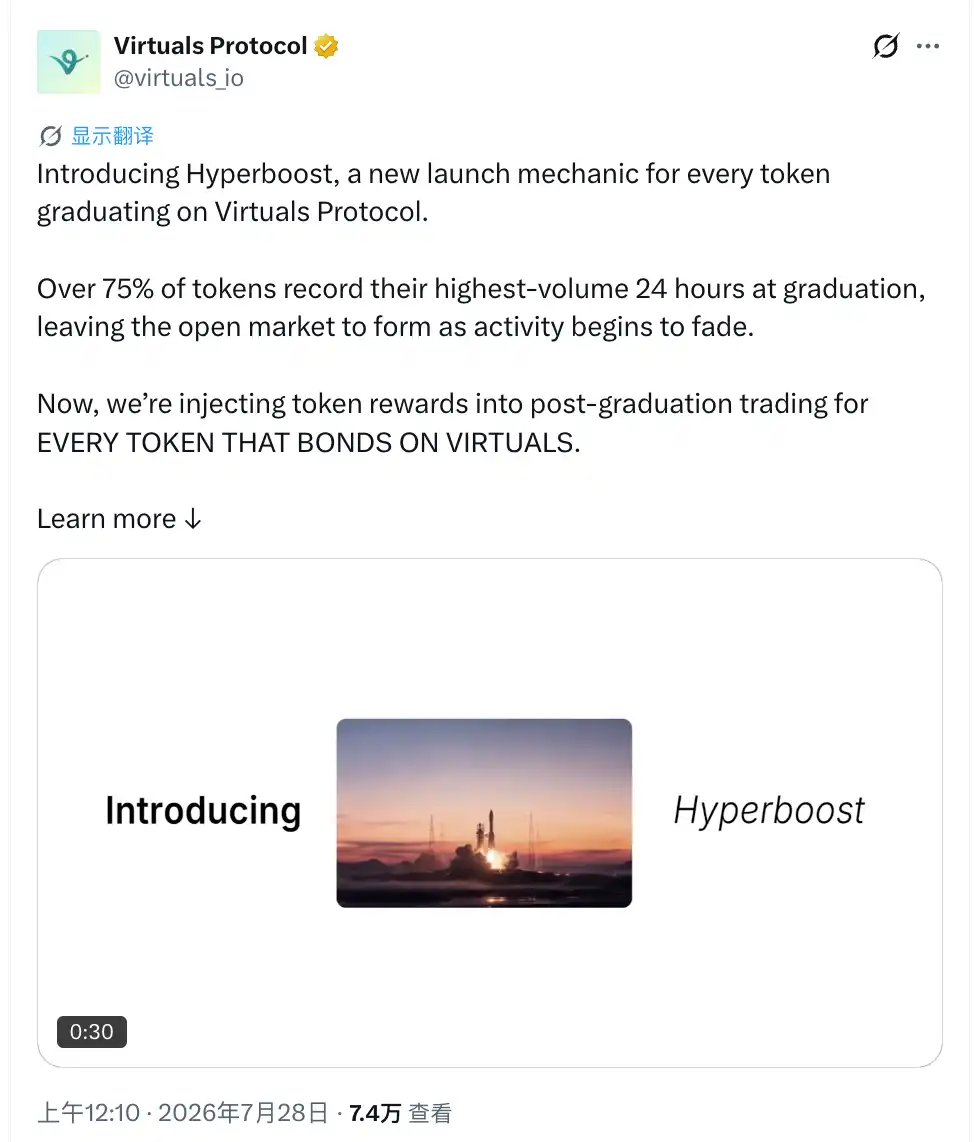
The AI Agent token launch platform Virtuals Protocol has long faced a persistent issue:

The day a token "graduates" from the bonding curve and launches, its trading volume typically peaks and then declines steadily. Platform data indicates that over 75% of tokens record their highest trading volume within 24 hours after graduation, with public market activity quickly fading thereafter.

On July 27th, Virtuals introduced the Hyperboost mechanism, attempting to use economic incentives to prolong post-graduation market interest.

Mechanism Breakdown: Idle Supply Converted to Trading Rewards, Released Daily for 14 Days

The core logic of Hyperboost is to activate a portion of token supply that was previously idle.

In the past, when a token graduated from the bonding curve and entered public trading on Uniswap, a portion of the supply was reserved for smoothing the transition, essentially remaining idle.

Hyperboost reallocates this portion, converting it into a reward pool released daily over the 14 days following graduation.

Rewards are distributed along two tracks: trading rewards are allocated based on a wallet's proportion of the day's trading volume; content rewards are directed at creators publishing content about the token on platforms like X. A total of 1/14th of the total rewards are released each day, with no lock-up or vesting restrictions upon claiming. Rewards are claimable upon arrival.

This mechanism activates automatically, requiring no founder configuration or manual activation. All tokens completing graduation after 16:00 UTC on July 27th will automatically enter the Hyperboost window.

The official whitepaper does not disclose the specific idle supply ratio or reward allocation percentage, only describing it as "a fraction of token supply".

Details regarding the content reward evaluation criteria are also limited. The community has raised questions about the transparency of anti-sybil mechanisms and content scoring rules.

Virtuals Ecosystem Status: 18k+ Agents, Market Cap ~$400M

Hyperboost is not an isolated product; it is embedded within Virtuals' broader AI Agent tokenization ecosystem.

As of H1 2026, the Virtuals Protocol platform has launched over 18,000 AI Agent tokens, with cumulative protocol revenue exceeding $75 million.

Amidst overall crypto market shifts and AI Agent development, Virtuals has undertaken intensive ecosystem and product expansion efforts since the beginning of the year. In March, it launched the ERC-8183 standard (in collaboration with the Ethereum Foundation) for on-chain AI Agent identity.

In early July, it completed the migration of cross-chain infrastructure from LayerZero to Chainlink CCIP, involving over $700 million in VIRTUAL liquidity. Robinhood Chain also announced plans to integrate Virtuals' AI Agent infrastructure on its new chain.

The above developments align more with long-term considerations and updates to the product foundation. Hyperboost appears more like an innovative play in token trading and rules.

Two Days Post-Launch, Some Graduated Projects Still 'Plummeting as Usual'

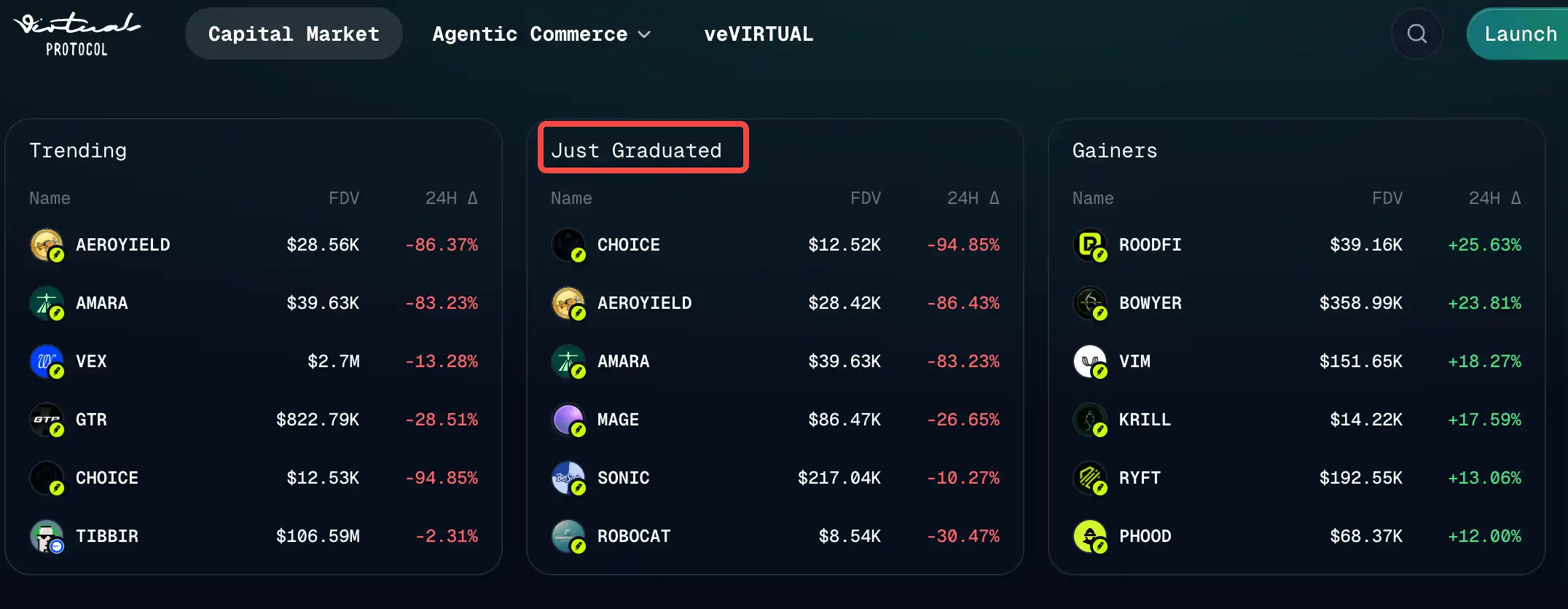
Hyperboost has been live for only about two days. The "Just Graduated" section on app.virtuals.io shows some early examples.

AMARA (Amara Exchange) graduated about 9 hours ago, FDV ~$51k, 24-hour decline ~78%, trading volume ~$358k, holders ~185.

MAGE is associated with the Mage Trading AI Agent, 24-hour decline ~55%. GTR (gtr.trade) launched ~4 days ago, FDV ~$700k, 24-hour decline ~44%, holders ~1700, liquidity ~$110k.

The data from these examples still presents the typical "peak post-graduation followed by decay" pattern, precisely what Hyperboost aims to mitigate. However, given the mechanism has been active for less than 48 hours and the first 14-day reward cycle is not yet complete, the current sample size and time span are insufficient to judge effectiveness.
Core Questions: Could Trading Volume Rewards Become a Farmer's ATM?

Currently, community discussions around this new product focus on several key points.

First, if trading rewards are allocated based on trading volume share, this design inherently attracts wash trading. If a wallet contributes 50% of the day's trading volume, it claims 50% of that day's trading rewards. For tokens with an FDV of only tens of thousands of dollars, the cost of wash trading could be lower than the reward revenue, creating a clear arbitrage opportunity.

The official response is that the daily reward pool is fixed. Even if someone wash trades, they merely take a larger slice of a fixed pie, not infinitely inflating it. However, this argument holds only if the reward pool itself is relatively small (undisclosed by the official). If the reward scale is significant, wash trading incentives remain.

Second, the evaluation criteria for content rewards are also vague. Current rules state "parameters are set by the protocol and may be adjusted to maintain distribution integrity" but do not disclose specifics like the content scoring mechanism, whether account verification is needed, or how to prevent bulk spamming.

For a mechanism publicly stated to incentivize content creation on platform X, the absence of these rules casts doubt on its practical effectiveness.

Limited Impact on VIRTUAL Token

In narrative terms, Hyperboost provides VIRTUAL with a new growth story. If the mechanism genuinely extends the active trading period of graduated tokens, it implies more trading volume flows through VIRTUAL-paired liquidity pools, indirectly increasing demand for VIRTUAL.

According to TronWeekly, the VIRTUAL price showed short-term technical bullish signals following the Hyperboost launch, with some analysts setting a short-term target of $0.70.

However, simultaneously, VIRTUAL has declined about 7.4% over the past 7 days, still generally weighed down by the broader market downturn. BTC recently turned negative, and overall crypto market sentiment is weak.

A breakout star token might be more effective in reversing this trend. Follow-up metrics to watch include the trading volume retention rate of graduated tokens during the 14-day window, whether the number of newly graduated tokens increases due to the incentives, and the actual consumption of VIRTUAL as a pairing asset.

Accumulating sufficient data for these points will likely take at least 2 to 4 weeks. Nevertheless, in a climate where many crypto projects are shutting down or pivoting, it is encouraging to see Virtuals continuously iterate and update its playbook.


Criptomoedas em alta

Perguntas relacionadas

QWhat is the Hyperboost mechanism launched by Virtuals Protocol and what problem does it aim to solve?

AVirtuals Protocol launched the Hyperboost mechanism on July 27th. It aims to combat the 'first-day peak curse,' where over 75% of tokens on the platform see their highest trading volume within 24 hours of graduation before rapidly declining. Hyperboost automatically converts a portion of a graduating token's initially idle supply into a 14-day reward pool, released daily to incentivize trading and content creation, thereby attempting to extend the price discovery window.

QHow does the Hyperboost mechanism distribute its rewards?

AThe Hyperboost reward pool is distributed across two tracks over 14 days: 1) Trading Rewards: Distributed to wallets based on their daily trading volume share for that specific token. 2) Content Rewards: Awarded to creators who publish content about the token on platforms like X (formerly Twitter). Each day, 1/14th of the total reward pool is released. Users can claim their rewards with no lock-up or vesting period.

QAccording to the article, what are the main concerns within the community regarding the Hyperboost mechanism?

AThe community's main concerns focus on potential exploitation: 1) Trading rewards based on volume share could incentivize wash trading, especially for low-FDV tokens where the reward might outweigh the cost of fake trading. 2) The criteria and anti-spam mechanisms for content rewards are vague and lack transparency, raising questions about how content quality is judged and how 'farming' with bot accounts will be prevented.

QWhat was the performance of some early token samples after the Hyperboost launch, and what does this indicate?

AEarly samples like AMARA, MAGE, and GTR, which graduated shortly after Hyperboost went live, still showed significant price declines (~44% to ~78% in 24 hours). This indicates the typical 'post-graduation slump' pattern that Hyperboost is designed to mitigate. However, the article notes that with the mechanism being active for less than 48 hours and the full 14-day cycle not yet complete, it's too early to judge its effectiveness based on this limited data.

QWhat is the potential impact of Hyperboost on the VIRTUAL token itself, and what factors will determine its success?

AHyperboost could indirectly benefit the VIRTUAL token by potentially increasing trading activity and volume across its paired liquidity pools, thus boosting demand for VIRTUAL as the pairing asset. However, its direct impact is considered limited, as VIRTUAL's price remains influenced by broader market trends. The mechanism's success should be measured by observing metrics over 2-4 weeks, such as the retention of trading volume for graduated tokens during the 14-day window, an increase in new token graduations, and the actual consumption/utility of VIRTUAL in these pools.

Leituras Relacionadas

Critical Moments in Bitcoin: Cost Zones That Demand Attention Have Been Identified!

Analytics firm Glassnode reported that reduced expectations for U.S. interest rate cuts, along with pricing in possible rate hikes, have suppressed risk appetite in the cryptocurrency market. The Fed's interest rate decisions are crucial for market direction. U.S. Treasury yields have surpassed returns from crypto carry trades, leading investors to favor cash and low-risk interest-bearing instruments over crypto assets. A strong U.S. dollar further weakens marginal demand for crypto. Bitcoin is currently trading below its most intensive cost basis level, with approximately $69,000 identified as the breakeven zone and significant resistance for short-term investors. For a stronger recovery, Bitcoin needs to reclaim the $69,000 threshold with increased trading volume. Renewed active demand for spot Bitcoin ETFs is also deemed critical. According to Glassnode, the current Bitcoin decline represents the shallowest bear market in terms of price drawdown depth to date. However, based on previous cycle durations, this downturn may not be over yet. Spot trading volumes have fallen to multi-year lows, and sell-side order books have thinned, though many buy orders are placed significantly below current prices. Glassnode's risk indicator, Vector, signaled "risk off," suggesting a capital preservation mindset. The current market structure is being driven more by macroeconomic factors like monetary policy, bond yields, and dollar strength than by crypto-sector developments. Losing Bitcoin's support range of $62,000-$68,000, coupled with renewed exchange inflows, could negate the recovery scenario. Conversely, more favorable monetary policy, increased trading volume, a Bitcoin recovery above $69,000, and a resumption of spot ETF buying could signal a market turnaround.

cryptonews.ruHá 1h

Critical Moments in Bitcoin: Cost Zones That Demand Attention Have Been Identified!

cryptonews.ruHá 1h

Breaking News: Full Detailed Rationale and Explanation of the Fed's Interest Rate Decision Released!

As expected, the Federal Reserve kept its key interest rate unchanged at 3.50-3.75 percent, marking the fifth consecutive meeting without a rate change. The Federal Open Market Committee's (FOMC) decision passed with a 9-3 majority vote. Cleveland Fed President Loretta Mester, Minneapolis Fed President Neel Kashkari, and Dallas Fed President Lorie Logan dissented, voting in favor of a 25 basis point rate hike. This was the first meeting since 2016 where three regional Fed presidents voted against holding rates steady, signaling growing influence among members advocating for tighter monetary policy to combat inflation. The Fed's statement noted that economic activity has been expanding at a solid pace despite high uncertainty, partly due to Middle East conflicts. It highlighted that growth in productivity and investment remained strong, employment gains have aligned with labor force growth, and the unemployment rate has remained relatively stable. The Fed also committed to maintaining ample reserves in the banking system. The statement emphasized that inflation remains above the Fed's 2% target. It noted that supply shocks, including in the energy sector, are adding to inflationary pressures. The Committee stated it will continue to closely monitor incoming data and risks in pursuit of its price stability goal. The dissenting members argued that the target range for the federal funds rate should have been increased by 25 basis points.

cryptonews.ruHá 1h

Breaking News: Full Detailed Rationale and Explanation of the Fed's Interest Rate Decision Released!

cryptonews.ruHá 1h

Trading

Spot

Artigos em Destaque

Como comprar ONE

Bem-vindo à HTX.com!Tornámos a compra de Harmony (ONE) simples e conveniente.Segue o nosso guia passo a passo para iniciar a tua jornada no mundo das criptos.Passo 1: cria a tua conta HTXUtiliza o teu e-mail ou número de telefone para te inscreveres numa conta gratuita na HTX.Desfruta de um processo de inscrição sem complicações e desbloqueia todas as funcionalidades.Obter a minha contaPasso 2: vai para Comprar Cripto e escolhe o teu método de pagamentoCartão de crédito/débito: usa o teu visa ou mastercard para comprar Harmony (ONE) instantaneamente.Saldo: usa os fundos da tua conta HTX para transacionar sem problemas.Terceiros: adicionamos métodos de pagamento populares, como Google Pay e Apple Pay, para aumentar a conveniência.P2P: transaciona diretamente com outros utilizadores na HTX.Mercado de balcão (OTC): oferecemos serviços personalizados e taxas de câmbio competitivas para os traders.Passo 3: armazena teu Harmony (ONE)Depois de comprar o teu Harmony (ONE), armazena-o na tua conta HTX.Alternativamente, podes enviá-lo para outro lugar através de transferência blockchain ou usá-lo para transacionar outras criptomoedas.Passo 4: transaciona Harmony (ONE)Transaciona facilmente Harmony (ONE) no mercado à vista da HTX.Acede simplesmente à tua conta, seleciona o teu par de trading, executa as tuas transações e monitoriza em tempo real.Oferecemos uma experiência de fácil utilização tanto para principiantes como para traders experientes.

357 Visualizações TotaisPublicado em {updateTime}Atualizado em 2026.06.02

Como comprar ONE

Discussões

Bem-vindo à Comunidade HTX. Aqui, pode manter-se informado sobre os mais recentes desenvolvimentos da plataforma e obter acesso a análises profissionais de mercado. As opiniões dos utilizadores sobre o preço de ONE (ONE) são apresentadas abaixo.

活动图片