If we look back just a year ago, it's hard to imagine Anthropic's revenue curve being this steep.
Just this morning, according to a Bloomberg report, Anthropic disclosed to investors that as of the end of July this year, the company's annualized revenue run rate (ARR) has reached $65 billion. Based on the annualized level projected to exceed $9 billion by the end of 2025, this figure has grown more than sevenfold in just a few months.
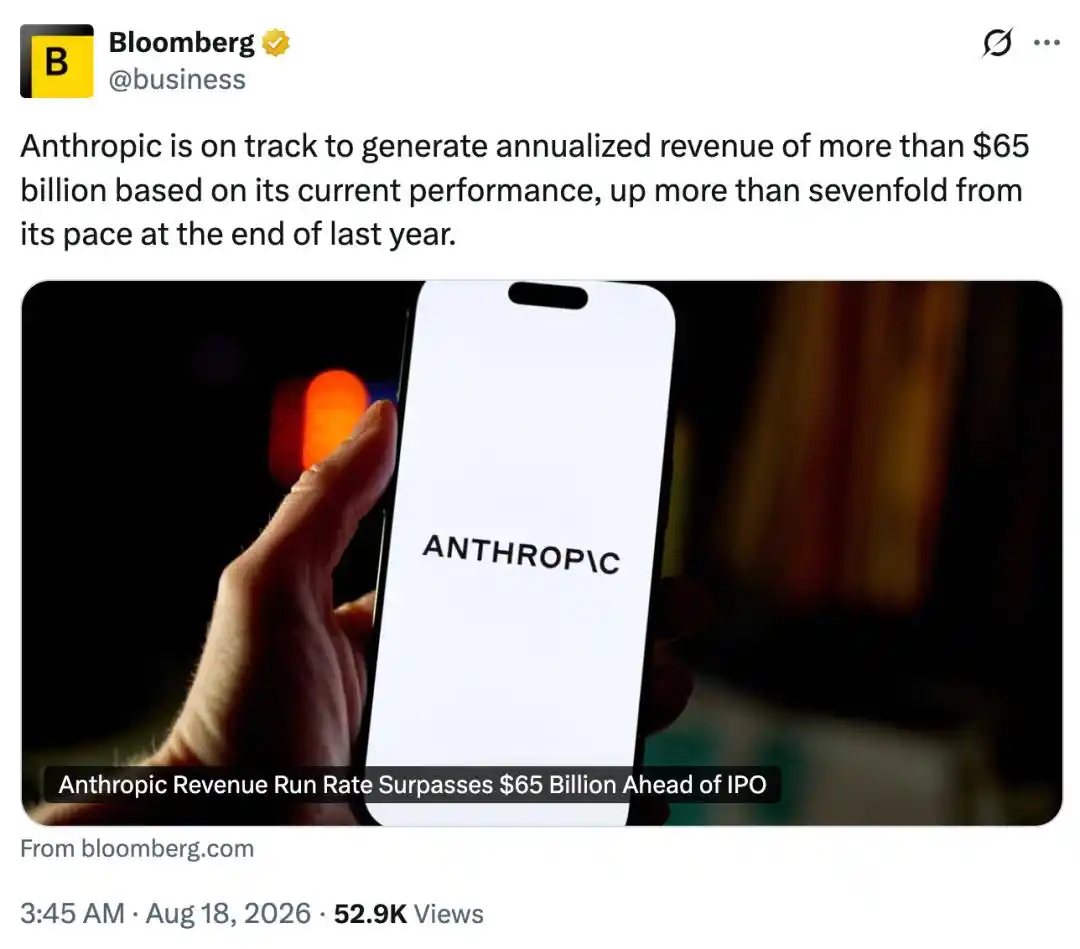
Meanwhile, Anthropic's preliminary revenue for its most recently completed quarter (Q2) also exceeded $11.5 billion. In the same period last year, this figure was only $787 million, meaning the latest quarterly revenue is approximately 14.6 times that of the same period last year.
For an AI company that was widely regarded as an OpenAI challenger a few years ago, this may represent the most intense acceleration in its commercialization process to date.
Two Months: Surging from $47 Billion to $65 Billion
It needs to be clarified first that $65 billion does not mean Anthropic has actually earned that much revenue in a single year.
The metric used here is the "annualized revenue run rate." Simply put, it extrapolates the revenue the company would generate in a full year if its current performance over a period of time were sustained for twelve months. This metric is particularly suitable for observing companies experiencing rapid growth, as it reflects current business changes more quickly than revenue from a completed fiscal year.
And Anthropic's current growth rate is very evident.
At the end of 2025, its annualized revenue run rate had just surpassed $9 billion; by May of this year, that figure had already crossed $47 billion; and as of the end of July, it had further reached $65 billion.
In other words, in just two months, Anthropic's annualized revenue run rate grew by approximately 38% again.
Looking at a longer time scale, the change is even more pronounced. According to data disclosed by Bloomberg, Anthropic's full-year revenue for 2025 was approximately $10 billion. Now, its annualized scale calculated based on the latest revenue pace is more than six times that number.
Revenue growth is also beginning to reflect on the profit level.
Anthropic's preliminary revenue for its most recent completed quarter exceeded $11.5 billion, a significant increase compared to $787 million in the same period of 2025. Simultaneously, the company recorded positive adjusted operating profit for that quarter. This is especially noteworthy for a frontier model company still in a phase of massive computing power investment.
Over the past few years, the growth story of large model companies has often been accompanied by another side: simultaneous inflation of training costs, inference costs, data center investments, and talent costs. Rapidly rising revenue does not necessarily mean losses will disappear quickly.
The emergence of positive adjusted operating profit for Anthropic at least indicates that its scale expansion is gradually demonstrating operating leverage.
Claude Code Changes the Commercialization Pace for Anthropic
Behind Anthropic's surging revenue, one unavoidable variable is the enterprise market, particularly in programming and complex knowledge work scenarios.
Claude was initially seen more as a direct competitor to ChatGPT. But over the past year, a notable change in Anthropic's commercialization has been its increasingly deep penetration into real workflow within enterprises. Claude Code is the most typical product in this regard.

Developers can directly have Claude read codebases, modify files, execute commands, troubleshoot problems, and continuously complete longer-chain software engineering tasks. As the usage scale of Coding Agents expands within enterprises, model calls have shifted from occasional one-off conversations to continuously running workflows consuming large amounts of Tokens.
For model companies, the revenue generated by these two usage patterns is completely different.
A single Q&A might only call the model for a few seconds; a software engineering Agent running for tens of minutes or even hours may repeatedly read context, call tools, modify code, and re-verify results. This also explains why enterprise-grade Agents are becoming the revenue engine for frontier model companies at an increasingly fast pace.
Judging from currently disclosed data, Anthropic is already one of the most obvious beneficiaries of this trend.
Bloomberg previously reported that OpenAI's recent annualized revenue run rate has exceeded $40 billion. If we simply compare this metric, Anthropic's latest disclosed $65 billion is already significantly higher.
However, these two figures still require cautious direct comparison. The statistical calibers for annualized revenue run rate may not be entirely consistent across different companies, including differences in revenue recognition methods, enterprise contract calculation methods, etc.
The IPO Draws Nearer; $65 Billion is the Most Direct Bargaining Chip
The timing of this figure's emergence is also delicate. Anthropic is on the eve of its public listing.
According to a previous Financial Times report, Anthropic's investors expect the company to potentially list on the public market in October this year, with an IPO valuation reaching $2 trillion or even higher.
If it ultimately lists with this valuation, Anthropic will surpass SpaceX, which went public earlier this year, becoming the highest-valued IPO in history.
For Anthropic, which is about to enter the capital market, a $65 billion annualized revenue run rate is clearly an extremely important card to play.
AI companies have commanded extremely high valuations in recent years, but the capital market ultimately returns to several very traditional questions: exactly how much revenue is there, how long can growth be sustained, when will profits appear, and whether massive computing power investments can translate into sustainable cash flow.
Anthropic was long seen as a follower behind OpenAI. Now, it has demonstrated a change to potential investors.
Model capability remains important, but penetration in the enterprise market, revenue growth speed, and profitability are gaining increasing weight.
The current environment Anthropic faces is not entirely smooth sailing either. In June this year, the company had to temporarily close access to its two advanced models, Claude Fable 5 and Mythos 5, due to government control requirements, resuming after about two weeks of negotiations. Even so, the company's latest revenue figures continue to grow rapidly, which instead makes this revenue curve appear even more noteworthy.
References:
https://www.bloomberg.com/news/articles/2026-08-17/anthropic-revenue-run-rate-surpasses-65-billion-ahead-of-ipo?srnd=phx-technology
https://www.ft.com/content/840ac156-af1c-4a82-b260-ae791072fcfa?syn-25a6b1a6=1
This article is from the WeChat public account "Almost Human" (ID: almosthuman2014), Author: Focus on AI Large Models