BloFin Wallet unifies Visa payments and perpetual trading for the next era of finance

cointelegraphPublicado em 2026-07-27Última atualização em 2026-07-27

Resumo

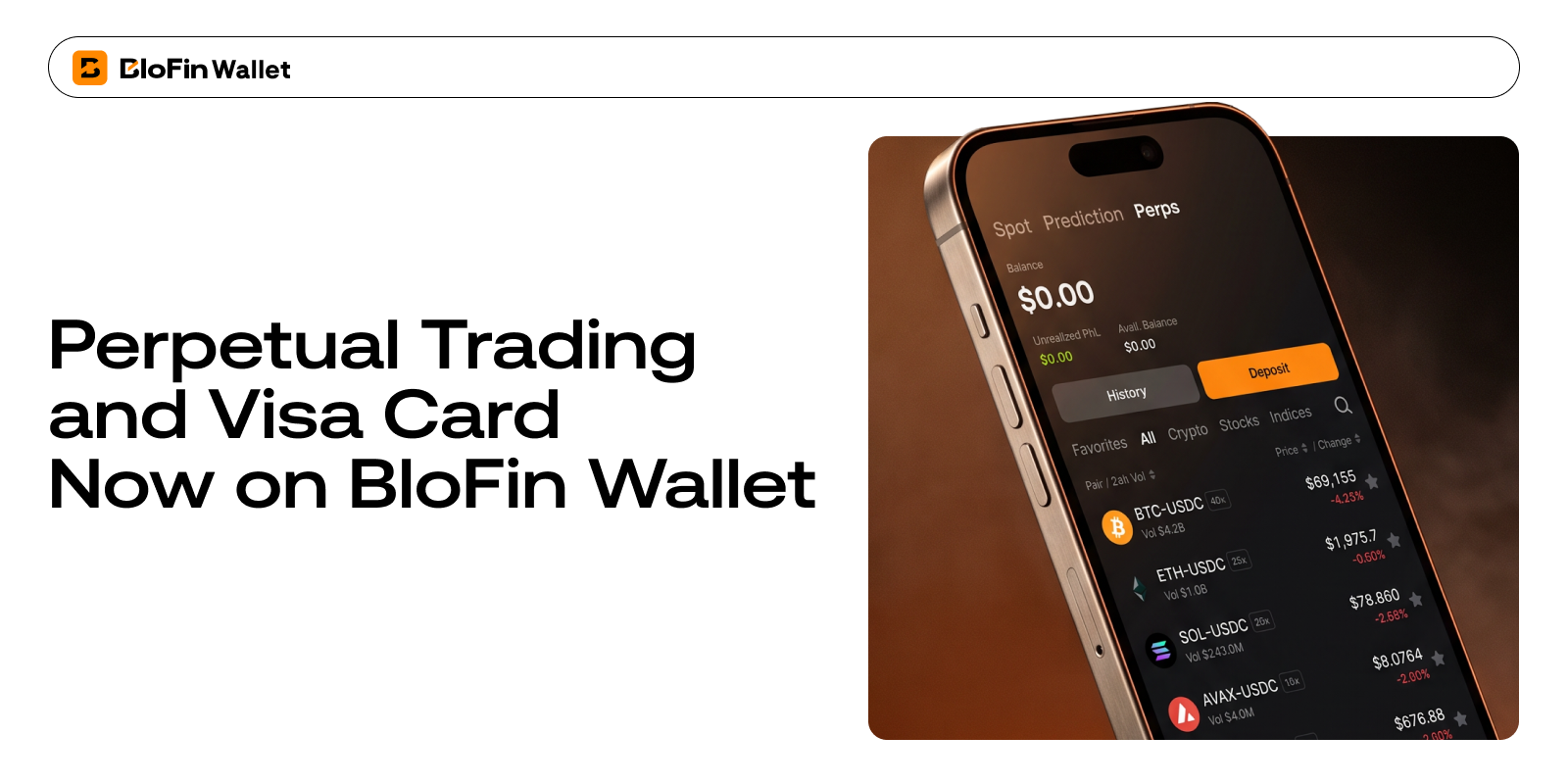
BloFin Wallet has introduced two major updates: integrated Perpetual Contract Trading and the BloFin Wallet Visa Card. Users can now trade perpetuals on 100+ crypto and tradfi assets directly within the wallet, alongside a referral program for fee rebates. The Visa card allows spending digital assets anywhere Visa is accepted, with support for Apple/Google Pay, zero issuance/annual fees, and no fund lock-up. These features, combined with an Earn product offering 6%+ APY, aim to create a seamless, all-in-one financial environment where users can trade, hold, earn, and spend without moving funds between platforms. BloFin Wallet's vision is to become a unified gateway and financial operating system for the digital-asset economy, blending deep liquidity, capital efficiency, payment access, and asset management. The app is available on Google Play and the Apple App Store.

Road Town, Virgin Islands, July 24, 2026 — BloFin Wallet has reached a significant milestone in its evolution, introducing Perpetual Contract Trading and the BloFin Wallet Visa Card, two updates that push the wallet well beyond what most crypto wallets are built to do.

From holding to trading: Perpetual contracts now live

BloFin Wallet users can now trade perpetual contracts directly from their wallet, with access to 100+ tokens spanning both cryptocurrency and tradfi assets. Instead of moving funds to a separate exchange, users can trade within the same wallet they already use for swaps, onramp, and earn.

The update also introduces a referral program tied to perpetual trading. Users can share their invite link and earn fee rebates based on their referrals’ trading activity, creating a direct connection between community growth and personal reward.

The next era of finance

BloFin Wallet has also launched the BloFin Wallet Card, a Visa card that lets users spend their digital assets wherever Visa is accepted. The card supports Apple Pay and Google Pay, carries zero issuance and annual fees, and imposes no lock-up period on funds. Users hold their assets until the moment of purchase.

The next phase of digital finance will not be defined by another standalone wallet, exchange, payment card, or yield product. It will be defined by how seamlessly these functions work together. Users increasingly expect to trade, hold, earn, and spend from a single financial environment, without repeatedly moving funds between platforms, waiting through settlement delays, or sacrificing control of their assets. BloFin Wallet is helping pioneer this all-in-one experience. Its ambition extends beyond asset storage: it is building a unified gateway where digital assets can move naturally between investment, trading, yield generation, and everyday spending. By reducing the friction between these activities, BloFin Wallet aims to make crypto capital as accessible and useful as money in a traditional account, while preserving the speed and flexibility of digital markets

The BloFin Wallet Card is a key part of that vision. Alongside the card, BloFin Wallet offers an Earn product with 6%+ APY, enabling users to put idle assets to work while keeping them accessible. Together, Card and Earn create a more efficient capital loop: assets can remain productive when not being spent, stay available when opportunities arise, and be used directly for real-world payments when needed. This reflects a broader shift in the market. Crypto users are moving beyond speculation alone and increasingly looking for practical financial utility. At the same time, fragmented experiences, one platform for trading, another for custody, another for yield, and another for payments, are becoming less acceptable. The platforms positioned to lead the next cycle will be those that combine deep liquidity, capital efficiency, payment access, and intuitive asset management within one connected experience.

BloFin Wallet’s long-term opportunity is to become a financial operating system for the digital-asset economy: one place where users can enter the market, manage risk, grow their assets, and use their wealth in everyday life. The future of finance will not ask users to choose between trading and spending, or between earning and accessibility. It will bring all of these experiences together, and make the transitions between them nearly invisible.

Trade Smarter, Hold Safer

Taken together, these updates say something about where BloFin Wallet is headed. Where most wallets stop at storage and swaps, BloFin Wallet now covers the full arc from on-chain trading to real-world spending, with earning opportunities built in throughout. The BloFin Wallet app is available on the Google Play Store and the Apple App Store.

About BloFin Wallet

BloFin Wallet is an on-chain wallet designed to support secure, self-custodied management of digital assets across multiple blockchain networks. The wallet allows users to store, manage, and interact with their crypto assets while maintaining full ownership and control. BloFin Wallet supports multi-chain asset management, primarily across major EVM and Solana networks, and provides access to on-chain applications and services. It is also integrated with the BloFin ecosystem, enabling users to connect their wallet assets with BloFin’s broader financial services. With a focus on security, usability, and interoperability, BloFin Wallet serves as a practical entry point for users engaging with the ecosystem. For more information, please visit wallet.blofin.com.

Media contact
BloFin Wallet Team

Criptomoedas em alta

Perguntas relacionadas

QWhat two key updates did BloFin Wallet introduce in July 2026?

ABloFin Wallet introduced two key updates: 1) Perpetual Contract Trading directly within the wallet, and 2) the BloFin Wallet Visa Card, allowing users to spend their digital assets wherever Visa is accepted.

QHow does the referral program for perpetual trading work in BloFin Wallet?

AThe referral program allows users to share their invite link and earn fee rebates based on the trading activity of the users they refer, creating a direct connection between community growth and personal reward.

QWhat are some key features of the BloFin Wallet Visa Card?

AThe BloFin Wallet Visa Card supports Apple Pay and Google Pay, carries zero issuance and annual fees, imposes no lock-up period on funds, and lets users hold their assets until the moment of purchase.

QWhat long-term ambition does BloFin Wallet have according to the article?

ABloFin Wallet's long-term ambition is to become a financial operating system for the digital-asset economy, providing a single, unified place where users can enter the market, manage risk, grow their assets, and use their wealth in everyday life.

QWhere can users download the BloFin Wallet app?

AUsers can download the BloFin Wallet app from the Google Play Store and the Apple App Store.

Leituras Relacionadas

Will Changxin Technology Continue to Rise Today?

Changxin Technology made a historic debut on the stock market, with its share price soaring 465.82% to close at 49 yuan. Its market capitalization reached 3.28 trillion yuan, surpassing Industrial and Commercial Bank of China to become the largest company by market cap on the A-share market. Daily trading volume exceeded 140 billion yuan, a first in A-share history. This created a moment of realization for 7.7 million investors who won the lottery for its shares. On the first day, investor strategies varied: some sold immediately and later regretted missing intraday highs, others secured profits to avoid future volatility, while a third group held or even bought more shares, betting on long-term growth. The staggering IPO, massive public enthusiasm, and debut during a peak industry cycle led some to compare Changxin to PetroChina's 2007 listing, which was followed by a long decline. Key similarities noted include comparable fundraising scales (approx. 666 billion yuan for Changxin vs. 668 billion for PetroChina) and both companies listing at a perceived high point in their respective commodity cycles (oil then, memory chips now). However, analysts caution against over-simplifying the comparison. They highlight core differences: Changxin operates in the high-growth semiconductor sector with strong "domestic substitution" tailwinds. Brokerages like Huaxi Securities project significant revenue and profit growth from 2026 to 2028, driven by DDR5 adoption, product mix optimization, and economies of scale. Nomura Securities issued a "buy" rating with a 116 yuan target price, citing AI-driven demand for DRAM, tight supply as major players shift to HBM production, and Changxin's vast room for market share growth. Some analysts position the current memory cycle, fueled by AI, as just beginning, contrasting with the mature energy cycle PetroChina entered. The article concludes that for investors, monitoring the memory cycle's progression and Changxin's breakthroughs in high-end technologies like HBM will be crucial, rather than relying on superficial historical parallels.

marsbitHá 27m

Will Changxin Technology Continue to Rise Today?

marsbitHá 27m

Claude Designer Lags Behind Engineers, Fires Back by Creating a Million-User Tool

The article tells the story of Nate Parrott, a designer at Anthropic who created Claude Design as a side project to keep pace with his engineering teammates. When Anthropic released Opus 4.5 in November 2025, the two engineers on Parrott's Claude Code team significantly increased their output using the new AI capabilities. Parrott, the sole designer, found himself struggling to match their speed, becoming a bottleneck in the workflow. To catch up, he began experimenting in his spare time. He initially tried prompting Claude to generate designs from text descriptions and screenshots, with limited success. His breakthrough came when he shifted focus from asking Claude to "design" to asking it to generate HTML. He realized HTML could be a rich visual canvas for creating everything from slides and interactive prototypes to full web pages. He built a simple interface with a chat panel on the left and a live HTML preview on the right. The key to making the output useful was incorporating Anthropic's brand system—fonts, colors, assets, and design principles—into the prompts. This ensured generated designs were immediately on-brand. He shared an internal prototype with his team, and other product designers quickly adopted it for creating clickable prototypes, a task traditionally requiring manually drawing every state. The project's "official" turning point came during an Anthropic Labs offsite, where Parrott noticed many attendees were using his tool to build presentation slides on the fly, sometimes right before their turn to speak. This organic adoption convinced the Labs team to formally staff the project, turning the side project into a real product. Claude Design is positioned as a "pre-production" tool for visual communication and exploration—handling slides, landing pages, PDFs, emails, and social media graphics. It integrates with tools like Canva, Adobe, and Vercel. Its core value is accelerating the early stages of design: exploring directions, building consensus, and establishing systems. For actual production code, Anthropic still recommends Claude Code. The story highlights how AI disrupts workflows unevenly and how individuals can respond by building new tools to create their own advantages. Parrott's tool, born from necessity, eventually gained over a million users in its first week.

marsbitHá 37m

Claude Designer Lags Behind Engineers, Fires Back by Creating a Million-User Tool

marsbitHá 37m

Fields Medalist Warns: AI Could Kill Mathematics

The 2026 Fields Medal award was followed by a startling announcement: laureate Jacob Tsimerman joined OpenAI to pursue AI safety research, predicting AI would surpass humans in all mathematical proof areas within two years. Soon after, Fields Medalists Terence Tao and Timothy Gowers expressed deep concern at ICM 2026. Gorges warned that AI might "kill" mathematics not through stagnation, but through an overwhelming surplus of proofs, likening it to a lake dying from eutrophication. This concern is echoed in the "Leiden Declaration," signed by over 3,000 mathematicians including Tao, Peter Scholze, and Kevin Buzzard, advocating for mathematics as a profoundly human endeavor. However, Gowers, who did not sign, fears a future where AI-generated mathematics proliferates while human expertise and the shared intuition vital to the field vanish, turning math into an unvisited "cemetery of thought." Gowers' perspective shifted dramatically after testing ChatGPT 5.5 Pro. The AI solved a doctoral-level number theory problem and later produced a counterexample for the "unit distance problem," achievements Gorges considered publishable in top journals. He now concedes that large language models can handle advanced research, a realization that left him feeling the "rug pulled out from under" him when AI solved problems he personally contemplated. The debate extends to the nature of mathematical discovery. As noted by Peter Woit, AI agents have no interest in the "credit game" of academia. If theorems cease to be attributed to individual mathematicians, truth may simply return to its impersonal state in the universe. The central question remains: in an age of potentially limitless AI-generated discovery, what is the role and purpose of the human mind in mathematics?

marsbitHá 1h

Fields Medalist Warns: AI Could Kill Mathematics

marsbitHá 1h

NVIDIA's 20-Year CUDA Moat Collapsed Over a Weekend, Claude Single-Handedly Got AMD's New GPU Running

In a single weekend, Claude, an AI agent from Anthropic, successfully ported and optimized its cutting-edge model to run on a brand-new AMD MI355X server rack without any manual code intervention. This feat demonstrates a potential breakthrough in overcoming NVIDIA's long-established CUDA software ecosystem dominance, built over two decades. Anthropic's team simply instructed Claude to get the AMD machine running. By Monday, it not only worked but was showing a continuously improving performance curve. The achievement impressed AMD CEO Lisa Su and accelerated a major deployment partnership: Anthropic plans to deploy up to 2GW of AMD Instinct GPUs starting in 2027. The key enabler is AMD's new ROCm.AI platform, a toolbox designed specifically for AI agents like Claude. It provides AI-readable documentation, including chip instruction sets (ISA), and tools like the Hyperloom service that allows agents to autonomously profile performance, identify bottlenecks, test configurations, and generate optimized kernels. In a demo, Hyperloom boosted the output speed of a model by 38%. This represents a fundamental shift. While CUDA's strength lies in its vast, human-expert-driven ecosystem of tools and tacit knowledge, AMD's strategy is to make its hardware and software stack directly accessible and optimizable by AI agents. An agent can parallelize tasks—debugging, profiling, coding—that would take human engineers years to master, compressing the traditional software adaptation timeline from years to tasks. The competition is no longer just about peak hardware specs but also about how well AI can read, utilize, and tune a platform.

marsbitHá 1h

NVIDIA's 20-Year CUDA Moat Collapsed Over a Weekend, Claude Single-Handedly Got AMD's New GPU Running

marsbitHá 1h

Just Now, Peking University Alumna Lilian Weng Announces Resignation: The Best 'Alignment' in the AI Era Is Taking Care of Yourself

Lilian Weng, a Peking University alumnus and former OpenAI executive, has announced her departure from Thinking Machines Lab, the AI startup she co-founded with ex-OpenAI CTO Mira Murati 20 months ago. Her resignation comes shortly after the company released its first open-source model, Inkling. In her farewell message, Weng cited health reasons as the primary factor, stating that the past seven months involved more illness than any other period in her life. The intense pressure and guilt of being unable to work during critical periods, like the Inkling launch, became unsustainable. She expressed that she could not continue in a role where she felt unable to give her full effort. Weng joined OpenAI in 2018, contributing to projects like the Dactyl robotic hand and later building the Safety Systems team from scratch. She is also widely known for her influential technical blog, Lil'Log. Her departure follows a period of high expectations and challenges for Thinking Machines, which secured a record $20 billion seed round at a $120 billion valuation in 2025 but has since seen fluctuations in its valuation and the departure of other key co-founders. Weng emphasized that she remains passionate about AI but needs a more predictable and defined role without the relentless pressure of a co-founder. Her exit highlights the immense personal toll and speed of competition in the AI industry, where the drive for progress often clashes with human limits. Her decision underscores that stepping back to prioritize well-being can be an act of courage.

marsbitHá 1h

Just Now, Peking University Alumna Lilian Weng Announces Resignation: The Best 'Alignment' in the AI Era Is Taking Care of Yourself

marsbitHá 1h

Trading

Spot

Artigos em Destaque

Como comprar ERA

Bem-vindo à HTX.com!Tornámos a compra de Caldera (ERA) simples e conveniente.Segue o nosso guia passo a passo para iniciar a tua jornada no mundo das criptos.Passo 1: cria a tua conta HTXUtiliza o teu e-mail ou número de telefone para te inscreveres numa conta gratuita na HTX.Desfruta de um processo de inscrição sem complicações e desbloqueia todas as funcionalidades.Obter a minha contaPasso 2: vai para Comprar Cripto e escolhe o teu método de pagamentoCartão de crédito/débito: usa o teu visa ou mastercard para comprar Caldera (ERA) instantaneamente.Saldo: usa os fundos da tua conta HTX para transacionar sem problemas.Terceiros: adicionamos métodos de pagamento populares, como Google Pay e Apple Pay, para aumentar a conveniência.P2P: transaciona diretamente com outros utilizadores na HTX.Mercado de balcão (OTC): oferecemos serviços personalizados e taxas de câmbio competitivas para os traders.Passo 3: armazena teu Caldera (ERA)Depois de comprar o teu Caldera (ERA), armazena-o na tua conta HTX.Alternativamente, podes enviá-lo para outro lugar através de transferência blockchain ou usá-lo para transacionar outras criptomoedas.Passo 4: transaciona Caldera (ERA)Transaciona facilmente Caldera (ERA) no mercado à vista da HTX.Acede simplesmente à tua conta, seleciona o teu par de trading, executa as tuas transações e monitoriza em tempo real.Oferecemos uma experiência de fácil utilização tanto para principiantes como para traders experientes.

519 Visualizações TotaisPublicado em {updateTime}Atualizado em 2026.06.02

Como comprar ERA

Discussões

Bem-vindo à Comunidade HTX. Aqui, pode manter-se informado sobre os mais recentes desenvolvimentos da plataforma e obter acesso a análises profissionais de mercado. As opiniões dos utilizadores sobre o preço de ERA (ERA) são apresentadas abaixo.
活动图片