Ansem: Why I Believe Token Buybacks Don't Solve Anything?

marsbitPublicado em 2026-07-17Última atualização em 2026-07-17

Resumo

Crypto trader Ansem argues that token buybacks alone do not create value. Instead, a project's valuation multiple is driven by "trust premium" built between the team and its community. He compares two high-revenue Solana protocols: Hyperliquid (estimated $800M annualized revenue, ~$650B FDV) and pump.fun (estimated $440M annualized revenue, ~$14B FDV). Both aggressively use most protocol revenue for buybacks, yet their valuation multiples differ by nearly 50x. Ansem attributes Hyperliquid's high valuation to the trust earned by its founder Jeff and team through consistent execution, transparent community rewards, and a dedicated user base. In contrast, he criticizes pump.fun for failing to fulfill a promised airdrop of 24% of its token supply for over a year since its July 2025 ICO, despite generating over $1B in revenue and raising $1B in the ICO. He suggests that honoring its commitments could significantly boost its token price and platform metrics. The core thesis is that trust, not just financial mechanics, is the key driver of crypto asset valuations.

Author: Claude, Deep Tide TechFlow

Deep Tide Introduction: Famous Solana trader Ansem posted that the buyback mechanism itself does not create value, and what determines the token valuation multiple is the "trust premium" between the team and the community. Using Hyperliquid (annualized revenue approx. $8 billion, FDV approx. $65 billion) and pump.fun (annualized revenue approx. $440 million, FDV only approx. $1.4 billion) as a comparison, he pointed out that both are conducting large-scale buybacks, but their valuation multiples differ by nearly 50 times.
One of the most enduring narratives in the crypto market is being challenged: dumping protocol revenue into buybacks will make the token price rise.

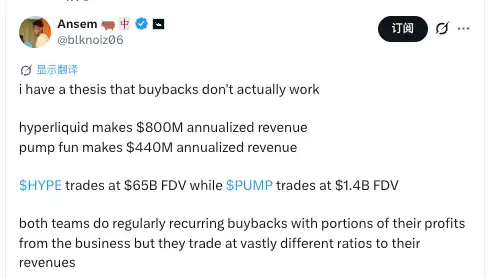
On July 16, famous Solana trader Ansem (@blknoiz06) posted a long thread on platform X, proposing a counterintuitive argument: the buyback mechanism itself does not create value; what truly determines the token trading multiple is the "trust premium" between the team and the community. This post quickly gained over 469,000 views, 3,240 likes, and 509 reposts.

Ansem selected two of the crypto industry's highest-earning protocols for comparison. Hyperliquid's annualized revenue is approximately $8 billion, HYPE's FDV is approximately $65 billion; pump.fun's annualized revenue is approximately $440 million, PUMP's FDV is only about $1.4 billion. Both teams are using the vast majority of their revenue for buybacks, but their valuation multiples differ by nearly 50 times.

Ansem's conclusion is: the gap is not in the scale of revenue, but in the trust accumulated through the team's actions.

Both Spending Heavily on Buybacks, Why Do Hyperliquid and pump.fun Have Such Widely Different Valuations?

Ansem deconstructed the buyback strategies of the two platforms in his post.

Hyperliquid directs 97% to 99% of protocol fees directly into HYPE buyback and burn. According to CryptoNews data, as of June 30, Hyperliquid's cumulative protocol revenue had exceeded $1 billion, with an annualized run rate close to $840 million. The platform has burned over 41 million HYPE tokens, worth over $1 billion, reducing the circulating supply by approximately 4.2%. At the time of writing, HYPE is quoted around $60 to $67, with an FDV of approximately $57 to $62 billion.

pump.fun is similarly aggressive. In 2025, the platform's total revenue was approximately $970 million, and it invested close to 100% of revenue into PUMP buybacks, accumulating about $213 million in buybacks. In April 2026, the team executed a one-time burn of PUMP tokens worth $370 million (about 36% of the circulating supply) and locked 50% of subsequent revenue for continuous burns. However, PUMP is currently quoted around $0.0016, with an FDV of approximately $1.4 to $1.7 billion.

pump.fun's annualized revenue is a bit more than half of Hyperliquid's, but its FDV is less than 3% of Hyperliquid's. If the buyback mechanism were the core driver of valuation, this multiple gap would be unexplainable.

Ansem's Explanation: Trust Premium is the Core of Pricing

Ansem believes the high valuation the market gives Hyperliquid stems from the trust established by Jeff (Hyperliquid founder) and his team.

He listed several points in his post: Hyperliquid has never overpromised; the team focuses solely on shipping products; user rewards are strictly distributed based on pre-determined on-chain metrics without opaque operations; the core user base has an extremely high trust rating for Jeff and the team. Ansem's original words stated that this trust premium "is one of the main reasons the token is trading so well."

Hyperliquid's historical actions support this judgment. The project did not accept VC investment, allocating 70% of the total supply to the community; the massive airdrop at launch in November 2024 fulfilled early promises; the platform showed resilience during the market sell-off in February 2026, indicating its user base includes many serious traders who rely on the platform for daily trading.

The pump.fun Problem: $1 Billion in Revenue, Promised Airdrop Unfulfilled for a Year

Ansem's criticism of pump.fun is more direct.

He pointed out that pump.fun has accumulated over $1 billion in revenue, raised another $1 billion in its ICO, but the airdrop promised to users has never been delivered. According to a Protos report, pump.fun clearly stated "airdrop coming soon" when announcing the PUMP token ICO on July 9, 2025, promising to allocate 24% of the supply to the community. By mid-July 2026, this promise has been outstanding for a full year, with no airdrop in sight.

Ansem had previously criticized this on June 25: "pump.fun is the only application in crypto that has sustained attention for several years, not even OpenSea achieved that. But people are angry because they promised a 24% airdrop and never delivered, just sitting on the cash now."

The $370 million token burn in April 2026 was intended to repair trust, but the community reaction backfired. Some users believed the burned tokens should have been used for the airdrop allocation, and burning them directly eliminated the community's deserved share. According to a Cryptopolitan report, the widespread community interpretation of this move was that it "deepened distrust."

In his latest post, Ansem made a hypothetical scenario: if pump.fun seriously fulfilled its airdrop promise and addressed the concerns of its core users, the token price could potentially increase 10 to 15 times, while trading volume, attention, and platform revenue would also see substantial growth.


Criptomoedas em alta

Perguntas relacionadas

QWhat is the core argument presented by Ansem regarding token buybacks?

AAnsem argues that token buyback mechanisms themselves do not create value. He believes the key driver of a token's valuation multiple is the 'trust premium' established between the project team and its community.

QAccording to the article, what is the significant valuation difference between Hyperliquid and pump.fun despite both engaging in buybacks?

ADespite both platforms aggressively using protocol revenue for buybacks, Hyperliquid's FDV is approximately $650 billion while pump.fun's FDV is only about $14 billion, representing a nearly 50x difference in valuation multiples.

QWhat reasons does Ansem give for the high 'trust premium' enjoyed by Hyperliquid?

AAnsem attributes Hyperliquid's trust premium to the team's focus on product delivery without overpromising, transparent and rule-based user reward distribution, and a core user base with high trust in founder Jeff and the team's execution.

QWhat is the specific criticism Ansem levels against pump.fun regarding community commitments?

AAnsem criticizes pump.fun for failing to fulfill its promise of a community airdrop allocating 24% of the token supply, a commitment made during its July 2025 ICO announcement that remained unfulfilled a year later.

QWhat was the community's reaction to pump.fun's $370 million token burn in April 2026, and why?

AThe community reaction was largely negative and deepened distrust. Many users perceived that the burned tokens should have been allocated for the promised airdrop, viewing the burn as destroying the community's rightful share.

Leituras Relacionadas

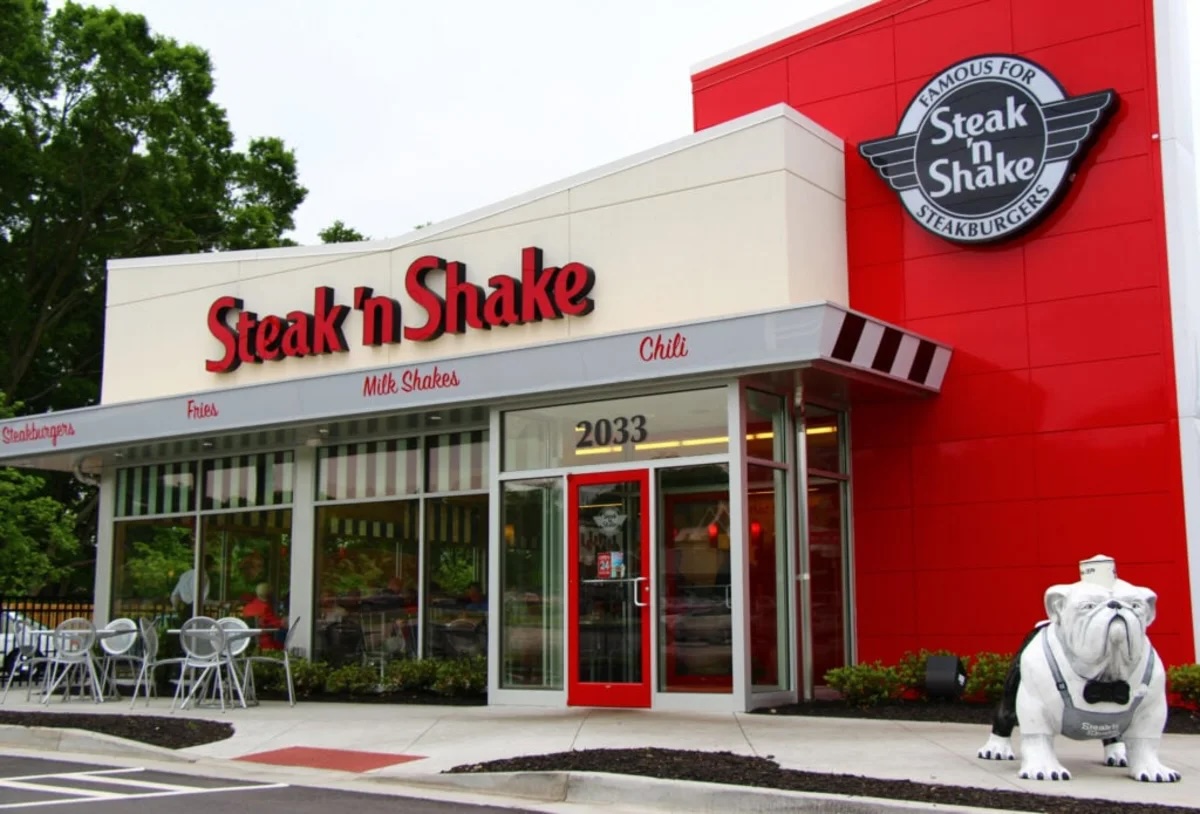
Revenue Soars 16%, Restaurant Chain Credits Bitcoin: Real Growth or PR Stunt?

Steak ’n Shake, a U.S. fast-food chain, attributed a 16% year-over-year increase in July same-store sales partly to its adoption of Bitcoin as a payment method. However, the company has not disclosed key data points, such as the actual number of Bitcoin transactions, total sales volume processed in Bitcoin, or the exact amount saved on payment processing fees. This lack of detailed information makes it difficult to isolate Bitcoin's direct impact on sales growth from other contributing factors like marketing campaigns, menu updates, promotional discounts, and operational changes. While the brand highlights the cost advantage of Bitcoin transactions—estimated to be about 50% cheaper per transaction than credit card fees—it has not provided evidence that a significant volume of sales actually uses this payment method. Steak ’n Shake’s parent company, Biglari Holdings, had already reported strong sales growth earlier in the year, driven by factors such as product upgrades and operational improvements, with no mention of Bitcoin in prior shareholder communications. The article questions whether the primary value of Bitcoin for Steak ’n Shake lies more in its public relations and branding benefits—attracting crypto enthusiasts and generating media attention—rather than in tangible business gains. To validate Bitcoin's role as a genuine growth driver and provide a replicable model for other merchants, the company would need to share comprehensive data, including Bitcoin transaction share, customer retention metrics, and detailed cost savings, allowing for a clearer analysis of its true contribution to revenue.

Foresight NewsHá 17m

Revenue Soars 16%, Restaurant Chain Credits Bitcoin: Real Growth or PR Stunt?

Foresight NewsHá 17m

The Price of DeFi Mass Adoption: Understanding the Profit Distribution and Hidden Risks of Aave Stable Vaults

**Title:** The Price of DeFi Mass Adoption: Understanding Aave Stable Vaults' Profit Distribution and Hidden Risks **Summary:** Aave Labs' new "Stable Vaults" product aims to simplify DeFi for mainstream users by offering fixed yields, a rarity in crypto. The model inserts a middleman layer between users and Aave's underlying lending pools. This layer, often a fintech app or digital bank, absorbs interest rate volatility, guaranteeing users a pre-set stable return while capturing any excess yield from Aave's underlying pools. In exchange for this predictable "peace of mind" and services like customer support and simplified onboarding, users sacrifice potential higher yields and take on new counterparty risks from the operating entity and its infrastructure. The article illustrates this with the example of payroll provider Rise, which transparently passes through most Aave yield, versus the higher profit margins possible through Stable Vaults. While a rational trade-off for many non-expert users prioritizing simplicity and security, the system centralizes risk and obfuscates true market yields. Aave benefits by attracting sticky, non-speculative capital crucial for its long-term economic model, highlighting the industry's shift towards catering to fundamental human preferences for convenience over complex, self-managed financial systems.

Foresight NewsHá 1h

The Price of DeFi Mass Adoption: Understanding the Profit Distribution and Hidden Risks of Aave Stable Vaults

Foresight NewsHá 1h

Trading

Spot

Artigos em Destaque

Como comprar ANSEM

Bem-vindo à HTX.com!Tornámos a compra de The Black Bull (ANSEM) simples e conveniente.Segue o nosso guia passo a passo para iniciar a tua jornada no mundo das criptos.Passo 1: cria a tua conta HTXUtiliza o teu e-mail ou número de telefone para te inscreveres numa conta gratuita na HTX.Desfruta de um processo de inscrição sem complicações e desbloqueia todas as funcionalidades.Obter a minha contaPasso 2: vai para Comprar Cripto e escolhe o teu método de pagamentoCartão de crédito/débito: usa o teu visa ou mastercard para comprar The Black Bull (ANSEM) instantaneamente.Saldo: usa os fundos da tua conta HTX para transacionar sem problemas.Terceiros: adicionamos métodos de pagamento populares, como Google Pay e Apple Pay, para aumentar a conveniência.P2P: transaciona diretamente com outros utilizadores na HTX.Mercado de balcão (OTC): oferecemos serviços personalizados e taxas de câmbio competitivas para os traders.Passo 3: armazena teu The Black Bull (ANSEM)Depois de comprar o teu The Black Bull (ANSEM), armazena-o na tua conta HTX.Alternativamente, podes enviá-lo para outro lugar através de transferência blockchain ou usá-lo para transacionar outras criptomoedas.Passo 4: transaciona The Black Bull (ANSEM)Transaciona facilmente The Black Bull (ANSEM) no mercado à vista da HTX.Acede simplesmente à tua conta, seleciona o teu par de trading, executa as tuas transações e monitoriza em tempo real.Oferecemos uma experiência de fácil utilização tanto para principiantes como para traders experientes.

52 Visualizações TotaisPublicado em {updateTime}Atualizado em 2026.07.01

Como comprar ANSEM

Discussões

Bem-vindo à Comunidade HTX. Aqui, pode manter-se informado sobre os mais recentes desenvolvimentos da plataforma e obter acesso a análises profissionais de mercado. As opiniões dos utilizadores sobre o preço de ANSEM (ANSEM) são apresentadas abaixo.

活动图片