Anatomy of the Helium Short Squeeze: A 5.7x Surge in Two Weeks While Revenue Plummets 82%, Who's Swimming Naked?

marsbitPublished on 2026-09-04Last updated on 2026-09-04

Abstract

"Helium HNT Surge Analysis: A 570% Pump Amidst 82% Revenue Drop" The Helium (HNT) token experienced a dramatic 570% price surge from its August low, driven by a combination of catalysts and a major short squeeze. Key triggers included the passing of governance proposal HIP-150—aimed at redirecting subDAO emissions to network operators—and a partnership with the city of Celina, Texas, for public WiFi coverage. However, on-chain data reveals a stark contradiction: while data usage on the Mobile network grew 2.4x year-over-year, actual protocol revenue from paid data credits plummeted 82% from its March peak. This revenue crash is attributed to the removal of subsidies from Nova Labs, providing a clearer picture of organic operator demand. The recent governance changes are designed to restore operator incentives after subsidy cuts. Yet, valuation metrics remain challenging. Annualized revenue stands around $3.1 million against a $95 million market cap, and operator-driven token burns are currently a fraction of new monthly emissions created by growth subsidies. The explosive price move was significantly amplified by market positioning. Deeply negative funding rates and over $1.6 million in short liquidations over a weekend indicate the rally was fueled by a short squeeze finding a narrative catalyst. The surge has repriced HNT as a growth bet, where future value depends entirely on operator data burn accelerating fast enough to outpace new token issuance.

Author:0xResearch

Compiled by: Deep Tide TechFlow

Deep Tide Introduction: The Helium token surged 5.7x from its bottom in two weeks. The apparent catalysts were city partnerships and governance proposal approvals, but on-chain data shows revenue actually plummeted by 82%. This article dissects the real causes of the short squeeze, helping investors distinguish between genuine demand and position squeezes to avoid buying at an emotional peak.

Good morning and happy Thursday!

Strong ETF inflows from institutions, coupled with on-chain breakthroughs by players on the Robinhood Chain, continue to paint a constructive picture for on-chain fundamentals, capital flows, and price action.

Below, we break down HNT's 5.7x rally, separating the true fundamental catalysts from the positioning dynamics that turned it into a short squeeze. The key question now is whether the burn from operator data offload can accelerate enough to outpace issuance and validate this valuation reset.
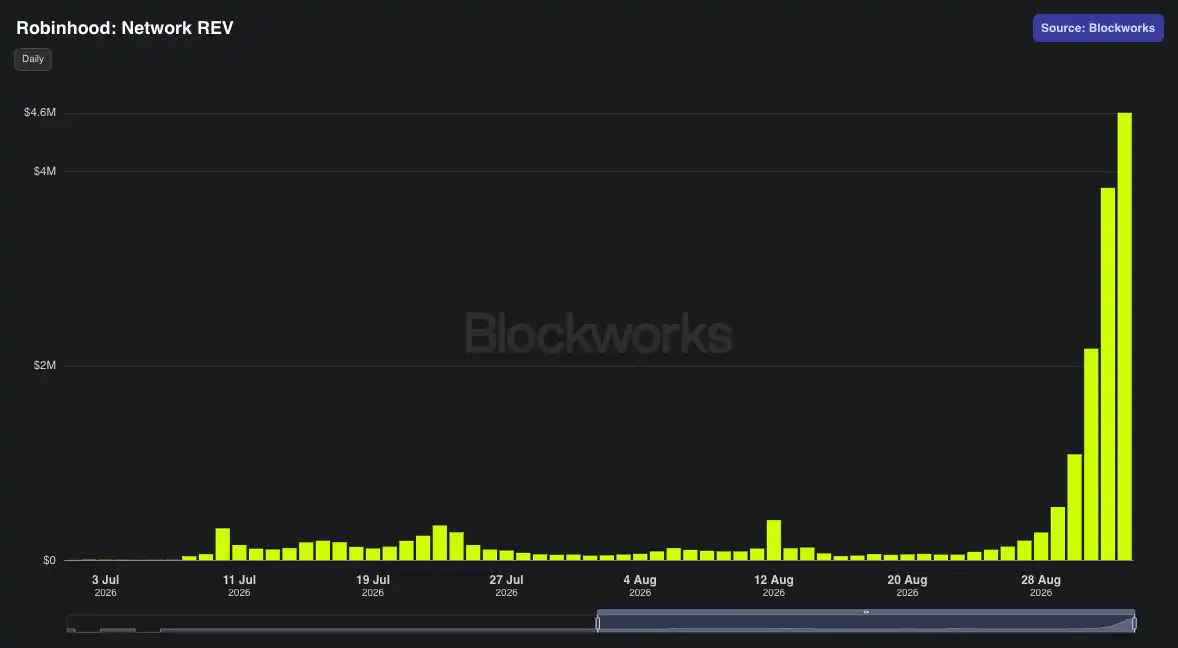
Block space demand on the Robinhood Chain is recovering, with REV breaking $4.6 million yesterday. This marks 11 consecutive days of rising demand on this young L2, bringing it to 97% of total L2 profits and 42% of all on-chain network revenue. One can't help but annualize that number and imagine even greater implications for HOOD stock and the network's applications.
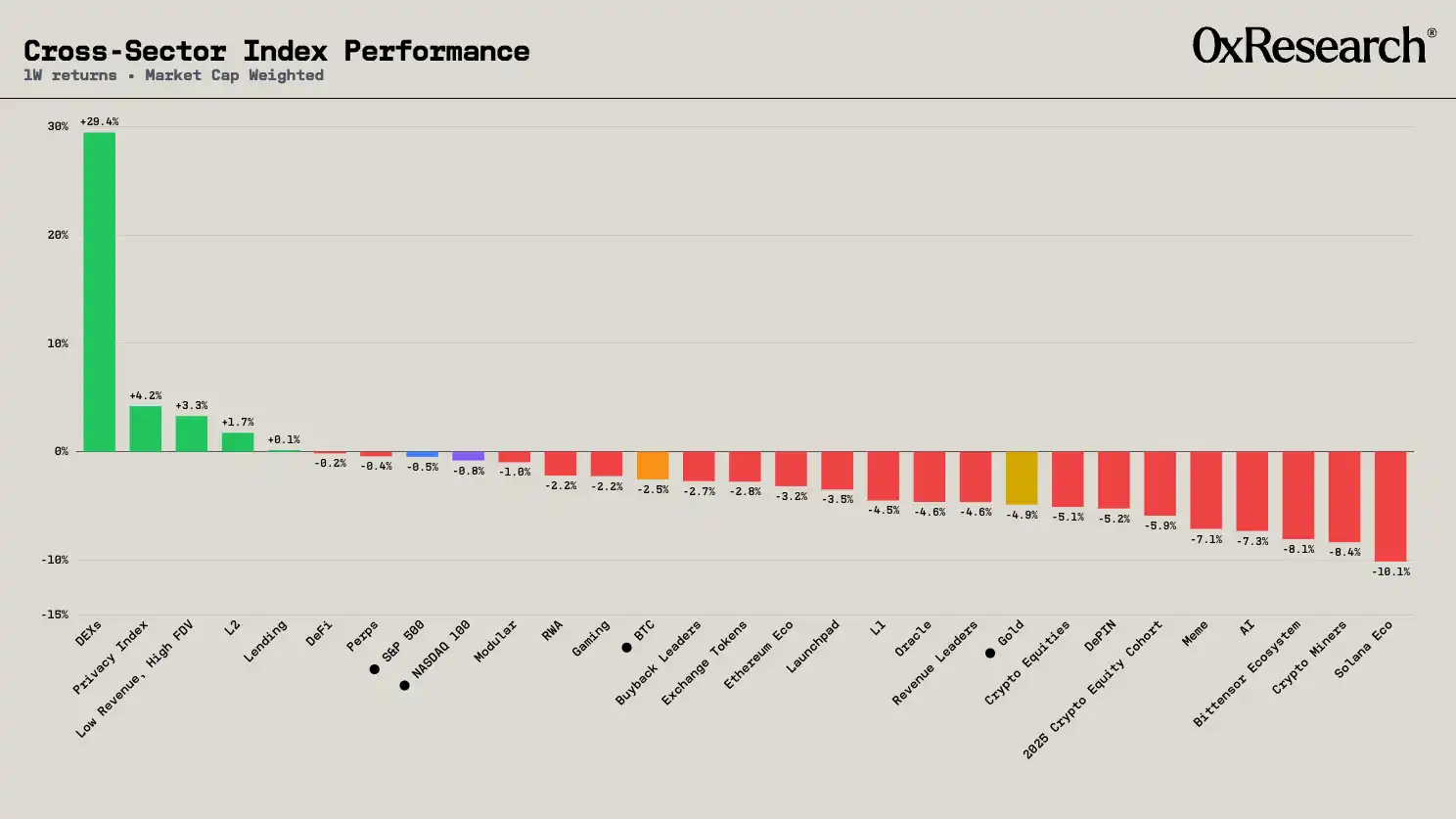
Uniswap is one such winner, being the largest DEX on the Robinhood Chain. Recent token incentive adjustments and a breakthrough deployment on Robinhood drove the token up 33% this week, leading index gains during a week of sideways movement for major coins and a stock market dip. Index data confirms this, with the DEX sector up 29% this week, a clear divergence from overall price action. UNI drove that outperformance.
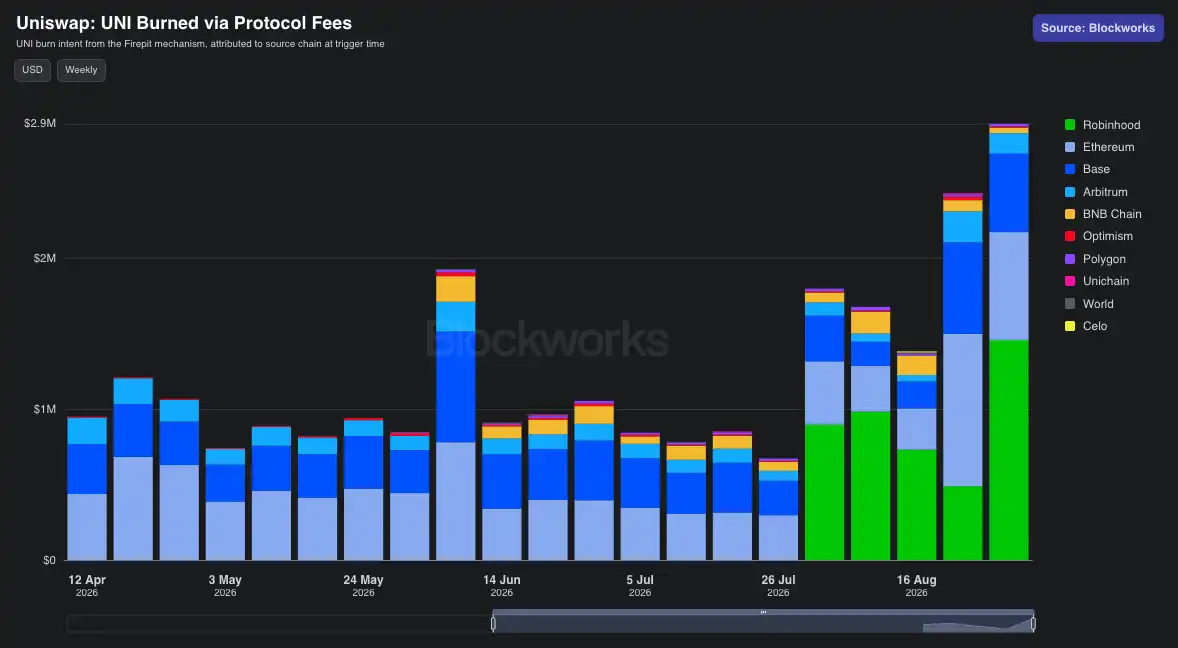
The launch of Robinhood Chain represents a "growing the pie" scenario. It's not taking volume from existing platforms but bringing incremental demand to the entire on-chain economy. For Uniswap, this is evident in the UNI burned via protocol fees, which are at weekly highs, with over 50% of the burn originating from Robinhood Chain. Similarly, over the past 30 days, Robinhood Chain accounted for more than 50% of all on-chain Uniswap total volume. Looking at recent activity, deployment volume on Robinhood exceeded the combined activity of all other chain deployments, including the ETH mainnet.
Beyond the on-chain battlefield, ETFs appear to be bottoming in AUM, suggesting major tokens might be forming a higher time frame low. In August, BTC ETFs added $3.871 billion, and ETH ETFs added $1.911 billion. SOL and HYPE products also saw demand, albeit far less than their predecessors.
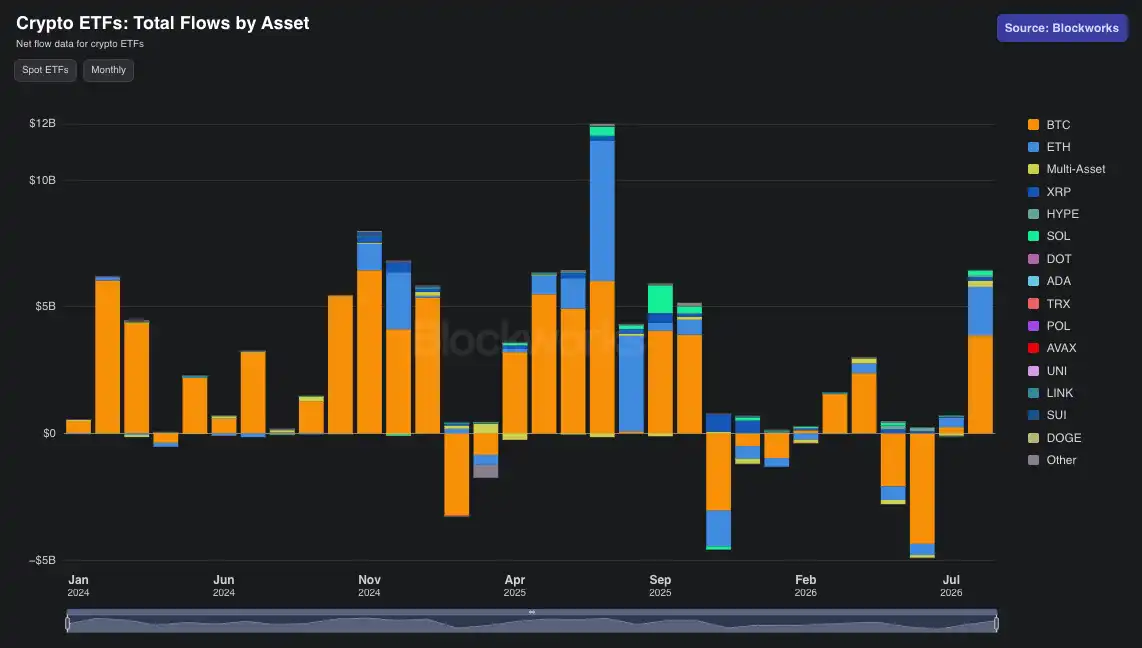
Taken together, flows, fundamentals, and price action all support an optimistic outlook for year-end and beyond.

Anatomy of the Helium Short Squeeze

HNT hit a multi-year low of $0.167 on August 15, with a market cap nearing $31 million. Two weeks later, the token touched $0.96 intraday, a 5.7x rally from trough to peak. As of this morning, it trades around $0.50, still up over 125% this week with a market cap of about $95 million. This rally warrants dissection because the catalysts were real, positioning amplified them, and the on-chain record is more interesting than either narrative.

The news unfolded in four steps. Helium published HIP-150 on August 21, proposing to redirect Mobile subDAO issuance to deployers carrying paid data traffic. On August 28, Helium announced Celina, Texas had switched its public Wi-Fi to operator coverage on the network. Shorts got crushed over that weekend, the community passed HIP-150 on August 31 with 96.2% voting power in favor, and Helium followed on Tuesday with the launch of HeliumOS, a B2B platform giving operators and MVNOs tools to lease coverage rather than build it themselves.

The US Census Bureau listed Celina as the fastest-growing US city among those with over 20,000 residents. The city layered Helium's operator offload onto its existing Wi-Fi in public libraries, senior centers, and downtown stores, with phones connecting via Passpoint credentials on their SIM cards. Helium's oracle showed the entire Mobile network transmitted 78,000 GB on the day of the announcement, with Celina accounting for roughly 0.1%.
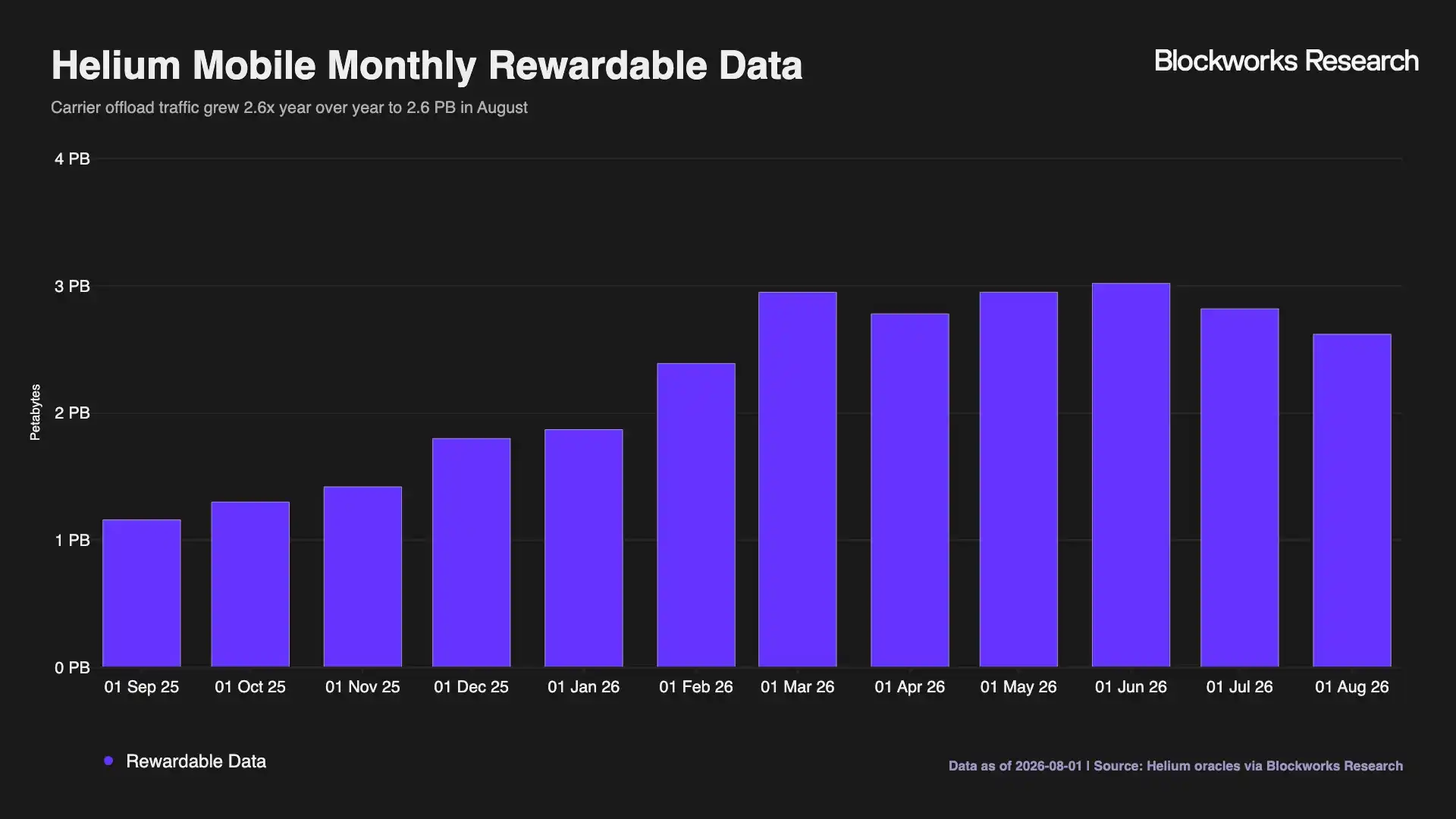
Zooming out, fundamentals diverge in two directions. Usage looks strong, with rewardable operator offload data up 2.4x year-over-year from 1.26 PB in August 2025 to 3.06 PB last month, and daily traffic holding the trend through the rally without an inflection. Revenue goes the other way. Payors spent $263,000 in Data Credits on mobile traffic in August, down 82% from a $1.47 million peak in March.

As we reported in June, the $0.50/GB rate behind that peak was subsidized by Nova Labs, burning its own HNT as a stopgap while operators negotiated location-based pricing ranging from zero in low-value sites to over $0.50 in airports. HIP-143 brought the nominal rate to about $0.10/GB, a level operators could accept at scale, and oracle data shows the subsidy tapered off in June. The March peak measured Nova's balance sheet as much as operator demand. August's DC burn is the first clean read of operators' organic spend.
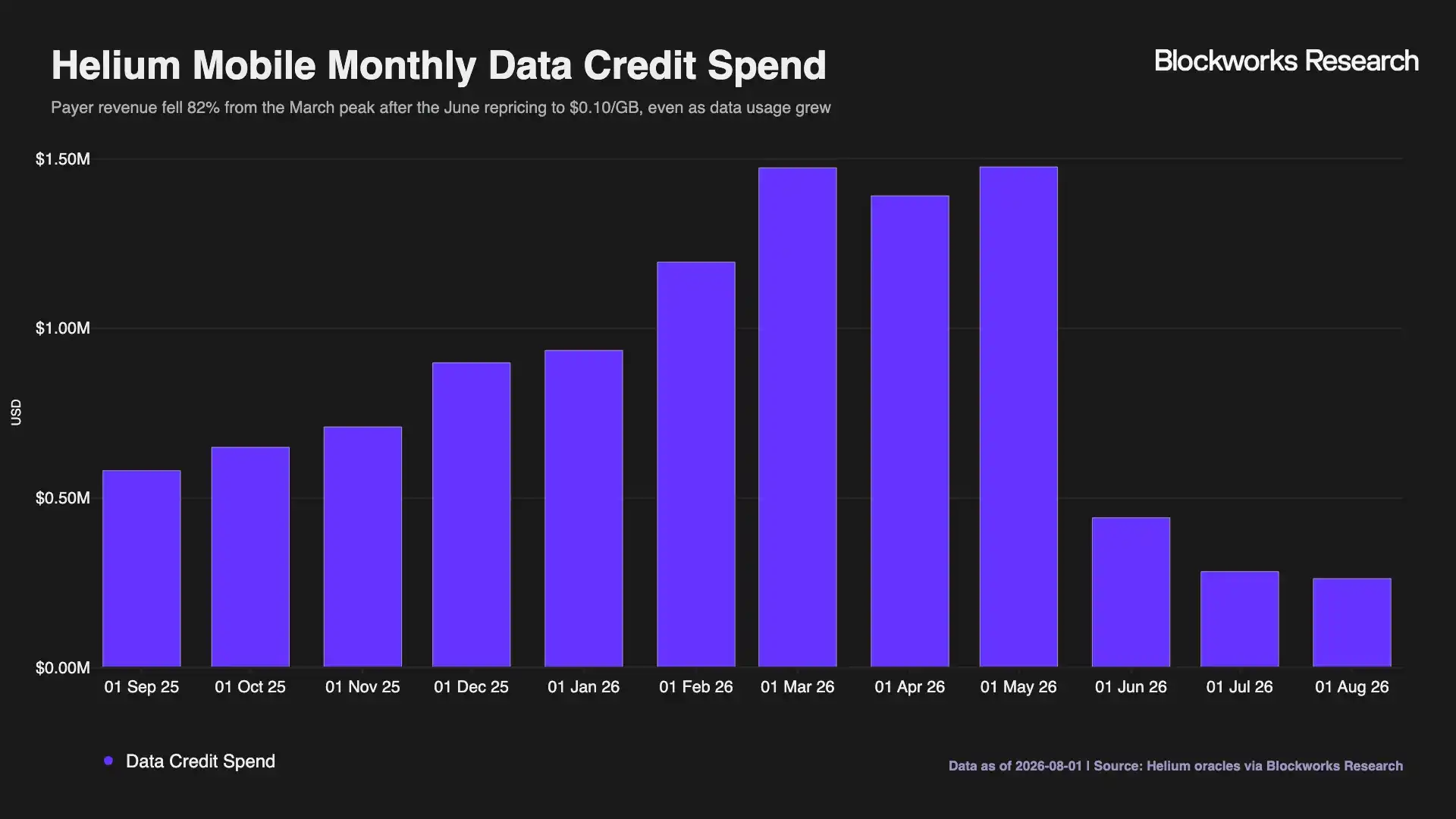
The subsidy's removal explains the urgency of HIP-150. HIP-149, passed in July, set deployer floor prices at 50% of the new operator rate, or $0.05/GB. August's proposal restored their economic incentive, raising floors to 80% ($0.08/GB) with multipliers up to 5x per hotspot, formalizing location-based pricing that operators had already negotiated off-chain, while redirecting Backstop mints directly to the deployer data rewards pool, plugging a leak where the DAO minted $1.60 worth of HNT for every $1.00 that reached deployers. Nova Labs will provide its service provider rewards through July 2027, raising the Mobile data bucket's share of the subDAO from 70% to 94%.
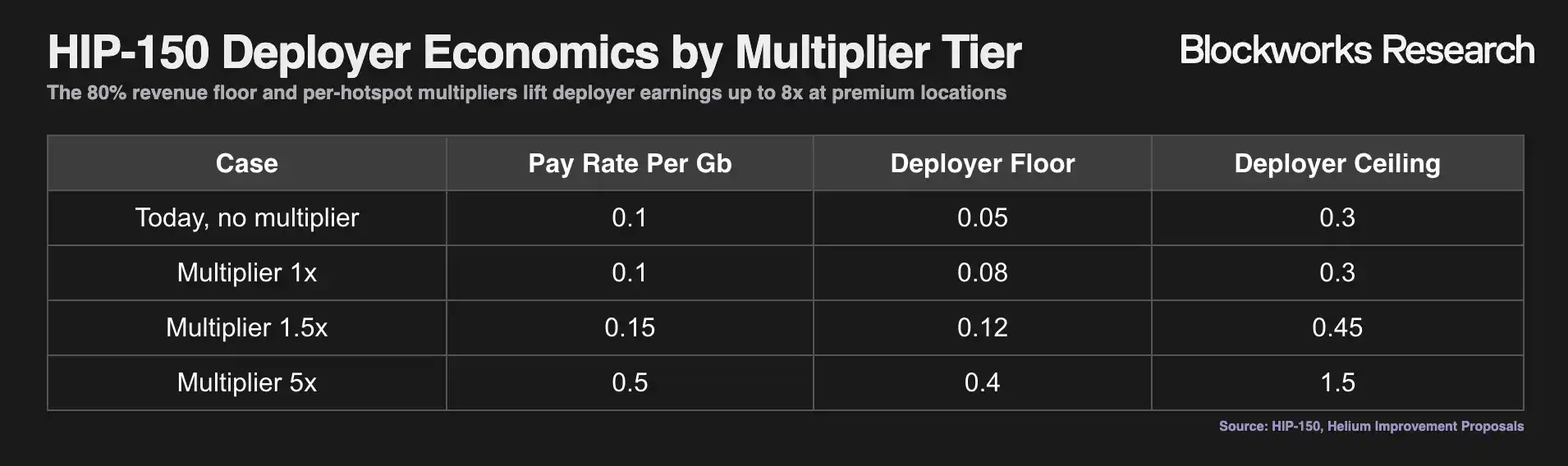
The valuation math remains harsh. August's Data Credit spend annualizes to ~$3.1 million against a $95 million market cap, or about 30x payor revenue, and the supply side works against holders.

HIP-149's growth subsidy mints ~5.96 million HNT per month for the first year into a Nova-managed treasury. That lifts the effective max supply from 206 million to 347 million tokens. So at current rates, operator burn runs at less than a tenth of monthly issuance.

Positioning filled the gap. HNT perpetual funding rates dropped below -1.2%, with $1.6 million in short liquidations over the weekend against less than $200,000 for longs. Volume hit $248 million on August 30, exceeding the entire market cap.

The tape describes a short squeeze that found a good story.

This squeeze has repriced HNT to a level where growth bets must pay off.

Nova sold the consumer business, ended the subsidy, and now funds operator expansion via the HIP-149 treasury. So value accrual can only come from operator offload burn growth, at a pace that exceeds new issuance.

Management set its own target in June: an inflection point at 7 to 10x current traffic. That's when Helium's roaming share from partner operators reaches double digits and pricing leverage flips.

HIP-150 keeps deployers solvent on the way there. HeliumOS is the platform layer promised in Di Dio's roadmap, though its launch customer Affinity Ventures owns Noble Mobile and recently acquired Helium Mobile.


Related Questions

QWhat is the main contradiction identified in Helium's (HNT) recent price surge?

AThe main contradiction is that while the HNT token price surged 5.7 times in two weeks, driven by news catalysts and a short squeeze, the network's actual revenue from data credits plummeted by 82% during the same period.

QWhat were the four key news events that drove the recent price action for HNT?

AThe four key events were: 1) The proposal of HIP-150 to redirect Mobile subDAO emissions to deployers carrying paid data traffic (August 21). 2) The announcement that Celina, Texas switched its public Wi-Fi to Helium network coverage (August 28). 3) The community passage of HIP-150 with 96.2% voting approval (August 31). 4) The launch of HeliumOS, a B2B platform for operators and MVNOs (September 3).

QHow did the change in Data Credit (DC) pricing and subsidies contribute to the drop in revenue?

AThe peak revenue in March was artificially high due to subsidies from Nova Labs, which burned its own HNT to set a rate of ~$0.50/GB. HIP-143 later adjusted the nominal rate to ~$0.10/GB, a level sustainable for operators. The subsidies were phased out by June. The August DC burn of $263k represents the first clean reading of organic operator spending, explaining the 82% drop from the subsidized peak.

QWhat role did market positioning and derivatives play in the HNT price surge?

AMarket positioning, particularly a high level of short interest, amplified the price surge into a short squeeze. HNT perpetual funding rates fell below -1.2%, and over a weekend, short liquidations reached $1.6 million compared to less than $200k for longs. Trading volume on August 30th exceeded the entire market cap, indicating intense speculative activity.

QAccording to the article, what must happen for Helium's current valuation to be justified?

AFor the current valuation to be justified, the growth from operator data offload burn must accelerate significantly to outpace the new token emissions. Management's target is for a tipping point at 7 to 10 times the current traffic, where Helium achieves a double-digit share of roaming partners' traffic and gains pricing leverage. The recent proposals aim to keep deployers solvent until that scale is reached.

Related Reads

GPT-6.1 Sol Participates in Live Brain Surgery! Three Rounds of Localization, Each More Accurate Than the Last

Exin Therapeutics CEO Gabriel Ocana-Santero reported an experiment in which GPT-6.1 Sol participated in three rounds of real mouse brain surgery positioning. The task involved locating Bregma and Lambda, two key skull landmarks used to calibrate stereotaxic coordinates for accurate targeting of brain regions. After each round, a professional surgeon corrected the model's positioning results, and the model retained its images, measurements, and expert corrections for reference in subsequent rounds. By the third round, GPT-6.1 Sol reduced landmark search time from 169 to 86 seconds, required corrections from four to two, and cut positioning error from 0.6 mm to 0.3 mm. Ocana-Santero described this as in-context learning from real-world experience. The team did not disclose how the experience records are integrated into the model or whether underlying weights are updated, so it cannot be described as autonomous training or parameter-level self-evolution. The sample is only three operations, far from proving stable surgical capability, but it demonstrates AI accumulating experience from real observations and expert feedback. This follows earlier Exin work in which AI selected gene therapy vectors, chose injection targets and coordinates, and controlled a stereotaxic device in a mouse experiment, with a licensed veterinarian supervising and safety limits in place. In a further experiment, Claude Sonnet 5, GPT-6.1 Sol, and Grok 4.7 chose different brain regions and treatment strategies for the same scientific goal, suggesting models may reason toward different experimental paths.

marsbit1h ago

GPT-6.1 Sol Participates in Live Brain Surgery! Three Rounds of Localization, Each More Accurate Than the Last

marsbit1h ago

From Drones to Nuclear Reactors: What Has Paradigm Invested in Since Leaving the Crypto World?

Paradigm, a venture capital firm known for crypto investments like Coinbase and Uniswap, is rapidly expanding into hard tech. In November, it co-led a $1.5 billion funding round for Zipline, a US drone delivery company now valued at $21.5 billion—nearly triple its valuation from January. Zipline, founded in 2014, began delivering medical supplies in Rwanda and now operates a large-scale automated logistics network, having completed 150 million miles of commercial autonomous flights. Walmart plans to add 300 new delivery sites, and Uber aims to scale their partnership to one million daily orders by 2029. Paradigm's broader portfolio now spans AI, robotics, manufacturing, semiconductors, space defense, and nuclear energy. Investments include open-source AI lab Nous Research, math-reasoning AI firm Harmonic, AI data company Idler, and GPU platform Andromeda. It also backs SendCutSend (metal parts manufacturing), Fab2 (compact semiconductor factories), True Anomaly (space defense), and Antares (micro nuclear reactors). In July, Paradigm launched a $12 billion new fund for frontier tech. This shift reflects a broader VC trend toward AI and physical technology, as crypto's path to sustained commercial revenue remains uncertain. Paradigm's bets focus on companies solving concrete industrial problems with existing markets, aiming to build a hard-tech network that transcends crypto cycles.

marsbit2h ago

From Drones to Nuclear Reactors: What Has Paradigm Invested in Since Leaving the Crypto World?

marsbit2h ago

Nomura: "Blue Wave" Hits US Data Centers, China's AI Benefits Instead

Nomura argues that the Democratic "blue wave" in the US midterms could paradoxically benefit China's AI economy. Democratic victories in key data-center states will likely tighten regulation, shift grid upgrade costs onto developers, and lengthen approval timelines, slowing US data-center expansion. Market reaction was sharp: the Nasdaq fell 5.5% in a single day, the SOX dropped nearly 15% over two days, Nvidia fell about 12%, and Micron about 24%. Because US cloud giants had been hoarding global GPU, HBM, and advanced logic chip capacity—driving black-market premiums of 200–300% at Asian logistics hubs—a US capex slowdown could collapse those speculative premiums, letting Chinese AI firms, cloud providers, and research institutions obtain GPUs, HBM modules, and advanced packaging materials more cheaply through intermediary trade hubs. China is also building a state-led national AI data-center network, with roughly RMB 2 trillion planned under the 15th Five-Year Plan to integrate regional computing by 2028, supported by low-cost renewable power in western hubs under the "East Data, West Computing" program. Morgan Stanley, meanwhile, does not see the blue wave as a real easing of US-China tensions; it expects strategic competition to persist but sees greater policy predictability. It prefers China's "self-sufficiency" AI trade—supported by both supply and demand under national policy priorities—over export chains tied to global AI capex. It also notes more balanced opportunities in Chinese equities, with valuations near historic lows.

marsbit2h ago

Nomura: "Blue Wave" Hits US Data Centers, China's AI Benefits Instead

marsbit2h ago

After GPT-6, Embodied Large Models Are Trapped in Their Own Territory! Next Year's Self-Research Budget Is Probably Up in the Air

The article discusses how the release of GPT-6 Astra (and the imminent GPT-6.2 Astra) has disrupted the embodied AI/robotics industry. General-purpose large models are now encroaching on capabilities that embodied AI companies previously developed in-house—such as in-context learning, out-of-distribution generalization, error correction, and open-vocabulary manipulation—often without task-specific post-training. On benchmarks like RoboDojo, teams combining general models with robot-use-agent techniques saw scores jump from 20–30 to 50–60, prompting many to question whether self-developing embodied foundation models still makes sense. Some companies have begun cutting algorithm roles. However, the article notes GPT-6 Astra still struggles with complex physical contact, force control, object deformation, and high-precision manipulation, and its cloud API inference latency is high (though this is not seen as a fundamental barrier). Experts argue that general models' current weaknesses shouldn't be treated as durable moats for embodied companies, since OpenAI is already hiring robotics talent and future models may absorb more robot operation data. The core argument is economic: embodied companies' opportunity lies not in building smarter models but in delivering better economic value. Stable, standardized industrial tasks may be better served by lightweight, specialized models or rule-based strategies, while open-ended tasks (e.g., home service robots) may benefit from general models. Ultimately, companies need to re-prioritize their R&D directions—leveraging general models for language understanding and task planning while focusing in-house efforts on physical interaction, embodiment-specific control, real-world adaptation, and deployment efficiency. The article concludes that the industry is moving past the demo-and-burn-investment stage, and the elimination round among the "hundred robot wars" has begun.

marsbit2h ago

After GPT-6, Embodied Large Models Are Trapped in Their Own Territory! Next Year's Self-Research Budget Is Probably Up in the Air

marsbit2h ago

Trading

Spot
活动图片