AI Reshapes the Semiconductor "Smile Curve": The Rising Logic Behind the Global Distributed Bull Market

marsbitPublicado em 2026-06-17Última atualização em 2026-06-17

Resumo

The Philadelphia Semiconductor Index (SOX) has hit a historic high above 14,000 points, driven by a concentrated AI-fueled semiconductor rally. Key drivers are extreme scarcity and pricing power in critical bottlenecks of the AI data center supply chain. Unlike traditional models where manufacturing held lower profits, AI has reshaped the "Smile Curve." Highly complex manufacturing and advanced packaging nodes—like TSMC's CoWoS, SK Hynix's HBM, and ASML's EUV lithography—have become exceptionally scarce and high-margin, rivaling design-side profitability. The market rewards those controlling irreplaceable segments: U.S. firms lead in AI chip design and cloud services; Taiwan and Korea dominate advanced foundry/logic and memory/HBM respectively; Japan and the Netherlands supply vital materials and equipment. Storage, particularly HBM, is the tightest bottleneck, with severe shortages predicted through 2027. While bullish analysts project sustained AI infrastructure spending growth, notable bears like Michael Burry warn of bubble-like exuberance reminiscent of the dot-com era, citing overleveraged private financing for data centers. Key near-term catalysts include earnings guidance from Micron and Nvidia, while longer-term risks hinge on the 2027-2028 capacity expansion wave and persistent geopolitical tensions in concentrated supply chains.

U.S. stocks closed overnight, with the Philadelphia Semiconductor Index (SOX) breaking through the 14,000-point mark for the first time, hitting a new all-time high.

Historically, there have only been two periods when the SOX rose over 230% within 14 months: from December 1998 to February 2000, and from April 2025 to the present.
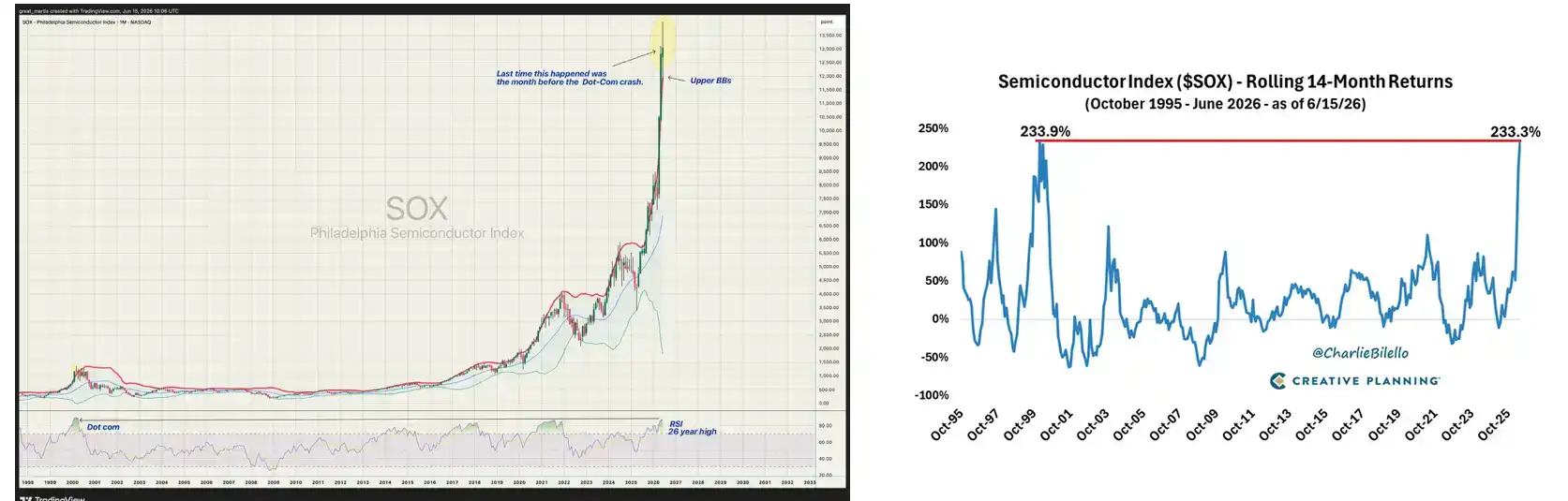
The returns in this semiconductor bull market have been highly concentrated and significant. The year-to-date gains for the memory trio—Micron, SK Hynix, and Samsung—are approximately 141%, 186%, and 114%, respectively. TSMC's U.S. ADR has gained over 50% year-to-date.

Nvidia hit a new all-time high of $235.47 on May 14. Broadcom, Marvell, and ASML have either set new records or are approaching them in their respective market segments. The 52-week low for the entire SOXX ETF is $148, with the high near $369, representing a price swing of nearly 150%.

In April, Goldman Sachs revised its 2026 DRAM supply-demand deficit forecast from 3.3% to 4.9%, calling it the most severe memory shortage in 15 years. HBM prices are even more staggering: a single HBM3E stack costs about $300, and the upcoming HBM4 is estimated at $500 per stack. SK Hynix's 2026 HBM capacity has already been fully booked by Microsoft, Google, and Nvidia, with some customers even paying deposits in full upfront to secure capacity.

Clearly, the speed of AI data center construction is far outpacing the expansion of chip production capacity.

The 'Bottleneck' Bull Market

Scarcity is the most profitable product.

Understanding this phrase essentially captures the core logic of this semiconductor bull market. Whoever controls the bottleneck in AI infrastructure holds the most powerful pricing authority. Conversely, for segments that can be substituted or face price pressure, even with high demand, stock prices won't rise.

Optical modules are a typical example of the latter. A Photon Capital report in April pointed out that while Chinese optical module companies hold seven of the top ten global spots, they aren't making much profit; the profits are still with the chip companies. Zhongji Innolight and Sunsea are at a global first-tier level in terms of shipment volume and cost control for 800G and 1.6T optical modules, directly squeezing the margins of U.S. optical module companies like Coherent and Lumentum. Demand has doubled, yet profit margins have thinned. The reason is singular: the assembly stage of optical modules is not scarce enough.

Memory, meanwhile, has become the hardest theme in this U.S. semiconductor bull market. Essentially, it's because it controls a bottleneck, and that grip is tightening.

HBM is not ordinary DRAM. 3D stacking, TSV (Through-Silicon Via), specialized packaging processes—each layer of technological barrier is the result of over a decade of heavy capital investment. Globally, only three companies can mass-produce HBM, with SK Hynix taking roughly half the market share.

Interestingly, this logic holds true even when magnified to a macro, national level.

The true winners in AI data center infrastructure are not "all semiconductor countries," but those countries and regions that, over the past few years or even decades, have built scarce industrial clusters in some irreplaceable link of the chain. Scarcity is the key.

Every Region Has Its Own Main Track

It's quite interesting to see this perspective raised in U.S. stock forums.
The United States remains at the top of the value chain.

Nvidia, AMD, Broadcom's ASIC design; Synopsys and Cadence's EDA tools; Arista's AI networking; the three major cloud providers packaging computing power as services sold worldwide. Google, Amazon, and Microsoft are all accelerating in-house ASIC development. Broadcom and Marvell collectively hold about 95% of the custom ASIC design market. Google alone spends roughly $8 billion annually on TPU development with Broadcom.

The core nodes in manufacturing are in Taiwan and South Korea, but they are eating from completely different plates.

Taiwan's story revolves around TSMC and advanced packaging. 3nm and 2nm processes can only be mass-produced by TSMC globally. TSMC's three CoWoS backend factories are fully loaded, with lead times of 52 to 78 weeks. Nvidia alone has locked up 60% to 70% of CoWoS capacity. TSMC is expanding its monthly capacity from 35,000 wafers at the end of 2024 to 130,000 wafers by the end of 2026, nearly a fourfold increase. Even with this expansion, capacity remains tight. Taiwan's server OEM system, including Foxconn, Quanta, and Wistron, is also benefiting from the surge in AI server shipments.

South Korea's story is entirely centered on memory. SK Hynix captures about 50% to 55% of the global HBM market share, Samsung holds 19% to 35%, and Micron around 5% to 20%. HBM is not the same as ordinary memory; 3D stacking, TSV, specialized packaging—each layer of technological barrier is the result of decades of continuous heavy investment by South Korean companies.

Japan and the Netherlands also play crucial roles. Tokyo Electron makes semiconductor equipment; Shin-Etsu Chemical and SUMCO produce silicon wafers; Ajinomoto makes ABF substrate materials. Japan has long been out of the competition in finished chip products, but its position in materials and precision processing remains irreplaceable today.

The Netherlands is even more direct: ASML monopolizes EUV lithography machines. In January, Morgan Stanley significantly raised its target price for ASML to 1400 euros, predicting that 2027 will be the company's year of highest profit growth, with EPS growing 57% year-over-year. They base this judgment on three drivers: better-than-expected expansion of advanced logic foundry capacity, large-scale expansion in the DRAM memory sector, and overall demand performing better than expected. Dutch packaging equipment companies like BESI are also securing large orders amid the explosion in AI chip packaging demand.

China and Europe have different entry points, but the logic is similar: they have established cost advantages or delivery capabilities in specific links of AI infrastructure.

Zhongji Innolight and Sunsea are at a global first-tier level in shipment volume and price control for 800G and 1.6T optical modules. However, Photon Capital's analysis also warns of an important time window: the current high profit margins of optical module companies come from temporary pricing power due to the short-term shortage of 800G capacity. Once 1.6T ramps up in the second half of 2026 into 2027 and second- and third-tier manufacturers also fill their capacity, price pressure on the module end will arrive quickly.

In Europe, companies like Schneider Electric, ABB, and Vertiv, which focus on power distribution and thermal management, are receiving orders far exceeding expectations against the backdrop of soaring data center power consumption. Wedbush estimates that hyperscalers' AI infrastructure spending in 2026 will be about $725 billion, a 77% year-over-year increase, with power infrastructure being one of the fastest-growing subcategories.

AI Reshapes the Semiconductor "Smile Curve"

Using the smile curve to summarize this landscape: The left end, led by the U.S., is responsible for "definition and design." The mid-to-high segment, involving Taiwan (China), South Korea, the Netherlands, and Japan, is responsible for "manufacturing advanced chips." The mid-to-low segment, involving Taiwan (China), China, and Southeast Asia, handles "large-scale assembly." The right end, with the U.S. and China, handles "cloud platforms, models, and customer access."
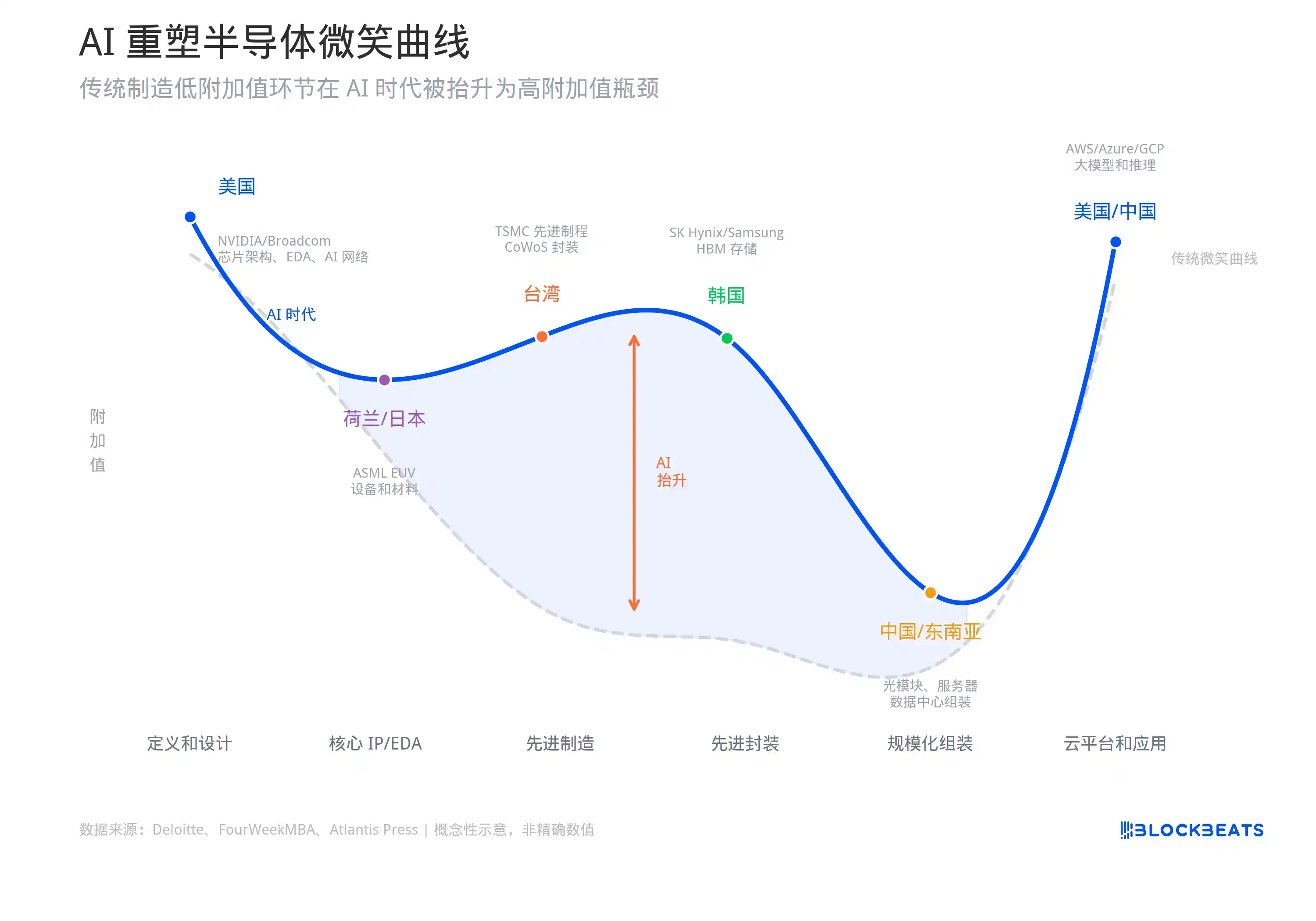
The original creator of this curve was Stan Shih, founder of Acer, who in 1992 used this model to explain why PC assembly had the thinnest profit margins.

But thirty years later, AI data centers are rewriting the shape of this curve.

Value chain analyses by FourWeekMBA and a paper published this year by Atlantis Press both point to the same conclusion: AI is re-elevating the middle segment of the traditional smile curve. TSMC's advanced CoWoS packaging, SK Hynix's HBM stacking, and ASML's EUV lithography machines—these segments, which in the traditional manufacturing smile curve belonged to the low-margin "middle manufacturing segment"—have become the most scarce resources in the AI era, with profit margins and pricing power not lower than those of the design or application ends.

Data from the paper shows that Nvidia's gross margin for 2023-2024 was 72.72%, with a net margin of 48.85%. However, TSMC's gross margin for Q1 2026 also reached 66.2%, with a net margin of 50.5%. The gap between design and manufacturing margins is narrowing, which is unprecedented in the history of the semiconductor industry.

The traditional smile curve posits that manufacturing has the thinnest margins. AI is turning the most difficult manufacturing links into the most scarce resources.

Morgan Stanley's March report on Asian semiconductors reached a similar conclusion: the 2023-2024 AI cycle was primarily focused on GPUs. From 2025 to 2026, demand is starting to diffuse across a broader industry chain, with memory, advanced packaging, custom ASICs, and data center networking taking the baton.

Every rotation of the bottleneck brings a new group of previously overlooked companies to the forefront, while those that gained the most in the previous phase enter a consolidation period.

How Much Further Can the Bull Run? Bull vs. Bear Views

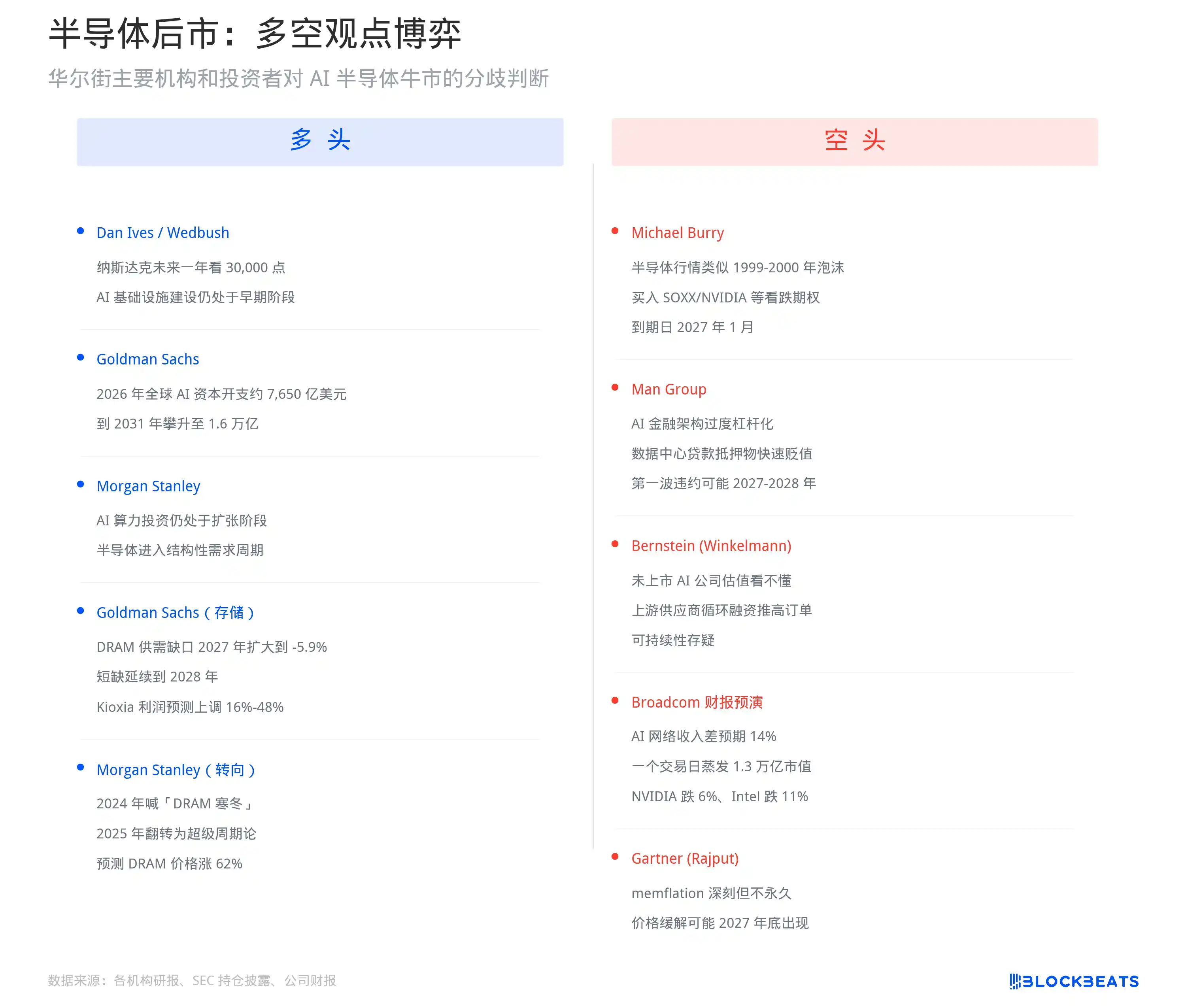
Let's first hear from the bulls. Wedbush's Dan Ives said on CNBC in May that he expects the Nasdaq to reach 30,000 points in the next year, citing that AI chip demand still far exceeds supply. Goldman Sachs provided more concrete numbers: global AI capital expenditure in 2026 is about $765 billion, climbing to $1.6 trillion by 2031.

Morgan Stanley's March report on Asian semiconductors explicitly stated: AI computing investment is still in an expansion phase, and the semiconductor industry is entering a new structural demand cycle.

Bullish calls on memory are even more aggressive. Goldman Sachs recently revised down its DRAM supply-demand deficit forecasts for 2026-2028 into deeper shortage territory, adjusting the 2027 deficit from -2.5% to -5.9%, almost double. Their judgment is that this memory cycle is different from past ones: AI server demand has higher visibility, supply growth is locked down by long-term contracts, and price increases will last longer than the market expects.

Goldman Sachs even significantly raised its operating profit forecasts for Kioxia for 2027-2029 by 16% to 48%, citing that this period of high profitability could last two to three years. For a company in the highly cyclical memory business, a "high profitability lasting three years" call is very rare on Wall Street.

Morgan Stanley's change in stance is even more interesting. In 2024, they were still calling for a "DRAM winter," predicting price declines for years starting in Q4 2024. By 2025, they completely flipped to a super-cycle thesis, forecasting a 62% DRAM price increase in 2026 and predicting that SK Hynix and Samsung's profits would exceed consensus expectations by 30% to 50%.

But the bearish voices are also loud and come from significant players.

Michael Burry publicly warned in May that this semiconductor rally closely resembles the final months of the 1999-2000 internet bubble. The SOX is up 65% year-to-date, gained 10% in a single week, and the SOXX ETF is 60% above its 200-day moving average—this level of technical stretch has rarely been sustainable historically. SEC filings show he purchased a large number of put options on SOXX, QQQ, Nvidia, Palantir, and Oracle, expiring in January 2027, with strike prices well below current levels.

Man Group (one of the world's largest listed hedge funds) published a lengthy article in June specifically dissecting AI bubble risks. Their core view is that the financial architecture built around AI has become too large, over-leveraged, and overly reliant on a few interconnected players.

They specifically mentioned that a significant portion of AI data center construction is financed through private credit, with these loans collateralized by "hardware that depreciates as quickly as mobile phones, not long-term assets like buildings." The first wave of defaults could emerge in 2027-2028, when initial leases expire and the gap between financing assumptions and reality becomes impossible to ignore.
Looking ahead, several time nodes are worth watching.

Micron's earnings report on June 24th will be crucial; forward guidance on HBM demand and capacity allocation will determine the direction of the entire memory sector for the summer. Nvidia's next earnings report is equally critical; if there is even a slight signal of deceleration in AI chip demand, the sentiment across the sector will be repriced once again.

Looking further out, the timeline for capacity ramp-up is the real watershed. SK Hynix's M15X fab is expected to ramp in mid-2027, with its Yongin new fab moved up to February 2027. Samsung's P5 fab will come online in 2028. Micron's Idaho Fab 1 is expected to contribute output in mid-2027.

Combined, industry capacity will increase by 20% to 30% in the second half of 2027 to the first half of 2028. The question is whether HBM demand, with a compound annual growth rate of over 40%, will be met. Whether supply can catch up with demand depends on whether AI capital expenditure slows down before then.

The final variable is geopolitics. The higher the concentration of the semiconductor supply chain, the greater the impact of a black swan event. TSMC alone accounts for over 90% of global advanced process foundry capacity—this number represents efficiency during a bull market but systemic risk in a conflict scenario. Factors like the Taiwan Strait situation, potential escalation of U.S. export controls on China, and the degree of cooperation from Japan and the Netherlands on equipment restrictions are topics no one wants to discuss when the market is good. But if something happens, repricing will happen faster than any fundamental change.

Criptomoedas em alta

Perguntas relacionadas

QWhat is the core logic behind the current semiconductor bull market, according to the article?

AThe core logic is scarcity. The companies that 'choke' or control the bottleneck in AI infrastructure—the most difficult-to-replace and technologically intensive segments like HBM memory and advanced chip manufacturing—hold the hardest pricing power and reap the greatest profits.

QHow is AI reshaping the traditional semiconductor 'smile curve'?

AAI is elevating the middle segments of the traditional smile curve. Previously considered low-margin manufacturing processes, such as TSMC's CoWoS advanced packaging, SK Hynix's HBM stacking, and ASML's EUV lithography machines, have become the most scarce resources in the AI era. Their profit margins and pricing power are now comparable to, and sometimes even higher than, the design and application ends of the curve.

QWhat are the key regional strengths in the AI-driven semiconductor value chain as described in the article?

AThe key regional strengths are: The US leads in design, EDA tools, AI networks, and cloud platforms/services. Taiwan (China) and South Korea are central to manufacturing; Taiwan excels in advanced foundry/logic (TSMC) and packaging, while South Korea dominates in memory/HBM production. Japan and the Netherlands control critical materials and equipment (e.g., ASML's EUV monopoly). China has cost advantages in assembly-scale segments like optical modules. Europe is strong in power and cooling infrastructure for data centers.

QAccording to the article, what are the main bullish arguments for the semiconductor market's continued growth?

ABullish arguments include: AI chip demand still far outstrips supply (Wedbush). Global AI capital expenditure is projected to grow massively, from ~$765B in 2026 to $1.6T by 2031 (Goldman Sachs). The industry is in a new structural demand cycle (J.P. Morgan). The DRAM shortage, especially for HBM, is seen as more severe and persistent than past cycles due to high-visibility AI server demand and long-term supply lock-ins, potentially sustaining high profits for several years (Goldman Sachs, J.P. Morgan).

QWhat are the primary risks or bearish concerns cited regarding the AI/semiconductor boom?

APrimary risks include: A potential bubble, with technical indicators and rapid price appreciation reminiscent of the 1999-2000 dot-com bubble (Michael Burry). An over-leveraged financial architecture where AI data centers are financed by private credit secured against rapidly depreciating hardware, raising default risks when initial leases expire around 2027-2028 (Man Group). A potential supply-demand inflection point when major new HBM/manufacturing capacities come online in 2027-2028. Geopolitical risks, as the highly concentrated supply chain (e.g., TSMC's dominance) is vulnerable to disruptions from events like cross-strait tensions or export control escalations.

Leituras Relacionadas

Unveiling the Whales of the World Cup Prediction Market: Smart Money Stumbles on the Pitch, 'Buy No' Outperforms 'Buy Yes'

**Title: Unveiling the Whales of the World Cup Prediction Market: "Smart Money" Stumbles on the Pitch as "Buying No" Outperforms "Buying Yes"** An analysis of pre-match trades over $5,000 on Polymarket for 20 completed group stage matches reveals a counterintuitive finding: large "smart money" bets were not consistently accurate. Aggregated pre-match buying volume was $89.55 million, with a weighted hit rate of only 48.5%. Holding these positions would have resulted in an estimated net loss of about $1.76 million (ROI -2.0%), challenging the notion that big money reliably predicts outcomes. The data highlights several key dynamics. Draws proved to be a major risk, significantly impacting bets on favored teams, as seen in Belgium-Egypt and Spain-Cape Verde. Markets were more efficient for clear mismatches (e.g., Germany's big win) but became prone to bias when favorites were overvalued. Notably, buying "No" shares (betting against a specific outcome) significantly outperformed buying "Yes," with hit rates of 62.4% vs. 37.5%. This suggests the market often overprices popular narratives, creating value in contrarian positions. Individual trades showed extreme volatility. One wallet (mintblade) earned an estimated $6.77 million by betting against Iran, while another (LEEEROYJENKINS) lost roughly $8.39 million on a Belgium win. The market favors high-risk, high-reward information trading rather than steady arbitrage. For sustained insight, wallets with consistent performance across multiple matches (e.g., swisstony) are more telling than one-off big bets. Ultimately, the Polymarket acts less as a crystal ball and more as a mirror, reflecting crowd bias and the inherent unpredictability of football. True "smart money" may lie not in predicting the future, but in identifying and exploiting market mispricings while respecting risk.

marsbitHá 10m

Unveiling the Whales of the World Cup Prediction Market: Smart Money Stumbles on the Pitch, 'Buy No' Outperforms 'Buy Yes'

marsbitHá 10m

Bezos' Third Startup Still Can't Avoid Musk

Jeff Bezos Returns as CEO for Third Venture, Still Can't Avoid Musk After stepping down as Amazon CEO in 2021, Jeff Bezos has returned to the front lines as co-CEO of Prometheus, an AI startup he founded. In a recent CNBC interview, Bezos described the experience as "Type 2 fun"—exhausting but ultimately rewarding. Founded less than a year ago, Prometheus has already raised over $18 billion in two funding rounds, achieving a staggering $41 billion valuation. Prometheus aims to develop a "General Engineer AI" to accelerate the entire "invention loop"—design, simulation, testing, and manufacturing—for complex physical products like jet engines, spacecraft, and medical devices. This positions the company at the intersection of Bezos's past experiences: Amazon's platform-building scale and Blue Origin's rigorous physical engineering. This marks Bezos's third major venture, following Amazon and Blue Origin. His co-CEO is Vik Bajaj, bringing expertise from life sciences and hard tech. Bezos now dedicates most of his time to Prometheus, signaling his belief in its transformative potential. The move also comes as Bezos's space company, Blue Origin, faces challenges, including a recent test explosion delaying its New Glenn rocket. Meanwhile, Elon Musk's SpaceX achieved a record-breaking IPO, surpassing Amazon's market cap. While Musk focuses on AI for executing physical tasks (like Tesla's robots and SpaceX's engineering), Bezos is betting on AI to *invent* in the physical world. Prometheus enters a crowded industrial AI field with players like OpenAI, NVIDIA, and Tesla's Optimus. Its lofty valuation bets on the unproven but massive opportunity to become the foundational platform for engineering in the AI era—a "blue ocean" Bezos hopes to define before Musk does.

marsbitHá 13m

Bezos' Third Startup Still Can't Avoid Musk

marsbitHá 13m

Won't US Stocks Ever Fall Again? The 'Great Melt-up' Trap in the Era of High Debt

The article analyzes a popular theory circulating online that the U.S. stock market may be mathematically incapable of a true, sustained decline due to the country's massive and growing national debt. The argument suggests that the government's only path to managing this debt is through inflation and money printing, which would nominally lift asset prices like stocks, creating a perpetual "melt-up." The author places this idea within the historical context of market melt-ups, such as the dot-com bubble and Japan's asset bubble, where prices detach from fundamentals driven by momentum and FOMO. While acknowledging that a high-debt environment creates incentives for inflation, which is generally favorable for assets over cash, the article refutes key claims of the online theory. It clarifies that interest payments are not about to exceed GDP, that printing money is not the only option for the government, and that stocks do not reliably rise in lockstep with hyperinflation, citing historical examples from Germany, Zimbabwe, and Venezuela. The more probable outcome, according to the author, is a prolonged period of financial repression—moderate inflation above interest rates that slowly erodes debt and cash purchasing power, leading to nominally higher asset prices but potentially lower real returns. The core warning is that while long-term market trends may be upward, this does not eliminate the risk of significant interim crashes (30%, 40%, or more) or guarantee real wealth creation during inflationary times. The conclusion advises against betting one's entire financial future on a smooth, perpetually rising market narrative. Instead, it recommends a disciplined, diversified strategy involving productive assets (stocks, real estate, some gold, short-term bonds) and an adequate cash buffer to avoid forced selling during downturns. The key takeaway is to avoid extreme concentration in expensive assets and leverage, and not to base investment decisions on the hope that every market dip will inevitably be rescued.

marsbitHá 33m

Won't US Stocks Ever Fall Again? The 'Great Melt-up' Trap in the Era of High Debt

marsbitHá 33m

The Fate of Digital Banks: No Fancy App Can Outshine a Banking License

The Fate of Digital Banks: A Flashy App is No Match for a Banking License The article argues that despite attracting billions of users with fee-free checking accounts and sleek apps, most "neobanks" struggle to be profitable because their core business—transaction fees—is inherently low-margin. The real profit engine of banking is lending (credit), which generates interest income. However, many early neobanks operated without their own banking licenses, which restricted their ability to lend at scale. Examples like Nubank, Revolut, and Chime illustrate the point. While they gained users with free accounts, their eventual profitability came from rolling out credit products. The piece highlights systemic risks for neobanks that rely on third-party infrastructure, citing the Synapse bankruptcy, which froze user funds and revealed the fragility of such models. The solution, according to the author, is obtaining a formal banking license, like the U.S. OCC's national trust charter. This provides regulatory backing, allows direct custody of funds, and eliminates dependency on intermediary partners. The trend is now evident in the crypto sector, where companies like Kraken, SoFi, and others are actively pursuing such licenses. The article concludes that while technology changes, the fundamental business logic of banking—profiting from lending—remains constant. Successful digital banks ultimately conform to this old model, just with better interfaces and fairer terms.

Foresight NewsHá 41m

The Fate of Digital Banks: No Fancy App Can Outshine a Banking License

Foresight NewsHá 41m

Trading

Spot
Futuros

Artigos em Destaque

O que é GROK AI

Grok AI: Revolucionar a Tecnologia Conversacional na Era Web3 Introdução No panorama em rápida evolução da inteligência artificial, a Grok AI destaca-se como um projeto notável que liga os domínios da tecnologia avançada e da interação com o utilizador. Desenvolvida pela xAI, uma empresa liderada pelo renomado empreendedor Elon Musk, a Grok AI procura redefinir a forma como interagimos com a inteligência artificial. À medida que o movimento Web3 continua a florescer, a Grok AI visa aproveitar o poder da IA conversacional para responder a consultas complexas, proporcionando aos utilizadores uma experiência que é não apenas informativa, mas também divertida. O que é a Grok AI? A Grok AI é um sofisticado chatbot de IA conversacional projetado para interagir com os utilizadores de forma dinâmica. Ao contrário de muitos sistemas de IA tradicionais, a Grok AI abraça uma gama mais ampla de perguntas, incluindo aquelas tipicamente consideradas inadequadas ou fora das respostas padrão. Os principais objetivos do projeto incluem: Raciocínio Fiável: A Grok AI enfatiza o raciocínio de senso comum para fornecer respostas lógicas com base na compreensão contextual. Supervisão Escalável: A integração de assistência de ferramentas garante que as interações dos utilizadores sejam monitorizadas e otimizadas para qualidade. Verificação Formal: A segurança é primordial; a Grok AI incorpora métodos de verificação formal para aumentar a fiabilidade das suas saídas. Compreensão de Longo Contexto: O modelo de IA destaca-se na retenção e recordação de um extenso histórico de conversas, facilitando discussões significativas e contextualizadas. Robustez Adversarial: Ao focar na melhoria das suas defesas contra entradas manipuladas ou maliciosas, a Grok AI visa manter a integridade das interações dos utilizadores. Em essência, a Grok AI não é apenas um dispositivo de recuperação de informações; é um parceiro conversacional imersivo que incentiva um diálogo dinâmico. Criador da Grok AI A mente por trás da Grok AI não é outra senão Elon Musk, um indivíduo sinónimo de inovação em vários campos, incluindo automóvel, viagens espaciais e tecnologia. Sob a égide da xAI, uma empresa focada em avançar a tecnologia de IA de maneiras benéficas, a visão de Musk visa reformular a compreensão das interações com a IA. A liderança e a ética fundacional são profundamente influenciadas pelo compromisso de Musk em ultrapassar os limites tecnológicos. Investidores da Grok AI Embora os detalhes específicos sobre os investidores que apoiam a Grok AI permaneçam limitados, é reconhecido publicamente que a xAI, a incubadora do projeto, é fundada e apoiada principalmente pelo próprio Elon Musk. As anteriores empreitadas e participações de Musk fornecem um forte apoio, reforçando ainda mais a credibilidade e o potencial de crescimento da Grok AI. No entanto, até agora, informações sobre fundações ou organizações de investimento adicionais que apoiam a Grok AI não estão prontamente acessíveis, marcando uma área para exploração futura potencial. Como Funciona a Grok AI? A mecânica operacional da Grok AI é tão inovadora quanto a sua estrutura conceptual. O projeto integra várias tecnologias de ponta que facilitam as suas funcionalidades únicas: Infraestrutura Robusta: A Grok AI é construída utilizando Kubernetes para orquestração de contêineres, Rust para desempenho e segurança, e JAX para computação numérica de alto desempenho. Este trio assegura que o chatbot opere de forma eficiente, escale eficazmente e sirva os utilizadores prontamente. Acesso a Conhecimento em Tempo Real: Uma das características distintivas da Grok AI é a sua capacidade de aceder a dados em tempo real através da plataforma X—anteriormente conhecida como Twitter. Esta capacidade concede à IA acesso às informações mais recentes, permitindo-lhe fornecer respostas e recomendações oportunas que outros modelos de IA poderiam perder. Dois Modos de Interação: A Grok AI oferece aos utilizadores a escolha entre “Modo Divertido” e “Modo Regular”. O Modo Divertido permite um estilo de interação mais lúdico e humorístico, enquanto o Modo Regular foca em fornecer respostas precisas e exatas. Esta versatilidade assegura uma experiência adaptada que atende a várias preferências dos utilizadores. Em essência, a Grok AI combina desempenho com envolvimento, criando uma experiência que é tanto enriquecedora quanto divertida. Cronologia da Grok AI A jornada da Grok AI é marcada por marcos fundamentais que refletem as suas fases de desenvolvimento e implementação: Desenvolvimento Inicial: A fase fundamental da Grok AI ocorreu ao longo de aproximadamente dois meses, durante os quais o treinamento inicial e o ajuste do modelo foram realizados. Lançamento Beta do Grok-2: Numa evolução significativa, o beta do Grok-2 foi anunciado. Este lançamento introduziu duas versões do chatbot—Grok-2 e Grok-2 mini—cada uma equipada com capacidades para conversar, programar e raciocinar. Acesso Público: Após o seu desenvolvimento beta, a Grok AI tornou-se disponível para os utilizadores da plataforma X. Aqueles com contas verificadas por um número de telefone e ativas há pelo menos sete dias podem aceder a uma versão limitada, tornando a tecnologia disponível para um público mais amplo. Esta cronologia encapsula o crescimento sistemático da Grok AI desde a sua concepção até ao envolvimento público, enfatizando o seu compromisso com a melhoria contínua e a interação com o utilizador. Principais Características da Grok AI A Grok AI abrange várias características principais que contribuem para a sua identidade inovadora: Integração de Conhecimento em Tempo Real: O acesso a informações atuais e relevantes diferencia a Grok AI de muitos modelos estáticos, permitindo uma experiência de utilizador envolvente e precisa. Estilos de Interação Versáteis: Ao oferecer modos de interação distintos, a Grok AI atende a várias preferências dos utilizadores, convidando à criatividade e personalização na conversa com a IA. Base Tecnológica Avançada: A utilização de Kubernetes, Rust e JAX fornece ao projeto uma estrutura sólida para garantir fiabilidade e desempenho ótimo. Consideração de Discurso Ético: A inclusão de uma função de geração de imagens demonstra o espírito inovador do projeto. No entanto, também levanta considerações éticas em torno dos direitos autorais e da representação respeitosa de figuras reconhecíveis—uma discussão em curso dentro da comunidade de IA. Conclusão Como uma entidade pioneira no domínio da IA conversacional, a Grok AI encapsula o potencial para experiências transformadoras do utilizador na era digital. Desenvolvida pela xAI e impulsionada pela abordagem visionária de Elon Musk, a Grok AI integra conhecimento em tempo real com capacidades avançadas de interação. Esforça-se por ultrapassar os limites do que a inteligência artificial pode alcançar, mantendo um foco nas considerações éticas e na segurança do utilizador. A Grok AI não apenas incorpora o avanço tecnológico, mas também representa um novo paradigma de conversas no panorama Web3, prometendo envolver os utilizadores com conhecimento hábil e interação lúdica. À medida que o projeto continua a evoluir, ele permanece como um testemunho do que a interseção da tecnologia, criatividade e interação humana pode alcançar.

480 Visualizações TotaisPublicado em {updateTime}Atualizado em 2024.12.26

O que é GROK AI

O que é ERC AI

Euruka Tech: Uma Visão Geral do $erc ai e as suas Ambições no Web3 Introdução No panorama em rápida evolução da tecnologia blockchain e das aplicações descentralizadas, novos projetos surgem frequentemente, cada um com objetivos e metodologias únicas. Um desses projetos é a Euruka Tech, que opera no vasto domínio das criptomoedas e do Web3. O foco principal da Euruka Tech, particularmente do seu token $erc ai, é apresentar soluções inovadoras concebidas para aproveitar as capacidades crescentes da tecnologia descentralizada. Este artigo tem como objetivo fornecer uma visão abrangente da Euruka Tech, uma exploração das suas metas, funcionalidade, a identidade do seu criador, potenciais investidores e a sua importância no contexto mais amplo do Web3. O que é a Euruka Tech, $erc ai? A Euruka Tech é caracterizada como um projeto que aproveita as ferramentas e funcionalidades oferecidas pelo ambiente Web3, focando na integração da inteligência artificial nas suas operações. Embora os detalhes específicos sobre a estrutura do projeto sejam um tanto elusivos, ele é concebido para melhorar o envolvimento dos utilizadores e automatizar processos no espaço cripto. O projeto visa criar um ecossistema descentralizado que não só facilita transações, mas também incorpora funcionalidades preditivas através da inteligência artificial, daí a designação do seu token, $erc ai. O objetivo é fornecer uma plataforma intuitiva que facilite interações mais inteligentes e um processamento eficiente de transações dentro da crescente esfera do Web3. Quem é o Criador da Euruka Tech, $erc ai? Neste momento, a informação sobre o criador ou a equipa fundadora da Euruka Tech permanece não especificada e algo opaca. Esta ausência de dados levanta preocupações, uma vez que o conhecimento sobre o histórico da equipa é frequentemente essencial para estabelecer credibilidade no setor blockchain. Portanto, categorizamos esta informação como desconhecida até que detalhes concretos sejam disponibilizados no domínio público. Quem são os Investidores da Euruka Tech, $erc ai? De forma semelhante, a identificação de investidores ou organizações de apoio para o projeto Euruka Tech não é prontamente fornecida através da pesquisa disponível. Um aspeto que é crucial para potenciais partes interessadas ou utilizadores que consideram envolver-se com a Euruka Tech é a garantia que vem de parcerias financeiras estabelecidas ou apoio de empresas de investimento respeitáveis. Sem divulgações sobre afiliações de investimento, é difícil tirar conclusões abrangentes sobre a segurança financeira ou a longevidade do projeto. Em linha com a informação encontrada, esta seção também se encontra no estado de desconhecido. Como funciona a Euruka Tech, $erc ai? Apesar da falta de especificações técnicas detalhadas para a Euruka Tech, é essencial considerar as suas ambições inovadoras. O projeto procura aproveitar o poder computacional da inteligência artificial para automatizar e melhorar a experiência do utilizador no ambiente das criptomoedas. Ao integrar IA com tecnologia blockchain, a Euruka Tech visa fornecer funcionalidades como negociações automatizadas, avaliações de risco e interfaces de utilizador personalizadas. A essência inovadora da Euruka Tech reside no seu objetivo de criar uma conexão fluida entre os utilizadores e as vastas possibilidades apresentadas pelas redes descentralizadas. Através da utilização de algoritmos de aprendizagem automática e IA, visa minimizar os desafios enfrentados por utilizadores de primeira viagem e agilizar as experiências transacionais dentro do quadro do Web3. Esta simbiose entre IA e blockchain sublinha a importância do token $erc ai, que se apresenta como uma ponte entre interfaces de utilizador tradicionais e as capacidades avançadas das tecnologias descentralizadas. Cronologia da Euruka Tech, $erc ai Infelizmente, devido à informação limitada disponível sobre a Euruka Tech, não conseguimos apresentar uma cronologia detalhada dos principais desenvolvimentos ou marcos na jornada do projeto. Esta cronologia, tipicamente inestimável para traçar a evolução de um projeto e compreender a sua trajetória de crescimento, não está atualmente disponível. À medida que informações sobre eventos notáveis, parcerias ou adições funcionais se tornem evidentes, atualizações certamente aumentarão a visibilidade da Euruka Tech na esfera cripto. Esclarecimento sobre Outros Projetos “Eureka” É importante abordar que múltiplos projetos e empresas partilham uma nomenclatura semelhante com “Eureka.” A pesquisa identificou iniciativas como um agente de IA da NVIDIA Research, que se concentra em ensinar robôs a realizar tarefas complexas utilizando métodos generativos, bem como a Eureka Labs e a Eureka AI, que melhoram a experiência do utilizador na educação e na análise de serviços ao cliente, respetivamente. No entanto, estes projetos são distintos da Euruka Tech e não devem ser confundidos com os seus objetivos ou funcionalidades. Conclusão A Euruka Tech, juntamente com o seu token $erc ai, representa um jogador promissor, mas atualmente obscuro, dentro do panorama do Web3. Embora os detalhes sobre o seu criador e investidores permaneçam não divulgados, a ambição central de combinar inteligência artificial com tecnologia blockchain destaca-se como um ponto focal de interesse. As abordagens únicas do projeto em promover o envolvimento do utilizador através da automação avançada podem diferenciá-lo à medida que o ecossistema Web3 avança. À medida que o mercado cripto continua a evoluir, as partes interessadas devem manter um olhar atento sobre os avanços em torno da Euruka Tech, uma vez que o desenvolvimento de inovações documentadas, parcerias ou um roteiro definido pode apresentar oportunidades significativas no futuro próximo. Neste momento, aguardamos por insights mais substanciais que possam desvendar o potencial da Euruka Tech e a sua posição no competitivo panorama cripto.

519 Visualizações TotaisPublicado em {updateTime}Atualizado em 2025.01.02

O que é ERC AI

O que é DUOLINGO AI

DUOLINGO AI: Integrar a Aprendizagem de Línguas com Inovação Web3 e IA Numa era em que a tecnologia transforma a educação, a integração da inteligência artificial (IA) e das redes blockchain anuncia uma nova fronteira para a aprendizagem de línguas. Apresentamos DUOLINGO AI e a sua criptomoeda associada, $DUOLINGO AI. Este projeto aspira a unir o poder educativo das principais plataformas de aprendizagem de línguas com os benefícios da tecnologia descentralizada Web3. Este artigo explora os principais aspectos do DUOLINGO AI, analisando os seus objetivos, estrutura tecnológica, desenvolvimento histórico e potencial futuro, mantendo a clareza entre o recurso educativo original e esta iniciativa independente de criptomoeda. Visão Geral do DUOLINGO AI No seu cerne, DUOLINGO AI procura estabelecer um ambiente descentralizado onde os alunos podem ganhar recompensas criptográficas por alcançar marcos educativos em proficiência linguística. Ao aplicar contratos inteligentes, o projeto visa automatizar processos de verificação de habilidades e alocação de tokens, aderindo aos princípios do Web3 que enfatizam a transparência e a propriedade do utilizador. O modelo diverge das abordagens tradicionais de aquisição de línguas ao apoiar-se fortemente numa estrutura de governança orientada pela comunidade, permitindo que os detentores de tokens sugiram melhorias ao conteúdo dos cursos e à distribuição de recompensas. Alguns dos objetivos notáveis do DUOLINGO AI incluem: Aprendizagem Gamificada: O projeto integra conquistas em blockchain e tokens não fungíveis (NFTs) para representar níveis de proficiência linguística, promovendo a motivação através de recompensas digitais envolventes. Criação de Conteúdo Descentralizada: Abre caminhos para educadores e entusiastas de línguas contribuírem com os seus cursos, facilitando um modelo de partilha de receitas que beneficia todos os colaboradores. Personalização Através de IA: Ao empregar modelos avançados de aprendizagem de máquina, o DUOLINGO AI personaliza as lições para se adaptar ao progresso de aprendizagem individual, semelhante às características adaptativas encontradas em plataformas estabelecidas. Criadores do Projeto e Governança A partir de abril de 2025, a equipa por trás do $DUOLINGO AI permanece pseudónima, uma prática frequente no panorama descentralizado das criptomoedas. Esta anonimidade visa promover o crescimento coletivo e o envolvimento das partes interessadas, em vez de se concentrar em desenvolvedores individuais. O contrato inteligente implementado na blockchain Solana indica o endereço da carteira do desenvolvedor, o que significa o compromisso com a transparência em relação às transações, apesar da identidade dos criadores ser desconhecida. De acordo com o seu roteiro, o DUOLINGO AI pretende evoluir para uma Organização Autónoma Descentralizada (DAO). Esta estrutura de governança permite que os detentores de tokens votem em questões críticas, como implementações de funcionalidades e alocação de tesouraria. Este modelo alinha-se com a ética de empoderamento comunitário encontrada em várias aplicações descentralizadas, enfatizando a importância da tomada de decisão coletiva. Investidores e Parcerias Estratégicas Atualmente, não existem investidores institucionais ou capitalistas de risco publicamente identificáveis ligados ao $DUOLINGO AI. Em vez disso, a liquidez do projeto origina-se principalmente de trocas descentralizadas (DEXs), marcando um contraste acentuado com as estratégias de financiamento das empresas tradicionais de tecnologia educacional. Este modelo de base indica uma abordagem orientada pela comunidade, refletindo o compromisso do projeto com a descentralização. No seu whitepaper, o DUOLINGO AI menciona a formação de colaborações com “plataformas de educação blockchain” não especificadas, com o objetivo de enriquecer a sua oferta de cursos. Embora parcerias específicas ainda não tenham sido divulgadas, estes esforços colaborativos sugerem uma estratégia para misturar inovação em blockchain com iniciativas educativas, expandindo o acesso e o envolvimento dos utilizadores em diversas vias de aprendizagem. Arquitetura Tecnológica Integração de IA O DUOLINGO AI incorpora dois componentes principais impulsionados por IA para melhorar as suas ofertas educativas: Motor de Aprendizagem Adaptativa: Este motor sofisticado aprende a partir das interações dos utilizadores, semelhante a modelos proprietários de grandes plataformas educativas. Ele ajusta dinamicamente a dificuldade das lições para abordar desafios específicos dos alunos, reforçando áreas fracas através de exercícios direcionados. Agentes Conversacionais: Ao empregar chatbots alimentados por GPT-4, o DUOLINGO AI oferece uma plataforma para os utilizadores se envolverem em conversas simuladas, promovendo uma experiência de aprendizagem de línguas mais interativa e prática. Infraestrutura Blockchain Construído na blockchain Solana, o $DUOLINGO AI utiliza uma estrutura tecnológica abrangente que inclui: Contratos Inteligentes de Verificação de Habilidades: Esta funcionalidade atribui automaticamente tokens aos utilizadores que passam com sucesso em testes de proficiência, reforçando a estrutura de incentivos para resultados de aprendizagem genuínos. Emblemas NFT: Estes tokens digitais significam vários marcos que os alunos alcançam, como completar uma seção do seu curso ou dominar habilidades específicas, permitindo-lhes negociar ou exibir as suas conquistas digitalmente. Governança DAO: Membros da comunidade com tokens podem participar na governança votando em propostas-chave, facilitando uma cultura participativa que incentiva a inovação nas ofertas de cursos e funcionalidades da plataforma. Cronologia Histórica 2022–2023: Conceituação O trabalho preliminar para o DUOLINGO AI começa com a criação de um whitepaper, destacando a sinergia entre os avanços em IA na aprendizagem de línguas e o potencial descentralizado da tecnologia blockchain. 2024: Lançamento Beta Um lançamento beta limitado introduz ofertas em línguas populares, recompensando os primeiros utilizadores com incentivos em tokens como parte da estratégia de envolvimento comunitário do projeto. 2025: Transição para DAO Em abril, ocorre um lançamento completo da mainnet com a circulação de tokens, promovendo discussões comunitárias sobre possíveis expansões para línguas asiáticas e outros desenvolvimentos de cursos. Desafios e Direções Futuras Obstáculos Técnicos Apesar dos seus objetivos ambiciosos, o DUOLINGO AI enfrenta desafios significativos. A escalabilidade continua a ser uma preocupação constante, particularmente no equilíbrio dos custos associados ao processamento de IA e à manutenção de uma rede descentralizada responsiva. Além disso, garantir a criação e moderação de conteúdo de qualidade num ambiente descentralizado apresenta complexidades na manutenção dos padrões educativos. Oportunidades Estratégicas Olhando para o futuro, o DUOLINGO AI tem o potencial de aproveitar parcerias de micro-certificação com instituições académicas, proporcionando validações verificadas em blockchain das habilidades linguísticas. Além disso, a expansão cross-chain poderia permitir que o projeto acedesse a bases de utilizadores mais amplas e a ecossistemas de blockchain adicionais, melhorando a sua interoperabilidade e alcance. Conclusão DUOLINGO AI representa uma fusão inovadora de inteligência artificial e tecnologia blockchain, apresentando uma alternativa focada na comunidade aos sistemas tradicionais de aprendizagem de línguas. Embora o seu desenvolvimento pseudónimo e o modelo económico emergente tragam certos riscos, o compromisso do projeto com a aprendizagem gamificada, educação personalizada e governança descentralizada ilumina um caminho a seguir para a tecnologia educativa no domínio do Web3. À medida que a IA continua a avançar e o ecossistema blockchain evolui, iniciativas como o DUOLINGO AI poderão redefinir a forma como os utilizadores interagem com a educação linguística, empoderando comunidades e recompensando o envolvimento através de mecanismos de aprendizagem inovadores.

450 Visualizações TotaisPublicado em {updateTime}Atualizado em 2025.04.11

O que é DUOLINGO AI

Discussões

Bem-vindo à Comunidade HTX. Aqui, pode manter-se informado sobre os mais recentes desenvolvimentos da plataforma e obter acesso a análises profissionais de mercado. As opiniões dos utilizadores sobre o preço de AI (AI) são apresentadas abaixo.

活动图片