AI Deceives with Perfection: How Can Crypto Users Defend Against New Scams?

marsbitPublicado em 2026-06-08Última atualização em 2026-06-08

Resumo

AI has made crypto scams more sophisticated by generating flawless text and realistic interfaces, rendering traditional detection methods like spotting typos and grammar errors obsolete. Scammers now use AI for polished phishing emails, fake customer service chats, and convincing websites. Crypto users face unique risks as blockchain transactions are irreversible, and attackers can steal assets simply by tricking users into authorizing malicious transactions. To defend against these advanced threats, users must adopt rigorous verification habits: - Carefully check website URLs for subtle spoofing. - Use only official links and channels. - Scrutinize all wallet permissions and token approvals before signing. - Verify contract addresses directly from trusted sources, not token names. - Ignore unsolicited private messages posing as customer support. - Treat urgent requests with extreme skepticism. The core principle is that a professional appearance no longer equals safety. In the AI era, security hinges on proactive verification of every link, transaction, and communication, not on trusting surface-level credibility.

Written by: Dilip Kumar Patairya

Compiled by: Chopper, Foresight News

In the past, cybersecurity education always taught simple ways to identify scams: look out for spelling errors, awkward phrasing, and abnormal formatting. In early phishing attacks, this approach was indeed effective. Scam emails were often hastily written, awkwardly translated, and full of obvious flaws. Over time, people began to view clumsy writing as a red flag.

The emergence of artificial intelligence has completely changed this landscape.

Leveraging advanced AI tools, scammers can quickly produce smooth and fluent emails, realistic customer service chats, seemingly legitimate websites, and highly deceptive social content. Perpetrators no longer need strong writing skills to create convincing scam traps. In the crypto space, once a user clicks to authorize a transaction, assets can be lost in an instant. This shift brings entirely new security risks.

Today, the threat no longer comes from poorly crafted false information; it is the well-written, seemingly legitimate scam content that is more likely to lower people's guard.

As AI technology continues to evolve, the mindset for crypto user security must also shift. Rather than fixating on whether information itself seems suspicious, it's better to verify each operation request one by one through independent channels.
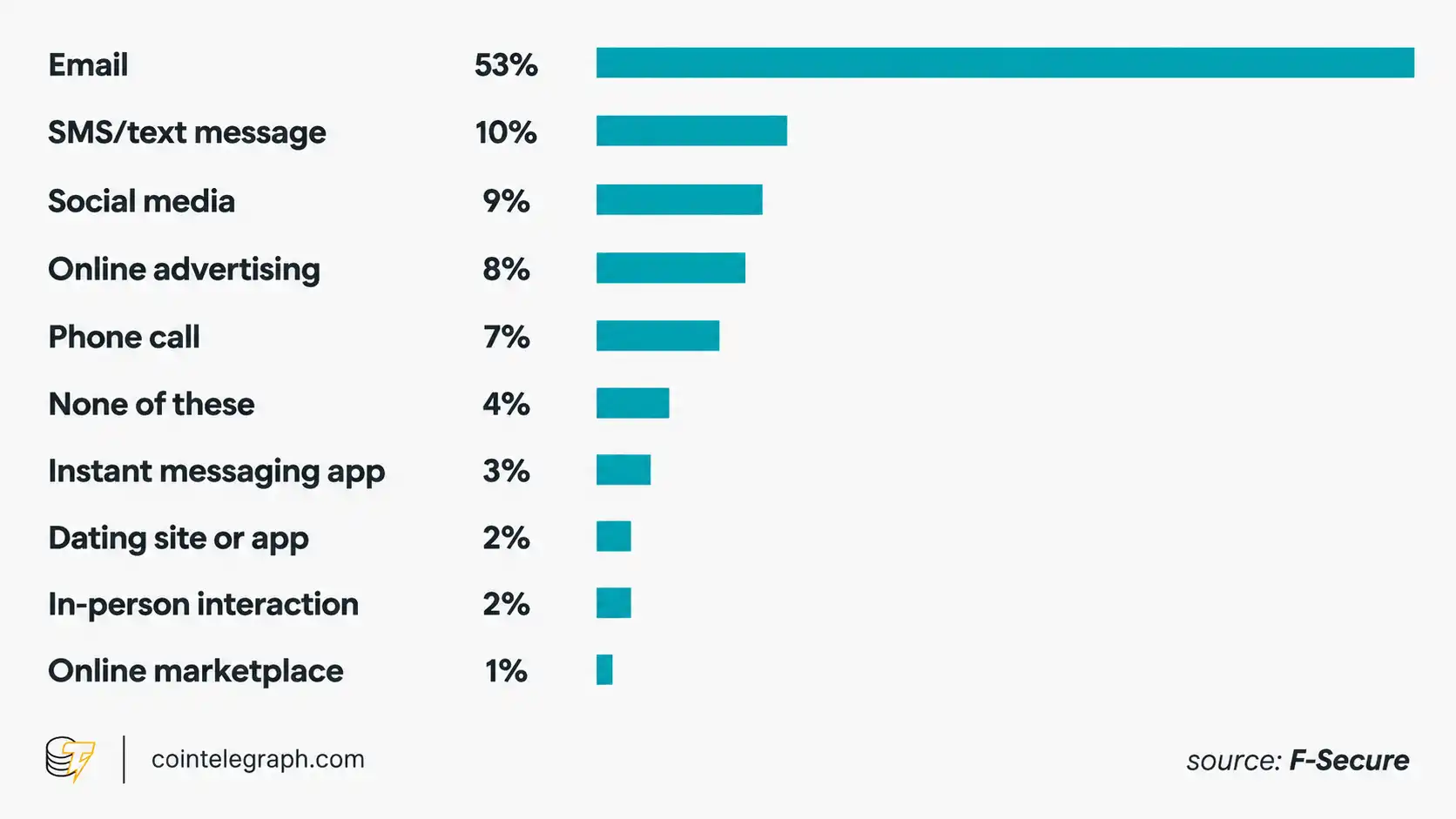
Common Scam Channels

Why Text Verification Used to Work

Early phishing scams focused on quantity over quality—scattershot spamming of messages, hoping a few would bite.

Since most scam groups were based overseas or used simple translation tools, the sent information often contained grammatical errors, stiff expressions, and messy formatting. Users gradually learned to treat these details as warning signs.

Various cybersecurity campaigns also promoted a series of basic identification techniques:

  • Check for spelling errors in the text
  • Avoid information with poor grammar
  • Be wary of strange-sounding wording
  • Pay attention to unusual formatting

These small tricks could quickly filter out crudely made scam content.

But it was never a foolproof defense, only serving as a reminder. Over time, however, many began to assume that professional and fluent writing equated to reliable content. The proliferation of AI has completely shattered this ingrained perception.

AI tools can batch-generate phishing content with excellent formatting and diction. Relying on finding text errors for fraud prevention is becoming increasingly unreliable.

How AI Upgrades Scam Tactics

Large language models can generate natural, fluent text in multiple languages, enabling scammers to create various false content:

  • Fake customer service chat records
  • Sophisticated phishing emails
  • Imitation of legitimate exchange notifications
  • Highly enticing investment pitches
  • Realistic Telegram group announcements
  • Customized false wallet recovery instructions

Simultaneously, AI also aids in implementing precise targeted attacks. Scammers use data breach information and user data from platforms like LinkedIn, X, Discord, and Telegram to tailor scam scripts.

The information users receive may mention these details:

  • Tokens you recently purchased
  • Your exchange account information
  • The wallet service you are using
  • Decentralized Finance (DeFi) platforms you have accessed
  • Customer service issues you've inquired about publicly

Highly customized content significantly increases the credibility of scams.

Furthermore, AI-generated images and voice cloning technology make identity impersonation simpler. Forging executive videos, simulating customer service voices, and replicating brand visual elements can now be easily achieved.

Unique Risks Faced by Crypto Users

The security logic of crypto assets is fundamentally different from traditional banking. In traditional finance, if you encounter a mistaken transfer or scam, you can usually contact the bank, payment institution, or risk control team to recover the funds. But once a crypto transaction is confirmed on the blockchain, it is essentially irreversible.

Self-custody wallets also amplify the attack surface. Scammers may not need to steal passwords or private keys; often, simply tricking users into authorizing malicious transactions or opening high-risk wallet permissions is enough to succeed.

This means that even if a user has never leaked their seed phrase, well-crafted scam interfaces still pose a huge risk.

Common scam forms in the crypto space include:

  • Fake airdrop claim websites
  • Counterfeit NFT minting events
  • Imitated exchange login pages
  • Inducing connections to malicious wallets
  • Pop-ups inducing authorization of malicious tokens
  • False staking/mining interfaces
  • Impersonating official customer service for fraud
  • Registering high-imitation accounts on platforms like Telegram, Discord

With the help of AI, such scams can be produced in bulk while maintaining the realism of content and interfaces.

Core Verification Methods Users Should Master

Faced with increasingly realistic scams, crypto users can no longer rely on superficial judgment; verification must become the first principle.

1) Carefully Verify the Domain Name

Website appearance can be imitated, but the URL is hard to make identical. Fraudulent domains often use these tricks: adding extra characters, random hyphens, using look-alike symbols, tampering with subdomains, choosing obscure domain suffixes.

Even if the page looks exactly like a legitimate platform, do not trust it based solely on logos and visuals. Recommended practices:

  • Manually type URLs for commonly used platforms
  • Use saved bookmarks for wallets and exchanges whenever possible
  • Always verify the domain before connecting a wallet
  • Do not click links in unfamiliar messages or promotional content

A beautiful page does not mean a legitimate website.

2) Prioritize Links from Official Channels

False announcements, influencer impersonation accounts, and scam accounts are common vectors for spreading scams. Fraudulent links are mainly disseminated through: Telegram groups, Discord channels, X comment sections, paid search ads, fake customer service messages.

Confirm that links come from the project's official website or officially announced channels. Additionally, cross-reference updates from multiple official accounts to further reduce risk.

Be highly vigilant when receiving unsolicited private messages claiming urgent issues with your account.
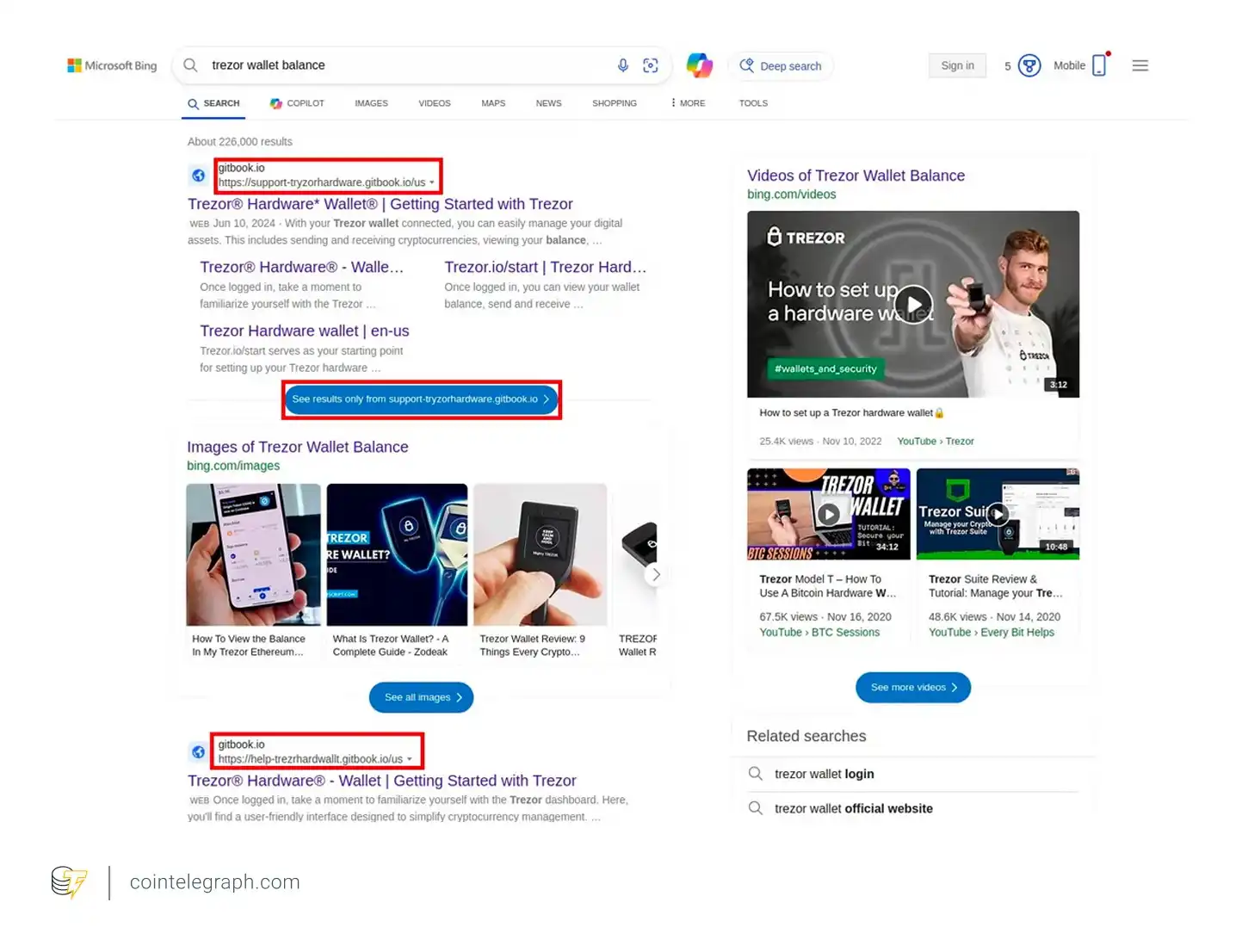
Malicious link found in a Bing search for a Trezor wallet balance check

3) Clarify Wallet Permissions Before Authorization

Many users have the misconception that any request popping up from their wallet is safe. Especially when facing seemingly professional websites, people often casually click confirm, ignoring permission details.

Wallet interactions involve various operation types: connecting a wallet, signing messages, authorizing token transfers, opening general permissions, triggering smart contract interactions, etc.

Among these, unlimited approval poses the highest risk, allowing malicious contracts to freely transfer your assets later. Before authorizing, always verify that the involved token type, permitted transfer amount, requesting contract address, and operation details match your expectations.

Even if a website looks flawless, it could trigger high-risk wallet operations.

4) Verify All Details Before Signing a Transaction

AI scams often exploit urgency to rush users into quick confirmation. Before signing any transaction, be sure to check every item: recipient address, token amount, selected blockchain, contract interaction information, fee rules, authorization scope.

If a page is labeled "Claim Reward" but asks for unlimited token permissions, or labeled "Wallet Verification" but initiates an asset transfer, stop immediately and investigate the risk.

Once transaction details do not match expectations, do not proceed.

Many wallet scams start with users publicly complaining about account issues on social platforms. Scammers monitor such posts and then impersonate customer service via private messages to commit fraud.

5) Verify Contract Addresses, Do Not Blindly Trust Token Names

Scammers will replicate token names and icons to create highly convincing counterfeit tokens. A token that appears to be named "USDT" or "ETH Yield" may have a completely unrelated issuer.

Verification method: Confirm the token's corresponding contract address through the project's official website, legitimate block explorers, officially published materials, and mainstream exchange information. As AI scams become more realistic, judging authenticity based solely on token names and icons carries increasing risk.

6) Be Wary of Unsolicited Customer Service Private Messages

Impersonating official customer service remains a prevalent scam tactic in the crypto space. Scammers monitor user help requests on social platforms, then privately message them pretending to be staff, tricking users into "verifying" wallets, asking for seed phrases, sending malicious links, recommending remote control tools, or guiding users to complete dangerous authorizations.

Legitimate official customer service almost never initiates private messages; platforms will never ask for private keys or seed phrases. If you encounter issues, proactively contact customer service through official channels; do not respond to unsolicited private messages.

7) Urgent Pressure is Often a Sign of a Scam

Even if a scam is crafted with utmost professionalism, scammers still use psychological pressure to create urgency. Common scripts include: "Your wallet has been compromised," "Tokens are about to expire, claim quickly," "Account will be suspended soon," "KYC verification failed," "Need to complete a security update immediately."

Such scripts can cloud judgment. The more they pressure you to act immediately, the more you should slow down and verify carefully.

Simple crypto security rule: Whenever asked to operate your wallet immediately, pause and calmly verify first.

A Polished Exterior No Longer Equals Safety

Today's scam websites can accurately replicate brand logos, color schemes, page layouts, and writing styles. AI can also help create high-imitation FAQ pages, fake customer service replies, counterfeit news articles, complete new user onboarding processes, and promotional copy.

Judging platform trustworthiness based on visual appeal alone is no longer possible. Attackers only need to catch a user's momentary lapse to carry out irreversible asset theft.

The core of security protection remains verification: verifying domain names, checking contracts, reviewing wallet requests, confirming customer service identity, clarifying transaction purposes. Good design does not equal trustworthiness.

Crypto Security Has Evolved into a Battle of Verification

AI hasn't created entirely new scam models; it has simply dramatically upgraded the presentation and disguise level of traditional scam techniques. In the past, people were accustomed to judging risk based on surface characteristics, neglecting the act of verification itself. This mindset can lead to massive losses in the crypto industry.

Behind a perfectly phrased text could lie a malicious link; behind a seemingly professional customer service reply could be a guide to authorizing asset transfers; a website convincing enough to pass as real could open high-risk permissions.

The core lesson is simple: smooth copy, exquisite interfaces, and familiar brand imagery cannot serve as security credentials. Faced with every link, every wallet pop-up, every customer service message—verify first, then act.


Perguntas relacionadas

QHow has AI changed the effectiveness of traditional methods for detecting phishing scams, such as looking for spelling errors?

AAI has significantly undermined traditional detection methods. Previously, users could often identify scams by looking for poor spelling, bad grammar, and awkward phrasing in phishing emails. Now, AI tools allow scammers to easily generate fluent, grammatically correct, and professionally styled text in multiple languages. This makes content that appears legitimate and trustworthy, removing the obvious red flags that users once relied on for quick identification.

QWhat is a key unique risk faced by crypto users compared to traditional banking when dealing with scams?

AA key unique risk is the irreversibility of transactions. In traditional banking, victims of fraud or mistaken transfers can often contact their bank or payment provider to freeze accounts or reverse transactions. However, once a cryptocurrency transaction is confirmed on the blockchain, it is typically impossible to reverse or cancel. This places a much higher burden on users to prevent fraudulent authorizations in the first place.

QAccording to the article, what should be the new first principle for crypto users to protect themselves against AI-enhanced scams?

AThe new first principle is verification. Instead of relying on surface-level cues like the quality of writing or website design, users must make independent verification their core habit. This involves meticulously checking domains, confirming contract addresses through official sources, scrutinizing every detail of wallet transaction requests before signing, and validating the identity of anyone claiming to be customer support.

QWhat are some common tactics used in fraudulent cryptocurrency domains to mimic legitimate websites?

AFraudulent domains commonly use tactics like adding extra characters, inserting random hyphens, using look-alike symbols (e.g., '0' instead of 'o'), modifying subdomains, or employing obscure top-level domain suffixes (like .xyz instead of .com). The goal is to create a URL that looks very similar to the legitimate one at a glance, hoping users won't notice the subtle difference.

QWhy is an 'unlimited approval' in a wallet transaction authorization considered highly risky?

AAn 'unlimited approval' is highly risky because it grants a smart contract permission to withdraw an unlimited amount of a specific token from your wallet at any time in the future. If the contract is malicious, the attacker can drain all tokens of that type from the user's wallet in a subsequent transaction, even if the initial interaction seemed harmless. Users should always check and limit the approved amount to only what is necessary for the current transaction.

Leituras Relacionadas

Is AI Creating a New Class of 'Information Poor'?

AI is generating a new kind of "information poverty." The core issue isn't that AI denies answers to the poor; it's that it provides abundant, cheap, and plausible-sounding answers to everyone. This availability shifts the true scarcity from obtaining answers to possessing the **judgment to evaluate them** and the access to turn them into real-world opportunities. New information poverty thus describes those who have AI tools and outputs, but lack the complementary skills, authorization, and contextual experience to critically assess and act on them. Research reveals a multi-layered divide: access to AI is stratified by income and platform design (e.g., premium vs. free, embedded tools). In workplaces, usage heavily favors higher-paid, more experienced, or formally trained employees, with AI often automating entry-level tasks that were traditional stepping stones. Crucially, the heaviest users are often mid-career professionals whose existing expertise allows them to effectively judge and leverage AI outputs, while novices risk over-relying on them without building judgment. While controlled experiments show AI can significantly boost low-skilled workers' performance, real-world adoption and benefit are constrained by unequal social and organizational structures. Historically, general-purpose technologies first reward those with existing complementary capital. AI, by affecting judgment-based work, may accelerate and deepen this initial inequality gap, even if it narrows over decades. The danger lies in the illusion of competence it creates, potentially stunting the very critical thinking needed in an era where judgment is paramount.

marsbitHá 14m

Is AI Creating a New Class of 'Information Poor'?

marsbitHá 14m

Jensen Huang 'Saves' South Korean Stock Market: Locks In SK Hynix Memory, Chip Shortage to Continue

On June 5th, South Korea's stock market experienced a sharp decline, with major chipmakers like Samsung and SK Hynix dropping nearly 10%. Amidst the turmoil, NVIDIA CEO Jensen Huang's visit to Seoul played a dramatic role in boosting market sentiment. Following a dinner meeting with SK Group Chairman Chey Tae-won and SK Hynix CEO Kwak Noh-Jung, Huang confirmed that NVIDIA's new Vera CPU will utilize SK Hynix DRAM. The companies announced a multi-year technical partnership to co-develop next-generation memory for NVIDIA's AI infrastructure, covering products from data centers to personal AI and robotics. This collaboration extends beyond memory supply. SK Hynix is integrating NVIDIA's AI and Omniverse platform into its own semiconductor design and manufacturing processes, including computational lithography and creating digital twins of its fabrication plants for autonomous operation. While strengthening ties with SK Hynix, NVIDIA is diversifying its supply chain for the upcoming HBM4 memory, with Samsung, SK Hynix, and Micron all certified as suppliers for its Vera Rubin platform. Despite this, Huang warned that the global chip shortage, driven by relentless demand from AI factory construction, is expected to persist for several years across the entire supply chain. His visit underscores NVIDIA's systematic effort to deepen integration with South Korea's broader tech industry.

marsbitHá 1h

Jensen Huang 'Saves' South Korean Stock Market: Locks In SK Hynix Memory, Chip Shortage to Continue

marsbitHá 1h

Nasdaq Plunges 4.2% in a Single Day: Does "Black Friday" Burst the U.S. Stock Market Bubble?

The Nasdaq plunged 4.18% on June 5, 2026, its worst single-day drop in over a year, as a much stronger-than-expected US jobs report triggered fears of economic overheating and delayed Federal Reserve interest rate cuts. The selloff, centered on high-valuation tech and AI stocks like Nvidia and Broadcom, spread across major indices. The article examines whether this signals a market top. The strong May non-farm payrolls data, nearly double expectations, pushed bond yields higher, directly hurting rate-sensitive tech stocks. This exposed vulnerabilities in the crowded AI trade, where valuations had soared on narratives of infinite growth, despite emerging signs of slowing order momentum and corporate AI monetization challenges. Prior to the drop, market indicators flashed warning signs: historically high valuations (e.g., Shiller CAPE ratio near 39.5), extreme bullish sentiment, and high levels of leverage. Technical charts showed key support levels being breached. Wall Street is divided on the outlook. Bears, citing risks of "stagflation" and AI bubble comparisons to the dot-com era, warn of a potential significant correction. Bulls view the drop as a healthy correction within a bull market, underpinned by a strong economy and expected corporate earnings growth of around 7% in 2026. The immediate future hinges on upcoming key events: the May CPI inflation data and the mid-June FOMC meeting. Their outcomes will critically shape market expectations for the Fed's rate path. The article concludes that conditions for a major market top are aligning, marking a fragile transition from narrative-driven gains to a phase demanding validation from macroeconomic data and corporate fundamentals. Caution is advised.

marsbitHá 1h

Nasdaq Plunges 4.2% in a Single Day: Does "Black Friday" Burst the U.S. Stock Market Bubble?

marsbitHá 1h

Nasdaq Plunges 4.2% in a Single Day, Did 'Black Friday' Pop the U.S. Stock Bubble?

The Nasdaq Composite plummeted 4.18% on June 5, its biggest single-day drop since April 2025, triggering widespread debate over whether the U.S. stock market has peaked. The sell-off was sparked by a stronger-than-expected U.S. non-farm payrolls report, which fueled fears of economic overheating and pushed back market expectations for Federal Reserve rate cuts, leading to a sharp rise in Treasury yields. The AI sector, the primary driver of the recent bull market, suffered severe losses, with the Philadelphia Semiconductor Index crashing over 10%. Stocks like Nvidia, Broadcom, and Micron led the decline. Concerns are mounting about the sustainability of AI capital expenditures and high valuations, with signs of order cuts for next-generation chips emerging. Analyses point to several warning signs: historically high market valuations (e.g., elevated Shiller CAPE ratio, Buffett Indicator), extreme bullish sentiment indicators, and significant insider selling. The sell-off also caused a key technical breakdown, with the S&P 500 breaking below its short-term moving average and testing its 200-day moving average. Wall Street is divided on the outlook. Bears warn this could be the start of a bubble deflation or a "stagflation" scenario, while bulls view it as a healthy, overdue correction within a bull market driven by solid corporate earnings growth. A more moderate view suggests the easy liquidity-driven rally is over, and markets are entering a phase of fundamental stock-picking with potential for consolidation. The immediate future hinges on key upcoming events: the May CPI report and the mid-June FOMC meeting. Their outcomes will be critical in determining whether this is a temporary pullback or the beginning of a more significant trend reversal. The consensus is that the era of one-directional market gains may be ending, requiring increased investor caution.

Odaily星球日报Há 1h

Nasdaq Plunges 4.2% in a Single Day, Did 'Black Friday' Pop the U.S. Stock Bubble?

Odaily星球日报Há 1h

The First Case on AI Agents: What Was Adjudicated?

"The First 'Agent' Ruling: What Was Decided?" On April 30, the Guangzhou Internet Court issued a ruling—China's first behavior preservation order in the intelligent agent (AI agent) field. The defendant, an open-source AI agent software, was ordered to stop downloads, cease actions that bypassed a platform's technical protection measures, and delete related tutorials and data. The core issue: the software used the operating system's "accessibility service" permissions to automate user interactions within other apps without those platforms' authorization. This mirrors a recent US case where Amazon sued Perplexity for similar reasons—bypassing Amazon's API to directly scrape and interact with its pages—and won a preliminary injunction. Both rulings establish a crucial legal boundary for the AI agent era: agents cannot operate unchecked. The article argues the fundamental legal principle emerging is one of **dual authorization**. An AI agent requires both **user consent** AND **platform consent** to operate legitimately within that platform's ecosystem. Bypassing platform rules through system-level permissions, even with user permission, undermines platform responsibilities for content moderation, data security, and user privacy, creating liability issues. The piece uses the evolution of "Doubao Phone" (an AI-integrated smartphone) as a case study. Its initial, aggressive version that bypassed platform controls faced roadblocks. Its upcoming 2.0 version is reportedly pivoting to negotiate API access and authorization deals with major platforms (like Alibaba's ecosystem), seen as a strategic adaptation to the new regulatory reality. A global trend is identified: the era of unregulated, "wild west" growth for AI agents is ending, replaced by a **compliance race**. This raises barriers to entry, as securing platform authorizations becomes a new cost. Open-source status is also not a legal shield if the code facilitates bypassing technical protections. In conclusion, these first rulings target not the largest, but the most **aggressive and representative** cases. By setting precedent with them, regulators are efficiently steering the entire industry towards a new, more regulated operating paradigm defined by dual authorization and platform cooperation.

marsbitHá 1h

The First Case on AI Agents: What Was Adjudicated?

marsbitHá 1h

Trading

Spot
Futuros
活动图片