KAITO moves $10.33M in tokens – Can bulls push price to $0.65?

ambcryptoPublicado em 2026-06-29Última atualização em 2026-06-29

Resumo

A significant whale transfer of 18 million KAITO tokens (worth $10.33M) to a new wallet sparked market speculation, though the tokens remained unspent, preventing immediate selling pressure. While this event boosted attention and derivatives market activity—with Open Interest rising 14%—spot market data showed persistent seller dominance, indicating trader caution and profit-taking. Technically, KAITO broke above key resistance at $0.5325, trading near $0.5794 and entering overbought territory with an RSI of 70.42. The outlook hinges on buyers defending the $0.5325 support level to potentially challenge the next resistance at $0.65; failure could see a return to the previous trading range.

KAITO transferred 18 million tokens worth $10.33 million to a newly created wallet, drawing fresh attention across the market as traders assessed the purpose behind the transaction. The transfer immediately fueled speculation over whether the tokens represented strategic repositioning rather than imminent selling.

Large wallet movements often reshape short-term market sentiment, especially when the receiving address has no prior transaction history. However, the tokens remained in the new wallet, leaving market participants with more questions than answers.

Investors closely tracked subsequent on-chain activity for signs of redistribution or prolonged holding. As a result, the transfer became the dominant catalyst behind KAITO’s recent market attention despite the absence of confirmed selling activity from the destination wallet.

Selling pressure lingered despite whale activity

Spot market data painted a different picture despite the attention surrounding the whale transfer.

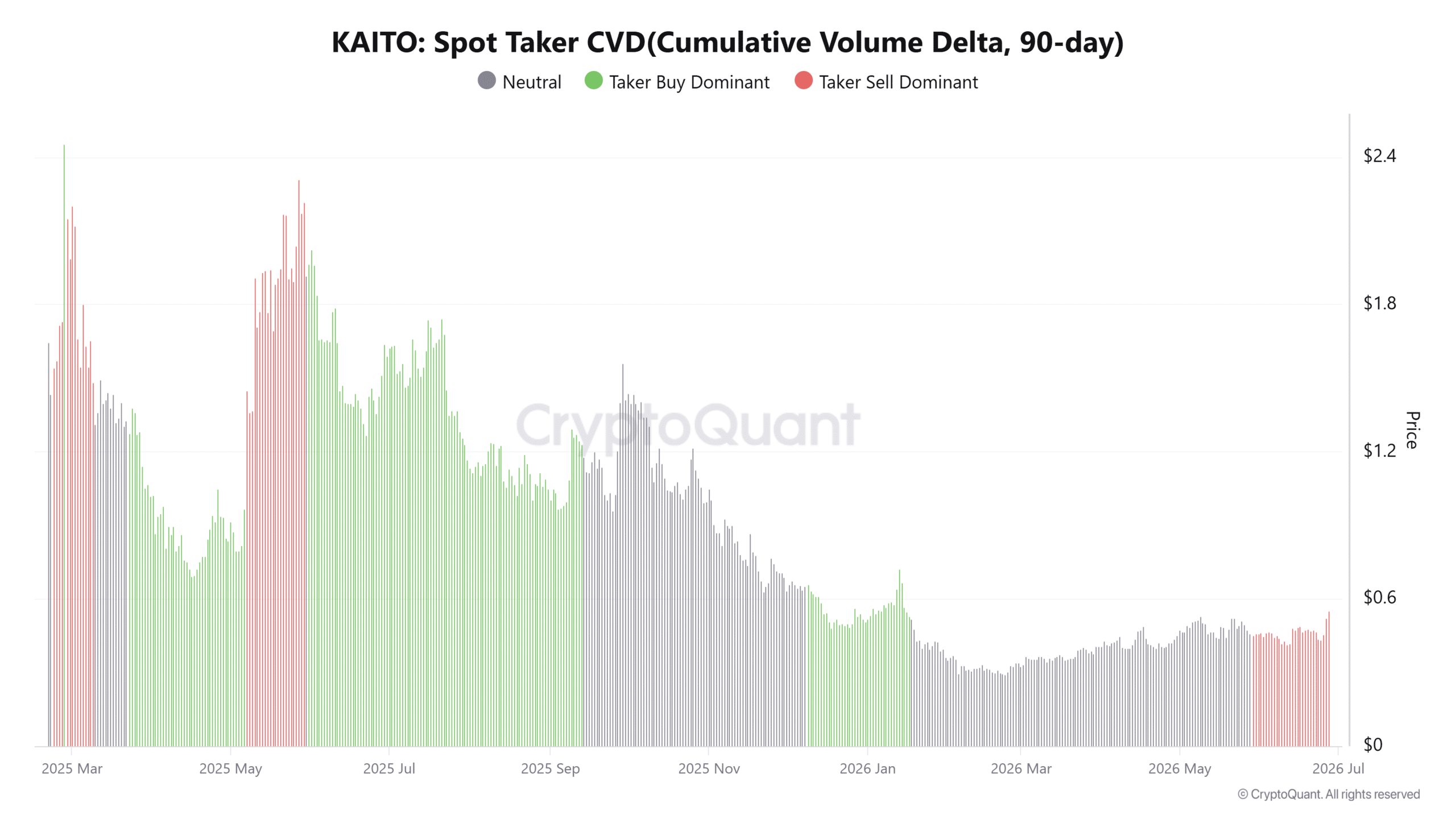
Spot Taker CVD remained seller-dominant, indicating that aggressive market sells continued to outweigh aggressive buys throughout the observed period. That divergence suggested many traders still preferred locking in profits instead of chasing higher prices.

Even though the large transfer encouraged speculation, spot participants maintained a cautious stance rather than following the bullish narrative immediately. Such behavior often reflected hesitation among short-term traders while waiting for stronger confirmation from price action.

Nevertheless, the absence of immediate exchange-related selling from the transferred tokens prevented broader panic, allowing KAITO to preserve its recent gains despite persistent sell-side aggression.
Source: CryptoQuant

Derivatives traders increased their bullish exposure

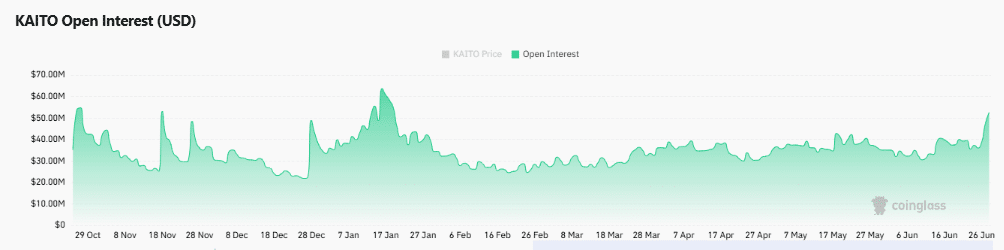
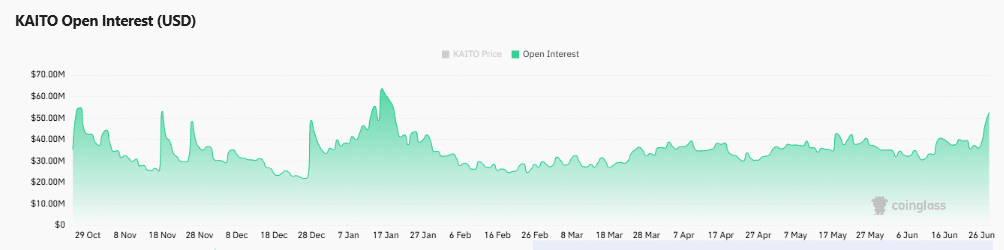
Activity across the derivatives market strengthened as Open Interest (OI) climbed by 14.02% to approximately $55.95 million as of writing. The increase showed that traders had opened additional positions while KAITO attracted greater market attention following the whale transfer.

Rising OI alongside firm prices generally reflected growing participation instead of widespread position closures. However, higher leverage also increased the possibility of larger price swings if sentiment changed suddenly.

Traders appeared willing to maintain exposure despite seller dominance in the spot market, highlighting a divergence between derivatives positioning and immediate spot demand. This growing participation suggests speculative interest had remained elevated, although sustained buying would still have been necessary to validate those newly opened positions.
Source: CoinGlass

KAITO breakout shifts attention toward higher resistance

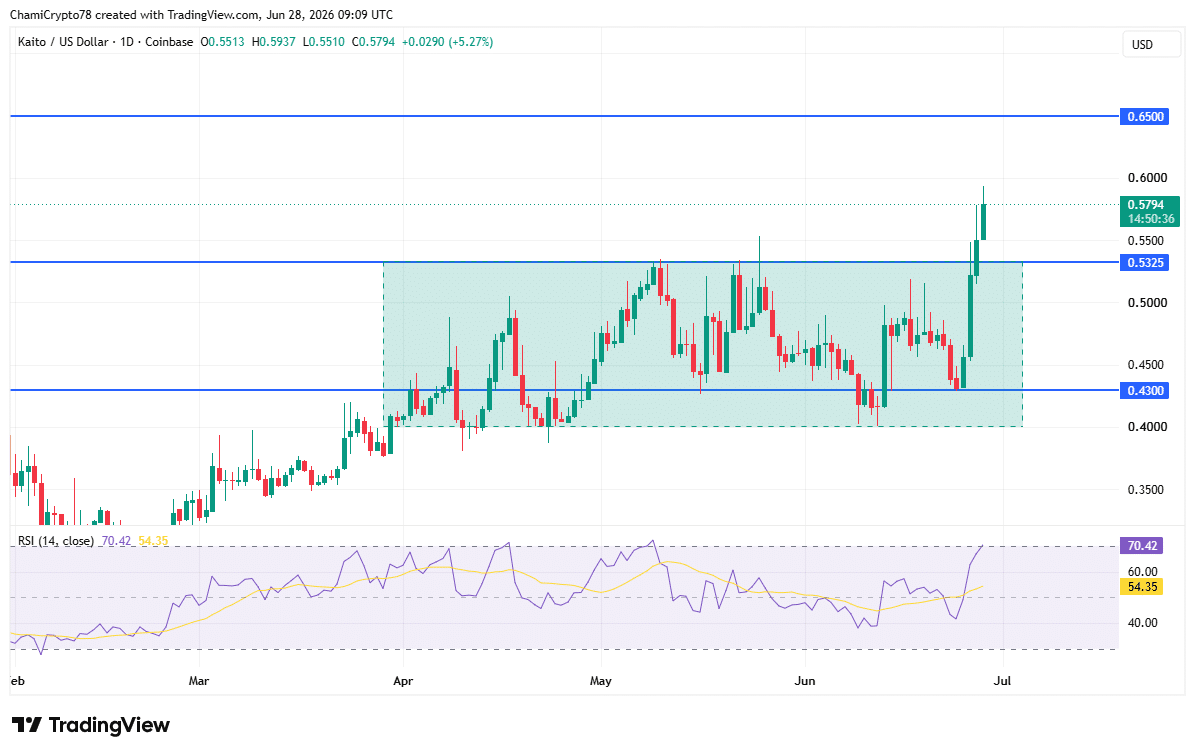
KAITO broke above its multi-month trading range after clearing the $0.5325 resistance level and traded around $0.5794 on the daily chart. Buyers successfully defended the former range before extending the rally toward the next resistance near $0.6500.

At press time, the Relative Strength Index climbed to 70.42, placing the asset in overbought territory after recovering sharply from lower readings earlier in June. The reading highlighted strong buying strength, although it also suggested that short-term cooling could emerge if demand weakened.

However, the breakout remained technically constructive because the price held above former resistance. If buyers continue defending the $0.5325 level, KAITO could challenge the $0.6500 resistance.
Source: TradingView

Will buyers keep control?

KAITO presented a constructive technical structure after reclaiming range resistance while derivatives participation increased noticeably. However, seller dominance in the spot market showed that conviction had not fully shifted toward buyers.

If demand strengthens and the breakout holds above $0.5325, buyers could extend the rally toward $0.6500. Otherwise, renewed selling pressure could drag the price back into its previous trading range despite the whale-driven optimism.


Final Summary

  • Whale transfer attracted fresh attention while derivatives participation increased across the KAITO market.
  • Spot sellers remained active despite breakout, leaving buyers to defend newly reclaimed resistance.


Criptomoedas em alta

Perguntas relacionadas

QWhat was the purpose and impact of the large KAITO token transfer mentioned in the article?

AThe article states that 18 million KAITO tokens worth $10.33 million were transferred to a new wallet with no prior history. This fueled market speculation about strategic repositioning rather than imminent selling. The transfer became a dominant catalyst for market attention, but as the tokens remained unmoved, it created more questions than answers. It did not immediately trigger panic selling, allowing KAITO to preserve its recent gains.

QAccording to the spot market data, what was the prevailing sentiment among traders despite the whale transfer?

ADespite the attention from the whale transfer, the spot market data showed seller dominance. The Spot Taker CVD remained seller-dominant, indicating aggressive market sells outweighed aggressive buys. This suggested many traders were locking in profits rather than chasing higher prices, reflecting a cautious stance and hesitation among short-term participants.

QHow did derivatives traders react to the situation, and what does the Open Interest data indicate?

ADerivatives traders increased their bullish exposure. The Open Interest (OI) climbed by 14.02% to approximately $55.95 million, showing traders opened new positions as KAITO gained attention. This rising OI alongside firm prices reflected growing speculative participation and interest, creating a divergence from the seller-dominant spot market, though it also increased the risk of larger price swings.

QWhat key technical levels and indicators are discussed regarding KAITO's price action?

ATechnically, KAITO broke above its multi-month trading range by clearing the $0.5325 resistance level and was trading around $0.5794. The next major resistance is near $0.6500. The Relative Strength Index (RSI) was at 70.42, placing the asset in overbought territory, indicating strong buying strength but also a potential for short-term cooling if demand weakens.

QWhat are the two main opposing factors that will determine KAITO's next price move, according to the article's conclusion?

AThe conclusion highlights two opposing factors: the constructive technical structure (with price holding above the $0.5325 breakout level) and increased derivatives participation versus persistent seller dominance in the spot market. The price could rally toward $0.6500 if demand strengthens and the breakout holds. Otherwise, selling pressure could push the price back into its previous trading range.

Leituras Relacionadas

Building the Bright Path While Secretly Crossing Chencang: Is Walsh Paving the Way for a September "Rate Cut"?

The title "Building the Plank Road Openly While Secretly Crossing at Chencang: Is Walsh Paving the Way for a September 'Rate Cut'?" suggests Federal Reserve Chair Kevin Walsh's hawkish stance may be a deliberate smokescreen. Academy Securities analyst Peter Tchir argues in a report that markets, currently pricing a 75% chance of a September hike, are missing a potential path to a September rate cut that Walsh himself might be quietly preparing. Tchir posits that Walsh's hawkish rhetoric aims to suppress long-term yield risks (with the 10-year Treasury yield falling recently) while creating room for a narrative shift based on upcoming data. The potential political endgame, according to this view, could be rate cuts in September and October, ahead of the midterm elections. This hinges on a political logic where the Trump administration's preference for lower rates remains unchanged. A core part of Tchir's argument involves redefining inflation metrics. He contends the Fed under Walsh may deprioritize the PCE index, criticizing its lagging components like Owners' Equivalent Rent (OER). Instead, he points to alternative, more real-time indicators like the New Tenant Repeat Rent Index (NTRR) and the Truflation daily index, which shows core inflation around 1.45%. He suggests the Fed could shift its data narrative to justify policy easing. Furthermore, Tchir downplays AI-driven inflation fears. He argues that consumer price sensitivity, evidenced by negative market reactions to price hikes (e.g., Apple), contradicts persistent inflation narratives. He also separates AI/data center spending—which he sees as relatively rate-insensitive—from broader consumer affordability issues, implying rate hikes are misdirected. Based on this analysis, Tchir sees a re-pricing of rate cut expectations as likely, creating opportunities in short-duration Treasuries. He maintains a neutral-to-slightly-bullish view on the long end of the yield curve. For equities, he recommends a significant overweight in energy (especially global nuclear assets) and, within defense/security themes, an overweight in biotech/pharma versus an underweight in semiconductors, expressing caution on AI/data center valuations.

marsbitHá 16m

Building the Bright Path While Secretly Crossing Chencang: Is Walsh Paving the Way for a September "Rate Cut"?

marsbitHá 16m

"King of Shilling" Hayes Strikes Again, This Time Setting His Sights on Deribit

On June 29, BitMEX co-founder Arthur Hayes acquired approximately 6.16 million SYN tokens via OTC platform Flowdesk, valued at around $2.2 million. Subsequently, Hayes publicly endorsed SYN on X, calling it one of the most asymmetric investments he's seen since HYPE and declaring it time for an on-chain options DEX to challenge industry leader Deribit, naming Hypercall as that challenger. The article details the evolution of the Synapse Protocol, originally launched in 2021 as a cross-chain messaging and liquidity network. While its TVL peaked above $1 billion during the last bull market, it has since declined. The protocol's team has since built Hypercall, an on-chain options trading platform on Hyperliquid's HyperEVM, which supports trading options on "any asset" with features like 24/7 trading and defined risk limited to the premium paid. Deribit, founded in 2016, is highlighted as the dominant centralized crypto options exchange, commanding roughly 85% market share in BTC and ETH options. Its strengths include deep liquidity and professional tools, though it faces critiques over custody risk, KYC requirements, and regulatory uncertainty. The analysis suggests Hypercall's potential lies in decentralization, permissionless access, and transparency, potentially carving a niche in DeFi-native and emerging asset options. However, it faces significant challenges competing with Deribit's established network effect and liquidity depth. The piece concludes by noting Hayes's recent and mixed "call" history, referencing his previous promotion and subsequent sale of HYPE, as well as a controversial price target report for CARDS from his family office, Maelstrom, which was followed by a significant price drop for the asset. This activity has drawn criticism, with some accusing Hayes of creating exit liquidity for his followers.

Foresight NewsHá 1h

"King of Shilling" Hayes Strikes Again, This Time Setting His Sights on Deribit

Foresight NewsHá 1h

One Year After the Crash of Crypto Treasury Companies, Copycats Are Already Making a Comeback

One year after the collapse of digital asset treasury (DAT) companies, which wiped out up to 99% for early investors, the scheme has returned in a new guise. Recently, Triller Group announced it would become a "SpaceX treasury company," causing its market cap to surge. This follows the rebranding of another firm, LGHL, now targeting a token called HYPE. The original model, popularized by MicroStrategy (MSTR) and its "Bitcoin yield" narrative, saw companies trading at massive premiums to their underlying crypto holdings. However, most followers like TwentyOne, Metaplanet, and Nakamoto have crashed 80-95%+ from their peaks, erasing nearly all value for late investors. The author argues these structures have no fundamental reason to trade at premiums when low-fee Bitcoin ETFs or direct ownership exist. The cycle persists due to speculative demand driven by FOMO, gamification, and a belief the system is rigged, met by insiders and promoters who profit from the pump-and-dump dynamics. Drawing a parallel to the 1637 Tulip Mania, the piece concludes that such frenzies are not a bug but a recurring product of markets, where greater fools provide demand and insiders supply the schemes. Despite holding Bitcoin personally, the author condemns this specific packaging of assets into leveraged corporate vehicles marketed as innovation, a cycle seemingly unstoppable until a major crash.

marsbitHá 1h

One Year After the Crash of Crypto Treasury Companies, Copycats Are Already Making a Comeback

marsbitHá 1h

Trading

Spot

Artigos em Destaque

Como comprar KAITO

Bem-vindo à HTX.com!Tornámos a compra de Kaito (KAITO) simples e conveniente.Segue o nosso guia passo a passo para iniciar a tua jornada no mundo das criptos.Passo 1: cria a tua conta HTXUtiliza o teu e-mail ou número de telefone para te inscreveres numa conta gratuita na HTX.Desfruta de um processo de inscrição sem complicações e desbloqueia todas as funcionalidades.Obter a minha contaPasso 2: vai para Comprar Cripto e escolhe o teu método de pagamentoCartão de crédito/débito: usa o teu visa ou mastercard para comprar Kaito (KAITO) instantaneamente.Saldo: usa os fundos da tua conta HTX para transacionar sem problemas.Terceiros: adicionamos métodos de pagamento populares, como Google Pay e Apple Pay, para aumentar a conveniência.P2P: transaciona diretamente com outros utilizadores na HTX.Mercado de balcão (OTC): oferecemos serviços personalizados e taxas de câmbio competitivas para os traders.Passo 3: armazena teu Kaito (KAITO)Depois de comprar o teu Kaito (KAITO), armazena-o na tua conta HTX.Alternativamente, podes enviá-lo para outro lugar através de transferência blockchain ou usá-lo para transacionar outras criptomoedas.Passo 4: transaciona Kaito (KAITO)Transaciona facilmente Kaito (KAITO) no mercado à vista da HTX.Acede simplesmente à tua conta, seleciona o teu par de trading, executa as tuas transações e monitoriza em tempo real.Oferecemos uma experiência de fácil utilização tanto para principiantes como para traders experientes.

204 Visualizações TotaisPublicado em {updateTime}Atualizado em 2026.06.02

Como comprar KAITO

Discussões

Bem-vindo à Comunidade HTX. Aqui, pode manter-se informado sobre os mais recentes desenvolvimentos da plataforma e obter acesso a análises profissionais de mercado. As opiniões dos utilizadores sobre o preço de KAITO (KAITO) são apresentadas abaixo.

活动图片