Earning Millions Per Day, Why Can't It Save PUMP's Bearish Downtrend?

Foresight NewsPublicado em 2026-07-15Última atualização em 2026-07-15

Resumo

Despite generating millions in daily revenue, the native token of Solana-based memecoin launchpad Pump.fun, PUMP, is struggling amidst a major token unlock and a bear market. On July 14, 2026, 8.25% of the total supply (825 billion tokens worth ~$131.35M) was unlocked for teams, advisors, and private investors, representing roughly 20% of the pre-unlock circulating supply. This event tests PUMP's core value mechanism: using 50% of net protocol fees to buy back and permanently burn tokens, a reduction from the initial 100% policy. While Pump.fun is one of Web3's most profitable applications, with ~$94.17k in average daily revenue over 90 days, the token's price has fallen significantly from its peak. Analysts point to the halved buyback pressure, ongoing legal challenges in the US labeling the platform an "illegal digital casino," and PUMP's inherent volatility and "casino gene" as key factors deterring institutional investment and weakening price support against the unlock sell-pressure. The token's long-term trajectory is seen as dependent not on this single unlock event, but on Pump.fun's ability to sustain its high revenue, which fuels the token's buyback-and-burn scarcity model.


Author: Ma He, Foresight News


On July 14, 2026, the native token PUMP of Pump.fun experienced its first large cliff unlock after TGE. According to cross-verification from Tokenomist, on-chain monitoring, and multiple data platforms, the theoretical maximum number of tokens unlocked on that day was 82.5 billion, accounting for 8.25% of the total supply (1 trillion tokens), valued at approximately $131.35 million (calculated at the price of about $0.00159 at the time), equivalent to about 20.23% of the circulating supply before the unlock.


This was the first unlock for two major allocation categories: team/advisors and private investors, with private investors unlocking 32.5 billion tokens, and the team and advisors unlocking 50 billion tokens.
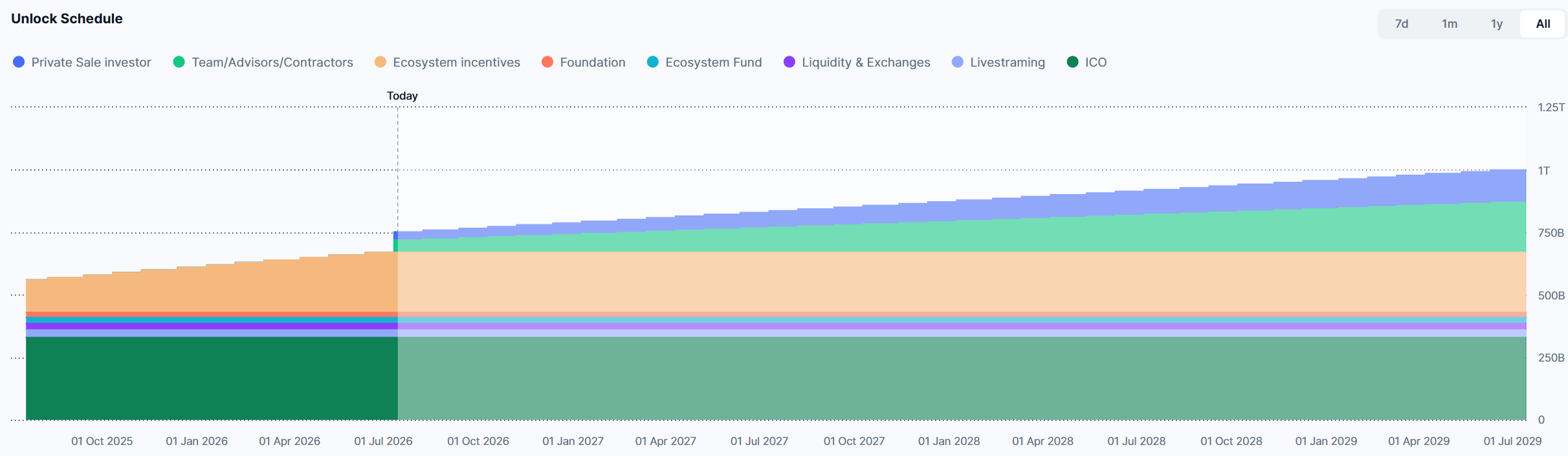


In the early hours of July 15, according to on-chain tracking data from Arkham, 57.279 billion tokens were unlocked and distributed to 121 wallets. PUMP's current market cap is approximately $650 million, with an FDV of about $1.6 billion.


Earning $20 Million Monthly, $940,000 Daily


This event occurred against the backdrop where Pump.fun has become one of the most profitable applications on Solana and even in the entire Web3 ecosystem. Over the past 30 days, the platform's protocol revenue reached $24.52 million (DefiLlama data), second only to Hyperliquid's $43.93 million and higher than Polymarket's $22 million. Cumulative revenue has exceeded $1.05 billion, with over 12 million tokens issued.


Even in a deep bear market environment, Pump.fun's weekly revenue currently remains around $5 million.
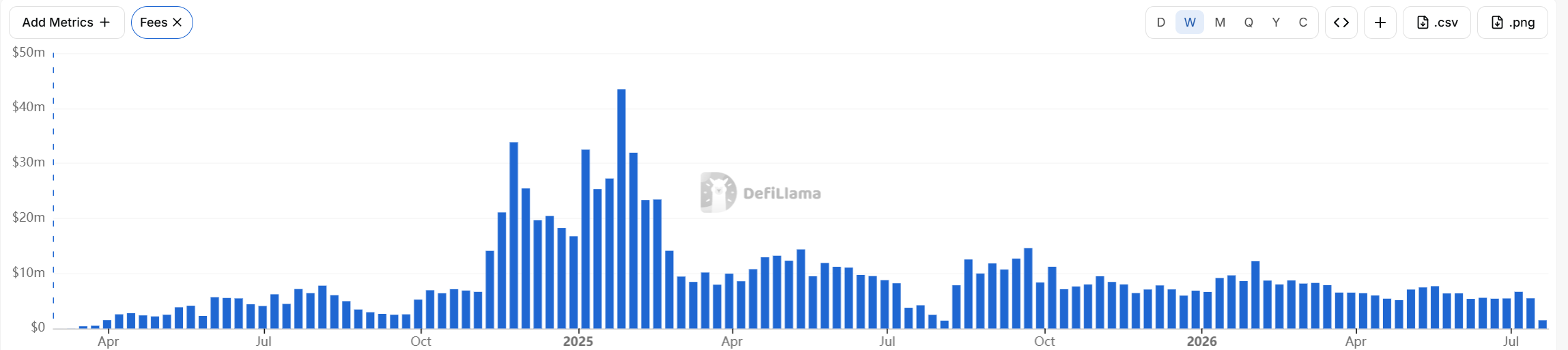


However, such substantial revenue does not seem to have created a positive cycle for its token price. PUMP has fallen from a peak of $0.008980 to around $0.001628, where it has been fluctuating.


What is the real issue?


The core value capture mechanism of Pump.fun is the use of protocol fees to buy back and permanently burn PUMP tokens. According to its official platform data, its annualized revenue currently stands at $343.71 million, with an average daily revenue of $941,700 over the past 90 days. The cumulative buyback and burn amount has reached $408.15 million, with the cumulative number of tokens burned accounting for 15.029% of the total supply.
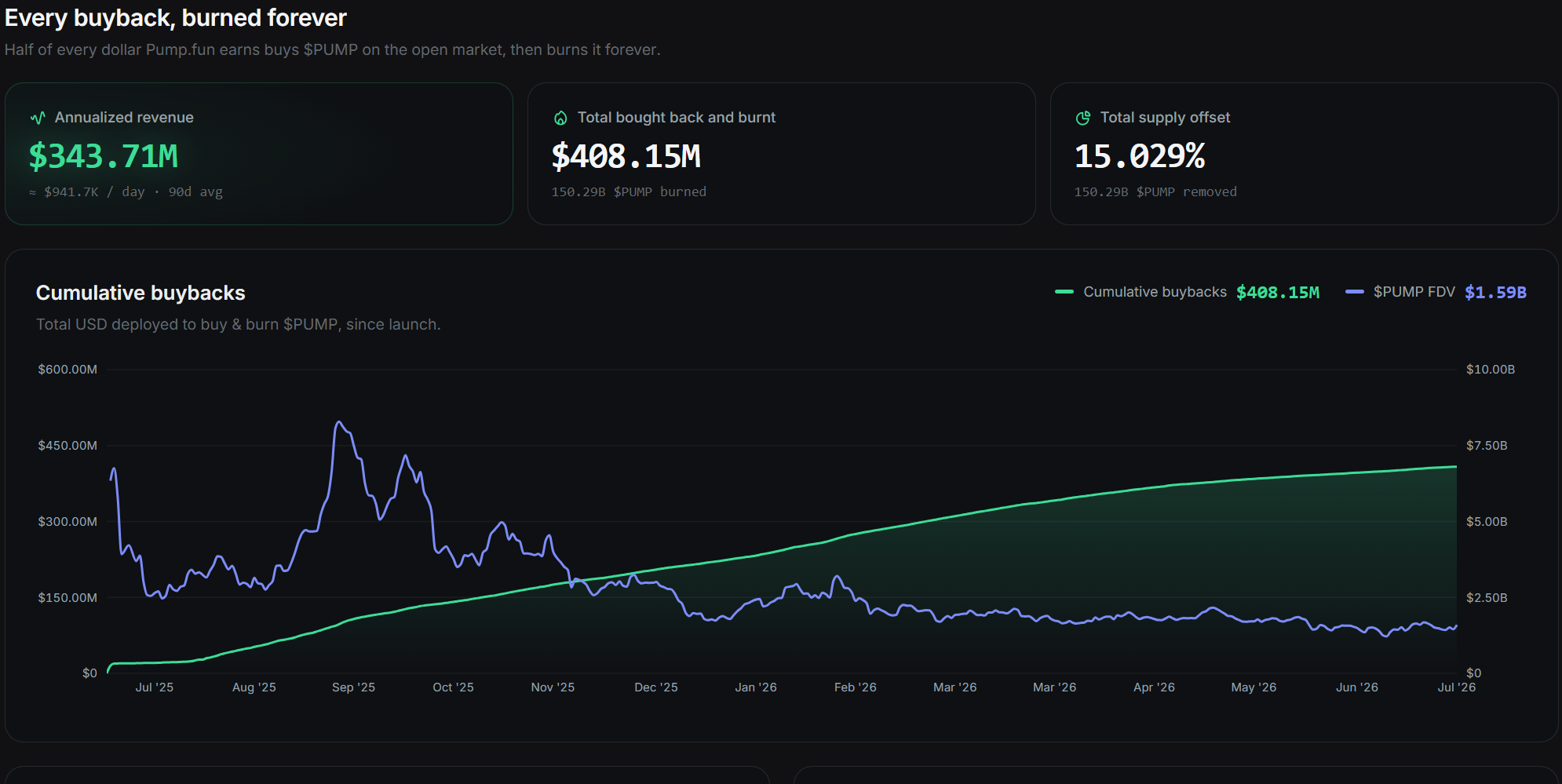


Pump started after its TGE in July 2025: Initially, 100% of net protocol fees (revenue from bonding curve, PumpSwap, Terminal cross-chain, etc., minus referral fees and cashback) were used to buy back and burn PUMP on the open market.


Adjusted on April 28, 2026: Switched to programmatically locking 50% of net revenue for buyback and burn, lasting one year; the other half is used for recruitment, marketing, and product development. All repurchased tokens are permanently burned, not locked. This constitutes PUMP's core flywheel, distinguishing it from most meme or platform tokens—the more profitable the platform, the scarcer the token supply.


However, the scale and duration of the buyback have sparked significant controversy. PUMP now allocates only 50% of net revenue for buyback and burn, a sharp reduction from the previous 100%, leading to a dramatic drop in buying support. Compared to HYPE, which uses nearly 99% of fees for buyback, and Lighter, which recently started using all revenue for buyback and burn, PUMP's buyback appears insufficient given a similar revenue scale, making it difficult to offset unlocking selling pressure, and consequently, the price remains weak.


Additionally, Pump.fun is currently facing a class-action lawsuit. U.S. plaintiffs have characterized it as an "illegal digital casino." Under such intense compliance pressure, cutting the buyback by 50% and reallocating significant funds to the treasury for hiring a "$5 million salary Chief Legal Officer" represents the team sacrificing the interests of secondary token holders to fund compliance costs for their own political risk mitigation.


Furthermore, after the one-year period ends, whether the buyback will continue remains a huge question mark.


A deeper reason lies in PUMP's "casino DNA." It is essentially a Meme launch platform, filled with PVP gambling and casino culture, characterized by extreme volatility, lowbrow narratives, and almost zero willingness from institutional funds to buy or HODL long-term. Compliance risks, reputational pressures, and a lack of real utility keep mainstream capital at bay. Relying solely on retail and speculative funds to support the price, any major unlock inevitably reveals weak liquidity and buying capacity.


Can the Market and Buyback Absorb the Massive Selling Pressure?


On-chain observations show that on the day of the unlock and the following day, some distribution wallets have already seen transfers. While this hasn't triggered a crash, short-term volatility and liquidity tests are inevitable. Moreover, PUMP's utility remains relatively weak (primarily for ecosystem incentives and potential governance). The market views it more as a "revenue-sharing certificate" rather than a strictly utility token, which amplifies sensitivity to selling pressure in a bearish market sentiment.


Compared to similar high-revenue protocols: Hyperliquid has higher monthly revenue but a market cap of nearly $15 billion (about 20+ times that of PUMP); Polymarket has similar revenue but hasn't issued a token, with a funding valuation already at the $15 billion level. The sustainable revenue capabilities of these two have been proven, while Pump.fun's revenue could sharply decline if the market turns bearish and meme coins wither.


However, this unlock is not a "one-time death sentence." The team and investors have a three-year vesting period, meaning tokens are not all sold immediately. Historical experience shows that some project teams and early investors may choose to hold or sell slowly to maintain reputation and long-term interests. Meanwhile, tokens unlocked for ecosystem incentives and the foundation can be used for growth rather than purely for selling pressure. Pump.fun has expanded from a single launchpad to include PumpSwap, multi-chain support, livestreaming, etc., forming a more complete ecosystem. As its native token, PUMP directly benefits from platform expansion.


The 82.5 billion token unlock is the real stress test for PUMP transitioning from the "100% buyback honeymoon phase" to a "sustainable but more restrained" stage. In the short term (weeks to 1-2 months), the struggle between selling pressure and buyback intensity will determine price volatility. If the market can absorb it well without liquidity drying up, it might even strengthen the narrative of high-revenue protocol tokens.


Long-term, what determines PUMP's fate is not a single unlock event, but whether Pump.fun can consistently generate revenue as a core infrastructure for the meme economy. As long as the revenue flywheel keeps turning, buybacks and burns will continue to compress supply. Conversely, any significant drop in revenue would make future unlocks a real burden.


Criptomoedas em alta

Perguntas relacionadas

QDespite Pump.fun's high daily revenue, why is its native token PUMP struggling in the bear market?

APUMP is struggling due to a combination of factors: a recent massive token unlock (8.25% of total supply) creating significant sell pressure, a reduction in the protocol's revenue share used for buyback-and-burn from 100% to 50%, which weakened buy-side support, inherent "casino" characteristics and regulatory risks that deter institutional investment, and a relatively weak token utility primarily as a revenue-sharing certificate.

QWhat was the scale of the recent PUMP token unlock, and who received the tokens?

AOn July 14, 2026, a total of 825 billion PUMP tokens (8.25% of the total 1 trillion supply) were unlocked, valued at approximately $131.35 million. This consisted of 325 billion tokens for private sale investors and 500 billion tokens for the team and advisors. Chain data shows 572.79 billion tokens were distributed to 121 wallets.

QHow has Pump.fun's token buyback-and-burn mechanism changed, and what is the criticism?

AInitially, Pump.fun used 100% of its net protocol revenue to buy back and burn PUMP tokens. On April 28, 2026, this was changed to allocate only 50% of net revenue to programmatic buyback-and-burn for one year, with the other 50% going to treasury for hiring, marketing, and development. Critics argue this halving of buyback support is insufficient to counteract sell pressure from unlocks, especially when compared to protocols like Hyperliquid and Lighter that commit nearly all revenue to buybacks.

QWhat are the main compliance and reputation challenges facing Pump.fun and PUMP?

APump.fun is facing a class-action lawsuit in the U.S. where plaintiffs have labeled it an "illegal digital casino." This creates significant regulatory risk and reputational pressure. The platform's core business revolves around meme coin launches, which is associated with high volatility, speculative PVP trading, and "casino culture." This deters mainstream institutional capital, leaving the token reliant on retail and speculative funds, which are more fragile during sell-offs.

QWhat is the long-term key factor that will determine PUMP's price fate according to the article?

AThe long-term determinant of PUMP's price is not a single token unlock event, but whether Pump.fun can sustain its high revenue generation as a core infrastructure for the meme economy. As long as the revenue flywheel keeps turning, the ongoing buyback-and-burn will continuously reduce token supply. Conversely, any significant drop in platform revenue would make future token unlocks a much heavier burden on the price.

Leituras Relacionadas

Founder of Real Vision: We Are Living in the Era of Exponential Growth

Real Vision founder Raoul Pal argues that humanity is now in an "Age of Exponential Growth," a reality the human brain's linear intuition struggles to comprehend. The core drivers are the convergence of multiple, mutually-reinforcing technological curves: Artificial Intelligence, robotics, solar & storage, biotechnology, and blockchain networks. He notes that while his 2021 analysis correctly identified fiat currency debasement and assets like Bitcoin as inflation hedges, he underestimated the scale of change. Beyond monetary liquidity, a more profound force is at work: these key technologies have moved from theoretical promise into simultaneous, accelerating commercialization. They are no longer growing in parallel but are fusing, creating a "double exponential" growth curve. AI and robotics create an "artificial labor supply," breaking the cycle of debt-driven growth needed to offset aging demographics. Energy, particularly solar power guided by Wright's Law, is seeing collapsing costs, removing a key bottleneck for compute-hungry AI. Cryptocurrencies are evolving from monetary assets into the essential, programmable settlement layer for transactions between future AI agents. This fusion creates a feedback loop: AI optimizes energy grids, cheaper energy powers more compute, which builds better AI, and crypto networks settle the transactions. This leads to "Reed's Law" playing out at scale, where intelligent nodes (AI agents) form and re-form groups at machine speed, creating network value that grows at 2^n. Pal concludes that the critical question is no longer how to protect jobs from machines, but how to own a share of the machines and their foundational infrastructure. He sees the 2030-2032 period as a potential "Economic Singularity" where these trends fully merge, fundamentally transforming the economy. The data, he asserts, shows this is not a bubble but an observable, quantifiable new era.

Foresight NewsHá 39m

Founder of Real Vision: We Are Living in the Era of Exponential Growth

Foresight NewsHá 39m

Golden Age VS Crisis Era? Bank of Korea Set to Hike Rates, Brokerage Margin Requirements May Increase 5-Fold

South Korea's financial authorities are taking coordinated action to cool an overheated and volatile stock market. The Bank of Korea is widely expected to raise its benchmark interest rate by 25 basis points to 2.75% on Thursday, which would be its first hike in approximately three and a half years since January 2023. Analysts predict further increases, potentially bringing the rate to 3.00% by year-end. This move aims to tighten market liquidity, raising costs for leveraged investments. Concurrently, major Korean brokerages have agreed to raise the minimum investment requirement for single-stock leveraged ETFs fivefold, from 10 million won to 50 million won, to curb excessive retail speculation. This follows extreme market swings focused on major chip stocks like Samsung Electronics and SK Hynix, which together account for nearly half of the KOSPI index's weight. The index itself has seen a dramatic 204% surge from its recent low. President Yoon Suk Yeol acknowledged market instability and urged regulators to address risks from leveraged products. Meanwhile, financial watchdogs are imposing new limits on stock-backed loans to individual investors to prevent bubble formation. These measures come as foreign investors have been massive net sellers this year, offloading a record $110 billion in assets, while domestic retail investors, using significant leverage, have been the primary buyers, absorbing the sales pressure. The government's multi-pronged strategy seeks to stabilize the market by restricting leverage, raising barriers, and tightening monetary policy.

Odaily星球日报Há 48m

Golden Age VS Crisis Era? Bank of Korea Set to Hike Rates, Brokerage Margin Requirements May Increase 5-Fold

Odaily星球日报Há 48m

Trading

Spot

Artigos em Destaque

Como comprar PUMP

Bem-vindo à HTX.com!Tornámos a compra de Pump.fun (PUMP) simples e conveniente.Segue o nosso guia passo a passo para iniciar a tua jornada no mundo das criptos.Passo 1: cria a tua conta HTXUtiliza o teu e-mail ou número de telefone para te inscreveres numa conta gratuita na HTX.Desfruta de um processo de inscrição sem complicações e desbloqueia todas as funcionalidades.Obter a minha contaPasso 2: vai para Comprar Cripto e escolhe o teu método de pagamentoCartão de crédito/débito: usa o teu visa ou mastercard para comprar Pump.fun (PUMP) instantaneamente.Saldo: usa os fundos da tua conta HTX para transacionar sem problemas.Terceiros: adicionamos métodos de pagamento populares, como Google Pay e Apple Pay, para aumentar a conveniência.P2P: transaciona diretamente com outros utilizadores na HTX.Mercado de balcão (OTC): oferecemos serviços personalizados e taxas de câmbio competitivas para os traders.Passo 3: armazena teu Pump.fun (PUMP)Depois de comprar o teu Pump.fun (PUMP), armazena-o na tua conta HTX.Alternativamente, podes enviá-lo para outro lugar através de transferência blockchain ou usá-lo para transacionar outras criptomoedas.Passo 4: transaciona Pump.fun (PUMP)Transaciona facilmente Pump.fun (PUMP) no mercado à vista da HTX.Acede simplesmente à tua conta, seleciona o teu par de trading, executa as tuas transações e monitoriza em tempo real.Oferecemos uma experiência de fácil utilização tanto para principiantes como para traders experientes.

369 Visualizações TotaisPublicado em {updateTime}Atualizado em 2026.07.09

Como comprar PUMP

Discussões

Bem-vindo à Comunidade HTX. Aqui, pode manter-se informado sobre os mais recentes desenvolvimentos da plataforma e obter acesso a análises profissionais de mercado. As opiniões dos utilizadores sobre o preço de PUMP (PUMP) são apresentadas abaixo.

活动图片