From ZEC's Surge to Vitalik's Support: Will the Privacy Narrative Resurface?

marsbitPublicado em 2026-05-27Última atualização em 2026-05-27

Resumo

From ZEC's surge to Vitalik's endorsement, is privacy making a comeback? The recent rally in ZEC has refocused attention on the crypto privacy sector. This resurgence stems from a growing market realization: while blockchain transparency builds trust, full exposure of user balances, trading strategies, and risk positions can become a vulnerability, especially for large traders and institutions on platforms like Hyperliquid. The privacy landscape has evolved beyond classic anonymity coins like ZEC, XMR, and DASH. It now encompasses privacy infrastructure projects such as Railgun (bringing privacy to DeFi) and Aztec (a privacy-focused L2), as well as newer entrants like Genius Terminal, SilentSwap, and 0xBow that emphasize transaction privacy while attempting to balance compliance. Industry trends confirm privacy is becoming integrated, not a niche feature. Perp DEX Aster has introduced a "Shield Mode," and Vitalik has discussed the need for native privacy at the Ethereum protocol level, including proposals like EIP-8182 for standardized private transfers. In conclusion, this revival is more than a simple sector rotation. It reflects a critical reassessment of transparency's limits. As on-chain finance matures, the challenge is finding a sustainable balance between necessary transparency for trust and essential privacy for protecting assets and strategies, making privacy a potential cornerstone of next-generation infrastructure.

Author: Changan I Biteye Content Team

A strong rally in ZEC has brought the long-dormant privacy sector back to the center of market attention.

Beyond the price increase, more importantly, it has reignited market discussion about the privacy narrative: In today's world of increasingly transparent on-chain data and easily traceable transactions, is privacy still a niche demand?

In the past, privacy was often understood as the anonymity needs of a few users. But as more funds, transactions, and strategies move on-chain, privacy is becoming a more realistic problem: If all behaviors are visible, will on-chain finance truly be safer?

Starting from ZEC's current price action, let's examine what the market is actually discussing behind the renewed focus on the privacy sector.

I. Full On-Chain Transparency: From Cornerstone of Trust to a Targeted Weakness

The open-book risk brought by on-chain transparency first appeared in lending liquidation scenarios.

As early as the last cycle, when institutions or large holders engaged in on-chain lending, their collateral, debt size, health factor, and liquidation prices were almost all publicly visible. By monitoring these addresses, one could clearly see their risk positions.

When a large holder's liquidation price is visible to everyone, other traders might trade around that liquidation line. The price could be pushed into the liquidation range, triggering a margin call, followed by a quick rebound.

Such cases made many realize for the first time that completely public on-chain data also means being targetable.

This issue has become even more pronounced in the current cycle.

With the popularity of on-chain derivatives platforms like Hyperliquid, more whales are opening positions on-chain. Large positions, trade direction, margin changes, and liquidation prices could all be monitored by the market.

  • For ordinary users, transparency might just mean information disclosure.

  • But for large-scale traders, transparency sometimes means exposing their trading intentions and risk positions to all counterparties.

Therefore, the renewed focus on the privacy sector is not just due to the rise of certain tokens, nor is it merely a rotation among legacy privacy coins.

The deeper issue is: Can a fully transparent on-chain environment continue to support larger-scale, more professional on-chain financial activities?

Users need transparency to build trust, but they also need privacy to protect assets, strategies, and trading security.

II. Overview of the Three Core Segments in the Privacy Sector

Judging from this cycle's market action, the privacy sector is no longer just about legacy anonymous coins. It can be roughly divided into three categories: one includes legacy privacy assets like ZEC and XMR; another includes privacy infrastructure represented by Railgun and Aztec; and a third includes projects like Genius, SilentSwap, and 0xBow, which emphasize transaction privacy and compliance.
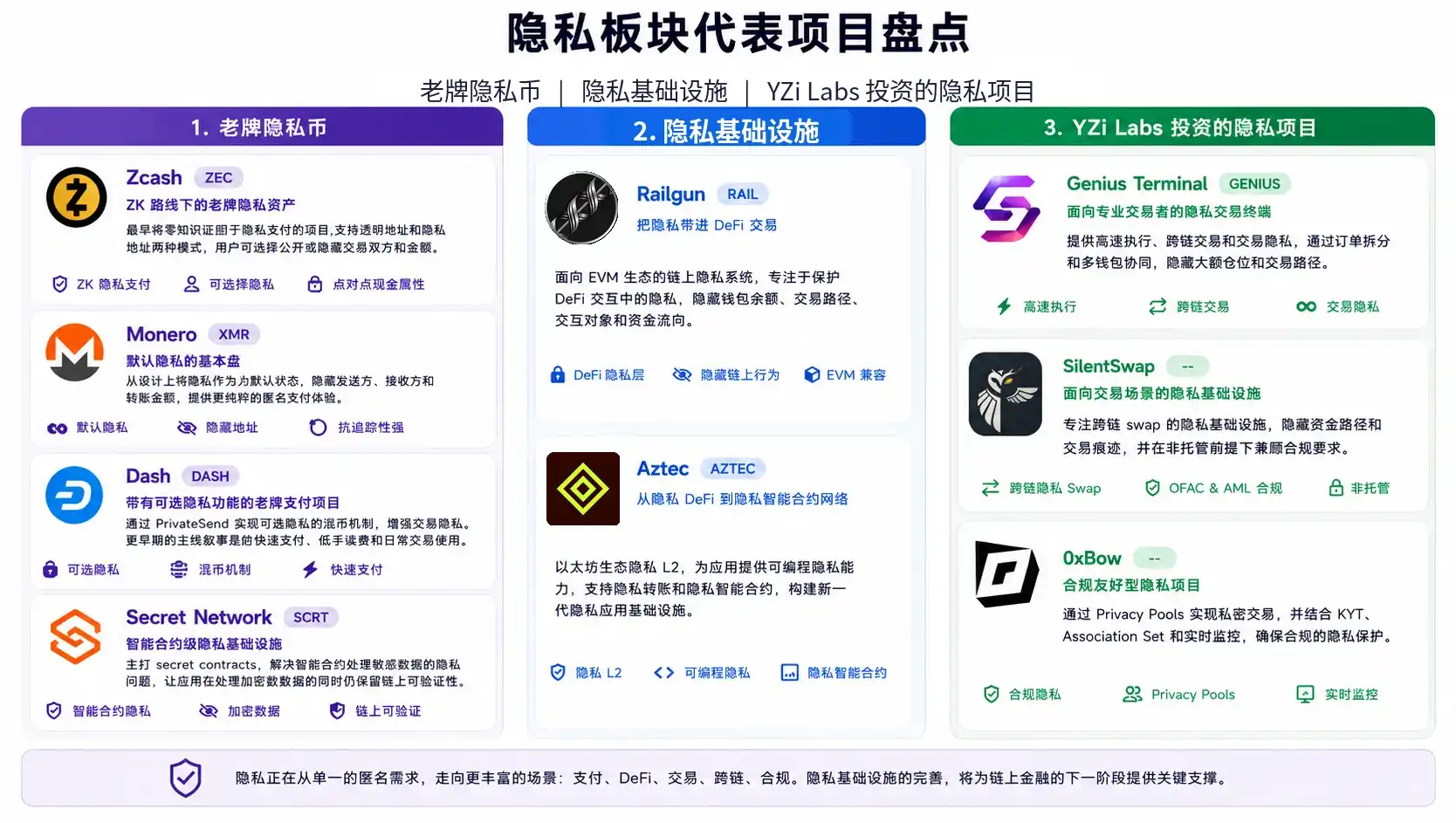
1. Legacy Privacy Coins: Asset and Payment Properties

Zcash (ZEC): Legacy Privacy Asset on the ZK Path

X: @zcash | XHunt Ranking: 13364

Zcash is a representative legacy privacy coin and one of the earliest crypto projects to use zero-knowledge proofs for private payments. Unlike regular public chains where all transactions are publicly viewable, Zcash supports both transparent and shielded (private) addresses.

Users can make public transfers like they would with Bitcoin, or they can hide the sender, receiver, and amount through shielded transactions.

Zcash's official definition is "encrypted electronic cash," emphasizing its properties for private peer-to-peer payments.

💰 Token Performance:

Naval Ravikant once stated on X: If Bitcoin is insurance against fiat currency risk, then Zcash is insurance against Bitcoin's transparency risk.

In terms of price performance, ZEC has been one of the most prominent primary assets in this cycle's privacy sector, rising from around $200 in March to $620.

Monero (XMR): The Default Privacy Baseline

X:@monero|XHunt Ranking: 4812

Monero is another highly representative project among legacy privacy coins, with its core positioning being default-private payments.

Unlike Zcash's optional privacy, Monero is designed with privacy as the default state from the ground up; transactions hide the sender, receiver, and amount.

Default privacy makes it more purist in the direction of anonymous payments, but it also subjects it to long-term higher regulatory pressure and exchange liquidity pressure.

💰 Token Performance:

However, judging from this cycle's market action, XMR's price performance hasn't been particularly outstanding. Although the broader market environment itself isn't strong, compared to ZEC, XMR clearly lacks elasticity.

Dash (DASH): Legacy Payment Project with Optional Privacy Features

X:@Dashpay|XHunt Ranking: 11376

Dash is an early entrant into the market, a legacy crypto project focused on payments. Dash's privacy features are optional, primarily implemented through PrivateSend.

The core idea of PrivateSend is to enhance transaction privacy through a coin mixing mechanism, allowing users to hide fund sources and transaction paths when needed. However, in terms of positioning, Dash is not a pure privacy coin; its earlier main narratives were actually fast payments, low fees, and everyday transactional use.

💰 Token Performance:

From this cycle's action, DASH has seen periodic rebounds, but its overall performance is not as prominent as ZEC's. Its current price is around 43 USDT. While it still carries the labels of a legacy payment project and optional privacy, the market's pricing of it seems more driven by sector rotation rather than a re-pricing of a primary privacy asset.

Secret Network (SCRT): Smart Contract-Level Privacy Infrastructure

X:@SecretNetwork|XHunt Ranking: 3677

Secret Network is an early public chain project focused on smart contract-level privacy, with its core feature being secret contracts. Unlike traditional privacy coins that focus on transfer privacy, it aims to solve data privacy problems at the application layer: Can smart contracts process sensitive data during execution without exposing everything on the public chain?

Secret Network's advantage lies in bringing privacy capabilities to the application layer. For applications like DeFi, NFTs, gaming, identity, and data markets, many scenarios are not suitable for completely public user data. The significance of secret contracts is enabling applications to process encrypted data while retaining on-chain verifiability.

💰 Token Performance:

In terms of price performance, SCRT hasn't clearly benefited from this round of privacy narrative resurgence. Its current price is around $0.08, still in a long-term low range.

2. New-Generation Privacy Infrastructure: Empowering the Application Layer

Railgun (RAIL): Bringing Privacy into DeFi Trading

X:@RAILGUN_Project|XHunt Ranking: 4099

Railgun is an on-chain privacy system for the EVM ecosystem, primarily serving DeFi scenarios. It doesn't aim to create a new privacy payment asset; rather, it hopes to bring privacy features into DeFi trading.

On public chains, users' wallet balances, transaction paths, counterparties, and fund flows can all be traced.

  • For ordinary users, this means asset exposure.

  • For traders, it means strategies could be copied or even targeted.

This is the problem Railgun aims to solve: allowing users to hide their on-chain behavior while participating in DeFi.

It's worth noting that Vitalik recently discussed the underlying problems faced by privacy protocols when talking about the Ethereum Foundation's future direction. He believes that protocols like smart contract wallets and Railgun still need intermediaries to submit transactions to the chain, which itself is a vulnerability.

💰 Token Performance:

RAIL has also clearly benefited from the recent warming of the privacy sector. The RAIL token's market cap has risen from 60M in April to 240M currently.

Compared to high-market-cap primary assets like ZEC, RAIL resembles more of a high-beta play within the privacy sector—easier to rally quickly when the narrative heats up, but with more pronounced liquidity and volatility.

Aztec (AZTEC): From Private DeFi to Private Smart Contract Network

X:@aztecnetwork|XHunt Ranking: 760

Aztec is a privacy L2 in the Ethereum ecosystem, positioned to provide programmable privacy for applications.

It's not a new project. Aztec initially launched zk.money and Aztec Connect, providing Ethereum users with private transfers and private DeFi entry points. However, in 2023, the team chose to shut down Aztec Connect and shift focus to a new private smart contract network.

In late 2025, AZTEC held a public token sale using a Continuous Clearing Auction mechanism, with the public sale price around $0.047.

💰 Token Performance:

From its secondary market performance, AZTEC's overall performance since listing hasn't been particularly strong. Its current price is around $0.025, still below the public sale cost. However, with the resurgence of the privacy sector, AZTEC has also seen a noticeable rebound recently.

3. YZi Labs' Investment Portfolio: Focusing on the Balance Between Transaction Privacy and Compliance

Genius Terminal (GENIUS): Privacy Trading Terminal for Professional Traders

X:@GeniusTerminal|XHunt Ranking: 7845

Genius Terminal is an on-chain trading terminal for professional DeFi users, emphasizing high-speed execution, cross-chain trading, and transaction privacy.

Genius can help users hide large positions and trading paths through order splitting and multi-wallet coordination. Users can complete cross-chain trades within one terminal without frequently switching wallets, bridges, and DEXs.

In January 2026, YZi Labs announced an investment in Genius, calling it a "private high-velocity on-chain trading terminal."

YZi Labs mentioned that Genius's goal is to provide an experience close to that of centralized exchanges in terms of speed, liquidity, and privacy, without sacrificing user ownership and decentralization.

💰 Token Performance:

In terms of secondary market performance, GENIUS has shown obvious short-term elasticity recently. Its current price is around $0.73.

SilentSwap: Privacy Infrastructure for Trading Scenarios

X:@SilentSwap|XHunt Ranking: 78144

SilentSwap is a privacy infrastructure for cross-chain trading scenarios, focusing on private cross-chain swaps. It aims to allow users to hide their fund paths and transaction traces when performing cross-chain swaps, transfers, and bridging assets.

On public chains, cross-chain transactions often expose a lot of information: which chain a user came from, what assets were swapped, the final destination of funds, and whether different addresses are associated. SilentSwap aims to solve this type of privacy leakage in cross-chain transactions.

Another feature of SilentSwap is that it doesn't just emphasize privacy; it also puts compliance among its product selling points. Its website explicitly lists "OFAC & AML Compliant" and states that it holds two legal opinions in the US. This sets it apart from traditional privacy projects that "only emphasize anonymity": it attempts to find a balance between non-custodial, cross-chain privacy, and compliance.

0xBow: Compliance-Friendly Privacy Project

X:@0xbowio|XHunt Ranking: 9376

0xBow is an infrastructure project for on-chain privacy and compliance scenarios, with its core direction being compliant onchain privacy.

Unlike traditional privacy projects emphasizing "untraceability," 0xBow is more concerned with: Can users prove their funds are not mixed with illicit activities while protecting their transaction privacy?

Its core product is Privacy Pools. Privacy Pools support peer-to-peer private transactions while avoiding users' funds mixing with illegal funds. 0xBow monitors deposits entering Privacy Pools and filters them through a Know Your Transaction mechanism. Only funds meeting the criteria enter the Association Set.

Behind this lies 0xBow's Association Set Provider (ASP). ASPs continuously monitor transactions within Privacy Pools, identify suspicious patterns, and support Proof of Association, real-time transaction monitoring, programmable compliance, and modular deployment.

In other words, 0xBow isn't simply creating an anonymous pool; it attempts to make private transactions operate within a compliance framework.

III. Industry Consensus: Privacy is No Longer an "Isolated Narrative"

Aster: Perp DEXs Also Begin Introducing Transaction Privacy

Aster itself is a Perp DEX, but its Shield Mode has already integrated privacy into the derivatives trading experience.

This indicates that privacy needs no longer exist only in transfer scenarios. For on-chain traders, what is truly sensitive is often trade direction, position size, transaction paths, and fund intentions.

Especially in Perp DEXs, if large trades and position changes are exposed in a public environment, they are prone to being copied, targeted, or even front-run.

Therefore, Aster's Shield Mode is essentially not a traditional privacy coin feature; it embeds transaction privacy into the Perp DEX product itself. It reflects a more specific trend: If on-chain derivatives want to continue attracting more professional trading demand, they may need to address not just liquidity and fees but also the issue of exposed trading intent.

Vitalik: Ethereum Also Needs Native Privacy

It's not just the application layer that is starting to value privacy; the Ethereum core roadmap is also beginning to revisit this issue.

Recently, Vitalik also mentioned Ethereum's lack of native privacy capabilities and proposed a set of short-term privacy improvement directions, including Account Abstraction, FOCIL, keyed nonces, and access-layer privacy work like Kohaku. These correspond to censorship resistance, transaction unlinkability, and privacy protection in wallets and chain-reading processes, respectively.

This shows that privacy is no longer just an add-on feature for external applications; it is also being discussed within wallet designs, transaction structures, access layers, and protocol design.

EIP-8182: Ethereum Also Discusses Native Private Transfers

EIP-8182 proposes introducing a standardized private transfer system for Ethereum. Through a shared shielded pool, system contracts, and ZK verification precompiles, it aims to give ETH and ERC-20 transfers native privacy capabilities.

Simply put, it asks: Can private transfers no longer rely on fragmented third-party applications but instead become shared infrastructure at the Ethereum protocol layer?

In the past, privacy on Ethereum was often fragmented. Different protocols had different privacy pools, different entry points, and different anonymity sets, resulting in a non-uniform user experience and diluted privacy effects.

EIP-8182 attempts to push this issue toward the protocol layer: If ETH and ERC-20s can share a common private transfer infrastructure, wallets, applications, and users can all more easily access privacy capabilities.

This also illustrates that privacy is no longer just the narrative of a few specific privacy projects. Whether it's Aster embedding privacy into its Perp DEX or EIP-8182 pushing private transfers toward the Ethereum protocol layer, they essentially point to the same thing:

The more mature the on-chain world becomes, the less privacy resembles a niche feature and the more it resembles part of the next stage of infrastructure.

IV. Conclusion: Finding the Balance Between Transparency and Protection

The privacy sector's return to the market spotlight this cycle appears, on the surface, to be a sector rotation play. However, if we only interpret it as "privacy coins are hot again," we might underestimate the significance of this change. What has truly changed is that the market is beginning to re-examine the boundaries of on-chain transparency.

In the past, the crypto industry often equated transparency with trust, believing that as long as all information is public, the system is more trustworthy. But transparency does not mean all financial behavior should be exposed without reservation. Users' asset balances, transaction paths, position changes, liquidation prices, and strategic intentions are essentially sensitive information. When this information is completely public, transparency can transform from a trust mechanism into a new source of risk.

Therefore, privacy is not the opposite of transparency; it is answering a more practical question: For on-chain finance to continue expanding, what information should be public, and what information should be protected? What will truly matter in the future may not be who can achieve the most complete anonymity, but who can find the balance between transparency, privacy, compliance, and usability.

When on-chain finance was still in the small-scale experimental stage, complete transparency might have sufficed. But if it is to carry larger funds, more complex trades, and more professional participants, privacy ceases to be merely a niche demand and becomes part of the infrastructure for the next stage.


Perguntas relacionadas

QWhat is the main reason behind the renewed interest in the privacy sector, beyond the rise in ZEC's price?

AThe deeper reason is market concern over whether a fully transparent on-chain environment can continue to support larger-scale, more professional on-chain financial activities. Users need transparency for trust but also need privacy to protect assets, strategies, and trading safety from risks like front-running and targeted attacks.

QAccording to the article, how is the modern privacy sector categorized?

AThe modern privacy sector is categorized into three main groups: 1) Legacy privacy assets like ZEC and XMR, focusing on private payments. 2) Next-generation privacy infrastructure like Railgun and Aztec, focusing on application-layer privacy (e.g., for DeFi). 3) Projects focusing on a balance between transaction privacy and compliance, like Genius, SilentSwap, and 0xBow, which are associated with YZi Labs' investments.

QWhat is the key difference between Zcash (ZEC) and Monero (XMR) regarding privacy?

AZcash offers optional privacy, allowing users to choose between transparent (public) addresses and shielded (private) addresses for transactions. Monero, in contrast, has privacy as its default state, where all transactions automatically hide the sender, receiver, and transaction amount by design.

QWhat point did Vitalik Buterin make about the current state of privacy protocols on Ethereum?

AVitalik pointed out that current privacy protocols, like those using smart contract wallets or Railgun, still have a vulnerability: they require an intermediary to submit transactions to the chain. He also discussed Ethereum's need for native privacy improvements, mentioning directions like Account Abstraction, FOCIL, and keyed nonces to address censorship resistance and transaction unlinkability.

QWhat is the core idea behind EIP-8182 for Ethereum?

AEIP-8182 proposes introducing a standardized private transfer system at the protocol level for Ethereum. It aims to enable native privacy for ETH and ERC-20 transfers by creating shared infrastructure like a shielded pool, system contracts, and ZK verification precompiles, moving away from fragmented, application-specific privacy solutions.

Leituras Relacionadas

A Trillion-Dollar Frenzy for Memory Sellers, Halved Profits for Memory Buyers

Summary: A stark divide has emerged in the tech industry. While memory chipmaker Micron's stock soared 19% in a single day, pushing its market cap over $1 trillion, smartphone manufacturer Xiaomi reported a 43% plunge in adjusted net profit. The core driver is a severe supply crunch in memory chips, particularly for AI applications. Wall Street analysts, led by UBS and its unprecedented 204% target price hike for Micron, argue that long-term agreements (LTAs) from AI cloud giants are fundamentally ending the sector's notorious boom-and-bust cycles, justifying a re-rating from cyclical to infrastructure-like valuations. However, the "storage" market is now fragmented into three tiers. The first, AI-grade memory like HBM and server DDR5, faces extreme shortages and soaring prices driven by massive cloud capex. The second, mobile memory for smartphones, is also seeing sharp price hikes as manufacturers like Xiaomi are forced to pay more for remaining capacity, severely squeezing their margins. The third, PC retail channels, shows price declines due to existing inventory. The article questions the sustainability of the "supercycle" narrative. It highlights that Micron's revenue surge is driven almost entirely by price increases, not shipment volumes, making it vulnerable to a potential demand slowdown. While LTAs may dampen volatility, history suggests they are often tested during downturns. The current peak earnings, used to justify high valuations, represent a classic cyclical top. The piece concludes with a note of caution: when the entire Street chants "this time is different," it's wise to remember past bubbles, even as it acknowledges AI demand may indeed be structural.

marsbitHá 58m

A Trillion-Dollar Frenzy for Memory Sellers, Halved Profits for Memory Buyers

marsbitHá 58m

This New Generation of US Stock Trading Gods No Longer Read Financial Reports

The new generation of "stock gods" in the 2026 US AI bull market are not analyzing traditional financial reports. Instead of focusing on giants like NVIDIA, figures like the 22-year-old Leopold Aschenbrenner (who reportedly turned $200M into $14B) and influencers like Serenity on platforms like Reddit's WallStreetBets, X, and Substack are gaining fame and returns by targeting obscure, low-cap "micro-cap" stocks. Their strategy, dubbed "supply chain sniping," involves identifying critical, often monopolistic, bottlenecks in the AI hardware supply chain—such as specific materials or components essential for giants like Google and NVIDIA—that are missed by mainstream Wall Street analysts. Serenity's call on AXTI, a $700M company supplying indium phosphide substrates crucial for photonics and optical interconnects, saw the stock soar from ~$12 to nearly $150. Similarly, accounts like KawzInvests and PhotonCap focus on thematic, supply-chain-driven research in areas like AI infrastructure, optics, and cloud services for SMEs, bypassing traditional valuation metrics. This shift represents a cultural move away from Warren Buffett-style value investing based on deep financial statement analysis. The new approach thrives on low liquidity, early narratives, and strong community propagation on social media, similar to meme stocks or crypto. However, this "attention economy" strategy carries risks: it depends on sustained information gaps, the underlying companies' ability to deliver fundamental results, and the potential for crowded, volatile exits as narratives shift. The trend also shows crypto traders applying their narrative-sensing skills to US micro-caps, marking a significant evolution in trading culture.

marsbitHá 1h

This New Generation of US Stock Trading Gods No Longer Read Financial Reports

marsbitHá 1h

Trillion-Dollar Euphoria for Memory Sellers, Halved Profits for Memory Buyers

Title: The Trillion-Dollar Memory Seller's Carnival vs. The Buyer's Halved Profits On May 26, a stark contrast unfolded. While memory chipmaker Micron's market cap surged past $1 trillion, smartphone maker Xiaomi reported plummeting profits. Xiaomi's Q1 2026 profits fell 43% year-on-year. Executive Lu Weibing cited memory prices quadrupling from last year, adding roughly $210 to a phone's cost. To survive, Xiaomi is cutting entry-level models, sacrificing volume. Micron's stock, however, skyrocketed over 19% in a day, capping an 8x gain in a year. Major banks like UBS and JPMorgan issued bullish reports, raising price targets drastically. Their core thesis: Long-Term Agreements (LTAs) with AI cloud giants (Microsoft, Google, etc.) are eliminating the memory industry's notorious boom-bust cycle. By locking in fixed-price, multi-year contracts for AI-grade memory (HBM, server DDR5), these deals promise stable, utility-like earnings, justifying a higher valuation (20-30x P/E vs. the historical 8-15x). The article reveals a three-tiered memory market in 2026: 1) **AI Storage (HBM/DDR5/Enterprise SSD)**: Extreme shortage, soaring prices, LTAs. This is Micron's story. 2) **Mobile/Embedded Memory**: Also facing sharp price hikes as AI production crowds out capacity, severely pressuring phone makers like Xiaomi. 3) **PC Retail**: Some spot prices are falling due to channel inventory liquidation, creating a divergence from contract markets. The author questions if LTAs truly end the cycle. It hinges on sustained, hyper-growth AI demand. Micron's current profits are at a cycle peak, driven mostly by price hikes, not volume. If AI capital expenditure growth slows, the massive industry capacity expansion (e.g., Micron's $250B+ CapEx plan) could lead to a glut. Historically, using peak-cycle earnings for valuation is a classic trap. While the AI-driven structural shift might be real, the unanimous Wall Street euphoria warrants caution, echoing past bubbles like Cisco's in 2000. The memory seller's trillion-dollar狂欢 (carnival) continues, but the cycle's shadow remains.

链捕手Há 1h

Trillion-Dollar Euphoria for Memory Sellers, Halved Profits for Memory Buyers

链捕手Há 1h

Trading

Spot
Futuros

Artigos em Destaque

O que é $S$

Compreender o SPERO: Uma Visão Abrangente Introdução ao SPERO À medida que o panorama da inovação continua a evoluir, o surgimento de tecnologias web3 e projetos de criptomoeda desempenha um papel fundamental na formação do futuro digital. Um projeto que tem atraído atenção neste campo dinâmico é o SPERO, denotado como SPERO,$$s$. Este artigo tem como objetivo reunir e apresentar informações detalhadas sobre o SPERO, para ajudar entusiastas e investidores a compreender as suas bases, objetivos e inovações nos domínios web3 e cripto. O que é o SPERO,$$s$? O SPERO,$$s$ é um projeto único dentro do espaço cripto que procura aproveitar os princípios da descentralização e da tecnologia blockchain para criar um ecossistema que promove o envolvimento, a utilidade e a inclusão financeira. O projeto é concebido para facilitar interações peer-to-peer de novas maneiras, proporcionando aos utilizadores soluções e serviços financeiros inovadores. No seu núcleo, o SPERO,$$s$ visa capacitar indivíduos ao fornecer ferramentas e plataformas que melhoram a experiência do utilizador no espaço das criptomoedas. Isso inclui a possibilidade de métodos de transação mais flexíveis, a promoção de iniciativas impulsionadas pela comunidade e a criação de caminhos para oportunidades financeiras através de aplicações descentralizadas (dApps). A visão subjacente do SPERO,$$s$ gira em torno da inclusão, visando fechar lacunas dentro das finanças tradicionais enquanto aproveita os benefícios da tecnologia blockchain. Quem é o Criador do SPERO,$$s$? A identidade do criador do SPERO,$$s$ permanece algo obscura, uma vez que existem recursos publicamente disponíveis limitados que fornecem informações detalhadas sobre o(s) seu(s) fundador(es). Esta falta de transparência pode resultar do compromisso do projeto com a descentralização—uma ética que muitos projetos web3 partilham, priorizando contribuições coletivas em vez de reconhecimento individual. Ao centrar as discussões em torno da comunidade e dos seus objetivos coletivos, o SPERO,$$s$ incorpora a essência do empoderamento sem destacar indivíduos específicos. Assim, compreender a ética e a missão do SPERO é mais importante do que identificar um criador singular. Quem são os Investidores do SPERO,$$s$? O SPERO,$$s$ é apoiado por uma diversidade de investidores que vão desde capitalistas de risco a investidores-anjo dedicados a promover a inovação no setor cripto. O foco desses investidores geralmente alinha-se com a missão do SPERO—priorizando projetos que prometem avanço tecnológico social, inclusão financeira e governança descentralizada. Essas fundações de investidores estão tipicamente interessadas em projetos que não apenas oferecem produtos inovadores, mas que também contribuem positivamente para a comunidade blockchain e os seus ecossistemas. O apoio desses investidores reforça o SPERO,$$s$ como um concorrente notável no domínio em rápida evolução dos projetos cripto. Como Funciona o SPERO,$$s$? O SPERO,$$s$ emprega uma estrutura multifacetada que o distingue de projetos de criptomoeda convencionais. Aqui estão algumas das características-chave que sublinham a sua singularidade e inovação: Governança Descentralizada: O SPERO,$$s$ integra modelos de governança descentralizada, capacitando os utilizadores a participar ativamente nos processos de tomada de decisão sobre o futuro do projeto. Esta abordagem promove um sentido de propriedade e responsabilidade entre os membros da comunidade. Utilidade do Token: O SPERO,$$s$ utiliza o seu próprio token de criptomoeda, concebido para servir várias funções dentro do ecossistema. Esses tokens permitem transações, recompensas e a facilitação de serviços oferecidos na plataforma, melhorando o envolvimento e a utilidade gerais. Arquitetura em Camadas: A arquitetura técnica do SPERO,$$s$ suporta modularidade e escalabilidade, permitindo a integração contínua de funcionalidades e aplicações adicionais à medida que o projeto evolui. Esta adaptabilidade é fundamental para manter a relevância no panorama cripto em constante mudança. Envolvimento da Comunidade: O projeto enfatiza iniciativas impulsionadas pela comunidade, empregando mecanismos que incentivam a colaboração e o feedback. Ao nutrir uma comunidade forte, o SPERO,$$s$ pode melhor atender às necessidades dos utilizadores e adaptar-se às tendências do mercado. Foco na Inclusão: Ao oferecer taxas de transação baixas e interfaces amigáveis, o SPERO,$$s$ visa atrair uma base de utilizadores diversificada, incluindo indivíduos que anteriormente podem não ter participado no espaço cripto. Este compromisso com a inclusão alinha-se com a sua missão abrangente de empoderamento através da acessibilidade. Cronologia do SPERO,$$s$ Compreender a história de um projeto fornece insights cruciais sobre a sua trajetória de desenvolvimento e marcos. Abaixo está uma cronologia sugerida que mapeia eventos significativos na evolução do SPERO,$$s$: Fase de Conceituação e Ideação: As ideias iniciais que formam a base do SPERO,$$s$ foram concebidas, alinhando-se de perto com os princípios de descentralização e foco na comunidade dentro da indústria blockchain. Lançamento do Whitepaper do Projeto: Após a fase conceitual, um whitepaper abrangente detalhando a visão, os objetivos e a infraestrutura tecnológica do SPERO,$$s$ foi lançado para atrair o interesse e o feedback da comunidade. Construção da Comunidade e Primeiros Envolvimentos: Esforços ativos de divulgação foram feitos para construir uma comunidade de primeiros adotantes e investidores potenciais, facilitando discussões em torno dos objetivos do projeto e angariando apoio. Evento de Geração de Tokens: O SPERO,$$s$ realizou um evento de geração de tokens (TGE) para distribuir os seus tokens nativos a apoiantes iniciais e estabelecer liquidez inicial dentro do ecossistema. Lançamento da dApp Inicial: A primeira aplicação descentralizada (dApp) associada ao SPERO,$$s$ foi lançada, permitindo que os utilizadores interagissem com as funcionalidades principais da plataforma. Desenvolvimento Contínuo e Parcerias: Atualizações e melhorias contínuas nas ofertas do projeto, incluindo parcerias estratégicas com outros players no espaço blockchain, moldaram o SPERO,$$s$ em um jogador competitivo e em evolução no mercado cripto. Conclusão O SPERO,$$s$ é um testemunho do potencial do web3 e das criptomoedas para revolucionar os sistemas financeiros e capacitar indivíduos. Com um compromisso com a governança descentralizada, o envolvimento da comunidade e funcionalidades inovadoras, abre caminho para um panorama financeiro mais inclusivo. Como em qualquer investimento no espaço cripto em rápida evolução, potenciais investidores e utilizadores são incentivados a pesquisar minuciosamente e a envolver-se de forma ponderada com os desenvolvimentos em curso dentro do SPERO,$$s$. O projeto demonstra o espírito inovador da indústria cripto, convidando a uma exploração mais aprofundada das suas inúmeras possibilidades. Embora a jornada do SPERO,$$s$ ainda esteja a desenrolar-se, os seus princípios fundamentais podem, de facto, influenciar o futuro de como interagimos com a tecnologia, as finanças e uns com os outros em ecossistemas digitais interconectados.

69 Visualizações TotaisPublicado em {updateTime}Atualizado em 2024.12.17

O que é $S$

O que é AGENT S

Agent S: O Futuro da Interação Autónoma no Web3 Introdução No panorama em constante evolução do Web3 e das criptomoedas, as inovações estão constantemente a redefinir a forma como os indivíduos interagem com plataformas digitais. Um projeto pioneiro, o Agent S, promete revolucionar a interação humano-computador através do seu framework aberto e agente. Ao abrir caminho para interações autónomas, o Agent S visa simplificar tarefas complexas, oferecendo aplicações transformadoras em inteligência artificial (IA). Esta exploração detalhada irá aprofundar-se nas complexidades do projeto, nas suas características únicas e nas implicações para o domínio das criptomoedas. O que é o Agent S? O Agent S é um framework aberto e agente, especificamente concebido para abordar três desafios fundamentais na automação de tarefas computacionais: Aquisição de Conhecimento Específico de Domínio: O framework aprende inteligentemente a partir de várias fontes de conhecimento externas e experiências internas. Esta abordagem dupla capacita-o a construir um rico repositório de conhecimento específico de domínio, melhorando o seu desempenho na execução de tarefas. Planeamento ao Longo de Longos Horizontes de Tarefas: O Agent S emprega planeamento hierárquico aumentado por experiência, uma abordagem estratégica que facilita a decomposição e execução eficientes de tarefas intrincadas. Esta característica melhora significativamente a sua capacidade de gerir múltiplas subtarefas de forma eficiente e eficaz. Gestão de Interfaces Dinâmicas e Não Uniformes: O projeto introduz a Interface Agente-Computador (ACI), uma solução inovadora que melhora a interação entre agentes e utilizadores. Utilizando Modelos de Linguagem Multimodais de Grande Escala (MLLMs), o Agent S pode navegar e manipular diversas interfaces gráficas de utilizador de forma fluida. Através destas características pioneiras, o Agent S fornece um framework robusto que aborda as complexidades envolvidas na automação da interação humana com máquinas, preparando o terreno para uma infinidade de aplicações em IA e além. Quem é o Criador do Agent S? Embora o conceito de Agent S seja fundamentalmente inovador, informações específicas sobre o seu criador permanecem elusivas. O criador é atualmente desconhecido, o que destaca ou o estágio nascente do projeto ou a escolha estratégica de manter os membros fundadores em anonimato. Independentemente da anonimidade, o foco permanece nas capacidades e no potencial do framework. Quem são os Investidores do Agent S? Como o Agent S é relativamente novo no ecossistema criptográfico, informações detalhadas sobre os seus investidores e financiadores não estão explicitamente documentadas. A falta de informações disponíveis publicamente sobre as fundações de investimento ou organizações que apoiam o projeto levanta questões sobre a sua estrutura de financiamento e roteiro de desenvolvimento. Compreender o apoio é crucial para avaliar a sustentabilidade do projeto e o seu impacto potencial no mercado. Como Funciona o Agent S? No núcleo do Agent S reside uma tecnologia de ponta que lhe permite funcionar eficazmente em diversos ambientes. O seu modelo operacional é construído em torno de várias características-chave: Interação Humano-Computador Semelhante: O framework oferece planeamento avançado em IA, esforçando-se para tornar as interações com computadores mais intuitivas. Ao imitar o comportamento humano na execução de tarefas, promete elevar as experiências dos utilizadores. Memória Narrativa: Utilizada para aproveitar experiências de alto nível, o Agent S utiliza memória narrativa para acompanhar os históricos de tarefas, melhorando assim os seus processos de tomada de decisão. Memória Episódica: Esta característica fornece aos utilizadores orientações passo a passo, permitindo que o framework ofereça suporte contextual à medida que as tarefas se desenrolam. Suporte para OpenACI: Com a capacidade de funcionar localmente, o Agent S permite que os utilizadores mantenham o controlo sobre as suas interações e fluxos de trabalho, alinhando-se com a ética descentralizada do Web3. Fácil Integração com APIs Externas: A sua versatilidade e compatibilidade com várias plataformas de IA garantem que o Agent S possa integrar-se perfeitamente em ecossistemas tecnológicos existentes, tornando-o uma escolha apelativa para desenvolvedores e organizações. Estas funcionalidades contribuem coletivamente para a posição única do Agent S no espaço cripto, à medida que automatiza tarefas complexas e em múltiplos passos com mínima intervenção humana. À medida que o projeto evolui, as suas potenciais aplicações no Web3 podem redefinir a forma como as interações digitais se desenrolam. Cronologia do Agent S O desenvolvimento e os marcos do Agent S podem ser encapsulados numa cronologia que destaca os seus eventos significativos: 27 de Setembro de 2024: O conceito de Agent S foi lançado num artigo de pesquisa abrangente intitulado “Um Framework Agente Aberto que Usa Computadores como um Humano”, mostrando a base para o projeto. 10 de Outubro de 2024: O artigo de pesquisa foi disponibilizado publicamente no arXiv, oferecendo uma exploração aprofundada do framework e da sua avaliação de desempenho com base no benchmark OSWorld. 12 de Outubro de 2024: Uma apresentação em vídeo foi lançada, proporcionando uma visão visual das capacidades e características do Agent S, envolvendo ainda mais potenciais utilizadores e investidores. Estes marcos na cronologia não apenas ilustram o progresso do Agent S, mas também indicam o seu compromisso com a transparência e o envolvimento da comunidade. Pontos-Chave Sobre o Agent S À medida que o framework Agent S continua a evoluir, várias características-chave destacam-se, sublinhando a sua natureza inovadora e potencial: Framework Inovador: Concebido para proporcionar um uso intuitivo de computadores semelhante à interação humana, o Agent S traz uma abordagem nova à automação de tarefas. Interação Autónoma: A capacidade de interagir autonomamente com computadores através de GUI significa um avanço em direção a soluções computacionais mais inteligentes e eficientes. Automação de Tarefas Complexas: Com a sua metodologia robusta, pode automatizar tarefas complexas e em múltiplos passos, tornando os processos mais rápidos e menos propensos a erros. Melhoria Contínua: Os mecanismos de aprendizagem permitem que o Agent S melhore a partir de experiências passadas, aprimorando continuamente o seu desempenho e eficácia. Versatilidade: A sua adaptabilidade em diferentes ambientes operacionais, como OSWorld e WindowsAgentArena, garante que pode servir uma ampla gama de aplicações. À medida que o Agent S se posiciona no panorama do Web3 e das criptomoedas, o seu potencial para melhorar as capacidades de interação e automatizar processos significa um avanço significativo nas tecnologias de IA. Através do seu framework inovador, o Agent S exemplifica o futuro das interações digitais, prometendo uma experiência mais fluida e eficiente para os utilizadores em diversas indústrias. Conclusão O Agent S representa um ousado avanço na união da IA e do Web3, com a capacidade de redefinir a forma como interagimos com a tecnologia. Embora ainda esteja nas suas fases iniciais, as possibilidades para a sua aplicação são vastas e cativantes. Através do seu framework abrangente que aborda desafios críticos, o Agent S visa trazer interações autónomas para o primeiro plano da experiência digital. À medida que avançamos mais profundamente nos domínios das criptomoedas e da descentralização, projetos como o Agent S desempenharão, sem dúvida, um papel crucial na formação do futuro da tecnologia e da colaboração humano-computador.

649 Visualizações TotaisPublicado em {updateTime}Atualizado em 2025.01.14

O que é AGENT S

Como comprar S

Bem-vindo à HTX.com!Tornámos a compra de Sonic (S) simples e conveniente.Segue o nosso guia passo a passo para iniciar a tua jornada no mundo das criptos.Passo 1: cria a tua conta HTXUtiliza o teu e-mail ou número de telefone para te inscreveres numa conta gratuita na HTX.Desfruta de um processo de inscrição sem complicações e desbloqueia todas as funcionalidades.Obter a minha contaPasso 2: vai para Comprar Cripto e escolhe o teu método de pagamentoCartão de crédito/débito: usa o teu visa ou mastercard para comprar Sonic (S) instantaneamente.Saldo: usa os fundos da tua conta HTX para transacionar sem problemas.Terceiros: adicionamos métodos de pagamento populares, como Google Pay e Apple Pay, para aumentar a conveniência.P2P: transaciona diretamente com outros utilizadores na HTX.Mercado de balcão (OTC): oferecemos serviços personalizados e taxas de câmbio competitivas para os traders.Passo 3: armazena teu Sonic (S)Depois de comprar o teu Sonic (S), armazena-o na tua conta HTX.Alternativamente, podes enviá-lo para outro lugar através de transferência blockchain ou usá-lo para transacionar outras criptomoedas.Passo 4: transaciona Sonic (S)Transaciona facilmente Sonic (S) no mercado à vista da HTX.Acede simplesmente à tua conta, seleciona o teu par de trading, executa as tuas transações e monitoriza em tempo real.Oferecemos uma experiência de fácil utilização tanto para principiantes como para traders experientes.

1.2k Visualizações TotaisPublicado em {updateTime}Atualizado em 2025.03.21

Como comprar S

Discussões

Bem-vindo à Comunidade HTX. Aqui, pode manter-se informado sobre os mais recentes desenvolvimentos da plataforma e obter acesso a análises profissionais de mercado. As opiniões dos utilizadores sobre o preço de S (S) são apresentadas abaixo.

活动图片