DeepSeek's $10 Trillion Path: Leveraging Open Source to Pivot a Trillion-Dollar Hardware Ecosystem

marsbitPublicado em 2026-05-25Última atualização em 2026-05-25

Resumo

This article proposes a strategic analysis of DeepSeek, arguing its goal is not short-term application-layer monetization but a long-term, foundational play to reshape the AI hardware ecosystem. It posits that DeepSeek's series of architectural innovations—MoE, MLA, DSA, CSA, Engram, TileLang—are fundamentally designed to drastically reduce the computational and memory (especially HBM) requirements for training and serving state-of-the-art AI models. By making AI feasible on hardware with lower performance (e.g., using NAND/SSD for KV Cache, LPDDR for weights and Engram storage), DeepSeek aims to foster and benefit from a viable alternative AI hardware supply chain, particularly in China. This strategy could unlock a trillion-dollar valuation for DeepSeek by enabling and owning a stake in a new, massive hardware ecosystem, rather than competing directly on subscriptions or multi-modal features.

Original Title: DeepSeek's 10 trillion USD grand strategy

Original Author: @bookwormengr

Original Compilation: Peggy, BlockBeats

Editor's Note: Over the past year, discussions about DeepSeek have mostly focused on model performance, open source strategy, and price wars. However, understanding DeepSeek solely from perspectives like "selling subscriptions or not," "having multimodal capabilities or not," or "being able to act as a coding agent or not" might underestimate what it truly aims to change.

This article proposes a more radical judgment: DeepSeek's goal might not be short-term monetization through the application layer, but rather to reshape the cost structure of AI training and inference through a series of foundational architectural innovations, and indirectly catalyze the formation of a new hardware ecosystem. From MoE and MLA to DSA, CSA, mHC, Engram, and further to Dual Path and TileLang, DeepSeek's technical roadmap consistently revolves around one core question: how to achieve stronger models with less high-end computing power, under constraints of HBM, advanced manufacturing processes, packaging, and the CUDA ecosystem.

The most noteworthy aspect of this article is not "whether DeepSeek can earn a few hundred million dollars through APIs or subscriptions," but whether it is binding model capabilities, memory architecture, and the domestic hardware ecosystem together. KV Cache compression reduces reliance on HBM, NAND and SSDs can accommodate long-term caching, LPDDR can be used for weight streaming and Engram storage, and TileLang attempts to weaken the CUDA moat. If these innovations continue to proliferate, the beneficiaries won't be just DeepSeek itself, but also storage, ASICs, GPUs, networking chips, and the entire AI infrastructure chain.

Of course, the judgments in the article about a "$10 trillion industrial ecosystem" and a "$1 trillion valuation" still carry a strong speculative tone. But it provides an important path to understanding DeepSeek: open source doesn't necessarily mean abandoning commercialization, and low prices aren't necessarily just about subsidizing the market. For DeepSeek, the real business might not be at the application layer, but in making more hardware viable and enabling lower-cost AI supply. In other words, what it's selling might not be the model itself, but the feasibility of the next generation of AI infrastructure.

Original Article:

Have you ever wondered how DeepSeek is actually going to make money, and potentially a lot of it?

It hasn't launched competitive coding subscription plans like GLM, MoonShot, and MiniMax; it doesn't have multimodal, audio, or video models. So far, it doesn't even have its own harness—the outer runtime framework for model invocation, tool integration, and task execution—though they have recently started hiring for related positions to build this system.

Meanwhile, DeepSeek seems to be a long-term, steadfast proponent of open source, even happily sharing its "secret sauce." Isn't this crazy? Isn't it just burning money for nothing? Are the investors ready to pour in $10 billion just throwing their money down the drain?

I personally believe the answer is quite the opposite.

Next, based on what DeepSeek has done so far, I'll offer some observations and analyze the strategy it appears to be following. DeepSeek CEO Liang Wenfeng's ambitions likely extend far beyond the current model competition. He might be aiming for a much bigger prize: DeepSeek has the opportunity to reach a $1 trillion valuation while catalyzing the formation of a new $10 trillion industry.
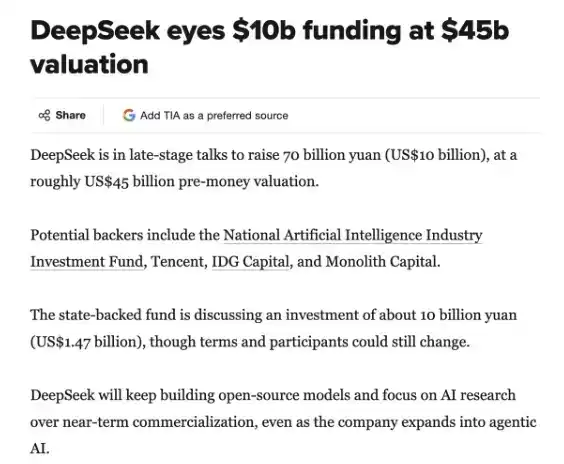
TechInAsia report on DeepSeek's latest funding round

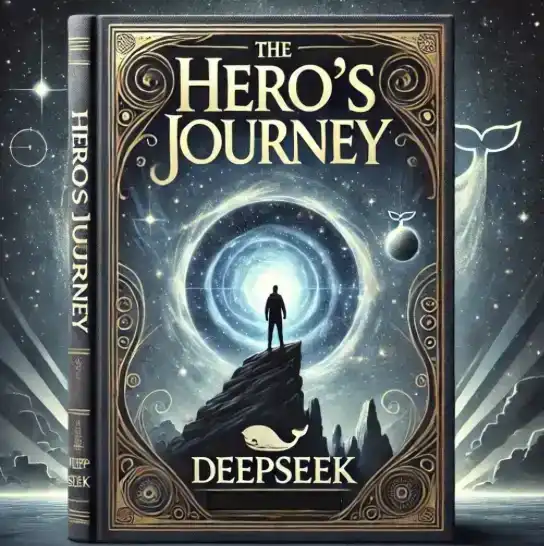
Revisiting DeepSeek's "Hero's Journey"

DeepSeek has always been going against the grain. It hasn't chosen to continuously release slightly better models and hastily package them as directly monetizable applications, like coding subscriptions. On January 27, 2025, I posted a widely circulated tweet about what I saw as DeepSeek's "Hero's Journey." Now, that story has become even more interesting.

While others were still trying to build dense models, DeepSeek chose the more difficult-to-train Mixture of Experts (MoE).

They adopted a "first principles" approach, inventing the new GRPO algorithm to replace the then-mainstream but costlier-to-implement PPO reinforcement learning algorithm.

They found that Reinforcement Learning from Verified Rewards (RLVR) was a key strategy for improving model reasoning capabilities.

They also proposed a simple speculative decoding strategy through "Multi Token Prediction," while also making training signals more dense.

They perfected the "ZERO bubble" pipeline to improve the utilization efficiency of limited GPU resources.

They released an expert load balancer, making it easier for everyone to deploy MoE models. Particularly, with the "Wide Expert Parallel" strategy, models can serve with larger batches, significantly reducing inference costs.

They invented mechanisms like MLA, DSA, CSA, HCA to reduce KV Cache requirements and keep the computational demand increase with context length as close to constant as possible.

They invented Engram, trading memory for computational efficiency.

They also invented mHC, enabling stable training even as model size scales. And there are many more examples like these.

In the "Hero's Journey," the most universal narrative structure, the hero never decides at the outset where their journey will ultimately lead. They learn along the way, gradually discovering their truly great mission and accomplishing it against formidable obstacles. They face many doubters but choose to ignore them. They also face malicious actors. They have apparent flaws or weaknesses but ultimately overcome them to fulfill their mission. They face seemingly insurmountable challenges but find ways to form alliances and learn to use their limited, precious resources wisely. This is precisely what makes the audience cheer for the hero. This is also why DeepSeek has won followers, global respect, and detractors.

As I will detail next, DeepSeek has been on this path for a long time and is gradually discovering its ultimate destiny: its goal is not to sell coding subscriptions, but to propel a $10 trillion Chinese AI hardware ecosystem and achieve a $1 trillion valuation for itself. In the process, it will also create opportunities for many new entrants in the Western hardware ecosystem.
Let's start with some interesting KV Cache calculations

Take a look at this very timely recent tweet by @SemiAnalysis_:
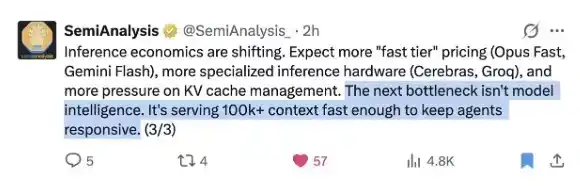
DeepSeek has solved this problem better than anyone else!

Let's do some fun KV Cache calculations. Don't worry, even if you don't like math. We'll use the recently released KV Cache calculator to see how much KV Cache savings DeepSeek V4 Pro brings and compare it with the latest GLM and Qwen models.

Here I calculate for a 1 million context length, assuming 8-bit KV precision and 16-bit indexer precision. You can also try this calculator yourself: https://kvcache.ai/tools/kv-cache-calculator/
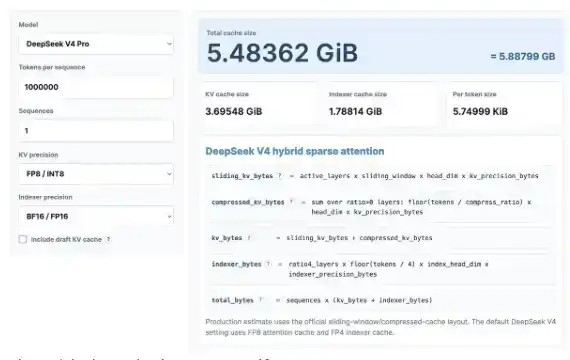
You can also try the calculator yourself!

At 1 million context length:

· DeepSeek V4 requires only 5.48GB HBM;

· GLM-5 requires 60GB HBM;

· Qwen3-235B-A22B requires a whopping 89GB HBM.

Note that:

· DeepSeek is a 1.6 trillion parameter model;

· GLM-5 is about 700 billion parameters and has already adopted DeepSeek's MLA and DSA, though not the latest compressed attention mechanisms;

· Qwen3-235B-A22B is about 235 billion parameters, using GQA attention mechanism.

DeepSeek has made fundamental contributions to alleviating memory pressure. If such innovations are widely adopted, they will significantly reduce the operating costs of long-horizon agents and unlock the next batch of new applications.
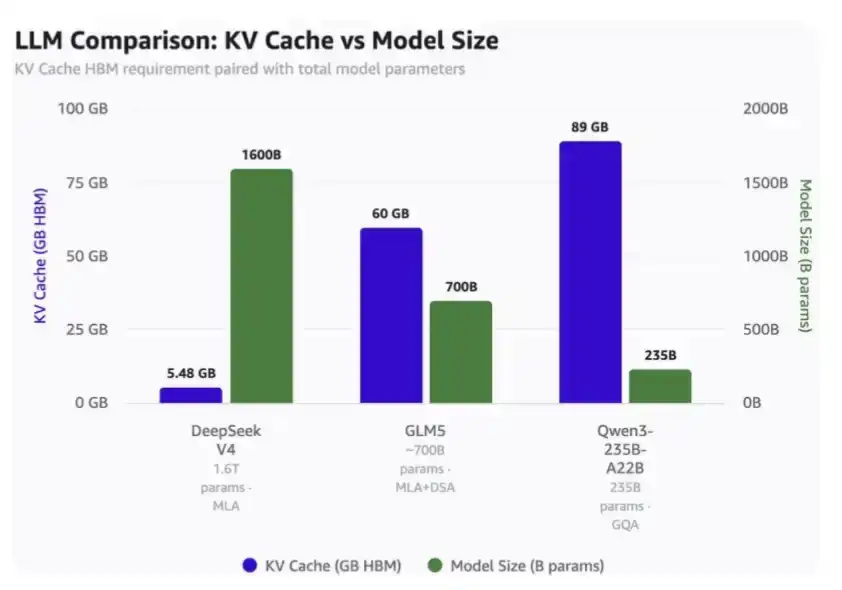
KV Cache occupancy comparison for 1 million token context and model sizes

The methodology behind the "madness"

The ability to keep the KV Cache volume so small without sacrificing model quality is precisely why DeepSeek can offer long-term caching at extremely low prices—less than 3% of Sonnet 4.6's cache hit price—and DeepSeek can keep the cache for hours.

For long-horizon tasks, a smaller KV Cache means it can be offloaded to SSD more economically and reloaded when needed. This reduces reliance on HBM. From the perspective of China's AI hardware industry, HBM is not only in tight supply but also one of the most difficult memory types to manufacture.

Furthermore, DeepSeek has developed technology to load KV Cache from SSDs faster, as described in its Dual Path paper.
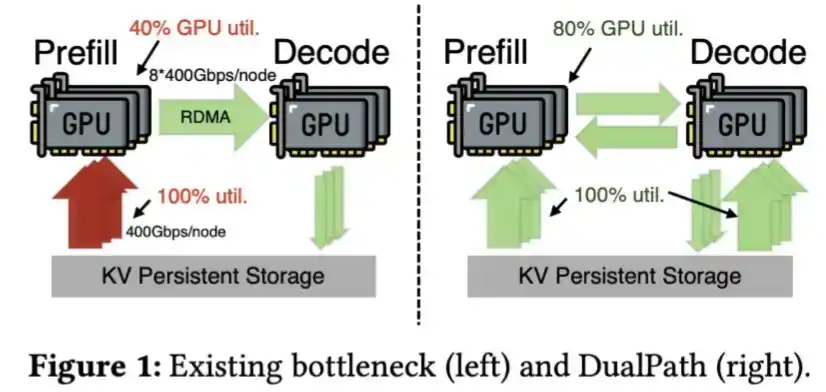
DeepSeek V4's compression of KV Cache is so significant that this step might not even be necessary.

So, who are the most direct beneficiaries of KV Cache compression?

Who supplies SSDs at scale? Don't forget, YMTC (Yangtze Memory Technologies Co.) is growing into a giant in the 3D NAND field. NAND can help DeepSeek avoid recomputing KV. In turn, DeepSeek creates a huge market for NAND and SSDs—benefiting not just YMTC but other related players.
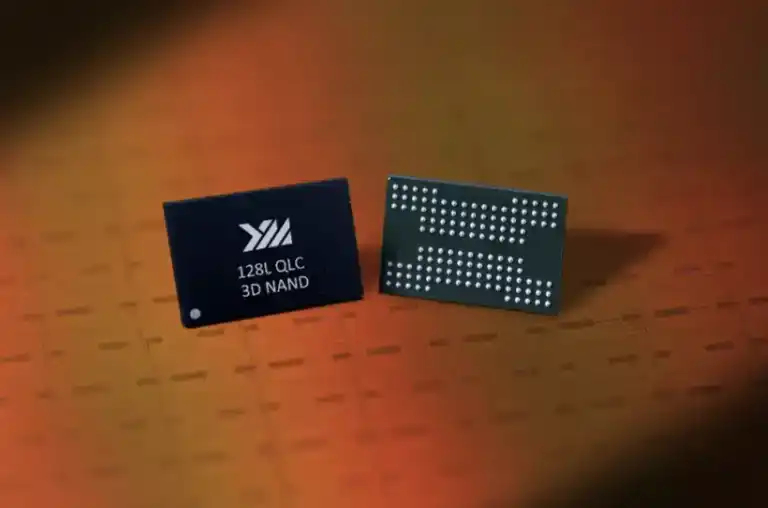
But it's not just about NAND and SSDs.

LPDDR memory also has huge potential. It can serve as a place to store model weights and stream them into HBM on demand, alleviating pressure on HBM. The SGLang team published a great blog post introducing this. The image below shows how this scheme works.

While DeepSeek hasn't specifically designed for this scheme, its MoE architecture, large number of expert models, and 4-bit weight characteristics all make this scheme easier to implement.
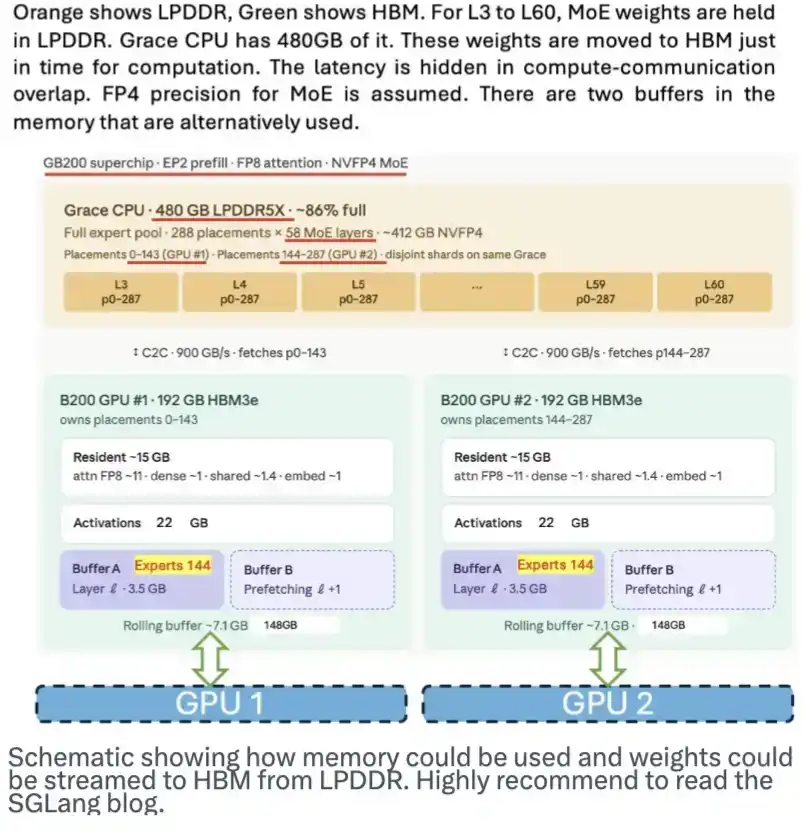
This schematic shows how memory might be used and how model weights are streamed from LPDDR to HBM. Highly recommend reading SGLang's blog post.

If this innovation is combined with extremely compact and lossless KV Cache, it will significantly reduce the demand for HBM.

So, who produces LPDDR in China? The answer is CXMT, ChangXin Memory Technologies. They are only about half a generation behind in LPDDR speed and one generation behind in density—not a huge gap.

Besides ample NAND, the Chinese AI ecosystem will also have ample LPDDR supply in the near future. Can this ease compute pressure? Answer: Yes. Keep reading.
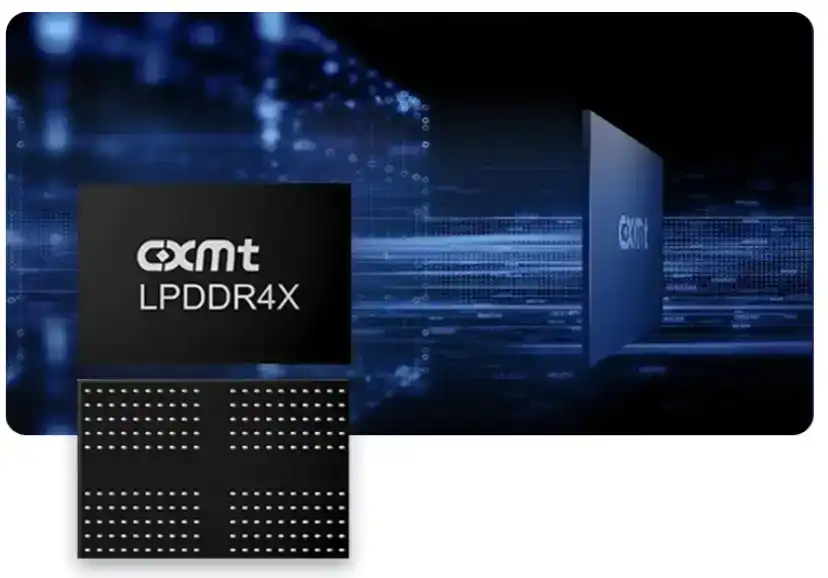
Intelligent memory usage can also alleviate GPU/ASIC pressure

The role of using NAND to store KV Cache is easy to understand: it allows KV Cache to be retained longer, reduces pressure on HBM, avoids recomputing KV Cache, and thus alleviates the computational burden on GPUs and ASICs.

Can LPDDR play a similar role? Besides serving as a storage location to stream weights "just-in-time" into HBM on demand, can it further reduce computational pressure?

Answer: Yes.

LPDDR can be used to store a large amount of content called Engram. In DeepSeek's Engram paper, they point out that MoE can expand model capacity through conditional computation, but the Transformer itself lacks a native "knowledge lookup" mechanism. Therefore, Transformers often have to inefficiently simulate retrieval through computation.

To solve this, DeepSeek proposed the Engram module. It modernizes classic N-gram embeddings, transforming them into a hash-based O(1) lookup mechanism, creating a complementary sparsification path they call conditional memory.

This saves computation but also requires memory to host the embedding table, which itself can be very large.

Essentially, this is a classic "trade memory for compute" scheme. But the key insight is: from a per-bit read cost perspective, the "memory" side is much cheaper—one LPDDR lookup is far cheaper than having data go through multiple Transformer layers for one full forward pass. Therefore, at scale, this is a very cost-effective trade-off.

This is how DeepSeek sacrifices some memory to gain computational savings.
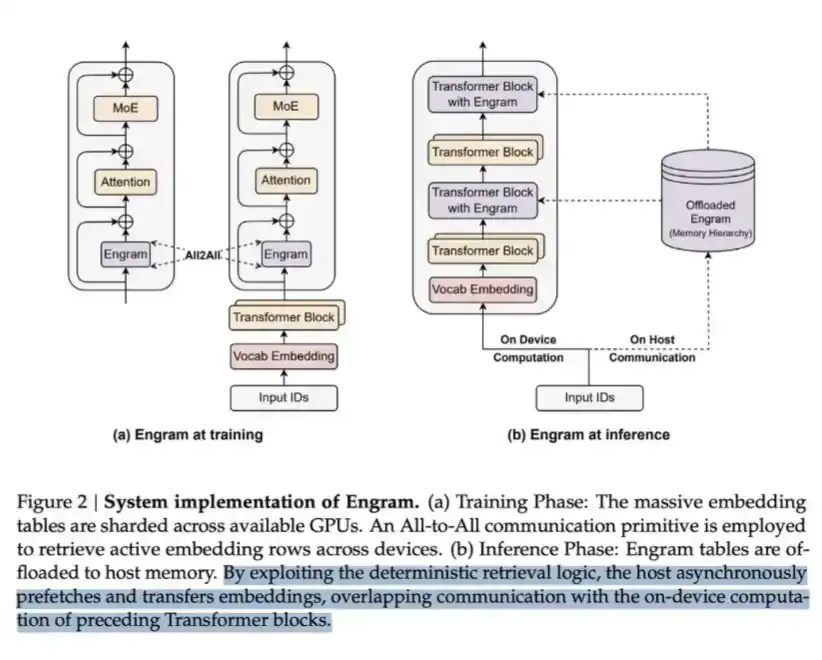
A worthwhile trade-off

Without comparable chip transistor density or EUV, Chinese GPUs and ASICs are likely to lag behind Western GPUs in raw FLOPs compute power for a long time. They also still have significant gaps in advanced packaging. Therefore, such trade-offs are very worthwhile, especially given that China can mass-produce NAND and LPDDR memory.

Reviewing DeepSeek's long-term strategy

Judging from these innovations, DeepSeek's goal doesn't seem to be making a few hundred million dollars in profit in the short term. Many of its past choices illustrate this: still no multimodal capabilities, no voice models, and video models are out of the question.

What it's really engaged in is a patient, potentially $10 trillion long-term game: catalyzing the formation of an alternative AI hardware ecosystem.

This is not only to make Chinese memory manufacturers key players in the Chinese and even global AI hardware markets but also to fundamentally reduce resource requirements, making AI model training and serving more cost-efficient. This way, many GPU, ASIC manufacturers, and networking chip vendors can become viable options.

At the same time, these innovations will also benefit the Western open-source ecosystem and the new generation of hardware manufacturers.

All the signs are already there. Let's review these innovations proposed by DeepSeek so far in detail:

1. Mixture of Experts (MoE) and MLA introduced in DeepSeek V2

DeepSeek introduced MoE and MLA in V2. MoE reduced the computation required to train high-intelligence models by about 40-50%; MLA reduced KV Cache by 90%.

This made offloading KV Cache to SSDs quite efficient.

These ideas first appeared in the DeepSeek V2 paper released in May 2024. Later, they also laid the foundation for training DeepSeek V3. At the time, DeepSeek trained a system close to closed-source model performance using only 2048 weakened H800 GPUs.
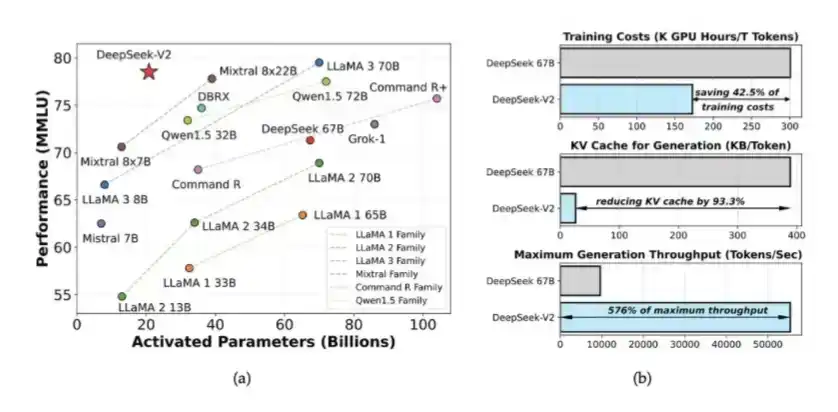
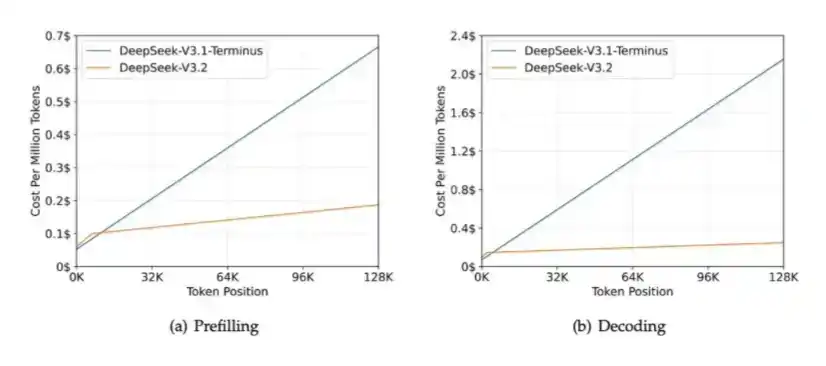
2. DSA: Introduced in DeepSeek V3.2 Exp to reduce computational overhead in long-context scenarios and alleviate HBM bandwidth pressure.

The core role of DSA is to ensure computational load doesn't continuously grow with increasing context length. Look at the chart below: as context length increases, DeepSeek-V3.2's processing time remains largely flat.
3. mHC: Proposed by DeepSeek in December 2025 in the paper "mHC: Manifold-Constrained Hyper-Connections."

mHC is a macro-architectural innovation by DeepSeek that redesigns information flow between Transformer layers.

Since ResNet, models typically used standard residual connections, i.e., x + F(x). mHC expands the residual flow into multiple parallel information channels and allows the model to perform learnable mixing between these channels. The key is that it constrains the mixing matrix to be doubly stochastic, restricting it to the Birkhoff polytope via Sinkhorn-Knopp projection. This mathematically guarantees stable signal magnitude regardless of how deep the model stacks.

This solves the catastrophic instability problem faced by earlier unconstrained Hyper-Connections. Hyper-Connections were initially proposed by ByteDance but, without constraints, signal amplification could explode 3000x at 27 billion parameters, causing training to collapse completely.

mHC's computational cost is low: it only adds about 6.7% actual training time overhead because it doesn't change the FLOPs of attention or FFN layers, only how the outputs of these layers are routed between layers.

But the performance improvement is noticeable: at 27 billion parameters, mHC improves scores by 7.2 points on BIG-Bench Hard reasoning tasks, 3.2 points on DROP, 2.8 points on GSM8K math, and 1.4 points on MMLU general knowledge—all at the same model size and nearly the same compute budget.

Essentially, mHC provides the network with a richer, more expressive inter-layer information routing topology, achieving higher intelligence per parameter with almost no extra FLOPs.
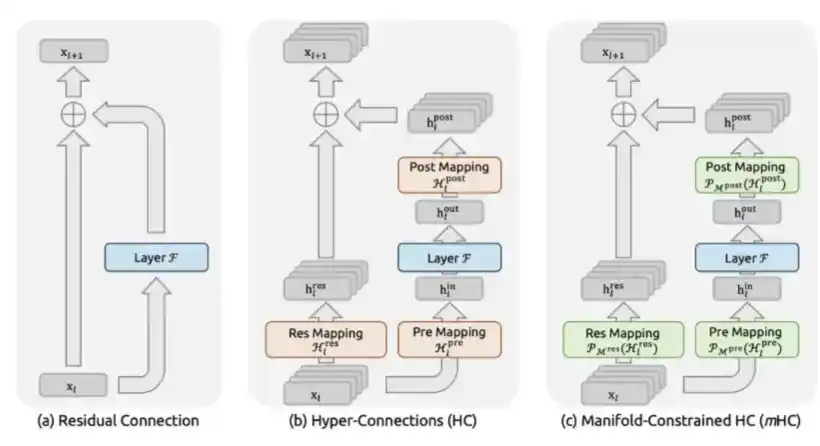
mHC is a complex architectural design, but it enables more stable training and higher intelligence per parameter.

4. CSA, HSA: Introduced by DeepSeek in V4 in April 2026.

The goal of CSA and HSA is to further reduce KV Cache requirements by another 90% by compressing KV tokens, while also significantly reducing required FLOPs, thereby alleviating pressure on both HBM and GPU/ASIC.
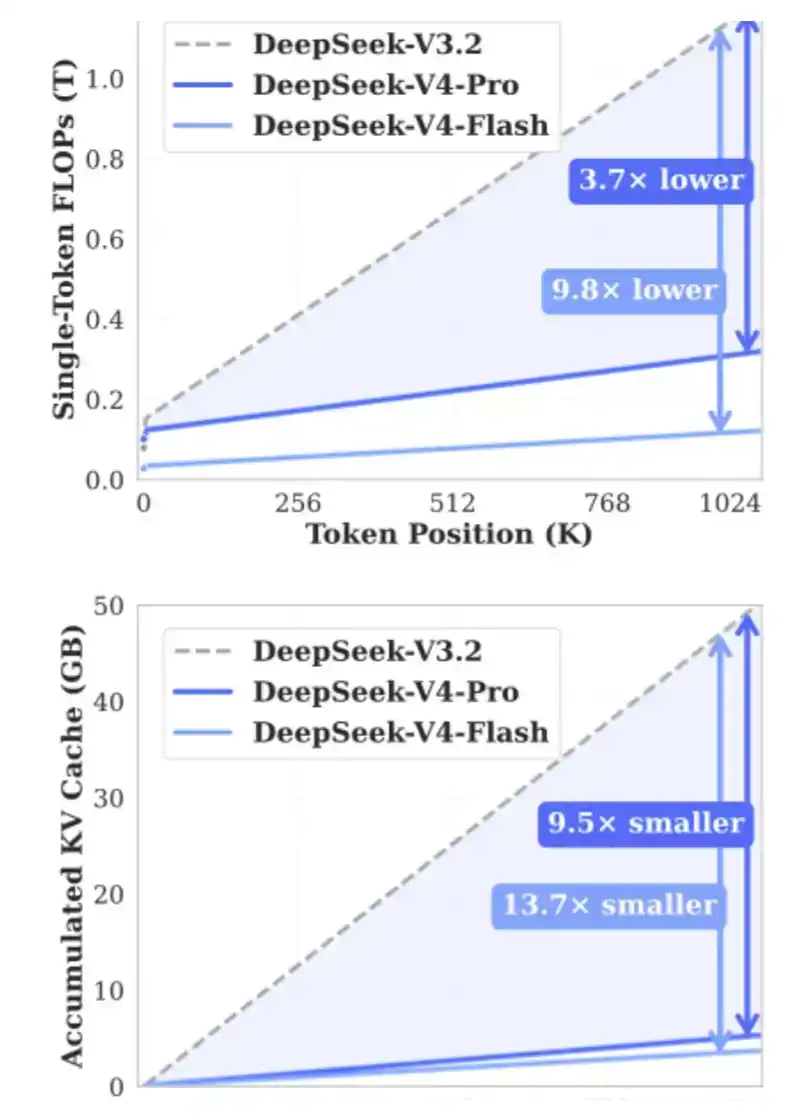
5. Engram: Introduced by DeepSeek in Q1 2026, essentially trading memory—LPDDR memory—for computational efficiency to some extent.

As shown in the detailed chart below, Engram provides noticeable performance improvement under the same total parameter budget.
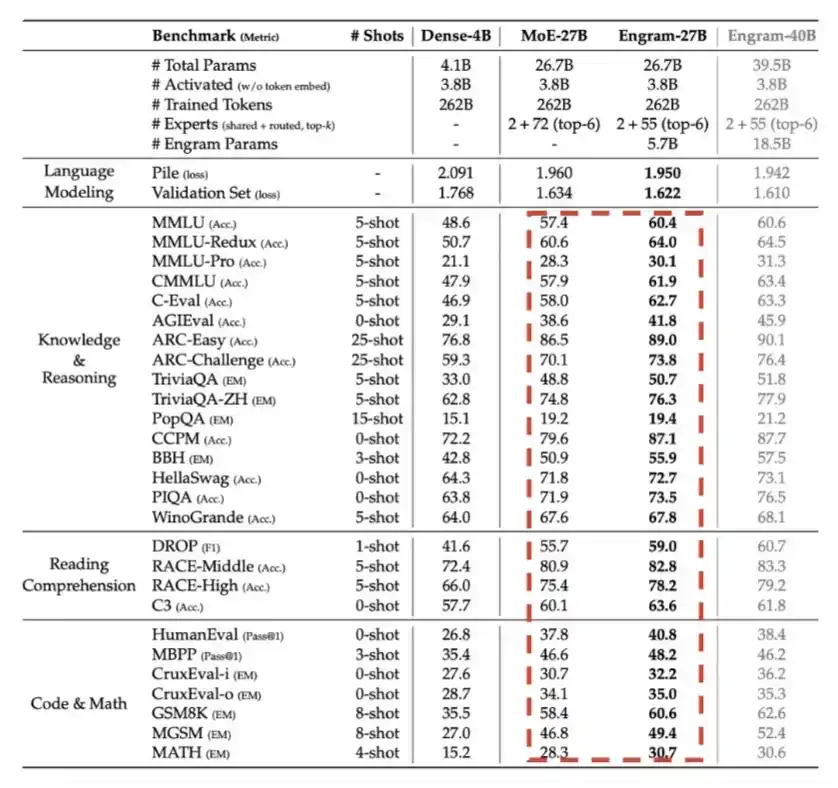
6. Engram: Introduced by DeepSeek in Q1 2026, essentially trading memory—LPDDR memory—for computational efficiency to some extent.

As shown in the detailed chart below, Engram provides noticeable performance improvement under the same total parameter budget.
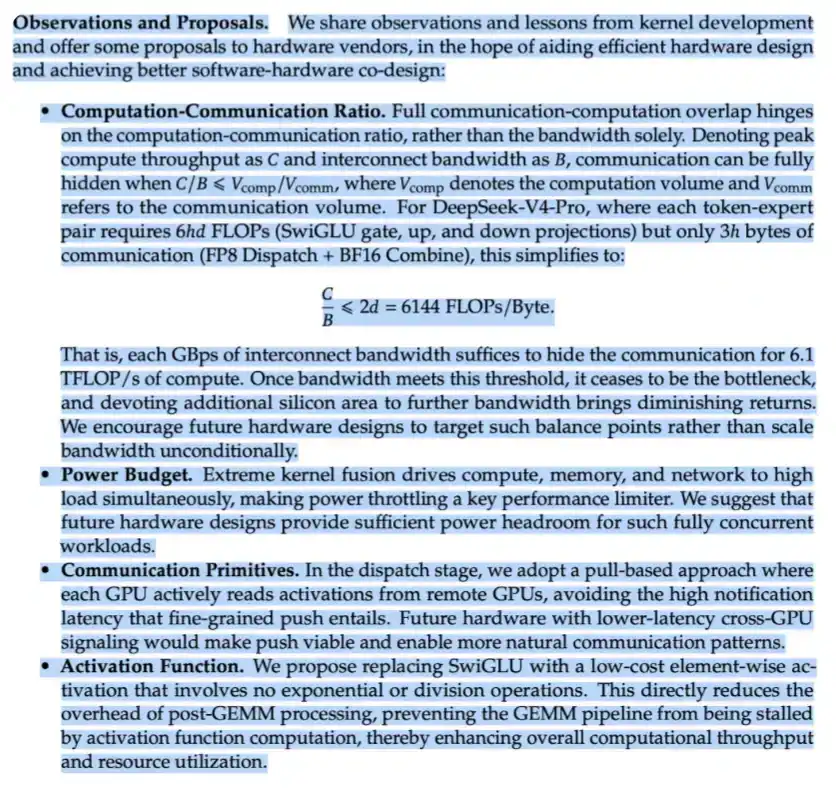
This is DeepSeek's recommendation shared with hardware vendors in the V4 paper. I'm sure in private discussions, their feedback would be even more extensive.

7. Investment in TileLang also points in the same direction: DeepSeek isn't just solving its own compute bottlenecks; it's enabling the Chinese hardware ecosystem to compete with the Western one.

With TileLang, developers can write a kernel—the low-level computational code—once and have it run successfully on multiple hardware platforms, provided those platforms have corresponding TileLang backends.

I expect other Chinese AI labs will join in gradually. This will help Chinese hardware vendors indirectly counter the so-called "CUDA moat." At the same time, it will also unlock the potential of more Western hardware, like AMD.

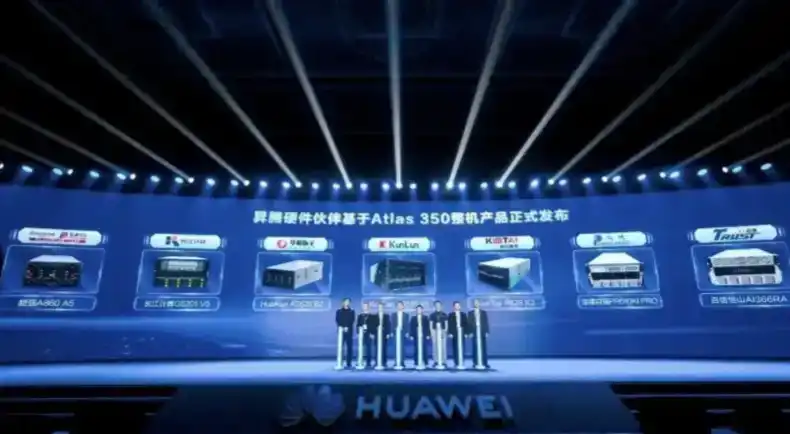
It should be noted that several Chinese AI hardware platforms already offer CUDA compatibility or CUDA translation layers. For example, Moore Threads, MetaX, Biren, and Tianshu Zhixin are Chinese chip vendors that achieve high CUDA compatibility through translation layers. So theoretically, they might not necessarily need TileLang.
Large-scale reinforcement learning and RSI

As DeepSeek gains access to more compute sources—more hardware options—and the models themselves require less computational resources, it will be able to pursue more ambitious training projects, especially reinforcement learning post-training.

Reinforcement learning requires generating a massive number of trajectories—trillions of tokens. This quickly becomes extremely expensive. Going further, training models with 1 million context length requires generating trajectories of the same length. Only training on such ultra-long trajectories can truly support long-horizon tasks.

Additionally, with more hardware options, DeepSeek will have access to more hardware resources, which will drive automated research, or RSI. RSI refers to AI designing and executing experiments itself. This involves a lot of trial and error, and costs escalate quickly. But RSI is crucial for exploring the full model design space. Before moving towards AGI, and subsequently ASI, DeepSeek must possess RSI capabilities.

What DeepSeek does today, the entire industry will follow tomorrow

DeepSeek's innovations around MoE, MLA, DSA, etc., have already been adopted by other AI labs globally and in China.

For example, ZAI, the developer of the GLM series, uses MLA and DSA. Kimi (Moonshot) also uses MLA and openly states its architecture is based on DeepSeek's design. Conversely, DeepSeek uses the Muon optimizer, which was first used at scale by Kimi (Moonshot) in large-scale training.

It should be noted:

MoE was first proposed by Google in 2017, key author Noam Shazeer. DeepSeek's contribution lies in applying MoE at scale and inventing its own accompanying techniques.

Muon, the MomentUm Orthogonalized by Newton-Schulz optimizer, was proposed by ML researcher Keller Jordan in late 2024. The Kimi (Moonshot) team was the first to use it for large-scale training.

What about the money-making issue?

We can look at the interesting example of OpenAI.

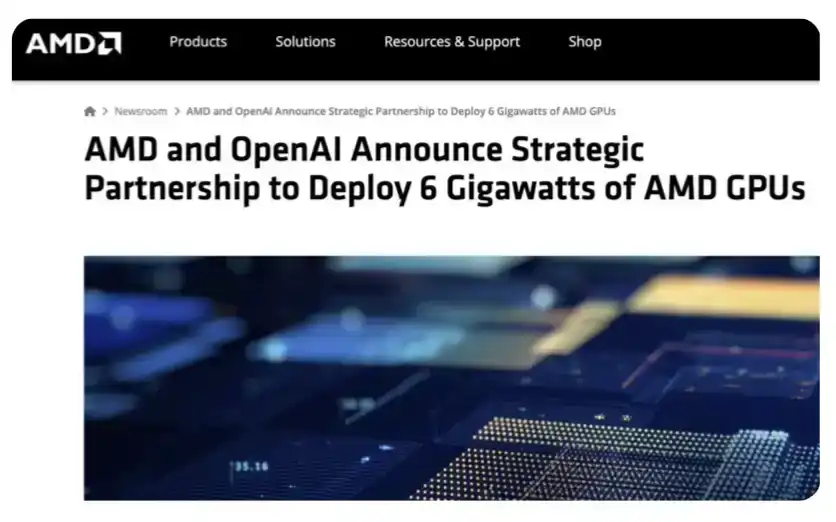
OpenAI received warrants/options to purchase AMD and Cerebras stock at a low price, tied to its compute consumption milestones. For AMD and Cerebras, this was a very good deal. Because once OpenAI commits to using their hardware, their long-term success probability increases significantly.

Here's a passage from AMD's announcement:

"As part of the agreement, to further align strategic interests, AMD issued to OpenAI warrants to purchase up to 160 million shares of AMD common stock, vesting based on the achievement of specific milestones. The first tranche vests upon completion of the initial 1 GW deployment, with subsequent tranches vesting as purchases scale to 6 GW. Vesting is also contingent on AMD achieving certain stock price targets and OpenAI reaching technical and commercial milestones required for AMD's large-scale deployment."
I expect DeepSeek will also enter into similar agreements with multiple Chinese memory, ASIC, CPU, and networking stack vendors, collaborating deeply to make these vendors' hardware stacks capable of handling leading AI workloads.

Considering the total market capitalization of AI stocks in the West, including East Asian allies, far exceeds $10 trillion, this "gain equity returns through cooperation" approach will give DeepSeek the opportunity to help China build an equally massive industry and claim its share of the pie, ultimately achieving its own $1 trillion valuation.

This would not only earn DeepSeek far more money than traditional application subscription businesses but also fulfill its stated goal of "making AGI beneficial to everyone." Liang Wenfeng is a big fan of Jim Simons and a savvy enough capital player; he couldn't miss this.

If you look back at everything DeepSeek has done so far, this is the only explanation that makes the most sense.
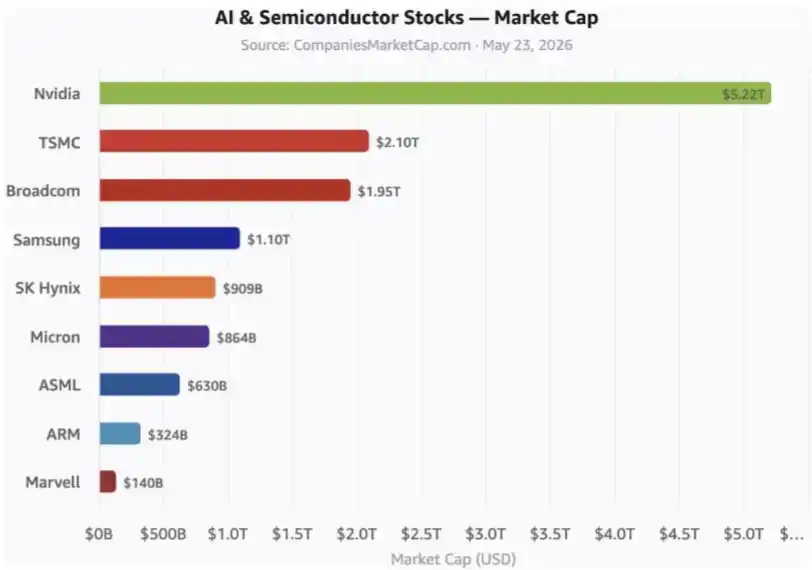
These are key AI stocks. The chart doesn't yet include hyperscalers and many other related companies.

Original Article Link

Perguntas relacionadas

QAccording to the article, what is DeepSeek's primary long-term strategic goal beyond short-term revenue from applications?

AThe article argues that DeepSeek's long-term goal is not immediate application-layer monetization, but rather to reshape the AI cost structure and drive the formation of a new hardware ecosystem worth $10 trillion, positioning DeepSeek itself for a potential $1 trillion valuation.

QHow does DeepSeek's work on KV Cache compression, like MLA, CSA, and HSA, benefit the broader AI hardware ecosystem according to the analysis?

ABy drastically reducing KV Cache size (e.g., requiring only 5.48GB HBM for 1M context vs. 60GB+ for competitors), DeepSeek's innovations lower dependency on high-performance HBM memory. This allows KV Cache to be offloaded to more abundant and cheaper storage like SSDs (benefiting NAND producers like YMTC) and enables efficient use of LPDDR for weight streaming and Engram storage, making a wider range of hardware, including alternative GPUs and ASICs, viable for AI workloads.

QWhat is the concept of 'Engram' proposed by DeepSeek, and what strategic advantage does it provide within the proposed hardware strategy?

AEngram is a 'conditional memory' mechanism that modernizes N-gram embeddings into a hash-based O(1) lookup system. It introduces a 'memory-for-compute' trade-off, where storing large embedding tables in cheaper, more abundant memory (like LPDDR) allows the model to retrieve knowledge efficiently, reducing the need for expensive computation through many transformer layers. This is a strategic advantage when hardware like Chinese GPUs/ASICs may lag in raw FLOPs but LPDDR supply is strong.

QWhat role does TileLang play in DeepSeek's strategy as described in the article?

ATileLang is an investment in software abstraction. It allows developers to write computational kernels once and have them run on multiple hardware platforms with supported backends. This initiative helps erode the CUDA ecosystem's moat, empowers a broader range of Chinese and Western hardware (like AMD) by improving their accessibility, and is aligned with DeepSeek's goal of fostering a competitive, diverse hardware ecosystem.

QHow does the article suggest DeepSeek could achieve a $1 trillion valuation, drawing a parallel to a similar industry deal?

AThe article suggests DeepSeek could follow a model similar to OpenAI's deals with AMD and Cerebras. By deeply collaborating with and committing to use hardware from Chinese memory, ASIC, CPU, and networking companies, DeepSeek could receive stock warrants or options tied to usage milestones. As DeepSeek's innovations make these companies' hardware viable for leading AI workloads, it helps build a massive $10 trillion industry. In return, DeepSeek gains significant equity stakes in these ecosystem players, creating a path to its own $1 trillion valuation.

Leituras Relacionadas

DeFi Has Reached Its Most Dangerous Moment: The Real Vulnerabilities Are Not in the Code

DeFi in Peril: The Real Vulnerability Isn't in the Code April 2026 marked a paradigm shift in DeFi security, with over $625 million lost across 30 incidents—the worst month in crypto history by event count. Crucially, none of the major exploits (Drift Protocol: $285M, KelpDAO: $292M, Wasabi Protocol: $4.5M) resulted from smart contract vulnerabilities. Instead, failures occurred in the operational "plumbing": social engineering to compromise multi-signature councils, a single-point-of-failure 1-of-1 bridge validator, and stolen admin private keys. These events expose a fundamental misalignment: the industry's security model has long focused on code audits, while the actual attack surface has shifted to privileged access points and off-chain infrastructure. The article introduces the term "OpenFi" to describe this reality: permissionless, on-chain, yet operationally dependent on trusted third parties (admins, validators, oracles) at key junctures. The KelpDAO exploit vividly demonstrated asymmetric "contagion risk." A configuration error in a smaller protocol triggered a panic, causing approximately $13.2 billion in outflows from larger, unaffected protocols like Aave within 48 hours, as users fled uncertain collateral. The core dilemma is the double-edged sword of centralization. Operational levers like emergency councils (e.g., Arbitrum freezing stolen funds post-KelpDAO) enable crisis response but also create catastrophic attack surfaces if compromised (e.g., Drift). The path forward demands radical honesty: protocols must clearly disclose their trust assumptions, operational levers, and failure modes. The industry must treat operational security (key management, configurations, incident response) with the same rigor as code security. Survival depends on building systems whose risks can be understood, priced, and insured, moving beyond the outdated "code is law" mantra to a mature model of disclosed and managed trust.

链捕手Há 22m

DeFi Has Reached Its Most Dangerous Moment: The Real Vulnerabilities Are Not in the Code

链捕手Há 22m

Vitalik's Article Emphasizes Ethereum Must Be 'Amazing', But Foundation Is Not the Center

Vitalik Buterin has published a lengthy response to recent community criticism directed at the Ethereum Foundation (EF). Acknowledging a sense of "unease," he addresses concerns about the EF's strategic direction, its perceived disconnect from ETH's price performance, and calls for its reduced central role. Vitalik rejects the notion that the EF should be the central governing body of Ethereum, framing it instead as one "node with a clear mandate" among many within the ecosystem. He highlights the EF's limited ETH holdings (≈0.16% of supply) compared to other blockchain foundations and states it will no longer sell significant amounts of ETH. Its future focus will be on long-term, critical projects that align with Ethereum's core values of censorship-resistance and decentralization, which might not otherwise happen. A core argument is that Ethereum must be "amazing," but not by merely chasing higher transaction speeds at the cost of decentralization. He proposes focusing on the "CROPS" dimensions: creating a Cryptographically provable, Reliable, Open, Private, and Secure network. This includes pursuing goals like a formally verifiable, bug-free Ethereum client and minimizing protocol-level reliance on intermediaries. The article concludes by noting that while Vitalik clarifies the EF's refocused role, he does not directly address community suggestions for creating a new organization explicitly aligned with ETH's economic interests. This "alignment gap" is presented as a key challenge for Ethereum's future.

链捕手Há 33m

Vitalik's Article Emphasizes Ethereum Must Be 'Amazing', But Foundation Is Not the Center

链捕手Há 33m

Galxe: How a Quest Platform Evolved into Web3's Growth Infrastructure

Galxe, once perceived as a simple Web3 quest platform, has evolved into a core growth infrastructure within the Web3 ecosystem. It addresses a fundamental Web3 growth dilemma: the lack of a mature, systematic user acquisition and retention system akin to Web2's advertising and analytics platforms. While users complete quests (social tasks, on-chain interactions) for rewards, Galxe's true innovation lies in transforming these fragmented, one-off actions into lasting, verifiable identity credentials. This process of *behavioral assetization* creates a persistent record of a user's activities across projects and chains. For users, their wallet accumulates a valuable history that can unlock future access and rewards, fostering a "profile-building" mentality. For projects, Galxe provides a pre-screened user pool with rich behavioral data, enabling targeted outreach to users based on their specific on-chain history and community engagement. Galxe employs a gamefied growth path, guiding users from low-friction social tasks into deeper, valuable on-chain interactions through a structured progression of quests. This solves the incentive-behavior mismatch common in Web3, filtering users by their willingness to engage. Beyond quests, products like Passport (identity verification) and Starboard (community analytics) position Galxe as a comprehensive growth operating system. The platform's defensible advantage is its self-reinforcing data and network flywheel: more projects attract more users, enriching behavioral data; richer data enables better user targeting, attracting more projects. Ultimately, Galxe is shifting Web3's growth logic from short-term "reward-driven" traffic towards a long-term "identity-driven" relationship model, where a user's accumulated on-chain履历 becomes a core asset.

marsbitHá 40m

Galxe: How a Quest Platform Evolved into Web3's Growth Infrastructure

marsbitHá 40m

Trading

Spot
Futuros

Artigos em Destaque

O que é $S$

Compreender o SPERO: Uma Visão Abrangente Introdução ao SPERO À medida que o panorama da inovação continua a evoluir, o surgimento de tecnologias web3 e projetos de criptomoeda desempenha um papel fundamental na formação do futuro digital. Um projeto que tem atraído atenção neste campo dinâmico é o SPERO, denotado como SPERO,$$s$. Este artigo tem como objetivo reunir e apresentar informações detalhadas sobre o SPERO, para ajudar entusiastas e investidores a compreender as suas bases, objetivos e inovações nos domínios web3 e cripto. O que é o SPERO,$$s$? O SPERO,$$s$ é um projeto único dentro do espaço cripto que procura aproveitar os princípios da descentralização e da tecnologia blockchain para criar um ecossistema que promove o envolvimento, a utilidade e a inclusão financeira. O projeto é concebido para facilitar interações peer-to-peer de novas maneiras, proporcionando aos utilizadores soluções e serviços financeiros inovadores. No seu núcleo, o SPERO,$$s$ visa capacitar indivíduos ao fornecer ferramentas e plataformas que melhoram a experiência do utilizador no espaço das criptomoedas. Isso inclui a possibilidade de métodos de transação mais flexíveis, a promoção de iniciativas impulsionadas pela comunidade e a criação de caminhos para oportunidades financeiras através de aplicações descentralizadas (dApps). A visão subjacente do SPERO,$$s$ gira em torno da inclusão, visando fechar lacunas dentro das finanças tradicionais enquanto aproveita os benefícios da tecnologia blockchain. Quem é o Criador do SPERO,$$s$? A identidade do criador do SPERO,$$s$ permanece algo obscura, uma vez que existem recursos publicamente disponíveis limitados que fornecem informações detalhadas sobre o(s) seu(s) fundador(es). Esta falta de transparência pode resultar do compromisso do projeto com a descentralização—uma ética que muitos projetos web3 partilham, priorizando contribuições coletivas em vez de reconhecimento individual. Ao centrar as discussões em torno da comunidade e dos seus objetivos coletivos, o SPERO,$$s$ incorpora a essência do empoderamento sem destacar indivíduos específicos. Assim, compreender a ética e a missão do SPERO é mais importante do que identificar um criador singular. Quem são os Investidores do SPERO,$$s$? O SPERO,$$s$ é apoiado por uma diversidade de investidores que vão desde capitalistas de risco a investidores-anjo dedicados a promover a inovação no setor cripto. O foco desses investidores geralmente alinha-se com a missão do SPERO—priorizando projetos que prometem avanço tecnológico social, inclusão financeira e governança descentralizada. Essas fundações de investidores estão tipicamente interessadas em projetos que não apenas oferecem produtos inovadores, mas que também contribuem positivamente para a comunidade blockchain e os seus ecossistemas. O apoio desses investidores reforça o SPERO,$$s$ como um concorrente notável no domínio em rápida evolução dos projetos cripto. Como Funciona o SPERO,$$s$? O SPERO,$$s$ emprega uma estrutura multifacetada que o distingue de projetos de criptomoeda convencionais. Aqui estão algumas das características-chave que sublinham a sua singularidade e inovação: Governança Descentralizada: O SPERO,$$s$ integra modelos de governança descentralizada, capacitando os utilizadores a participar ativamente nos processos de tomada de decisão sobre o futuro do projeto. Esta abordagem promove um sentido de propriedade e responsabilidade entre os membros da comunidade. Utilidade do Token: O SPERO,$$s$ utiliza o seu próprio token de criptomoeda, concebido para servir várias funções dentro do ecossistema. Esses tokens permitem transações, recompensas e a facilitação de serviços oferecidos na plataforma, melhorando o envolvimento e a utilidade gerais. Arquitetura em Camadas: A arquitetura técnica do SPERO,$$s$ suporta modularidade e escalabilidade, permitindo a integração contínua de funcionalidades e aplicações adicionais à medida que o projeto evolui. Esta adaptabilidade é fundamental para manter a relevância no panorama cripto em constante mudança. Envolvimento da Comunidade: O projeto enfatiza iniciativas impulsionadas pela comunidade, empregando mecanismos que incentivam a colaboração e o feedback. Ao nutrir uma comunidade forte, o SPERO,$$s$ pode melhor atender às necessidades dos utilizadores e adaptar-se às tendências do mercado. Foco na Inclusão: Ao oferecer taxas de transação baixas e interfaces amigáveis, o SPERO,$$s$ visa atrair uma base de utilizadores diversificada, incluindo indivíduos que anteriormente podem não ter participado no espaço cripto. Este compromisso com a inclusão alinha-se com a sua missão abrangente de empoderamento através da acessibilidade. Cronologia do SPERO,$$s$ Compreender a história de um projeto fornece insights cruciais sobre a sua trajetória de desenvolvimento e marcos. Abaixo está uma cronologia sugerida que mapeia eventos significativos na evolução do SPERO,$$s$: Fase de Conceituação e Ideação: As ideias iniciais que formam a base do SPERO,$$s$ foram concebidas, alinhando-se de perto com os princípios de descentralização e foco na comunidade dentro da indústria blockchain. Lançamento do Whitepaper do Projeto: Após a fase conceitual, um whitepaper abrangente detalhando a visão, os objetivos e a infraestrutura tecnológica do SPERO,$$s$ foi lançado para atrair o interesse e o feedback da comunidade. Construção da Comunidade e Primeiros Envolvimentos: Esforços ativos de divulgação foram feitos para construir uma comunidade de primeiros adotantes e investidores potenciais, facilitando discussões em torno dos objetivos do projeto e angariando apoio. Evento de Geração de Tokens: O SPERO,$$s$ realizou um evento de geração de tokens (TGE) para distribuir os seus tokens nativos a apoiantes iniciais e estabelecer liquidez inicial dentro do ecossistema. Lançamento da dApp Inicial: A primeira aplicação descentralizada (dApp) associada ao SPERO,$$s$ foi lançada, permitindo que os utilizadores interagissem com as funcionalidades principais da plataforma. Desenvolvimento Contínuo e Parcerias: Atualizações e melhorias contínuas nas ofertas do projeto, incluindo parcerias estratégicas com outros players no espaço blockchain, moldaram o SPERO,$$s$ em um jogador competitivo e em evolução no mercado cripto. Conclusão O SPERO,$$s$ é um testemunho do potencial do web3 e das criptomoedas para revolucionar os sistemas financeiros e capacitar indivíduos. Com um compromisso com a governança descentralizada, o envolvimento da comunidade e funcionalidades inovadoras, abre caminho para um panorama financeiro mais inclusivo. Como em qualquer investimento no espaço cripto em rápida evolução, potenciais investidores e utilizadores são incentivados a pesquisar minuciosamente e a envolver-se de forma ponderada com os desenvolvimentos em curso dentro do SPERO,$$s$. O projeto demonstra o espírito inovador da indústria cripto, convidando a uma exploração mais aprofundada das suas inúmeras possibilidades. Embora a jornada do SPERO,$$s$ ainda esteja a desenrolar-se, os seus princípios fundamentais podem, de facto, influenciar o futuro de como interagimos com a tecnologia, as finanças e uns com os outros em ecossistemas digitais interconectados.

69 Visualizações TotaisPublicado em {updateTime}Atualizado em 2024.12.17

O que é $S$

O que é AGENT S

Agent S: O Futuro da Interação Autónoma no Web3 Introdução No panorama em constante evolução do Web3 e das criptomoedas, as inovações estão constantemente a redefinir a forma como os indivíduos interagem com plataformas digitais. Um projeto pioneiro, o Agent S, promete revolucionar a interação humano-computador através do seu framework aberto e agente. Ao abrir caminho para interações autónomas, o Agent S visa simplificar tarefas complexas, oferecendo aplicações transformadoras em inteligência artificial (IA). Esta exploração detalhada irá aprofundar-se nas complexidades do projeto, nas suas características únicas e nas implicações para o domínio das criptomoedas. O que é o Agent S? O Agent S é um framework aberto e agente, especificamente concebido para abordar três desafios fundamentais na automação de tarefas computacionais: Aquisição de Conhecimento Específico de Domínio: O framework aprende inteligentemente a partir de várias fontes de conhecimento externas e experiências internas. Esta abordagem dupla capacita-o a construir um rico repositório de conhecimento específico de domínio, melhorando o seu desempenho na execução de tarefas. Planeamento ao Longo de Longos Horizontes de Tarefas: O Agent S emprega planeamento hierárquico aumentado por experiência, uma abordagem estratégica que facilita a decomposição e execução eficientes de tarefas intrincadas. Esta característica melhora significativamente a sua capacidade de gerir múltiplas subtarefas de forma eficiente e eficaz. Gestão de Interfaces Dinâmicas e Não Uniformes: O projeto introduz a Interface Agente-Computador (ACI), uma solução inovadora que melhora a interação entre agentes e utilizadores. Utilizando Modelos de Linguagem Multimodais de Grande Escala (MLLMs), o Agent S pode navegar e manipular diversas interfaces gráficas de utilizador de forma fluida. Através destas características pioneiras, o Agent S fornece um framework robusto que aborda as complexidades envolvidas na automação da interação humana com máquinas, preparando o terreno para uma infinidade de aplicações em IA e além. Quem é o Criador do Agent S? Embora o conceito de Agent S seja fundamentalmente inovador, informações específicas sobre o seu criador permanecem elusivas. O criador é atualmente desconhecido, o que destaca ou o estágio nascente do projeto ou a escolha estratégica de manter os membros fundadores em anonimato. Independentemente da anonimidade, o foco permanece nas capacidades e no potencial do framework. Quem são os Investidores do Agent S? Como o Agent S é relativamente novo no ecossistema criptográfico, informações detalhadas sobre os seus investidores e financiadores não estão explicitamente documentadas. A falta de informações disponíveis publicamente sobre as fundações de investimento ou organizações que apoiam o projeto levanta questões sobre a sua estrutura de financiamento e roteiro de desenvolvimento. Compreender o apoio é crucial para avaliar a sustentabilidade do projeto e o seu impacto potencial no mercado. Como Funciona o Agent S? No núcleo do Agent S reside uma tecnologia de ponta que lhe permite funcionar eficazmente em diversos ambientes. O seu modelo operacional é construído em torno de várias características-chave: Interação Humano-Computador Semelhante: O framework oferece planeamento avançado em IA, esforçando-se para tornar as interações com computadores mais intuitivas. Ao imitar o comportamento humano na execução de tarefas, promete elevar as experiências dos utilizadores. Memória Narrativa: Utilizada para aproveitar experiências de alto nível, o Agent S utiliza memória narrativa para acompanhar os históricos de tarefas, melhorando assim os seus processos de tomada de decisão. Memória Episódica: Esta característica fornece aos utilizadores orientações passo a passo, permitindo que o framework ofereça suporte contextual à medida que as tarefas se desenrolam. Suporte para OpenACI: Com a capacidade de funcionar localmente, o Agent S permite que os utilizadores mantenham o controlo sobre as suas interações e fluxos de trabalho, alinhando-se com a ética descentralizada do Web3. Fácil Integração com APIs Externas: A sua versatilidade e compatibilidade com várias plataformas de IA garantem que o Agent S possa integrar-se perfeitamente em ecossistemas tecnológicos existentes, tornando-o uma escolha apelativa para desenvolvedores e organizações. Estas funcionalidades contribuem coletivamente para a posição única do Agent S no espaço cripto, à medida que automatiza tarefas complexas e em múltiplos passos com mínima intervenção humana. À medida que o projeto evolui, as suas potenciais aplicações no Web3 podem redefinir a forma como as interações digitais se desenrolam. Cronologia do Agent S O desenvolvimento e os marcos do Agent S podem ser encapsulados numa cronologia que destaca os seus eventos significativos: 27 de Setembro de 2024: O conceito de Agent S foi lançado num artigo de pesquisa abrangente intitulado “Um Framework Agente Aberto que Usa Computadores como um Humano”, mostrando a base para o projeto. 10 de Outubro de 2024: O artigo de pesquisa foi disponibilizado publicamente no arXiv, oferecendo uma exploração aprofundada do framework e da sua avaliação de desempenho com base no benchmark OSWorld. 12 de Outubro de 2024: Uma apresentação em vídeo foi lançada, proporcionando uma visão visual das capacidades e características do Agent S, envolvendo ainda mais potenciais utilizadores e investidores. Estes marcos na cronologia não apenas ilustram o progresso do Agent S, mas também indicam o seu compromisso com a transparência e o envolvimento da comunidade. Pontos-Chave Sobre o Agent S À medida que o framework Agent S continua a evoluir, várias características-chave destacam-se, sublinhando a sua natureza inovadora e potencial: Framework Inovador: Concebido para proporcionar um uso intuitivo de computadores semelhante à interação humana, o Agent S traz uma abordagem nova à automação de tarefas. Interação Autónoma: A capacidade de interagir autonomamente com computadores através de GUI significa um avanço em direção a soluções computacionais mais inteligentes e eficientes. Automação de Tarefas Complexas: Com a sua metodologia robusta, pode automatizar tarefas complexas e em múltiplos passos, tornando os processos mais rápidos e menos propensos a erros. Melhoria Contínua: Os mecanismos de aprendizagem permitem que o Agent S melhore a partir de experiências passadas, aprimorando continuamente o seu desempenho e eficácia. Versatilidade: A sua adaptabilidade em diferentes ambientes operacionais, como OSWorld e WindowsAgentArena, garante que pode servir uma ampla gama de aplicações. À medida que o Agent S se posiciona no panorama do Web3 e das criptomoedas, o seu potencial para melhorar as capacidades de interação e automatizar processos significa um avanço significativo nas tecnologias de IA. Através do seu framework inovador, o Agent S exemplifica o futuro das interações digitais, prometendo uma experiência mais fluida e eficiente para os utilizadores em diversas indústrias. Conclusão O Agent S representa um ousado avanço na união da IA e do Web3, com a capacidade de redefinir a forma como interagimos com a tecnologia. Embora ainda esteja nas suas fases iniciais, as possibilidades para a sua aplicação são vastas e cativantes. Através do seu framework abrangente que aborda desafios críticos, o Agent S visa trazer interações autónomas para o primeiro plano da experiência digital. À medida que avançamos mais profundamente nos domínios das criptomoedas e da descentralização, projetos como o Agent S desempenharão, sem dúvida, um papel crucial na formação do futuro da tecnologia e da colaboração humano-computador.

645 Visualizações TotaisPublicado em {updateTime}Atualizado em 2025.01.14

O que é AGENT S

Como comprar S

Bem-vindo à HTX.com!Tornámos a compra de Sonic (S) simples e conveniente.Segue o nosso guia passo a passo para iniciar a tua jornada no mundo das criptos.Passo 1: cria a tua conta HTXUtiliza o teu e-mail ou número de telefone para te inscreveres numa conta gratuita na HTX.Desfruta de um processo de inscrição sem complicações e desbloqueia todas as funcionalidades.Obter a minha contaPasso 2: vai para Comprar Cripto e escolhe o teu método de pagamentoCartão de crédito/débito: usa o teu visa ou mastercard para comprar Sonic (S) instantaneamente.Saldo: usa os fundos da tua conta HTX para transacionar sem problemas.Terceiros: adicionamos métodos de pagamento populares, como Google Pay e Apple Pay, para aumentar a conveniência.P2P: transaciona diretamente com outros utilizadores na HTX.Mercado de balcão (OTC): oferecemos serviços personalizados e taxas de câmbio competitivas para os traders.Passo 3: armazena teu Sonic (S)Depois de comprar o teu Sonic (S), armazena-o na tua conta HTX.Alternativamente, podes enviá-lo para outro lugar através de transferência blockchain ou usá-lo para transacionar outras criptomoedas.Passo 4: transaciona Sonic (S)Transaciona facilmente Sonic (S) no mercado à vista da HTX.Acede simplesmente à tua conta, seleciona o teu par de trading, executa as tuas transações e monitoriza em tempo real.Oferecemos uma experiência de fácil utilização tanto para principiantes como para traders experientes.

1.2k Visualizações TotaisPublicado em {updateTime}Atualizado em 2025.03.21

Como comprar S

Discussões

Bem-vindo à Comunidade HTX. Aqui, pode manter-se informado sobre os mais recentes desenvolvimentos da plataforma e obter acesso a análises profissionais de mercado. As opiniões dos utilizadores sobre o preço de S (S) são apresentadas abaixo.

活动图片