Author: @ryanyoon_eth, Tiger Research
Compiled by: AididiaoJP, Foresight News
Market attention largely remains focused on the issuance end of stablecoins, but the greater opportunity actually lies beyond issuance. This article systematically dissects the core opportunities in the five stages of the stablecoin value chain—onboarding, transfer, payments, and yield.
Core Takeaways
- Beyond the issuance market dominated by the Tether and Circle duopoly, this report delves into the actual commercial structures formed across five value chain stages (issuance, onboarding, transfer, payments, yield).
- The mainstream strategy is not "rebuilding the system from scratch," but rather, like Stripe's acquisition of Bridge, overlaying stablecoin efficiencies (instant settlement, low-cost remittance) onto existing traditional financial infrastructure. Only the yield generation segment is difficult for traditional finance to directly penetrate, requiring independent professional expertise.
- As interest rate cuts weaken the appeal of interest income from issuance and competition intensifies, market value is accelerating its migration to the "underlying settlement layer." Stablecoins are not replacing traditional finance but showing a trend of deep vertical integration with the regulated financial system.
Time to See the Full Stablecoin Value Chain
Previous discussions on stablecoins have been highly concentrated on the issuance stage. The performance of leading issuers like Tether and Circle, as well as regulatory moves in various countries, are often treated as core market indicators, but this is actually just the starting point of the value chain.
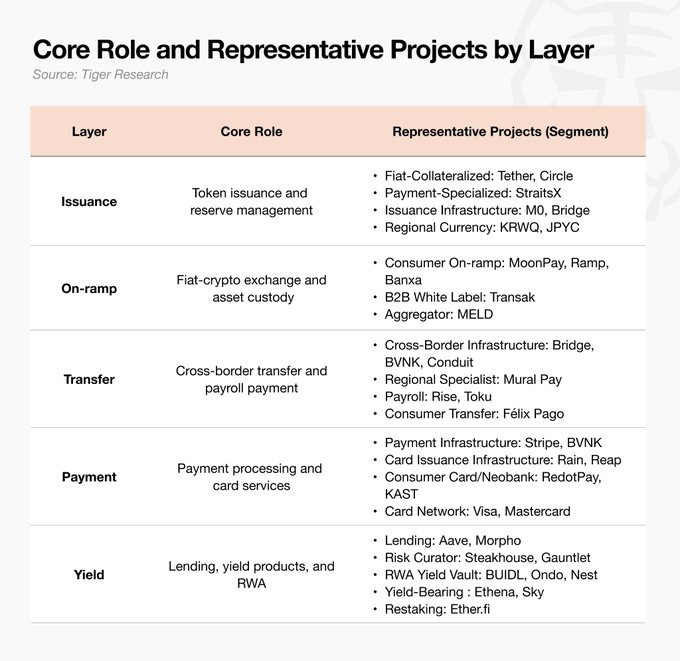
The complete stablecoin value chain refers to the full "flow" path of a token after issuance within the economic system, specifically divided into five stages: Issuance → Onboarding (on-ramp) → Transfer → Payments → Yield Generation.
Viewing the industry from a value chain perspective reveals: while the issuance end is oligopolized by a few players, there are more competitors in the downstream layers, and market opportunities are broader.
From Issuance to Yield: Tracking the Flow Path of $1,000
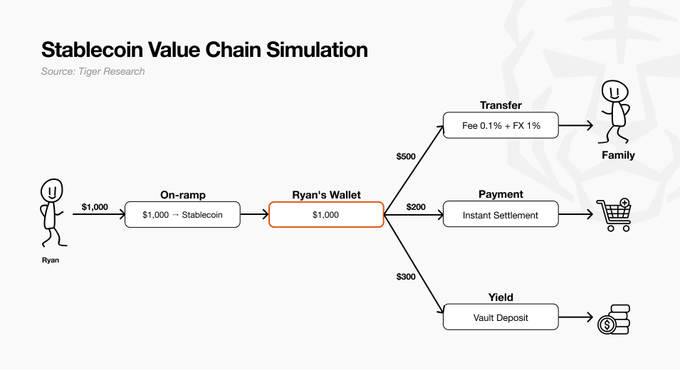
Using the $1,000 in Ryan's bank account as an example, observing how it flows within the stablecoin ecosystem clearly illustrates the sequence of the five stages.
- Issuance: Leading issuers mint stablecoins backed by assets like U.S. Treasuries, providing ample market liquidity.
- Onboarding: Ryan exchanges $1,000 for stablecoins via an on-ramp service. The service processes the request and deposits tokens into his wallet. Assets leave the fiat system, transforming into on-chain liquidity.
- Transfer: Ryan sends $500 to family in Mexico for living expenses. Transfer infrastructure processes instantly, and the recipient converts to local currency.
- Payments: Ryan uses the remaining $200 to checkout at a supermarket. Payment infrastructure handles instant settlement.
- Yield: The final $300 left in the wallet is not idle; it's deposited into a yield protocol vault, managed as an interest-bearing asset.
Through this process, Ryan's $1,000 transforms from fiat to stablecoin, then evolves into a cross-border payment tool and an asset management tool. Each layer the funds pass through precisely corresponds to a stage in the stablecoin industry's value chain.
Issuance
The issuance market is a typical market with economies of scale. Entry barriers are built on trust and liquidity. Tether and Circle, with their significant first-mover advantages, have formed an oligopoly. Newcomers must break away from the "reserve interest" model and find differentiated paths.
Industry Structure
Stablecoin issuance involves minting and burning tokens backed by reserves (primarily U.S. Treasuries) to peg the value. Current total market cap is approximately $300 billion, with USD-pegged assets accounting for 99.99%. Tether and Circle collectively hold about 83% share. The economies of scale effect—deeper liquidity, better trading convenience, and higher trust—is deeply entrenched.
As the industry matures, functions once monopolized by a single issuer are being professionally unbundled. Superficially, it's one issuer, but internally, four functions (licensing/regulatory qualification, reserve management & custody, token minting/burning, distribution) are allocated to different entities, shifting substantial operational responsibilities externally.
For example, Circle delegates a significant portion of distribution to Coinbase; Tether entrusts a large amount of reserves to custodian Cantor Fitzgerald.
Business Model Types
- Reserve Interest Model: Main revenue from reserve management earnings, suitable for leading issuers with large-scale liquidity pools (Tether, Circle).
- Payment Fee Model: Revenue from fees generated when tokens are used for payment settlement; profitability depends on transaction turnover speed, not market cap (StraitsX).
- Issuance-as-a-Service (IaaS): Does not directly issue tokens; instead, rents out infrastructure and licenses, earning spreads; relies on network effects rather than scale expansion (m0, Paxos, Stablecoin).
- Regional Model: First mover into regulatory gray areas or non-USD currency markets, locking in exclusive liquidity (KrwqCash, JPYC).
Case Study: Circle
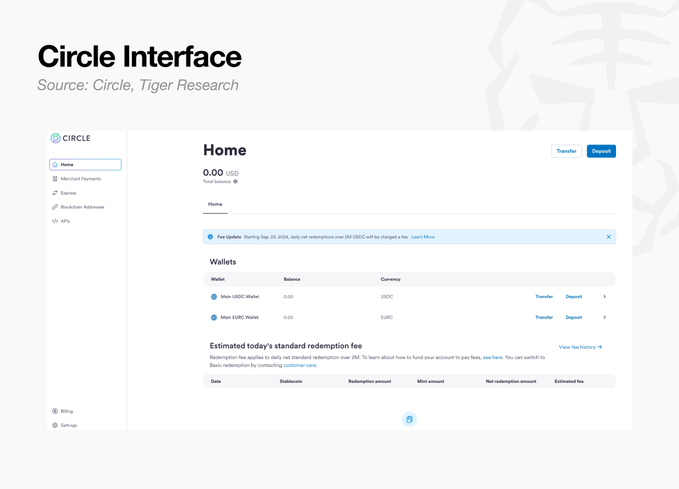
Institutional clients deposit USD into Circle Mint (its on/off-ramp platform), and Circle mints USDC at a 1:1 ratio. Circle's main revenue comes from interest on these deposits; therefore, it does not charge additional minting fees upon issuance. The core goal is to maximize the scale of non-interest-bearing float. Deposits are held in a money market fund (Circle Reserve Fund) managed by BlackRock and registered with the SEC, primarily invested in short-term U.S. Treasuries.
Circle allocates this interest income through agreements with distribution channels. According to the cooperation agreement signed with Coinbase in August 2023:
- USDC on Coinbase platform: Coinbase receives 100% of corresponding reserve interest.
- USDC on Circle's own platform: Circle retains 100%.
- USDC circulating off-platform (including third-party exchanges, individual/institutional wallets, DeFi): 50/50 split.
This is a deliberately designed strategy: by carefully structuring incentives for on- and off-platform holdings, sharing part of the issuance revenue with core distribution partners in exchange for maximizing USDC distribution base and ecosystem share.
Key Insights
Stablecoin issuance is a market with economies of scale; first-mover advantage and liquidity scale determine success. The barrier for newcomers to directly engage in issuance is extremely high. New entrants should focus more on the unbundling of value chain functions rather than being fixated on issuance itself.
A more effective strategy is: building irreplaceable professional expertise in specific segments like licensing, asset custody, settlement infrastructure, or distribution channels, becoming middleware that other players cannot easily replace. The future competition essence lies not in who issues the largest stablecoin volume, but in who can capture value and occupy strategic positions within the complete chain of stablecoin flow and consumption.
Onboarding (On-ramp)
Onboarding revenue comes from transaction volume-based fees and spreads. Consumer-perceived fees vary greatly by payment method: bank transfer ~2-4%, credit card ~4-7%, but the actual net take for service providers is around 3% (using Banxa data as reference). The conversion function itself is hard to differentiate, competition is so fierce that aggregators have emerged, specifically routing transactions to the lowest-cost option.
Industry Structure
This layer consists of on-ramp services (fiat to crypto) and wallet/custody services (holding assets), closely linked. Onboarding revenue correlates with transaction volume, with profit margins varying significantly by payment method. However, the conversion function itself is highly commoditized; multiple service providers offer very similar products, with net take converging around 3%.
Business Model Types
- Consumer-facing Onboarding: Provides exchange directly to end-users, charging fees and spreads. Difficult to differentiate; competitiveness depends on license coverage, breadth of payment networks, and reputation (conversion rate) (MoonPay, Ramp, Banxa).
- B2B White-label: Embeds on-ramp channels into wallets and apps, sharing ~1% fee per transaction with partners. Achieves distribution without a consumer brand; deep integration with large partners creates switching costs as a moat (Transak).
- Aggregator: Routes transactions across multiple on-ramp services, finding optimal paths, charging intermediary fees. Value increases with more on-ramp services but also limited by dependence on partnership networks (Meld).
Case Study: MoonPay
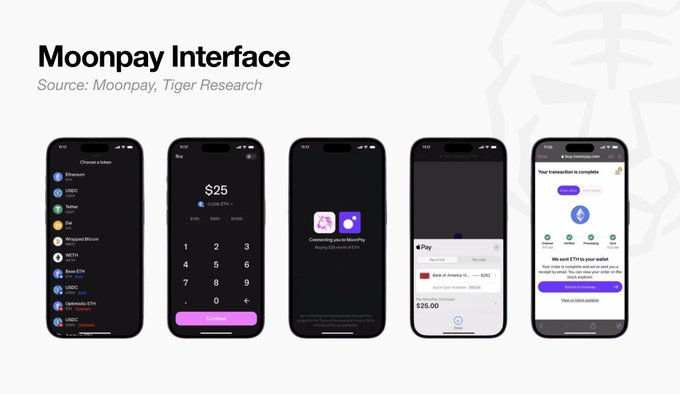
MoonPay is a non-custodial on-ramp platform; after users buy crypto with fiat, it goes directly to their own wallets. Main revenue comes from per-transaction fees and trading spreads: bank transfer ~1%, credit card ~4.5%, minimum $3.99 for small transactions. Public fee tiers, divided into three bands, reflect how MoonPay allocates revenue and builds distribution.
Its revenue structure splits into two channels: direct traffic and transactions embedded through partners. Especially the model of embedding solutions into 500+ wallets and apps, allowing partners to set their own pricing, is the core driver for MoonPay to efficiently gain large-scale distribution while sharing revenue with partners.
Key Insights
Fee-based revenue from pure on-ramp services is facing severe profit pressure from commoditization and price wars. To build a sustainable business, the one-time fee structure must be transformed into stable recurring revenue.
Therefore, consumer-facing on-ramp providers are expanding downstream into issuance and settlement infrastructure. MoonPay's acquisition of Iron and move into branded issuance services exemplifies this, though the financial results of this recurring revenue strategy are yet to be proven.
The "embedded" strategy has led to two distinct outcomes: some service providers have built independent competitiveness, becoming standalone moats (Transak, Turnkey); others have been acquired by larger payment and custody companies (Privy acquired by Stripe, Dynamic by Fireblocks).
It's still difficult to judge which outcome will become mainstream, but the hub status of the onboarding and wallet layers within the industry is already clear.
Transfer
The transfer layer handles the movement of stablecoins, including individual and business transfers, as well as wage payments for the global workforce.
This segment attracts significant attention because it showcases the cost advantage of stablecoins in the most concrete, quantifiable form. Average cost of traditional cross-border transfers exceeds 6%, significantly reducible using stablecoins.
Industry Structure
Fees and FX spreads occur at both ends (USD to crypto, crypto back to local currency); the movement of the on-chain token itself is almost free.
Therefore, revenue is not concentrated in the transfer itself, but in the conversion at both ends and the licenses required to legally process transfers. Obtaining Money Transmitter Licenses (MTL) in US states takes 12-24 months, making renting out the license itself as infrastructure (compliance-as-infrastructure) a powerful revenue model.
Business Model Types
- Cross-border B2B Infrastructure: Coordinates cross-border payments and settlements between businesses, typically charging transfer fees (~5-10 bps) plus FX spreads (varying from tens of bps to ~1% depending on corridor and volume). Some also issue their own stablecoins, capturing additional reserve interest (Stablecoin, BVNK, Conduit).
- Payroll Services: Specializes in wage disbursement, managing client relationships with both workers and employers. Builds on SaaS subscription fees (fixed monthly fee per contractor, ~25 bps for payouts) by layering interest earnings from float funds (pending wages) (Rise Earn, Toku).
- Consumer-level Transfers: Focuses on P2P cross-border remittance, using stablecoins to lower backend costs, expanding own margins through lower fixed fees than traditional service providers (Felix).
Case Study: Rise
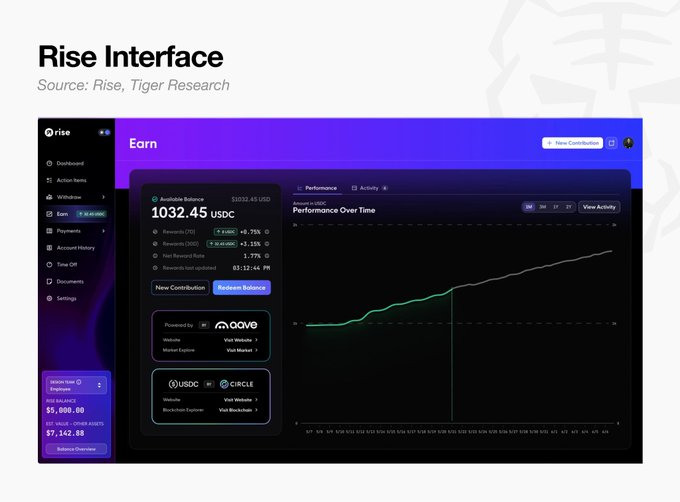
Rise is a stablecoin payroll platform; businesses can pay wages in fiat (USD) or USDC. Workers can choose from over 90 local currencies and stablecoins for each pay period; of the $1.5B processed cumulatively, over half of recent withdrawals were completed in stablecoins. However, what Rise actually charges for is not the token transfer, but the management of the employment relationship: automating KYC/AML, generating country-specific contracts, producing tax documents, charging recurring fees for this.
Rise's revenue is structured into three tiers along the payroll fund flow:
- Subscription & Transaction Fees: Employers can choose a fixed $50 monthly subscription per contractor, or pay 3% of the amount, plus a $2.5 transfer fee per transaction. Since payroll is inherently recurring, this is recurring revenue.
- Legal Liability Assumption (EOR/AOR): Premium service where Rise becomes the legal signatory, bearing misclassification risk for workers. Employer of Record (EOR) service is $399 per worker per month. The eightfold price difference compared to simple payment processing comes from compliance liability, not the transfer function itself.
- Float Fund Management (Rise Earn): Rise invests USDC balances reserved by companies before payroll and held by workers after receipt but before withdrawal into Aave lending pools on Arbitrum. No custody fee is charged; instead, it takes a 1% commission from generated interest, collected upon withdrawal (launched March 2026).
Because payroll is a monthly, inevitable cash flow, the platform naturally accumulates balances both before payment and after receipt but before withdrawal. Rise's three-tier structure monetizes this characteristic: in an environment where on-chain transfers are almost free, it deliberately shifts the charge points from the employment relationship (subscription) to legal liability (EOR), and then to idle funds (yield).
Key Insights
Winners in the transfer market won't just be the service providers moving tokens the cheapest, but comprehensive players who control conversion at both ends and licenses (Mural Pay, Yellow Card), grasp substantive client relationships through payroll (Rise), and layer yield revenue on top (Rise Earn).
The eventual acquisition of cross-border infrastructure provider BVNK by card network Mastercard for up to $1.8 billion also indicates that the underlying settlement infrastructure of the transfer and payment layers will ultimately converge.
Payments
Payments is the core layer of the value chain, where stablecoins settle goods and services. Merchant payments and card services are the current mainstay, but economic reality remains immature relative to market expectations. The retail velocity of on-chain stablecoins is only about one-twentieth of the M1 money supply, because users top up and spend intermittently, not tightly linking payroll and daily spending as in traditional finance.
Industry Structure
Interchange fees (fees charged per transaction by card networks and issuers) are the core of payment revenue, scaling with payment volume. However, low velocity leads to weak per-card profitability, and revenue is further split between card networks, issuers, and payment gateways. The real profit pool isn't in the consumer-facing card brand, but in the underlying issuance and settlement infrastructure.
Most consumer card service providers lack their own issuing licenses, relying on this infrastructure, with revenue structures largely limited to spreads.
Business Model Types
- Payment Infrastructure: Coordinates merchant payments and settlement. Beyond payment processing fees, also captures reserve interest by issuing own stablecoins. Stripe's Bridge Open Issuance distributes a Circle-like reserve earnings structure to enterprises, one of the most profitable businesses in this layer (Stripe, BVNK).
- Card Issuance Infrastructure: Backend supporting businesses to issue cards. As principal members of major networks like Visa, shares interchange fees, and generates revenue through program management and FX spreads. Core differentiation lies in T+0 on-chain settlement based on USDC, which can reduce collateral requirements by up to 60%, significantly improving capital efficiency (Rain, Reap).
- Consumer Cards & Neobanks: Provides cards and accounts to end-users. Revenue includes interchange fee shares, FX spreads, membership subscription fees, or deposit management profits. Not being the issuer themselves, most have difficulty directly obtaining reserve interest, relying on issuance infrastructure like Rain or Reap (Cypher, KAST).
- Card Networks: Networks for payment authorization and settlement. Interchange fees go to issuers; card networks benefit from transaction volume growth through per-transaction network fees. Card networks are introducing stablecoin settlement as a backend layer to strengthen ties with partner banks (Visa, Mastercard).
Case Study: Rain
Rain is a B2B backend infrastructure helping wallets, exchanges, and neobanks issue their own branded consumer cards. Partners design card programs via a single API integration; Rain, as a principal member of Visa and Mastercard, handles network sponsorship, compliance, issuance, and operations.
When a user swipes a Rain-powered card, the processing flow is as follows:
- Authorization (Real-time): Authorized on Visa or Mastercard network like a regular card; merchant and consumer experience identical, stablecoin invisible at surface.
- Balance Deduction & Ledger Management: Real-time conversion and deduction of authorized amount from user's on-chain balance; Rain manages the program's entire ledger.
- Network Settlement (Daily): Rain settles entirely in USDC with card networks. Not bound by bank cutoff times, can settle every day of the year (including weekends/holidays); funds aren't stuck for days over weekends/holidays.
- Funding Recovery & Working Capital: Under credit structure, user repayments occur later than settlement, requiring issuer funding. Rain tokenizes card receivables, uses them as collateral for on-chain loans to raise settlement funds early; cumulative borrowing and repayment exceed $175M. Result: collateral requirements up to 60% lower than traditional issuers.
In short, when consumers use Rain-powered cards, the entire flow—from authorization, settlement to fund sourcing—is handled by Rain behind the scenes.
Key Insights
The core of payment revenue is not the visible card payment processing fee, but the reserve interest accompanying issuer status, and the capital efficiency gained through T+0 settlement. Most consumer card brands are merely front-end customer touchpoints layered on top of this infrastructure.
Major card networks have already directly acquired cross-border payment infrastructure like BVNK, and Visa, Mastercard, Stripe, and Google are advancing the joint stablecoin alliance Open USD. This can be interpreted as a vertical integration strategy: internalizing the platform to secure exclusive reserve interest revenue.
Yield
Yield is the endpoint of the value chain and the layer with the most complex commercial structure. Interest that issuers cannot directly pass on to holders ultimately flows back to users here, with lending businesses evolving into a full-fledged asset management industry.
Industry Structure
Early on-chain lending pooled all assets together, where a default on any asset could impact the entire system. This structural limitation has been addressed by isolated (or modular) models: separating collateral and loan terms by market, clearly differentiating immutable lending protocol infrastructure from yield management layers operated by risk curators.
This structural separation has spawned a genuine on-chain asset management industry. Risk curators, like traditional asset managers, charge up to 50% performance fees and up to 5% annual management fees on managed vaults. The top four players collectively control ~65% of curated TVL, forming an oligopoly.
Built on top of this yield infrastructure is the financial product layer actually consumed by end-users, including RWAs like tokenized U.S. Treasuries and private credit, yield-bearing synthetic dollars, restaking, etc.
Business Model Types
- Lending Infrastructure: Captures a portion of the spread between deposit and loan rates (Reserve Factor), or takes protocol revenue from interest generated by its own stablecoin (e.g., Aave's GHO). Another model, exemplified by Morpho, shuts off its own protocol fees, transferring value to downstream curators and token ecosystems to drive network growth (Aave, Morpho).
- Risk Curators: Design asset allocation and risk models on top of lending protocols, charging vault management fees. Steakhouse manages ~$1.7B in assets with a team of fewer than 20, taking ~5% of interest. It's an archetype of on-chain asset management, with cost structures far more efficient than traditional financial institutions (Steakhouse, Gauntlet).
- RWA Yield Vaults: Issue and distribute tokenized U.S. Treasuries or money market funds, charging ~0.15%-0.5% annual management fees. BlackRock's BUIDL is the underlying asset; Ondo Finance repackages for DeFi ecosystem; Plume Nest distributes via a Layer 1 built specifically for RWAs.
- Yield-bearing & Synthetic Dollars: Generate yield through delta-neutral basis trading or managing net interest margin (NIM), then pay it as interest to token holders. Divided into those relying on crypto-native derivative yield and those relying on stable treasury collateral (Ethena, Sky).
- Restaking: Makes already staked assets liquid again (restaking) to capture additional yield. Some providers further vertically integrate, extending from charging DeFi vault management fees to directly connecting with consumer card payments (ether.fi).
Case Study: Steakhouse
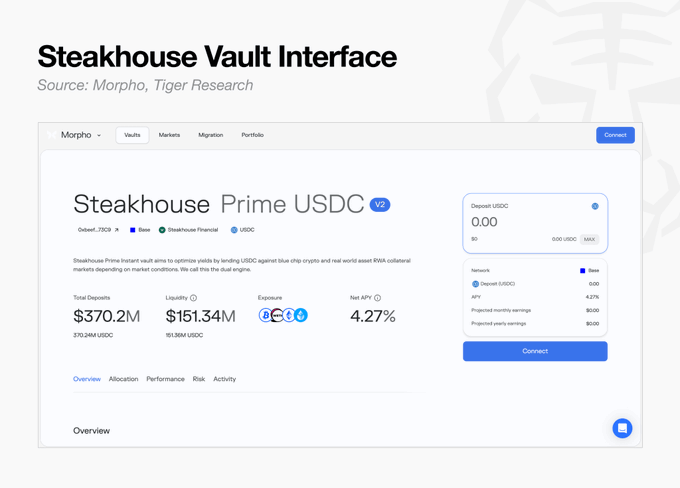
Steakhouse is a risk curator, i.e., an on-chain asset manager. It doesn't build its own lending protocols but operates on existing infrastructure like Morpho, acting as a sub-advisor: selecting collateral assets, designing risk parameters (e.g., loan-to-value ratios), allocating capital across markets.
Its revenue structure also resembles traditional asset management, taking a portion of generated interest as performance and management fees. Because lending protocols like Morpho already handle operational infrastructure, accounting, settlement, and custody, curators can scale efficiently relying solely on risk design expertise without bearing additional infrastructure costs.
Key Insights
Currently, assets under management by on-chain curators are ~$7B, merely one-twenty-thousandth of the global traditional asset management market (~$147 trillion). The massive gap indicates a long growth runway for on-chain asset management.
But high yield only makes sense when the underlying system remains stable. Recent de-pegging events and cascading impacts in the restaking space have exposed operational and tail risks not discoverable by smart contract audits alone.
Consequently, market funds are shifting from high-yield synthetic dollars towards products with relatively lower returns but collateralized by Treasuries. What institutional investors truly want is not high APY, but predictability and controlled risk.
Where is the Stablecoin Value Chain Heading?
The success of the stablecoin market doesn't depend on simply expanding issuance scale, but on who can control specific customer segments. Building infrastructure from scratch in a crypto-native way is both slow and expensive.
The most realistic and executable strategy is overlaying stablecoin efficiencies (same-day settlement, 24/7 operation, low-cost transfer, programmable yield) onto existing traditional financial infrastructure (rails). Recent major M&As—Stripe acquiring Bridge, Mastercard partnering with BVNK—all point in this direction: the combination of traditional financial infrastructure with stablecoin efficiency.
Two trends are amplifying this opportunity: regional currency proliferation and fusion with regulated finance.
- Regional Currency Proliferation: When governments and institutions prepare to issue local currency stablecoins, they are more likely to adopt proven issuance infrastructure and local banking channels rather than building from scratch.
- Fusion with Regulated Finance: Regulated financial institutions like JPMorgan, Visa, BlackRock also clearly prefer mature infrastructure over in-house technology development.
Therefore, market opportunities will further expand for card issuance & settlement, custody infrastructure, asset management—gateways through which institutional finance must enter the market.
Because stablecoins are essentially money, a powerful "technology upgrade" that maximizes the efficiency of existing financial rails.
The issuance market is an oligopoly requiring massive capital and trust, while layers post-issuance—onboarding, payments, asset management—have relatively lower entry barriers, accommodating richer business models.
The current market is still in the early stages of integration with traditional financial rails. Whoever shapes the form of this integration and replacement will become the dominant player.

This shift has become a large-scale theme of our era that cannot be avoided. EastPoint, to be held in Seoul on September 28, 2026, will serve as a forum to delve into this industry-wide transformation. Traditional financial institutions and the digital asset industry will discuss the stablecoin ecosystem and broader issues under one roof, a substantive first step toward crossing existing boundaries and moving toward true integration.