What's New in Jensen Huang's 'Agent Factory'?

marsbitPublicado em 2026-06-01Última atualização em 2026-06-01

Resumo

In a keynote at COMPUTEX 2026, NVIDIA CEO Jensen Huang shifted the company's focus from hardware "full-stack" solutions to the era of AI Agents. The centerpiece is the Vera Rubin platform, now in production, which is designed specifically for Agent workloads and offers 10x the efficiency of its predecessor. The platform features the new Vera CPU, built for AI, and incorporates Spectrum-X Ethernet Photonics with CPO technology for improved networking and energy efficiency. NVIDIA introduced DSX, an integrated toolkit for designing, simulating, and operating AI data centers, aiming to streamline "AI factory" deployment and management. For end-user deployment, the company unveiled DGX Station for Windows, a desktop AI supercomputer for running Agents locally, and the RTX Spark SoC for AI PCs. On the software front, NVIDIA launched the 550B-parameter Nemotron 3 Ultra model for enterprise Agents and the Cosmos 3 foundation model for physical AI, unifying visual reasoning and action prediction. In robotics, a partnership with Unitree yielded the H2 Plus, a reference humanoid robot built on the Isaac GR00T platform to lower development barriers. Security was emphasized with enhanced confidential computing for Vera Rubin and new data path security features for the BlueField-4 STX storage platform. The presentation highlighted a strategic pivot: NVIDIA is reorganizing its entire technology stack—from chips and data centers to models, software, and robots—around the emerging ecosyst...

Original Author: Li Hailun, Su Yang

Original Editor: Xu Qingyang

Original Source: Tencent Technology

June 1, 2026 - NVIDIA Founder and CEO Jensen Huang delivered a keynote speech at the NVIDIA GTC Taipei conference held during COMPUTEX 2026.

It had only been three months since the last GTC.

At that time, NVIDIA announced the "chip family bundle" of Vera Rubin, including: the Vera CPU, Rubin GPU, Groq 3 LPU, ConnectX-9, BlueField-4 DPU, and Spectrum-6 switch. These six chips form a rack-scale AI supercomputer, announcing that the number of GPUs required to train large MoE models was reduced to one-quarter, inference throughput per watt improved 10x, and single token cost dropped to one-tenth.

Different from previous emphasis on system-level solutions like the "chip family bundle" or "computing power family bundle," three months later at COMPUTEX, Jensen Huang turned his focus to the target these infrastructures will serve—Agents.

In his speech, Jensen Huang revealed: Vera Rubin has officially entered mass production, Vera CPUs have begun shipping globally, DGX Station for the first time comes to enterprise desktops in a Windows form factor, Cosmos 3 redefines the perceptual framework for physical AI, and DSX becomes the operating system for AI factories. NVIDIA also partnered with Unitree to launch the H2 Plus—the first humanoid robot reference design based on Isaac GR00T, extending Agent boundaries from the digital world to physical form.

NVIDIA is reorganizing its complete technical system around the Agent ecosystem, from chips and data centers to models, software, and robotics platforms.

Jensen Huang said: "The era of Agent AI and practical artificial intelligence has arrived. Now tokens are the unit of profit, AI is the 'generator' of GDP, and the number of software engineers is increasing. People talk about AI reducing jobs; that's complete nonsense. In fact, more software engineers are being hired."
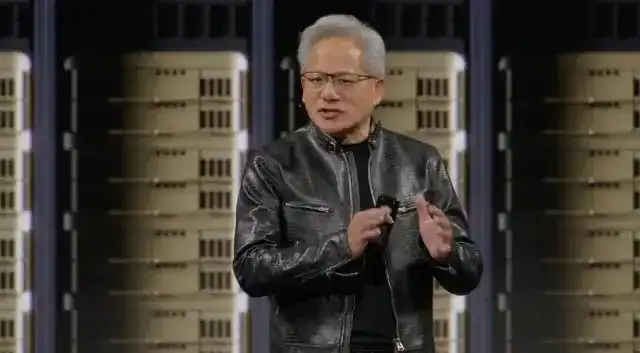
The Same AI Factory, Runs 10x More Agent Tasks

The Vera Rubin platform is now in full production.

Unlike the past, which mainly focused on large model training and inference, Vera Rubin was designed from the start with Agent as a key workload.

In his speech, Jensen Huang stated that an Agent task is often not just a single model inference, but includes multiple steps such as inference, search, tool calls, code execution, and result validation, potentially involving thousands of steps behind the scenes. In the future, data centers will need to handle not just individual model requests but more of these continuous, collaborative Agent tasks.

The platform is defined as a massive, unified compute-unit-level AI supercomputer built specifically for handling Agent workloads from inference, retrieval to tool usage. In a same-scale hyperscale data center, using the new Vera Rubin platform to run autonomous AI Agent tasks achieves a processing efficiency 10 times that of the previous generation Grace Blackwell platform.

Beyond the compute platform itself, networking has also become a focus of the Vera Rubin upgrade.

In the past, data transmission between GPUs in data centers relied primarily on traditional optical modules and switch architectures. However, as cluster sizes continue to expand, power consumption, cooling, and deployment complexity rapidly increase. To address this, NVIDIA introduced the Spectrum-X Ethernet Photonics networking system into the Vera Rubin platform.

This marks NVIDIA's first large-scale introduction of Co-Packaged Optics (CPO) technology into AI data center networks.

Simply put, traditional solutions require plugging optical modules externally into switches, while CPO directly integrates optical devices into the switch internal, thereby reducing energy consumption and signal loss.

Additionally, security is a core capability heavily emphasized in this Vera Rubin platform.

To this end, NVIDIA extended Confidential Computing capabilities across the entire Vera Rubin platform. Through trusted execution environments, hardware-level verification, and end-to-end encryption mechanisms, enterprises can achieve higher levels of security assurance when handling private data, industry-sensitive information, and critical models.

Jensen Huang revealed that Vera Rubin has entered mass production. As a third-generation MGX rack-level system, it involves over 150 partners, more than 350 factories, and a supply chain covering over 30 countries and regions. According to NVIDIA's announced plan, Vera Rubin will begin official shipments this fall.
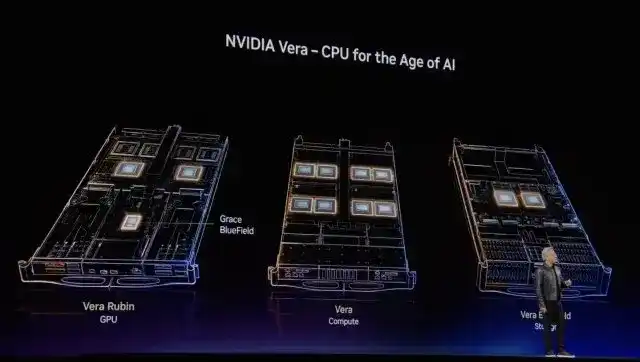
The "Born-for-Agent" Processor

NVIDIA launched a new type of processor, Vera, designed specifically for the Agent era and has entered full production.

Jensen Huang pointed out that advancements in memory systems will drive innovation and modernization in storage systems. All CPUs to date have been built for humans, but Vera is a CPU designed for the AI era, built for Agents.

As the successor to Grace, Vera adopts NVIDIA's self-designed "Olympus" CPU core architecture, increasing core count from 72 to 88 cores and significantly improving memory and data processing capabilities. According to NVIDIA, in testing with Agent-related workloads, Vera achieved task execution speeds 1.8 times faster than contemporary x86 server CPUs.

More important than pure performance gains is the change in the relationship between Vera and the Rubin GPU: Vera connects to the Rubin GPU via second-generation NVLink-C2C, with an interconnect bandwidth reaching 1.8TB/s, further reducing the overhead of data transfer between CPU and GPU during Agent operation.

Jensen Huang stated that Vera Rubin uses HBM (High-Bandwidth Memory) from Micron, SK Hynix, and Samsung, and the supply chain scale is "twice" that of the previous generation Blackwell. However, deploying a large Blackwell rack took two hours, while the time for Vera Rubin has been compressed to the 5-minute level.
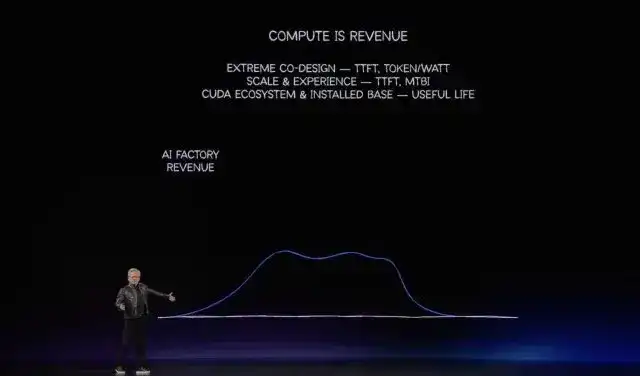
Moving AI Factories from "Construction" to "Operation"

The DSX launched by NVIDIA this time can be understood as an "AI Factory Construction and Operation Toolkit."

In the past, building an AI data center required clients to separately consider servers, networking, power, cooling, facility design, and operational systems, with many steps relying on coordination among different suppliers. DSX aims to integrate these previously fragmented steps into a single framework, providing clients with a standardized, verifiable reference plan from design, simulation, construction, to operation.

Jensen Huang stated at the launch event: "NVIDIA isn't just selling chips; we're providing infrastructure builders with a complete AI factory blueprint."

The most important new capabilities in DSX this time are two-fold.

The first is DSX MaxLPS. It addresses the most practical problem for AI factories: given a fixed power budget, how to place more GPUs and run more Tokens.

According to NVIDIA, MaxLPS, combined with liquid cooling and intra-rack power optimization, allows operators to run up to 40% more GPUs without significantly impacting performance.

The second is DSX OS. It acts as the operational software for the AI factory, responsible for lifecycle management, intelligent scheduling, health monitoring, failure recovery, multi-tenancy management, and more. Simply put, if an AI factory is a complex facility, DSX OS ensures its continuous, stable operation.

Within the DSX product matrix, Reference Design provides AI factory reference designs, telling clients how to build facilities, racks, networking, power, and cooling systems; DSX Sim handles simulation, allowing clients to verify designs before construction; DSX Flex connects the AI factory to the power grid, enabling data centers to adjust tasks based on electricity prices, loads, and demand response signals; DSX Exchange is responsible for data interfaces between IT systems, operational systems, energy, and cooling systems.

In terms of the ecosystem, cloud partners like CoreWeave, Crusoe, and Lambda are deploying DSX Sim, MaxLPS, and DSX OS to reduce risks and improve GPU utilization. Manufacturers like Dell, HPE, Lenovo, Supermicro, and ASUS, Foxconn, GIGABYTE, Wistron are building DSX-compatible systems.

Teaming Up with Windows and ARM

In his live speech, Jensen Huang officially announced the unveiling of the "DGX Station for Windows" workstation, defined by NVIDIA as a desktop-level AI supercomputer for the Windows ecosystem.

Hardware-wise, it features the GB300 Grace Blackwell Ultra Desktop Superchip, connecting the Blackwell Ultra GPU and 72-core Grace CPU via NVLink-C2C, offering up to 748GB unified memory and 20 PFLOPS FP4 performance, and equipped with up to 800Gb/s networking capability.

The key point of this product lies in the change in Agent deployment methods.

NVIDIA hopes enterprises can run multiple Agents locally, securely, and manageably within a Windows environment and integrate them into workflows like design, engineering, data science, inference, and Physical AI. Simultaneously launched, OpenShell handles Agent runtime security through isolated sandboxes and system-level policy control, limiting Agents from unauthorized operations or leaking credentials and private data.

Besides products for enterprise desktops, Jensen Huang also announced a system-level SoC—the RTX Spark SoC—integrating the N1X CPU and Blackwell GPU into a single chip with unified memory architecture, specifically for thin-and-light laptops and small form-factor desktops.

Among these, N1X is NVIDIA's first PC processor co-developed with Microsoft, based on Arm architecture, custom-designed by MediaTek, and manufactured using TSMC's 3nm process. It will debut this fall on laptops from Microsoft, Dell, HP, ASUS, Lenovo, and MSI, with over 30 models initially, targeting high-end thin-and-light notebooks.

This is NVIDIA's "super chip" prepared for the AI PC era, which Jensen Huang sees as a significant redefinition of the PC form factor.
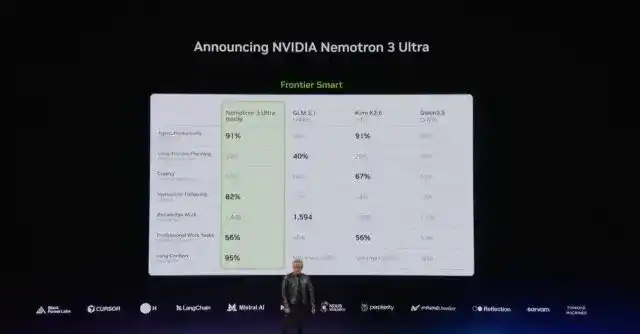
The Agent's "Two Brains"

At this launch event, NVIDIA announced the latest progress on two core model product lines, corresponding to two scenarios for Agents: one running within enterprise systems and one running in the physical world.

NVIDIA released Nemotron 3 Ultra, a 550-billion-parameter Mixture-of-Experts (MoE) model, providing top-tier intelligence for long-running agents in code development, scientific research, and enterprise business processes. Compared to mainstream open-source frontier models of similar scale, this model offers up to 5x faster inference speed and up to 30% lower usage cost, helping agents complete tasks more efficiently and affordably.

Surrounding the Nemotron open model, NVIDIA released a series of software, open-source models, and partnership progress, aiming to enable enterprises to build "digital colleagues" that assist employees in scenarios like engineering design, healthcare, software development, and business operations.

In this combination, Nemotron provides foundational model capabilities, NemoClaw organizes models into Agents, OpenShell handles runtime security, and Agent Toolkit transforms NVIDIA software libraries like CUDA-X into tools directly callable by Agents. Agents can use tools, call data, execute tasks, and integrate into existing enterprise systems within a controlled environment.

Jensen Huang stated that global software companies are bringing AI Agents into real work systems, enabling them to help employees complete complex tasks faster. NemoClaw provides open components needed to build long-running Agents, including orchestration, context, memory, tool calling, and security control capabilities.

In the past, enterprise discussions on AI focused more on what models could answer; now, NVIDIA aims to solve how Agents can securely integrate tools, data, and business processes and operate continuously in real work.

There's also Cosmos 3, officially launched as the third generation of the Cosmos series, representing an architectural-level redesign.

Cosmos 3 is a world foundation model for physical AI, providing the underlying ability to "understand the physical world, predict what will happen, and decide what to do."

Compared to previous Cosmos versions, earlier editions primarily targeted robotics and autonomous driving developers, focusing on video generation and physical world simulation, essentially being a relatively single-modal generation framework. Cosmos 3 adopts a new architecture—a hybrid Transformer—for the first time unifying three aspects: visual reasoning, world generation, and action prediction into a single system.

It can natively understand and generate text, images, videos, ambient sounds, and actions, achieving leading levels of physical accuracy, and is the world's first fully open, all-capable model. NVIDIA claims it has the potential to compress physical AI training and evaluation cycles from months in the past to days.

Jensen Huang predicted that due to breakthroughs in multimodal reasoning for language, vision, and world models, the big bang of physical AI is imminent.

The Cosmos 3 series of open frontier all-capable models provides developers with generational leap capabilities for building robots, autonomous vehicles, and visual AI that can perceive, reason, plan, and act in the physical world.

Lowering the Barrier to Physical AI

NVIDIA and Unitree jointly launched the H2 Plus—a sample humanoid robot for research and developers.

"Sample" means: Unitree is responsible for the robot body, NVIDIA is responsible for the software and computing platform, with both sides pre-integrating hardware and software. Development teams can start skill development immediately upon receiving it, without spending time solving underlying integration issues. It is also the world's first open humanoid robot built on the NVIDIA Isaac GR00T development platform.

This sample model targets a long-standing pain point in humanoid robot development: hardware integration, data collection, simulation, training, evaluation, deployment—each step operates in silos, making the entire process highly fragmented.

NVIDIA stated that research teams receiving a robot body often spend significant time on underlying integration, delaying actual skill development. What H2 Plus attempts to do is streamline this path, allowing research teams to skip underlying integration and directly enter skill development and real-world scenario validation.

In Jensen Huang's view, humanoid robots will bring physical AI to the world's largest industries, unlocking multi-trillion-dollar economic opportunities, and H2 Plus is the starting point for pushing frontier research into real scenarios like factories, warehouses, and logistics systems.

Additionally, NVIDIA announced the official open-sourcing of a set of Physical AI Skills toolkits, covering core scenarios like robotics, autonomous driving, visual AI, and industrial digital twins.

These "Skills" can be understood as standardized usage methods of NVIDIA's platforms like Cosmos, Omniverse, Isaac, Metropolis, written into operational instructions that Agents can directly read and execute. Open-sourcing these packaged instructions forms the toolkit released this time.

When an Agent receives a task, for example, generating a batch of training data for defect detection, it knows which model to call, what format to output, and how to validate results, automatically running the entire process without human step-by-step operation of each stage.

Upgrading AI Storage: From "Fast Running" to "Managed Control"

At the March GTC in San Jose, NVIDIA launched the Vera BlueField-4 STX. At that time, Jensen Huang focused on "AI-native storage architecture," with the core selling point being high-performance KV Cache storage support for Agents' long-context reasoning.

Now, NVIDIA announced the addition of a new set of security capabilities to STX, shifting the focus from "storage performance" to "storage security."

The core logic here stems from the changing context of enterprise AI usage. Now, many enterprises are actively deploying Agents. When Agents access enterprise systems, continuously reading and writing, sharing information across systems without direct human supervision—questions like who is accessing what data, whether there's unauthorized access, or data leakage become major headaches for enterprises.

NVIDIA's solution is to add a layer of security on top of accelerated storage—through a unified NVIDIA DOCA security software and hardware-enforced policies directly in the BlueField-4 chip, platforms based on STX can inspect and control interactions between agents, data, and contextual memory in real-time, helping enterprises achieve continuous policy enforcement across the AI data path.

Jensen Huang explained: "Agents have turned enterprise data into a real-time, living system, and this system must be protected wherever data moves, wherever context is stored, wherever Agents act. What Vera BlueField-4 STX aims to do is use inherently secure design to enforce trust at chip-level, at AI speeds."

Being "Mutual Suppliers" with TSMC

A particularly interesting point in this conference was the collaboration between NVIDIA and TSMC—Currently, TSMC is utilizing NVIDIA technology to improve cycle time, energy efficiency, yield, and operational productivity in advanced wafer fabs.

For the past thirty years, the relationship between TSMC and NVIDIA had only one form: TSMC manufacturing chips for NVIDIA. But now, roles have subtly changed; NVIDIA has begun helping TSMC "manage factories."

Jensen Huang stated: "NVIDIA and TSMC have collaborated for nearly thirty years, continuously pushing the limits of computing. TSMC is bringing NVIDIA's AI and accelerated computing inside the wafer fab, using simulation, optimization, and AI to tackle the world's most complex design and manufacturing challenges, improving speed, efficiency, and yield for next-generation chips."

Their relationship has evolved from a one-way client-vendor dynamic to one of mutual interdependence.

Conclusion

Looking back at this launch event, NVIDIA is piecing together a new blueprint around "Agents."

Vera CPU schedules tasks for Agents, Vera Rubin provides compute power for Agents, BlueField-4 STX secures data for Agents, Cosmos 3 enables Agents to understand the physical world, Nemotron+NemoClaw+OpenShell enables Agents to be organized, invoked, and constrained, DGX Station for Windows brings Agents to enterprise employee desktops, H2 Plus gives Agents a physical body, and DSX and Skills enable all this to be mass-produced and deployed.

From this perspective, Jensen Huang is attempting to depict a new computing era. This echoes his opening statement: "The era of Agent AI and practical artificial intelligence has arrived."

Ultimately, what Jensen Huang wanted to convey this time is one thing: when Agents become AI infrastructure, every layer can have NVIDIA.


Perguntas relacionadas

QAccording to the article, what is the main focus of NVIDIA's new strategy at COMPUTEX 2026, as outlined by Jensen Huang?

AAccording to Jensen Huang's keynote at COMPUTEX 2026, NVIDIA's main strategic focus has shifted from emphasizing 'system-level solutions' like chip or computing power 'family buckets' to the infrastructure's ultimate target: the Agent. NVIDIA is reorganizing its entire technology stack—from chips and data centers to models, software, and robotics platforms—around the Agent ecosystem.

QWhat key performance claim does NVIDIA make for the new Vera Rubin AI platform compared to its predecessor?

ANVIDIA claims that the new Vera Rubin platform can handle autonomous AI agent tasks with 10 times the processing efficiency of the previous-generation Grace Blackwell platform, within similarly sized mega-data centers.

QWhat is the significance of NVIDIA's collaboration with Unitree on the H2 Plus robot?

AThe collaboration with Unitree resulted in the H2 Plus, which is described as the first open humanoid robot reference design built on the NVIDIA Isaac GR00T platform. It serves as a 'template' or 'sample machine' that integrates hardware (by Unitree) and software/platform (by NVIDIA), allowing research teams to skip complex low-level integration and focus directly on skill development and real-world validation. Its goal is to lower the barrier to entry for Physical AI development.

QWhat are the two core model product lines NVIDIA announced for Agents, and what are their respective purposes?

ANVIDIA announced updates to two core model product lines for Agents: 1) The Nemotron series, exemplified by the Nemotron 3 Ultra model, is designed for 'digital colleagues' running within enterprise systems to assist with tasks like code development and business processes. 2) The Cosmos 3 series is a foundational world model for Physical AI, providing the underlying ability to understand the physical world, predict outcomes, and decide on actions for robots, autonomous vehicles, and visual AI.

QHow has the relationship between NVIDIA and TSMC evolved, as mentioned in the article?

AThe relationship between NVIDIA and TSMC has evolved from a traditional, one-way supplier-client dynamic (where TSMC manufactures chips for NVIDIA) into a more bidirectional, interdependent partnership. TSMC is now implementing NVIDIA's AI and accelerated computing technology within its own advanced wafer fabs to improve turnaround time, energy efficiency, yield, and operational productivity for next-generation chip manufacturing.

Leituras Relacionadas

The Midlife Crisis of Crypto GPs: No PMF, No Next Check from LPs

The article "The Midlife Crisis of Crypto GPs: No PMF, No Next LP Check" analyzes the shifting crypto fundraising landscape. It argues the era of selling grand visions to LPs is over; GPs must now offer products with clear Product-Market Fit (PMF). The author categorizes crypto fundraising products into three types: Primary (VC funds), Liquid (trading strategies), and CeFi/DeFi Native Yield. This summary focuses on the Primary market. Key points include: * **Market Shift:** LPs are impatient, demand immediate returns, and are skeptical of future promises. The "easy money" narrative has faded. * **GP Value Erosion:** LP learning curves have shortened (aided by AI), reducing the value of a GP's basic "crypto knowledge." Superior judgment is now rare. * **Weakened LP Motivations:** Traditional reasons for LPs to invest in crypto VC funds (capturing industry beta, gaining access, leveraging GP judgment) have weakened due to new products like ETFs and increased LP sophistication. * **Surviving in Primary:** The primary market will likely persist for: 1) large funds in endowment mandates treating it as a lottery ticket, 2) family offices/HNWIs using proprietary capital, 3) a few funds with proven recent outperformance, and 4) funds with strong ecosystem "deal-making" capabilities. * **Conclusion:** For most GPs, rebuilding trust requires starting over in a niche, demonstrating alpha-generating ability, or providing concrete value/services to LPs.

marsbitHá 4h

The Midlife Crisis of Crypto GPs: No PMF, No Next Check from LPs

marsbitHá 4h

Trading

Spot
Futuros

Artigos em Destaque

O que é $S$

Compreender o SPERO: Uma Visão Abrangente Introdução ao SPERO À medida que o panorama da inovação continua a evoluir, o surgimento de tecnologias web3 e projetos de criptomoeda desempenha um papel fundamental na formação do futuro digital. Um projeto que tem atraído atenção neste campo dinâmico é o SPERO, denotado como SPERO,$$s$. Este artigo tem como objetivo reunir e apresentar informações detalhadas sobre o SPERO, para ajudar entusiastas e investidores a compreender as suas bases, objetivos e inovações nos domínios web3 e cripto. O que é o SPERO,$$s$? O SPERO,$$s$ é um projeto único dentro do espaço cripto que procura aproveitar os princípios da descentralização e da tecnologia blockchain para criar um ecossistema que promove o envolvimento, a utilidade e a inclusão financeira. O projeto é concebido para facilitar interações peer-to-peer de novas maneiras, proporcionando aos utilizadores soluções e serviços financeiros inovadores. No seu núcleo, o SPERO,$$s$ visa capacitar indivíduos ao fornecer ferramentas e plataformas que melhoram a experiência do utilizador no espaço das criptomoedas. Isso inclui a possibilidade de métodos de transação mais flexíveis, a promoção de iniciativas impulsionadas pela comunidade e a criação de caminhos para oportunidades financeiras através de aplicações descentralizadas (dApps). A visão subjacente do SPERO,$$s$ gira em torno da inclusão, visando fechar lacunas dentro das finanças tradicionais enquanto aproveita os benefícios da tecnologia blockchain. Quem é o Criador do SPERO,$$s$? A identidade do criador do SPERO,$$s$ permanece algo obscura, uma vez que existem recursos publicamente disponíveis limitados que fornecem informações detalhadas sobre o(s) seu(s) fundador(es). Esta falta de transparência pode resultar do compromisso do projeto com a descentralização—uma ética que muitos projetos web3 partilham, priorizando contribuições coletivas em vez de reconhecimento individual. Ao centrar as discussões em torno da comunidade e dos seus objetivos coletivos, o SPERO,$$s$ incorpora a essência do empoderamento sem destacar indivíduos específicos. Assim, compreender a ética e a missão do SPERO é mais importante do que identificar um criador singular. Quem são os Investidores do SPERO,$$s$? O SPERO,$$s$ é apoiado por uma diversidade de investidores que vão desde capitalistas de risco a investidores-anjo dedicados a promover a inovação no setor cripto. O foco desses investidores geralmente alinha-se com a missão do SPERO—priorizando projetos que prometem avanço tecnológico social, inclusão financeira e governança descentralizada. Essas fundações de investidores estão tipicamente interessadas em projetos que não apenas oferecem produtos inovadores, mas que também contribuem positivamente para a comunidade blockchain e os seus ecossistemas. O apoio desses investidores reforça o SPERO,$$s$ como um concorrente notável no domínio em rápida evolução dos projetos cripto. Como Funciona o SPERO,$$s$? O SPERO,$$s$ emprega uma estrutura multifacetada que o distingue de projetos de criptomoeda convencionais. Aqui estão algumas das características-chave que sublinham a sua singularidade e inovação: Governança Descentralizada: O SPERO,$$s$ integra modelos de governança descentralizada, capacitando os utilizadores a participar ativamente nos processos de tomada de decisão sobre o futuro do projeto. Esta abordagem promove um sentido de propriedade e responsabilidade entre os membros da comunidade. Utilidade do Token: O SPERO,$$s$ utiliza o seu próprio token de criptomoeda, concebido para servir várias funções dentro do ecossistema. Esses tokens permitem transações, recompensas e a facilitação de serviços oferecidos na plataforma, melhorando o envolvimento e a utilidade gerais. Arquitetura em Camadas: A arquitetura técnica do SPERO,$$s$ suporta modularidade e escalabilidade, permitindo a integração contínua de funcionalidades e aplicações adicionais à medida que o projeto evolui. Esta adaptabilidade é fundamental para manter a relevância no panorama cripto em constante mudança. Envolvimento da Comunidade: O projeto enfatiza iniciativas impulsionadas pela comunidade, empregando mecanismos que incentivam a colaboração e o feedback. Ao nutrir uma comunidade forte, o SPERO,$$s$ pode melhor atender às necessidades dos utilizadores e adaptar-se às tendências do mercado. Foco na Inclusão: Ao oferecer taxas de transação baixas e interfaces amigáveis, o SPERO,$$s$ visa atrair uma base de utilizadores diversificada, incluindo indivíduos que anteriormente podem não ter participado no espaço cripto. Este compromisso com a inclusão alinha-se com a sua missão abrangente de empoderamento através da acessibilidade. Cronologia do SPERO,$$s$ Compreender a história de um projeto fornece insights cruciais sobre a sua trajetória de desenvolvimento e marcos. Abaixo está uma cronologia sugerida que mapeia eventos significativos na evolução do SPERO,$$s$: Fase de Conceituação e Ideação: As ideias iniciais que formam a base do SPERO,$$s$ foram concebidas, alinhando-se de perto com os princípios de descentralização e foco na comunidade dentro da indústria blockchain. Lançamento do Whitepaper do Projeto: Após a fase conceitual, um whitepaper abrangente detalhando a visão, os objetivos e a infraestrutura tecnológica do SPERO,$$s$ foi lançado para atrair o interesse e o feedback da comunidade. Construção da Comunidade e Primeiros Envolvimentos: Esforços ativos de divulgação foram feitos para construir uma comunidade de primeiros adotantes e investidores potenciais, facilitando discussões em torno dos objetivos do projeto e angariando apoio. Evento de Geração de Tokens: O SPERO,$$s$ realizou um evento de geração de tokens (TGE) para distribuir os seus tokens nativos a apoiantes iniciais e estabelecer liquidez inicial dentro do ecossistema. Lançamento da dApp Inicial: A primeira aplicação descentralizada (dApp) associada ao SPERO,$$s$ foi lançada, permitindo que os utilizadores interagissem com as funcionalidades principais da plataforma. Desenvolvimento Contínuo e Parcerias: Atualizações e melhorias contínuas nas ofertas do projeto, incluindo parcerias estratégicas com outros players no espaço blockchain, moldaram o SPERO,$$s$ em um jogador competitivo e em evolução no mercado cripto. Conclusão O SPERO,$$s$ é um testemunho do potencial do web3 e das criptomoedas para revolucionar os sistemas financeiros e capacitar indivíduos. Com um compromisso com a governança descentralizada, o envolvimento da comunidade e funcionalidades inovadoras, abre caminho para um panorama financeiro mais inclusivo. Como em qualquer investimento no espaço cripto em rápida evolução, potenciais investidores e utilizadores são incentivados a pesquisar minuciosamente e a envolver-se de forma ponderada com os desenvolvimentos em curso dentro do SPERO,$$s$. O projeto demonstra o espírito inovador da indústria cripto, convidando a uma exploração mais aprofundada das suas inúmeras possibilidades. Embora a jornada do SPERO,$$s$ ainda esteja a desenrolar-se, os seus princípios fundamentais podem, de facto, influenciar o futuro de como interagimos com a tecnologia, as finanças e uns com os outros em ecossistemas digitais interconectados.

69 Visualizações TotaisPublicado em {updateTime}Atualizado em 2024.12.17

O que é $S$

O que é AGENT S

Agent S: O Futuro da Interação Autónoma no Web3 Introdução No panorama em constante evolução do Web3 e das criptomoedas, as inovações estão constantemente a redefinir a forma como os indivíduos interagem com plataformas digitais. Um projeto pioneiro, o Agent S, promete revolucionar a interação humano-computador através do seu framework aberto e agente. Ao abrir caminho para interações autónomas, o Agent S visa simplificar tarefas complexas, oferecendo aplicações transformadoras em inteligência artificial (IA). Esta exploração detalhada irá aprofundar-se nas complexidades do projeto, nas suas características únicas e nas implicações para o domínio das criptomoedas. O que é o Agent S? O Agent S é um framework aberto e agente, especificamente concebido para abordar três desafios fundamentais na automação de tarefas computacionais: Aquisição de Conhecimento Específico de Domínio: O framework aprende inteligentemente a partir de várias fontes de conhecimento externas e experiências internas. Esta abordagem dupla capacita-o a construir um rico repositório de conhecimento específico de domínio, melhorando o seu desempenho na execução de tarefas. Planeamento ao Longo de Longos Horizontes de Tarefas: O Agent S emprega planeamento hierárquico aumentado por experiência, uma abordagem estratégica que facilita a decomposição e execução eficientes de tarefas intrincadas. Esta característica melhora significativamente a sua capacidade de gerir múltiplas subtarefas de forma eficiente e eficaz. Gestão de Interfaces Dinâmicas e Não Uniformes: O projeto introduz a Interface Agente-Computador (ACI), uma solução inovadora que melhora a interação entre agentes e utilizadores. Utilizando Modelos de Linguagem Multimodais de Grande Escala (MLLMs), o Agent S pode navegar e manipular diversas interfaces gráficas de utilizador de forma fluida. Através destas características pioneiras, o Agent S fornece um framework robusto que aborda as complexidades envolvidas na automação da interação humana com máquinas, preparando o terreno para uma infinidade de aplicações em IA e além. Quem é o Criador do Agent S? Embora o conceito de Agent S seja fundamentalmente inovador, informações específicas sobre o seu criador permanecem elusivas. O criador é atualmente desconhecido, o que destaca ou o estágio nascente do projeto ou a escolha estratégica de manter os membros fundadores em anonimato. Independentemente da anonimidade, o foco permanece nas capacidades e no potencial do framework. Quem são os Investidores do Agent S? Como o Agent S é relativamente novo no ecossistema criptográfico, informações detalhadas sobre os seus investidores e financiadores não estão explicitamente documentadas. A falta de informações disponíveis publicamente sobre as fundações de investimento ou organizações que apoiam o projeto levanta questões sobre a sua estrutura de financiamento e roteiro de desenvolvimento. Compreender o apoio é crucial para avaliar a sustentabilidade do projeto e o seu impacto potencial no mercado. Como Funciona o Agent S? No núcleo do Agent S reside uma tecnologia de ponta que lhe permite funcionar eficazmente em diversos ambientes. O seu modelo operacional é construído em torno de várias características-chave: Interação Humano-Computador Semelhante: O framework oferece planeamento avançado em IA, esforçando-se para tornar as interações com computadores mais intuitivas. Ao imitar o comportamento humano na execução de tarefas, promete elevar as experiências dos utilizadores. Memória Narrativa: Utilizada para aproveitar experiências de alto nível, o Agent S utiliza memória narrativa para acompanhar os históricos de tarefas, melhorando assim os seus processos de tomada de decisão. Memória Episódica: Esta característica fornece aos utilizadores orientações passo a passo, permitindo que o framework ofereça suporte contextual à medida que as tarefas se desenrolam. Suporte para OpenACI: Com a capacidade de funcionar localmente, o Agent S permite que os utilizadores mantenham o controlo sobre as suas interações e fluxos de trabalho, alinhando-se com a ética descentralizada do Web3. Fácil Integração com APIs Externas: A sua versatilidade e compatibilidade com várias plataformas de IA garantem que o Agent S possa integrar-se perfeitamente em ecossistemas tecnológicos existentes, tornando-o uma escolha apelativa para desenvolvedores e organizações. Estas funcionalidades contribuem coletivamente para a posição única do Agent S no espaço cripto, à medida que automatiza tarefas complexas e em múltiplos passos com mínima intervenção humana. À medida que o projeto evolui, as suas potenciais aplicações no Web3 podem redefinir a forma como as interações digitais se desenrolam. Cronologia do Agent S O desenvolvimento e os marcos do Agent S podem ser encapsulados numa cronologia que destaca os seus eventos significativos: 27 de Setembro de 2024: O conceito de Agent S foi lançado num artigo de pesquisa abrangente intitulado “Um Framework Agente Aberto que Usa Computadores como um Humano”, mostrando a base para o projeto. 10 de Outubro de 2024: O artigo de pesquisa foi disponibilizado publicamente no arXiv, oferecendo uma exploração aprofundada do framework e da sua avaliação de desempenho com base no benchmark OSWorld. 12 de Outubro de 2024: Uma apresentação em vídeo foi lançada, proporcionando uma visão visual das capacidades e características do Agent S, envolvendo ainda mais potenciais utilizadores e investidores. Estes marcos na cronologia não apenas ilustram o progresso do Agent S, mas também indicam o seu compromisso com a transparência e o envolvimento da comunidade. Pontos-Chave Sobre o Agent S À medida que o framework Agent S continua a evoluir, várias características-chave destacam-se, sublinhando a sua natureza inovadora e potencial: Framework Inovador: Concebido para proporcionar um uso intuitivo de computadores semelhante à interação humana, o Agent S traz uma abordagem nova à automação de tarefas. Interação Autónoma: A capacidade de interagir autonomamente com computadores através de GUI significa um avanço em direção a soluções computacionais mais inteligentes e eficientes. Automação de Tarefas Complexas: Com a sua metodologia robusta, pode automatizar tarefas complexas e em múltiplos passos, tornando os processos mais rápidos e menos propensos a erros. Melhoria Contínua: Os mecanismos de aprendizagem permitem que o Agent S melhore a partir de experiências passadas, aprimorando continuamente o seu desempenho e eficácia. Versatilidade: A sua adaptabilidade em diferentes ambientes operacionais, como OSWorld e WindowsAgentArena, garante que pode servir uma ampla gama de aplicações. À medida que o Agent S se posiciona no panorama do Web3 e das criptomoedas, o seu potencial para melhorar as capacidades de interação e automatizar processos significa um avanço significativo nas tecnologias de IA. Através do seu framework inovador, o Agent S exemplifica o futuro das interações digitais, prometendo uma experiência mais fluida e eficiente para os utilizadores em diversas indústrias. Conclusão O Agent S representa um ousado avanço na união da IA e do Web3, com a capacidade de redefinir a forma como interagimos com a tecnologia. Embora ainda esteja nas suas fases iniciais, as possibilidades para a sua aplicação são vastas e cativantes. Através do seu framework abrangente que aborda desafios críticos, o Agent S visa trazer interações autónomas para o primeiro plano da experiência digital. À medida que avançamos mais profundamente nos domínios das criptomoedas e da descentralização, projetos como o Agent S desempenharão, sem dúvida, um papel crucial na formação do futuro da tecnologia e da colaboração humano-computador.

652 Visualizações TotaisPublicado em {updateTime}Atualizado em 2025.01.14

O que é AGENT S

Como comprar S

Bem-vindo à HTX.com!Tornámos a compra de Sonic (S) simples e conveniente.Segue o nosso guia passo a passo para iniciar a tua jornada no mundo das criptos.Passo 1: cria a tua conta HTXUtiliza o teu e-mail ou número de telefone para te inscreveres numa conta gratuita na HTX.Desfruta de um processo de inscrição sem complicações e desbloqueia todas as funcionalidades.Obter a minha contaPasso 2: vai para Comprar Cripto e escolhe o teu método de pagamentoCartão de crédito/débito: usa o teu visa ou mastercard para comprar Sonic (S) instantaneamente.Saldo: usa os fundos da tua conta HTX para transacionar sem problemas.Terceiros: adicionamos métodos de pagamento populares, como Google Pay e Apple Pay, para aumentar a conveniência.P2P: transaciona diretamente com outros utilizadores na HTX.Mercado de balcão (OTC): oferecemos serviços personalizados e taxas de câmbio competitivas para os traders.Passo 3: armazena teu Sonic (S)Depois de comprar o teu Sonic (S), armazena-o na tua conta HTX.Alternativamente, podes enviá-lo para outro lugar através de transferência blockchain ou usá-lo para transacionar outras criptomoedas.Passo 4: transaciona Sonic (S)Transaciona facilmente Sonic (S) no mercado à vista da HTX.Acede simplesmente à tua conta, seleciona o teu par de trading, executa as tuas transações e monitoriza em tempo real.Oferecemos uma experiência de fácil utilização tanto para principiantes como para traders experientes.

1.2k Visualizações TotaisPublicado em {updateTime}Atualizado em 2026.06.01

Como comprar S

Discussões

Bem-vindo à Comunidade HTX. Aqui, pode manter-se informado sobre os mais recentes desenvolvimentos da plataforma e obter acesso a análises profissionais de mercado. As opiniões dos utilizadores sobre o preço de S (S) são apresentadas abaixo.

活动图片