From Identity Protocol to AI Gateway: How Ambitious Is World?

marsbitPublicado em 2026-06-16Última atualização em 2026-06-16

Resumo

The article discusses Worldcoin's (WLD) evolution from a "proof of personhood" network to a potential identity infrastructure for the AI era. Initially focused on unique digital identities via iris scans, Worldcoin faced skepticism over real-world use cases. However, entering "The Simple Plan" Phase 3, it's shifting from token incentives to utility-driven growth. Key applications are emerging: enterprise solutions (e.g., deepfake verification with Zoom, Okta), consumer use cases (e.g., reducing bots on Tinder or in ticket sales), and notably, the AI Agent sector via AgentKit, which aims to establish trusted authorization between humans and AI agents. The author argues AI's proliferation makes authentic human identity a scarce and valuable resource. Worldcoin's strategy is now focused on key markets for network effects and developing self-service Orb hardware to scale sustainably. The launch of World ID 4.0 introduces a fee model for issuers/protocols, creating a potential revenue stream. In conclusion, WLD's rise reflects a market reassessment. Worldcoin's ambition is to become the foundational identity layer and crucial entry point for the coming AI Agent economy, moving crypto narratives beyond finance into verifiable human identity.

Author:Flora,CryptoPulse Labs

Recently, in the cryptocurrency market, WLD has become one of the focal points of market attention. Market data shows that WLD has continued to rise, breaking through $0.6, with a total market capitalization exceeding $3 billion.

The main driver behind the warming market sentiment is World's announcement that it has officially entered the third stage of "The Simple Plan," shifting its growth logic from early-stage token incentives to utility-driven mechanisms. Therefore, the question worth considering now is: is World truly evolving into a critical piece of infrastructure for the AI era?

一、From Iris Scanning to Real-World Application: World Enters a New Phase

From its inception, World's core objective has been unequivocally clear: to build a global "proof-of-personhood" network.

Simply put, it aims to address an increasingly critical problem in the internet world: how to prove you are a real human being, not a bot, script, or AI-generated identity.
In the past few years, this problem seemed distant. However, with the explosion of generative AI, it is rapidly becoming a real-world necessity. Today, AI can generate highly realistic images, videos, and audio, even operate social media accounts in bulk and execute complex tasks autonomously.

In the future, a significant portion of active users on the internet may not be real people but rather AI Agents. Against this backdrop, verifying that the entity on the other end is human is becoming a fundamental issue for the internet.

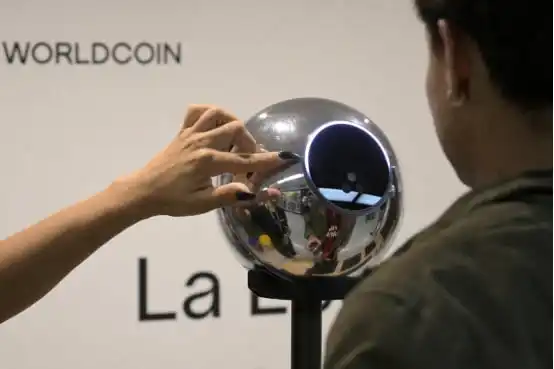
This is precisely the market World aims to capture. Its core product, World ID, uses the Orb device to scan a user's iris, generating a unique digital identity credential for each individual. This system attempts to achieve a "one person, one ID" principle, verifying authenticity while protecting user privacy as much as possible, and supporting on-chain calls.

Previously, the biggest market skepticism towards World was that, while the identity system held great imaginative potential, it consistently lacked real-world use cases. However, as it enters the third stage, this is changing. World has explicitly stated it will promote adoption across three main directions: enterprise, individual users, and AI Agents.

On the enterprise front, World is collaborating with companies like Zoom, Okta, and DocuSign to launch identity verification products targeting deepfake issues. As AI scams and deepfake attacks become more common, the demand for real-person verification is rising rapidly. Whether for video conferencing, remote work, or electronic signing, verifying identity authenticity is becoming crucial.

On the individual user front, World is targeting higher-frequency pain points on the internet. For example, Tinder could use World ID to verify if a user is a real person, and the Concert Kit for ticket purchases could reduce bot scalping and ticket touting.

This means World is attempting to solve the long-standing internet industry problems of fake accounts and bot traffic.

The most noteworthy aspect is the AI Agent front. World has launched AgentKit, aiming to establish a trusted authorization relationship between humans and AI. In the future, if everyone has their own AI assistant, these Agents might help users manage assets, execute transactions, sign agreements, or even participate in on-chain governance.

But before that, the system must be able to verify whom an AI represents and whether it has obtained authorization from a real human. The value of AgentKit lies in establishing a foundational trust framework for the future AI economy.

二、The AI Era: "Real Human Identity" is Becoming Scarce

The core reason for WLD's price increase isn't merely news-driven hype but the market beginning to reprice the scarcity value of "real human identity."

Over the past few years, numerous identity-focused projects have emerged in the crypto market, but most struggled to sustain themselves, fundamentally due to insufficient demand. While traditional internet had identity verification needs, it wasn't enough to support a massive, independent sector. However, the arrival of the AI era has completely changed this logic.

When the cost of generating AI content approaches zero, the truly scarce resource becomes human beings themselves. In the past, the internet's most important resources were traffic, content, and attention. In the future, scarcer resources might be real human identity, real human behavior, and real human authorization.

The reason is simple. AI can infinitely replicate text, images, audio, and even video, but it cannot naturally possess an independent human identity. This means that in the future internet, real humans could become an increasingly scarce resource. Whoever can verify a "real person" holds the key gateway.

This is also why the market is beginning to reassess World's long-term value. It is no longer betting on just a crypto narrative but on a crucial infrastructure need for the AI era.

Simultaneously, World's operational strategy has undergone a significant shift. The team announced it will concentrate resources on a few high-density, high-value cities, including San Francisco, New York, as well as regions like the UK, Germany, Japan, and South Korea, while scaling back operations in non-priority areas. This indicates the team is no longer pursuing widespread expansion but prioritizing establishing network effects in high-value markets first.

The business logic behind this strategy is clear. The value of an identity system inherently comes from network effects. Only when a region has enough users, enterprises, and application scenarios can the true value of World ID be realized. Otherwise, even with user growth, it's difficult to form a stable value loop.

Another key change is hardware upgrades. The next-generation Orb will move towards self-service, aiming to achieve 95% autonomous operation by the end of 2026. This is crucial.

Previously, the bottleneck in Orb expansion was the high labor cost, requiring offline operational support for each additional user. Once the device can achieve large-scale self-service operation, customer acquisition and expansion costs will significantly decrease, making the business model healthier.

三、The AI Agent Era: World Could Become a Key Gateway

From a broader perspective, World's advancement could have profound implications for the crypto industry.

First, it could drive the crypto narrative further from finance into identity. In the past, market discussions about Crypto primarily revolved around DeFi, stablecoins, ETFs, and RWA, essentially financial logic. But World represents another path: identity infrastructure.

In the future, identity itself could become a composable asset. Users with a trusted identity might gain access to airdrops, credit scores, governance rights, and even AI usage permissions.

Around the identity layer, new market sectors could emerge, such as identity protocols, human credit protocols, and AI authorization protocols.

Second, World could become important infrastructure for the AI Agent economy. If AI Agents truly become the next generation of productivity tools, the entire industry must solve three problems: who does the Agent belong to, is the Agent trustworthy, and is the Agent verifiable. World is addressing these three core needs.

From this angle, World's ambition isn't merely to be a crypto project but to become the identity gateway for the AI era. Just as Google became the gateway for information and Meta for social interaction, World aims to become the gateway for identity. If this positioning holds, the valuation logic for WLD would be fundamentally reconstructed.

Finally, the market's most pressing concern remains: how does WLD capture value? This is also a significant change brought by World ID 4.0. The new protocol introduces a fee mechanism, allowing credential issuers and the protocol to charge users (the service consumers), while end-users can still use it for free.

The significance of this model is that it gives World a real source of revenue. Users use the protocol for free, while ecosystem participants pay, which is highly similar to the business model of internet platforms.

As the number of identity verifications increases, enterprise adoption scales up, and protocol call frequency rises, the entire network has the potential to generate sustainable cash flow.

For the market, this might be the most crucial change, as it means World is no longer just telling a future story but beginning to establish a verifiable business model and value capture path.

Conclusion

WLD's price rise appears, on the surface, to be a recovery in market sentiment. At a deeper level, it reflects a shift in market perception. World's true bet isn't on short-term token price, but on the most fundamental question of the AI era: how to prove you are human.

As AI becomes more human-like, the value of a real human's identity will likely continue to appreciate. And whoever masters the proof-of-personhood network might control a key gateway to the next-generation internet. For World, this might just be the beginning.

Perguntas relacionadas

QWhat is the core goal of World, according to the article?

AAccording to the article, World's core goal is to build a global 'proof of personhood' network, aimed at solving the critical internet problem of verifying that a user is a real human and not a bot, script, or AI-generated identity.

QWhat are the three key directions World is pushing for adoption in its third stage 'The Simple Plan'?

AIn the third stage of 'The Simple Plan,' World is pushing for adoption in three key directions: the enterprise side (e.g., partnerships with Zoom, Okta for deepfake verification), the individual user side (e.g., verifying real users on Tinder, preventing bots in ticket sales), and the AI Agent side (providing a trusted authorization framework between humans and AI via AgentKit).

QWhy does the article suggest that 'real human identity' is becoming a scarce resource in the AI era?

AThe article suggests that as the cost of AI-generated content approaches zero, what becomes truly scarce are genuine human identity, human behavior, and human authorization. AI can replicate content infinitely but cannot inherently possess an independent human identity, making verified human presence a critical and increasingly scarce resource on the future internet.

QWhat significant change does the introduction of World ID 4.0 protocol bring regarding value capture?

AThe introduction of the World ID 4.0 protocol brings a fee mechanism that allows credential issuers and the protocol to charge usage fees from parties utilizing the service, while end-users can still use it for free. This change provides World with a potential real revenue stream, moving towards a verifiable business model similar to internet platforms.

QWhat broader impact might World's development have on the cryptocurrency industry, as mentioned in the article?

AThe article mentions that World's development could expand the crypto narrative from primarily finance to include identity infrastructure. It could make identity a composable asset and establish itself as crucial infrastructure for the AI Agent economy. Furthermore, by aiming to become the 'identity gateway' for the AI era, it could fundamentally reshape valuation logic for projects like WLD.

Leituras Relacionadas

Ray Dalio: AI Bull Market Continues to Soar, Should Investors Go All In or Cash Out and Leave the Field?

In his latest notes, Ray Dalio addresses a critical question for investors amid the AI-driven stock market surge: how should one allocate assets during a transformative technological revolution? Dalio emphasizes that technological advancement does not automatically make related stocks attractive. Historical tech cycles—marked by excitement, crowding, volatility, and eventual shakeouts—show that even long-term winners like Microsoft and Apple experienced severe drawdowns. Today's AI sector faces similar uncertainties: overinvestment, intensifying competition, geopolitical tensions (e.g., Taiwan's chip supply), tax policy shifts, anti-AI sentiment, and potential disruption from future technologies like quantum computing. Dalio's core argument focuses on the highly concentrated market structure, where a few tech giants dominate major indices. He warns investors against unknowingly holding concentrated, correlated exposures. Instead of chasing a handful of AI leaders, he advocates for a robust, diversified portfolio of 15 or more high-quality, uncorrelated investments, risk-balanced to match an investor's volatility tolerance. Mathematically, such diversification significantly improves the risk-return ratio—for example, holding 15 uncorrelated assets can boost the ratio by over four times compared to a single concentrated bet. Dalio cautions that future equity returns appear low, with his bubble indicator suggesting real returns could be negative over the next 5-10 years. He stresses that knowing what you don't know is as important as knowing what you do. In an environment of high uncertainty and concentration, avoiding large, concentrated bets on AI stocks is prudent. The optimal strategy is disciplined diversification—the "holy grail" of investing—to navigate this technologically driven cycle with lower risk and comparable or better returns.

marsbitHá 4m

Ray Dalio: AI Bull Market Continues to Soar, Should Investors Go All In or Cash Out and Leave the Field?

marsbitHá 4m

The World Cup has only been played for a few days, but some AI prediction models have already been crowned as oracles, while others have stumbled badly.

The 2026 FIFA World Cup has sparked significant interest not only on the pitch but also in AI-driven match prediction. Major models like Qwen, Copilot, and ChatGPT are being used to forecast outcomes, scores, upsets, red cards, and key player performances. Qwen gained early attention by accurately predicting Mexico's 2-0 win over South Africa (including a red card risk) and South Korea's 2-1 victory over the Czech Republic in the opening matches. Copilot's pre-tournament predictions had notable successes, such as correctly calling the Mexico 2-0 scoreline, South Korea's 2-1 win, and Brazil's 1-1 draw with Morocco. However, it also had clear misses, failing to predict upsets like Australia's 2-0 win over Turkey or Switzerland's draw with Qatar. ChatGPT provided detailed analytical reasoning, correctly predicting Mexico's 2-0 win, but its full-tournament predictions tended to favor favorites, missing several underdog results and draws. Tests pitting multiple models (ChatGPT, Gemini, Grok, Claude) against the same match, like Mexico vs. South Africa, showed varying predictions, with only some hitting the exact score. In summary, while AI models like Qwen have shown promising early results in specific match details, and others have had isolated successes, they collectively struggle to consistently identify upsets and underdog performances. AI is becoming an additional reference tool for prediction markets but is far from a definitive source.

marsbitHá 4m

The World Cup has only been played for a few days, but some AI prediction models have already been crowned as oracles, while others have stumbled badly.

marsbitHá 4m

Missed Out on SpaceX's IPO? Take a Look at SpaceX's Complete Supply Chain

SpaceX is now public, but its high valuation and losses may deter some investors. However, the real opportunity, as seen with Apple, Tesla, and Nvidia, may lie in its extensive supply chain. SpaceX, funded primarily by its profitable Starlink service, spends hundreds of billions annually on components for its rockets, satellites, and planned orbital AI data centers, creating significant revenue streams for suppliers. Key suppliers are categorized by their indispensability. The first group includes irreplaceable players like **NVIDIA** (GPUs for AI supercomputers), **Eutelsat (SATS)** (spectrum rights), **Filtronic** (millimeter-wave amplifiers), **Materion (MTRN)** (beryllium alloys), and **STMicroelectronics (STM)** (phased array chips). The second category comprises suppliers costly to replace due to long certification cycles or deep integration, such as **Honeywell (HON)** (flight controls), **Carpenter Technology (CRS)** (specialty steel), **Hexcel (HXL)** (carbon fiber), **Broadcom (AVGO)** (data switching), and **Linde** (industrial gases). The third group involves high-volume, cost-critical manufacturers for mass-produced items like Starlink terminals. Major players here include Taiwanese contract manufacturer **Wistron NeWeb (6285)** and several Chinese-listed firms: **Sunway Communication (300136)**, **Parker Advanced Materials (605123)**, **Western Superconducting (002149)**, and **Yingliu Co., Ltd. (603308)**. Other niche providers include **Tianyin Electromechanical**, **Tongyu Communication**, **Trimble (TRMB)**, **Astronics (ATRO)**, and **CTSH**. The timing is now relevant because: 1) SpaceX's procurement is accelerating with plans for 100 launches in 2026, 30 million Starlink terminals, and orbital data centers. 2) Its IPO has brought unprecedented transparency to its supply chain. 3) This phase mirrors early days of the Tesla supply chain boom. The investment thesis shifts from betting on SpaceX's stock to betting on the steady, order-book-driven revenues of its essential suppliers. Risks remain, such as commodity cycles, geopolitical factors, and technological shifts, but the supply chain offers a potentially less speculative path to participate in SpaceX's growth.

marsbitHá 22m

Missed Out on SpaceX's IPO? Take a Look at SpaceX's Complete Supply Chain

marsbitHá 22m

Jane Street: The Most Powerful Behind-the-Scenes Operator in the Crypto Industry

Jane Street: Crypto's Most Powerful Behind-the-Scenes Operator A recent 13F filing revealed Jane Street, the secretive Wall Street quant giant, drastically reduced its Bitcoin ETF holdings while increasing stakes in Ethereum ETFs. This move highlights its role not as a directional investor, but as a critical infrastructure player extracting "tolls" from crypto's institutionalization. The firm, founded in 2000 and famously lacking a CEO, has systematically embedded itself across crypto markets. It acts as a key Authorized Participant (AP) and market maker for major Bitcoin and Ethereum ETFs, profiting from arbitrage between ETF shares and underlying assets. Its approach combines quantitative prowess with a willingness to hold positions for structural arbitrage, differing from pure high-frequency traders. Jane Street faces allegations related to the 2022 Terra (LUNA) collapse. A lawsuit claims it used non-public information to withdraw $85 million in UST minutes before a critical withdrawal by Terraform Labs, allegedly exacerbating the crash and avoiding over $200 million in losses. The company denies the claims. Further indicating its reach, a wallet suspected to be operated by Jane Street ("JaneStreetIndia") was identified on the prediction market Polymarket. This bot executed over 11,000 high-frequency trades on short-term crypto price movements with a near-perfect win rate, showcasing a套利 strategy divorced from traditional prediction. Beyond trading, Jane Street holds equity in crypto infrastructure like Kraken, 1inch, and Arbitrum, and mining stocks. Its strategy is clear: avoid betting on winners, but secure a position in the market's essential plumbing. By becoming a ubiquitous part of the liquidity infrastructure—from ETFs to OTC trading and potentially链上 markets—Jane Street operates as a market force itself, raising questions about whether crypto's decentralized,散户-friendly alpha is being permanently eroded by traditional finance's most sophisticated players.

Foresight NewsHá 25m

Jane Street: The Most Powerful Behind-the-Scenes Operator in the Crypto Industry

Foresight NewsHá 25m

U.S.-Iran Ceasefire: How Much of a Bitcoin Rally Can a Truce Agreement Support?

Headline: "U.S.-Iran Truce: How Much Can a Ceasefire Agreement Propel Bitcoin's Rebound?" On June 15th, Bitcoin rebounded to around $67,255, marking its first return to the $67,000 level since falling below $60,000 earlier in June. Ethereum and Solana also saw significant gains. The immediate driver for this market-wide recovery in crypto and global risk assets was the signing of a U.S.-Iran ceasefire memorandum, with a formal ceremony scheduled for June 19th. The agreement, which includes reopening the Strait of Hormuz, caused oil prices to plunge roughly 5%, easing inflation expectations and boosting prospects for Federal Reserve rate cuts. This macroeconomic shift fueled a rally in U.S. equities, with the Dow Jones hitting a record high. SpaceX's spectacular post-IPO performance further energized market sentiment. However, on-chain and derivatives data from Glassnode suggest this move is more indicative of a technical rebound from deeply oversold conditions rather than a confirmed trend reversal. The crypto market is undergoing noticeable capital rotation. While Bitcoin ETFs recently saw their worst outflows on record, the bleeding has slowed significantly. Meanwhile, new altcoin ETFs for assets like XRP and Solana are attracting substantial inflows, causing Bitcoin's market dominance to drop to 58%. Despite the rebound, the Crypto Fear & Greed Index remains in "Extreme Fear" territory at 22. The price quickly retreated after touching the $67,000 resistance level, indicating selling pressure persists. Analysis shows short-term speculative supply has been heavily washed out, with holder structure shifting toward a more long-term profile. While panic is subsiding and some on-chain metrics point to accumulation at lower prices, the market currently lacks the strong, sustained institutional buying needed to establish a new bullish trend.

Foresight NewsHá 42m

U.S.-Iran Ceasefire: How Much of a Bitcoin Rally Can a Truce Agreement Support?

Foresight NewsHá 42m

Trading

Spot
Futuros

Artigos em Destaque

Como comprar WLD

Bem-vindo à HTX.com!Tornámos a compra de Worldcoin (WLD) simples e conveniente.Segue o nosso guia passo a passo para iniciar a tua jornada no mundo das criptos.Passo 1: cria a tua conta HTXUtiliza o teu e-mail ou número de telefone para te inscreveres numa conta gratuita na HTX.Desfruta de um processo de inscrição sem complicações e desbloqueia todas as funcionalidades.Obter a minha contaPasso 2: vai para Comprar Cripto e escolhe o teu método de pagamentoCartão de crédito/débito: usa o teu visa ou mastercard para comprar Worldcoin (WLD) instantaneamente.Saldo: usa os fundos da tua conta HTX para transacionar sem problemas.Terceiros: adicionamos métodos de pagamento populares, como Google Pay e Apple Pay, para aumentar a conveniência.P2P: transaciona diretamente com outros utilizadores na HTX.Mercado de balcão (OTC): oferecemos serviços personalizados e taxas de câmbio competitivas para os traders.Passo 3: armazena teu Worldcoin (WLD)Depois de comprar o teu Worldcoin (WLD), armazena-o na tua conta HTX.Alternativamente, podes enviá-lo para outro lugar através de transferência blockchain ou usá-lo para transacionar outras criptomoedas.Passo 4: transaciona Worldcoin (WLD)Transaciona facilmente Worldcoin (WLD) no mercado à vista da HTX.Acede simplesmente à tua conta, seleciona o teu par de trading, executa as tuas transações e monitoriza em tempo real.Oferecemos uma experiência de fácil utilização tanto para principiantes como para traders experientes.

210 Visualizações TotaisPublicado em {updateTime}Atualizado em 2026.06.02

Como comprar WLD

Discussões

Bem-vindo à Comunidade HTX. Aqui, pode manter-se informado sobre os mais recentes desenvolvimentos da plataforma e obter acesso a análises profissionais de mercado. As opiniões dos utilizadores sobre o preço de WLD (WLD) são apresentadas abaixo.

活动图片