The Strategy That Would Never Sell Bitcoin Opened a Permanent Sales Channel

marsbitPublicado em 2026-06-30Última atualização em 2026-06-30

Resumo

MicroStrategy, a company long known for its "never sell Bitcoin" mantra, announced a "Digital Credit Capital Framework" allowing it to sell up to $1.25 billion worth of Bitcoin. Surprisingly, its stock (MSTR) rose nearly 7% pre-market. This shift, coming just a month after a small, "ad-hoc" sale of 32 BTC for dividends, transitions from a temporary action to a formal, institutional tool. The framework outlines four clear purposes for potential sales: bolstering USD reserves, paying preferred stock dividends/interest, and repurchasing its own preferred and common stock. The key driver for this change is the immense financial pressure from MicroStrategy's complex capital structure, specifically its massive $8.5 billion perpetual preferred stock (STRC). STRC features a variable interest rate that has been reset upward eight times in a year to 12% in an attempt to stabilize its price. However, the stock has fallen over 25% below its face value. Combined with other preferred stocks and convertible notes, MicroStrategy's total annual fixed obligations now stand at $1.76 billion, equating to a daily burn of roughly $4.8 million. While its $2.55 billion in USD reserves and the new $1.25 billion BTC sales framework provide a two-year+ runway, a dangerous feedback loop exists. Falling Bitcoin prices would force the sale of more BTC to meet fixed obligations, potentially creating further sell-side pressure and lowering MSTR's asset valuation multiple. This, in turn, limits its ability...

For four years, Saylor told everyone that MicroStrategy would never sell its Bitcoin. On June 29th, his company released a document titled "Digital Capital Framework", the core of which is to allow MicroStrategy to sell up to $1.25 billion worth of Bitcoin. Following the news, MSTR's pre-market price rose by nearly 7%.

The market treated it as good news when a company whose creed was "never sell" announced a plan to do just that. This is worth unpacking.

From 32 Coins to $1.25 Billion

At the end of May, according to a CoinDesk report, MicroStrategy quietly sold 32 Bitcoin, worth approximately $2.5 million. It was the first sale since 2022, with the direct purpose of paying preferred stock dividends. MSTR's price fell immediately, as investors felt Saylor's promise of "never selling" had been broken.

A month later, the framework document raised the potential sale amount by 500 times.
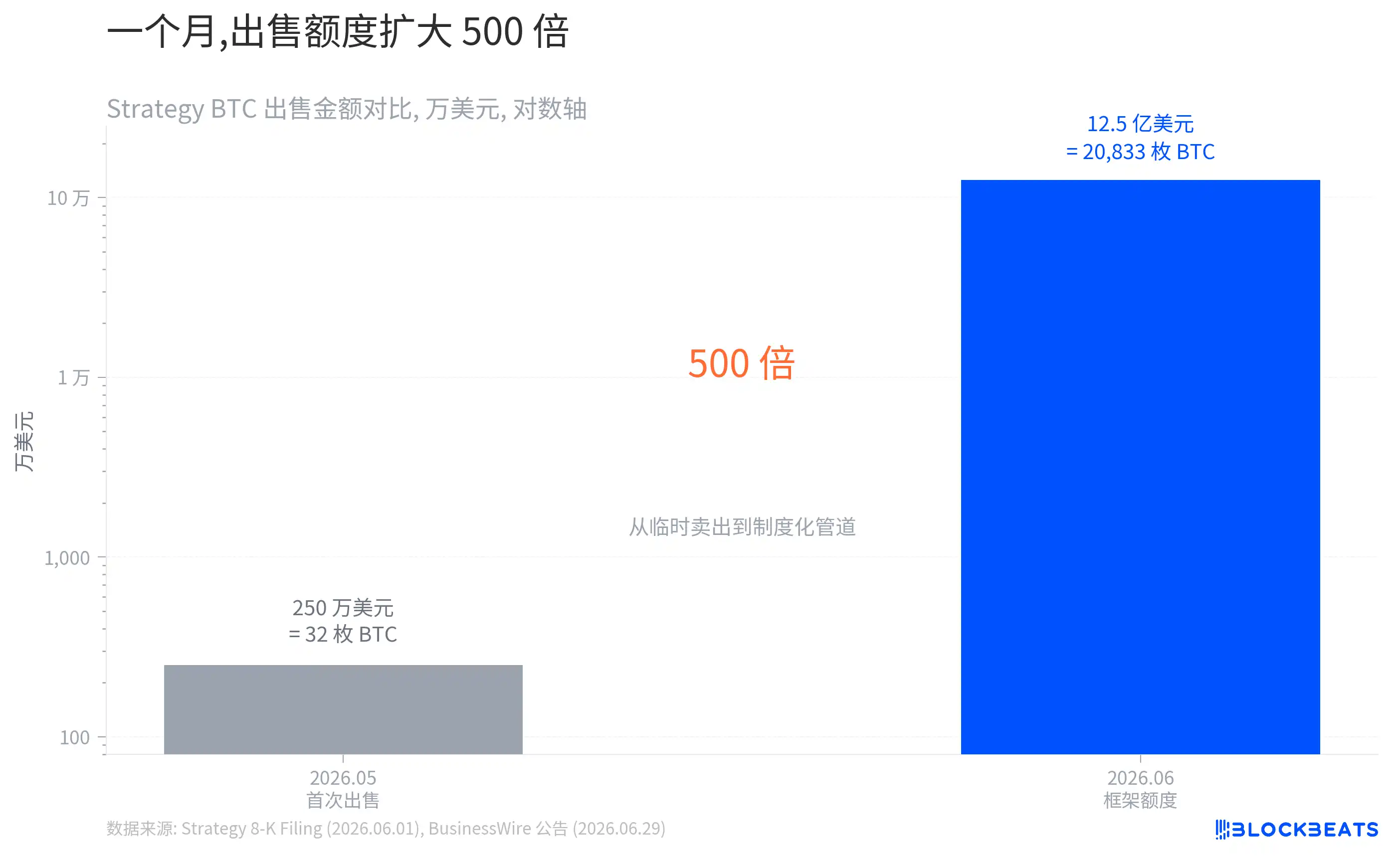
At the current price, this amount is roughly equivalent to 20,000 Bitcoin, about 2.5% of MicroStrategy's total holdings.

But the change in scale is superficial. The real transformation lies in the nature of the sales. According to MicroStrategy's 8-K filing, the May sale was characterized as "ad-hoc," meaning temporary or occasional. The new framework is an institutionalized pipeline, outlining four specific purposes: bolstering US dollar reserves, paying preferred stock dividends and interest, repurchasing its own preferred stock, and repurchasing MSTR common stock.

Selling Bitcoin is no longer an emergency measure; it has become part of the operational toolkit. MicroStrategy CEO Phong Le's wording in the announcement was direct, stating the company is moving "from a one-way capital issuance model to active capital management." From exception to institution took only a month. The question is, what is driving this shift behind the scenes?

Price Falls, Interest Rate Rises

The answer lies within MicroStrategy's largest preferred stock issue, STRC.

STRC is a perpetual preferred stock issued in July 2025 with a face value of $100. According to a BusinessWire announcement, the issuance size was approximately $8.5 billion, making it the largest single preferred stock issue globally. STRC features a unique mechanism where its dividend rate is not fixed but resets monthly. In theory, raising the rate can attract buyers and stabilize the price.

In practice, it has indeed been adjusting upward. According to dividend records on strcincome.com, STRC's rate increased from 9% to 12% within a year. Adjusted eight times in a year—roughly every six weeks—each hike means MicroStrategy pays a little more for this globally largest preferred stock.

But the rate hikes haven't stabilized the price; instead, it fell further. Data from stockanalysis.com shows STRC trading at $74.57, a discount of over 25% from its face value.

Related Reading: 《Can Income Investors Still Bottom-fish as STRC Drops Below $80?》
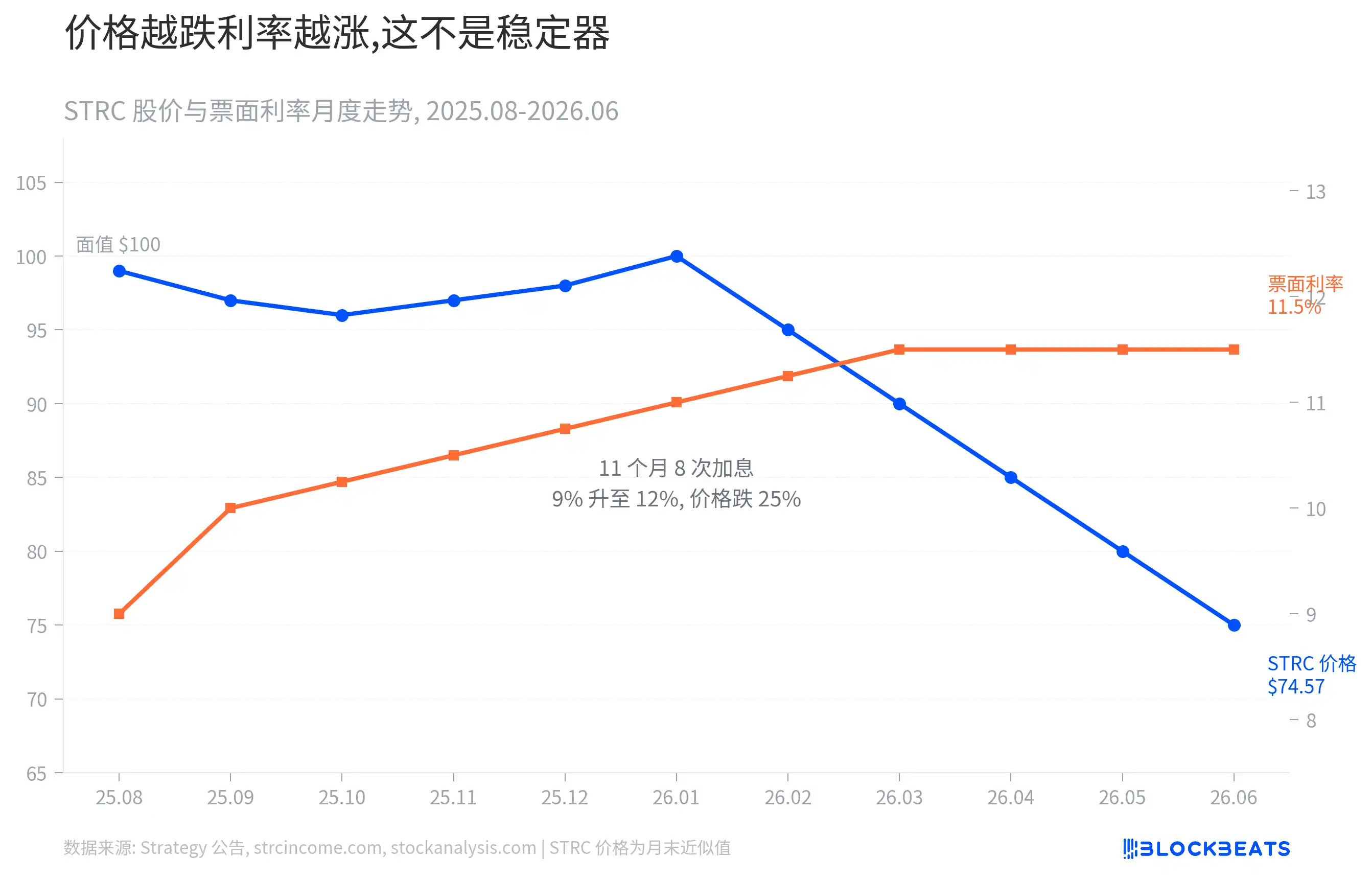
The scissors chart divergence in the image began accelerating at the start of 2026. Each rate increase means MicroStrategy pays more per share, while each price drop means the market doubts its ability to pay. Rate hikes, intended as a stabilizer, became an accelerator.

How expensive are these scissors? STRC's principal is $8.5 billion, with a current rate of 12%.

This single item implies an annualized dividend obligation exceeding $1 billion.

MicroStrategy also has three other preferred stock series—STRK, STRF, STRD—and approximately $6.7 billion in convertible notes. According to company announcements, the total capital structure's annualized fixed obligations reach $1.76 billion.

What does $1.76 billion represent? It's roughly equivalent to burning through $4.8 million per day.

According to the same announcement, MicroStrategy's dollar reserves stand at $2.55 billion. At the current burn rate, this would last about a year and a half. Adding the Bitcoin monetization capacity from the framework could extend the coverage to over two years.

This is the framework's raison d'être. It's not about panic-selling Bitcoin on the market; it's about providing an oxygen tube for an increasingly expensive capital structure.

What If the Price Falls Further?

How long the framework can sustain depends on Bitcoin's price. It's a simple yet brutal arithmetic problem.

At the current price, the framework's capacity would require selling about 20,000 Bitcoin, or 2.5% of total holdings. This proportion seems manageable. But as the chart below shows, the number of coins needed to be sold climbs rapidly as the price falls. If Bitcoin drops 40%, nearly double the amount would be needed to raise the same dollar sum.
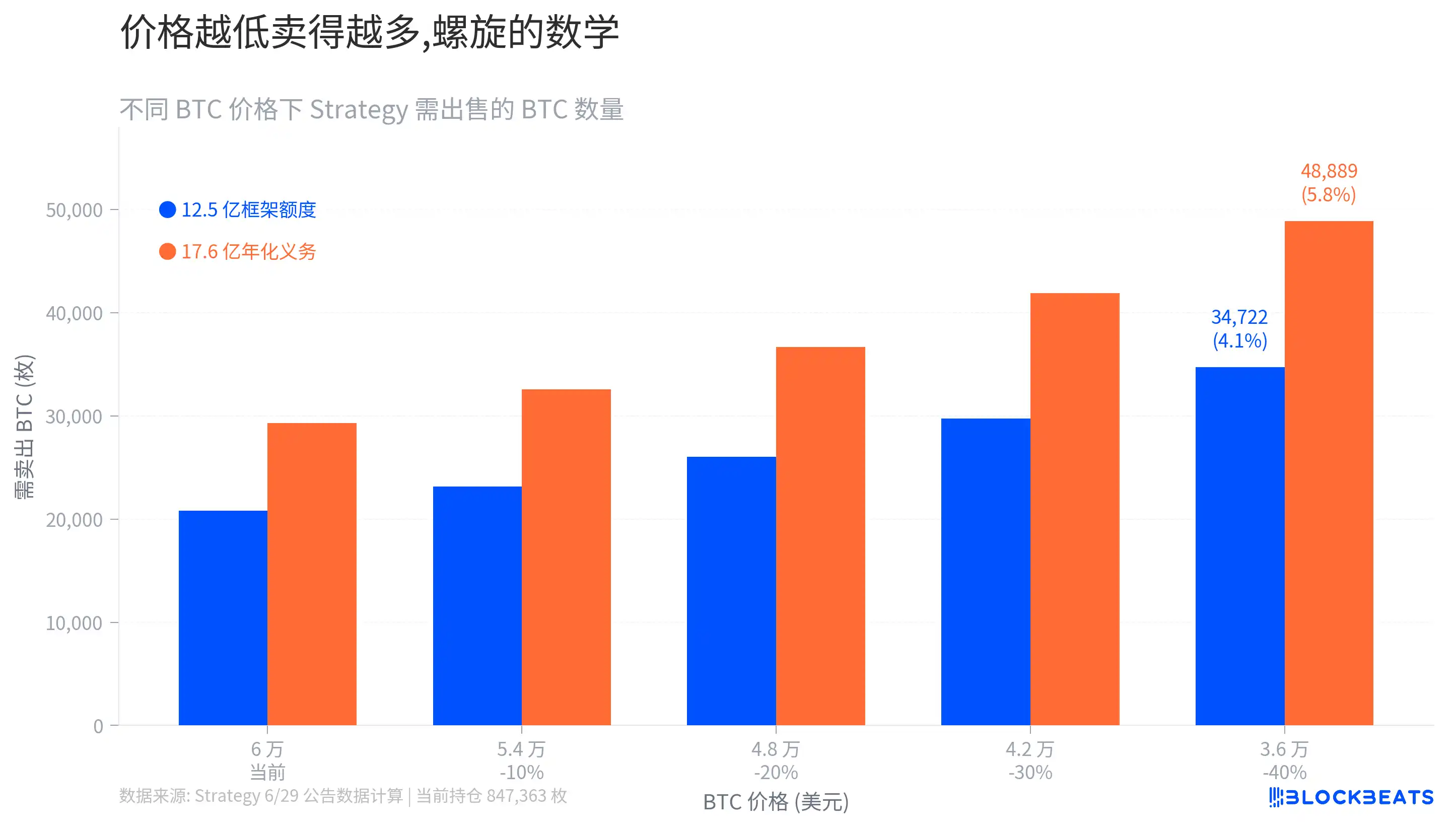
More noteworthy is the scenario beyond the framework. According to a VanEck analysis, if all annualized obligations had to be covered by selling Bitcoin, under the most extreme price assumptions, MicroStrategy would need to sell nearly 50,000 coins in a year, or 5.8% of its holdings.

This hides a self-reinforcing loop. A falling Bitcoin price would lower MSTR's asset net value (mNAV) multiple. According to a Trefis analysis, MSTR's current mNAV is approximately 0.64x, meaning the market values each dollar of MicroStrategy's Bitcoin at only 64 cents.

What does an mNAV below 1 mean? At this discount level, issuing stock at the market price (ATM offering) is equivalent to selling its own Bitcoin at a discount. According to analyses by multiple institutions, this channel, which was once MicroStrategy's primary financing avenue, is effectively frozen.

The remaining options are few. If dollar reserves dwindle and STRC's discount widens further, its rate would be forced higher. Higher rates increase annual obligations, which in turn could force MicroStrategy to sell more Bitcoin, creating more selling pressure and further depressing Bitcoin's price. Selling Bitcoin itself might not break this cycle; it could make it spin faster.

However, the 5.8% annual burn rate is the most extreme assumption. According to the announcement, MicroStrategy's reserves plus the framework capacity total $3.8 billion, sufficient to cover over two years of obligation payments. Large-scale Bitcoin sales are not needed in the short term.

The logic behind the market's 7% rise may lie here. Before the framework announcement, investors were pricing in a worse scenario—that MicroStrategy might be forced into disorderly Bitcoin sales or even fail to pay preferred dividends. The framework replaces panic with an institutionalized plan. According to analysis by Bohan Jiang, Senior Derivatives Trader at FalconX, the framework is "positive for both common and preferred shareholders."

But alleviating liquidity anxiety does not solve the structural problem. The $1.76 billion in annual obligations doesn't shrink because the framework exists, and STRC's rate is still 12%. If Bitcoin's price doesn't recover, the length of this oxygen tube is calculable.


Criptomoedas em alta

Perguntas relacionadas

QWhat is the core content of the new 'Digital Credit Capital Framework' announced by MicroStrategy, and why was its announcement seen as a market positive?

AThe core of MicroStrategy's new 'Digital Credit Capital Framework' is a provision allowing the company to sell up to $1.25 billion worth of Bitcoin. The market viewed it positively (MSTR pre-market rose ~7%) because it replaced the risk of a potential disorderly, panic-driven Bitcoin sell-off with a structured, pre-defined plan. This institutionalized 'oxygen line' provides liquidity certainty to cover fixed obligations for over two years, easing immediate investor anxiety.

QHow does the nature of the Bitcoin sale described in the June framework differ fundamentally from the 32 BTC sale in May?

AThe May sale of 32 BTC was an 'ad-hoc' or one-off, temporary action specifically to pay a preferred stock dividend. In contrast, the June framework establishes a permanent, institutionalized pipeline. It is not for emergency relief but is integrated as a part of 'active capital management,' with four defined purposes: bolstering dollar reserves, paying preferred dividends/interest, and repaying/buying back preferred and common stock.

QWhat is the main driver behind MicroStrategy's shift towards establishing a permanent Bitcoin sale pipeline according to the article?

AThe primary driver is the escalating financial pressure from MicroStrategy's capital structure, specifically the massive $8.5 billion STRC perpetual preferred stock. Its price has fallen over 25% below face value, while its floating monthly coupon rate has been repeatedly raised to 12% in an attempt to stabilize it. This 'scissors gap' of rising costs and falling asset value creates annual fixed obligations of $1.76 billion, burning approximately $4.8 million per day and necessitating a reliable liquidity source.

QWhat potential self-reinforcing negative cycle does the article describe concerning MicroStrategy's situation and Bitcoin price?

AThe article describes a vicious cycle: If Bitcoin's price falls, it lowers MicroStrategy's mNAV (market cap to Bitcoin NAV) ratio, currently at ~0.64x. This discount effectively freezes their primary fundraising tool (ATM equity offerings), as issuing new stock would mean selling their Bitcoin at a discount. To cover fixed obligations, they may need to sell more Bitcoin (per the framework), which could add selling pressure and further depress Bitcoin's price. Lower Bitcoin prices could also force further STRC coupon rate hikes, increasing annual costs and perpetuating the cycle.

QAccording to the article, what is the estimated coverage period provided by MicroStrategy's combined dollar reserves and the new Bitcoin sale framework?

AAccording to the article, MicroStrategy's $2.55 billion in dollar reserves, combined with the $1.25 billion framework allowance (totaling $3.8 billion), is sufficient to cover the company's fixed annual obligations for over two years. This means a large-scale, forced sale of Bitcoin is not an immediate concern in the short term, which contributed to the positive market reaction.

Leituras Relacionadas

South Korea Reaps Riches, America Turns Hostile

The US has filed a collective antitrust lawsuit in California against Samsung, SK Hynix, and US-based Micron, alleging they colluded to create a "RAMpocalypse" by slashing traditional DRAM production and raising prices 700% over four years amid the AI boom. This lawsuit targets the heart of the AI supply chain: High Bandwidth Memory (HBM), critical for Nvidia's GPUs. Currently, SK Hynix (57%), Samsung (22%), and Micron (21%) dominate global HBM production. The case highlights a deeper US concern: in the AI era, South Korea, through its HBM dominance, is capturing an estimated 35% of global AI profits, second only to the US (49%). SK Hynix's operating profit margin recently hit a record 72%. In response to the lawsuit, South Korea announced a massive $800 trillion won investment to build four new chip plants, doubling down on its strategic position. Analysts see the lawsuit not merely as a consumer price issue but as strategic pressure. It aims to support Micron's US manufacturing expansion (subsidized by the CHIPS Act) and secure America's share of AI profits by bringing more HBM production onshore. However, South Korea's rapid execution and massive cash flow from current HBM sales give it a significant speed advantage over US build-out timelines. The conflict underscores a fundamental shift: AI infrastructure like GPUs and HBM is becoming a new form of strategic national resource, akin to oil. While Nvidia and Korean memory giants are interdependent, the struggle over profit distribution and industrial sovereignty in this new landscape is just beginning. This lawsuit may be the first major skirmish in the AI resource wars.

marsbitHá 3m

South Korea Reaps Riches, America Turns Hostile

marsbitHá 3m

AAVE Rallies 30% in a Week, Is It Back on Track?

Over the past week, the price of AAVE surged from around $70 to nearly $100, a rebound exceeding 30%. This occurred despite Aave's TVL continuing to decline following the Kelp DAO security incident. The price movement was partly driven by market rumors, first reported by CoinDesk, that Kraken was negotiating to acquire a stake in Aave. While Aave founder Stani Kulechov denied the specific terms, he confirmed discussions with multiple parties about purchasing Aave Labs' AAVE tokens. He also revealed ongoing work on Tokenomics 3.0, featuring an automated buyback mechanism, and plans to expand into securities-backed lending. Analysts remain optimistic about Aave's long-term prospects. Standard Chartered gave an extremely bullish $3,500 price target for 2030, citing DeFi revival and RWA tokenization. Grayscale offered a more conservative one-year target of $175. However, competitors like Morpho are gaining traction, with recent reports highlighting its advantages in capital efficiency and customization. Morpho also secured a massive $175 million funding round. Fundamentally, Aave maintains its dominance as the leading DeFi lending protocol. Its TVL is nearly double that of second-place Morpho and rivals the combined total of the next several competitors. Key metrics like active borrowing, total supply, and revenue significantly outpace rivals. While Aave faces challenges from newer, more flexible protocols, its deep liquidity and established position make it a preferred choice for large, yield-seeking users. The article concludes that despite setbacks, Aave's long-tested protocol merits ongoing attention in a market with increasingly scarce quality projects.

Foresight NewsHá 40m

AAVE Rallies 30% in a Week, Is It Back on Track?

Foresight NewsHá 40m

Real-life 'Black Mirror' Pumpfun Go: 40 Yuan to Lick Toilets, 14,000 USD for a Logo Tattoo on the Forehead

The article discusses the controversial new platform "Pumpfun Go," a bounty task platform launched by the meme coin platform Pump.fun. Its slogan is "Pay anyone to do anything." The platform allows users to anonymously post tasks with cryptocurrency rewards, which are held in escrow until completion and verification. The piece highlights extreme and disturbing tasks that have gained notoriety, such as licking a gas station toilet floor for roughly $5.63, eating live insects, getting a company logo tattooed on one's forehead for $14,000, and even a now-removed $700,000 bounty for suicide. These tasks are often linked to promoting specific meme coins by generating shocking, attention-grabbing content. While some tasks involve community-building or charity, critics, including New York Governor Kathy Hochul, condemn the platform for exploiting economic desperation and encouraging humiliating or dangerous behavior. They argue it mirrors dystopian narratives from shows like "Black Mirror" and movies like "Nerve," where online dares escalate for viewers' entertainment. Supporters and some participants counter that the platform provides much-needed income opportunities for the financially struggling. One user claimed the bounty money far exceeded his monthly salary. The article concludes by questioning the morality of a system where the wealthy pay for spectacle and the poor trade dignity for survival, reflecting a long history of public consumption of others' suffering. It suggests hope may lie in future technological abundance freeing people from such desperate choices.

marsbitHá 1h

Real-life 'Black Mirror' Pumpfun Go: 40 Yuan to Lick Toilets, 14,000 USD for a Logo Tattoo on the Forehead

marsbitHá 1h

Trading

Spot

Artigos em Destaque

O que é BITCOIN

Compreender o HarryPotterObamaSonic10Inu (ERC-20) e a Sua Posição no Espaço Cripto Nos últimos anos, o mercado de criptomoedas assistiu a um aumento na popularidade das moedas meme, cativando não apenas os traders, mas também aqueles que procuram envolvimento comunitário e valor de entretenimento. Entre estes tokens únicos está o HarryPotterObamaSonic10Inu (ERC-20), um projeto intrigante que mistura referências culturais no tecido das criptomoedas. Este artigo explora os principais aspetos do HarryPotterObamaSonic10Inu, examinando os seus mecanismos, a sua ética orientada pela comunidade e o seu envolvimento com o vasto panorama cripto. O que é o HarryPotterObamaSonic10Inu (ERC-20)? Como o nome sugere, o HarryPotterObamaSonic10Inu é uma moeda meme construída na blockchain Ethereum, classificada sob o padrão ERC-20. Ao contrário das criptomoedas tradicionais, que podem enfatizar a utilidade prática ou o potencial de investimento, este token prospera no valor de entretenimento e na força da sua comunidade. O projeto visa promover um ambiente onde utilizadores envolvidos possam reunir-se, partilhar ideias e participar em atividades inspiradas por diversos fenómenos culturais. Uma característica notável do HarryPotterObamaSonic10Inu é a zero taxa sobre transações. Este elemento atraente visa encorajar a negociação e o envolvimento da comunidade, isento de encargos adicionais que podem desencorajar os traders de pequena escala. A oferta total da moeda está fixada em mil milhões de tokens, uma cifra que marca a sua intenção de manter uma circulação substancial dentro da comunidade. Criador do HarryPotterObamaSonic10Inu (ERC-20) As origens do HarryPotterObamaSonic10Inu estão um pouco envoltas em mistério; os detalhes sobre o criador permanecem desconhecidos. O desenvolvimento deste token carece de uma equipa identificável ou de um plano explícito, o que não é raro no setor das moedas meme. Em vez disso, o projeto surgiu de forma orgânica, com o seu progresso a depender fortemente do entusiasmo e da participação da sua comunidade. Investidores do HarryPotterObamaSonic10Inu (ERC-20) No que diz respeito a investimentos externos e apoios, o HarryPotterObamaSonic10Inu também permanece ambíguo. O token não lista quaisquer fundações de investimento conhecidas ou apoio organizacional significativo. Em vez disso, o “sangue vital” do projeto é a sua comunidade de base, que informa o seu crescimento e sustentabilidade através da ação coletiva e do envolvimento no espaço cripto. Como Funciona o HarryPotterObamaSonic10Inu (ERC-20)? Como uma moeda meme, o HarryPotterObamaSonic10Inu opera principalmente fora dos quadros tradicionais que muitas vezes governam o valor dos ativos. Existem vários aspetos distintivos que definem como o projeto funciona: Transações Sem Taxas: Sem taxas sobre transações, os utilizadores podem comprar e vender o token livremente, sem a preocupação de custos ocultos. Envolvimento da Comunidade: O projeto prospera na interação da comunidade, aproveitando plataformas de redes sociais para criar entusiasmo e facilitar a participação. Discussões, partilha de conteúdo e envolvimento são elementos cruciais que ajudam a expandir o seu alcance e a fomentar a lealdade entre os apoiantes. Sem Utilidade Prática: Deve ser notado que o HarryPotterObamaSonic10Inu não oferece utilidade concreta dentro do ecossistema financeiro. Em vez disso, é classificado como um token principalmente para entretenimento e atividades comunitárias. Referência Cultural: O token incorpora de forma inteligente elementos da cultura popular para atrair interesse, conectando-se tanto com entusiastas de memes como com seguidores de criptomoedas. HarryPotterObamaSonic10Inu exemplifica como as moedas meme operam de forma diferente de projetos de criptomoedas mais tradicionais, entrando no mercado como construções sociais inovadoras em vez de ativos utilitários. Linha do Tempo do HarryPotterObamaSonic10Inu (ERC-20) A história do HarryPotterObamaSonic10Inu é marcada por vários marcos notáveis: Criação: O token surgiu de um meme viral, capturando a imaginação de muitos entusiastas de criptomoedas. Datas específicas de criação não estão disponíveis, sublinhando a sua ascensão orgânica. Listagem em Exchanges: O HarryPotterObamaSonic10Inu conseguiu entrar em várias exchanges, permitindo um acesso e negociação mais fáceis pela comunidade. Iniciativas de Envolvimento da Comunidade: Atividades contínuas direcionadas a melhorar a interação comunitária, incluindo concursos, campanhas em redes sociais e geração de conteúdo por fãs e defensores. Planos de Expansão Futura: O roteiro do projeto inclui o lançamento de uma coleção de NFTs, mercadorias e um site de eCommerce relacionado aos seus temas culturais, envolvendo ainda mais a comunidade e tentando adicionar mais dimensões ao seu ecossistema. Pontos-Chave sobre o HarryPotterObamaSonic10Inu (ERC-20) Natureza Orientada pela Comunidade: O projeto prioriza a contribuição coletiva e a criatividade, assegurando que o envolvimento dos utilizadores está na vanguarda do seu desenvolvimento. Classificação como Moeda Meme: Representa o epítome da criptomoeda baseada em entretenimento, destacando-se dos veículos de investimento tradicionais. Sem Afiliação Direta com o Bitcoin: Apesar da semelhança no nome do ticker, o HarryPotterObamaSonic10Inu é distinto e não tem qualquer relação com o Bitcoin ou outras criptomoedas estabelecidas. Foco na Colaboração: O HarryPotterObamaSonic10Inu é projetado para criar um espaço de colaboração e partilha de histórias entre os seus detentores, proporcionando uma via para a criatividade e o fortalecimento da comunidade. Perspectivas Futuras: A ambição de expandir além da sua premissa inicial para NFTs e mercadorias delineia um caminho para o projeto potencialmente entrar em avenidas mais mainstream dentro da cultura digital. À medida que as moedas meme continuam a capturar a imaginação da comunidade cripto, HarryPotterObamaSonic10Inu (ERC-20) destaca-se devido aos seus laços culturais e abordagem centrada na comunidade. Embora possa não se encaixar no molde típico de um token orientado para utilidade, a sua essência reside na alegria e camaradagem fomentadas entre os seus apoiantes, destacando a natureza em evolução das criptomoedas em uma era cada vez mais digital. À medida que o projeto continua a desenvolver-se, será importante observar como as dinâmicas comunitárias influenciam a sua trajetória no panorama em constante mudança da tecnologia blockchain.

1.7k Visualizações TotaisPublicado em {updateTime}Atualizado em 2024.12.03

O que é BITCOIN

Como comprar BTC

Bem-vindo à HTX.com!Tornámos a compra de Bitcoin (BTC) simples e conveniente.Segue o nosso guia passo a passo para iniciar a tua jornada no mundo das criptos.Passo 1: cria a tua conta HTXUtiliza o teu e-mail ou número de telefone para te inscreveres numa conta gratuita na HTX.Desfruta de um processo de inscrição sem complicações e desbloqueia todas as funcionalidades.Obter a minha contaPasso 2: vai para Comprar Cripto e escolhe o teu método de pagamentoCartão de crédito/débito: usa o teu visa ou mastercard para comprar Bitcoin (BTC) instantaneamente.Saldo: usa os fundos da tua conta HTX para transacionar sem problemas.Terceiros: adicionamos métodos de pagamento populares, como Google Pay e Apple Pay, para aumentar a conveniência.P2P: transaciona diretamente com outros utilizadores na HTX.Mercado de balcão (OTC): oferecemos serviços personalizados e taxas de câmbio competitivas para os traders.Passo 3: armazena teu Bitcoin (BTC)Depois de comprar o teu Bitcoin (BTC), armazena-o na tua conta HTX.Alternativamente, podes enviá-lo para outro lugar através de transferência blockchain ou usá-lo para transacionar outras criptomoedas.Passo 4: transaciona Bitcoin (BTC)Transaciona facilmente Bitcoin (BTC) no mercado à vista da HTX.Acede simplesmente à tua conta, seleciona o teu par de trading, executa as tuas transações e monitoriza em tempo real.Oferecemos uma experiência de fácil utilização tanto para principiantes como para traders experientes.

4.2k Visualizações TotaisPublicado em {updateTime}Atualizado em 2026.06.02

Como comprar BTC

O que é $BITCOIN

OURO DIGITAL ($BITCOIN): Uma Análise Abrangente Introdução ao OURO DIGITAL ($BITCOIN) OURO DIGITAL ($BITCOIN) é um projeto baseado em blockchain que opera na rede Solana, com o objetivo de combinar as características dos metais preciosos tradicionais com a inovação das tecnologias descentralizadas. Embora partilhe um nome com o Bitcoin, frequentemente referido como “ouro digital” devido à sua percepção como uma reserva de valor, o OURO DIGITAL é um token separado projetado para criar um ecossistema único dentro da paisagem Web3. O seu objetivo é posicionar-se como um ativo digital alternativo viável, embora os detalhes sobre as suas aplicações e funcionalidades ainda estejam em desenvolvimento. O que é o OURO DIGITAL ($BITCOIN)? OURO DIGITAL ($BITCOIN) é um token de criptomoeda explicitamente projetado para uso na blockchain Solana. Em contraste com o Bitcoin, que fornece um papel amplamente reconhecido como armazenamento de valor, este token parece focar em aplicações e características mais amplas. Aspectos notáveis incluem: Infraestrutura Blockchain: O token é construído na blockchain Solana, conhecida pela sua capacidade de lidar com transações de alta velocidade e baixo custo. Dinâmicas de Oferta: O OURO DIGITAL tem um fornecimento máximo limitado a 100 quatrilhões de tokens (100P $BITCOIN), embora os detalhes sobre o seu fornecimento circulante ainda não tenham sido divulgados. Utilidade: Embora as funcionalidades precisas não estejam explicitamente delineadas, existem indicações de que o token poderia ser utilizado para várias aplicações, potencialmente envolvendo aplicações descentralizadas (dApps) ou estratégias de tokenização de ativos. Quem é o Criador do OURO DIGITAL ($BITCOIN)? Neste momento, a identidade dos criadores e da equipa de desenvolvimento por trás do OURO DIGITAL ($BITCOIN) permanece desconhecida. Esta situação é típica entre muitos projetos inovadores no espaço da blockchain, particularmente aqueles alinhados com finanças descentralizadas e fenómenos de moedas meme. Embora tal anonimato possa fomentar uma cultura orientada pela comunidade, intensifica as preocupações sobre governança e responsabilidade. Quem são os Investidores do OURO DIGITAL ($BITCOIN)? As informações disponíveis indicam que o OURO DIGITAL ($BITCOIN) não tem apoiantes institucionais conhecidos ou investimentos proeminentes de capital de risco. O projeto parece operar num modelo peer-to-peer focado no apoio e adoção da comunidade, em vez de rotas de financiamento tradicionais. A sua atividade e liquidez estão principalmente situadas em exchanges descentralizadas (DEXs), como a PumpSwap, em vez de plataformas de negociação centralizadas estabelecidas, destacando ainda mais a sua abordagem de base. Como Funciona o OURO DIGITAL ($BITCOIN) A mecânica operacional do OURO DIGITAL ($BITCOIN) pode ser elaborada com base no seu design de blockchain e nas características da rede: Mecanismo de Consenso: Ao aproveitar o exclusivo proof-of-history (PoH) da Solana combinado com um modelo de proof-of-stake (PoS), o projeto assegura uma validação eficiente das transações, contribuindo para o alto desempenho da rede. Tokenomics: Embora mecanismos deflacionários específicos não tenham sido extensivamente detalhados, o vasto fornecimento máximo de tokens implica que pode atender a microtransações ou casos de uso de nicho que ainda estão por definir. Interoperabilidade: Existe o potencial para integração com o ecossistema mais amplo da Solana, incluindo várias plataformas de finanças descentralizadas (DeFi). No entanto, os detalhes sobre integrações específicas permanecem não especificados. Cronologia de Eventos Chave Aqui está uma cronologia que destaca marcos significativos relacionados ao OURO DIGITAL ($BITCOIN): 2023: O lançamento inicial do token ocorre na blockchain Solana, marcado pelo seu endereço de contrato. 2024: O OURO DIGITAL ganha visibilidade ao tornar-se disponível para negociação em exchanges descentralizadas como a PumpSwap, permitindo que os utilizadores o negociem contra SOL. 2025: O projeto testemunha atividade de negociação esporádica e potencial interesse em envolvimentos liderados pela comunidade, embora não tenham sido documentadas parcerias ou avanços técnicos notáveis até ao momento. Análise Crítica Forças Escalabilidade: A infraestrutura subjacente da Solana suporta altos volumes de transações, o que pode aumentar a utilidade do $BITCOIN em vários cenários de transação. Acessibilidade: O potencial preço de negociação baixo por token pode atrair investidores de retalho, facilitando uma participação mais ampla devido a oportunidades de propriedade fracionada. Riscos Falta de Transparência: A ausência de apoiantes, desenvolvedores ou um processo de auditoria publicamente conhecidos pode gerar ceticismo em relação à sustentabilidade e confiabilidade do projeto. Volatilidade do Mercado: A atividade de negociação depende fortemente do comportamento especulativo, o que pode resultar em volatilidade significativa dos preços e incerteza para os investidores. Conclusão O OURO DIGITAL ($BITCOIN) surge como um projeto intrigante, mas ambíguo, dentro do ecossistema em rápida evolução da Solana. Embora tente aproveitar a narrativa do “ouro digital”, a sua divergência do papel estabelecido do Bitcoin como reserva de valor sublinha a necessidade de uma diferenciação mais clara da sua utilidade pretendida e estrutura de governança. A aceitação e adoção futuras dependerão provavelmente da abordagem da atual opacidade e da definição mais explícita das suas estratégias operacionais e económicas. Nota: Este relatório abrange informações sintetizadas disponíveis até outubro de 2023, e desenvolvimentos podem ter ocorrido além do período de pesquisa.

107 Visualizações TotaisPublicado em {updateTime}Atualizado em 2025.05.13

O que é $BITCOIN

Discussões

Bem-vindo à Comunidade HTX. Aqui, pode manter-se informado sobre os mais recentes desenvolvimentos da plataforma e obter acesso a análises profissionais de mercado. As opiniões dos utilizadores sobre o preço de BTC (BTC) são apresentadas abaixo.

活动图片