Report Interpretation: J.P. Morgan Details Micron's Pre-Earnings Sentiment, Current Hardware Sector Dynamics

marsbitPublicado em 2026-06-22Última atualização em 2026-06-22

Resumo

Morgan Stanley analyst Joshua Meyers' report (June 21, 2026) highlights key trends in the hardware and semiconductor sector ahead of Micron's earnings. The core takeaways are: 1. **Micron & Memory:** Memory remains a high-conviction long theme, driven by strong AI demand and rising ASPs. However, investor focus is shifting to the sustainability of Micron's >80% gross margins and the specifics of potential new long-term supply agreements (SCAs). 2. **Hardware Supply Chain:** AI-related demand for servers, networking, and storage remains robust, but company performance is diverging. Celestica (CLS) shows improved margin confidence, Western Digital and Seagate benefit from pricing, Fabrinet (FN) sees predictable AI optics growth, and Teradyne (TER) anticipates a new Google customer. 3. **AI Capex & WFE Forecasts:** JPMorgan increased its Wafer Fab Equipment (WFE) market growth forecasts to 28% in 2026 and 29% in 2027. AI infrastructure financing is evolving, with higher project-level debt reducing constraints on capex expansion. The report signals that while the AI-driven hardware cycle is strong, the market is entering a phase focused on execution verification (e.g., Micron's SCA details, Fabrinet's ramp with Amazon) and valuation sustainability. Key near-term signals include Micron's guidance, Arista Networks' outlook, and the pace of demand normalization post potential tariff-related pull-ins.

Written by: TideResearch

Author: Rita

TideResearch Insights

J.P. Morgan expert Joshua Meyers released a report on June 21, synthesizing findings from a survey of buyer sentiment ahead of Micron's earnings, feedback from pre-earnings checks with hardware companies, updated AI capital expenditure forecasts, and key developments for several major companies. The core message conveyed in the report: The memory sector where Micron operates remains the most consensus-driven long position within the AI segment, but the sustainability of high gross margins and valuation methodologies are sparking discussion. Within the hardware supply chain, AI-related demand for servers, networking, and storage remains robust, but divergence is emerging among individual stocks. Suitable for investors tracking the U.S. stock hardware and semiconductor sectors.

Three Key Takeaways

1 Buyer sentiment remains strong ahead of Micron's earnings, but two issues are simmering.

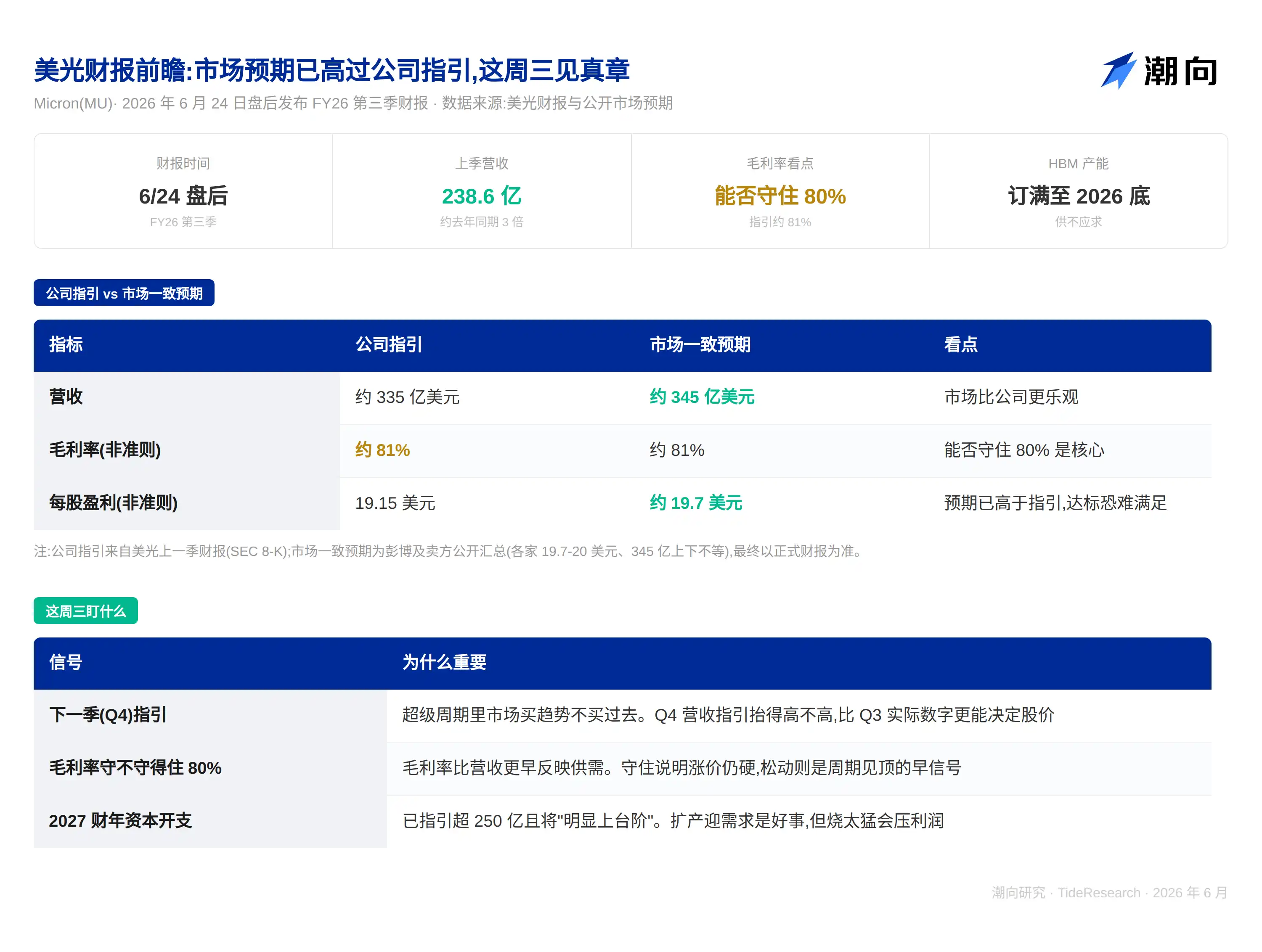
Meyers notes that memory is one of the most consensus-driven long positions in the tech sector and across the broader market. AI demand continues to improve, recently buoyed by unexpected growth in demand for agent CPUs, and the average selling price (ASP) has been ticking up with each industry survey. Demand has indeed been somewhat disrupted, but supply-side responses remain relatively measured. The market generally expects Micron to announce more Supply Commitment Agreements (SCAs) in this earnings report, with roughly 75% of surveyed buyers anticipating new contracts. The market's focus is on: Micron's gross margins have exceeded 80%, sparking debate; how the company views the room for AI applications to further drive ASPs; and the level of detail that can be disclosed regarding the specific terms of the long-term agreements.
2 Pre-earnings checks with the hardware supply chain: AI-related demand robust, clear stock divergence.

Meyers summarizes pre-quarter communications with hardware and networking equipment companies. Celestica's (CLS) margin outlook has improved, showing greater confidence in AI networking projects. Western Digital and Seagate benefit from continued pricing improvements, with no need to concede pricing during product generation transitions in a supply-constrained environment. Fabrinet's (FN) visibility on growth in its AI optical module business has increased, with Amazon-related products starting to contribute revenue this quarter and gradually ramping up. Teradyne's (TER) revenue is expected to decline sequentially in the second half of the year, but Google is likely to become a new VIP compute customer by year-end, representing a significant incremental contributor for the following year.

3 AI capital expenditure forecasts raised again, 2027 WFE market growth seen at 29%.

J.P. Morgan's global semiconductor team has raised its 2026 Wafer Fab Equipment (WFE) market growth forecast from 21% to 28% (equivalent to $155 billion) and its 2027 forecast from 18% to 29% (equivalent to $200 billion). DRAM, TSMC, Intel Foundry, and Samsung Foundry are the primary sources of the increase. The investment and financing model for AI infrastructure is also evolving, with the debt financing proportion at the project level having risen to over 85%. Considering that the market value of projects post-construction significantly exceeds their build cost, the actual loan-to-value (LTV) ratio is only about 60%, indicating that financing constraints on the expansion of AI capital expenditures are weakening.

The Supply Chain Signal Behind Celestica's Improving Margins

Among the pre-quarter communications with the hardware supply chain, Celestica's (CLS) feedback deserves special attention.

Meyers points out that Celestica had previously expressed concerns about Tomahawk (Broadcom switch chip) pricing, but its tone was noticeably more positive during this communication. The company is more confident in its ability to pass on costs through price increases and is also vying for more rack-based AI networking projects, which offer thicker margins. The market expects its FY26 operating margins to continue expanding, possibly by 10 to 20 basis points. The outlook for FY27 is even more optimistic, with the potential for stable margins combined with operating leverage to prompt more positive guidance in the next earnings report.

Regarding AI chip supply, Celestica works with both Broadcom and MediaTek, and its confidence in the supply chain is markedly stronger than that of Arista Networks, as hyperscale customers are receiving higher supply priority. This signal suggests that demand dynamics for AI networking equipment are still consolidating around leading suppliers, with supply chain allocation capabilities becoming a competitive moat.

Short-Term Focus on Earnings Validation, Long-Term Focus on Valuation Anchors

Micron's earnings report is the most immediate catalyst. Market consensus has largely priced in a strong quarter. The real variable lies in the level of detail provided about long-term agreement disclosures. If the coverage ratio of SCAs allows the market to gain clarity on future revenue visibility, Micron's valuation logic could undergo further reshaping.

Another key variable for the hardware sector is the pace of demand. Distributors like CDW report that a significant portion of the current robust demand for servers and networking equipment stems from customers placing advance orders due to concerns about potential further tariff hikes. How long this pull-forward demand can persist is the biggest uncertainty for the hardware sector in the second half of the year.

Three Signals to Track:

The level of detail in Micron's SCA disclosures and its gross margin outlook. Whether Arista Networks can raise its full-year guidance in its next earnings report. Whether Fabrinet's Amazon optical module revenue can ramp up as expected to $250 million per quarter within a year.

Disclaimer

This article is TideResearch's compilation and interpretation of a third-party brokerage research report. The ratings, price targets, earnings forecasts, and related judgments cited herein represent the views of that brokerage's analyst, reflecting solely the position of their affiliated institution. They do not represent TideResearch's views and do not constitute any investment advice.

Please note three points while reading: First, price targets are analysts' expectations for approximately the next 12 months; they are predictions, not promises, and will be adjusted repeatedly based on performance and market conditions. Second, sell-side research reports inherently lean bullish, and some covered companies may have investment banking relationships with the brokerage. Third, the value of a research report lies in its core logic and underlying assumptions, not solely in a specific price target. Focus on the logic, not just the price.

The market carries risks; decisions should be made independently. This article should not be used as the basis for trading any securities.

Data source: J.P. Morgan Research Report (Joshua Meyers et al., June 21, 2026) · Company public disclosures

TideResearch · June 2026

Perguntas relacionadas

QWhat are the three key conclusions from J.P. Morgan's report regarding Micron and the hardware sector?

A1. Strong bullish sentiment on Micron ahead of earnings, but questions are emerging about the sustainability of high gross margins (over 80%) and the details of potential long-term agreements (SCAs). 2. AI-related demand in the hardware supply chain remains robust, but performance is diverging among individual companies (e.g., Celestica, Western Digital, Seagate, Fabrinet, Teradyne). 3. AI capital expenditure forecasts have been raised again, with the wafer fabrication equipment (WFE) market expected to grow 28% in 2026 and 29% in 2027. The financing model for AI infrastructure is also evolving, easing constraints on capex expansion.

QWhat signals regarding the AI hardware supply chain can be drawn from Celestica's (CLS) improved margin outlook?

ACelestica's improved confidence in passing on costs (like Tomahawk chip pricing) and securing more rack-based AI networking projects (which offer better margins) signals a strengthening position for leading suppliers. Their stronger supply chain confidence compared to Arista Networks also suggests that supply allocation capabilities are becoming a competitive moat, with hyperscale customers getting priority.

QWhat is a key uncertainty for the hardware sector in the second half of the year, according to the report?

AA key uncertainty is the duration of the current strong demand for servers and networking equipment. Distributor feedback (e.g., from CDW) indicates that a significant portion of this demand is due to customers placing orders early to avoid potential tariff-related price increases. How long this front-loaded demand can last is the sector's biggest uncertainty for H2.

QWhat are the three specific signals the report suggests investors should track?

A1. The level of detail disclosed in Micron's earnings regarding its long-term agreements (SCAs) and its gross margin outlook. 2. Whether Arista Networks can raise its full-year guidance in its next earnings report. 3. Whether Fabrinet's revenue from Amazon optical modules can ramp up as expected to $250 million per quarter within a year.

QAccording to the report, what is the primary catalyst for Micron and what could reshape its valuation logic?

AMicron's upcoming earnings report is the most immediate catalyst. The key variable is the detailed disclosure of its long-term supply and capacity agreements (SCAs). If the coverage and terms of these SCAs provide clear visibility into future revenue, it could significantly reshape Micron's valuation logic by offering more predictable, contracted income streams.

Leituras Relacionadas

Research Report Analysis: The Fed's New Chair's Debut – New Leader, But Same Script?

Report Analysis: Federal Reserve's New Chair Debut – A New Captain, But the Same Script? Morgan Stanley's chief global economist Seth B. Carpenter analyzes the first FOMC meeting under new Fed Chair Kevin Warsh in a June 21 report. Warsh deliberately avoided providing forward guidance on interest rates, aligning with his philosophy. However, market expectations for a rate hike this year were reinforced. Key signals lie elsewhere: inflation may fall more than expected, and quantitative tightening (QT) could be more aggressive than anticipated. The FOMC's "dot plot" suggests only one rate hike in 2026. Carpenter argues that if inflation undershoots forecasts, the logic for even a single hike weakens, especially as projections indicate potential rate cuts in 2027. On QT, Warsh's stance is clear. Carpenter notes that measures like halving the Treasury's account balance could shrink the Fed's balance sheet by around $500 billion with minimal market impact. Combined with adjustments to reserve interest and liquidity rules, the ultimate QT scale may exceed expectations, though its market effect might be less disruptive unless the Fed actively sells Mortgage-Backed Securities (MBS). While Warsh initiated a review of the Fed's policy framework, the 2% inflation target remains intact for now. The report concludes that the market may be overestimating the significance of reduced forward guidance and the near-term rate hike risk, while potentially underestimating the scope and manageable nature of the coming balance sheet reduction. The key debates will hinge on upcoming core PCE data, the specifics of the QT path, and the framework review's findings.

marsbitHá 3h

Research Report Analysis: The Fed's New Chair's Debut – New Leader, But Same Script?

marsbitHá 3h

Critical Game Week: BTC Retracement Confirmation vs. HYPE Support Battle | Guest Analysis

This weekly analysis outlines a critical juncture for BTC and HYPE markets, focusing on key price level confirmations. **BTC Analysis:** BTC is at a pivotal point after a five-wave rally from the June 5th low of $59,100. The price has broken below a short-term rising channel's lower boundary, with the current move seen as a pullback to test this breakdown. Failure to reclaim this level could lead to a retest of the $59,000-$60,000 support zone. The core scenario hinges on this channel retest outcome. * **Key Levels:** Resistance at $64,500-$65,000 (channel boundary) and $69,500-$70,500. Support at $59,000-$60,000 and $55,000. * **Strategy:** A core bearish stance is maintained (20% short from last week), with short-term plans for tactical trades. Three detailed contingency plans (A/B/C) are provided for short positions on resistance tests or breakdowns, emphasizing strict stop-loss discipline. **HYPE Analysis:** HYPE shows strong momentum but is currently in a corrective phase after hitting a new high of $76.94. The price is retesting the crucial $64-$66 support area. * **Key Levels:** Resistance near $77 and $80-$82. Support at $64-$66 and $52-$54. * **Strategy:** The short-term approach is "buy on dips, avoid chasing rallies." A long position is considered only if clear stabilization signals appear at the $64-$66 or deeper $52-$54 support zones, with tight risk controls. **General Risk Management:** A standardized trailing stop-loss protocol is emphasized: set initial stop, breakeven at +1% profit, then trail stops upward to lock in gains. *Disclaimer: All analysis is presented as a personal trading framework, not investment advice. Market conditions are complex and require dynamic adjustment.*

marsbitHá 3h

Critical Game Week: BTC Retracement Confirmation vs. HYPE Support Battle | Guest Analysis

marsbitHá 3h

Research Report Interpretation: Citi Attends AWS Summit, Bullish on Cloud Business Acceleration but Data Governance Remains Key Variable

Citi analyst Tyler Radke's team attended the AWS New York Summit (June 17-18), engaging with over 10 clients and partners. In a June 19 report, they highlighted the summit's focus on scaling agent AI for enterprise deployment. Citi maintains a "Buy" rating on Amazon, forecasting AWS revenue growth to accelerate to 37% in FY27 from 30% in FY26, noting this estimate may be conservative. Key takeaways: 1. **AWS Strategy Shift:** AWS is moving from proof-of-concepts to scalable deployment. New offerings like AWS Context (building enterprise knowledge graphs), Amazon Quick (cross-application AI assistant), and security tool Continuum address core enterprise pain points for AI adoption. 2. **Data Infrastructure Beneficiaries:** Data infrastructure companies like Snowflake, Elastic, Oracle, and ClickHouse are seen as direct beneficiaries of scaling AI workloads, as evidenced by strong growth and use cases presented. 3. **Critical Role of Data Governance:** As AI agents scale from hundreds to thousands, effective data governance becomes the key variable for deploying AI in core business processes. AWS Context represents AWS's strategic extension from providing compute/models to offering a data governance infrastructure layer. The report emphasizes that without solving data governance, AI will remain confined to pilot projects. The investment thesis focuses on AWS revenue acceleration and data infrastructure vendors' growth, while monitoring signals like AWS's quarterly revenue growth, Bedrock AgentCore task volume, and pricing impacts on companies like Elastic.

marsbitHá 3h

Research Report Interpretation: Citi Attends AWS Summit, Bullish on Cloud Business Acceleration but Data Governance Remains Key Variable

marsbitHá 3h

Crucial Week of Contention: BTC Tests Support and HYPE's Key Level Battle | Special Analysis

**Market Enters Critical Week: Bitcoin Pullback Test and HYPE Support Battle** The market enters a crucial phase of contention this week. The marginal shifts in Federal Reserve policy expectations continue to dictate the pricing rhythm for risk assets. Meanwhile, in the crypto market, following a period of sideways consolidation, the divergence between bulls and bears is becoming concentrated at key price levels. **Bitcoin (BTC) Analysis & Strategy** * **Technical View:** The 4-hour chart suggests BTC is in a five-wave structure since the June 5th low near $59,100. Price action shows a short-term rising channel. The recent drop below this channel's lower boundary is now being followed by a pullback attempt (wave 40-41). The outcome of this retest is critical. * **This Week's Outlook:** The core focus is whether BTC can reclaim and hold above the channel's lower boundary. * **Bullish Scenario:** A successful hold could lead to a continued rebound, potentially challenging the $69,500 - $70,500 resistance zone. * **Bearish Scenario:** Failure to hold may trigger a renewed test of the $59,000 - $60,000 core support area, with $55,000 as a deeper support level. * **Operational Strategy:** The author maintains a 20% mid-term short position initiated last week near $64,500, based on a model signaling a shift to a bearish structure. Short-term tactics involve using 30% capital for potential "spread" trades, with three contingency plans (A, B, C) outlined for reacting to resistance tests, breakouts, or support breakdowns. **HYPE Analysis & Strategy** * **Technical View:** On the 4-hour chart, HYPE shows strong momentum, having recently broken to a new high since January. The current pullback presents a clear three-wave correction structure, bringing the price back to the critical $64 - $66 support zone. * **This Week's Outlook:** The focus is on the battle for the $64 - $66 support area. * **Bullish Scenario:** Holding this support could signal a continuation of the uptrend from the June 10th low, leading to new highs. * **Bearish Scenario:** A breakdown could extend the correction, potentially testing the deeper $52 - $54 support band. * **Operational Strategy:** The recommended short-term approach is "buy on dips, avoid chasing rallies." A light long position (under 30% capital) could be considered if HYPE shows stabilization signals at the $64-$66 or $52-$54 support zones, confirmed by model signals. Strict stop-loss discipline is emphasized. **General Risk Management:** A strict trailing stop-loss protocol is advised: set an initial stop; move to breakeven at +1% profit; lock in profits progressively thereafter. *Disclaimer: All analysis is presented as the author's personal technical perspective and trading log, not as investment advice. Markets are complex and dynamic; risk control is paramount.*

Odaily星球日报Há 3h

Crucial Week of Contention: BTC Tests Support and HYPE's Key Level Battle | Special Analysis

Odaily星球日报Há 3h

Trading

Spot
Futuros
活动图片