From OpenSea to OpenRouter: Is Alex Atallah Repeating His 'Exit at the Peak' Playbook?

链捕手Publicado em 2026-07-24Última atualização em 2026-07-24

Resumo

From OpenSea to OpenRouter: Is Alex Atallah Repeating His "Exit at the Peak" Playbook? According to the Wall Street Journal, payments giant Stripe is in talks to acquire the AI model aggregation platform OpenRouter in a potential deal valuing the company near $100 billion. This would mark founder Alex Atallah's second creation of a company reaching a $100 billion valuation, following his co-founding of NFT marketplace OpenSea. OpenRouter, founded just over three years ago, has grown rapidly by acting as a unified gateway for developers to access over 400 AI models. It currently has about 10 million users and processes over 200 trillion tokens monthly. While the platform's annualized revenue is around $50 million, its valuation has skyrocketed from $1.3 billion in March 2026. The potential acquisition by Stripe, a company OpenRouter's founder once likened it to, represents a major expansion into AI infrastructure for the payments leader. This move echoes Atallah's previous timing with OpenSea, where he departed before the NFT market's significant downturn. For OpenRouter, selling now may be strategic. Despite its scale, its business model—charging a 5-5.5% fee on AI inference calls—faces pressure from competition, open-source models, and potential price wars among model providers, limiting its profitability narrative for an IPO. A key asset for potential acquirers like Stripe is OpenRouter's vast repository of real-world AI usage data, which offers unique insights into mod...

Author:Nancy,PANews

Over four years ago, Alex Atallah exited before the peak of the NFT bubble; now, he is in the spotlight again amid the AI boom and is preparing to sell his AI model aggregation platform OpenRouter at a high price.

On July 23, according to the Wall Street Journal, payment giant Stripe is in talks to acquire OpenRouter, with a potential transaction valuation nearing $10 billion. If the deal goes through, this would be another successful creation of a company worth tens of billions of dollars by Alex Atallah, following the NFT platform OpenSea.

Stripe Plans to Acquire OpenRouter, Valuation Could Reach $10 Billion

Rumors of OpenRouter's "sell-out" have been brewing for some time.

Last week, multiple foreign media outlets including The Information and Jawl reported that OpenRouter has received acquisition interest from several large technology companies and has initiated discussions regarding a sale, with a potential deal size reaching several billion dollars.
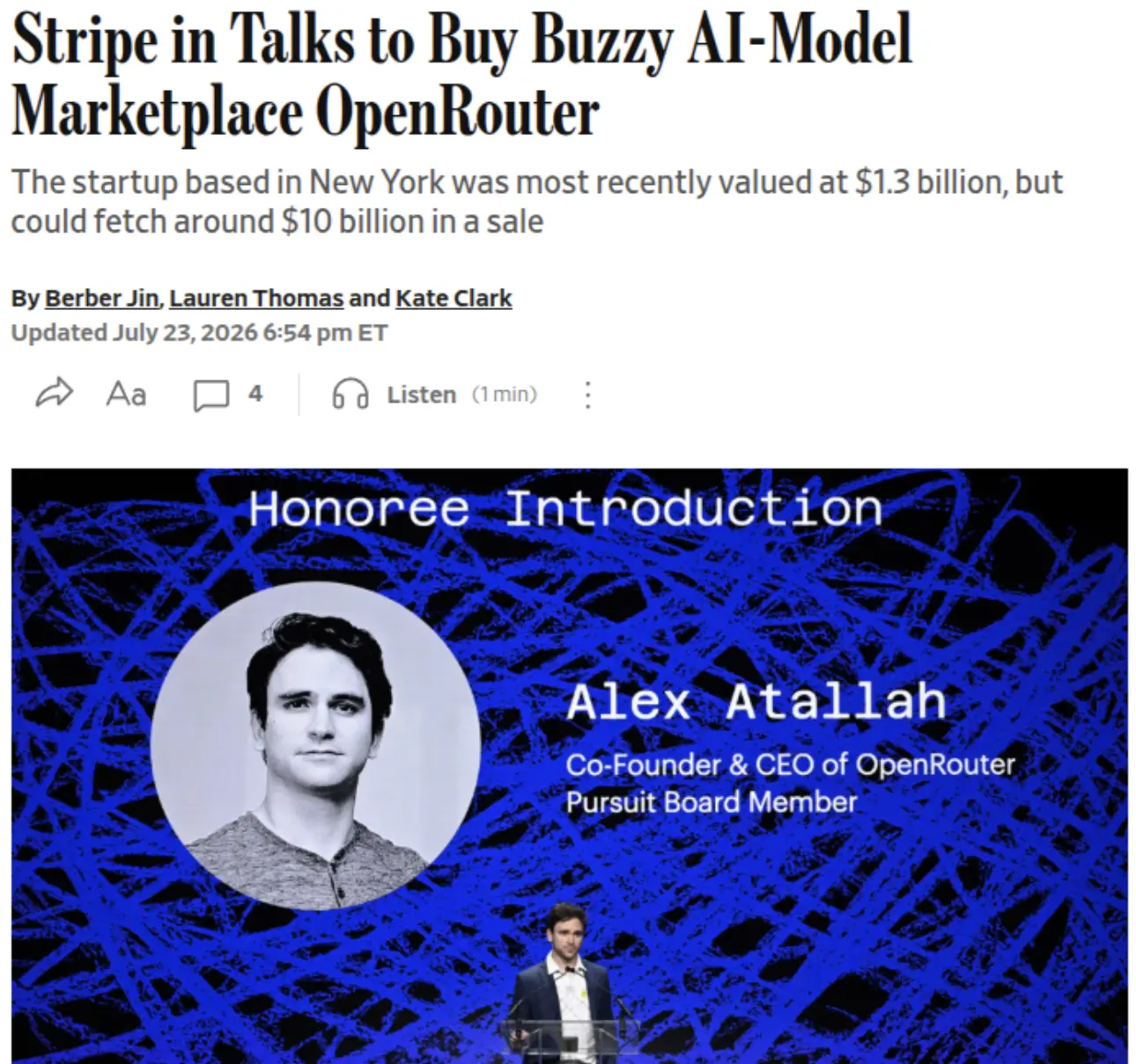
According to the latest report from the Wall Street Journal, Stripe is considering acquiring this global largest AI model aggregation platform. Informed sources reveal that transaction talks between the two parties may be announced soon, but uncertainties remain, and the possibility of negotiation breakdown or other potential buyers joining the bid cannot be ruled out.

Interestingly, Alex Atallah once described OpenRouter as "the Stripe of the AI field." In his view, just as Stripe helps clients handle various payments through a unified entry point, OpenRouter aims to become a unified entry point for enterprises to access different AI models, reducing the cost of switching between multiple AI suppliers while avoiding being "locked in" by a single model supplier.

In fact, OpenRouter and Stripe have already established a cooperative relationship. This potential transaction between the two parties is also seen as an important strategic move by the payment infrastructure giant to further extend into the AI infrastructure sector. It's worth noting that this could be another major acquisition move by Stripe, following recent market rumors of its plan to acquire PayPal.

Currently, neither party has disclosed specific transaction amounts. However, according to informed sources, if the deal is finalized, OpenRouter's valuation at the time of sale could be close to $10 billion.

This figure far exceeds OpenRouter's valuation during its previous financing rounds. In just over three years since its founding, this AI infrastructure company has achieved rapid growth driven by the wave of large models.
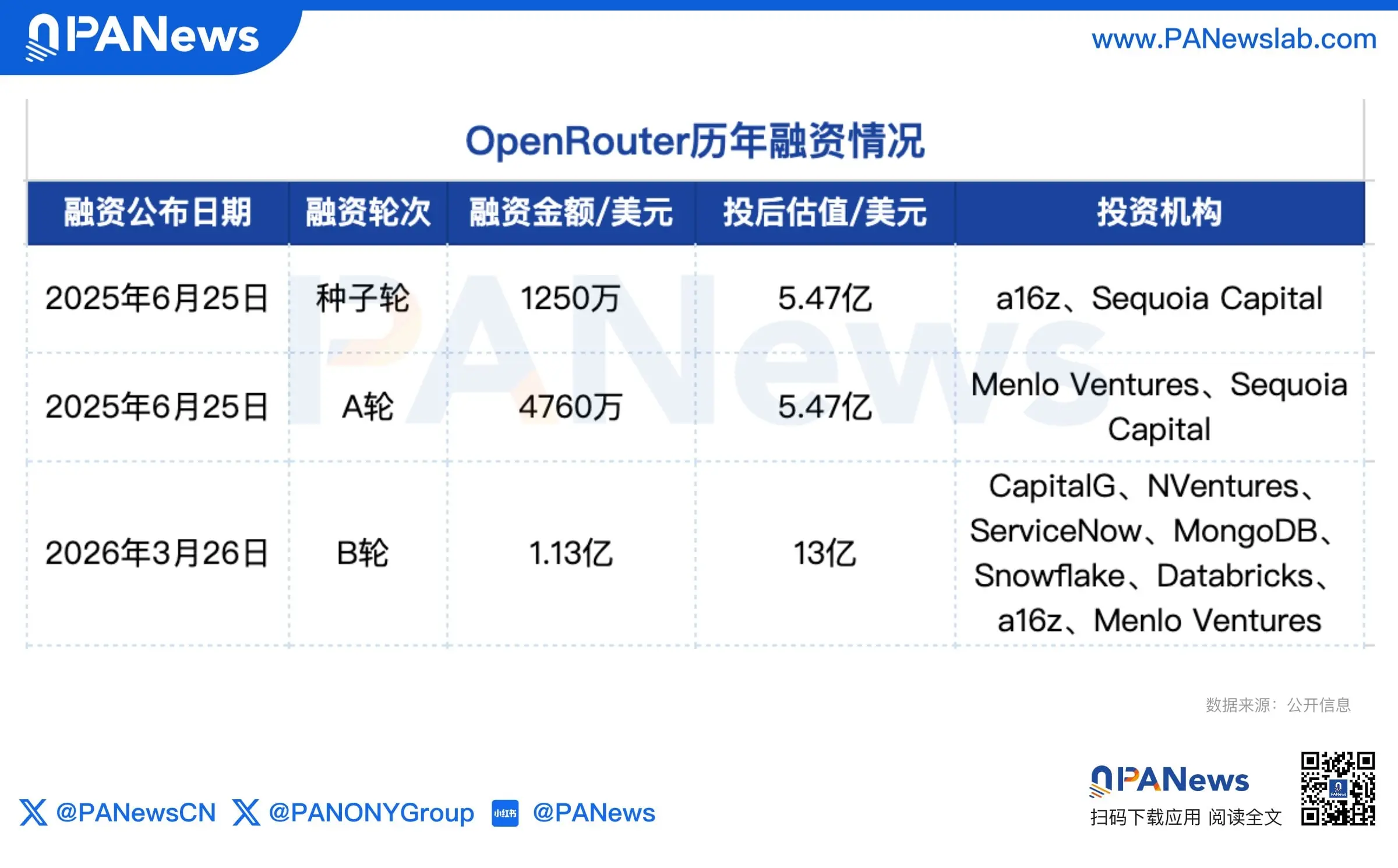
Public data shows that OpenRouter has completed three rounds of financing, raising over $150 million cumulatively. In June 2025, OpenRouter announced the completion of $40 million in seed and Series A funding, with a post-money valuation of approximately $547 million at the time; on March 26, 2026, OpenRouter announced the completion of a $113 million Series B funding round, with a post-money valuation of about $1.3 billion.

If this transaction materializes, it would mean OpenRouter's valuation could increase nearly tenfold within months, joining the ranks of decacorns (companies valued over $10 billion).

Behind OpenRouter's rising value lies not only the explosive demand brought about by the rapid expansion of large models but also increased attention from the capital market towards the AI infrastructure sector.

Repeating the OpenSea Exit Playbook? Why is OpenRouter Choosing to 'Sell Out'?

This is not the first time Alex Atallah has built a company worth tens of billions of dollars.

Prior to this, the serial entrepreneur co-founded OpenSea, bringing NFTs from a niche circle into the mainstream spotlight. During the peak of NFT frenzy, OpenSea grew from a little-known platform into the world's largest NFT marketplace, with its valuation once exceeding $13 billion, and the net worth of its two founders reaching approximately $2.2 billion each.

However, before the comprehensive downturn of the NFT market in 2022, Alex Atallah chose to leave OpenSea. Subsequently, as the industry bubble burst, OpenSea's valuation shrank significantly, and the former NFT leader gradually faded from its peak glory. Alex Atallah's early exit was also seen by the market as a significant signal of the peak.

Afterwards, Alex Atallah turned his focus to AI infrastructure, and the OpenRouter he founded became the largest transit hub in the AI era.
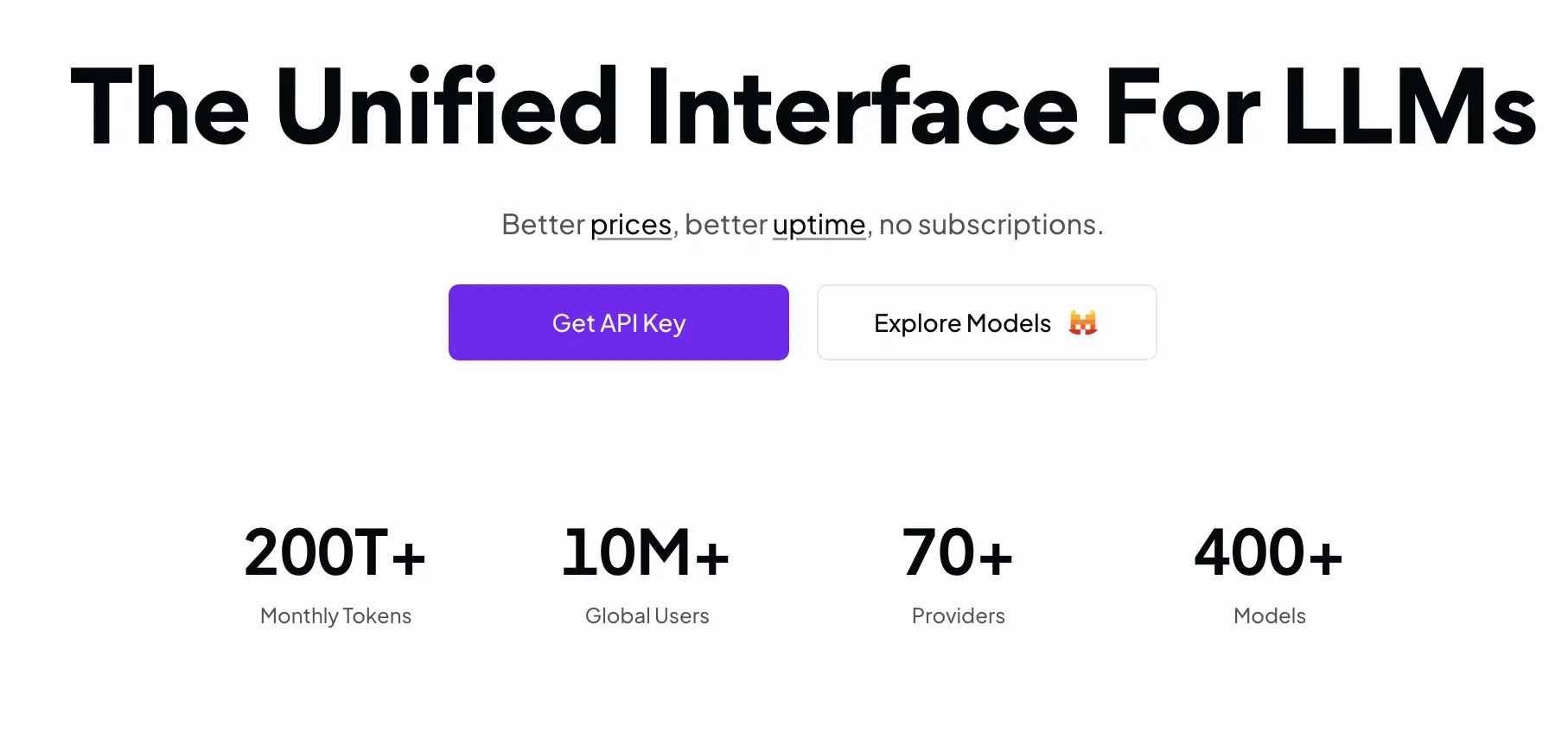
Currently, OpenRouter has integrated over 400 AI models, boasts approximately 10 million users, and processes over 200 trillion tokens per month. This year, the number of tokens processed through its API has increased roughly tenfold.

But it is worth noting that despite rapid business growth, OpenRouter has not chosen an IPO but is heading down the path of a potential sale. The reason lies in it being a large-scale but low-margin gateway business.

Currently, OpenRouter primarily profits by charging a platform service fee when developers call AI models, with a commission rate of about 5%-5.5%. Although its annualized AI inference consumption scale has reached several hundred million dollars, as of April 2026, the company's annualized revenue was approximately $50 million.

In other words, OpenRouter connects to a massive AI demand market but does not fully control the upstream value chain. As model capabilities gradually standardize, the platform is susceptible to factors such as the rise of open-source models, ecosystem lock-in by cloud providers, and direct price reductions by model suppliers, which could continuously pressure profit margins. OpenRouter finds it difficult to tell a story of exponential growth and ultra-high profits in the capital market.

Meanwhile, competition in the AI model aggregation track is intensifying. For example, Meta's internal AI incubator is developing a dispatch service similar to OpenRouter to reduce code development and compute costs; domestically in China, large model aggregation platforms have also emerged, including Cheetah Mobile's EasyRouter and NetEase Youdao's ThinkFlow.

Therefore, the high valuation currently given to OpenRouter by the market is more about pricing its future potential rather than its current profitability.

However, for potential buyers, the truly attractive asset of OpenRouter may not be its current revenue scale but rather the real AI usage data it has accumulated over the long term.

By connecting hundreds of models and tens of millions of users, OpenRouter has amassed a large amount of invocation data from real production environments, including performance differences of various models in actual tasks, developer preferences, price sensitivity, and substitution relationships between open-source and closed-source models. Compared to lab test data, this real-world AI usage data is closer to market demand and harder to replicate quickly through short-term investment. This is perhaps a key reason why large technology companies are willing to pay a high premium for OpenRouter.

From NFTs to AI, Alex Atallah has twice caught the wave of the times. If OpenRouter is ultimately sold at a $10 billion valuation, will it signify a repricing of AI infrastructure value or be another signal of a cyclical peak? The answer may still require time to verify.

Criptomoedas em alta

Perguntas relacionadas

QWho is the founder of OpenRouter, and what other notable company did he co-found before?

AThe founder of OpenRouter is Alex Atallah. He previously co-founded the NFT marketplace OpenSea.

QWhat is the reported potential valuation of OpenRouter in the acquisition talks with Stripe?

AThe reported potential valuation of OpenRouter in the acquisition talks with Stripe is close to 100 billion US dollars.

QHow does OpenRouter generate its revenue according to the article?

AOpenRouter generates revenue primarily by charging a platform service fee, approximately 5%-5.5%, when developers use its API to call AI models.

QWhat are some competitive challenges OpenRouter faces in the AI model aggregation space?

AOpenRouter faces competitive challenges such as the rise of open-source models, potential bundling by cloud service providers, price reductions by model suppliers, and new entrants like Meta's internal AI incubator service and similar platforms in China.

QWhat unique asset of OpenRouter is highlighted as a key attraction for potential acquirers like Stripe?

AA key asset of OpenRouter is its extensive collection of real-world AI usage data, including performance differences of models in production tasks, developer preferences, and substitution relationships between open-source and closed-source models, which is difficult to replicate quickly.

Leituras Relacionadas

The Verdict in Choi Tae-won's Divorce Case: Revealing the Inheritance Undercurrent Behind SK Hynix's Trillion-Won Empire

SK Group Chairman Chey Tae-won's high-profile divorce case, involving a record 1.38 trillion won settlement, has drawn attention to the succession plans for Korea's second-largest conglomerate, especially its crown jewel, SK hynix. Unlike traditional chaebol scripts centered on the eldest son, Chey's three children from his marriage to former President Roh Tae-woo's daughter, Roh Soh-yeong, are carving distinct, non-traditional paths. Eldest daughter Chey Yun-jung (b. 1989) is seen as the most evident successor. With a scientific and consulting background, she holds executive roles at SK bioscience and SK Inc.'s growth support department, focusing on future strategy and biopharma. Her marriage is to an AI infrastructure entrepreneur, not a traditional business alliance. Second daughter Chey Min-jung (b. 1991) took a unique route, voluntarily serving as a South Korean naval officer, including an anti-piracy deployment. She later worked on policy and strategy for SK hynix in Washington D.C. before co-founding an AI-driven healthcare startup. She married a former U.S. Marine Corps officer, connecting her to U.S. defense and policy circles—networks crucial for a global semiconductor giant. The only son, Chey In-geun (b. 1995), who studied physics like his father, worked briefly at SK E&S before joining McKinsey. Despite fitting the traditional "heir" profile as the eldest son, he remains silent and holds no public position or shares in SK, suggesting the old succession playbook is obsolete. As SK hynix's valuation soars, becoming a geopolitical asset in the AI era, the heirs' legitimacy is no longer automatic. They must prove themselves in fields like AI biotech, global policy, and strategic consulting. Their marriages also reflect new elite networks in tech and defense, not old political alliances. Their inheritance is the complex challenge of navigating a globalized, tech-driven world, not just a corporate throne.

marsbitHá 13h

The Verdict in Choi Tae-won's Divorce Case: Revealing the Inheritance Undercurrent Behind SK Hynix's Trillion-Won Empire

marsbitHá 13h

Trading

Spot

Artigos em Destaque

O que é VERONA

I. Introdução ao Projeto VERONA é uma blockchain construída para todos, em todo o lado, através da abstração da cadeia. Utilizando a sua camada de Abstração Generalizada, a VERONA distingue-se por integrar funcionalidades complexas de blockchain, como contas, assinaturas e interoperabilidade, diretamente ao nível do protocolo. Esta abordagem permite a interação com aplicações de blockchain sem a necessidade de compreender as tecnologias subjacentes.1) Informação Básica Nome: VERONA (VERONA)III. Links Relacionados Link do site oficial: https://xion.burnt.com/ Whitepaper: https://xion.burnt.com/whitepaper.pdf Exploradores: https://explorer.burnt.com/ Mídias Sociais: https://x.com/burnt_xion Nota: A introdução ao projeto provém dos materiais publicados ou fornecidos pela equipa oficial do projeto, que é apenas para referência e não constitui aconselhamento de investimento. A HTX não se responsabiliza por quaisquer perdas diretas ou indiretas resultantes.

778 Visualizações TotaisPublicado em {updateTime}Atualizado em 2026.06.22

O que é VERONA

O que é NES

I. Introdução ao ProjetoNesa é a maior plataforma e ecossistema de IA descentralizada apoiada por uma camada de IA com foco na privacidade. A sua tecnologia de inferência encriptada proprietária suporta uma ampla gama de cargas de trabalho e serve clientes empresariais da Fortune 500 em indústrias como retalho, saúde e TI.II. Informação sobre o TokenNome do token: NES(Nesa)III. Links RelacionadosWebsite:https://nesa.ai/Exploradores:https://bscscan.com/address/0x3131f6B80C26936aB03F7d9D29Eb4Ddf36AC3FB5Twitter:https://x.com/nesaorgNota: A introdução ao projeto provém dos materiais publicados ou fornecidos pela equipa oficial do projeto, que é apenas para referência e não constitui aconselhamento de investimento. A HTX não se responsabiliza por quaisquer perdas diretas ou indiretas resultantes.

190 Visualizações TotaisPublicado em {updateTime}Atualizado em 2026.06.24

O que é NES

O que é ANSEM

I. Introdução ao ProjetoO Black Bull ($ANSEM) é uma memecoin transparente e orientada pela comunidade na Solana, construída em torno de um credo: avançar independentemente das circunstâncias. O projeto é focado no frontend e totalmente verificável — o seu website lê dados de mercado e em cadeia em tempo real diretamente da Solana, incluindo preço, liquidez, volume, capitalização de mercado e distribuição de detentores, para que qualquer pessoa possa auditar as alegações sem necessidade de login e sem recolha de dados de utilizador. Para além do token, oferece um Radar de chamadas Ansem, Pods de liquidez comunitária não custodiais no PumpSwap e um terminal de memes baseado em navegador. O $ANSEM é um token SPL padrão do Pump.fun (6 casas decimais) negociando contra SOL e USDC.II. Informação sobre o TokenSímbolo do Token: ANSEM (O Black Bull)III. Links RelacionadosWebsite:https://www.blackbullsol.com/X: https://x.com/blknoiz06Endereço do Contrato: https://solscan.io/token/9cRCn9rGT8V2imeM2BaKs13yhMEais3ruM3rPvTGpumpNota: A introdução ao projeto provém dos materiais publicados ou fornecidos pela equipa oficial do projeto, que é apenas para referência e não constitui aconselhamento de investimento. A HTX não se responsabiliza por quaisquer perdas diretas ou indiretas resultantes.

445 Visualizações TotaisPublicado em {updateTime}Atualizado em 2026.07.01

O que é ANSEM

Discussões

Bem-vindo à Comunidade HTX. Aqui, pode manter-se informado sobre os mais recentes desenvolvimentos da plataforma e obter acesso a análises profissionais de mercado. As opiniões dos utilizadores sobre o preço de O (O) são apresentadas abaixo.

活动图片