Author: Zhou Hang
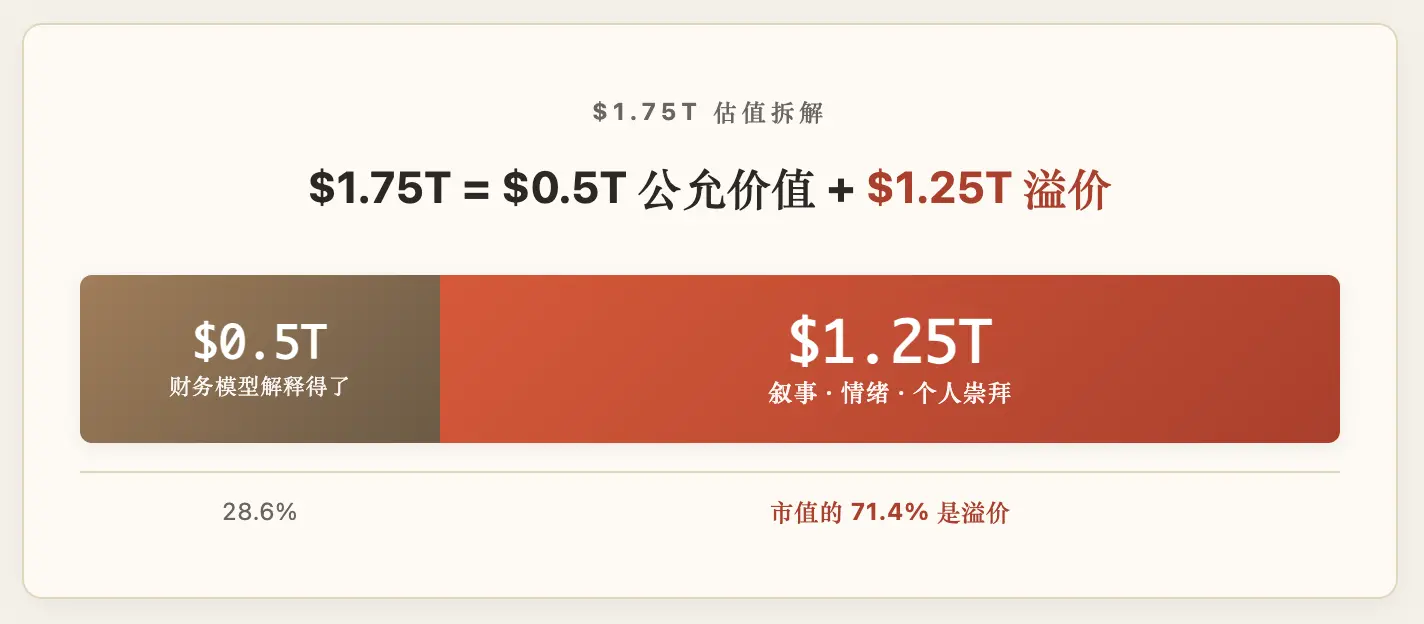
SpaceX may be overvalued by $1.25 trillion around its IPO.
This is not denying SpaceX's greatness. On the contrary, anyone seriously discussing SpaceX must first acknowledge: it might be one of the greatest industrial companies of the past 50 years.
But the greatness of a company and whether its stock is worth buying at any price are two completely different things.
SpaceX can simultaneously be the "greatest industrial entity of the 21st century" and a "seriously overvalued investment target." These two things are not contradictory.
■ First, Acknowledge Its True Greatness
Any honest discussion about SpaceX's valuation must start with one sentence: It is the most successful industrial company of the past 25 years, bar none—even more successful than Tesla. This is not mere praise; it's an economic and engineering fact.
Tesla disrupted a 150-year-old mature industry—automobiles. Its rivals are Mercedes, Ford, Toyota. These opponents are not weak, but they are commercial companies, without the backing of national interests or political barriers; the essence of the competition is product, brand, supply chain.
SpaceX disrupted a 60-year-old state-monopoly industry—space. Its opponents are NASA, Roscosmos, ESA, CNSA. This is an entirely different level of difficulty: higher engineering barriers, greater capital intensity, more complex regulation, deeper entanglement with national interests. In 2002 when Musk founded SpaceX, the entire space industry was essentially an extension of national missions; commercial companies were not believed capable of building rockets, let alone rockets cheaper than national ones.
More than 20 years later, SpaceX has slashed launch costs from $54,500/kg in the Space Shuttle era to $1,500/kg—a 36-fold decrease. It now launches 165 times a year, with one company exceeding the total launch count of all other countries and all commercial players combined. It built humanity's first truly reusable rocket, with a single Falcon 9 first stage flying 32 times and a success rate over 99%. It constructed the world's first global satellite internet—covering capacity for over 1 billion users, becoming a decisive strategic asset on the first day of the Ukraine war.
Tesla in 2025 still faces fierce competition from Chinese EVs; SpaceX's share in the global commercial launch market is approaching monopoly.
SpaceX is a great company, perhaps the greatest industrial company on Earth in the past 50 years. Any criticism about its valuation must first acknowledge this.
■ What Does $1.75 Trillion Even Mean?
Let's look at it through a set of comparisons:
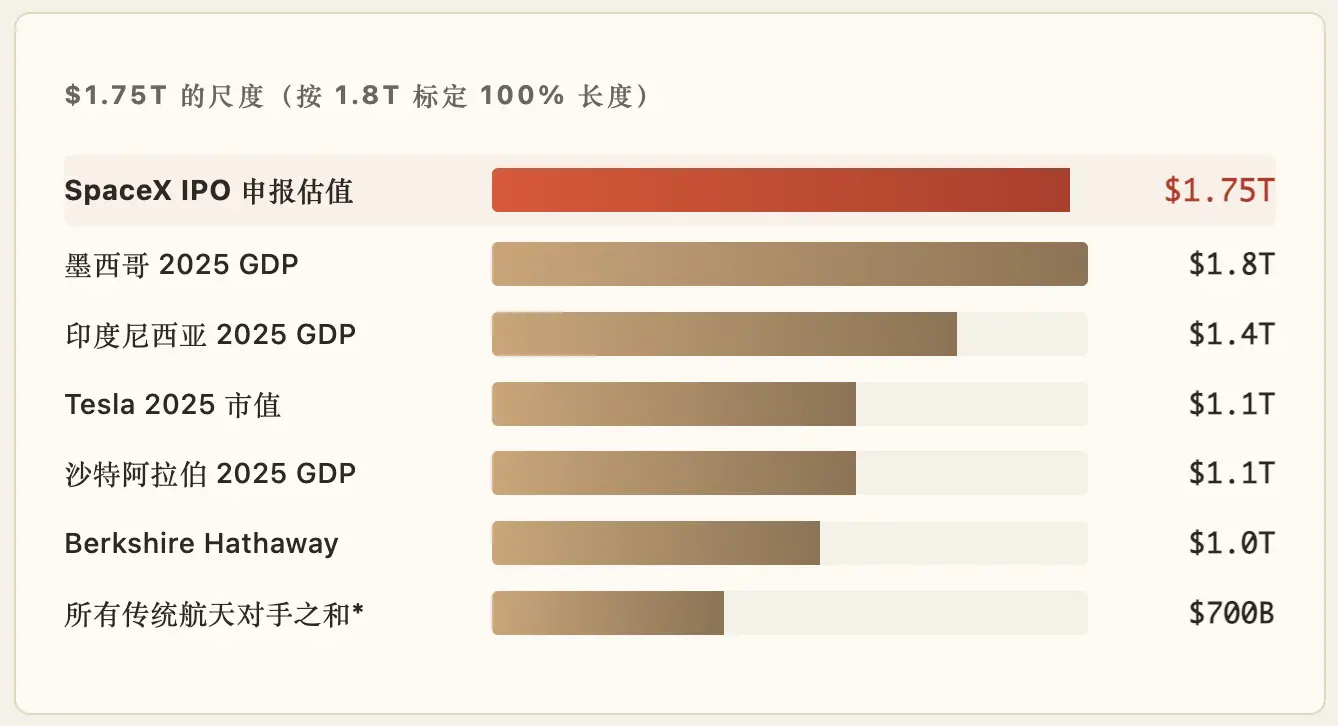
* Combined market cap of Boeing + Lockheed + Northrop + RTX + GD. SpaceX's valuation alone is 2.5 times their total.
In other words, the valuation of SpaceX alone would exceed Mexico's full-year GDP, surpass either Tesla or Berkshire, and be 2.5 times the total market cap of all its traditional space rivals.
This itself isn't the problem—great companies deserve great valuations. But that 2.5x ratio means the market is not pricing it as a "space company," nor as an "industrial company." The market is pricing it with a paradigm closer to some hybrid of "sovereign asset + AI-era infrastructure + narrative premium."
Is this pricing reasonable?
List all of SpaceX's current businesses and realistically calculate how much revenue they could generate by 2030, using a reasonable optimistic scenario for each line:
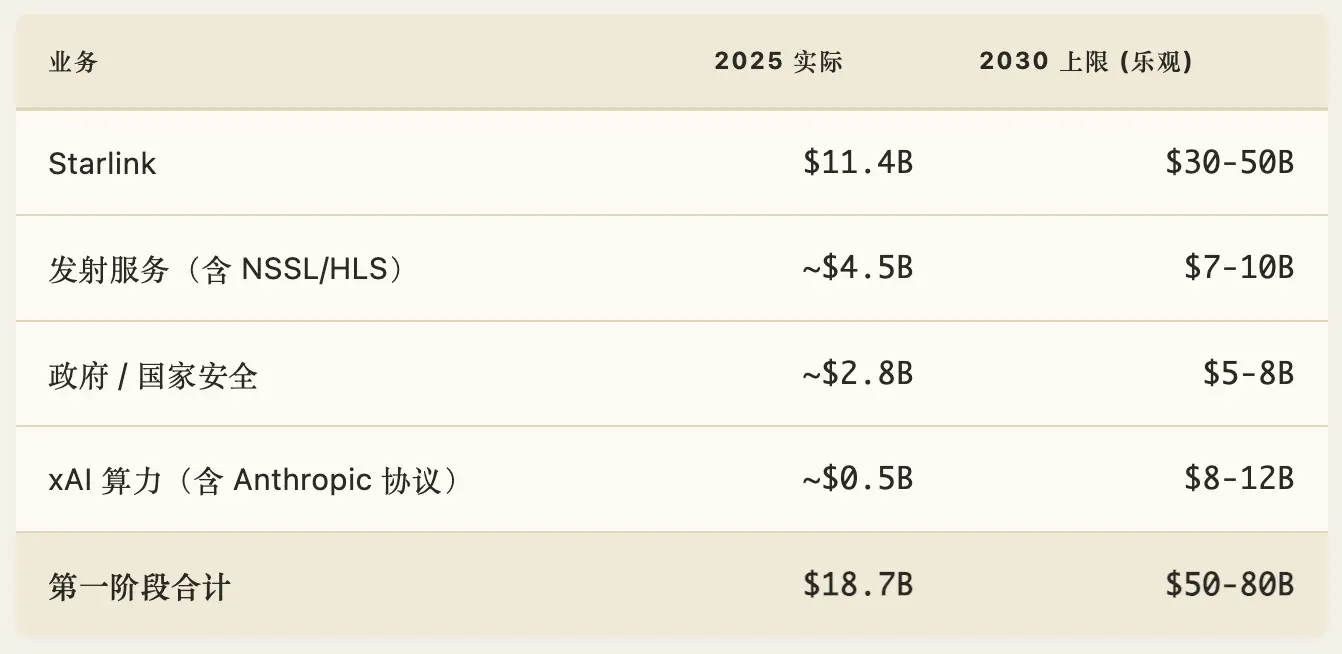
If SpaceX achieves $50-80B in revenue by 2030, corresponding EBITDA (Earnings Before Interest, Taxes, Depreciation, and Amortization, roughly understood as the operating cash profit from the company's main business) would be about $20-35B (using a 40% margin, already a very optimistic assumption).
Using the SaaS-diversified standard EV/EBITDA multiple of 25-35x—this is already a premium tech company valuation—SpaceX's "reasonable valuation" range in 2030 is from $500B to $1.2T.
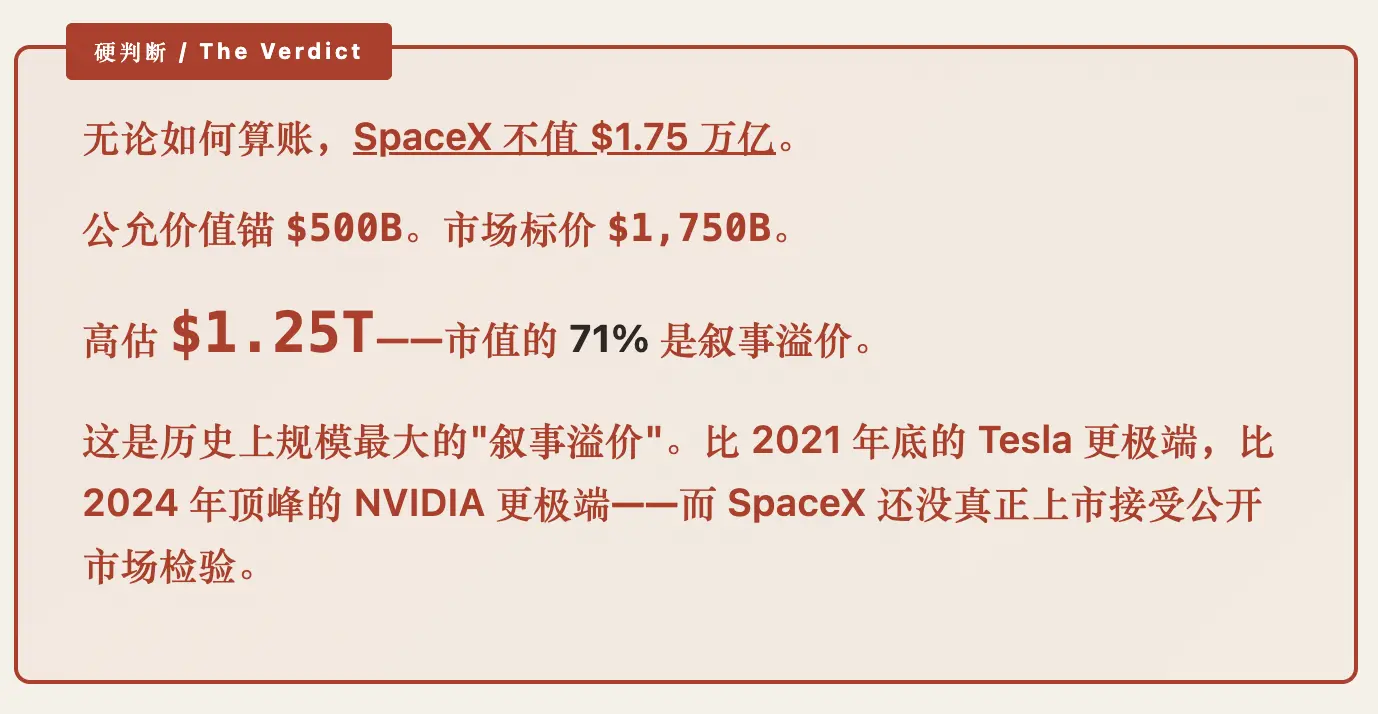
Taking the conservative anchor of $500B (i.e., valuing all 2030 businesses at a reasonable, not wild, level), the market price is $1.75T.
Difference:$1.25T.
This difference cannot be explained by any standard financial model. It is not the result of DCF (Discounted Cash Flow), nor the result of pushing a P/S multiple, nor the result of comparable company benchmarking—none of these methods yield $1.75T.
This difference doesn't appear out of thin air. It has three real sources:
First source: Long-term vision premium. If Starship becomes stable between 2027-2030, launch costs could drop to $200/kg or lower. That's a 30x increase in capacity—enough to support new businesses (orbital data centers, lunar commerce, deep-space robotics). Anthropic has publicly expressed interest in "paying for GW-level computing power in space." If this narrative materializes, SpaceX's total addressable market including new businesses by 2040 could reach $200-500B/year. This ceiling is indeed massive—so it's reasonable for the market to leave room for a "vision premium."
Second source: Sovereign asset + strategic positioning premium. SpaceX is no longer just a commercial company; it's a US national strategic asset. $22B in government contracts, HLS lunar lander, NRO's secret reconnaissance constellations, Golden Dome missile tracking—these bind SpaceX into the US national security apparatus. In today's rapidly fragmenting global communications order (Chinese sphere / American sphere / third parties), Starlink automatically gains "soft sovereignty" in all markets it can serve. The monetization of this position may take 10+ years to fully manifest, but the premium is real.
Third source: Retail investors' yearning for a heroic narrative + Musk's personal cult. This is the hardest to quantify, but anyone familiar with capital markets knows its power. Musk has 200 million followers on platform X; he himself is a valuation variable. The SpaceX story—a private company sending people to Mars, building a global internet, making humanity a multiplanetary species—is the most heroic commercial story of the past 50 years.
Retail investors aren't buying EBITDA; they're buying a ticket to participate in history.
The first two premiums are "real, but slow"; the third premium is "large, but fragile." The current $1.75T valuation bets that all three hold true and nothing goes wrong. This is a difficult combination to sustain.
What Happens After the IPO?
Assuming SpaceX completes its IPO in the second half of 2026, the next 3-5 years will likely look like this:
Scenario A: Valuation solidifies (Probability ~25%). Starship V3 successfully debuts in 2027, enters stable operation in 2028, and the first GW-level contract for space computing lands in 2028. Lunar commerce proceeds on NASA's schedule. Although Starlink growth slows, aviation + maritime + D2C segments make up for the deceleration in the residential market. In this scenario, $1.75T "starts to look cheap"—the market would revalue it to $2-3T.
Scenario B: Flat, volatile valuation (Probability ~50%). Starship progress is slower than expected—if the 2025 flight test success rate of 5/25 = 20% continues through 2026-2027, V3's true maturity may not arrive until 2029-2030. Starlink growth slows to +20%/year, the xAI-Anthropic agreement brings real cash flow but no second major contract follows. The market realizes "the narrative is ahead of reality," and the valuation oscillates between $1.2T - $1.8T for 3-5 years. This is the most probable scenario.
Scenario C: Revaluation (Probability ~25%). Persistent Starship delays, xAI lags significantly in AI competition, a Musk personal risk event (health, reputation, politics) triggers. The sentiment premium rapidly contracts. The market re-prices using financial models—valuation falls back to the $800B-$1.2T range, equivalent to "the reasonable valuation a great industrial company deserves." This scenario is actually good for long-term holders—but means a 30-50% paper loss for retail investors who buy after the IPO.
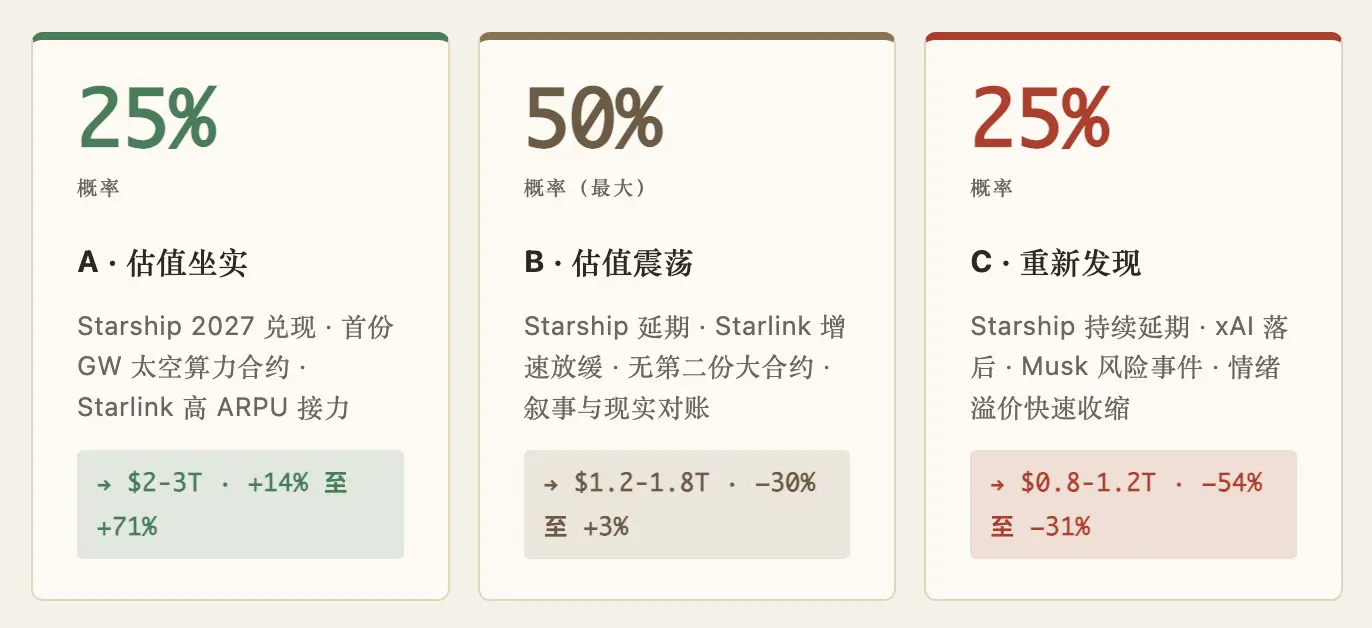
Probability-weighted = 0.25 × upside + 0.50 × volatility + 0.25 × downside ≈ expected value of $1.3-1.5T, lower than the IPO filing price of $1.75T.
Weighting the three probabilities, the expected central value for SpaceX's valuation over the next 3-5 years is around $1.3-1.5T—below the current IPO filing price.
In plain English: buying at $1.75T on IPO day results in a negative expected return over 5 years. This is the inevitable result after weighting the three scenarios by probability: you get no return in the most probable scenario; you lose 30-50% in the worst scenario; only in 1/4 of scenarios do you make money.
In the words of Charlie Munger: This is not an attractive bet.
■ For Those Planning to Buy on IPO Day
SpaceX is a great company, but a great company does not equal a stock that should be bought at any price. These two things must not be confused.
Tesla at the end of 2021 was also considered by many as "a buy at any price"—back then its market cap was $1.2T. Then over the next two years, Tesla fell 70%, from $1.2T to $400B. This wasn't because Tesla became a bad company—it remains an excellent EV company. It's because the price had run too far ahead of fundamentals.
SpaceX's current situation is highly similar to Tesla's at the end of 2021—possibly more dangerous, because SpaceX's "vision premium" accounts for a higher proportion, its story is grander, and retail participation could be deeper.
If you truly believe in SpaceX's long-term vision and are willing to hold for 10+ years without selling, then buying at the IPO price may be fine—in 10 years, this company will likely be worth more. But if you expect to "double your money within 1-3 years," the math is not on your side.
A more rational strategy:
- Do not chase the price on IPO day
The premium is usually highest on the first day of any mega-IPO - Wait for at least one of three things to happen
Starship V3 stable operation, the first GW-level space computing contract, or the stock price falling below $1T - If you must buy now, limit your position
Don't treat it as a "sure bet"—it's not. It's a "meaningful long-term +/- 30% uncertainty"
■ A Great Company, Can Also Be an Expensive Stock
A company's greatness is a fact; whether a stock's price is reasonable is math. Facts don't change, math changes every day. In SpaceX's current valuation structure, financial models can only explain half; the other half is market sentiment + sovereign status + personal cult—this part does exist, but it is fragile.
After the IPO, one thing will happen: retail investors will start measuring this company by its quarterly earnings. The first quarterly report, the second, the third—each will force the market to reconcile "story" with "reality." This reconciliation process is usually unfriendly to short-term valuation.
If you're buying the company—the great industrial entity, humanity's post-Starship infrastructure, the sovereign asset—then the IPO price is just a point in a 20-year marathon, no need to obsess.
If you're buying the story—participating in history, following a hero, for the sake of us becoming a multiplanetary species—then please acknowledge this is consumption, not investment. Consumption can be expensive, but you need to know what you're doing.
A company can be the world's best, and its stock can simultaneously be overvalued by $1.25 trillion. Both can be true, but they must be viewed separately. Distinguish whether you're buying the company, or the story.