Three 'Reflexivity' Shadows Hang Over the Market

链捕手Publicado em 2026-07-27Última atualização em 2026-07-27

Resumo

Global markets are currently enveloped by three mutually reinforcing "reflexive" loops: oil price politics, outsized capital expenditure by hyperscale cloud providers, and AI debt risks. According to Goldman Sachs, the combined negative feedback from these factors places the market in a fragile and precarious state. The first loop involves the two-way feedback between surging oil prices and rising interest rates. Brent crude's brief breach of $100 per barrel tests expectations of a U.S. policy response to curb prices and inflation. However, the delay in such intervention forces markets to increasingly price in the risks themselves. Higher energy costs are already impacting corporate earnings, as seen with an airline's profit warning, and threaten to fuel broader inflation. The second loop concerns the massive, escalating capital expenditure (capex) by major tech firms like Google, which recently raised its 2026 capex forecast significantly. The market's tolerance for viewing such spending as a cost-free growth signal is waning, shifting focus to investment returns. This competitive capex spiral pressures the entire cloud and semiconductor sector. Furthermore, the competitive gap in AI between leading closed-source and Chinese open-source models is narrowing rapidly, threatening the economic rationale behind massive investments. The third reflexive danger lies in the financing structures supporting this expansion. Bond prices for entities funding AI infrastructure, such as ...

Author: Wall Street Insights

Global markets are currently facing three mutually reinforcing reflexivity loops: oil price politics, massive capex from hyperscale cloud providers, and AI debt risks. Goldman Sachs warns that the combined negative feedback mechanism formed by these three factors leaves the current market in a fragile and precarious balance.

This week, Rich Privorotsky, head of 1-Delta Trading at Goldman Sachs, pointed out in his latest client report that the dual pressures of soaring oil prices and rising interest rates are making the market increasingly difficult to digest, and the negative shock on the bond side has deteriorated sharply.

He stated that without substantive easing at the political level, the market will have to absorb the risks on its own, pushing the situation towards a worse direction.

At the same time, the uncontrolled expansion of capital expenditures by tech giants and the price collapse of AI infrastructure-related bonds are shaking investor confidence in the hyperscale cloud provider narrative.

Privorotsky warns that betting on these companies is essentially evolving into a high-stakes gamble on "the revenue inflection point arriving before the peak in expenditures."

The two-way feedback mechanism between oil prices and politics is the first reflexivity chain Privorotsky is most concerned about.

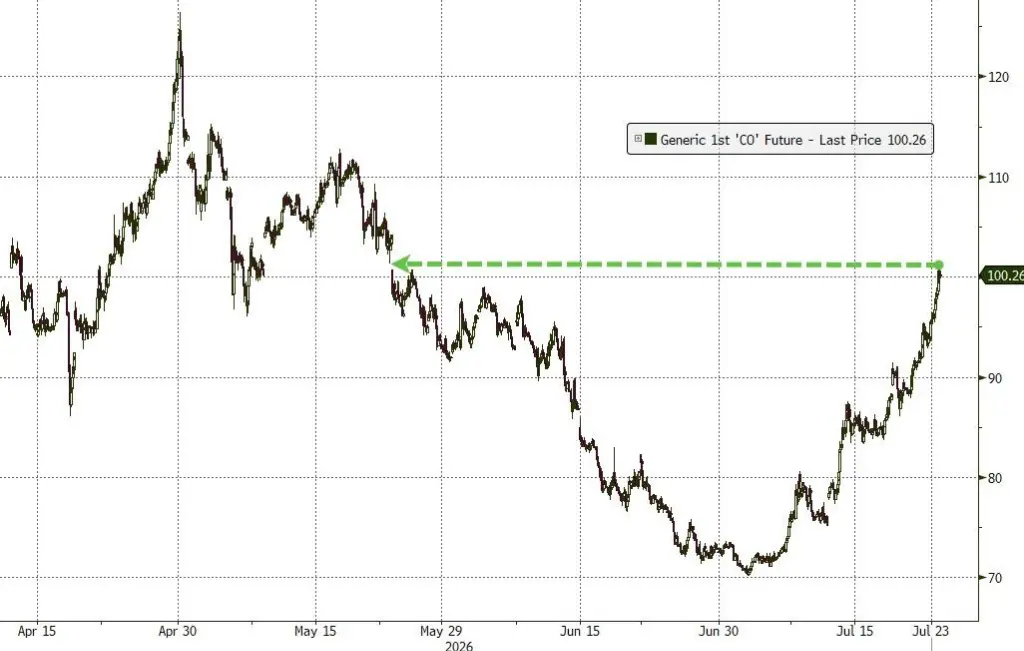
Brent crude oil prices briefly broke through $100 per barrel this week, testing market expectations regarding Trump's policy responses.
Previously, the market generally expected that once oil prices breached a certain threshold, pushing up retail gasoline prices and dragging down presidential approval ratings, the Trump administration would intervene to curb oil prices.
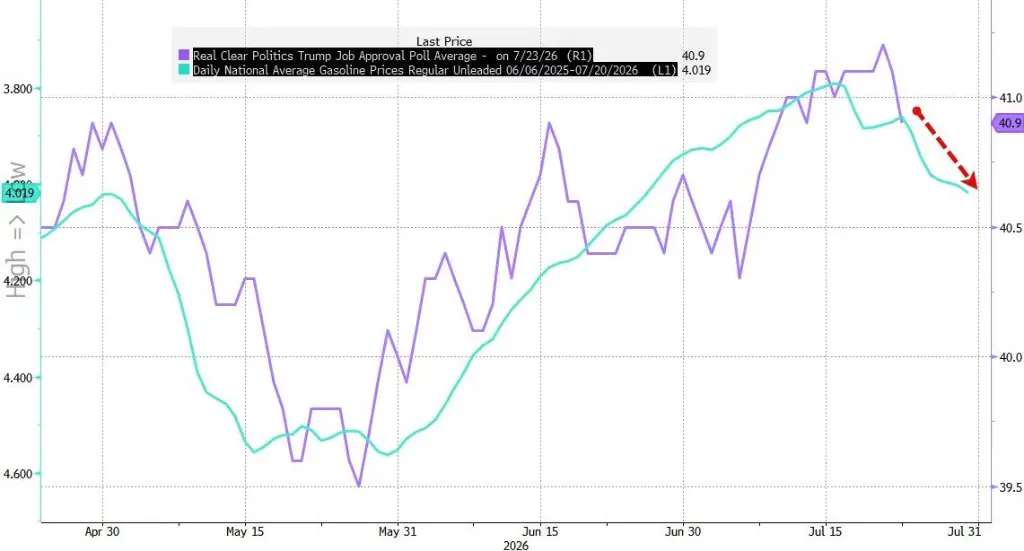
This expectation has supported stock market resilience to some extent, but Privorotsky pointed out that each day that passes without a policy response at the same price level forces the market to drive the outcome itself.

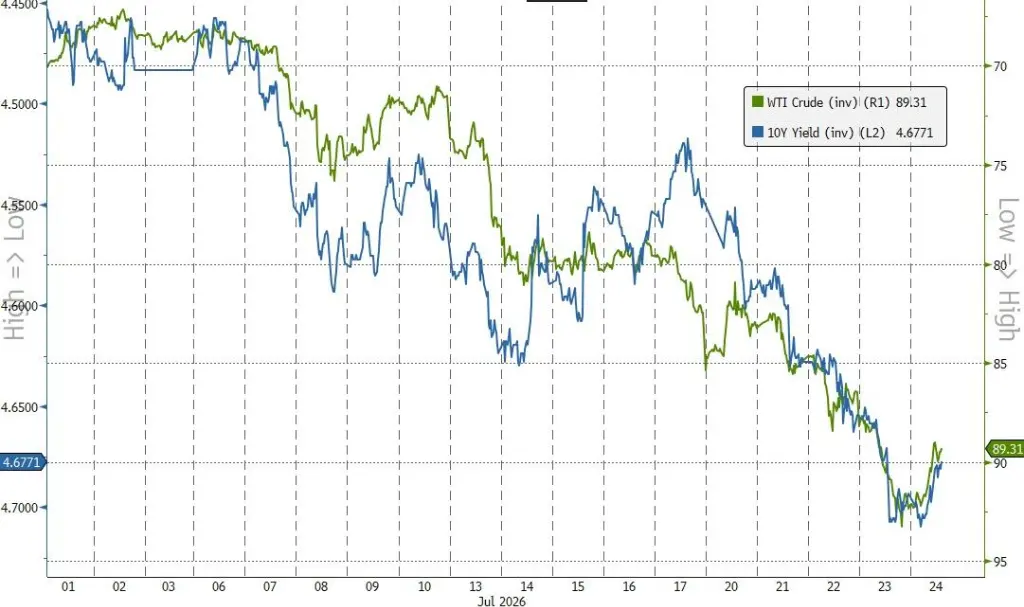
The interest rate shock is becoming the most difficult variable to ignore in this loop.
Meanwhile, the transmission of energy costs into food inflation is also about to become a reality.
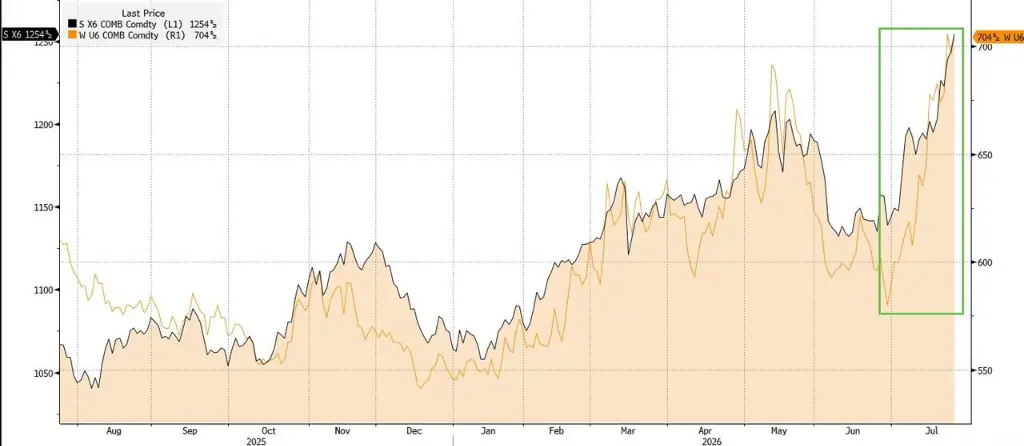
Warning signals have already appeared at the real economy level—despite record-high revenues, rising ticket prices, and relatively robust demand, American Airlines still lowered its 2026 performance guidance, citing that its fuel costs have increased by about $1.6 billion since early July.

Geopolitical tensions continue to heat up.

According to CCTV News, on July 24 local time, when discussing the "exit strategy" for the war with Iran at the White House, President Trump stated that the US has two choices: first, continue current military operations, possibly intensifying strikes, and gradually destroy Iran's military capabilities; second, reach an agreement through negotiations.

Wall Street Insights mentioned that earlier that day, Reuters cited sources reporting that Pakistan is exploring ways to push for the resumption of stalled US-Iran negotiations.

Israeli Prime Minister Netanyahu will visit the White House to meet with Trump next Tuesday. Privorotsky suggests this timing may be brewing a "TACO moment" for the market—a sudden negotiation or compromise-driven market movement.

The second reflexivity loop revolves around the capital expenditures of hyperscale tech companies, with its core contradiction being: is the market still willing to view massive investments as growth signals with no cost?

Google became the negative symbol of this earnings season for tech. The company announced an increase in its 2026 capital expenditure guidance to $195-205 billion, with free cash flow for the quarter at negative $5.9 billion, and its stock price subsequently fell by 6.9%.

While operational data such as 82% growth in cloud business was impressive, the market is no longer willing to view expenditures as cost-free strategic investments, and questions about cutting-edge product roadmaps and return on investment received almost no positive response.

The deeper impact lies in competitive transmission. If Google increases spending, it will force peers to follow suit, putting pressure on the entire hyperscale cloud computing sector. The hardware side is also sounding alarms:

  • STMicroelectronics' core profits missed expectations, and Q3 revenue guidance appeared slightly weak, with the stock falling about 14%;
  • Texas Instruments (TXN) performed relatively solidly but still closed down 3%.

Regarding the competitive landscape in artificial intelligence, Privorotsky pointed out that the gap between leading closed-source models and Chinese open-source models has narrowed significantly.
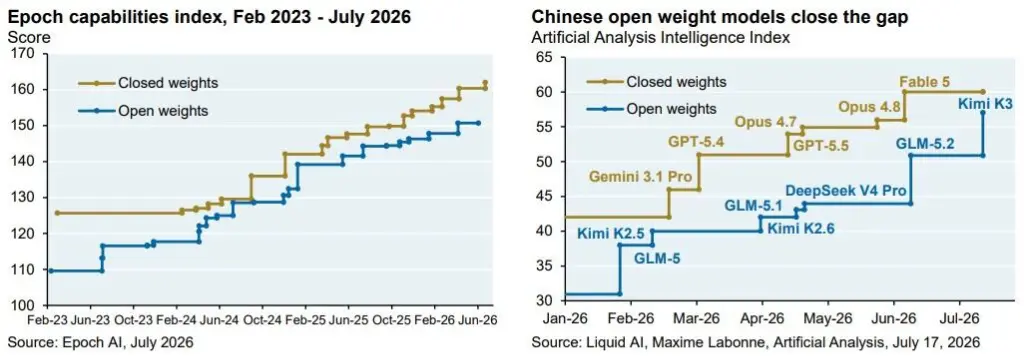
He stated that the gap, previously measured in nine to twelve months, has now compressed to weeks on some benchmarks. The cost-to-marginal-benefit ratio of pre-training versus reinforcement learning and post-training is creating vastly different economic models; the intensity of competition at the application layer and the flatness of the competitive landscape are historically rare.

He believes that the risks from small models and efficiency improvements are a "story for later," but should not be underestimated.

The third reflexivity loop is hidden within the bond and financing structures of hyperscale tech companies.

Privorotsky views the bond market as the most noteworthy risk signal at present.

Taking Meta's "Hyperion" financing of $27.3 billion completed through the Beignet SPV as an example, this bond issuance was priced at par and later traded above 109, but has now fallen back to around 95.
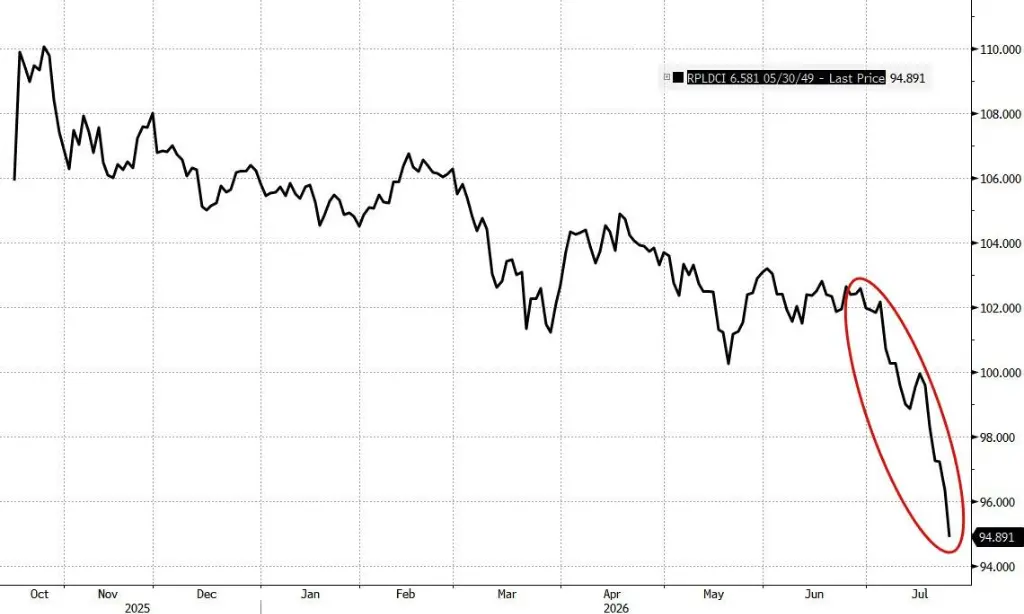
Although the overall financial health of hyperscale cloud providers remains robust, with balance sheet leverage not high, the impact of valuation repricing on stock multiples has been quite significant.
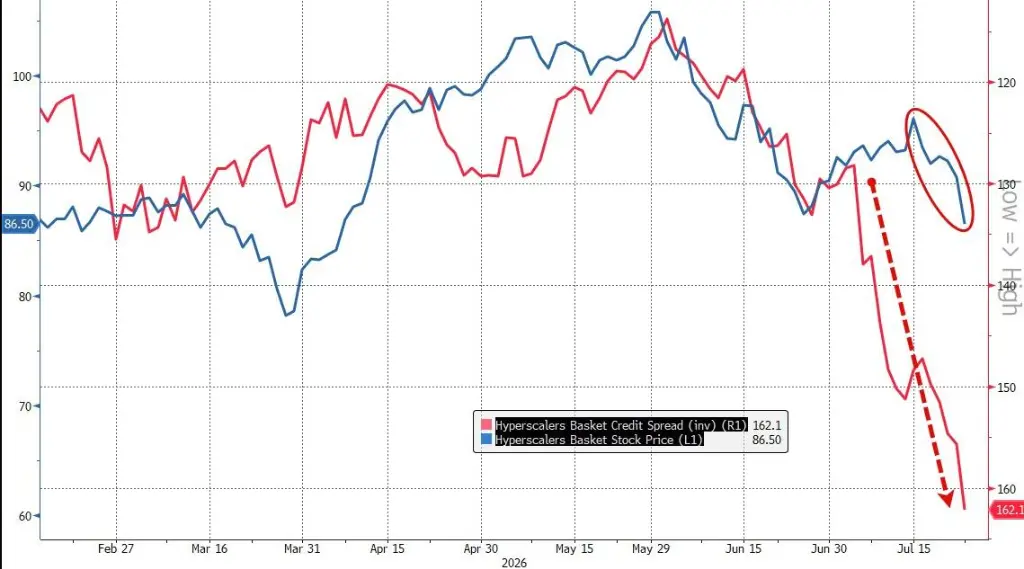
The more severe problem is that as capital expenditures accelerate, free cash flow conversion continues to deteriorate, and the impact on leveraged entities providing financing for infrastructure construction will be even more drastic.

Privorotsky warns that today's capacity expansion could evolve into tomorrow's computing power oversupply, and at that time, larger-scale depreciation expenses will begin to wash over the income statement.
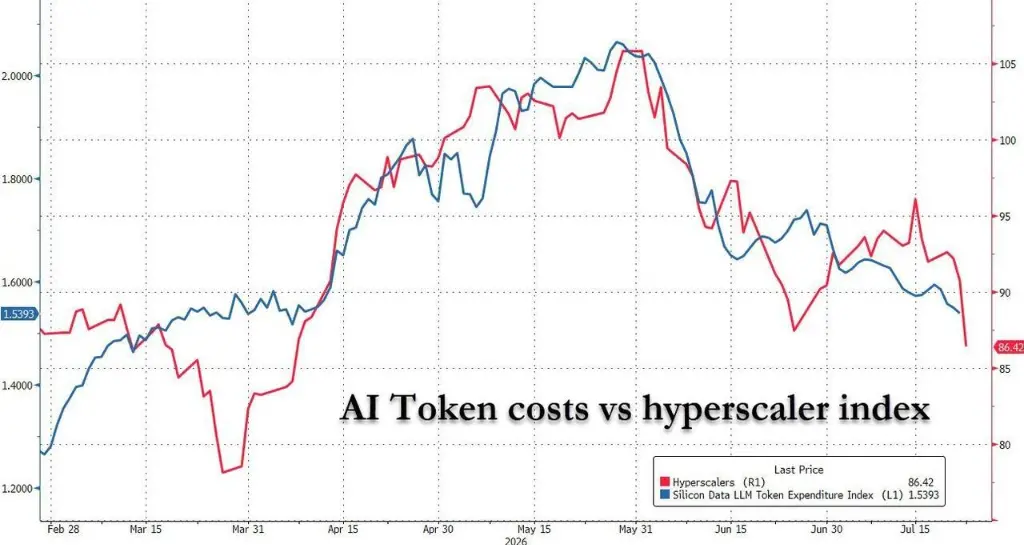
Looking ahead to the near term, Privorotsky named two events that will serve as crucial tests for the aforementioned reflexivity themes.

The first is Microsoft's earnings conference call this Wednesday. He believes, "If the reflexivity theme is to play out, this might be the most crucial call."

The market will closely scrutinize Microsoft's balance between capital expenditures, cloud growth, and free cash flow to judge whether the hyperscale tech narrative can stabilize.

The second is the IPO of Chinese memory chipmaker ChangXin Memory on the STAR Market. ChangXin Memory is currently the world's fourth-largest DRAM producer, and this fundraising round amounts to approximately $8.6 billion.

Privorotsky emphasized, "This is by no means an insignificant new competitor." If its post-IPO stock price trades close to the valuation levels implied by the OTC perpetual market, it will have a significant impact on the entire memory chip sector.

Privorotsky concluded with a sentence summarizing the current situation:

It feels a bit like circular referencing on the oil price issue.

In a market dominated by reflexivity, every variable is both cause and effect.

Perguntas relacionadas

QWhat are the three self-reinforcing reflexive loops mentioned by Goldman Sachs's Rich Privorotsky that are putting the global market in a fragile and dangerous balance?

AThe three self-reinforcing reflexive loops are: 1) The two-way feedback mechanism between oil prices and politics. 2) The capital expenditure explosion by hyperscale technology (cloud) companies. 3) The debt and financing risks embedded in the bonds and funding structures of these same hyperscale companies.

QWhy did Google's stock fall despite strong cloud growth in its recent earnings report, according to the article?

AGoogle's stock fell because the market is no longer willing to view massive capital expenditures as cost-free strategic investments. The company raised its 2026 capital expenditure guidance significantly to $195-205 billion and reported negative free cash flow of $5.9 billion for the quarter, raising investor concerns about investment returns and future profitability.

QWhat is the 'TACO moment' that Privorotsky suggests might be brewing around the meeting between Israeli PM Netanyahu and President Trump?

AA 'TACO moment' refers to an unexpected negotiation or compromise that triggers sudden market movements. Privorotsky suggests the upcoming meeting between Netanyahu and Trump could be a catalyst for such a moment, potentially impacting oil prices and geopolitical tensions.

QWhat specific warning does Privorotsky give regarding the bond market, using Meta's 'Hyperion' financing as an example?

APrivorotsky warns that the bond market is a key risk signal. He cites Meta's 'Hyperion' bond issuance of $27.3 billion, which was priced at par (100) and traded above 109, but has since fallen to around 95. This price drop indicates growing market concern about the debt used to finance AI infrastructure, suggesting a repricing of risk for hyperscale companies.

QWhich two upcoming events does Privorotsky identify as critical tests for the 'reflexivity thesis' presented in the article?

AThe two critical upcoming events are: 1) Microsoft's earnings call, where the market will scrutinize its balance between capital expenditure, cloud growth, and free cash flow. 2) The IPO of Chinese memory chip maker CXMT (ChangXin Memory Technologies) on the STAR Market, as its post-listing valuation could significantly impact the global memory chip sector.

Leituras Relacionadas

Lei Jun Earns 7 Billion in One Day from CXMT's IPO? Xiaomi Executive Responds

On July 28th, Changxin Technology's stock price on the Sci-Tech Innovation Board experienced minor fluctuations. The company had made a historic market debut the previous day, becoming the first A-share stock to record a single-day trading volume exceeding 1 trillion yuan. This led to significant paper gains for its strategic investors. Among them, Xiaomi's wholly-owned subsidiary was allocated 18.24 million shares with an initial investment of approximately 158 million yuan. Reports estimated a paper profit of 717 million yuan for Xiaomi founder Lei Jun based on his shareholding structure. However, a Xiaomi executive clarified that this was a corporate investment and should not be conflated with personal wealth. Other major beneficiaries included Alibaba and Nio. Alibaba, an early investor, held nearly a 5% stake through two entities, with an estimated paper gain exceeding 160 billion yuan. Nio, participating in the strategic placement, also saw substantial paper returns. Additionally, state-owned banks and insurance institutions that invested in Changxin recorded potential gains in the hundreds of billions. Conversely, companies like Country Garden reportedly missed out on nearly 50 billion yuan in potential gains after divesting their stakes before the IPO due to liquidity pressures. The article notes that these are paper profits based on the listing price, as the allocated shares are subject to lock-up periods, and final realized gains will depend on future stock performance. An employee from Changxin Technology commented that ordinary staff remain focused on their salaries and benefits rather than the market hype.

marsbitHá 5m

Lei Jun Earns 7 Billion in One Day from CXMT's IPO? Xiaomi Executive Responds

marsbitHá 5m

Selling Tokens or Selling Outcomes: Several Paradoxes of the AI Business Model

"The Token vs. Outcome Sale: Key Paradoxes in the AI Business Model By mid-2026, the AI industry shows rapid growth in revenue and token usage, yet the underlying business models differ significantly. This article analyzes four structural paradoxes defining the current landscape, all pointing to the commoditization of intelligence and the concentration of profits in few segments. **The Cost Paradox: Cheaper Tokens, Heavier Bills** Despite a >95% price drop for equivalent AI capability since 2023, total spending has skyrocketed due to the Jevons Paradox: lower prices expand usage into previously uneconomical tasks. Furthermore, the shift to autonomous agents operating 24/7 multiplies consumption. However, efficiency gains often remain unrealized due to unchanged organizational workflows (the Solow Paradox). The focus is shifting from optimizing token price to optimizing the task itself. **The Hierarchy Paradox: The App is King vs. The App is Dead** While conventional wisdom holds that value accrues at the application layer, the AI stack is inverted. Infrastructure (chips) captures ~70% of industry revenue and ~80% of gross profit, while application-layer margins are thin (0-30%). Fast-evolving base models threaten "thin" apps. Sustainable applications are those that embed intelligence into specific contexts, possessing private data, workflows, or delivery capabilities that become more valuable as the base model improves. **The Responsibility Paradox: Profit Follows Accountability** Growth rates alone don't guarantee profit. A key differentiator is a company's willingness and ability to take responsibility for specific outcomes. Selling by the token competes for IT budgets; selling by the outcome (e.g., a resolved support ticket) taps into larger human labor budgets. Low-responsibility, high-volume tasks (e.g., generic客服) face commoditization. High-stakes, regulated domains (e.g., law, healthcare) where vendors assume heavier liability for results command higher margins, as seen with companies like Harvey in legal tech. **The Open-Source Paradox: Open Wins Traffic, Closed Wins Revenue** Open-source models dominate in usage share and developer adoption, often being 5-20x cheaper. However, closed-source models still capture the majority of enterprise spending (~89%). Enterprises pay a premium for closed-source reliability, support, compliance, and accountability. The total cost of ownership (TCO) is converging as closed-source prices fall faster than open-source builds trust, leading to hybrid deployments. Profit is migrating from the model layer itself to upstream (compute) and downstream (orchestration, data, services)."

marsbitHá 6m

Selling Tokens or Selling Outcomes: Several Paradoxes of the AI Business Model

marsbitHá 6m

Ethereum's 2030 Blueprint: 200x Speed Increase, Quantum-Resistance, and Native Privacy

Ethereum's 2030 Roadmap: 200x Speed, Quantum-Resistant, Native Privacy Ethereum, now in its 11th year, is guided by the "Lean Ethereum" vision, a unified development blueprint aiming to streamline the network. This plan, outlined in the evolving "Strawmap" document, targets five core goals for 2030. **1. Fast L1:** Ethereum aims for near-instant finality and faster block times. By using Zero-Knowledge (ZK) proofs to aggregate validator votes, final confirmation could drop from ~15 minutes to seconds. Block times are slated to decrease from 12 seconds to 6 seconds (2027-28) and eventually 4 seconds (2029-30). The minimum staking requirement may also lower to 1 ETH, enhancing decentralization. **2. 1 Billion Gas L1:** To break the scalability-decentralization trade-off, L1 ZK-EVM will replace redundant transaction execution with ZK proofs. This allows nodes (even on phones) to verify blocks without re-running computations, paving the way to increase L1 throughput ~200x to 1 billion gas per second. **3. Trillion-Gas L2:** Ethereum will become a high-capacity settlement layer for Layer 2 networks (L2s). Planned upgrades, like PeerDAS and subsequent optimizations, target 1 GB per second of data bandwidth for L2s (Blobs), enabling a massive ecosystem of high-throughput rollups for specialized use cases. **4. Quantum-Resistant L1:** To counter future quantum computing threats, Ethereum plans to migrate its cryptographic signatures (ECDSA, BLS) to quantum-resistant, hash-based schemes. This multi-upgrade transition is targeted for completion by 2029, securing the network in the post-quantum era. **5. Privacy-Native L1:** For the first time, native transaction privacy is an official goal. Using ZK proofs, transactions could hide sender, receiver, and amount while proving compliance with rules. This infrastructure is tentatively planned, though details remain fluid and subject to regulatory landscapes. Driven by a broader ecosystem beyond the core Foundation, this ambitious roadmap seeks to make Ethereum faster, more scalable, quantum-secure, and private, while preserving its core tenets of neutrality and trustlessness. All plans remain subject to ongoing research, audits, and community consensus.

marsbitHá 19m

Ethereum's 2030 Blueprint: 200x Speed Increase, Quantum-Resistance, and Native Privacy

marsbitHá 19m

Trading

Spot
活动图片